Genre


 Applying genre to your
      chosen text
An introduction to genre
  ‘Genre’ is a critical tool that helps us study texts and
   audience responses to texts by dividing them into
   categories based on common elements.
  Daniel Chandler (2001) - the word genre comes from
   the French (and originally Latin) word for ‘type'.
  The term is widely used in literary theory, media
   theory to refer to a distinctive type of ‘text’.
  Steve Neale (1980) declares that “genres are
   instances of repetition and difference” – it is essential
   for genres to deviate occasionally in order to attract
   and engage audiences.
Which genre is your text?
 Music video – which genre category is it? Performance, illustrative
  or disjuncture? (Andrew Goodwin)
 What genre is your music?
 Which generic conventions have you applied? E.g. lip-sync close-
  up, mimed playing of instruments, repetition of chorus shots to
  enhance ‘repeatability’, unusual camera shots and angles, first
  person mode of address directly engaging the viewer through the
  camera, star image
OR
 Film – what genre is your film?
 Which generic conventions have you applied?
Genres are recognisable through the repeated use of generic
codes and conventions:

Tom Ryall suggests that the types of conventions found in
genres might be grouped within the following categories:

Iconographies: (symbolic forms associated with the genre)
Narrative: (structure, open/closed)
Representations: (characters/stereotypes)
Ideologies (beliefs and ideas of the ‘ideal’ concept, themes)

Which of the above codes/conventions does your c/w use
and how?
Genre and audiences
   If we recognise the genre of a text it enables us to feel at
    home and we gain enjoyment from “spotting the conventions”
    (repetition) and making comparisons with other films of the
    same genre.
   However if a text deviates from the conventions it can confuse
    us, but at the same time we enjoy seeing the rules broken,
    providing that the film-maker doesn’t go too far.
   We are more advanced than audiences of the past simply
    because we’ve seen more films than anyone in the history of
    the media, so we expect genres to be played with.
   Which conventions would your audience enjoy spotting in
    your text?
Genre and audiences
   Genre offers audiences a structure or framework
    enabling us to feel secure in our knowledge.
   Audiences like the anticipation of waiting for the
    predictable features and getting involved in a
    text.
   Audiences can influence genres by reviving
    them.
Pleasure of genre for audiences

• Rick Altman (1999) argues that genre offers audiences ‘a set
of pleasures’.
Emotional Pleasures: The emotional pleasures offered to
audiences of genre films are particularly significant when they
generate a strong audience response.
Visceral Pleasures: Visceral pleasures are ‘gut’ responses and
are defined by how the film’s stylistic construction elicits a
physical effect upon its audience. This can be a feeling of
revulsion, kinetic speed, or a ‘roller coaster ride’.
Intellectual Puzzles: Certain film genres such as the thriller
offer the pleasure in trying to unravel a mystery
or a puzzle. Pleasure is derived from deciphering the plot and
forecasting the end or the being surprised by the unexpected.
•Which set of pleasures does your genre offer?
Frank McConnell – 5 Genres
   Frank McConnell’s theory is based around the
    idea that instead of basing genres on their visual
    clues (mise en scene etc) it is more meaningful
    to split texts according to their themes, plots and
    leading characters.
   He argues that his genres can be applied to any
    situation in a film where the lead character will fit
    one of these roles and the state will be their
    family, business or empire…
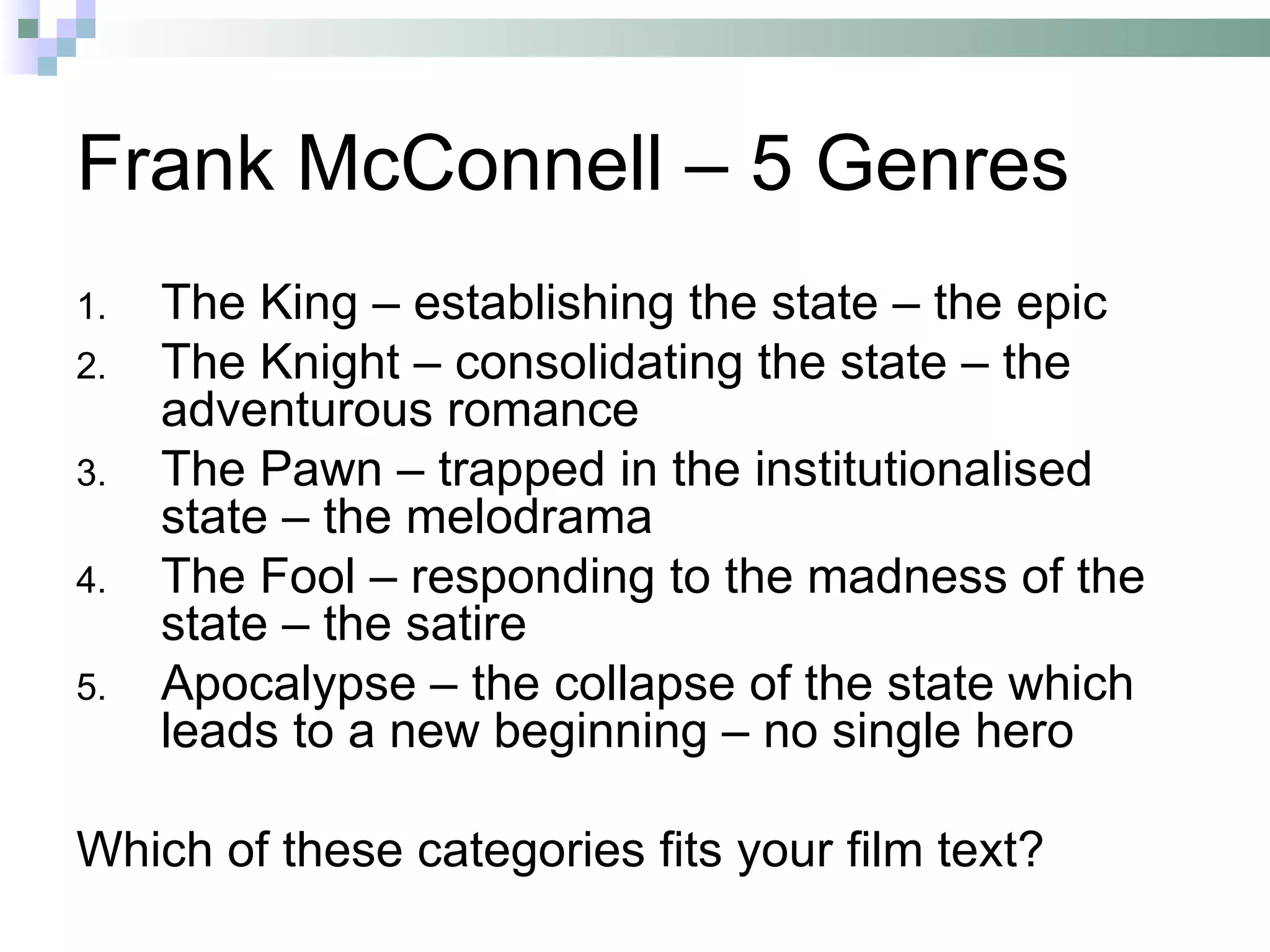
Frank McConnell – 5 Genres
1.   The King – establishing the state – the epic
2.   The Knight – consolidating the state – the
     adventurous romance
3.   The Pawn – trapped in the institutionalised
     state – the melodrama
4.   The Fool – responding to the madness of the
     state – the satire
5.   Apocalypse – the collapse of the state which
     leads to a new beginning – no single hero

Which of these categories fits your film text?
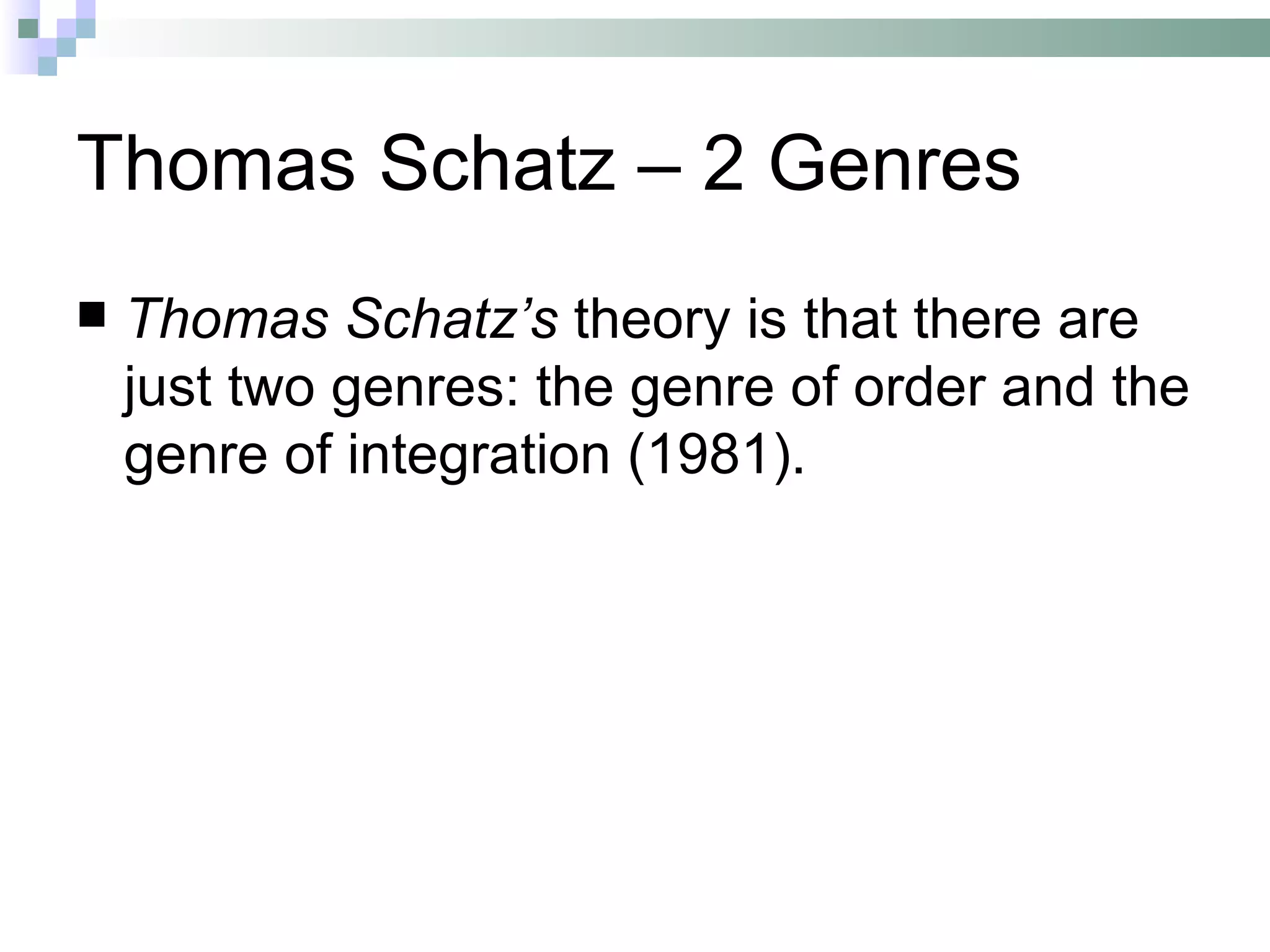
Thomas Schatz – 2 Genres
   Thomas Schatz’s theory is that there are
    just two genres: the genre of order and the
    genre of integration (1981).
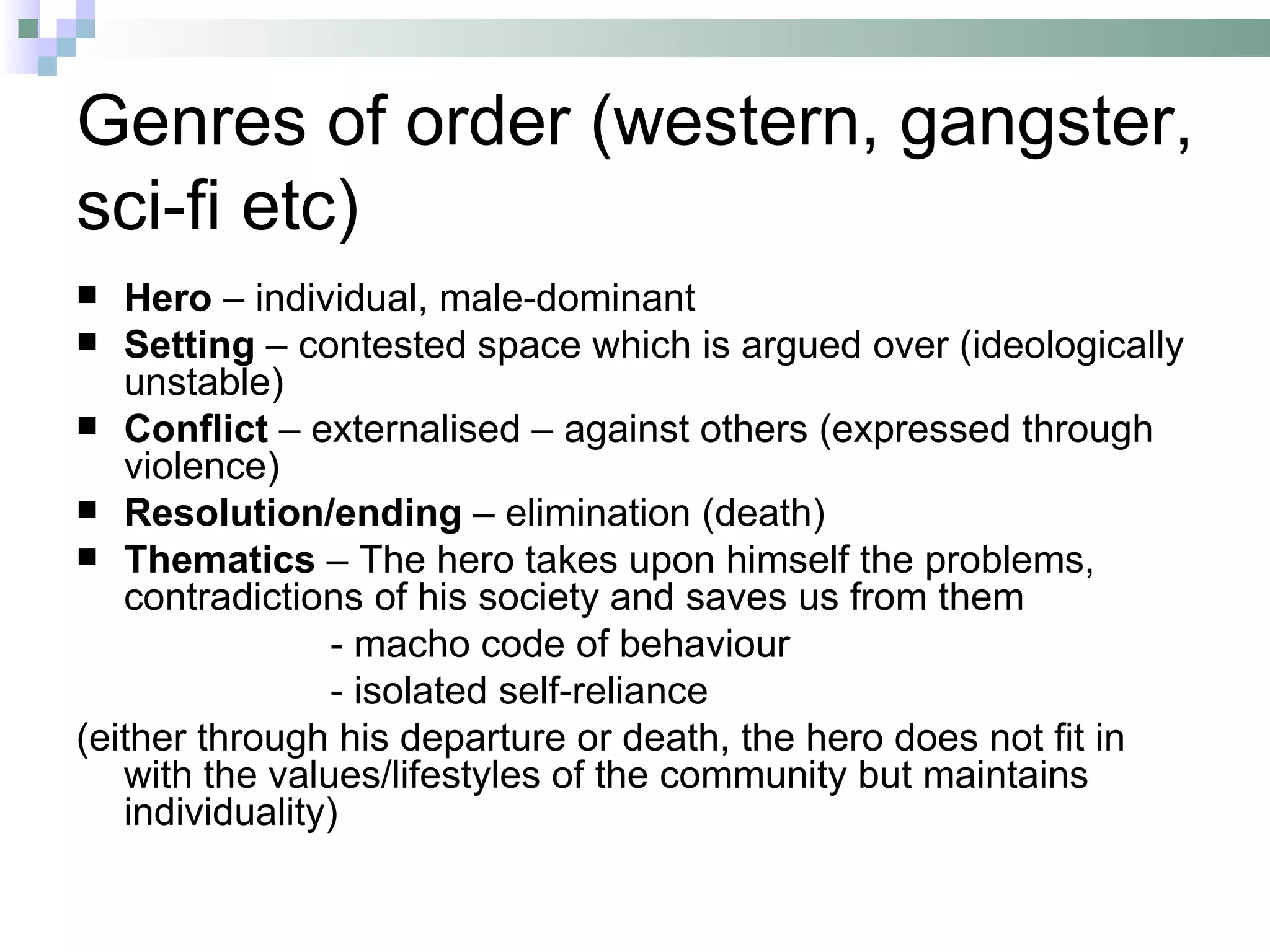
Genres of order (western, gangster,
sci-fi etc)
  Hero – individual, male-dominant
 Setting – contested space which is argued over (ideologically
   unstable)
 Conflict – externalised – against others (expressed through
   violence)
 Resolution/ending – elimination (death)
 Thematics – The hero takes upon himself the problems,
   contradictions of his society and saves us from them
                - macho code of behaviour
                - isolated self-reliance
(either through his departure or death, the hero does not fit in
   with the values/lifestyles of the community but maintains
   individuality)
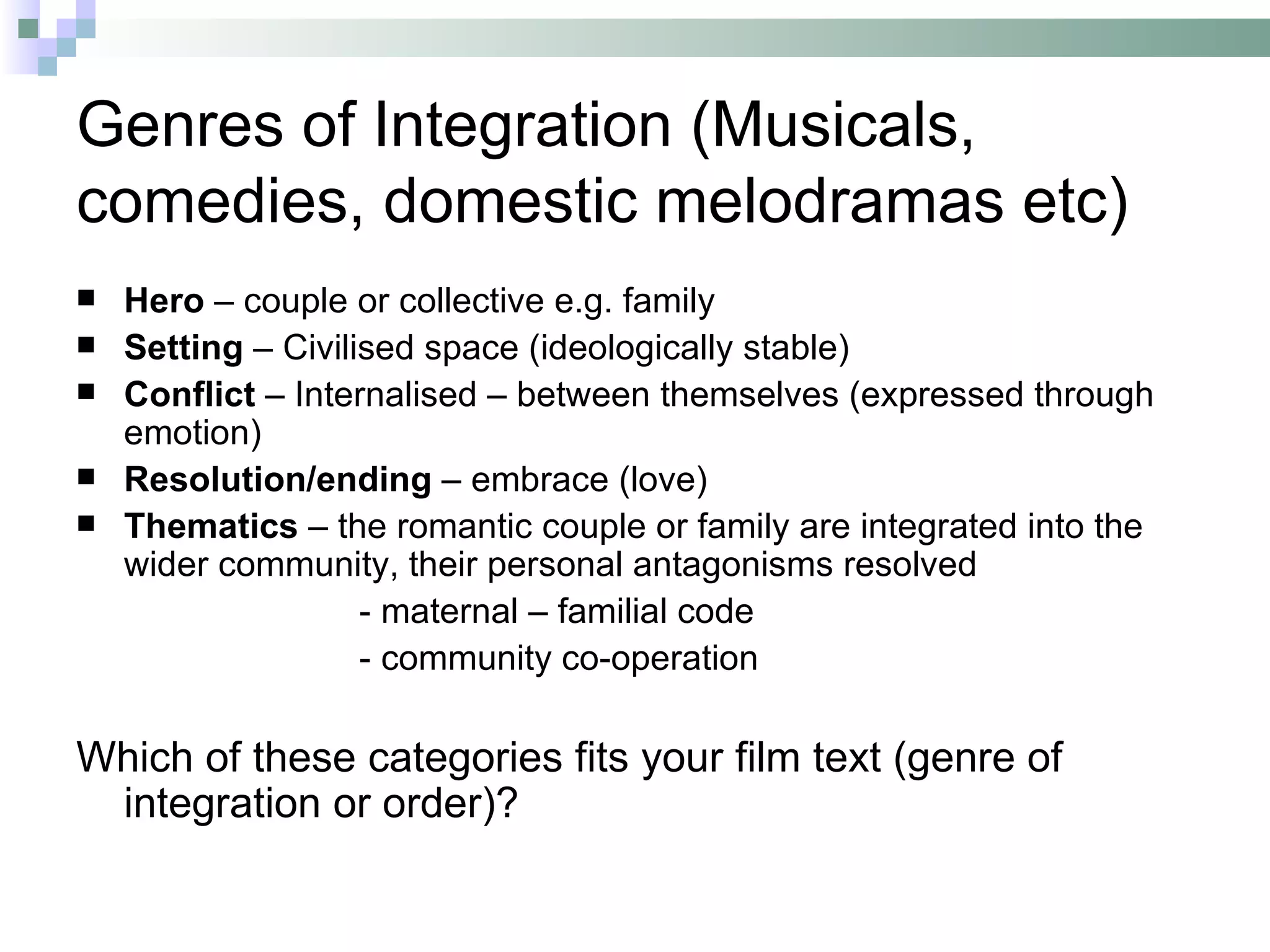
Genres of Integration (Musicals,
comedies, domestic melodramas etc)
   Hero – couple or collective e.g. family
   Setting – Civilised space (ideologically stable)
   Conflict – Internalised – between themselves (expressed through
    emotion)
   Resolution/ending – embrace (love)
   Thematics – the romantic couple or family are integrated into the
    wider community, their personal antagonisms resolved
                    - maternal – familial code
                    - community co-operation

Which of these categories fits your film text (genre of
 integration or order)?
The Strengths Of Genre Theory
The main strength of genre theory is that
everybody uses it and understands it –
media experts use it to study media texts, the
media industry uses it to develop and market
texts and audiences use it to decide what texts
to consume.

The potential for the same concept to be
understood by producers, audiences and
scholars makes genre a useful critical tool. Its
accessibility as a concept also means that it
can be applied across a wide range of texts.
Genres are not fixed. They constantly change
and evolve over time.

David Buckingham (1993) argues that 'genre
is not... Simply "given" by the culture:
rather, it is in a constant process of
negotiation and change’.
In terms of your coursework...

• How we define a genre depends on our
purposes (Chandler, 2001).

• What was your purpose and the medium?

• Your audience and the industry sector you
were working within will have defined what
you understood as the genre and sub-genre
of the texts you created.
Practice question
“Media texts rely on audience knowledge
of generic codes and conventions in order
for them to create meaning”.
Analyse one of your coursework
productions in relation to genre.

Applying genre to your text

  • 1.
    Genre Applying genreto your chosen text
  • 2.
    An introduction togenre  ‘Genre’ is a critical tool that helps us study texts and audience responses to texts by dividing them into categories based on common elements.  Daniel Chandler (2001) - the word genre comes from the French (and originally Latin) word for ‘type'.  The term is widely used in literary theory, media theory to refer to a distinctive type of ‘text’.  Steve Neale (1980) declares that “genres are instances of repetition and difference” – it is essential for genres to deviate occasionally in order to attract and engage audiences.
  • 3.
    Which genre isyour text?  Music video – which genre category is it? Performance, illustrative or disjuncture? (Andrew Goodwin)  What genre is your music?  Which generic conventions have you applied? E.g. lip-sync close- up, mimed playing of instruments, repetition of chorus shots to enhance ‘repeatability’, unusual camera shots and angles, first person mode of address directly engaging the viewer through the camera, star image OR  Film – what genre is your film?  Which generic conventions have you applied?
  • 4.
    Genres are recognisablethrough the repeated use of generic codes and conventions: Tom Ryall suggests that the types of conventions found in genres might be grouped within the following categories: Iconographies: (symbolic forms associated with the genre) Narrative: (structure, open/closed) Representations: (characters/stereotypes) Ideologies (beliefs and ideas of the ‘ideal’ concept, themes) Which of the above codes/conventions does your c/w use and how?
  • 5.
    Genre and audiences  If we recognise the genre of a text it enables us to feel at home and we gain enjoyment from “spotting the conventions” (repetition) and making comparisons with other films of the same genre.  However if a text deviates from the conventions it can confuse us, but at the same time we enjoy seeing the rules broken, providing that the film-maker doesn’t go too far.  We are more advanced than audiences of the past simply because we’ve seen more films than anyone in the history of the media, so we expect genres to be played with.  Which conventions would your audience enjoy spotting in your text?
  • 6.
    Genre and audiences  Genre offers audiences a structure or framework enabling us to feel secure in our knowledge.  Audiences like the anticipation of waiting for the predictable features and getting involved in a text.  Audiences can influence genres by reviving them.
  • 7.
    Pleasure of genrefor audiences • Rick Altman (1999) argues that genre offers audiences ‘a set of pleasures’. Emotional Pleasures: The emotional pleasures offered to audiences of genre films are particularly significant when they generate a strong audience response. Visceral Pleasures: Visceral pleasures are ‘gut’ responses and are defined by how the film’s stylistic construction elicits a physical effect upon its audience. This can be a feeling of revulsion, kinetic speed, or a ‘roller coaster ride’. Intellectual Puzzles: Certain film genres such as the thriller offer the pleasure in trying to unravel a mystery or a puzzle. Pleasure is derived from deciphering the plot and forecasting the end or the being surprised by the unexpected. •Which set of pleasures does your genre offer?
  • 8.
    Frank McConnell –5 Genres  Frank McConnell’s theory is based around the idea that instead of basing genres on their visual clues (mise en scene etc) it is more meaningful to split texts according to their themes, plots and leading characters.  He argues that his genres can be applied to any situation in a film where the lead character will fit one of these roles and the state will be their family, business or empire…
  • 9.
    Frank McConnell –5 Genres 1. The King – establishing the state – the epic 2. The Knight – consolidating the state – the adventurous romance 3. The Pawn – trapped in the institutionalised state – the melodrama 4. The Fool – responding to the madness of the state – the satire 5. Apocalypse – the collapse of the state which leads to a new beginning – no single hero Which of these categories fits your film text?
  • 10.
    Thomas Schatz –2 Genres  Thomas Schatz’s theory is that there are just two genres: the genre of order and the genre of integration (1981).
  • 11.
    Genres of order(western, gangster, sci-fi etc)  Hero – individual, male-dominant  Setting – contested space which is argued over (ideologically unstable)  Conflict – externalised – against others (expressed through violence)  Resolution/ending – elimination (death)  Thematics – The hero takes upon himself the problems, contradictions of his society and saves us from them - macho code of behaviour - isolated self-reliance (either through his departure or death, the hero does not fit in with the values/lifestyles of the community but maintains individuality)
  • 12.
    Genres of Integration(Musicals, comedies, domestic melodramas etc)  Hero – couple or collective e.g. family  Setting – Civilised space (ideologically stable)  Conflict – Internalised – between themselves (expressed through emotion)  Resolution/ending – embrace (love)  Thematics – the romantic couple or family are integrated into the wider community, their personal antagonisms resolved - maternal – familial code - community co-operation Which of these categories fits your film text (genre of integration or order)?
  • 13.
    The Strengths OfGenre Theory The main strength of genre theory is that everybody uses it and understands it – media experts use it to study media texts, the media industry uses it to develop and market texts and audiences use it to decide what texts to consume. The potential for the same concept to be understood by producers, audiences and scholars makes genre a useful critical tool. Its accessibility as a concept also means that it can be applied across a wide range of texts.
  • 14.
    Genres are notfixed. They constantly change and evolve over time. David Buckingham (1993) argues that 'genre is not... Simply "given" by the culture: rather, it is in a constant process of negotiation and change’.
  • 15.
    In terms ofyour coursework... • How we define a genre depends on our purposes (Chandler, 2001). • What was your purpose and the medium? • Your audience and the industry sector you were working within will have defined what you understood as the genre and sub-genre of the texts you created.
  • 16.
    Practice question “Media textsrely on audience knowledge of generic codes and conventions in order for them to create meaning”. Analyse one of your coursework productions in relation to genre.