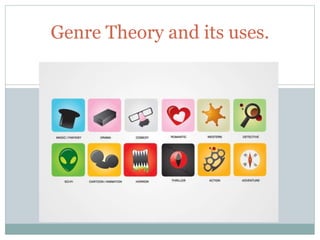
Genre Theory and its uses.
Genre Theory
 Daniel Chandler: Conventional definitions of
genres tend to be based on the notion that they
constitute particular conventions of content (such
as themes or settings) and/or form (including
structure and style) which are shared by the texts
which are regarded as belonging to them.
Generic Conventions
 “Die Hard is a generic action film because it uses
action props such as guns and the narrative
contains many fight scenes between hero and
villain”
 When you see things you expect to see in any type
of film, lets say a horror, you seeing the GENERIC
CONVENTIONS
 You recognise that a film is GENERIC because of
the sheer number of times you have seen this
genre of film use these CONVENTIONS
How to identify generic conventions
You are looking for:
 Typical narratives (storylines): structure of the
story/character types
 Typical Micro elements:
lighting/costume/font/colour/props etc
 Typical themes: good vs. evil/crime and
punishment/ achieving goals etc
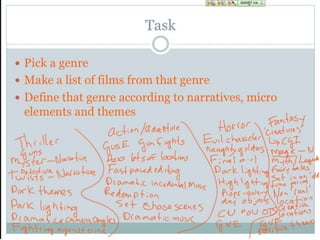
Task
 Pick a genre
 Make a list of films from that genre
 Define that genre according to narratives, micro
elements and themes
Are all films the same?
 It is easy to underplay the differences within a genre. Steve
Neale declares that 'genres are instances of repetition and
difference' (Neale 1980, 48). He adds that 'difference is
absolutely essential to the economy of genre': mere
repetition would not attract an audience.
 Look back at the genre you chose for the last slide. Can you think of
films that develop/challenge some of the genre expectation?
Hybrid
 Some films are not simply a HORROR or a COMEDY
 They seem to use generic conventions from a number of
different genres
 These are called HYBRIDS
 Shaun of the Dead: Romantic, Zombie, Comedy
 David Buckingham argues that 'genre is not...
simply "given" by the culture: rather, it is in a
constant process of negotiation and change'
(Buckingham 1993).
 Can you think of other Hybrids?
Typical or Challenging conventions
 You can normally prove that a film is GENERIC by
giving Micro element examples
 But sometimes, films do things you don’t expect that
genre to do
 This is called challenging conventions
 It is good for films to do things that audiences don’t
expect, it stops the films from becoming repetitive
and boring
Genre and Audience
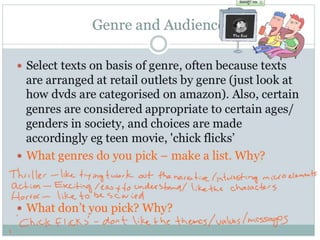
 Select texts on basis of genre, often because texts
are arranged at retail outlets by genre (just look at
how dvds are categorised on amazon). Also, certain
genres are considered appropriate to certain
ages/genders in society, and choices are made
accordingly eg teen movie, 'chick flicks’
 What genres do you pick – make a list. Why?
 What don’t you pick? Why?
‘
Genre and Audience
 Uses and gratifications‘ research has identified many
potential pleasures of genre, including the following:
• One pleasure may simply be the recognition of the features
of a particular genre because of our familiarity with it.
Recognition of what is likely to be important (and what is
not), derived from our knowledge of the genre, is necessary
in order to follow a plot.
• Genres may offer various emotional pleasures such as
empathy and escapism - a feature which some theoretical
commentaries seem to lose sight of. Aristotle acknowledged
the special emotional responses which were linked to
different genres. Deborah Knight notes that 'satisfaction is
guaranteed with genre; the deferral of the inevitable
provides the additional pleasure of prolonged anticipation'
(Knight 1994).
Genre and Audience
• Steve Neale argues that pleasure is derived from
'repetition and difference' (Neale 1980); there would
be no pleasure without difference. We may derive
pleasure from observing how the conventions of the
genre are manipulated (Abercrombie 1996). We may
also enjoy the stretching of a genre in new directions
and the consequent shifting of our expectations.
• Other pleasures can be derived from sharing our
experience of a genre with others within an
'interpretive community' which can be characterized by
its familiarity with certain genres (Daniel Chandler) –
Fan culture.
Genre and the interrelationship between P and A
 Tom Ryall (1978) – Genre provides a framework of structuring
rules, in the shape of patterns/forms/styles/structures, which act
as a form of ‘supervision’ over the work of production of
filmmakers and the work of reading by the audience.
 John Fiske defines genres as ‘attempts to structure some order
into the wide range of texts and meanings that circulate in our
culture for the convenience of both producers and audiences.’
 Steve Neale (1990) argues that Hollywood’s generic regime
performs two inter-related functions: i) to guarantee meanings
and pleasures for audiences ii) to offset the considerable
economic risks of industrial film production by providing
cognitive collateral against innovation and difference.
From the perspective of the Producers
 Market and publicise films according to genre
because they know they will reach genre fans
 Will see what genres have done well at the cinema
and try to repeat that success by making films of the
same genre
 Will have a ‘ideal reader’ in mind when they
construct a text and they will embed within the texts
assumptions about the 'ideal reader', including their
attitudes towards the subject matter and often their
class, age, gender and ethnicity.
Homework - Our Case Studies
 Avengers: Age of Ultron
 The Goob
 Kings Speech
 Harry Potter and the
Deathly Hallows
 Precious
 The Imitation Game
 What genres are our
films and what fan might
they appeal to?
 Which are ‘popular’
genres at the moment
and why?
 Who is the ‘ideal reader’
fro each of our films?
From the perspective of the Producers
 Denis McQuail refers to the commercial and
industrial significance of genres. This theorist
suggested that genre helps the target audience of
producers to capitalize on the success of previous
films because audiences may choose to see a film
based on the genre or perhaps the content of the
film, or even the actors in it. Christine Gledhill
notes that “differences between genres means that
different audiences could be identified and catered
to. This makes it easier to standardise and stabilise
production. To the mass media, genre is part of the
process of targeting different market sectors”.
Categorising films by genre is seen as both
positive and negative.
WHY?
Negative thing?
 On one hand, conforming to generic conventions and
giving the audience what they want, can actually lead to
the "they're all the same" judgement
 This is what happened to the traditional Hollywood
Western and Musical – because some films were success,
other studios started to churn out lots and lots of them,
the audience got bored and stopped watching.
 It is now only when a ‘new’ Musical that challenges the
typical generic conventions (Moulin Rouge or Sweeney
Todd) comes out, that audiences are willing to watch.
Positive thing?
 On the other hand, genre provides structure which
can allow a great deal of creativity, especially when a
genuine reworking of generic conventions comes
along
 Genre provides key elements for an audience to
recognise, so that they may enjoy the film and be
fully involved
 Genre allows for expectations to be met, resulting in
a more fulfilled audience.
The Genre Cycle
1. To the producers of films, genre is a template for what they
make.
2. To the distributor/promoter, genre provides assumptions
about who the audience is and how to market the films for
that specific audience.
3. To the audience, it is a label that identifies a liked or
disliked formula and provides certain rules of engagement
for the spectator in terms of anticipation of pleasure.
4. When genres become classic, they can exert tremendous
influence: production can be come quicker and more
confident because film-makers are following tested
formulae and have a ready shorthand to work with, and
actors can be filtered into genres.
The Genre Cycle
5. In turn, viewers become ‘generic spectators’ and can be
said to develop generic memory which helps the in the
anticipation of events, even though the films themselves
might play on certain styles rather than follow closely a
clichéd formula. We do not consume films as individual
entities, but in an intertextual way. Film is a post-modern
medium in this way, because movies make sense in
relation to other films, not to reality.
6. It is the way genre films deviate from the clichéd formulae
that leads to a more interesting experience for the viewer,
but fore this to work properly, the audience must be
familiar with generic conventions and style.

Genre final

  • 1.
  • 2.
    Genre Theory  DanielChandler: Conventional definitions of genres tend to be based on the notion that they constitute particular conventions of content (such as themes or settings) and/or form (including structure and style) which are shared by the texts which are regarded as belonging to them.
  • 3.
    Generic Conventions  “DieHard is a generic action film because it uses action props such as guns and the narrative contains many fight scenes between hero and villain”  When you see things you expect to see in any type of film, lets say a horror, you seeing the GENERIC CONVENTIONS  You recognise that a film is GENERIC because of the sheer number of times you have seen this genre of film use these CONVENTIONS
  • 4.
    How to identifygeneric conventions You are looking for:  Typical narratives (storylines): structure of the story/character types  Typical Micro elements: lighting/costume/font/colour/props etc  Typical themes: good vs. evil/crime and punishment/ achieving goals etc
  • 5.
    Task  Pick agenre  Make a list of films from that genre  Define that genre according to narratives, micro elements and themes
  • 6.
    Are all filmsthe same?  It is easy to underplay the differences within a genre. Steve Neale declares that 'genres are instances of repetition and difference' (Neale 1980, 48). He adds that 'difference is absolutely essential to the economy of genre': mere repetition would not attract an audience.  Look back at the genre you chose for the last slide. Can you think of films that develop/challenge some of the genre expectation?
  • 7.
    Hybrid  Some filmsare not simply a HORROR or a COMEDY  They seem to use generic conventions from a number of different genres  These are called HYBRIDS  Shaun of the Dead: Romantic, Zombie, Comedy  David Buckingham argues that 'genre is not... simply "given" by the culture: rather, it is in a constant process of negotiation and change' (Buckingham 1993).  Can you think of other Hybrids?
  • 8.
    Typical or Challengingconventions  You can normally prove that a film is GENERIC by giving Micro element examples  But sometimes, films do things you don’t expect that genre to do  This is called challenging conventions  It is good for films to do things that audiences don’t expect, it stops the films from becoming repetitive and boring
  • 9.
    Genre and Audience Select texts on basis of genre, often because texts are arranged at retail outlets by genre (just look at how dvds are categorised on amazon). Also, certain genres are considered appropriate to certain ages/genders in society, and choices are made accordingly eg teen movie, 'chick flicks’  What genres do you pick – make a list. Why?  What don’t you pick? Why?
  • 10.
    ‘ Genre and Audience Uses and gratifications‘ research has identified many potential pleasures of genre, including the following: • One pleasure may simply be the recognition of the features of a particular genre because of our familiarity with it. Recognition of what is likely to be important (and what is not), derived from our knowledge of the genre, is necessary in order to follow a plot. • Genres may offer various emotional pleasures such as empathy and escapism - a feature which some theoretical commentaries seem to lose sight of. Aristotle acknowledged the special emotional responses which were linked to different genres. Deborah Knight notes that 'satisfaction is guaranteed with genre; the deferral of the inevitable provides the additional pleasure of prolonged anticipation' (Knight 1994).
  • 11.
    Genre and Audience •Steve Neale argues that pleasure is derived from 'repetition and difference' (Neale 1980); there would be no pleasure without difference. We may derive pleasure from observing how the conventions of the genre are manipulated (Abercrombie 1996). We may also enjoy the stretching of a genre in new directions and the consequent shifting of our expectations. • Other pleasures can be derived from sharing our experience of a genre with others within an 'interpretive community' which can be characterized by its familiarity with certain genres (Daniel Chandler) – Fan culture.
  • 12.
    Genre and theinterrelationship between P and A  Tom Ryall (1978) – Genre provides a framework of structuring rules, in the shape of patterns/forms/styles/structures, which act as a form of ‘supervision’ over the work of production of filmmakers and the work of reading by the audience.  John Fiske defines genres as ‘attempts to structure some order into the wide range of texts and meanings that circulate in our culture for the convenience of both producers and audiences.’  Steve Neale (1990) argues that Hollywood’s generic regime performs two inter-related functions: i) to guarantee meanings and pleasures for audiences ii) to offset the considerable economic risks of industrial film production by providing cognitive collateral against innovation and difference.
  • 13.
    From the perspectiveof the Producers  Market and publicise films according to genre because they know they will reach genre fans  Will see what genres have done well at the cinema and try to repeat that success by making films of the same genre  Will have a ‘ideal reader’ in mind when they construct a text and they will embed within the texts assumptions about the 'ideal reader', including their attitudes towards the subject matter and often their class, age, gender and ethnicity.
  • 14.
    Homework - OurCase Studies  Avengers: Age of Ultron  The Goob  Kings Speech  Harry Potter and the Deathly Hallows  Precious  The Imitation Game  What genres are our films and what fan might they appeal to?  Which are ‘popular’ genres at the moment and why?  Who is the ‘ideal reader’ fro each of our films?
  • 15.
    From the perspectiveof the Producers  Denis McQuail refers to the commercial and industrial significance of genres. This theorist suggested that genre helps the target audience of producers to capitalize on the success of previous films because audiences may choose to see a film based on the genre or perhaps the content of the film, or even the actors in it. Christine Gledhill notes that “differences between genres means that different audiences could be identified and catered to. This makes it easier to standardise and stabilise production. To the mass media, genre is part of the process of targeting different market sectors”.
  • 16.
    Categorising films bygenre is seen as both positive and negative. WHY?
  • 17.
    Negative thing?  Onone hand, conforming to generic conventions and giving the audience what they want, can actually lead to the "they're all the same" judgement  This is what happened to the traditional Hollywood Western and Musical – because some films were success, other studios started to churn out lots and lots of them, the audience got bored and stopped watching.  It is now only when a ‘new’ Musical that challenges the typical generic conventions (Moulin Rouge or Sweeney Todd) comes out, that audiences are willing to watch.
  • 18.
    Positive thing?  Onthe other hand, genre provides structure which can allow a great deal of creativity, especially when a genuine reworking of generic conventions comes along  Genre provides key elements for an audience to recognise, so that they may enjoy the film and be fully involved  Genre allows for expectations to be met, resulting in a more fulfilled audience.
  • 19.
    The Genre Cycle 1.To the producers of films, genre is a template for what they make. 2. To the distributor/promoter, genre provides assumptions about who the audience is and how to market the films for that specific audience. 3. To the audience, it is a label that identifies a liked or disliked formula and provides certain rules of engagement for the spectator in terms of anticipation of pleasure. 4. When genres become classic, they can exert tremendous influence: production can be come quicker and more confident because film-makers are following tested formulae and have a ready shorthand to work with, and actors can be filtered into genres.
  • 20.
    The Genre Cycle 5.In turn, viewers become ‘generic spectators’ and can be said to develop generic memory which helps the in the anticipation of events, even though the films themselves might play on certain styles rather than follow closely a clichéd formula. We do not consume films as individual entities, but in an intertextual way. Film is a post-modern medium in this way, because movies make sense in relation to other films, not to reality. 6. It is the way genre films deviate from the clichéd formulae that leads to a more interesting experience for the viewer, but fore this to work properly, the audience must be familiar with generic conventions and style.