Section A: Question 1 B:
Theoretical Evaluation of Production
Genre:Genre: Critical Perspectives ExamCritical Perspectives Exam
Question 1(B) requires candidates to select ONE PRODUCTION & evaluate it
in relation to a media concept.
You will focus on your TRAILER ONLY.
The list of concepts to which questions will relate is as follows:
• GENRE *
• Narrative
• Representation
• Audience
• Media Language
In the exam, questions will be set using one of these concepts.
Film:Film: Media ConceptsMedia Concepts
QUESTIONS
1. What is Genre? Feedback
 
2. What is the purpose of having Genre? Brainstorm
3. What are ‘Sub-Genres’ and ‘Hybrid Genres’? Discuss + Apply
4. What is the ‘Horror Genre’ and why do audiences consume
horrific content? Feedback
5. What Sub-Genre did you chose? What are the
characteristics/conventions? Discuss and List
• Genre is generally understood as a means of
categorising films under the labels of sci-fi, action,
horror etc.
• This categorization is based on similarities in the
narrative elements from which films are constructed.
• Fictional films are usually categorized according to
their setting, theme, & mood,
1. Setting is the environment where the story and
action takes place.
2. Theme refers to the issues or concepts that the
film revolves around.
3. Mood is the emotional tone of the film.
• An additional way of categorizing film genres is by
the target audience
Film:Film: GenreGenre
• So, film genres have particular rules attached to them.
• For example, in a horror film:
– There is usually a death in the first five minutes of the film.
– Horror films should be scary, otherwise the audience would feel cheated!
– These rules are known in the industry as conventions
Genre:Genre: ConventionsConventions
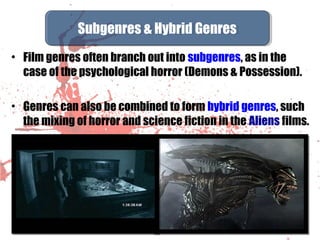
• Film genres often branch out into subgenres, as in the
case of the psychological horror (Demons & Possession).
• Genres can also be combined to form hybrid genres, such
the mixing of horror and science fiction in the Aliens films.
Subgenres & Hybrid GenresSubgenres & Hybrid Genres
• Audiences gain pleasure from the familiarity of recognisable elements in
films. They know such films will fulfil certain expectations so genre can be
used as a selection device (distinguishing films from one another).
• Therefore, genre can be seen as a language – codes and conventions
recognised by audiences.
• Audiences have expectations about content and style of a text, according
to its genre. This enables them to take particular pleasures in repetition,
and of predicted resolution. Pleasure may also be drawn from differences.
• Audiences can select texts on the basis of genre, often because texts are
arranged at retail outlets by genre. Also, certain genres are considered
appropriate to certain ages/genders in society, and choices are made
accordingly e.g. teen movie, 'chick flicks‘ etc.
AudiencesAudiencesGenre:Genre:
GENRE
QUOTES – Include one/two in your answer
• “Genre creates expectations that condition our responses. Genre sets up
hopes and promises and brings pleasure if these are fulfilled” - Warren
Buckland.
• “Different genres specify different ‘contracts’ to be negotiated between
the text and the reader” - Sonia Livingstone.
• “Genre is not… simply ‘given’ by the culture, but rather it is in a constant
process of negotiation and change” – David Buckingham.
• “Genre is a recurring type or category of text, as defined by structural
and thematic criteria” – David Duff.
• A media theorist called Graeme Burton
suggests that we can understand a lot about
film genre by looking at a number of key
concepts.
In his book called
More than meets the eye,
Burton wrote about the
key elements of genre…
Genre:Genre: Graeme BurtonGraeme Burton
Burton argued that films from a particular genre will all
contain recognisable conventions or key elements:
• Protagonists (main characters)
• Stock characters (minor characters)
• Stock situations (e.g. car chases, shoot outs)
• Icons (props, actors, music – something which becomes
iconic of the film or genre)
• Background and décor (setting, set decoration)
• Themes (e.g. love, revenge, betrayal, survival, family, honour)
All these elements add up to the genre formula.
Graeme Burton:
Key Elements of Genre
Graeme Burton:
Key Elements of Genre
Protagonists:
• A ‘final girl’ called Sidney (the
unisex name is a convention)
• A masked killer (Antagonist)
Burton’s key elements applied to Scream
(Wes Craven, 1996)
Burton’s key elements applied to Scream
(Wes Craven, 1996)
Stock characters:
• Teenagers (who are all more
superficial than Sidney)
• The dumb policeman
(Dewey)
• The ‘red herring’
(someone that we, the
audience, are made to think
is the killer, but turns out not
to be)
Burton’s key elements applied to Scream
(Wes Craven, 1996)
Burton’s key elements applied to Scream
(Wes Craven, 1996)
Stock Situations.
• Situations/scenarios in genre
films, that seem very familiar to
the viewer.
• Someone falls over as they are
being chased by the killer.
• The killer walks after someone,
who is running, but the killer is
able to catch up with them.
Burton’s key elements applied to Scream
(Wes Craven, 1996)
Burton’s key elements applied to Scream
(Wes Craven, 1996)
Icons:
• The mask/knife have become iconic of
the teen-slasher horror film.
• The Scream Mask (Scream Series)
• Jason’s Knife (Friday 13th
)
• Freddie's Claw (Nightmare on Elm St)
• The Jaws music has become iconic of
horror films featuring monsters.
• Some actors become icons of their
genre- e.g. Arnold Schwarzenegger
has become iconic of action films.
Burton’s key elements applied to Scream
(Wes Craven, 1996)
Burton’s key elements applied to Scream
(Wes Craven, 1996)
Background and Décor:
• Many horror films are set in
suburban or countryside
settings (isolated), as this is in
contrast to what most people
expect-
• For example, we expect nasty
murders to happen in cities
but not in the countryside.
Burton’s key elements applied to Scream
(Wes Craven, 1996)
Burton’s key elements applied to Scream
(Wes Craven, 1996)
Themes:
• Themes in the horror genre, a
key theme is self belief.
• Love and betrayal.
• Often the protagonist in horror
films doesn’t believe their
own sanity/eyes until it is
too late.
• Sidney in Scream is
traumatised by her own
mothers death, meaning that
she doesn’t realise that her own
boyfriend is the killer!
Burton’s key elements applied to Scream
(Wes Craven, 1996)
Burton’s key elements applied to Scream
(Wes Craven, 1996)
• Genres depend on their ability to change or adapt in order to survive… if a
film follows genre conventions too much, it can become too predictable.
• Steve Neale (1980) argues that pleasure is derived from ‘repetition and
difference’ and there would be no pleasure without difference. We may
derive pleasure from observing how the conventions of the genre are
manipulated, we may also enjoy the stretching of a genre in new directions
and the consequent shifting of our expectations.
• Genres emerged as a way of predicting and fulfilling audience expectation -
giving the public what they want. If the film gives you what you expect you
will go away gratified, if it doesn’t, you will go away disappointed.
• You want familiar conventions but with a new element or twist; you would
not be on the edge of your seat if the killer/monster always jumped out of
the same place. So genres need to combine familiarity with innovation. If
genres do not adapt over time, they will die out. Maybe to reappear at a later
date with a new element.
Steve Neale: Familiarity with InnovationSteve Neale: Familiarity with Innovation
TASKS – EXAM PREP
LEVEL 4 21-25
“Candidates demonstrate a clear understanding of audience and relevant media theory and can relate concepts
articulately to the production outcome, describing specific elements in relation to theoretical ideas about how
media texts are produced for and received by audiences in various ways. Candidates offer a broad range of
specific, relevant, interesting and clear examples of how their product can be understood in relation to relevant
theories of audience and reception. The use of conceptual language is excellent. Complex issues have been
expressed clearly and fluently using a style of writing appropriate to the complex subject matter. Sentences and
paragraphs, consistently relevant, have been well structured, using appropriate technical terminology. There may
be few, if any, errors of spelling, punctuation and grammar”.
  
CONSTRUCT AN ESSAY STRUCTURE
INCLUDE: INTRODUCTION + THEORIES + RMT’S + CONCLUSION

1. genre

  • 1.
    Section A: Question1 B: Theoretical Evaluation of Production Genre:Genre: Critical Perspectives ExamCritical Perspectives Exam
  • 2.
    Question 1(B) requirescandidates to select ONE PRODUCTION & evaluate it in relation to a media concept. You will focus on your TRAILER ONLY. The list of concepts to which questions will relate is as follows: • GENRE * • Narrative • Representation • Audience • Media Language In the exam, questions will be set using one of these concepts. Film:Film: Media ConceptsMedia Concepts
  • 3.
    QUESTIONS 1. What isGenre? Feedback   2. What is the purpose of having Genre? Brainstorm 3. What are ‘Sub-Genres’ and ‘Hybrid Genres’? Discuss + Apply 4. What is the ‘Horror Genre’ and why do audiences consume horrific content? Feedback 5. What Sub-Genre did you chose? What are the characteristics/conventions? Discuss and List
  • 4.
    • Genre isgenerally understood as a means of categorising films under the labels of sci-fi, action, horror etc. • This categorization is based on similarities in the narrative elements from which films are constructed. • Fictional films are usually categorized according to their setting, theme, & mood, 1. Setting is the environment where the story and action takes place. 2. Theme refers to the issues or concepts that the film revolves around. 3. Mood is the emotional tone of the film. • An additional way of categorizing film genres is by the target audience Film:Film: GenreGenre
  • 5.
    • So, filmgenres have particular rules attached to them. • For example, in a horror film: – There is usually a death in the first five minutes of the film. – Horror films should be scary, otherwise the audience would feel cheated! – These rules are known in the industry as conventions Genre:Genre: ConventionsConventions
  • 6.
    • Film genresoften branch out into subgenres, as in the case of the psychological horror (Demons & Possession). • Genres can also be combined to form hybrid genres, such the mixing of horror and science fiction in the Aliens films. Subgenres & Hybrid GenresSubgenres & Hybrid Genres
  • 7.
    • Audiences gainpleasure from the familiarity of recognisable elements in films. They know such films will fulfil certain expectations so genre can be used as a selection device (distinguishing films from one another). • Therefore, genre can be seen as a language – codes and conventions recognised by audiences. • Audiences have expectations about content and style of a text, according to its genre. This enables them to take particular pleasures in repetition, and of predicted resolution. Pleasure may also be drawn from differences. • Audiences can select texts on the basis of genre, often because texts are arranged at retail outlets by genre. Also, certain genres are considered appropriate to certain ages/genders in society, and choices are made accordingly e.g. teen movie, 'chick flicks‘ etc. AudiencesAudiencesGenre:Genre:
  • 8.
    GENRE QUOTES – Includeone/two in your answer • “Genre creates expectations that condition our responses. Genre sets up hopes and promises and brings pleasure if these are fulfilled” - Warren Buckland. • “Different genres specify different ‘contracts’ to be negotiated between the text and the reader” - Sonia Livingstone. • “Genre is not… simply ‘given’ by the culture, but rather it is in a constant process of negotiation and change” – David Buckingham. • “Genre is a recurring type or category of text, as defined by structural and thematic criteria” – David Duff.
  • 9.
    • A mediatheorist called Graeme Burton suggests that we can understand a lot about film genre by looking at a number of key concepts. In his book called More than meets the eye, Burton wrote about the key elements of genre… Genre:Genre: Graeme BurtonGraeme Burton
  • 10.
    Burton argued thatfilms from a particular genre will all contain recognisable conventions or key elements: • Protagonists (main characters) • Stock characters (minor characters) • Stock situations (e.g. car chases, shoot outs) • Icons (props, actors, music – something which becomes iconic of the film or genre) • Background and décor (setting, set decoration) • Themes (e.g. love, revenge, betrayal, survival, family, honour) All these elements add up to the genre formula. Graeme Burton: Key Elements of Genre Graeme Burton: Key Elements of Genre
  • 11.
    Protagonists: • A ‘finalgirl’ called Sidney (the unisex name is a convention) • A masked killer (Antagonist) Burton’s key elements applied to Scream (Wes Craven, 1996) Burton’s key elements applied to Scream (Wes Craven, 1996)
  • 12.
    Stock characters: • Teenagers(who are all more superficial than Sidney) • The dumb policeman (Dewey) • The ‘red herring’ (someone that we, the audience, are made to think is the killer, but turns out not to be) Burton’s key elements applied to Scream (Wes Craven, 1996) Burton’s key elements applied to Scream (Wes Craven, 1996)
  • 13.
    Stock Situations. • Situations/scenariosin genre films, that seem very familiar to the viewer. • Someone falls over as they are being chased by the killer. • The killer walks after someone, who is running, but the killer is able to catch up with them. Burton’s key elements applied to Scream (Wes Craven, 1996) Burton’s key elements applied to Scream (Wes Craven, 1996)
  • 14.
    Icons: • The mask/knifehave become iconic of the teen-slasher horror film. • The Scream Mask (Scream Series) • Jason’s Knife (Friday 13th ) • Freddie's Claw (Nightmare on Elm St) • The Jaws music has become iconic of horror films featuring monsters. • Some actors become icons of their genre- e.g. Arnold Schwarzenegger has become iconic of action films. Burton’s key elements applied to Scream (Wes Craven, 1996) Burton’s key elements applied to Scream (Wes Craven, 1996)
  • 15.
    Background and Décor: •Many horror films are set in suburban or countryside settings (isolated), as this is in contrast to what most people expect- • For example, we expect nasty murders to happen in cities but not in the countryside. Burton’s key elements applied to Scream (Wes Craven, 1996) Burton’s key elements applied to Scream (Wes Craven, 1996)
  • 16.
    Themes: • Themes inthe horror genre, a key theme is self belief. • Love and betrayal. • Often the protagonist in horror films doesn’t believe their own sanity/eyes until it is too late. • Sidney in Scream is traumatised by her own mothers death, meaning that she doesn’t realise that her own boyfriend is the killer! Burton’s key elements applied to Scream (Wes Craven, 1996) Burton’s key elements applied to Scream (Wes Craven, 1996)
  • 17.
    • Genres dependon their ability to change or adapt in order to survive… if a film follows genre conventions too much, it can become too predictable. • Steve Neale (1980) argues that pleasure is derived from ‘repetition and difference’ and there would be no pleasure without difference. We may derive pleasure from observing how the conventions of the genre are manipulated, we may also enjoy the stretching of a genre in new directions and the consequent shifting of our expectations. • Genres emerged as a way of predicting and fulfilling audience expectation - giving the public what they want. If the film gives you what you expect you will go away gratified, if it doesn’t, you will go away disappointed. • You want familiar conventions but with a new element or twist; you would not be on the edge of your seat if the killer/monster always jumped out of the same place. So genres need to combine familiarity with innovation. If genres do not adapt over time, they will die out. Maybe to reappear at a later date with a new element. Steve Neale: Familiarity with InnovationSteve Neale: Familiarity with Innovation
  • 18.
    TASKS – EXAMPREP LEVEL 4 21-25 “Candidates demonstrate a clear understanding of audience and relevant media theory and can relate concepts articulately to the production outcome, describing specific elements in relation to theoretical ideas about how media texts are produced for and received by audiences in various ways. Candidates offer a broad range of specific, relevant, interesting and clear examples of how their product can be understood in relation to relevant theories of audience and reception. The use of conceptual language is excellent. Complex issues have been expressed clearly and fluently using a style of writing appropriate to the complex subject matter. Sentences and paragraphs, consistently relevant, have been well structured, using appropriate technical terminology. There may be few, if any, errors of spelling, punctuation and grammar”.    CONSTRUCT AN ESSAY STRUCTURE INCLUDE: INTRODUCTION + THEORIES + RMT’S + CONCLUSION