Introduction to Programming in C++
Eight Edition
Lesson 3.1:
Variables and Constants
An Introduction to Programming with C++, Eight Edition
• Distinguish among a variable, a named constant, and a
literal constant
• Explain how data is stored in memory
• Select an appropriate name, data type, and initial value
for a memory location
• Declare a memory location in C++
Objectives
2
An Introduction to Programming with C++, Eight Edition
• After Step 3, programmer has an algorithm and has
desk-checked it
• The fourth step in the process is coding the algorithm
into a program
• The step begins by assigning a descriptive name, data
type, and (optionally) initial value to each unique input,
processing, and output item in the IPO chart
• These are used to store the item in the computer’s
internal memory
Beginning Step 4 in the Problem-
Solving Process
3
An Introduction to Programming with C++, Eight Edition
• Computer’s internal memory is composed of memory
locations, each with a unique numeric address
• Similar to collection of storage bins
• Each address can store one item at a time
• Address can contain numbers, text, or program
instructions
• To use a memory location, programmer must reserve
the address, called declaring
Internal Memory
4
An Introduction to Programming with C++, Eight Edition
• Declaring a memory location is done with an instruction
that assigns a name, data type, and (optional) initial
value
• The name allows the programmer to refer to the
memory location elsewhere in the program using a
descriptive word, rather than the numeric address
• The data type indicates what type of information the
address will store (e.g., number or text)
Internal Memory (cont’d.)
5
An Introduction to Programming with C++, Eight Edition
• Two types of memory locations can be declared:
variables and named constants
• Variables are memory locations whose values can
change during runtime (when the program is running)
• Most memory locations are variables
• Named constants are memory locations whose values
cannot change during program execution
Internal Memory (cont’d.)
6
An Introduction to Programming with C++, Eight Edition
Internal Memory (cont’d.)
7
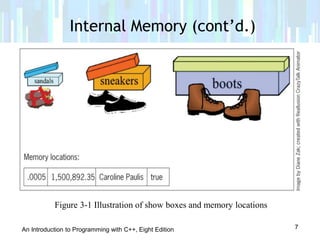
Figure 3-1 Illustration of show boxes and memory locations
An Introduction to Programming with C++, Eight Edition
• Name (identifier) assigned to a memory location should
be descriptive
• Should help the programmer/other programmers
remember/understand the memory location’s purpose
• Should be as short as possible while still being
descriptive (especially if referenced often)
• Short names are easier to read and result in more
concise code
Selecting a Name for a Memory Location
8
An Introduction to Programming with C++, Eight Edition
• Rules for memory location names/identifiers in C++
– Name must begin with a letter and contain only letters,
numbers, and the underscore character
– No punctuation marks, spaces, or other special characters
(such as $ or %) are allowed
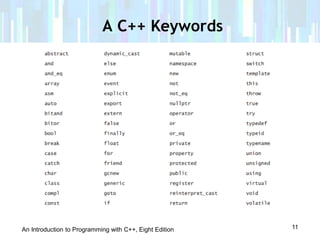
– Cannot be a keyword (word that has special meaning in
C++)
– Names are case sensitive
• Example: discount is different from DISCOUNT
and from Discount
Selecting a Name for a Memory Location (cont’d.)
9
An Introduction to Programming with C++, Eight Edition
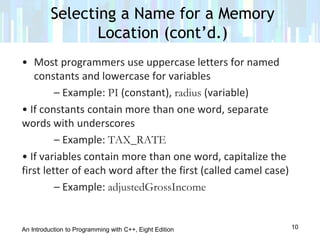
• Most programmers use uppercase letters for named
constants and lowercase for variables
– Example: PI (constant), radius (variable)
• If constants contain more than one word, separate
words with underscores
– Example: TAX_RATE
• If variables contain more than one word, capitalize the
first letter of each word after the first (called camel case)
– Example: adjustedGrossIncome
Selecting a Name for a Memory
Location (cont’d.)
10
An Introduction to Programming with C++, Eight Edition
A C++ Keywords
11
An Introduction to Programming with C++, Eight Edition
A C++ Keywords
12
An Introduction to Programming with C++, Eight Edition
Selecting a Name for a Memory
Location (cont’d.)
13
An Introduction to Programming with C++, Eight Edition
Revisiting the Addison O’Reilly Problem
14
Figure 3-3 Problem specification, IPO chart, and desk-check table from Chapter 2
An Introduction to Programming with C++, Eight Edition
• IPO chart contains four input, processing, and output
items
• Four memory locations are needed to store the values of
the items
• Memory locations will be variables since their values will
change during runtime
Revisiting the Addison O’Reilly Problem
(cont’d.)
15
An Introduction to Programming with C++, Eight Edition
Revisiting the Addison O’Reilly
Problem (cont’d.)
16
An Introduction to Programming with C++, Eight Edition
The End ♥ ♥ ♥
17

Lesson 3.1 variables and constant

  • 1.
    Introduction to Programmingin C++ Eight Edition Lesson 3.1: Variables and Constants
  • 2.
    An Introduction toProgramming with C++, Eight Edition • Distinguish among a variable, a named constant, and a literal constant • Explain how data is stored in memory • Select an appropriate name, data type, and initial value for a memory location • Declare a memory location in C++ Objectives 2
  • 3.
    An Introduction toProgramming with C++, Eight Edition • After Step 3, programmer has an algorithm and has desk-checked it • The fourth step in the process is coding the algorithm into a program • The step begins by assigning a descriptive name, data type, and (optionally) initial value to each unique input, processing, and output item in the IPO chart • These are used to store the item in the computer’s internal memory Beginning Step 4 in the Problem- Solving Process 3
  • 4.
    An Introduction toProgramming with C++, Eight Edition • Computer’s internal memory is composed of memory locations, each with a unique numeric address • Similar to collection of storage bins • Each address can store one item at a time • Address can contain numbers, text, or program instructions • To use a memory location, programmer must reserve the address, called declaring Internal Memory 4
  • 5.
    An Introduction toProgramming with C++, Eight Edition • Declaring a memory location is done with an instruction that assigns a name, data type, and (optional) initial value • The name allows the programmer to refer to the memory location elsewhere in the program using a descriptive word, rather than the numeric address • The data type indicates what type of information the address will store (e.g., number or text) Internal Memory (cont’d.) 5
  • 6.
    An Introduction toProgramming with C++, Eight Edition • Two types of memory locations can be declared: variables and named constants • Variables are memory locations whose values can change during runtime (when the program is running) • Most memory locations are variables • Named constants are memory locations whose values cannot change during program execution Internal Memory (cont’d.) 6
  • 7.
    An Introduction toProgramming with C++, Eight Edition Internal Memory (cont’d.) 7 Figure 3-1 Illustration of show boxes and memory locations
  • 8.
    An Introduction toProgramming with C++, Eight Edition • Name (identifier) assigned to a memory location should be descriptive • Should help the programmer/other programmers remember/understand the memory location’s purpose • Should be as short as possible while still being descriptive (especially if referenced often) • Short names are easier to read and result in more concise code Selecting a Name for a Memory Location 8
  • 9.
    An Introduction toProgramming with C++, Eight Edition • Rules for memory location names/identifiers in C++ – Name must begin with a letter and contain only letters, numbers, and the underscore character – No punctuation marks, spaces, or other special characters (such as $ or %) are allowed – Cannot be a keyword (word that has special meaning in C++) – Names are case sensitive • Example: discount is different from DISCOUNT and from Discount Selecting a Name for a Memory Location (cont’d.) 9
  • 10.
    An Introduction toProgramming with C++, Eight Edition • Most programmers use uppercase letters for named constants and lowercase for variables – Example: PI (constant), radius (variable) • If constants contain more than one word, separate words with underscores – Example: TAX_RATE • If variables contain more than one word, capitalize the first letter of each word after the first (called camel case) – Example: adjustedGrossIncome Selecting a Name for a Memory Location (cont’d.) 10
  • 11.
    An Introduction toProgramming with C++, Eight Edition A C++ Keywords 11
  • 12.
    An Introduction toProgramming with C++, Eight Edition A C++ Keywords 12
  • 13.
    An Introduction toProgramming with C++, Eight Edition Selecting a Name for a Memory Location (cont’d.) 13
  • 14.
    An Introduction toProgramming with C++, Eight Edition Revisiting the Addison O’Reilly Problem 14 Figure 3-3 Problem specification, IPO chart, and desk-check table from Chapter 2
  • 15.
    An Introduction toProgramming with C++, Eight Edition • IPO chart contains four input, processing, and output items • Four memory locations are needed to store the values of the items • Memory locations will be variables since their values will change during runtime Revisiting the Addison O’Reilly Problem (cont’d.) 15
  • 16.
    An Introduction toProgramming with C++, Eight Edition Revisiting the Addison O’Reilly Problem (cont’d.) 16
  • 17.
    An Introduction toProgramming with C++, Eight Edition The End ♥ ♥ ♥ 17