Types of image
Raster, Vector and file extensions
What can you remember from last
week?
• Raster
• Vector
• Compression
• Lossy
• Lossless
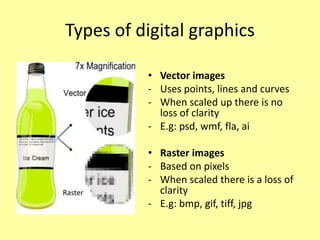
Types of digital graphics
• Vector images
- Uses points, lines and curves
- When scaled up there is no
loss of clarity
- E.g: psd, wmf, fla, ai
• Raster images
- Based on pixels
- When scaled there is a loss of
clarity
- E.g: bmp, gif, tiff, jpg
Raster
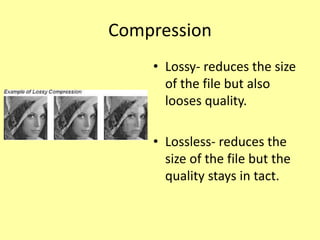
Compression
• Lossy- reduces the size
of the file but also
looses quality.
• Lossless- reduces the
size of the file but the
quality stays in tact.
Learning Aims:
• All of you will be able to
discuss the different types of
image
• Most of you will be able to
research and make references
to the different types of
images
• Some of you will be able to
criticise the use of different
image types in graphics.
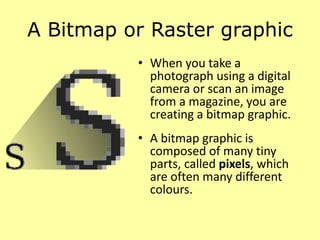
A Bitmap or Raster graphic
• When you take a
photograph using a digital
camera or scan an image
from a magazine, you are
creating a bitmap graphic.
• A bitmap graphic is
composed of many tiny
parts, called pixels, which
are often many different
colours.
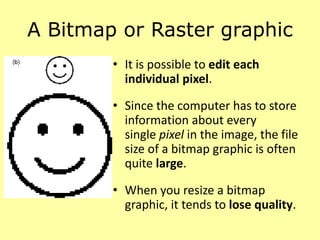
A Bitmap or Raster graphic
• It is possible to edit each
individual pixel.
• Since the computer has to store
information about every
single pixel in the image, the file
size of a bitmap graphic is often
quite large.
• When you resize a bitmap
graphic, it tends to lose quality.
What are vector graphics?
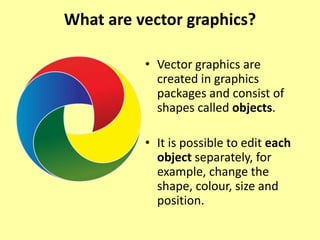
• Vector graphics are
created in graphics
packages and consist of
shapes called objects.
• It is possible to edit each
object separately, for
example, change the
shape, colour, size and
position.
What are vector graphics?
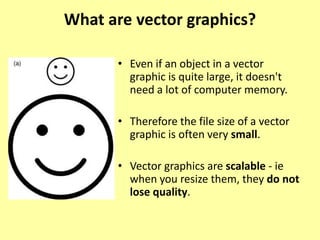
• Even if an object in a vector
graphic is quite large, it doesn't
need a lot of computer memory.
• Therefore the file size of a vector
graphic is often very small.
• Vector graphics are scalable - ie
when you resize them, they do not
lose quality.
File Types used in graphics
• bmp,
• png,
• gif,
• jpg,
• Psd
• tiff
Tiff files ending in .tif
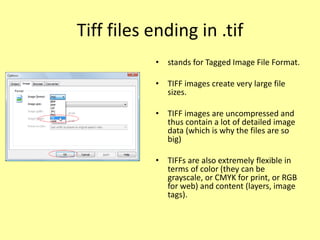
• stands for Tagged Image File Format.
• TIFF images create very large file
sizes.
• TIFF images are uncompressed and
thus contain a lot of detailed image
data (which is why the files are so
big)
• TIFFs are also extremely flexible in
terms of color (they can be
grayscale, or CMYK for print, or RGB
for web) and content (layers, image
tags).
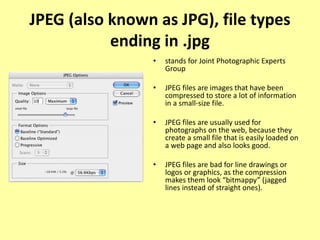
JPEG (also known as JPG), file types
ending in .jpg
• stands for Joint Photographic Experts
Group
• JPEG files are images that have been
compressed to store a lot of information
in a small-size file.
• JPEG files are usually used for
photographs on the web, because they
create a small file that is easily loaded on
a web page and also looks good.
• JPEG files are bad for line drawings or
logos or graphics, as the compression
makes them look “bitmappy” (jagged
lines instead of straight ones).
What can you remember about GIFs?
• What does it stand
for?
• Lossy or lossless?
• What is it mainly used
for?
• Stands for Graphic
Interchange Format
• compresses images but, as
different from JPEG, the
compression is lossless
• This format is never used for
photography, because of the
limited number of colors.
• GIFs can also be used for
animations
PNG, file types ending in .png
• stands for Portable Network
Graphics.
• It’s used almost exclusively for web
images, never for print images.
• It also allows for a full range of color
and better compression.
• PNG can retain it’s transparency
Psd, file types ending in .psd
• Photoshop document
• These types of files are very
large files allowing for large
colour information.
• Usually images are retained
in this format for print.
• These types of files are
generally raster files, but
there are some elements
which are vector based.
.Ai file types
• Illustrator document
• Vector images
• Use large colour
information
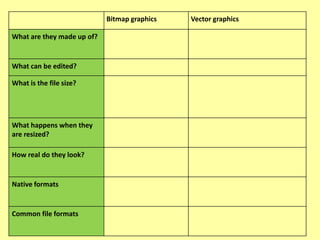
Bitmap graphics Vector graphics
What are they made up of?
What can be edited?
What is the file size?
What happens when they
are resized?
How real do they look?
Native formats
Common file formats
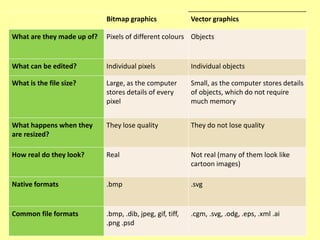
Bitmap graphics Vector graphics
What are they made up of? Pixels of different colours Objects
What can be edited? Individual pixels Individual objects
What is the file size? Large, as the computer
stores details of every
pixel
Small, as the computer stores details
of objects, which do not require
much memory
What happens when they
are resized?
They lose quality They do not lose quality
How real do they look? Real Not real (many of them look like
cartoon images)
Native formats .bmp .svg
Common file formats .bmp, .dib, jpeg, gif, tiff,
.png .psd
.cgm, .svg, .odg, .eps, .xml .ai
TASK: Write your article “What is digital
graphics technology?”
Research and explain using examples:
• Vector Graphics
• Raster Graphics
• Types of image
• Advantages and
disadvantages of using
different types of
graphics.
• How Vector and raster
graphics are created

Lesson 3 graphics types

  • 1.
    Types of image Raster,Vector and file extensions
  • 2.
    What can youremember from last week? • Raster • Vector • Compression • Lossy • Lossless
  • 3.
    Types of digitalgraphics • Vector images - Uses points, lines and curves - When scaled up there is no loss of clarity - E.g: psd, wmf, fla, ai • Raster images - Based on pixels - When scaled there is a loss of clarity - E.g: bmp, gif, tiff, jpg Raster
  • 4.
    Compression • Lossy- reducesthe size of the file but also looses quality. • Lossless- reduces the size of the file but the quality stays in tact.
  • 5.
    Learning Aims: • Allof you will be able to discuss the different types of image • Most of you will be able to research and make references to the different types of images • Some of you will be able to criticise the use of different image types in graphics.
  • 6.
    A Bitmap orRaster graphic • When you take a photograph using a digital camera or scan an image from a magazine, you are creating a bitmap graphic. • A bitmap graphic is composed of many tiny parts, called pixels, which are often many different colours.
  • 7.
    A Bitmap orRaster graphic • It is possible to edit each individual pixel. • Since the computer has to store information about every single pixel in the image, the file size of a bitmap graphic is often quite large. • When you resize a bitmap graphic, it tends to lose quality.
  • 8.
    What are vectorgraphics? • Vector graphics are created in graphics packages and consist of shapes called objects. • It is possible to edit each object separately, for example, change the shape, colour, size and position.
  • 9.
    What are vectorgraphics? • Even if an object in a vector graphic is quite large, it doesn't need a lot of computer memory. • Therefore the file size of a vector graphic is often very small. • Vector graphics are scalable - ie when you resize them, they do not lose quality.
  • 10.
    File Types usedin graphics • bmp, • png, • gif, • jpg, • Psd • tiff
  • 11.
    Tiff files endingin .tif • stands for Tagged Image File Format. • TIFF images create very large file sizes. • TIFF images are uncompressed and thus contain a lot of detailed image data (which is why the files are so big) • TIFFs are also extremely flexible in terms of color (they can be grayscale, or CMYK for print, or RGB for web) and content (layers, image tags).
  • 12.
    JPEG (also knownas JPG), file types ending in .jpg • stands for Joint Photographic Experts Group • JPEG files are images that have been compressed to store a lot of information in a small-size file. • JPEG files are usually used for photographs on the web, because they create a small file that is easily loaded on a web page and also looks good. • JPEG files are bad for line drawings or logos or graphics, as the compression makes them look “bitmappy” (jagged lines instead of straight ones).
  • 13.
    What can youremember about GIFs? • What does it stand for? • Lossy or lossless? • What is it mainly used for? • Stands for Graphic Interchange Format • compresses images but, as different from JPEG, the compression is lossless • This format is never used for photography, because of the limited number of colors. • GIFs can also be used for animations
  • 14.
    PNG, file typesending in .png • stands for Portable Network Graphics. • It’s used almost exclusively for web images, never for print images. • It also allows for a full range of color and better compression. • PNG can retain it’s transparency
  • 15.
    Psd, file typesending in .psd • Photoshop document • These types of files are very large files allowing for large colour information. • Usually images are retained in this format for print. • These types of files are generally raster files, but there are some elements which are vector based.
  • 16.
    .Ai file types •Illustrator document • Vector images • Use large colour information
  • 17.
    Bitmap graphics Vectorgraphics What are they made up of? What can be edited? What is the file size? What happens when they are resized? How real do they look? Native formats Common file formats
  • 18.
    Bitmap graphics Vectorgraphics What are they made up of? Pixels of different colours Objects What can be edited? Individual pixels Individual objects What is the file size? Large, as the computer stores details of every pixel Small, as the computer stores details of objects, which do not require much memory What happens when they are resized? They lose quality They do not lose quality How real do they look? Real Not real (many of them look like cartoon images) Native formats .bmp .svg Common file formats .bmp, .dib, jpeg, gif, tiff, .png .psd .cgm, .svg, .odg, .eps, .xml .ai
  • 19.
    TASK: Write yourarticle “What is digital graphics technology?” Research and explain using examples: • Vector Graphics • Raster Graphics • Types of image • Advantages and disadvantages of using different types of graphics. • How Vector and raster graphics are created