Unit 7:Film Practices
Learning Outcomes:
• MUST be able to use narrative techniques when
constructing a script.
• SHOULD be able to use adjectives and verbs when writing
dialogue for a script.
• COULD use the correct script format.
Use Verbs and adjectives to write dialogue in your script
(Aim to fit this into your script today)
English
Target
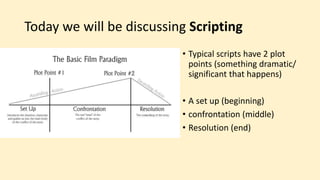
Today we will be discussing Scripting
• Typical scripts have 2 plot
points (something dramatic/
significant that happens)
• A set up (beginning)
• confrontation (middle)
• Resolution (end)
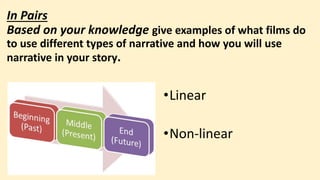
In Pairs
Based on your knowledge give examples of what films do
to use different types of narrative and how you will use
narrative in your story.
•Linear
•Non-linear
• Why do some scripts hold back information
from their audiences?
Discuss in pairs and share
• Which part of your story might you hold
back from your audience and why?
• What will this do to your story?
• How would you choose to reveal the
information eventually?
Watch the clip and consider what you think needs
to be included in a script
Think- Pair-Share.
• https://www.youtube.com/watch?v=vKBloLOSFnE&list=PLku-
YXIZuPRZTPwhntnn8QSRf87L7LZbk
Analyse the script in pairs (10 mins)
• https://www.youtube.com/watch?v=v
KBloLOSFnE&list=PLku-
YXIZuPRZTPwhntnn8QSRf87L7LZbk
• Analyse and annotate the script
looking for typical “features”
• How has the script held back
information from the audience?
• What narrative device did they use?
Scriptwriting
Scriptwriting
• Use the building a character story to help write out a storyline for
your game, then highlight the information into what you wish to show
in your trailer.
• This means thinking about Dialogue, Scenes, Formatting.
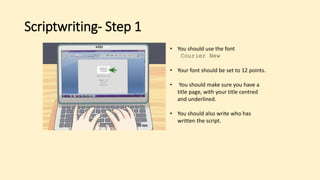
Scriptwriting- Step 1
• You should use the font
Courier New
• Your font should be set to 12 points.
• You should make sure you have a
title page, with your title centred
and underlined.
• You should also write who has
written the script.
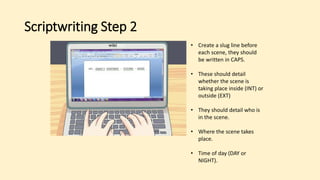
Scriptwriting Step 2
• Create a slug line before
each scene, they should
be written in CAPS.
• These should detail
whether the scene is
taking place inside (INT) or
outside (EXT)
• They should detail who is
in the scene.
• Where the scene takes
place.
• Time of day (DAY or
NIGHT).
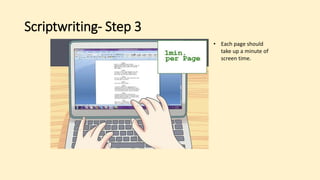
Scriptwriting- Step 3
• Each page should
take up a minute of
screen time.
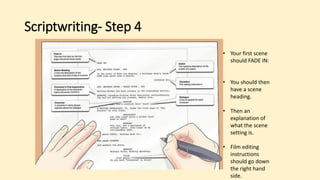
Scriptwriting- Step 4
• Your first scene
should FADE IN:
• You should then
have a scene
heading.
• Then an
explanation of
what the scene
setting is.
• Film editing
instructions
should go down
the right hand
side.
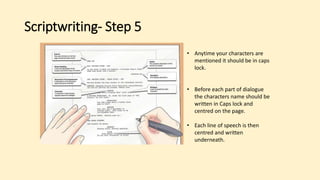
Scriptwriting- Step 5
• Anytime your characters are
mentioned it should be in caps
lock.
• Before each part of dialogue
the characters name should be
written in Caps lock and
centred on the page.
• Each line of speech is then
centred and written
underneath.
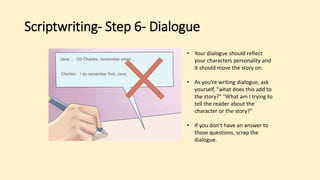
Scriptwriting- Step 6- Dialogue
• Your dialogue should reflect
your characters personality and
it should move the story on.
• As you're writing dialogue, ask
yourself, "what does this add to
the story?" "What am I trying to
tell the reader about the
character or the story?"
• If you don't have an answer to
those questions, scrap the
dialogue.
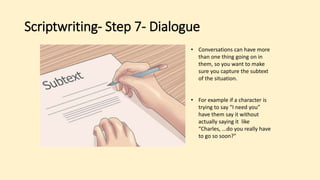
Scriptwriting- Step 7- Dialogue
• Conversations can have more
than one thing going on in
them, so you want to make
sure you capture the subtext
of the situation.
• For example if a character is
trying to say “I need you”
have them say it without
actually saying it like
“Charles, ...do you really have
to go so soon?"
Learning Outcomes you need to work towards today:
• MUST be able to use narrative techniques when
constructing a script.
• SHOULD be able to use adjectives and verbs when writing
dialogue for a script.
• COULD use the correct script format.
Use Verbs and adjectives to write dialogue in your script
(Aim to fit this into your script today)
English
Target

Unit 7 film practices wk4b

  • 1.
  • 2.
    Learning Outcomes: • MUSTbe able to use narrative techniques when constructing a script. • SHOULD be able to use adjectives and verbs when writing dialogue for a script. • COULD use the correct script format. Use Verbs and adjectives to write dialogue in your script (Aim to fit this into your script today) English Target
  • 3.
    Today we willbe discussing Scripting • Typical scripts have 2 plot points (something dramatic/ significant that happens) • A set up (beginning) • confrontation (middle) • Resolution (end)
  • 4.
    In Pairs Based onyour knowledge give examples of what films do to use different types of narrative and how you will use narrative in your story. •Linear •Non-linear
  • 5.
    • Why dosome scripts hold back information from their audiences? Discuss in pairs and share • Which part of your story might you hold back from your audience and why? • What will this do to your story? • How would you choose to reveal the information eventually?
  • 6.
    Watch the clipand consider what you think needs to be included in a script Think- Pair-Share. • https://www.youtube.com/watch?v=vKBloLOSFnE&list=PLku- YXIZuPRZTPwhntnn8QSRf87L7LZbk
  • 7.
    Analyse the scriptin pairs (10 mins) • https://www.youtube.com/watch?v=v KBloLOSFnE&list=PLku- YXIZuPRZTPwhntnn8QSRf87L7LZbk • Analyse and annotate the script looking for typical “features” • How has the script held back information from the audience? • What narrative device did they use?
  • 8.
  • 9.
    Scriptwriting • Use thebuilding a character story to help write out a storyline for your game, then highlight the information into what you wish to show in your trailer. • This means thinking about Dialogue, Scenes, Formatting.
  • 10.
    Scriptwriting- Step 1 •You should use the font Courier New • Your font should be set to 12 points. • You should make sure you have a title page, with your title centred and underlined. • You should also write who has written the script.
  • 11.
    Scriptwriting Step 2 •Create a slug line before each scene, they should be written in CAPS. • These should detail whether the scene is taking place inside (INT) or outside (EXT) • They should detail who is in the scene. • Where the scene takes place. • Time of day (DAY or NIGHT).
  • 12.
    Scriptwriting- Step 3 •Each page should take up a minute of screen time.
  • 13.
    Scriptwriting- Step 4 •Your first scene should FADE IN: • You should then have a scene heading. • Then an explanation of what the scene setting is. • Film editing instructions should go down the right hand side.
  • 14.
    Scriptwriting- Step 5 •Anytime your characters are mentioned it should be in caps lock. • Before each part of dialogue the characters name should be written in Caps lock and centred on the page. • Each line of speech is then centred and written underneath.
  • 15.
    Scriptwriting- Step 6-Dialogue • Your dialogue should reflect your characters personality and it should move the story on. • As you're writing dialogue, ask yourself, "what does this add to the story?" "What am I trying to tell the reader about the character or the story?" • If you don't have an answer to those questions, scrap the dialogue.
  • 16.
    Scriptwriting- Step 7-Dialogue • Conversations can have more than one thing going on in them, so you want to make sure you capture the subtext of the situation. • For example if a character is trying to say “I need you” have them say it without actually saying it like “Charles, ...do you really have to go so soon?"
  • 17.
    Learning Outcomes youneed to work towards today: • MUST be able to use narrative techniques when constructing a script. • SHOULD be able to use adjectives and verbs when writing dialogue for a script. • COULD use the correct script format. Use Verbs and adjectives to write dialogue in your script (Aim to fit this into your script today) English Target