Professional Development
Assignment 2- Career Plan
Learning Aims
• MUST be able to plan out your film activities for the next 8 weeks.
• SHOULD be able to take into consideration the roles and processes
involved in filmmaking.
• COULD discuss the skills and techniques required to develop your film
and how you intend to experimenting and learn new skills.
Over the next 8 weeks you will need to finalise your plans
and begin your filming for your short film
• Finding locations and assessing quality of
location & Assessing risks at the location
• Advertising for actors and conducting
auditions
• Finalising your script
• Storyboarding a plan for your
cinematography
• Creating call sheets and a script breakdown
• Filming your sequences
Lets have a look at what these processes involve and
what skillsets you might need for them
4
What is involved in a location scout & recce?
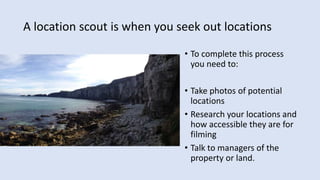
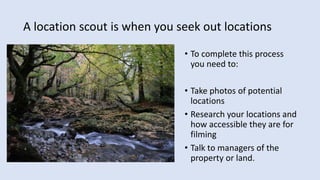
A location scout is when you seek out locations
• To complete this process
you need to:
• Take photos of potential
locations
• Research your locations and
how accessible they are for
filming
• Talk to managers of the
property or land.
A location scout is when you seek out locations
• To complete this process
you need to:
• Take photos of potential
locations
• Research your locations and
how accessible they are for
filming
• Talk to managers of the
property or land.
Ok so you have found your location now we have to
recce it (gather information about it)
• Look at the natural light where it is coming from and how you might use additional lighting if you need to (powe
• Consider background noises (do you need to turn off machines? Where will you need to position yourself to get t
• Consider the look and feel of the location (does it feel right for your scene, will it tell the story well? does it look t
• Consider where you will take your angles from
• What health and safety risks are there, how will you prevent problems
• Have you got permission? Have you spoken to the manager to ensure you have access to the building?
What skills do you need to achieve your
location scout and recce?
9
Ways to advertise and seek out actors for
your production
• work with people you know
• create posters you can put up around college with an
audition date on.
• look for actors online could be at local drama groups, or
on services such as star now (but be careful about who
you approach)
• Place ads online for actors to audition.
• approach the drama department and ask for actors
• Have an audition date in mind before you approach
people and a script to give them.
Creating a script breakdown
• A script breakdown is a document that is used to create a breakdown
of each scene of the script for production.
• Pages are split into 8ths and each breakdown sheet is representative
of 1 scene.
• The pages show what should be included in each scene and what
considerations should be made, for example props, special effects,
locations, etc.
• This helps the AD’s and producers know what they need to organize
for the shoot.
Call Sheets
• Call sheets are used to tell the actors and directors which scenes will
be shot each day, when and where they will be shot.
• They also include safety information and a contact list.
• The producers and directors carry these around with them on days of
shooting to keep organised.
• One is produced for each day of shooting.
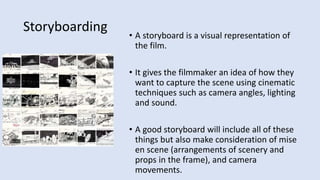
Storyboarding • A storyboard is a visual representation of
the film.
• It gives the filmmaker an idea of how they
want to capture the scene using cinematic
techniques such as camera angles, lighting
and sound.
• A good storyboard will include all of these
things but also make consideration of mise
en scene (arrangements of scenery and
props in the frame), and camera
movements.
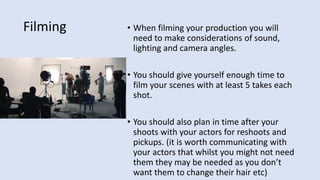
Filming • When filming your production you will
need to make considerations of sound,
lighting and camera angles.
• You should give yourself enough time to
film your scenes with at least 5 takes each
shot.
• You should also plan in time after your
shoots with your actors for reshoots and
pickups. (it is worth communicating with
your actors that whilst you might not need
them they may be needed as you don’t
want them to change their hair etc)
TASK- Plot out an 8 week plan for your film
planning
• Consider the skills you might need to develop for these activities on
your 8 week tracker.
• Finding locations and assessing quality of location & Assessing risks at
the location
• Advertising for actors and conducting auditions
• Finalizing your script
• Storyboarding a plan for your cinematography
• Filming your sequences

Professional practice

  • 1.
  • 2.
    Learning Aims • MUSTbe able to plan out your film activities for the next 8 weeks. • SHOULD be able to take into consideration the roles and processes involved in filmmaking. • COULD discuss the skills and techniques required to develop your film and how you intend to experimenting and learn new skills.
  • 3.
    Over the next8 weeks you will need to finalise your plans and begin your filming for your short film • Finding locations and assessing quality of location & Assessing risks at the location • Advertising for actors and conducting auditions • Finalising your script • Storyboarding a plan for your cinematography • Creating call sheets and a script breakdown • Filming your sequences
  • 4.
    Lets have alook at what these processes involve and what skillsets you might need for them 4
  • 5.
    What is involvedin a location scout & recce?
  • 6.
    A location scoutis when you seek out locations • To complete this process you need to: • Take photos of potential locations • Research your locations and how accessible they are for filming • Talk to managers of the property or land.
  • 7.
    A location scoutis when you seek out locations • To complete this process you need to: • Take photos of potential locations • Research your locations and how accessible they are for filming • Talk to managers of the property or land.
  • 8.
    Ok so youhave found your location now we have to recce it (gather information about it) • Look at the natural light where it is coming from and how you might use additional lighting if you need to (powe • Consider background noises (do you need to turn off machines? Where will you need to position yourself to get t • Consider the look and feel of the location (does it feel right for your scene, will it tell the story well? does it look t • Consider where you will take your angles from • What health and safety risks are there, how will you prevent problems • Have you got permission? Have you spoken to the manager to ensure you have access to the building?
  • 9.
    What skills doyou need to achieve your location scout and recce? 9
  • 10.
    Ways to advertiseand seek out actors for your production • work with people you know • create posters you can put up around college with an audition date on. • look for actors online could be at local drama groups, or on services such as star now (but be careful about who you approach) • Place ads online for actors to audition. • approach the drama department and ask for actors • Have an audition date in mind before you approach people and a script to give them.
  • 11.
    Creating a scriptbreakdown • A script breakdown is a document that is used to create a breakdown of each scene of the script for production. • Pages are split into 8ths and each breakdown sheet is representative of 1 scene. • The pages show what should be included in each scene and what considerations should be made, for example props, special effects, locations, etc. • This helps the AD’s and producers know what they need to organize for the shoot.
  • 12.
    Call Sheets • Callsheets are used to tell the actors and directors which scenes will be shot each day, when and where they will be shot. • They also include safety information and a contact list. • The producers and directors carry these around with them on days of shooting to keep organised. • One is produced for each day of shooting.
  • 13.
    Storyboarding • Astoryboard is a visual representation of the film. • It gives the filmmaker an idea of how they want to capture the scene using cinematic techniques such as camera angles, lighting and sound. • A good storyboard will include all of these things but also make consideration of mise en scene (arrangements of scenery and props in the frame), and camera movements.
  • 14.
    Filming • Whenfilming your production you will need to make considerations of sound, lighting and camera angles. • You should give yourself enough time to film your scenes with at least 5 takes each shot. • You should also plan in time after your shoots with your actors for reshoots and pickups. (it is worth communicating with your actors that whilst you might not need them they may be needed as you don’t want them to change their hair etc)
  • 15.
    TASK- Plot outan 8 week plan for your film planning • Consider the skills you might need to develop for these activities on your 8 week tracker. • Finding locations and assessing quality of location & Assessing risks at the location • Advertising for actors and conducting auditions • Finalizing your script • Storyboarding a plan for your cinematography • Filming your sequences