Johnel V. Esponilla
Physical Science
Grade 11 – STEM, ABM, HUMSS
Agenda
Why Do Atoms Bond?
Energy and Bonding
What Happens When Atoms Bond?
Covalent Bonding
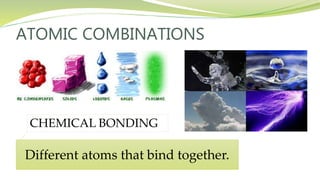
ATOMIC COMBINATIONS
CHEMICAL BONDING
Different atoms that bind together.
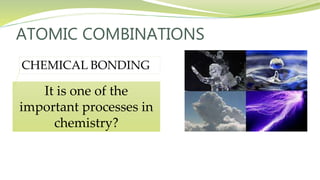
ATOMIC COMBINATIONS
CHEMICAL BONDING
It is one of the
important processes in
chemistry?
ATOMIC COMBINATIONS
CHEMICAL BONDING
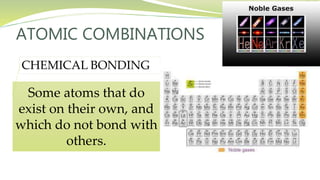
Some atoms that do
exist on their own, and
which do not bond with
others.
ATOMIC COMBINATIONS
WHY DO ATOMS BOND?
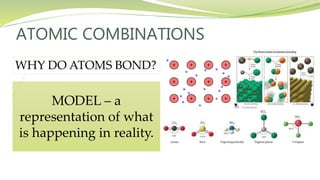
MODEL – a
representation of what
is happening in reality.
ATOMIC COMBINATIONS
WHY DO ATOMS BOND?
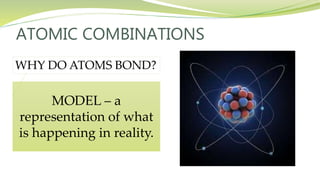
MODEL – a
representation of what
is happening in reality.
ATOMIC COMBINATIONS
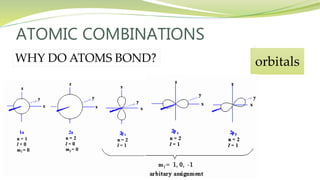
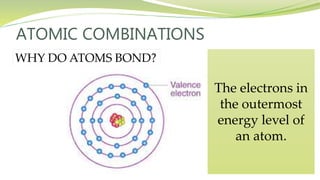
WHY DO ATOMS BOND? orbitals
ATOMIC COMBINATIONS
WHY DO ATOMS BOND?
The electrons in
the outermost
energy level of
an atom.
ATOMIC COMBINATIONS
WHY DO ATOMS BOND?
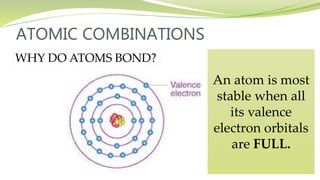
An atom is most
stable when all
its valence
electron orbitals
are FULL.
ATOMIC COMBINATIONS
WHY DO ATOMS BOND?
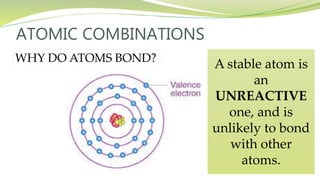
A stable atom is
an
UNREACTIVE
one, and is
unlikely to bond
with other
atoms.
ATOMIC COMBINATIONS
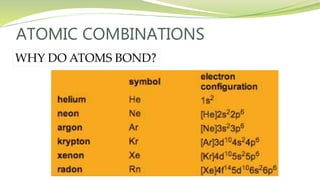
WHY DO ATOMS BOND?
ATOMIC COMBINATIONS
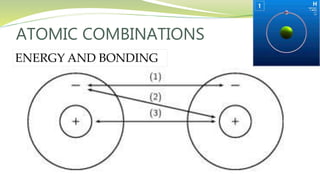
ENERGY AND BONDING
ATOMIC COMBINATIONS
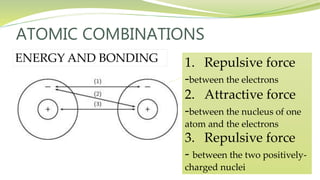
ENERGY AND BONDING 1. Repulsive force
-between the electrons
2. Attractive force
-between the nucleus of one
atom and the electrons
3. Repulsive force
- between the two positively-
charged nuclei
ATOMIC COMBINATIONS
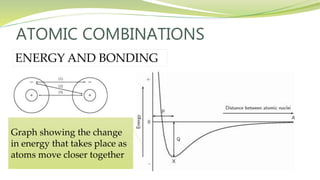
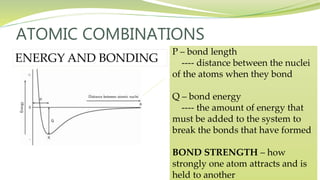
ENERGY AND BONDING
Graph showing the change
in energy that takes place as
atoms move closer together
ATOMIC COMBINATIONS
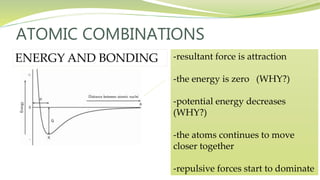
ENERGY AND BONDING -resultant force is attraction
-the energy is zero (WHY?)
-potential energy decreases
(WHY?)
-the atoms continues to move
closer together
-repulsive forces start to dominate
ATOMIC COMBINATIONS
ENERGY AND BONDING
P – bond length
---- distance between the nuclei
of the atoms when they bond
Q – bond energy
---- the amount of energy that
must be added to the system to
break the bonds that have formed
BOND STRENGTH – how
strongly one atom attracts and is
held to another
ATOMIC COMBINATIONS
WHAT HAPPENS WHEN ATOMS BOND?
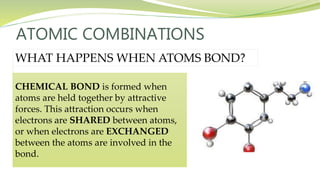
CHEMICAL BOND is formed when
atoms are held together by attractive
forces. This attraction occurs when
electrons are SHARED between atoms,
or when electrons are EXCHANGED
between the atoms are involved in the
bond.
ATOMIC COMBINATIONS
WHAT HAPPENS WHEN ATOMS BOND?
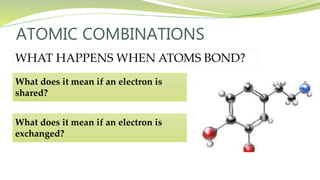
What does it mean if an electron is
shared?
What does it mean if an electron is
exchanged?
ATOMIC COMBINATIONS
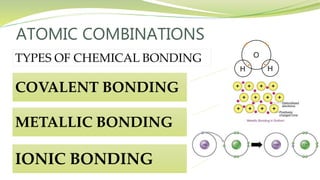
TYPES OF CHEMICAL BONDING
COVALENT BONDING
METALLIC BONDING
IONIC BONDING
ATOMIC COMBINATIONS
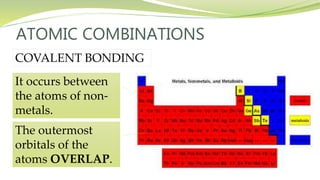
COVALENT BONDING
It occurs between
the atoms of non-
metals.
The outermost
orbitals of the
atoms OVERLAP.
ATOMIC COMBINATIONS
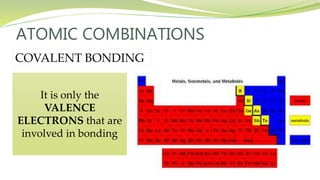
COVALENT BONDING
It is only the
VALENCE
ELECTRONS that are
involved in bonding
ATOMIC COMBINATIONS
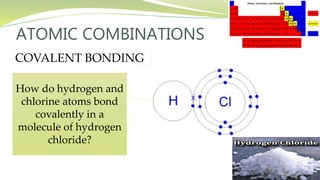
COVALENT BONDING
How do hydrogen and
chlorine atoms bond
covalently in a
molecule of hydrogen
chloride?
ATOMIC COMBINATIONS
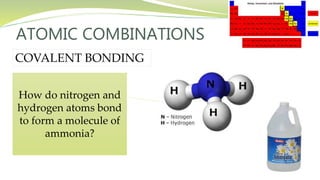
COVALENT BONDING
How do nitrogen and
hydrogen atoms bond
to form a molecule of
ammonia?
ATOMIC COMBINATIONS
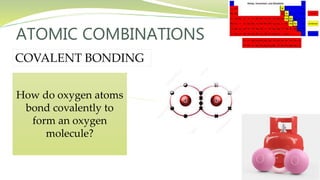
COVALENT BONDING
How do oxygen atoms
bond covalently to
form an oxygen
molecule?
ATOMIC COMBINATIONS
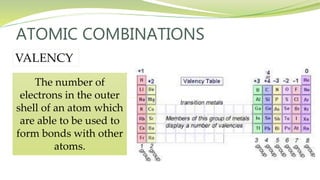
VALENCY
The number of
electrons in the outer
shell of an atom which
are able to be used to
form bonds with other
atoms.
ATOMIC COMBINATIONS
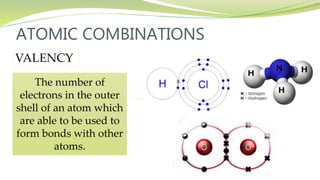
VALENCY
The number of
electrons in the outer
shell of an atom which
are able to be used to
form bonds with other
atoms.
ATOMIC COMBINATIONS
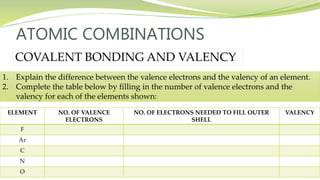
COVALENT BONDING AND VALENCY
1. Explain the difference between the valence electrons and the valency of an element.
2. Complete the table below by filling in the number of valence electrons and the
valency for each of the elements shown:
ELEMENT NO. OF VALENCE
ELECTRONS
NO. OF ELECTRONS NEEDED TO FILL OUTER
SHELL
VALENCY
F
Ar
C
N
O
ATOMIC COMBINATIONS
COVALENT BONDING AND VALENCY
3. Draw simple diagrams to show how electrons are arranged in the following covalent
molecules:
a. Water H2O
b. Chlorine Cl2

Chemical bonding