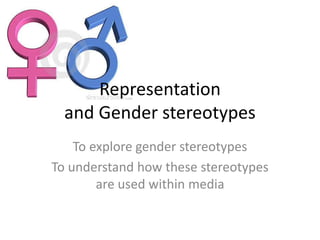
Representation
and Gender stereotypes
To explore gender stereotypes
To understand how these stereotypes
are used within media
Recap…
• As we grow up, we ‘learn’ what is expected in
terms of our gender identity from a range of
sources: parents, school, books, the media,
peer pressure…
• The power to conform is so strong in us that
we tend to copy the gender models we see.
Thus, by the time we have started school,
most of us have “learnt” how to be masculine
or feminine as our culture defines it.
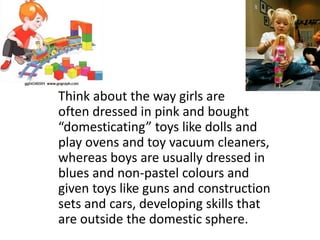
Think about the way girls are
often dressed in pink and bought
“domesticating” toys like dolls and
play ovens and toy vacuum cleaners,
whereas boys are usually dressed in
blues and non-pastel colours and
given toys like guns and construction
sets and cars, developing skills that
are outside the domestic sphere.
• Over time, the two genders have developed
quite distinct and often oppositional gender
codes – activities, spheres of activity and
qualities that are deemed to be exclusive to
only one group.
MASCULINE

FEMININE

• TASK: In groups draw up a list divided into two
columns and label one side MASCULINE and
the other FEMININE and see what traditional
associations you make with each gender
under the headings on the next slides.
•
•
•
•
•
•
•
•
•
•

Colours
Clothes
Toys
Jobs
Leisure Activities
Responsibilities in the Home
Drinks on a Night Out
A Typical Night Out
Favourite Genre of Films
Typical Character Qualities
Feedback
• What do you notice about these different
ideas associated traditionally with each
gender? What image do they conjure up of
each group?
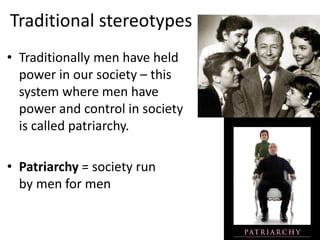
Traditional stereotypes
• Traditionally men have held
power in our society – this
system where men have
power and control in society
is called patriarchy.
• Patriarchy = society run
by men for men
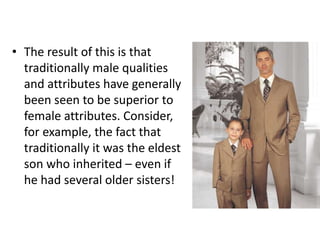
• The result of this is that
traditionally male qualities
and attributes have generally
been seen to be superior to
female attributes. Consider,
for example, the fact that
traditionally it was the eldest
son who inherited – even if
he had several older sisters!
• This was often reflected in the media, as most
media companies were run by men!
• Masculinity was often represented in ways
that were shown to be superior to feminine
qualities. Men were often shown to be more
important and powerful than women.
• Women were often shown in roles that suited
men and which kept them from challenging
men for power.
• In other words, the media showed men and
women how men wanted them to be!
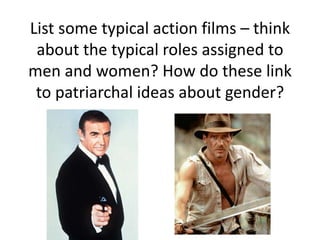
List some typical action films – think
about the typical roles assigned to
men and women? How do these link
to patriarchal ideas about gender?
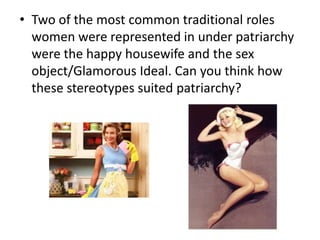
• Two of the most common traditional roles
women were represented in under patriarchy
were the happy housewife and the sex
object/Glamorous Ideal. Can you think how
these stereotypes suited patriarchy?
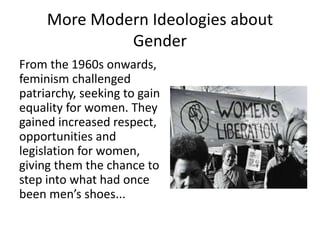
More Modern Ideologies about
Gender
From the 1960s onwards,
feminism challenged
patriarchy, seeking to gain
equality for women. They
gained increased respect,
opportunities and
legislation for women,
giving them the chance to
step into what had once
been men’s shoes...
• Suddenly gender roles were less rigid and
defined and this is often reflected in newer
media representations
• .TASK: Again, we will look at two short extracts
to see how men and women are being
represented today.
• 1 – Million Dollar Baby extract
• 2 - Aero Melt ad
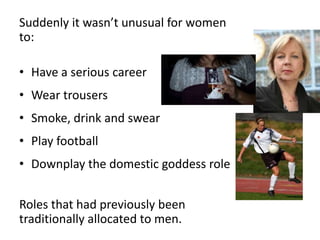
Suddenly it wasn’t unusual for women
to:
• Have a serious career

• Wear trousers
• Smoke, drink and swear

• Play football
• Downplay the domestic goddess role
Roles that had previously been
traditionally allocated to men.
A word of caution…
AS Lesson 2   gender and stereotypes

AS Lesson 2 gender and stereotypes

  • 1.
    Representation and Gender stereotypes Toexplore gender stereotypes To understand how these stereotypes are used within media
  • 2.
    Recap… • As wegrow up, we ‘learn’ what is expected in terms of our gender identity from a range of sources: parents, school, books, the media, peer pressure… • The power to conform is so strong in us that we tend to copy the gender models we see. Thus, by the time we have started school, most of us have “learnt” how to be masculine or feminine as our culture defines it.
  • 3.
    Think about theway girls are often dressed in pink and bought “domesticating” toys like dolls and play ovens and toy vacuum cleaners, whereas boys are usually dressed in blues and non-pastel colours and given toys like guns and construction sets and cars, developing skills that are outside the domestic sphere.
  • 4.
    • Over time,the two genders have developed quite distinct and often oppositional gender codes – activities, spheres of activity and qualities that are deemed to be exclusive to only one group. MASCULINE FEMININE • TASK: In groups draw up a list divided into two columns and label one side MASCULINE and the other FEMININE and see what traditional associations you make with each gender under the headings on the next slides.
  • 5.
    • • • • • • • • • • Colours Clothes Toys Jobs Leisure Activities Responsibilities inthe Home Drinks on a Night Out A Typical Night Out Favourite Genre of Films Typical Character Qualities
  • 6.
    Feedback • What doyou notice about these different ideas associated traditionally with each gender? What image do they conjure up of each group?
  • 7.
    Traditional stereotypes • Traditionallymen have held power in our society – this system where men have power and control in society is called patriarchy. • Patriarchy = society run by men for men
  • 8.
    • The resultof this is that traditionally male qualities and attributes have generally been seen to be superior to female attributes. Consider, for example, the fact that traditionally it was the eldest son who inherited – even if he had several older sisters!
  • 9.
    • This wasoften reflected in the media, as most media companies were run by men! • Masculinity was often represented in ways that were shown to be superior to feminine qualities. Men were often shown to be more important and powerful than women. • Women were often shown in roles that suited men and which kept them from challenging men for power. • In other words, the media showed men and women how men wanted them to be!
  • 10.
    List some typicalaction films – think about the typical roles assigned to men and women? How do these link to patriarchal ideas about gender?
  • 11.
    • Two ofthe most common traditional roles women were represented in under patriarchy were the happy housewife and the sex object/Glamorous Ideal. Can you think how these stereotypes suited patriarchy?
  • 12.
    More Modern Ideologiesabout Gender From the 1960s onwards, feminism challenged patriarchy, seeking to gain equality for women. They gained increased respect, opportunities and legislation for women, giving them the chance to step into what had once been men’s shoes...
  • 13.
    • Suddenly genderroles were less rigid and defined and this is often reflected in newer media representations • .TASK: Again, we will look at two short extracts to see how men and women are being represented today. • 1 – Million Dollar Baby extract • 2 - Aero Melt ad
  • 14.
    Suddenly it wasn’tunusual for women to: • Have a serious career • Wear trousers • Smoke, drink and swear • Play football • Downplay the domestic goddess role Roles that had previously been traditionally allocated to men.
  • 19.
    A word ofcaution…