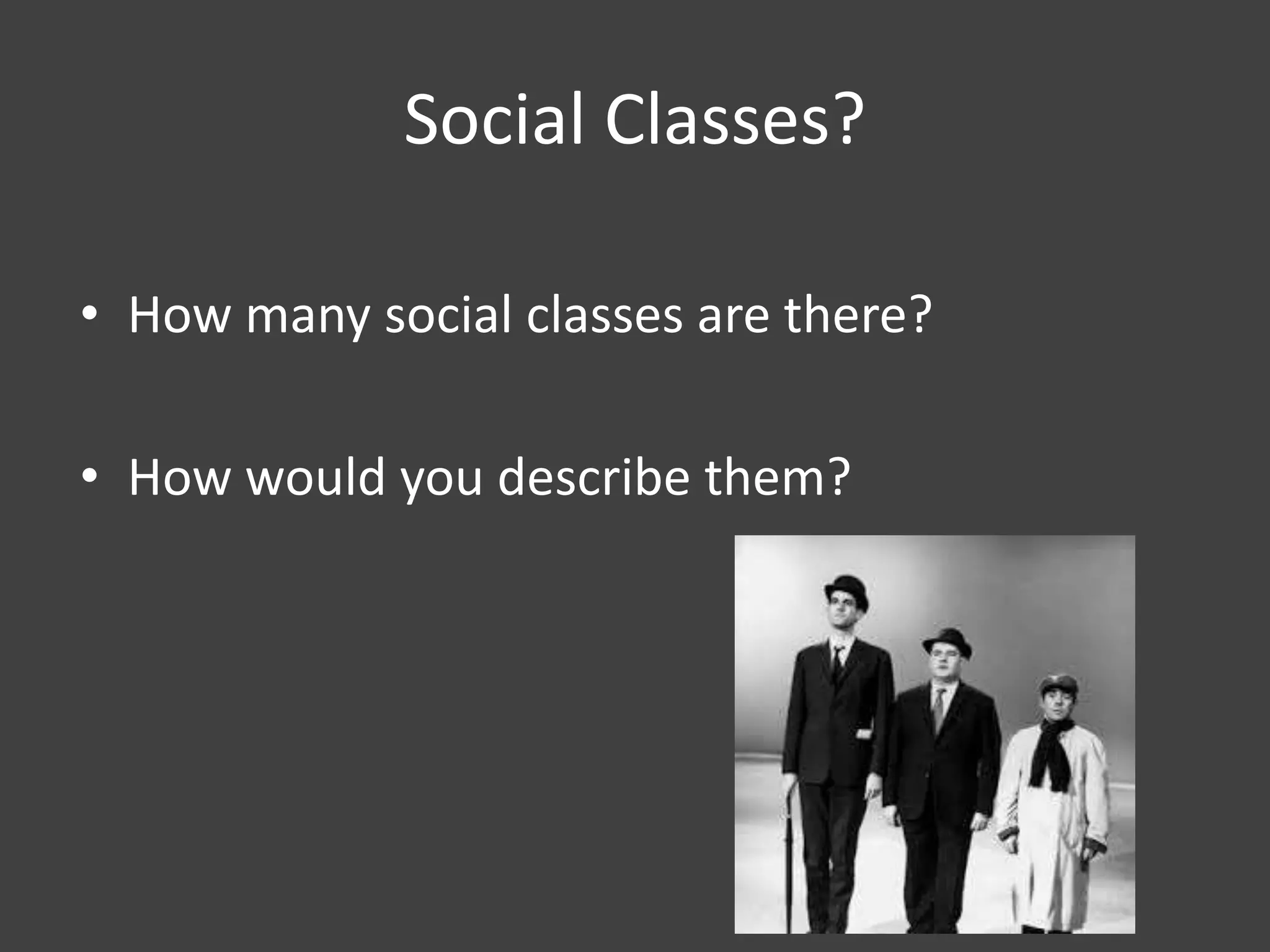
Social Classes?
• How many social classes are there?
• How would you describe them?
Working class
• Presented in the stereotypical context of
traditional working class communities such
Eastenders and Corrie, Shameless
• Community values often praised but do not
reflect reality,
• Working class communities have declined with
the collapse of traditional industries such as coal
mining,
• Often presented in the context of trouble,
undesirable welfare scroungers, unable to cope
with their delinquent children.
Upper class
• Mainly done through the coverage of the
monarchy,
• Seen as well bred and cultured,
• Represented through their accents, estates,
and a taste for shooting and hunting,
• Usually represented in costume and period
drama.
How does the media represent social
class ?
• Lack of focus on the tensions or class conflict
which exist within society and have been
highlighted by key sociological perspectives such
as Marxism
• Media through its representation of social class
ensures the cultural hegemony of the dominant
capitalist class which maintains inequality and
exploitation.
Nairn (1988) – Monarchy
• “Royal Family” concept = niceness, decency,
ordinariness,
• Royal family can be deemed to be “like us” but
“not like us” – the queen seen as ordinary
working mother doing extraordinary things,
• Obsession with the royal family develops
through the British society following WWII
Representations of the upper class and
wealth
• Neo-marxist believe that the mass media representations
of social class tend to be celebrate hierarchy and wealth,
• UK mass media never portrays the upper class in a critical
light,

• Upper classes usually portrayed in an eccentric or nostalgic
way.
• http://www.youtube.com/watch?v=PwtZuGvawwY&featur
e=related
Reiner (2007) and Young (2007)
• Media tends to portray the UK as a meritocratic society
in which intelligence, talent and hard work are
rewarded;
• Neo Marxists argue that this concept of meritocracy is
in fact a myth as wealth rather than ability opens up
the doors and access to Oxbridge and top jobs;
• This supports Cohen and Young (1981) theory, which
believed that the British culture is a monetary culture
characterized by a “chaos of reward”:
– Top businessmen are rewarded for failure (e.g bankers),
– Celebrities are over rewarded by their “talent”.
Newman (2006)
• Argues that the tabloid media dedicate a great
deal of their content to examining the lives of
another section of the wealthy elite,
• This dedication invites the audiences to
admire the achievements of these celebrities,
• Media over focuses on consumer items such
as luxury cars, costly holiday spots and fashion
accessories
The middle class
• Presented as educated and successful as well as
able to cope with problems,
• Over represented in the media due to their
lifestyle,
• Representation fits in with the hegemonic
ideology of the dominant class in society,
• Representation justifies the existing class
structure and inequalities by suggesting people
need to become more competent and successful
in order to cope with life.
• http://www.youtube.com/watch?v=qp5U7J-7NTk
Representations of the middle class
• Overrepresented on TV in dramas, soap operas,
and situation comedies,
• Substantial percentage of newspapers and
magazines are aimed at the middle classes such
as a Daily Mail and the Daily Telegraph which
focuses on their consumptions and taste,
• Content of newspapers expresses the concerns of
the middle classes with regards to the declining
moral standards along with their pride for their
British identity and heritage,
Representations of the working class
• Newman (2006) argues that there are very few
situation comedies, television or drama which
focuses on the everyday lives of working class
who constitute a significant section of society,
• Newman argues that when in the media working
class are often depicted in a very non positive
light dumb buffoons (Homer Simpson) and
immature machos (Phil Mitchell),
• Butsch (1992) – working class portrayed as
flawed individuals (benefit cheats, etc)
Representations of the working class
• Curran and Seaton (2003) – newspapers aimed at
the working class make the assumption that they
are uninterested in serious analysis of either the
political or social organisation,
• Marxists argue that the content of newspapers
such as the Sun and the Daily Star is an attempt
to distract the working class audiences from the
inequalities of capitalism.
Representations of poverty and
underclass
• Portrayal usually negative and stereotypical,
• Portrayed in the form of statistics in news bulletin such as
figures of unemployment,
• Recent media interest in the labelling of the poor such as
“chavs” which according to Shildrick and MacDonald (2007)
suggest that the poor are undeserving of sympathy,
• Hayward and Yar (2006) – the term chav is used as an
amusing term of abuse for young poor people
• http://www.youtube.com/watch?v=bVjKVBf-AxI
• http://www.youtube.com/watch?v=a7BFZqQ4ruA
Lawler (2005)
• Chav is used as a term of disgust and contempt,
• Argues that the media use the discriminatory and
offensive language to vilify what they depict as a
peasant underclass symbolised by stereotypical
forms of appearance,
• Swale (2006) – usage of the term NEET (Not in
Employment Education or Training),
• Newspapers suggest that those from the
underclass are responsible for their own poverty.
• http://www.youtube.com/watch?v=UHoOHfQWB
ME
McKendrick et al (2008)
• Poverty is rarely explored in the media,
• Programmes such as Shameless present a sanitized
picture of poverty,
• Jeremy Kyle paints a picture of poverty which is seen as
entertainment.
• http://www.youtube.com/watch?v=Gfsh5NeCeLU&feat
ure=related
• http://www.youtube.com/watch?v=fnI3ez5jIU&feature=related
Cohen (2009)
• Argues that the UK mass media was so
concerned about trumpeting the good fortune
of British capitalism that it paid less attention
to its casualties
HOMEWORK:
Research any of the classes. Find a Youtube clip to
analyse.
How is your chosen class represented in your
example?
Look at:
• Mise-en-scene
• Camera shots, movement, angles and
composition
• Editing
• Sound

AS Lesson 12 - social classes and exam practice

  • 2.
    Social Classes? • Howmany social classes are there? • How would you describe them?
  • 3.
    Working class • Presentedin the stereotypical context of traditional working class communities such Eastenders and Corrie, Shameless • Community values often praised but do not reflect reality, • Working class communities have declined with the collapse of traditional industries such as coal mining, • Often presented in the context of trouble, undesirable welfare scroungers, unable to cope with their delinquent children.
  • 4.
    Upper class • Mainlydone through the coverage of the monarchy, • Seen as well bred and cultured, • Represented through their accents, estates, and a taste for shooting and hunting, • Usually represented in costume and period drama.
  • 5.
    How does themedia represent social class ? • Lack of focus on the tensions or class conflict which exist within society and have been highlighted by key sociological perspectives such as Marxism • Media through its representation of social class ensures the cultural hegemony of the dominant capitalist class which maintains inequality and exploitation.
  • 6.
    Nairn (1988) –Monarchy • “Royal Family” concept = niceness, decency, ordinariness, • Royal family can be deemed to be “like us” but “not like us” – the queen seen as ordinary working mother doing extraordinary things, • Obsession with the royal family develops through the British society following WWII
  • 7.
    Representations of theupper class and wealth • Neo-marxist believe that the mass media representations of social class tend to be celebrate hierarchy and wealth, • UK mass media never portrays the upper class in a critical light, • Upper classes usually portrayed in an eccentric or nostalgic way. • http://www.youtube.com/watch?v=PwtZuGvawwY&featur e=related
  • 8.
    Reiner (2007) andYoung (2007) • Media tends to portray the UK as a meritocratic society in which intelligence, talent and hard work are rewarded; • Neo Marxists argue that this concept of meritocracy is in fact a myth as wealth rather than ability opens up the doors and access to Oxbridge and top jobs; • This supports Cohen and Young (1981) theory, which believed that the British culture is a monetary culture characterized by a “chaos of reward”: – Top businessmen are rewarded for failure (e.g bankers), – Celebrities are over rewarded by their “talent”.
  • 9.
    Newman (2006) • Arguesthat the tabloid media dedicate a great deal of their content to examining the lives of another section of the wealthy elite, • This dedication invites the audiences to admire the achievements of these celebrities, • Media over focuses on consumer items such as luxury cars, costly holiday spots and fashion accessories
  • 10.
    The middle class •Presented as educated and successful as well as able to cope with problems, • Over represented in the media due to their lifestyle, • Representation fits in with the hegemonic ideology of the dominant class in society, • Representation justifies the existing class structure and inequalities by suggesting people need to become more competent and successful in order to cope with life. • http://www.youtube.com/watch?v=qp5U7J-7NTk
  • 11.
    Representations of themiddle class • Overrepresented on TV in dramas, soap operas, and situation comedies, • Substantial percentage of newspapers and magazines are aimed at the middle classes such as a Daily Mail and the Daily Telegraph which focuses on their consumptions and taste, • Content of newspapers expresses the concerns of the middle classes with regards to the declining moral standards along with their pride for their British identity and heritage,
  • 12.
    Representations of theworking class • Newman (2006) argues that there are very few situation comedies, television or drama which focuses on the everyday lives of working class who constitute a significant section of society, • Newman argues that when in the media working class are often depicted in a very non positive light dumb buffoons (Homer Simpson) and immature machos (Phil Mitchell), • Butsch (1992) – working class portrayed as flawed individuals (benefit cheats, etc)
  • 13.
    Representations of theworking class • Curran and Seaton (2003) – newspapers aimed at the working class make the assumption that they are uninterested in serious analysis of either the political or social organisation, • Marxists argue that the content of newspapers such as the Sun and the Daily Star is an attempt to distract the working class audiences from the inequalities of capitalism.
  • 14.
    Representations of povertyand underclass • Portrayal usually negative and stereotypical, • Portrayed in the form of statistics in news bulletin such as figures of unemployment, • Recent media interest in the labelling of the poor such as “chavs” which according to Shildrick and MacDonald (2007) suggest that the poor are undeserving of sympathy, • Hayward and Yar (2006) – the term chav is used as an amusing term of abuse for young poor people • http://www.youtube.com/watch?v=bVjKVBf-AxI • http://www.youtube.com/watch?v=a7BFZqQ4ruA
  • 15.
    Lawler (2005) • Chavis used as a term of disgust and contempt, • Argues that the media use the discriminatory and offensive language to vilify what they depict as a peasant underclass symbolised by stereotypical forms of appearance, • Swale (2006) – usage of the term NEET (Not in Employment Education or Training), • Newspapers suggest that those from the underclass are responsible for their own poverty. • http://www.youtube.com/watch?v=UHoOHfQWB ME
  • 16.
    McKendrick et al(2008) • Poverty is rarely explored in the media, • Programmes such as Shameless present a sanitized picture of poverty, • Jeremy Kyle paints a picture of poverty which is seen as entertainment. • http://www.youtube.com/watch?v=Gfsh5NeCeLU&feat ure=related • http://www.youtube.com/watch?v=fnI3ez5jIU&feature=related
  • 17.
    Cohen (2009) • Arguesthat the UK mass media was so concerned about trumpeting the good fortune of British capitalism that it paid less attention to its casualties
  • 18.
    HOMEWORK: Research any ofthe classes. Find a Youtube clip to analyse. How is your chosen class represented in your example? Look at: • Mise-en-scene • Camera shots, movement, angles and composition • Editing • Sound