Reflective approach
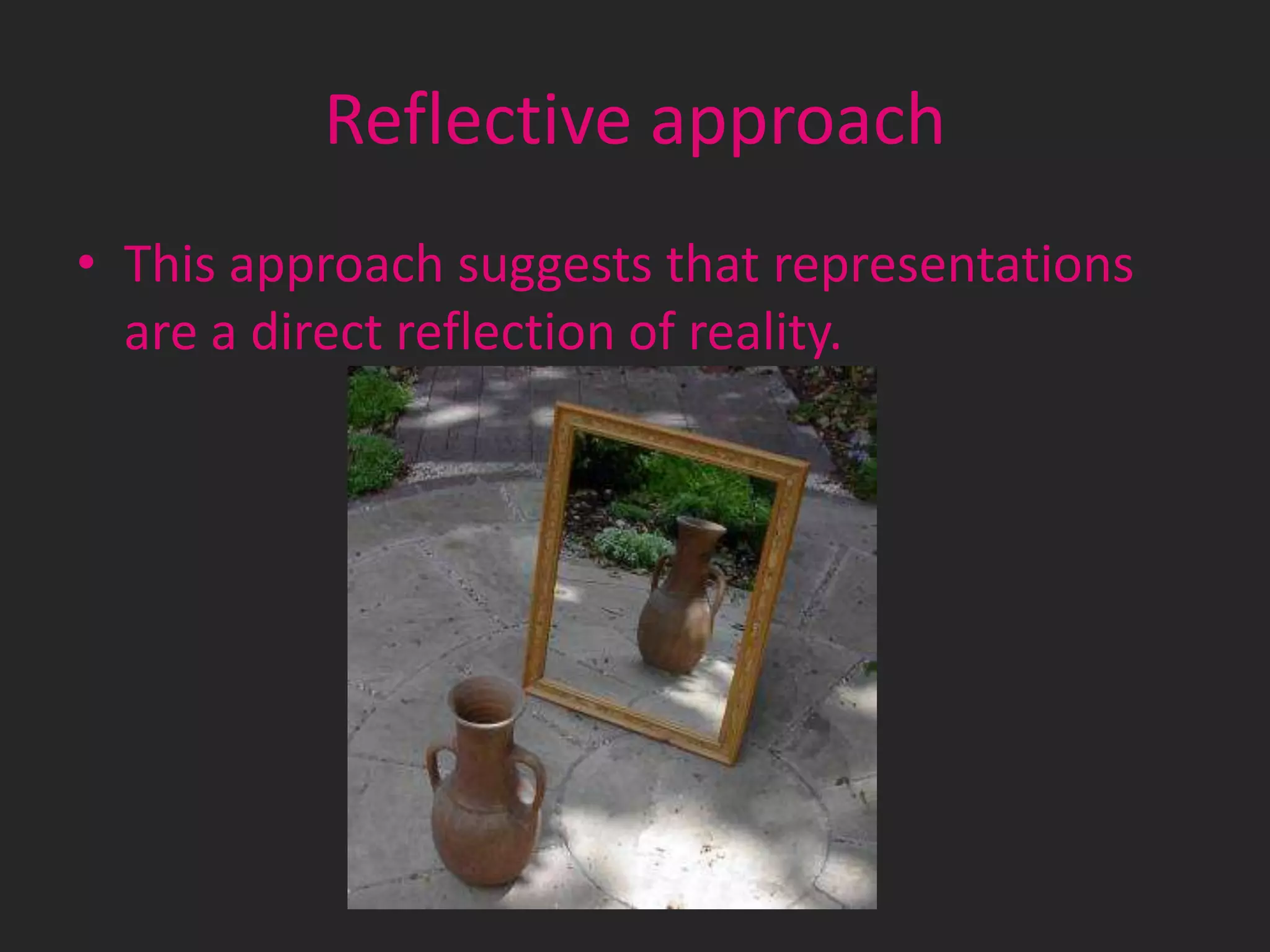
• This approach suggests that representations
are a direct reflection of reality.
Intentional Approach
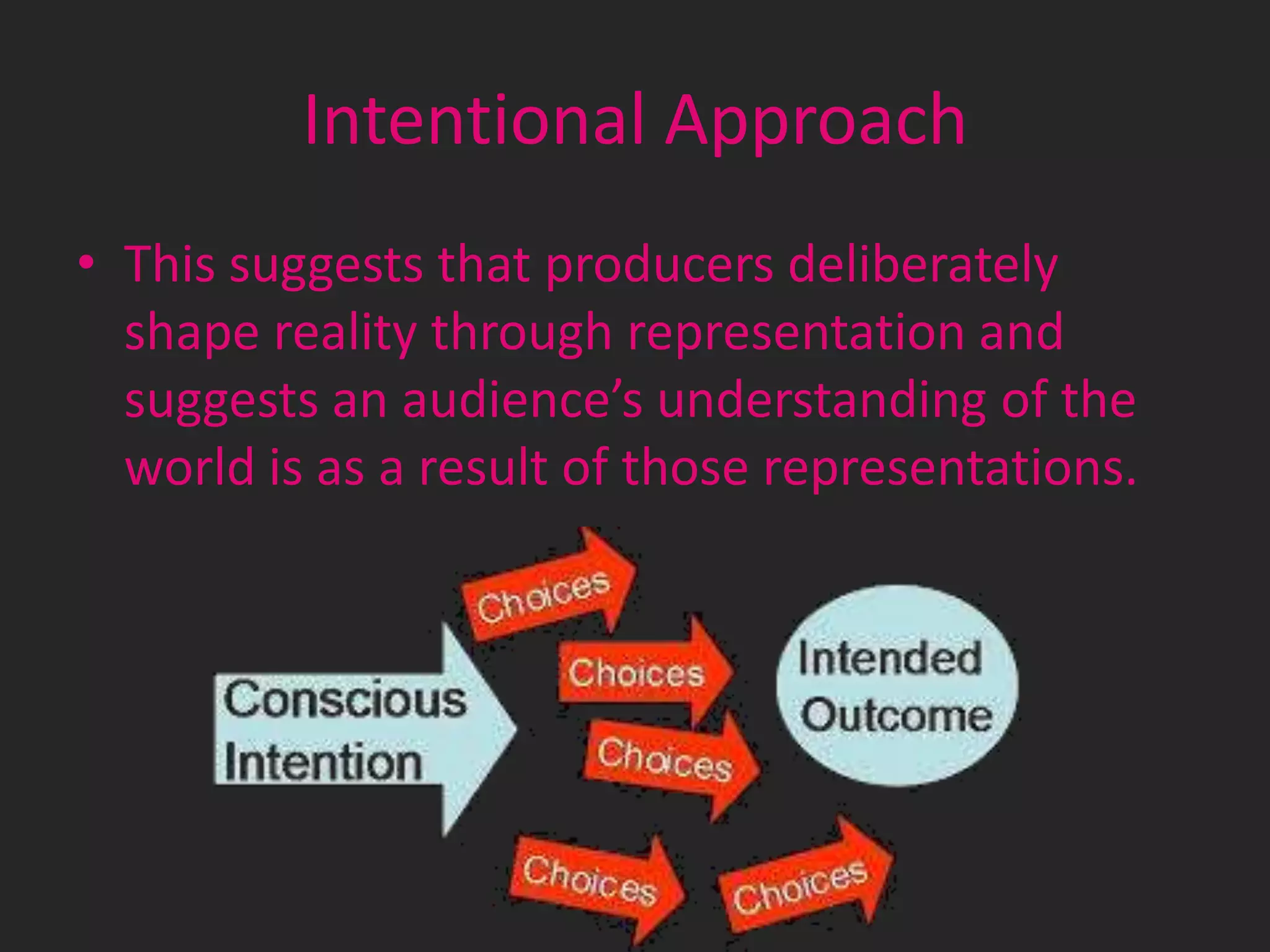
• This suggests that producers deliberately
shape reality through representation and
suggests an audience’s understanding of the
world is as a result of those representations.
Constructionist Approach
• This is a mixture! It
accepts that
representations
construct meaning, but
that this meaning is
understood through
reference to reality and
the audience’s own
ability to analyse, accept
and reject.
Constructionists believe:
• Representation is a mixture of:
– The actual thing being represented
– The values/attitudes and lifestyle (VALs) of the
people/institutions constructing the
representation
– The reaction of the individual member of the
audience (and their VALs)
– The context of the society in which the
representation is taking place
Ideology
• Media texts convey ideological messages:
• Ideology is a system of ideas, values and
beliefs promoted by dominant groups to
reinforce their power (e.g: governments, state
institutions, corporations).
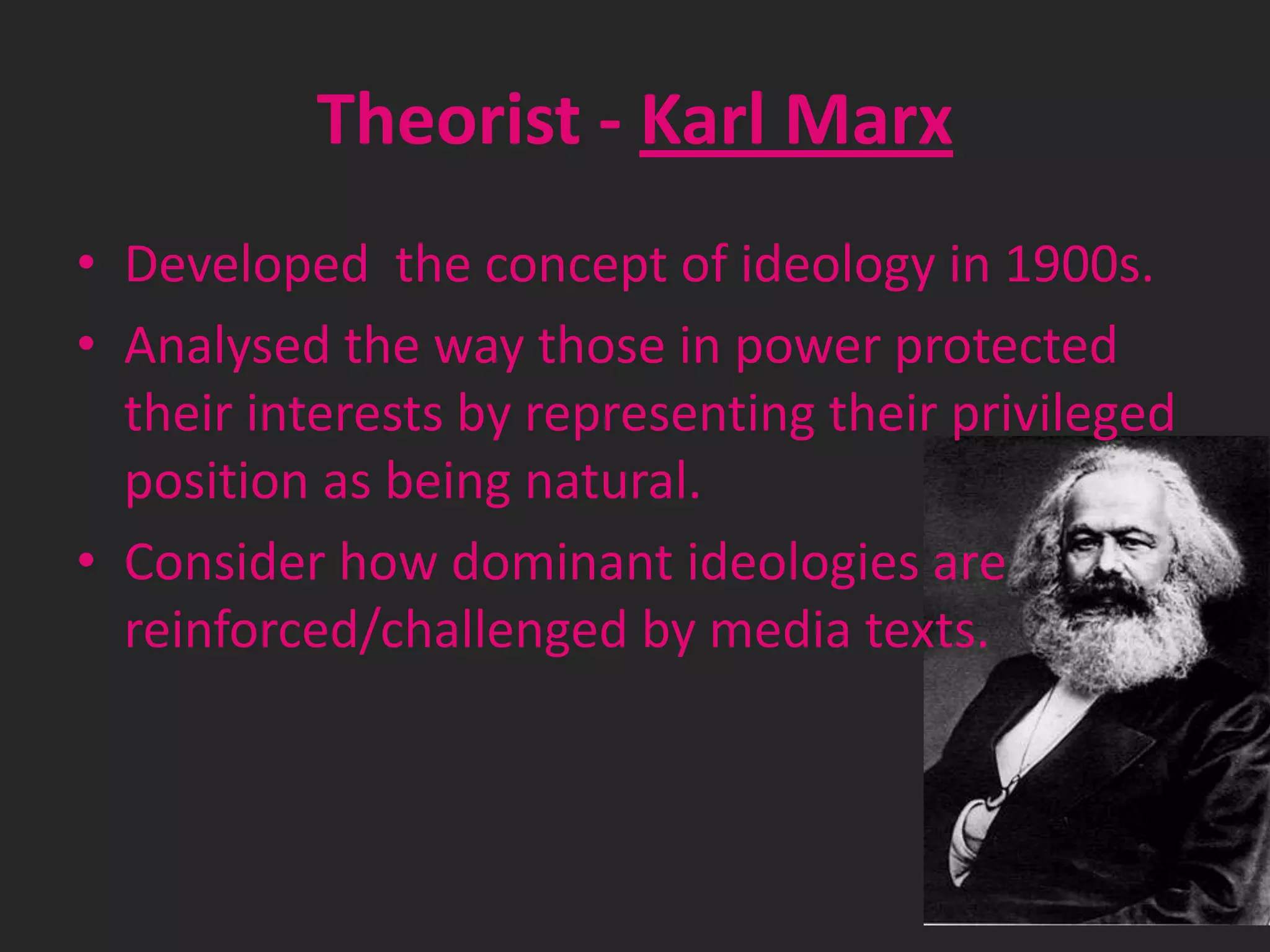
Theorist - Karl Marx
• Developed the concept of ideology in 1900s.
• Analysed the way those in power protected
their interests by representing their privileged
position as being natural.
• Consider how dominant ideologies are
reinforced/challenged by media texts.
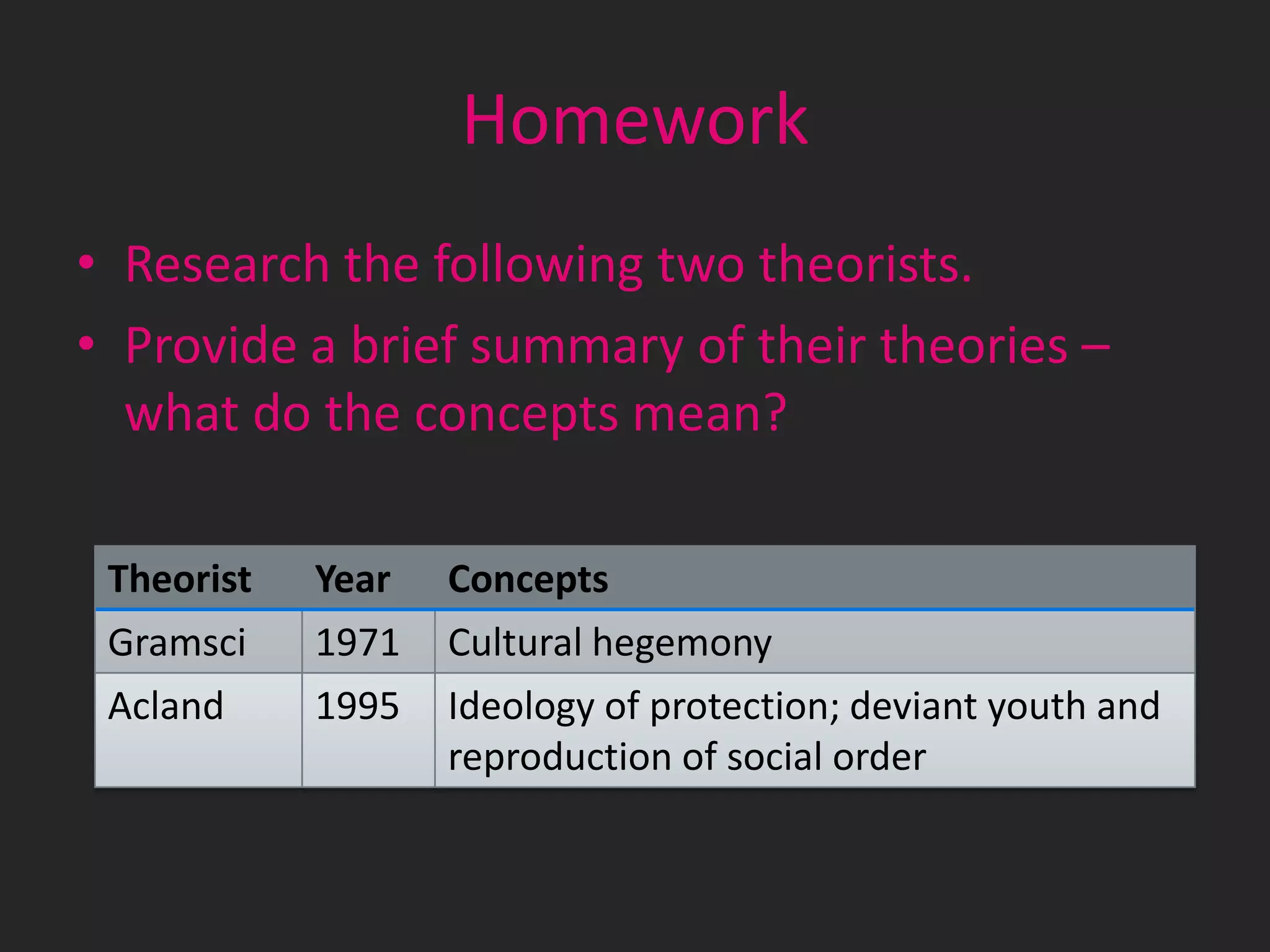
Homework
• Research the following two theorists.
• Provide a brief summary of their theories –
what do the concepts mean?
Theorist
Gramsci
Acland

Year
1971
1995

Concepts
Cultural hegemony
Ideology of protection; deviant youth and
reproduction of social order
Positive/negative representations
• If representations do affect the way in which
we think about particular groups, what does
that suggest about the media audience?
Your task
• In pairs, to research representation of age
from any medium on the next slide.
• Produce a presentation, including
images/footage: saved to the ‘Mac Shared’
Area.
• Make reference to semiotics (visual codes and
audio codes if appropriate).
The choices! Ooh!
•
•
•
•
•
•
•
•
•
•

Soaps
Adverts
Magazines
Films
News
Sitcoms
Cartoons
Comics
Reality TV
TV Drama
Representations of age
• What is the media (form and genre).
• How has the representation been constructed
(visual and audio codes)?
• What reasons are there for the representation?
• How might the representation affect audience?
• Who produced the representation?
• What approach do you think could apply to your
chosen example?
Your presentations!

AS Lesson 6 - 3 approaches

  • 2.
    Reflective approach • Thisapproach suggests that representations are a direct reflection of reality.
  • 3.
    Intentional Approach • Thissuggests that producers deliberately shape reality through representation and suggests an audience’s understanding of the world is as a result of those representations.
  • 4.
    Constructionist Approach • Thisis a mixture! It accepts that representations construct meaning, but that this meaning is understood through reference to reality and the audience’s own ability to analyse, accept and reject.
  • 5.
    Constructionists believe: • Representationis a mixture of: – The actual thing being represented – The values/attitudes and lifestyle (VALs) of the people/institutions constructing the representation – The reaction of the individual member of the audience (and their VALs) – The context of the society in which the representation is taking place
  • 6.
    Ideology • Media textsconvey ideological messages: • Ideology is a system of ideas, values and beliefs promoted by dominant groups to reinforce their power (e.g: governments, state institutions, corporations).
  • 7.
    Theorist - KarlMarx • Developed the concept of ideology in 1900s. • Analysed the way those in power protected their interests by representing their privileged position as being natural. • Consider how dominant ideologies are reinforced/challenged by media texts.
  • 8.
    Homework • Research thefollowing two theorists. • Provide a brief summary of their theories – what do the concepts mean? Theorist Gramsci Acland Year 1971 1995 Concepts Cultural hegemony Ideology of protection; deviant youth and reproduction of social order
  • 9.
    Positive/negative representations • Ifrepresentations do affect the way in which we think about particular groups, what does that suggest about the media audience?
  • 10.
    Your task • Inpairs, to research representation of age from any medium on the next slide. • Produce a presentation, including images/footage: saved to the ‘Mac Shared’ Area. • Make reference to semiotics (visual codes and audio codes if appropriate).
  • 11.
  • 12.
    Representations of age •What is the media (form and genre). • How has the representation been constructed (visual and audio codes)? • What reasons are there for the representation? • How might the representation affect audience? • Who produced the representation? • What approach do you think could apply to your chosen example?
  • 13.