Principles of Information Security,
Fifth Edition
Chapter 9
Physical Security
Lesson 2 – File Detection
and Response
Learning Objectives
• Upon completion of this material, you should be
able to:
– Discuss the relationship between information
security and physical security
– Describe key physical security considerations,
including fire control and surveillance systems
– Identify critical physical environment considerations
for computing facilities, including uninterruptible
power supplies
Principles of Information Security, Fifth Edition 2
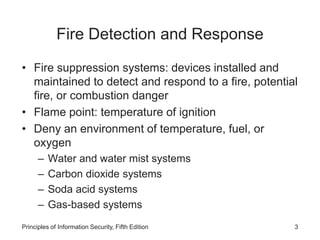
Fire Detection and Response
• Fire suppression systems: devices installed and
maintained to detect and respond to a fire, potential
fire, or combustion danger
• Flame point: temperature of ignition
• Deny an environment of temperature, fuel, or
oxygen
– Water and water mist systems
– Carbon dioxide systems
– Soda acid systems
– Gas-based systems
Principles of Information Security, Fifth Edition 3
Fire Detection and Response (cont’d)
• Fire detection
– Fire detection systems fall into two general
categories: manual and automatic
– To prevent an attacker slipping into offices during an
evacuation, programs often designate a person from
each office area to serve as a floor monitor.
– There are three basic types of fire detection
systems: thermal detection, smoke detection, flame
detection
Principles of Information Security, Fifth Edition 4
Fire Detection and Response (cont’d)
• Fire suppression
– Systems can consist of portable, manual, or
automatic apparatus.
– Portable extinguishers are rated by the type of fire:
Class A, Class B, Class C, Class D, Class K.
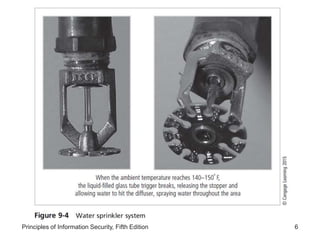
– Installed systems apply suppressive agents, usually
either sprinkler or gaseous systems.
Principles of Information Security, Fifth Edition 5
Principles of Information Security, Fifth Edition 6
Fire Detection and Response (cont’d)
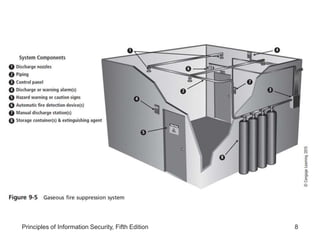
• Gaseous emission systems
– Until recently, two types of systems: carbon dioxide
and Halon
– Carbon dioxide removes fire’s oxygen supply.
– Halon is clean but has been classified as an ozone-
depleting substance; new installations are prohibited.
– Alternative clean agents presented in Table 9-1
(found on pages 484-485 in the text) are reported to
be less effective than Halon.
Principles of Information Security, Fifth Edition 7
Principles of Information Security, Fifth Edition 8
Failure of Supporting Utilities and
Structural Collapse
• Supporting utilities (heating, ventilation, and air
conditioning; power; water) have significant impact
on continued safe operation of a facility.
• Each utility must be properly managed to prevent
potential damage to information and information
systems.
Principles of Information Security, Fifth Edition 9
Heating, Ventilation, and Air
Conditioning
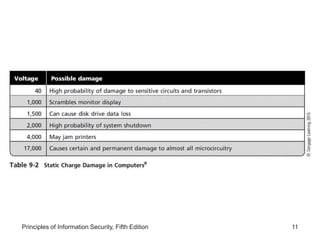
• Areas within heating, ventilation, and air
conditioning (HVAC) systems that can cause
damage to information systems include:
– Temperature
– Filtration
– Humidity
– Static electricity
Principles of Information Security, Fifth Edition 10
Principles of Information Security, Fifth Edition 11
Heating, Ventilation, and Air
Conditioning (cont’d)
• Ventilation shafts
– While ductwork is small in residential buildings, in
large commercial buildings it can be large enough
for an individual to climb through.
– If ducts are large, security can install wire mesh
grids at various points to compartmentalize the runs.
Principles of Information Security, Fifth Edition 12
Heating, Ventilation, and Air
Conditioning (cont’d)
• Power management and conditioning
– Power systems used by information-processing
equipment must be properly installed and correctly
grounded.
– Noise that interferes with the normal 60 Hertz cycle
can result in inaccurate time clocks or unreliable
internal clocks inside CPU.
Principles of Information Security, Fifth Edition 13
Heating, Ventilation, and Air
Conditioning (cont’d)
• Grounding and amperage
– Grounding ensures that returning flow of current is
properly discharged to ground
– GFCI: capable of quickly identifying and interrupting
a ground fault
– Overloading a circuit can create a load exceeding
electrical cable’s rating, increasing the risk of
overheating and fire.
Principles of Information Security, Fifth Edition 14
Heating, Ventilation, and Air
Conditioning (cont’d)
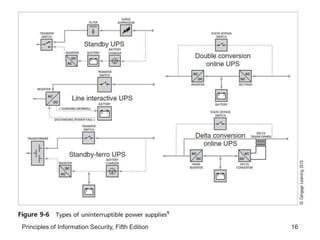
• Uninterruptible power supply (UPS)
– In case of power outage, UPS is the backup power
source for major computing systems.
– Basic UPS configurations:
• Standby
• Line-interactive
• Standby online hybrid
• Standby ferroresonant
• Double conversion online
• Data conversion online
Principles of Information Security, Fifth Edition 15
Principles of Information Security, Fifth Edition 16
Heating, Ventilation, and Air
Conditioning (cont’d)
• Emergency shutoff
– Important aspect of power management is the ability
to stop power immediately if the current represents a
risk to human or machine safety.
– Most computer rooms and wiring closets are
equipped with an emergency power shutoff.
Principles of Information Security, Fifth Edition 17
Water Problems
• Lack of water poses problem to systems, including
fire suppression and air-conditioning systems.
• Surplus of water, or water pressure, poses a real
threat (flooding, leaks).
• Very important to integrate water detection systems
into alarm systems that regulate overall facility
operations
Principles of Information Security, Fifth Edition 18
Structural Collapse
• Unavoidable environmental factors/forces can cause
failures in structures that house an organization.
• Structures are designed and constructed with
specific load limits; overloading these limits results
in structural failure and potential injury or loss of life.
• Periodic inspections by qualified civil engineers
assist in identifying potentially dangerous structural
conditions.
Principles of Information Security, Fifth Edition 19
Maintenance of Facility Systems
• Physical security must be constantly documented,
evaluated, and tested.
• Documentation of facility’s configuration, operation,
and function should be integrated into disaster
recovery plans and standard operating procedures.
• Testing helps improve the facility’s physical security
and identify weak points.
Principles of Information Security, Fifth Edition 20
Interception of Data
• Three methods of data interception:
– Direct observation
– Interception of data transmission
– Electromagnetic interception
• U.S. government developed TEMPEST program to
reduce the risk of electromagnetic radiation (EMR)
monitoring.
Principles of Information Security, Fifth Edition 21
Securing Mobile and Portable Systems
• Mobile computing requires more security than
typical computing infrastructures on the
organization’s premises.
• Many mobile computing systems
– Have corporate information stored within them
– Some are configured to facilitate user’s access into
organization’s secure computing facilities.
Principles of Information Security, Fifth Edition 22
Securing Mobile and Portable Systems
(cont’d)
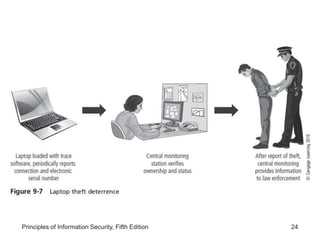
• Controls support security and retrieval of lost or
stolen laptops
– CompuTrace software, stored on laptop; reports to a
central monitoring center
– Burglar alarms are made up of a PC card that
contains a motion detector.
Principles of Information Security, Fifth Edition 23
Principles of Information Security, Fifth Edition 24
Remote Computing Security
• Remote site computing involves variety of
computing sites outside the organization’s main
facility.
• Telecommuting: off-site computing using Internet,
dial-up, or leased point-to-point links
• Employees may need to access networks on
business trips; telecommuters need access from
home systems or satellite offices.
• Telecommuter’s computers must be made more
secure than organization’s systems.
Principles of Information Security, Fifth Edition 25
Special Considerations for Physical
Security Threats
• Develop physical security in-house or outsource?
– Many qualified and professional agencies
– Benefit of outsourcing includes gaining experience
and knowledge of agencies.
– Downside includes high expense, loss of control
over individual components, and level of trust that
must be placed in another company.
• Social engineering: use of people skills to obtain
information from employees that should not be
released
Principles of Information Security, Fifth Edition 26
Inventory Management
• Computing equipment should be inventoried and
inspected on a regular basis.
• Classified information should also be inventoried
and managed.
• Physical security of computing equipment, data
storage media, and classified documents varies for
each organization.
Principles of Information Security, Fifth Edition 27
Summary
• Threats to information security that are unique to
physical security
• Key physical security considerations in a facility
site
• Physical security monitoring components
• Essential elements of access control
• Fire safety, fire detection, and response
• Importance of supporting utilities, especially use of
uninterruptible power supplies
• Countermeasures to physical theft of computing
devices
Principles of Information Security, Fifth Edition 28

Lesson 2

  • 1.
    Principles of InformationSecurity, Fifth Edition Chapter 9 Physical Security Lesson 2 – File Detection and Response
  • 2.
    Learning Objectives • Uponcompletion of this material, you should be able to: – Discuss the relationship between information security and physical security – Describe key physical security considerations, including fire control and surveillance systems – Identify critical physical environment considerations for computing facilities, including uninterruptible power supplies Principles of Information Security, Fifth Edition 2
  • 3.
    Fire Detection andResponse • Fire suppression systems: devices installed and maintained to detect and respond to a fire, potential fire, or combustion danger • Flame point: temperature of ignition • Deny an environment of temperature, fuel, or oxygen – Water and water mist systems – Carbon dioxide systems – Soda acid systems – Gas-based systems Principles of Information Security, Fifth Edition 3
  • 4.
    Fire Detection andResponse (cont’d) • Fire detection – Fire detection systems fall into two general categories: manual and automatic – To prevent an attacker slipping into offices during an evacuation, programs often designate a person from each office area to serve as a floor monitor. – There are three basic types of fire detection systems: thermal detection, smoke detection, flame detection Principles of Information Security, Fifth Edition 4
  • 5.
    Fire Detection andResponse (cont’d) • Fire suppression – Systems can consist of portable, manual, or automatic apparatus. – Portable extinguishers are rated by the type of fire: Class A, Class B, Class C, Class D, Class K. – Installed systems apply suppressive agents, usually either sprinkler or gaseous systems. Principles of Information Security, Fifth Edition 5
  • 6.
    Principles of InformationSecurity, Fifth Edition 6
  • 7.
    Fire Detection andResponse (cont’d) • Gaseous emission systems – Until recently, two types of systems: carbon dioxide and Halon – Carbon dioxide removes fire’s oxygen supply. – Halon is clean but has been classified as an ozone- depleting substance; new installations are prohibited. – Alternative clean agents presented in Table 9-1 (found on pages 484-485 in the text) are reported to be less effective than Halon. Principles of Information Security, Fifth Edition 7
  • 8.
    Principles of InformationSecurity, Fifth Edition 8
  • 9.
    Failure of SupportingUtilities and Structural Collapse • Supporting utilities (heating, ventilation, and air conditioning; power; water) have significant impact on continued safe operation of a facility. • Each utility must be properly managed to prevent potential damage to information and information systems. Principles of Information Security, Fifth Edition 9
  • 10.
    Heating, Ventilation, andAir Conditioning • Areas within heating, ventilation, and air conditioning (HVAC) systems that can cause damage to information systems include: – Temperature – Filtration – Humidity – Static electricity Principles of Information Security, Fifth Edition 10
  • 11.
    Principles of InformationSecurity, Fifth Edition 11
  • 12.
    Heating, Ventilation, andAir Conditioning (cont’d) • Ventilation shafts – While ductwork is small in residential buildings, in large commercial buildings it can be large enough for an individual to climb through. – If ducts are large, security can install wire mesh grids at various points to compartmentalize the runs. Principles of Information Security, Fifth Edition 12
  • 13.
    Heating, Ventilation, andAir Conditioning (cont’d) • Power management and conditioning – Power systems used by information-processing equipment must be properly installed and correctly grounded. – Noise that interferes with the normal 60 Hertz cycle can result in inaccurate time clocks or unreliable internal clocks inside CPU. Principles of Information Security, Fifth Edition 13
  • 14.
    Heating, Ventilation, andAir Conditioning (cont’d) • Grounding and amperage – Grounding ensures that returning flow of current is properly discharged to ground – GFCI: capable of quickly identifying and interrupting a ground fault – Overloading a circuit can create a load exceeding electrical cable’s rating, increasing the risk of overheating and fire. Principles of Information Security, Fifth Edition 14
  • 15.
    Heating, Ventilation, andAir Conditioning (cont’d) • Uninterruptible power supply (UPS) – In case of power outage, UPS is the backup power source for major computing systems. – Basic UPS configurations: • Standby • Line-interactive • Standby online hybrid • Standby ferroresonant • Double conversion online • Data conversion online Principles of Information Security, Fifth Edition 15
  • 16.
    Principles of InformationSecurity, Fifth Edition 16
  • 17.
    Heating, Ventilation, andAir Conditioning (cont’d) • Emergency shutoff – Important aspect of power management is the ability to stop power immediately if the current represents a risk to human or machine safety. – Most computer rooms and wiring closets are equipped with an emergency power shutoff. Principles of Information Security, Fifth Edition 17
  • 18.
    Water Problems • Lackof water poses problem to systems, including fire suppression and air-conditioning systems. • Surplus of water, or water pressure, poses a real threat (flooding, leaks). • Very important to integrate water detection systems into alarm systems that regulate overall facility operations Principles of Information Security, Fifth Edition 18
  • 19.
    Structural Collapse • Unavoidableenvironmental factors/forces can cause failures in structures that house an organization. • Structures are designed and constructed with specific load limits; overloading these limits results in structural failure and potential injury or loss of life. • Periodic inspections by qualified civil engineers assist in identifying potentially dangerous structural conditions. Principles of Information Security, Fifth Edition 19
  • 20.
    Maintenance of FacilitySystems • Physical security must be constantly documented, evaluated, and tested. • Documentation of facility’s configuration, operation, and function should be integrated into disaster recovery plans and standard operating procedures. • Testing helps improve the facility’s physical security and identify weak points. Principles of Information Security, Fifth Edition 20
  • 21.
    Interception of Data •Three methods of data interception: – Direct observation – Interception of data transmission – Electromagnetic interception • U.S. government developed TEMPEST program to reduce the risk of electromagnetic radiation (EMR) monitoring. Principles of Information Security, Fifth Edition 21
  • 22.
    Securing Mobile andPortable Systems • Mobile computing requires more security than typical computing infrastructures on the organization’s premises. • Many mobile computing systems – Have corporate information stored within them – Some are configured to facilitate user’s access into organization’s secure computing facilities. Principles of Information Security, Fifth Edition 22
  • 23.
    Securing Mobile andPortable Systems (cont’d) • Controls support security and retrieval of lost or stolen laptops – CompuTrace software, stored on laptop; reports to a central monitoring center – Burglar alarms are made up of a PC card that contains a motion detector. Principles of Information Security, Fifth Edition 23
  • 24.
    Principles of InformationSecurity, Fifth Edition 24
  • 25.
    Remote Computing Security •Remote site computing involves variety of computing sites outside the organization’s main facility. • Telecommuting: off-site computing using Internet, dial-up, or leased point-to-point links • Employees may need to access networks on business trips; telecommuters need access from home systems or satellite offices. • Telecommuter’s computers must be made more secure than organization’s systems. Principles of Information Security, Fifth Edition 25
  • 26.
    Special Considerations forPhysical Security Threats • Develop physical security in-house or outsource? – Many qualified and professional agencies – Benefit of outsourcing includes gaining experience and knowledge of agencies. – Downside includes high expense, loss of control over individual components, and level of trust that must be placed in another company. • Social engineering: use of people skills to obtain information from employees that should not be released Principles of Information Security, Fifth Edition 26
  • 27.
    Inventory Management • Computingequipment should be inventoried and inspected on a regular basis. • Classified information should also be inventoried and managed. • Physical security of computing equipment, data storage media, and classified documents varies for each organization. Principles of Information Security, Fifth Edition 27
  • 28.
    Summary • Threats toinformation security that are unique to physical security • Key physical security considerations in a facility site • Physical security monitoring components • Essential elements of access control • Fire safety, fire detection, and response • Importance of supporting utilities, especially use of uninterruptible power supplies • Countermeasures to physical theft of computing devices Principles of Information Security, Fifth Edition 28