Principles of Information Security, 3rd Edition 2
Introduction
 Physical security addresses the design, implementation,
and maintenance of countermeasures that protect physical
resources of an organization
 Most controls can be circumvented if an attacker gains
physical access
 Physical security is as important as logical security
Principles of Information Security, 3rd Edition 3
Introduction (continued)
 Seven major sources of physical loss:
 Extreme temperature
 Gases
 Liquids
 Living organisms
 Projectiles
 Movement
 Energy anomalies
Principles of Information Security, 3rd Edition 4
Introduction (continued)
 Community roles
 General management: responsible for facility security
 IT management and professionals: responsible for
environmental and access security
 Information security management and professionals:
perform risk assessments and implementation reviews
 Secure facility: physical location engineered with controls
designed to minimize risk of attacks from physical threats
Principles of Information Security, 3rd Edition 5
Physical Security Controls
 Walls, fencing, and gates
 Guards
 Dogs
 ID cards and badges
 Locks and keys
 Mantraps
 Electronic monitoring
 Alarms and alarm systems
 Computer rooms and wiring closets
 Interior walls and doors
Principles of Information Security, 3rd Edition 6
ID Cards and Badges
 Ties physical security with information access control
 ID card is typically concealed
 Name badge is visible
 Serve as simple form of biometrics (facial recognition)
 Should not be only means of control as cards can be easily
duplicated, stolen, and modified
 Tailgating occurs when unauthorized individual follows
authorized user through the control
Principles of Information Security, 3rd Edition 7
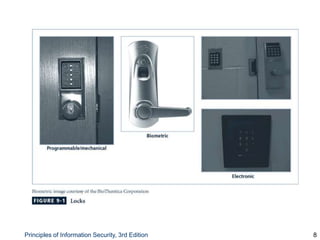
Locks and Keys
 Locks can also be divided into four categories: manual,
programmable, electronic, biometric
 Locks fail and alternative procedures for controlling access
must be put in place
 Locks fail in one of two ways:
 Fail-safe lock
 Fail-secure lock
Principles of Information Security, 3rd Edition 8
Figure 9-1
Principles of Information Security, 3rd Edition 9
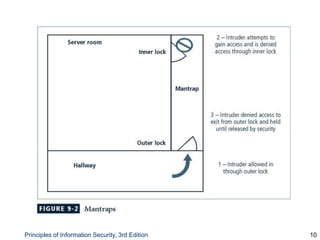
Mantrap
 Small enclosure that has entry point and different exit point
 Individual enters mantrap, requests access, and if verified,
is allowed to exit mantrap into facility
 Individual denied entry is not allowed to exit until security
official overrides automatic locks of the enclosure
Principles of Information Security, 3rd Edition 10
Figure 9-2 Mantraps
Principles of Information Security, 3rd Edition 11
Electronic Monitoring
 Records events where other types of physical controls are
impractical or incomplete
 May use cameras with video recorders; includes closed-
circuit television (CCT) systems
 Drawbacks
 Reactive; does not prevent access or prohibited activity
 Recordings often are not monitored in real time; must be
reviewed to have any value
Principles of Information Security, 3rd Edition 12
Alarms and Alarm Systems
 Alarm systems notify when an event occurs
 Detect fire, intrusion, environmental disturbance, or an
interruption in services
 Rely on sensors that detect event; e.g., motion detectors,
smoke detectors, thermal detectors, glass breakage
detectors, weight sensors, contact sensors, vibration
sensors
Principles of Information Security, 3rd Edition 13
Computer Rooms and Wiring Closets
 Require special attention to ensure confidentiality, integrity,
and availability of information
 Logical controls easily defeated if attacker gains physical
access to computing equipment
 Custodial staff often the least scrutinized persons who
have access to offices; are given greatest degree of
unsupervised access
Principles of Information Security, 3rd Edition 14
Interior Walls and Doors
 Information asset security sometimes compromised by
construction of facility walls and doors
 Facility walls typically either standard interior or firewall
 High-security areas must have firewall-grade walls to
provide physical security from potential intruders and
improve resistance to fires
 Doors allowing access to high security rooms should be
evaluated
 Recommended that push or crash bars be installed on
computer rooms and closets
Principles of Information Security, 3rd Edition 15
Fire Security and Safety
 Most serious threat to safety of people who work in an
organization is possibility of fire
 Fires account for more property damage, personal injury,
and death than any other threat
 Imperative that physical security plans examine and
implement strong measures to detect and respond to fires
Principles of Information Security, 3rd Edition 16
Fire Detection
 Fire detection systems fall into two general categories:
manual and automatic
 Part of a complete fire safety program includes individuals
that monitor chaos of fire evacuation to prevent an attacker
accessing offices
 There are three basic types of fire detection systems:
thermal detection, smoke detection, flame detection
Principles of Information Security, 3rd Edition 17
Fire Suppression
 Fire suppression systems: devices installed and maintained to
detect and respond to a fire
 Deny an environment of heat, fuel, or oxygen
 Systems consist of portable, manual, or automatic apparatus
 Portable extinguishers are rated by the type of fire: Class A, Class B,
Class C, Class D
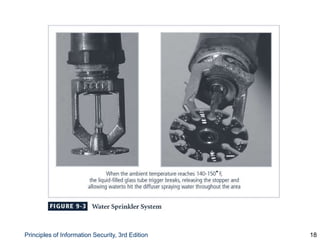
 Installed systems apply suppressive agents; usually either sprinkler
or gaseous systems
Principles of Information Security, 3rd Edition 18
Figure 9-3 Water Sprinkler System
Principles of Information Security, 3rd Edition 19
Gaseous Emission Systems
 Until recently, two types of systems: carbon dioxide
and Halon
 Carbon dioxide robs a fire of oxygen supply
 Halon is clean but has been classified as an ozone-
depleting substance; new installations are prohibited
 Alternative clean agents include FM-200, Inergen, carbon
dioxide, FE-13 (trifluromethane)
Principles of Information Security, 3rd Edition 20
Failure of Supporting Utilities and
Structural Collapse
 Supporting utilities (heating, ventilation, and air
conditioning; power; water; and others) have significant
impact on continued safe operation of a facility
 Each utility must be properly managed to prevent potential
damage to information and information systems
Principles of Information Security, 3rd Edition 21
Heating, Ventilation, and Air Conditioning
 Areas within heating, ventilation, and air conditioning
(HVAC) systems that can cause damage to information
systems include:
 Temperature
 Filtration
 Humidity
 Static electricity
Principles of Information Security, 3rd Edition 22
Ventilation Shafts
 While ductwork is small in residential buildings, in large
commercial buildings it can be large enough for an
individual to climb though
 If vents are large, security can install wire mesh grids at
various points to compartmentalize the runs
Principles of Information Security, 3rd Edition 23
Power Management and Conditioning
 Electrical quantity (voltage level, amperage rating) is a
concern, as is quality of power (cleanliness, proper
installation)
 Noise that interferes with the normal 60 Hertz cycle can
result in inaccurate time clocks or unreliable internal clocks
inside CPU
 Grounding ensures that returning flow of current is properly
discharged to ground
 Overloading a circuit causes problems with circuit tripping
and can overload electrical cable, increasing risk of fire
Principles of Information Security, 3rd Edition 24
Uninterruptible Power Supply (UPS)
 In case of power outage, UPS is backup power source for
major computer systems
 Four basic UPS configurations:
 Standby
 Ferroresonant standby
 Line-interactive
 True online (double conversion online)
Principles of Information Security, 3rd Edition 25
Emergency Shutoff
 Important aspect of power management is the need to be
able to stop power immediately should a current represent
a risk to human or machine safety
 Most computer rooms and wiring closets are equipped with
an emergency power shutoff
Principles of Information Security, 3rd Edition 26
Water Problems
 Lack of water poses problem to systems, including
functionality of fire suppression systems and ability of
water chillers to provide air-conditioning
 Surplus of water, or water pressure, poses a real threat
(flooding, leaks)
 Very important to integrate water detection systems into
alarm systems that regulate overall facilities operations
Principles of Information Security, 3rd Edition 27
Structural Collapse
 Unavoidable forces can cause failures of structures that
house organization
 Structures designed and constructed with specific load
limits; overloading these limits results in structural failure
and potential injury or loss of life
 Periodic inspections by qualified civil engineers assist in
identifying potentially dangerous structural conditions
Principles of Information Security, 3rd Edition 28
Maintenance of Facility Systems
 Physical security must be constantly documented,
evaluated, and tested
 Documentation of facility’s configuration, operation, and
function should be integrated into disaster recovery plans
and operating procedures
 Testing helps improve the facility’s physical security and
identify weak points
Principles of Information Security, 3rd Edition 29
Interception of Data
 Three methods of data interception:
 Direct observation
 Interception of data transmission
 Electromagnetic interception
 U.S. government developed TEMPEST program to reduce
risk of electromagnetic radiation (EMR) monitoring
Principles of Information Security, 3rd Edition 30
Mobile and Portable Systems
 With the increased threat to information security for
laptops, handhelds, and PDAs, mobile computing requires
more security than average in-house system
 Many mobile computing systems have corporate
information stored within them; some are configured to
facilitate user’s access into organization’s secure
computing facilities
Principles of Information Security, 3rd Edition 31
Mobile and Portable Systems (continued)
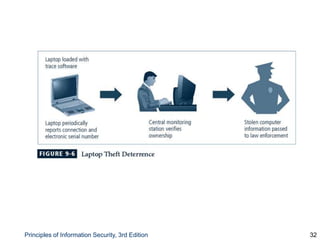
 Controls support security and retrieval of lost or stolen
laptops
 CompuTrace software, stored on laptop; reports to a central
monitoring center
 Burglar alarms made up of a PC card that contains a motion
detector
Principles of Information Security, 3rd Edition 32
Figure 9-6 Laptop Theft Deterrence
Principles of Information Security, 3rd Edition 33
Remote Computing Security
 Remote site computing: away from organizational facility
 Telecommuting: computing using telecommunications
including Internet, dial-up, or leased point-to-point links
 Employees may need to access networks on business
trips; telecommuters need access from home systems or
satellite offices
 To provide secure extension of organization’s internal
networks, all external connections and systems must be
secured
Principles of Information Security, 3rd Edition 34
Special Considerations for Physical
Security Threats
 Develop physical security in-house or outsource?
 Many qualified and professional agencies
 Benefit of outsourcing includes gaining experience and
knowledge of agencies
 Downside includes high expense, loss of control over
individual components, and level of trust that must be
placed in another company

Chapter 9 (1).ppt

  • 2.
    Principles of InformationSecurity, 3rd Edition 2 Introduction  Physical security addresses the design, implementation, and maintenance of countermeasures that protect physical resources of an organization  Most controls can be circumvented if an attacker gains physical access  Physical security is as important as logical security
  • 3.
    Principles of InformationSecurity, 3rd Edition 3 Introduction (continued)  Seven major sources of physical loss:  Extreme temperature  Gases  Liquids  Living organisms  Projectiles  Movement  Energy anomalies
  • 4.
    Principles of InformationSecurity, 3rd Edition 4 Introduction (continued)  Community roles  General management: responsible for facility security  IT management and professionals: responsible for environmental and access security  Information security management and professionals: perform risk assessments and implementation reviews  Secure facility: physical location engineered with controls designed to minimize risk of attacks from physical threats
  • 5.
    Principles of InformationSecurity, 3rd Edition 5 Physical Security Controls  Walls, fencing, and gates  Guards  Dogs  ID cards and badges  Locks and keys  Mantraps  Electronic monitoring  Alarms and alarm systems  Computer rooms and wiring closets  Interior walls and doors
  • 6.
    Principles of InformationSecurity, 3rd Edition 6 ID Cards and Badges  Ties physical security with information access control  ID card is typically concealed  Name badge is visible  Serve as simple form of biometrics (facial recognition)  Should not be only means of control as cards can be easily duplicated, stolen, and modified  Tailgating occurs when unauthorized individual follows authorized user through the control
  • 7.
    Principles of InformationSecurity, 3rd Edition 7 Locks and Keys  Locks can also be divided into four categories: manual, programmable, electronic, biometric  Locks fail and alternative procedures for controlling access must be put in place  Locks fail in one of two ways:  Fail-safe lock  Fail-secure lock
  • 8.
    Principles of InformationSecurity, 3rd Edition 8 Figure 9-1
  • 9.
    Principles of InformationSecurity, 3rd Edition 9 Mantrap  Small enclosure that has entry point and different exit point  Individual enters mantrap, requests access, and if verified, is allowed to exit mantrap into facility  Individual denied entry is not allowed to exit until security official overrides automatic locks of the enclosure
  • 10.
    Principles of InformationSecurity, 3rd Edition 10 Figure 9-2 Mantraps
  • 11.
    Principles of InformationSecurity, 3rd Edition 11 Electronic Monitoring  Records events where other types of physical controls are impractical or incomplete  May use cameras with video recorders; includes closed- circuit television (CCT) systems  Drawbacks  Reactive; does not prevent access or prohibited activity  Recordings often are not monitored in real time; must be reviewed to have any value
  • 12.
    Principles of InformationSecurity, 3rd Edition 12 Alarms and Alarm Systems  Alarm systems notify when an event occurs  Detect fire, intrusion, environmental disturbance, or an interruption in services  Rely on sensors that detect event; e.g., motion detectors, smoke detectors, thermal detectors, glass breakage detectors, weight sensors, contact sensors, vibration sensors
  • 13.
    Principles of InformationSecurity, 3rd Edition 13 Computer Rooms and Wiring Closets  Require special attention to ensure confidentiality, integrity, and availability of information  Logical controls easily defeated if attacker gains physical access to computing equipment  Custodial staff often the least scrutinized persons who have access to offices; are given greatest degree of unsupervised access
  • 14.
    Principles of InformationSecurity, 3rd Edition 14 Interior Walls and Doors  Information asset security sometimes compromised by construction of facility walls and doors  Facility walls typically either standard interior or firewall  High-security areas must have firewall-grade walls to provide physical security from potential intruders and improve resistance to fires  Doors allowing access to high security rooms should be evaluated  Recommended that push or crash bars be installed on computer rooms and closets
  • 15.
    Principles of InformationSecurity, 3rd Edition 15 Fire Security and Safety  Most serious threat to safety of people who work in an organization is possibility of fire  Fires account for more property damage, personal injury, and death than any other threat  Imperative that physical security plans examine and implement strong measures to detect and respond to fires
  • 16.
    Principles of InformationSecurity, 3rd Edition 16 Fire Detection  Fire detection systems fall into two general categories: manual and automatic  Part of a complete fire safety program includes individuals that monitor chaos of fire evacuation to prevent an attacker accessing offices  There are three basic types of fire detection systems: thermal detection, smoke detection, flame detection
  • 17.
    Principles of InformationSecurity, 3rd Edition 17 Fire Suppression  Fire suppression systems: devices installed and maintained to detect and respond to a fire  Deny an environment of heat, fuel, or oxygen  Systems consist of portable, manual, or automatic apparatus  Portable extinguishers are rated by the type of fire: Class A, Class B, Class C, Class D  Installed systems apply suppressive agents; usually either sprinkler or gaseous systems
  • 18.
    Principles of InformationSecurity, 3rd Edition 18 Figure 9-3 Water Sprinkler System
  • 19.
    Principles of InformationSecurity, 3rd Edition 19 Gaseous Emission Systems  Until recently, two types of systems: carbon dioxide and Halon  Carbon dioxide robs a fire of oxygen supply  Halon is clean but has been classified as an ozone- depleting substance; new installations are prohibited  Alternative clean agents include FM-200, Inergen, carbon dioxide, FE-13 (trifluromethane)
  • 20.
    Principles of InformationSecurity, 3rd Edition 20 Failure of Supporting Utilities and Structural Collapse  Supporting utilities (heating, ventilation, and air conditioning; power; water; and others) have significant impact on continued safe operation of a facility  Each utility must be properly managed to prevent potential damage to information and information systems
  • 21.
    Principles of InformationSecurity, 3rd Edition 21 Heating, Ventilation, and Air Conditioning  Areas within heating, ventilation, and air conditioning (HVAC) systems that can cause damage to information systems include:  Temperature  Filtration  Humidity  Static electricity
  • 22.
    Principles of InformationSecurity, 3rd Edition 22 Ventilation Shafts  While ductwork is small in residential buildings, in large commercial buildings it can be large enough for an individual to climb though  If vents are large, security can install wire mesh grids at various points to compartmentalize the runs
  • 23.
    Principles of InformationSecurity, 3rd Edition 23 Power Management and Conditioning  Electrical quantity (voltage level, amperage rating) is a concern, as is quality of power (cleanliness, proper installation)  Noise that interferes with the normal 60 Hertz cycle can result in inaccurate time clocks or unreliable internal clocks inside CPU  Grounding ensures that returning flow of current is properly discharged to ground  Overloading a circuit causes problems with circuit tripping and can overload electrical cable, increasing risk of fire
  • 24.
    Principles of InformationSecurity, 3rd Edition 24 Uninterruptible Power Supply (UPS)  In case of power outage, UPS is backup power source for major computer systems  Four basic UPS configurations:  Standby  Ferroresonant standby  Line-interactive  True online (double conversion online)
  • 25.
    Principles of InformationSecurity, 3rd Edition 25 Emergency Shutoff  Important aspect of power management is the need to be able to stop power immediately should a current represent a risk to human or machine safety  Most computer rooms and wiring closets are equipped with an emergency power shutoff
  • 26.
    Principles of InformationSecurity, 3rd Edition 26 Water Problems  Lack of water poses problem to systems, including functionality of fire suppression systems and ability of water chillers to provide air-conditioning  Surplus of water, or water pressure, poses a real threat (flooding, leaks)  Very important to integrate water detection systems into alarm systems that regulate overall facilities operations
  • 27.
    Principles of InformationSecurity, 3rd Edition 27 Structural Collapse  Unavoidable forces can cause failures of structures that house organization  Structures designed and constructed with specific load limits; overloading these limits results in structural failure and potential injury or loss of life  Periodic inspections by qualified civil engineers assist in identifying potentially dangerous structural conditions
  • 28.
    Principles of InformationSecurity, 3rd Edition 28 Maintenance of Facility Systems  Physical security must be constantly documented, evaluated, and tested  Documentation of facility’s configuration, operation, and function should be integrated into disaster recovery plans and operating procedures  Testing helps improve the facility’s physical security and identify weak points
  • 29.
    Principles of InformationSecurity, 3rd Edition 29 Interception of Data  Three methods of data interception:  Direct observation  Interception of data transmission  Electromagnetic interception  U.S. government developed TEMPEST program to reduce risk of electromagnetic radiation (EMR) monitoring
  • 30.
    Principles of InformationSecurity, 3rd Edition 30 Mobile and Portable Systems  With the increased threat to information security for laptops, handhelds, and PDAs, mobile computing requires more security than average in-house system  Many mobile computing systems have corporate information stored within them; some are configured to facilitate user’s access into organization’s secure computing facilities
  • 31.
    Principles of InformationSecurity, 3rd Edition 31 Mobile and Portable Systems (continued)  Controls support security and retrieval of lost or stolen laptops  CompuTrace software, stored on laptop; reports to a central monitoring center  Burglar alarms made up of a PC card that contains a motion detector
  • 32.
    Principles of InformationSecurity, 3rd Edition 32 Figure 9-6 Laptop Theft Deterrence
  • 33.
    Principles of InformationSecurity, 3rd Edition 33 Remote Computing Security  Remote site computing: away from organizational facility  Telecommuting: computing using telecommunications including Internet, dial-up, or leased point-to-point links  Employees may need to access networks on business trips; telecommuters need access from home systems or satellite offices  To provide secure extension of organization’s internal networks, all external connections and systems must be secured
  • 34.
    Principles of InformationSecurity, 3rd Edition 34 Special Considerations for Physical Security Threats  Develop physical security in-house or outsource?  Many qualified and professional agencies  Benefit of outsourcing includes gaining experience and knowledge of agencies  Downside includes high expense, loss of control over individual components, and level of trust that must be placed in another company