Information and Network Security 10IS835
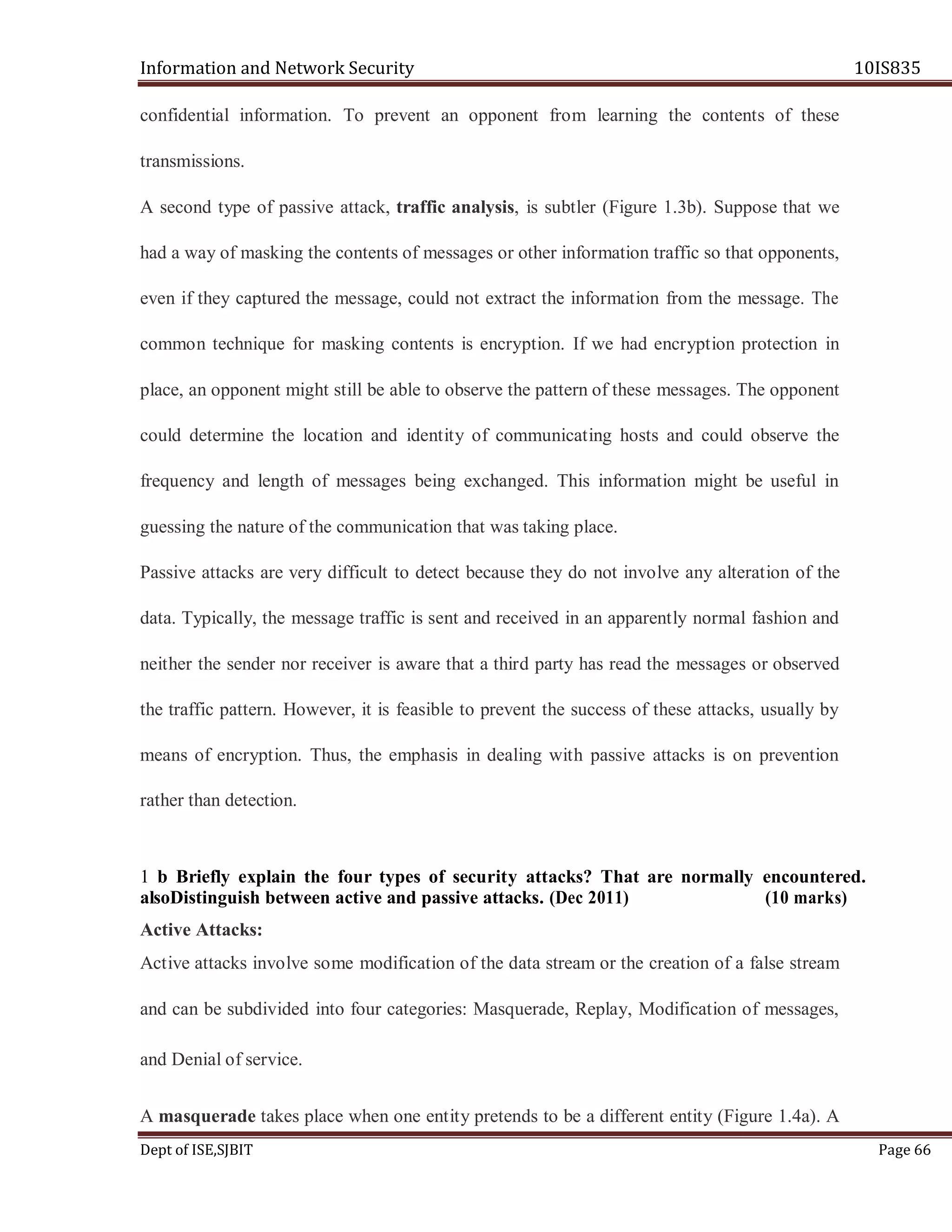
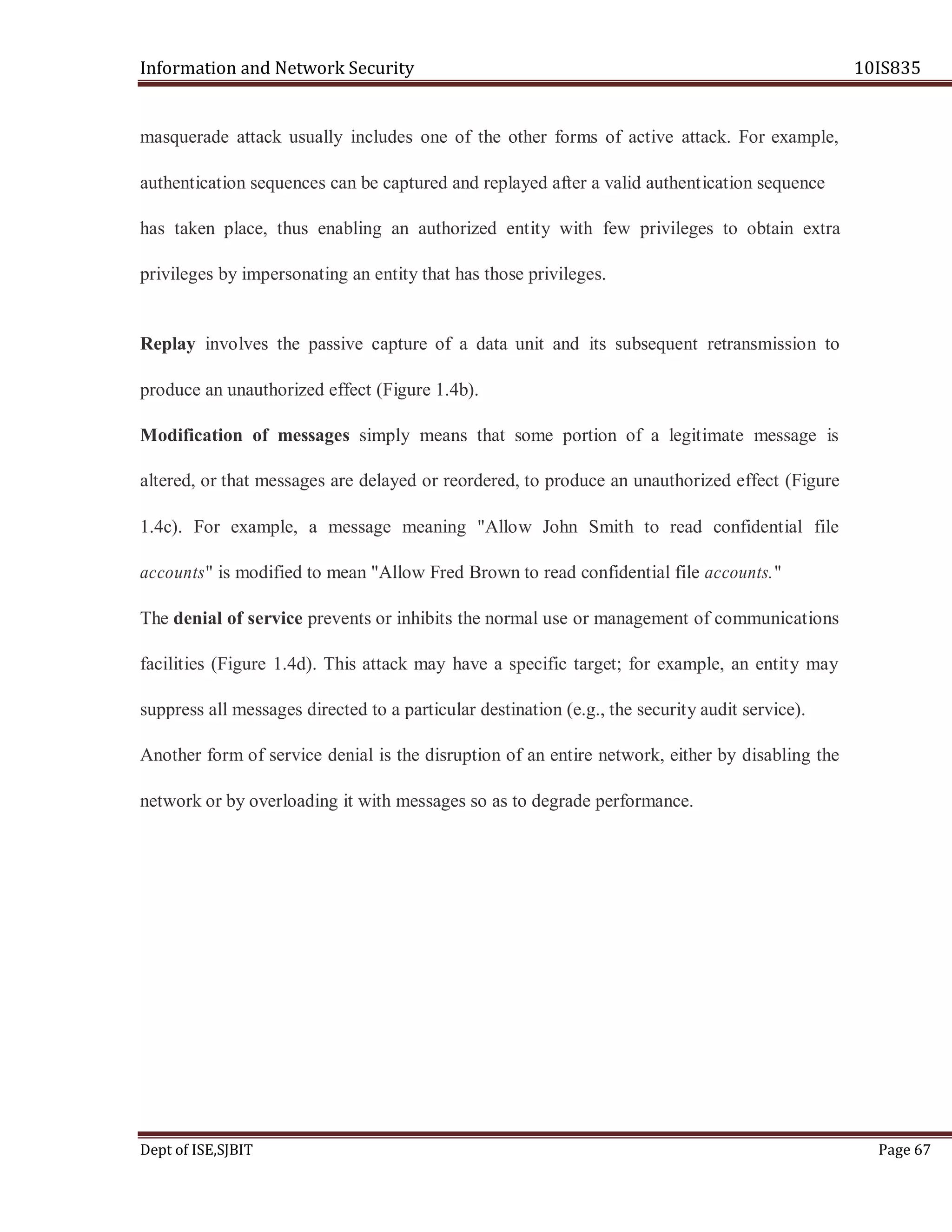
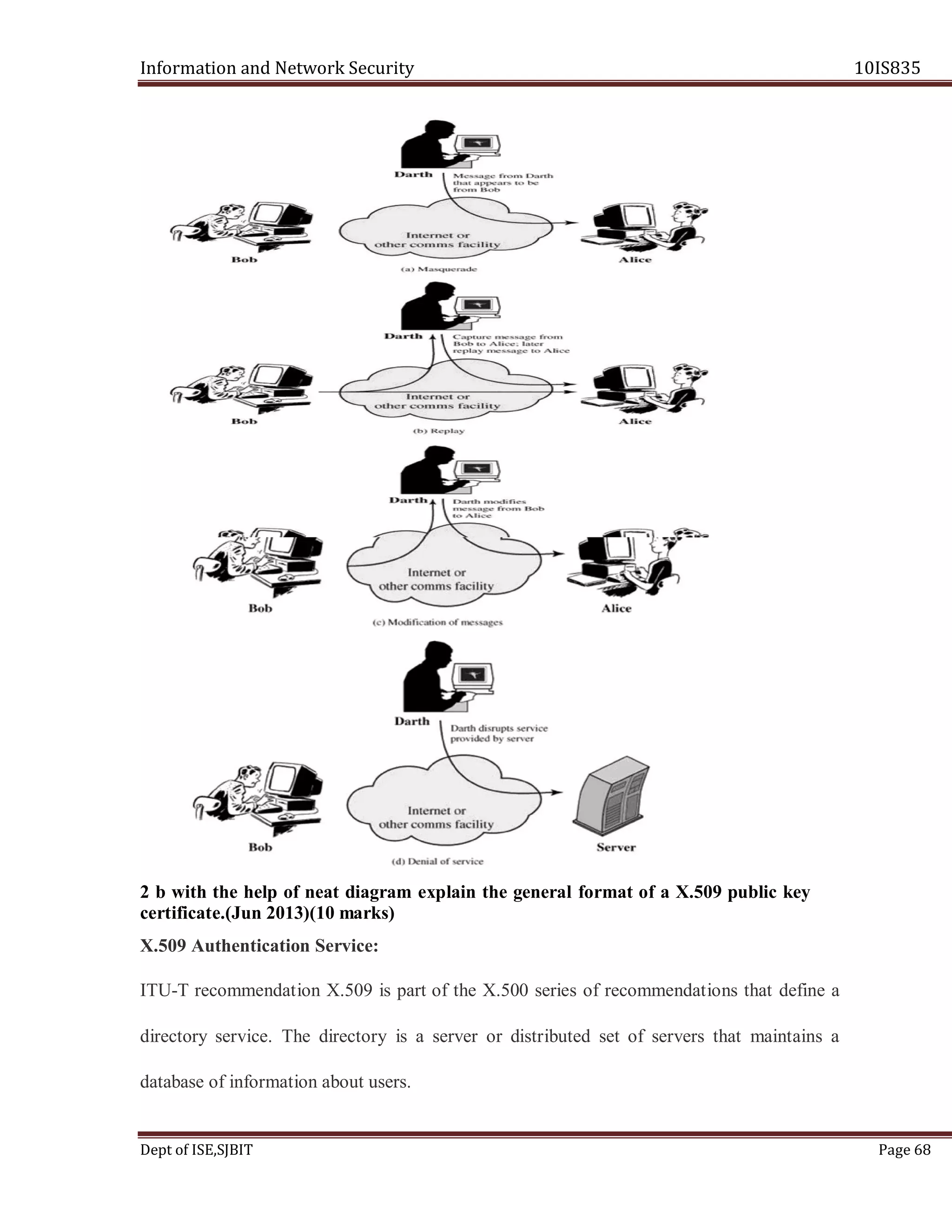
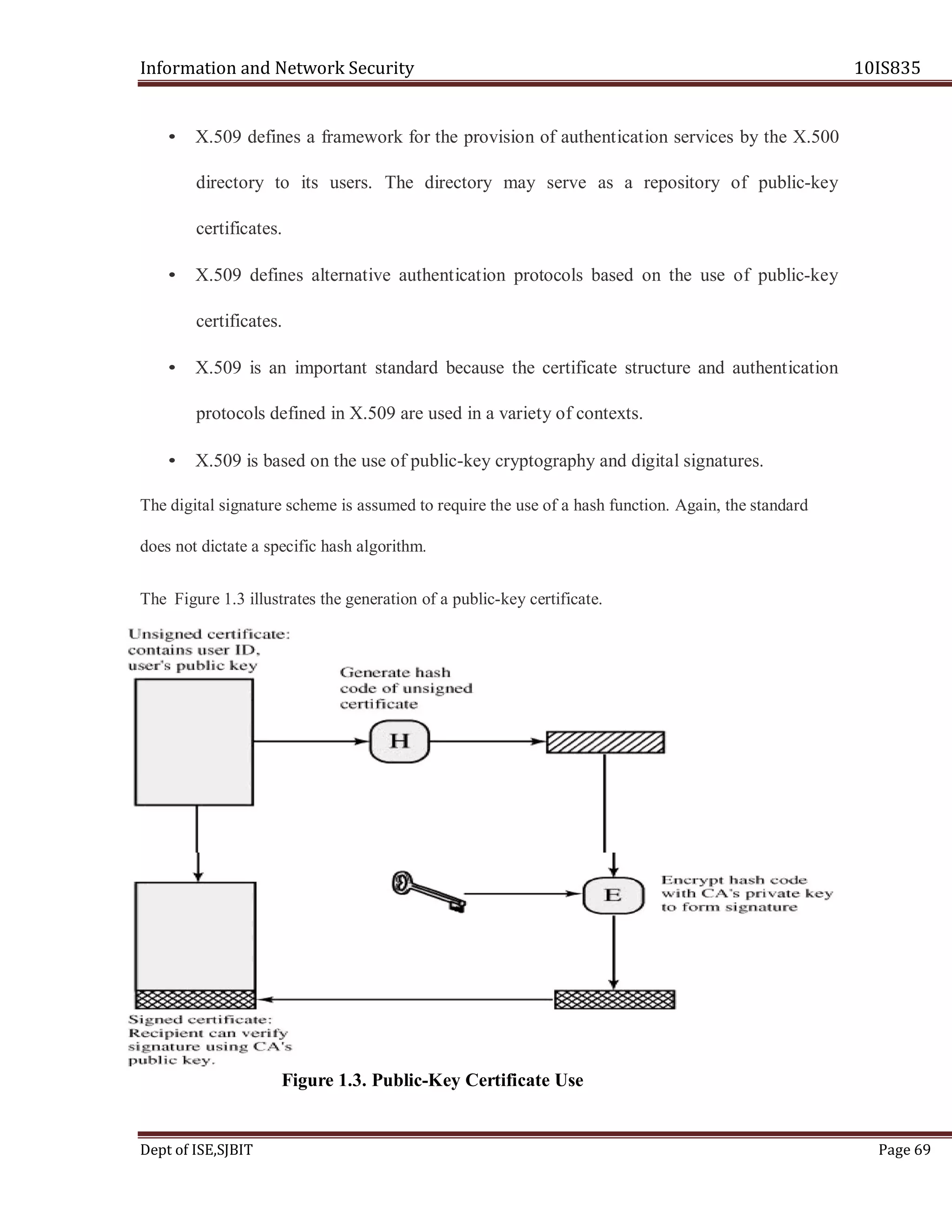
Dept of ISE,SJBIT Page 1
VTU QUESTION PAPER SOLUTION
PART A
UNIT 1
Planning for Security
1 a Discuss the system specific security policy .How managerial guidelines and technical
specification can be used in SysSP? (Dec 2011,Jun 2013)
Systems-Specific Policy (SysSP)
While issue-specific policies are formalized as written documents, distributed to sers, and
agreed to in writing, SysSPs are frequently codified as standards and procedures to be used
When configuring or maintaining systems
Systems-specific policies fall into two groups:
– Access control lists (ACLs) consist of the access control lists, matrices, and
capability tables governing the rights and privileges of a particular user to a
particular system. An ACL is a list of access rights used by file storage systems, object
brokers, or other network communications devices to determine which individuals or
groups may access an object that it controls.(Object Brokers are system components that
handle message requests between the software components of a system)
– A similar list, which is also associated with users and groups, is called a Capability
This specifies which subjects and objects a user or group can access. Capability
tables are frequently complex matrices, rather than simple lists or tables.
– Configuration rules: comprise the specific configuration codes entered into security
systems to guide the execution of the system when information is passing through it.
1 b. Who is responsible for policy management? How a policy is managed. Explain?
Responsible individual .(Dec 2011,Dec 2012)
(10 marks)
– The policy champion and manager is called the policy administrator.
– Policy administrator is a mid-level staff member and is responsible for the
10 marks
Table.
Information and Network Security 10IS835
Dept of ISE,SJBIT Page 2
revision, distribution, and storage of the policy.
– It is good practice to actively solicit input both from the technically dept
security experts and from the business-focused managers in each community
of interest when making revisions to security policies.
– This individual should also notify all affected members of the organization when the
is modified.
– The policy administrator must be clearly identified on the policy document as the
point of contact for additional information or for revision suggestions to the policy.
2 a. Explain issue-specific Security policy?(Jun-2012) (10 marks)
Issue-Specific Security Policy (ISSP)
– As various technologies and processes are implemented, certain guidelines are needed to
use them properly
– The ISSP:
– addresses specific areas of technology like
–Electronic mail
–Use of the Internet
– Specific minimum configurations of computers to defend against worms
viruses.
– Prohibitions against hacking or testing organization security controls.
– Home use of company-owned computer equipment.
– Use of personal equipment on company networks
– Use of telecommunications technologies (FAX and Phone)
– Use of photocopy equipment. requires frequent updates contains an issue
creation,
information
policy
primary
and
Information and Network Security 10IS835
Dept of ISE,SJBIT Page 3
statement on the organization‟s position on an issue
There are a number of approaches to take when creating and managing ISSPs within
Independent ISSP documents, each tailored to a specific issue.
A single comprehensive ISSP document covering all issues.
A modular ISSP document that unifies policy creation and
administration, while maintaining each specific issue„s requirements.
– The independent document approach to take when creating and managing ISSPs
has a scattershot effect.
– Each department responsible for a particular application of technology creates a
governing its use, management, and control.
– This approach to creating ISSPs may fail to cover all of the necessary issues, and can
to poor policy distribution, management, and enforcement.
– The single comprehensive policy approach is centrally managed and controlled.
– With formal procedures for the management of ISSPs in place , the Comprehensive
approach establishes guidelines for overall coverage of necessary issues and
identifies processes for the dissemination, enforcement, and review of these
guidelines.
– Usually, these policies are developed by those responsible for managing the
technology resources.
The optimal balance between the independent and comprehensive ISSP approaches is
modular approach.
It is also certainly managed and controlled but tailored to the individual technology issues.
– The modular approach provides a balance between issue orientation and
–
an
–
Orgni
Three approaches:
typically
Policy
lead
policy
clearly
information
–
the
–
Information and Network Security 10IS835
Dept of ISE,SJBIT Page 4
management.
– The policies created with this approach comprise individual modules, each created
updated by individuals responsible for the issues addressed.
– These individuals report to a central policy administration group that incorporates
issues into an overall comprehensive policy.
Example ISSP Structure
– Statement of Policy
– Authorized Access and Usage of Equipment
– Prohibited Usage of Equipment
– Systems Management
– Violations of Policy
– Policy Review and Modification
– Limitations of Liability
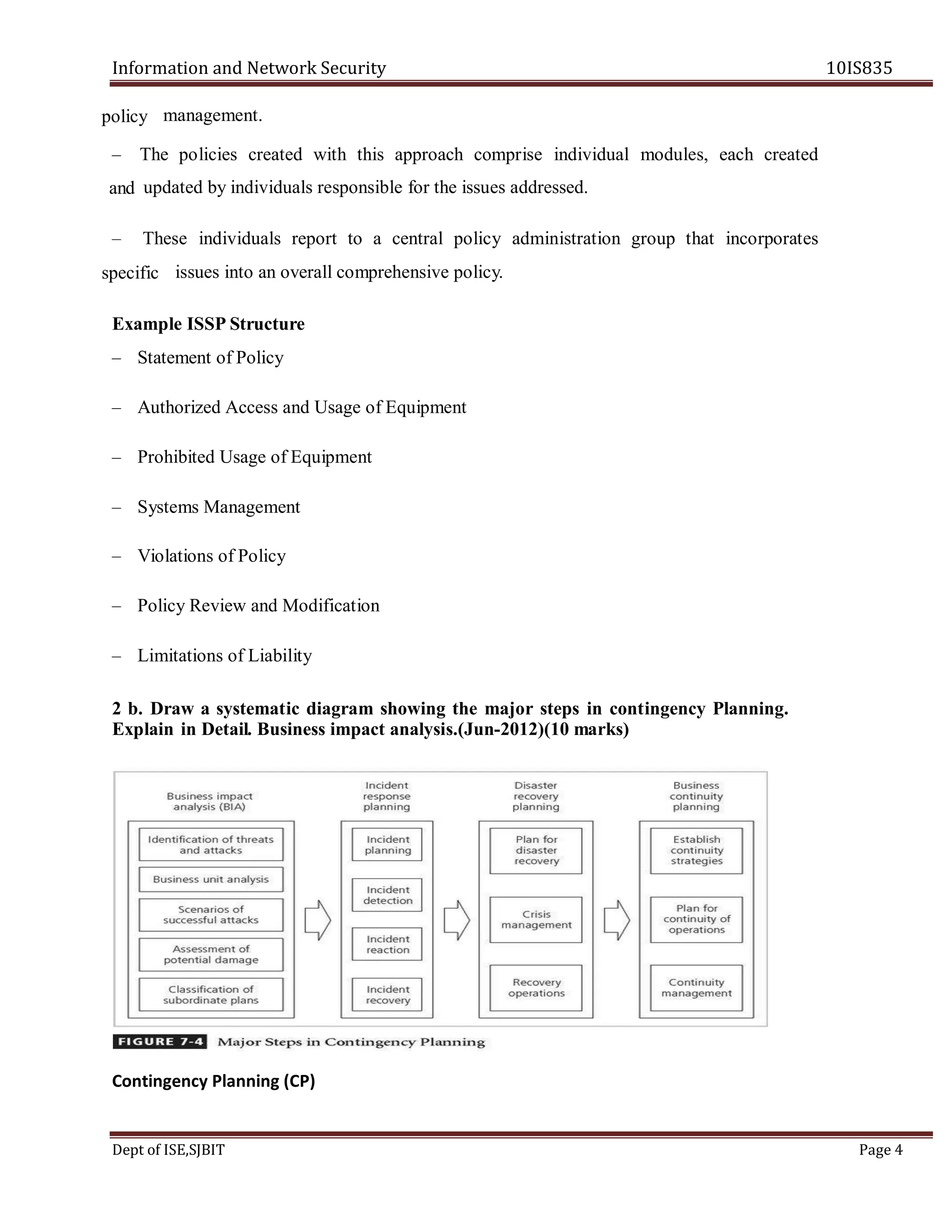
2 b. Draw a systematic diagram showing the major steps in contingency Planning.
Explain in Detail. Business impact analysis.(Jun-2012)(10 marks)
Contingency Planning (CP)
policy
and
specific
Information and Network Security 10IS835
Dept of ISE,SJBIT Page 5
– Incident Response Planning (IRP)
– Disaster Recovery Planning (DRP)
– Business Continuity Planning (BCP)
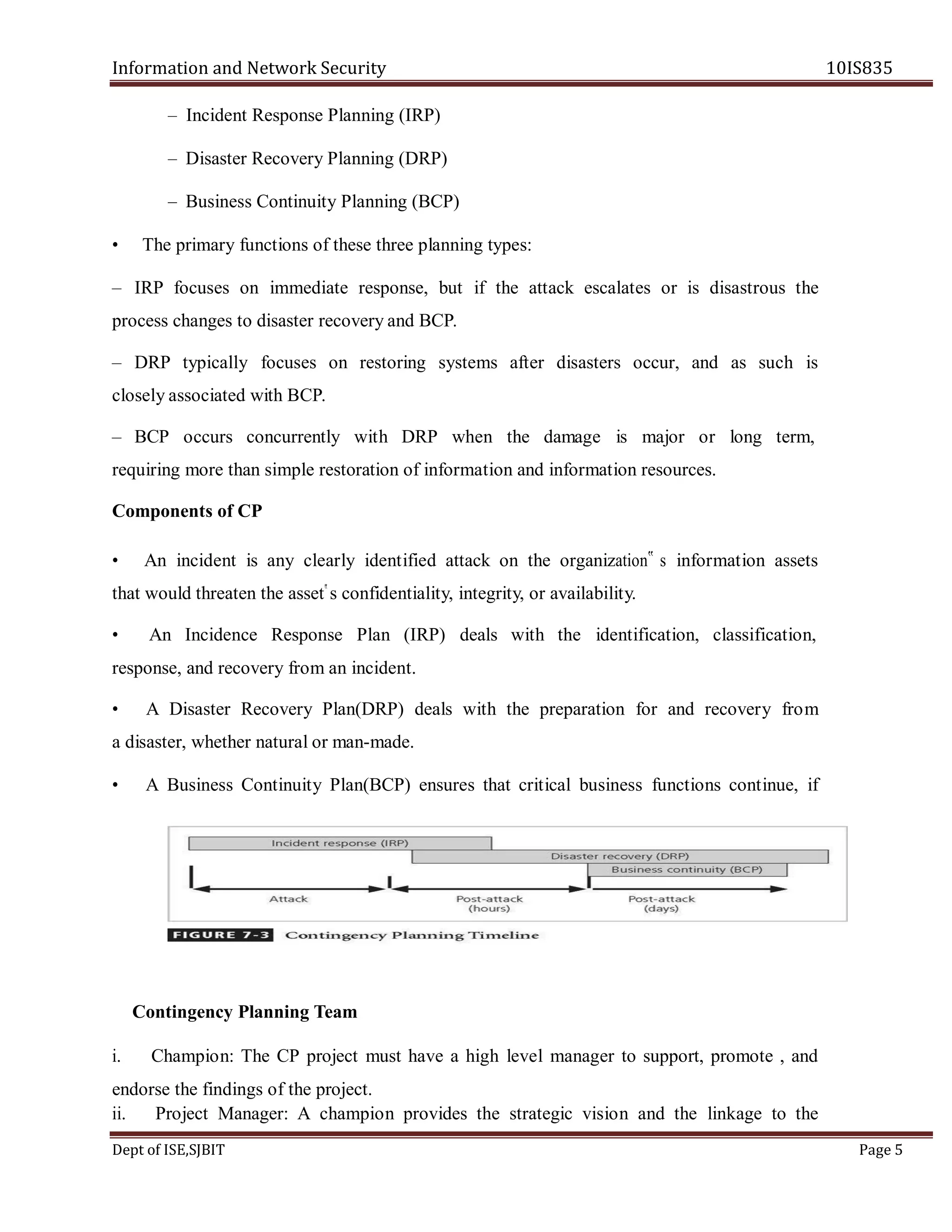
• The primary functions of these three planning types:
– IRP focuses on immediate response, but if the attack escalates or is disastrous the
process changes to disaster recovery and BCP.
– DRP typically focuses on restoring systems after disasters occur, and as such is
closely associated with BCP.
– BCP occurs concurrently with DRP when the damage is major or long term,
requiring more than simple restoration of information and information resources.
Components of CP
• An incident is any clearly identified attack on the organization‟ s information assets
that would threaten the asset‟s confidentiality, integrity, or availability.
• An Incidence Response Plan (IRP) deals with the identification, classification,
response, and recovery from an incident.
• A Disaster Recovery Plan(DRP) deals with the preparation for and recovery from
a disaster, whether natural or man-made.
• A Business Continuity Plan(BCP) ensures that critical business functions continue, if
Contingency Planning Team
i. Champion: The CP project must have a high level manager to support, promote , and
endorse the findings of the project.
ii. Project Manager: A champion provides the strategic vision and the linkage to the
Information and Network Security 10IS835
Dept of ISE,SJBIT Page 6
power structure of the organization.
iii. Team members: The team members for this project should be the managers or
their representatives from the various communities of interest: Business, Information
technology, and information security.
Business Impact Analysis
• The first phase in the development of the CP process is the Business Impact Analysis.
• A BIA is an investigation and assessment of the impact that various attacks can have on
the organization.
• It begins with the prioritized list of threats and vulnerabilities identified in the
risk management.
• The BIA therefore adds insight into what the organization must do to respond to
attack, minimize the damage from the attack, recover from the effects, and return to
normal operations.
Begin with Business Impact Analysis (BIA)
if the attack succeeds, what do we do then?
Obviously the organization‟ s security team does everything In its power to stop these
attacks, but some attacks, such as natural disasters, deviations from service providers,
acts of human failure or error, and deliberate acts of sabotage and vandalism, may be
unstoppable.
• The CP team conducts the BIA in the following stages:
Threat attack identification
Business unit analysis
Attack success scenarios
Potential damage assessment
Subordinate plan classification
Information and Network Security 10IS835
Dept of ISE,SJBIT Page 7
3 a. Explain the Pipkin’s three categories of incident indicators. (Jun 2013) (12 Marks)
Ans : There are a number of occurrences that could signal the presence of an incident
candidate. Donald Pipkin, an IT security expert identifies THREE categories of incident
indicators:
POSSIBLE,
PROBABLE and
DEFINITE
Possible Indicators
• Presence of unfamiliar files.
If users report discovering files in their home directories or on their office computers, or
administrators find files that do not seem to have been placed in a logical location or that were
not created by an authorized user, the presence of these files may signal the occurrence of an
incident.
• Possible Indicators
Presence or execution of unknown program or process:
If users or administrators detect unfamiliar programs running or processes executing
on office machines or network servers, this could be an incident.
Probable Indicators
a) Activities at unexpected times.
If traffic levels on the organization‟ s network exceed the measured baseline values, there
is a probability that an incident is underway.
If systems are accessing drives, such as floppies, and CD –ROMS, when the end user is
not using them, is an incident.
b) Presence of new accounts
Periodic review of user accounts can reveal an account that the administrator does not
remember creating, or accounts that are not logged in the administrator‟ s journal.
Even one unlogged new account is a candidate incident.
c) Reported Attacks
If users of the system report a suspected attack, there is a high probability that an incident
Information and Network Security 10IS835
Dept of ISE,SJBIT Page 8
is underway or has already occurred.
d) Notification from IDS
If the organization has installed host-based or network based intrusion detection system
and if they are correctly configures, the notification from the IDS could indicate a strong
likelihood that an incident is in progress.
Definite Indicators
Definite indicators are the activities which clearly signal that an incident is in progress or
has occurred.
• USE OF DORMANT ACCOUNTS
Many network servers maintain default accounts that came with the systems from the
manufacturer. Although industry best practices indicate that these accounts should be changed
or removed; some organizations ignore these practices by making the default accounts inactive.
• In addition, systems may have any number of accounts that are not actively used, such
as those of previous employees, employees on extended vacation or sabbatical, or dummy
accounts set up to support system testing.
• If any of these dormant accounts suddenly become active without a change in status for
the underlying user, this indicates incident occurred.
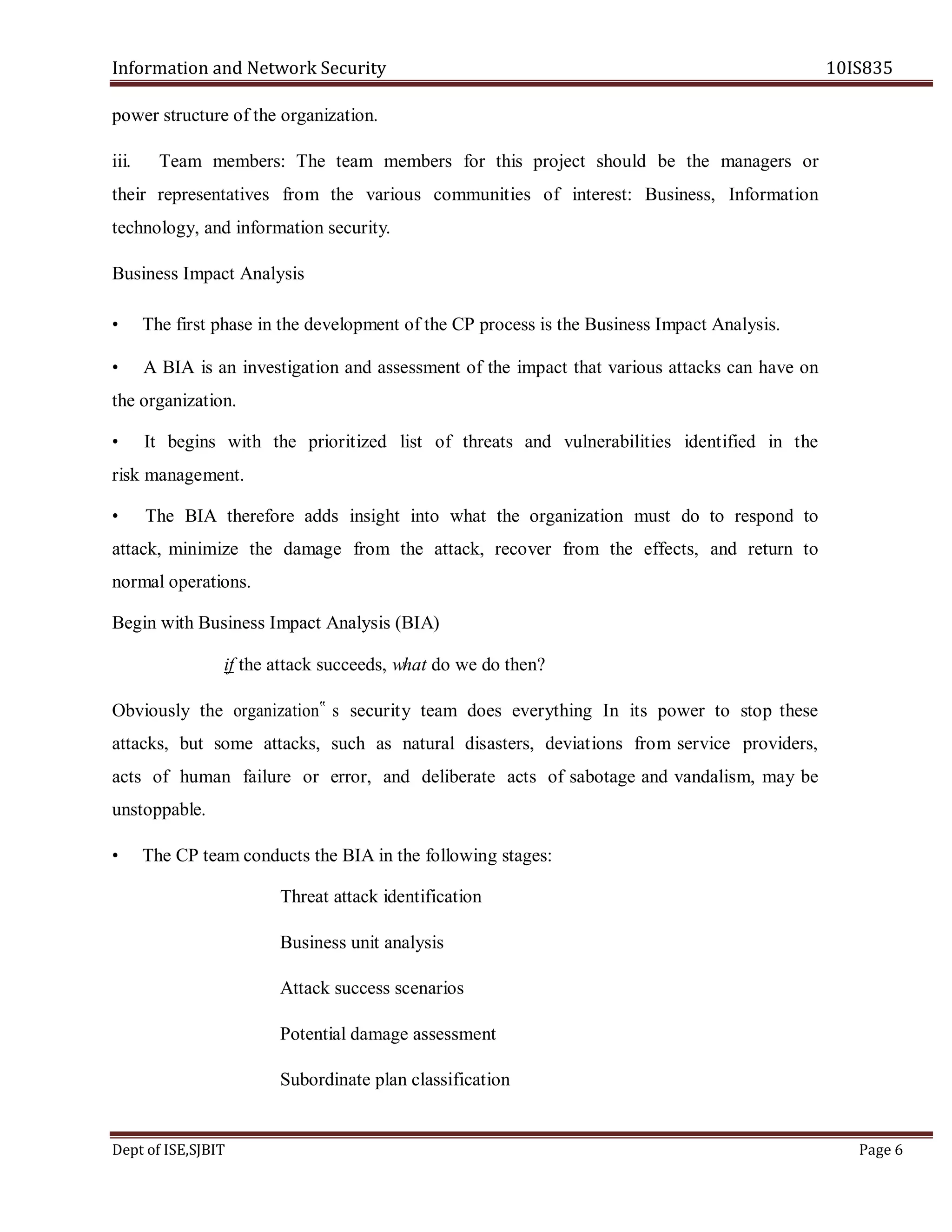
3 b. Explain the ISO/IEC 270 01 : 2005 plan-DO-Check-Act cycle. (Jun 2012,Dec 2012) (8
Marks)
Ans :
Information and Network Security 10IS835
Dept of ISE,SJBIT Page 9
4 a. Define policy and explain issue specific security policy. (Jun 2011) (10 Marks)
Ans : A policy is a plan or course of action used by an organization to convey instructions
from its senior-most management to those who make decisions, take actions, and perform
other duties on behalf of the organization.
The ISSP :
addresses specific areas of technology like
–Electronic mail
–Use of the Internet
– Specific minimum configurations of computers to defend against worms
viruses.
– Prohibitions against hacking or testing organization security controls.
– Home use of company-owned computer equipment.
– Use of personal equipment on company networks
– Use of telecommunications technologies (FAX and Phone)
– Use of photocopy equipment.
requires frequent updates contains an issue statement on the organization‟s position on an
issue
There are a number of approaches to take when creating and managing ISSPs within
organization.
Three approaches:
Independent ISSP documents, each tailored to a specific issue.
A single comprehensive ISSP document covering all issues.
A modular ISSP document that unifies policy creation and administration,
while maintaining each specific issue„s requirements.
– The independent document approach to take when creating and managing ISSPs
has a scattershot effect.
– Each department responsible for a particular application of technology creates a
and
–
an
–
typically
Information and Network Security 10IS835
Dept of ISE,SJBIT Page 10
governing its use, management, and control.
– This approach to creating ISSPs may fail to cover all of the necessary issues, and can
lead
to poor policy distribution, management, and enforcement.
– The single comprehensive policy approach is centrally managed and controlled.
– With formal procedures for the management of ISSPs in place , the comprehensive
pproach establishes guidelines for overall coverage of necessary issues and
identifies processes for the dissemination, enforcement, and review of these
guidelines.
– Usually, these policies are developed by those responsible for managing the
technology resources.
– The optimal balance between the independent and comprehensive ISSP approaches is the
modular approach.It is also certainly managed and controlled but tailored to the individual
technology issues.
– The modular approach provides a balance between issue orientation and policy
management.
– The policies created with this approach comprise individual modules, each created and
updated by individuals responsible for the issues addressed.
– These individuals report to a central policy administration group that incorporates specific
issues into an overall comprehensive policy.
4 b. Explain the importance of incident response planning strategy. (Jun 2011,jun 2012)
(10 marks)
Incident response planning covers the identification of, classification of, and
response to an incident.
• What is incident? What is incident Response?
• An incident is an attack against an information asset that poses a clear threat to the
confidentiality, integrity, or availability of information resources.
• If an action that threatens information occurs and is completed, the action is classified as
an incident. an incident.
policy
policy a
clearly
information
•
Ans :
Information and Network Security 10IS835
Dept of ISE,SJBIT Page 11
• Attacks are only classified as incidents if they have the following characteristics:
1) . They are directed against information assets.
2) . They have a realistic chance of success.
3) . They could threaten the confidentiality, integrity, or availability of information
resources.
Incident Response-IR
IR is therefore the set of activities taken to plan for, detect, and correct the impact of an
incident on information assets.
• IR is more reactive than proactive.
• IR consists of the following FOUR phases:
1. Planning
2. Detection
3. Reaction
4. Recovery
Incident Planning
• Planning for incidents is the first step in the overall process of incident response
planning.
• Planning for an incident requires a detailed understanding of the scenarios developed for
the BIA.
• With this information in hand, the planning team can develop a series of predefined
responses that guide the organizations‟ incident response (IR) team and information
security staff.
• This assumes TWO things
The organization has an IR team and
The organization can detect the incident.
• The IR team consists of those individuals who must be present to handle the systems and
functional areas that can minimize the impact of an incident as it takes place.
Information and Network Security 10IS835
Dept of ISE,SJBIT Page 12
• IR team verifies the threat, determines the appropriate response, ands co-ordinates the
actions necessary to deal with the situation.
# Format and Content
-The IR plan must be organized in such a way to support, rather than impede, quick and easy
access to require information, such as to create a directory of incidents with tabbed sections for
each incident.
-To respond to an incident, the responder simply opens the
binder, flips to the appropriate section, and follows the clearly outlined procedures for an
assigned role.
# Storage
• Where is the IR plan stored?
• Note that the information in the IR plan should be protected as sensitive information.
• If attackers gain knowledge of how a company responds to a particular incident, they can
improve their chances of success in the attacks.
• The document could be stored adjacent to the administrators workstation, or in a book case
in the server room.
# Testing
• A plan untested is not a useful plan
• “ Train as you fight, and fight as you train”
• Even if an organization has what appears on paper to be an effective IR plan, the
procedures that come from the plan has been practiced and tested.
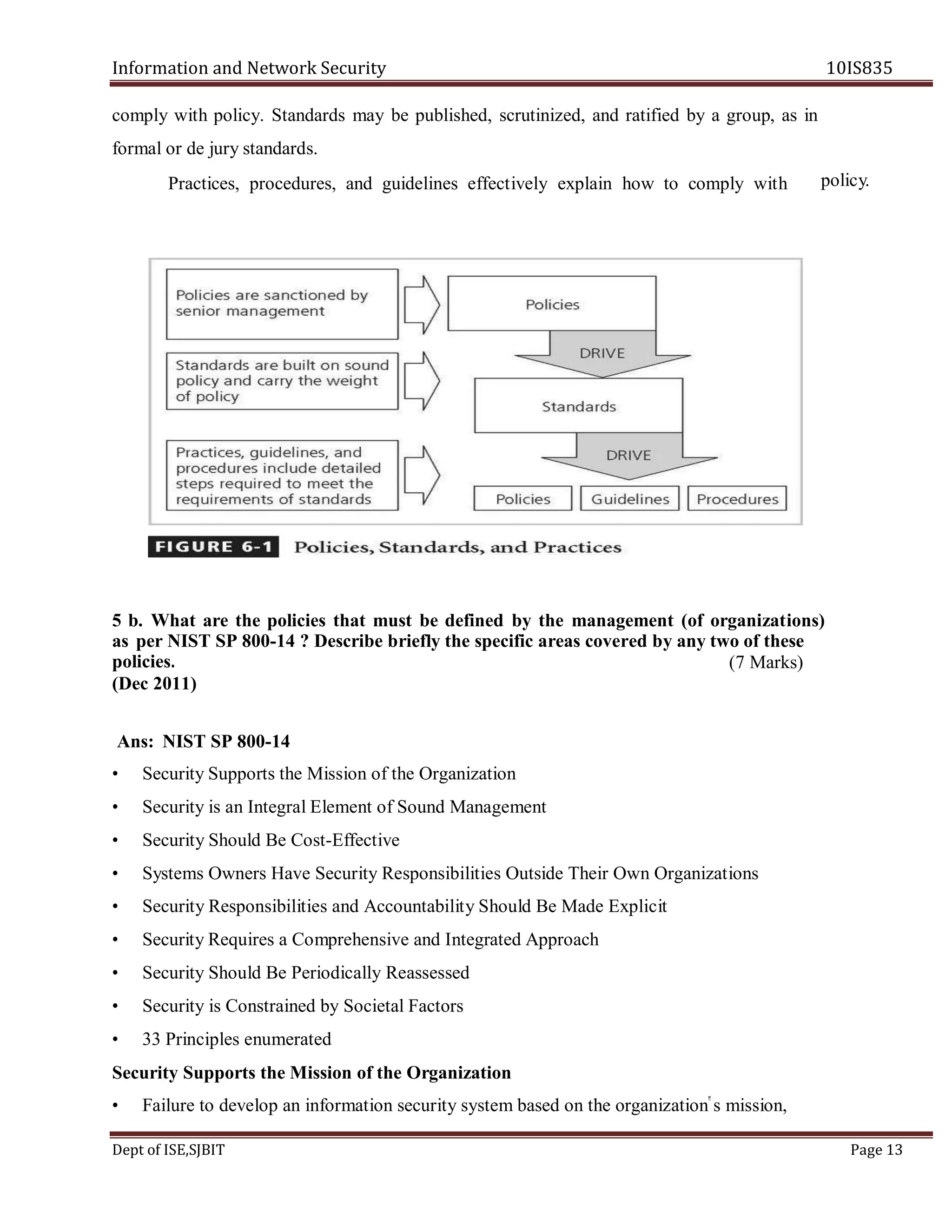
5 a. Define the terms: Policy, Standards and practices in the context of information
security.Draw a schematic diagram depicting the inter-relationship between the above. (Dec
2011,)
(6 Marks)
A policy is a plan or course of action used by an organization to convey instructions
from its senior-most management to those who make decisions, take actions, and perform
other duties on behalf of the organization.
Standards, on the other hand, are more detailed statements of what must be done to
Ans :
Information and Network Security 10IS835
Dept of ISE,SJBIT Page 13
comply with policy. Standards may be published, scrutinized, and ratified by a group, as in
formal or de jury standards.
Practices, procedures, and guidelines effectively explain how to comply with
5 b. What are the policies that must be defined by the management (of organizations)
as per NIST SP 800-14 ? Describe briefly the specific areas covered by any two of these
policies.
(Dec 2011)
Ans: NIST SP 800-14
• Security Supports the Mission of the Organization
• Security is an Integral Element of Sound Management
• Security Should Be Cost-Effective
• Systems Owners Have Security Responsibilities Outside Their Own Organizations
• Security Responsibilities and Accountability Should Be Made Explicit
• Security Requires a Comprehensive and Integrated Approach
• Security Should Be Periodically Reassessed
• Security is Constrained by Societal Factors
• 33 Principles enumerated
Security Supports the Mission of the Organization
• Failure to develop an information security system based on the organization‟s mission,
policy.
(7 Marks)
Information and Network Security 10IS835
Dept of ISE,SJBIT Page 14
vision and culture guarantees the failure of the information security program.
Security is an Integral Element of Sound Management
• Effective management includes planning, organizing, leading, and controlling.
• Security enhances these areas by supporting the planning function when
information security policies provide input into the organization initiatives.
• Information security specifically supports the controlling function, as security
controls support sound management by means of the enforcement of both managerial and
security policies.
5c. What are the components of contingency planning? Describe briefly the important
steps involved in the recovery process after the extent of damage caused by an incident
has been assessed. (Dec 2011) 7 marks
Ans: Components of CP
• An incident is any clearly identified attack on the organization‟ s information assets
that would threaten the asset‟s confidentiality, integrity, or availability.
• An Incidence Response Plan (IRP) deals with the identification, classification,
response,and recovery from an incident.
• A Disaster Recovery Plan(DRP) deals with the preparation for and recovery from
a
disaster, whether natural or man-made.
• A Business Continuity Plan(BCP) ensures that critical business functions continue,
1 b Explain the steps which are unique to security system development life cycle.(Jun 2013
(10 marks)
Information and Network Security 10IS835
Dept of ISE,SJBIT Page 15
Systems Design
• At this point in the Security SDLC, the analysis phase is complete and the design phase
begins – many work products have been created
• Designing a plan for security begins by creating or validating a security blueprint
• Then use the blueprint to plan the tasks to be accomplished and the order in which to
proceed
• Setting priorities can follow the recommendations of published sources, or from published
standards provided by government agencies, or private consultants
UNIT 2
SECURITY TECHNOLOGY: FIREWALLS AND VPNS
1a Explain the major steps specified in BSS7799:2 document. How these steps help in
security planning (Dec 2012) (10 marks)
• One of the most widely referenced and often discussed security models is the
Information
Technology – Code of Practice for Information Security Management, which
was originally published as British Standard BS 7799
• This Code of Practice was adopted as an international standard by the
International Organization for Standardization (ISO) and the International Electro
technical Commission (IEC) as ISO/IEC 17799 in 2000 as a framework for information
security.
Content Outline
The Sections of ISO/IEC 17799
1) Organizational Security Policy
Information and Network Security 10IS835
Dept of ISE,SJBIT Page 16
2) Organizational Security Infrastructure
3) Asset Classification and Control.
4) Personnel Security
5) Physical and Environmental Security
6) Communications and Operations Management
7) System Access Control
8) System Development and Maintenance.
9) Business Continuity Planning
10) Compliance
• The stated purpose of ISO/IEC 17799 is to “give recommendations for information
security management for use by those who are responsible for initiating,
implementing, or maintaining security in their organization.
• It is intended to provide a common basis for developing organizational security
standards and effective security management practice and to provide confidence in
inter-organizational dealings.
• This International Standard is actually drawn from only the first volume of the two-
volume British Standard 7799.
• Volume 2 of BS7799 picks up where ISO/IEC 17799 leaves off.
• Where Volume 1 of BS7799 and ISO/IEC 17799 are focused on a broad overview of
the various areas of security, providing information on 127 controls over ten broad areas.
• Volume 2 of BS7799 provides information on how to implement Volume 1 and
ISO/IEC 17799 and how to set up an information security management system (ISMS).
• Several countries have not adopted 17799 claiming there are fundamental problems:
– The global information security community has not defined any justification for
a code of practice as identified in the ISO/IEC 17799
Information and Network Security 10IS835
Dept of ISE,SJBIT Page 17
– 17799 lacks “the necessary measurement precision of a technical standard”
– There is no reason to believe that 17799 is more useful than any other
approach currently available
– 17799 is not as complete as other frameworks available
– 17799 is perceived to have been hurriedly prepared given the tremendous impact ts
adoption could have on industry information security control
• Organizational Security Policy is needed to provide management direction and support
Objectives:
– Organizational Security Policy
– Organizational Security Infrastructure
– Asset Classification and Control
– Personnel Security
– Physical and Environmental Security
– Communications and Operations Management
– System Access Control
– System Development and Maintenance
– B usiness Continuity Planning
– Compliance
1 b What is firewall? Show the working of screened host and dual homed firewall?
(December 2012,Jun 2013)(10 marks)
Firewalls
A firewall in an information security program is similar to a buildings firewall in
that it prevents specific types of information from moving between the outside
world, known as the untrusted network(eg., the Internet), and the inside world,
known as the trusted network.
• The firewall may be a separate computer system, a software service running on an
existing router or server, or a separate network containing a number of supporting
devices.
Screened Host Firewalls
This architecture combines the packet filtering router with a separate, dedicated
firewall, such as an application proxy server. This approach allows the router to
Information and Network Security 10IS835
Dept of ISE,SJBIT Page 18
pre-screen packets to minimize the network traffic and loads on the internal
proxy.The application proxy examines an application layer protocol, such as
HTTP, and perform the proxy services. This separate host is often referred to as a
bastion host; it can be a rich target for external attacks, and should be very
thoroughly secured.Evn though the bastion host/application proxy actually
contains only cached copies of the internal Web documents, it can still present a
promising target, because compromise of the bastion host can disclose the
configuration of internal networks and possibly provide external sources with
internal information. Since the bastion host stands as a sloe defender on the
network perimeter, it is also commonly referred to as the Sacrificial Host.
To its advantage, this configuration requires the external attack to compromise
two separate systems, before the attack can access internal data. Inthis way, the
bastion host protects the data more fully than the router alone. Fig 6-11 shows a
typical configuration of a screened host architectural approach.
Dual-Homed Host Firewalls
The next step up in firewall architectural complexity is the dual-homed host. When this
architectural approach is used, the bastion host contains two NICs (Network Interface
Cards) rather than one, as in the bastion host configuration. One NIC is connected to the
external network, and one is connected to the internal network, providing an additional
layer of protection. With TWO NICs , all traffic must physically go through the firewall
to move between the internal and external networks.
Implementation of this architecture often makes use of NATs. NAT is a method of
mapping real, valid, external IP addresses to special ranges of non-routable internal IP
addresses, thereby creating yet another barrier to intrusion from external attackers.
The internal addresses used by NAT consist of three different ranges. Organizations that
need Class A addresses can use the 10.x.x.x range, which has over 16.5 million usable
addresses. Organization‟ s that need Class B addresses can use the 192.168.x.x range,
which has over 65,500 addresses. Finally , organiazations with smaller needs , such as
those needing onlya few Class C addresses, can use the c172.16.0.0 to 172.16..0 range,
which hs over 16 Class C addresses or about 4000 usable addresses.
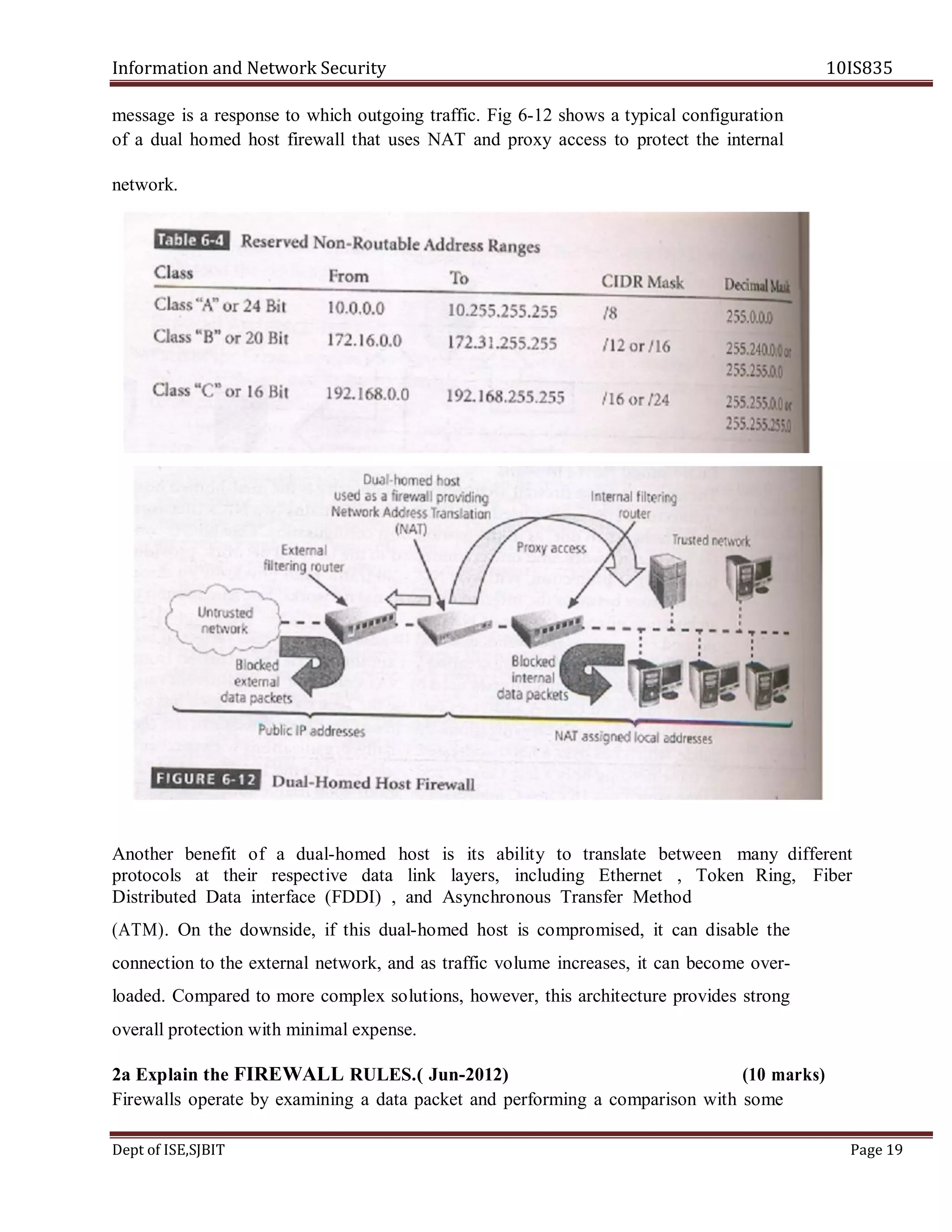
See table 6-4 for a recap of the IP address ranges reseved fro non-public networks.
Messages sent with internal addresses within these three internal use addresses is directly
connected to the external network, and avoids the NAT server, its traffic cannot be routed
on the public network. Taking advantage of this , NAT prevents external attacks from
reaching internal machines with addresses in specified ranges.If the NAT server is a
multi-homed bastion host, it translates between the true, external IP addresses assigned to
the organization by public network naming authorities ansd the internally assigned, non-
routable IP addresses. NAT translates by dynamically assigning addresses to internal
communications and tracking the conversions with sessions to determine which incoming
Information and Network Security 10IS835
Dept of ISE,SJBIT Page 19
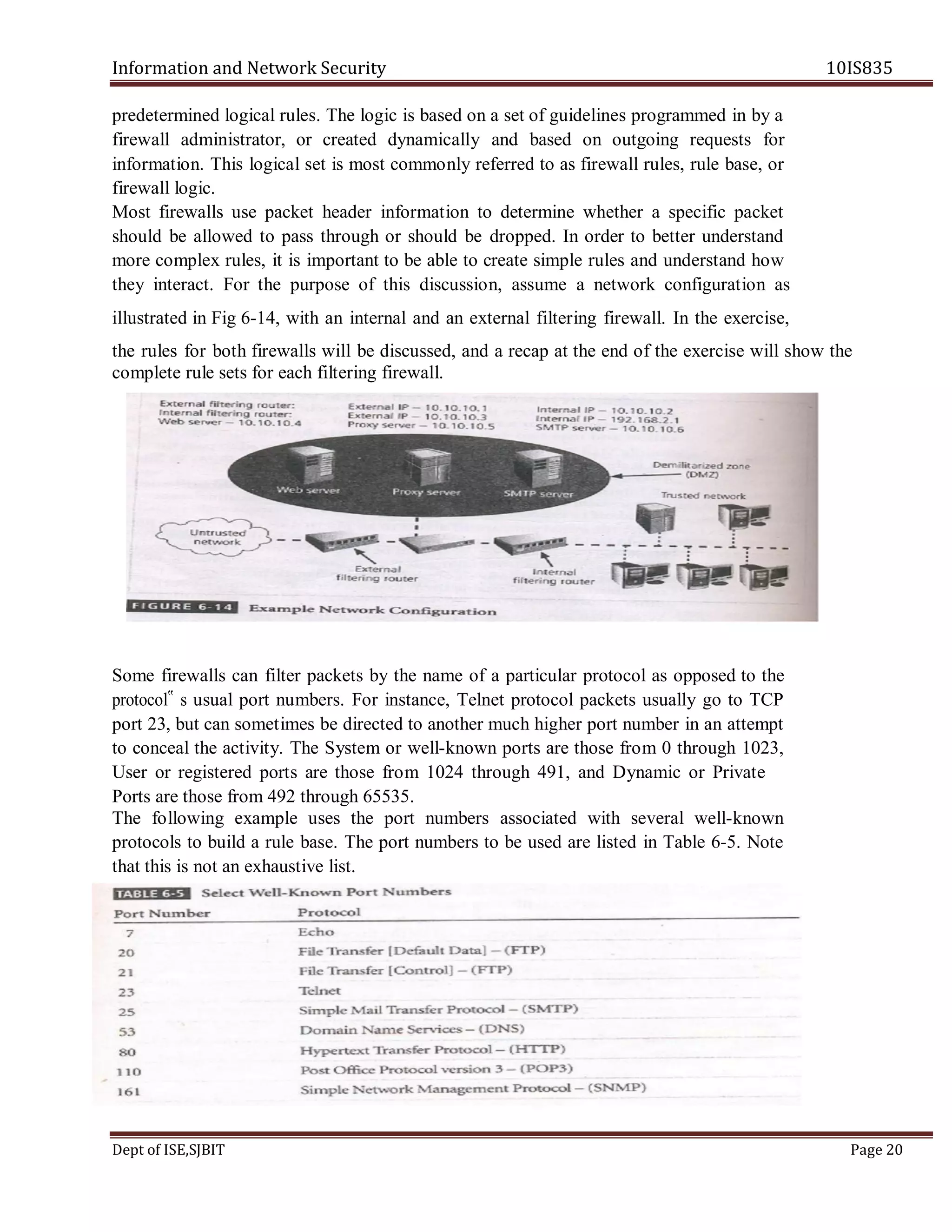
message is a response to which outgoing traffic. Fig 6-12 shows a typical configuration
of a dual homed host firewall that uses NAT and proxy access to protect the internal
network.
Another benefit of a dual-homed host is its ability to translate between many different
protocols at their respective data link layers, including Ethernet , Token Ring, Fiber
Distributed Data interface (FDDI) , and Asynchronous Transfer Method
(ATM). On the downside, if this dual-homed host is compromised, it can disable the
connection to the external network, and as traffic volume increases, it can become over-
loaded. Compared to more complex solutions, however, this architecture provides strong
overall protection with minimal expense.
2a Explain the FIREWALL RULES.( Jun-2012) (10 marks)
Firewalls operate by examining a data packet and performing a comparison with some
Information and Network Security 10IS835
Dept of ISE,SJBIT Page 20
predetermined logical rules. The logic is based on a set of guidelines programmed in by a
firewall administrator, or created dynamically and based on outgoing requests for
information. This logical set is most commonly referred to as firewall rules, rule base, or
firewall logic.
Most firewalls use packet header information to determine whether a specific packet
should be allowed to pass through or should be dropped. In order to better understand
more complex rules, it is important to be able to create simple rules and understand how
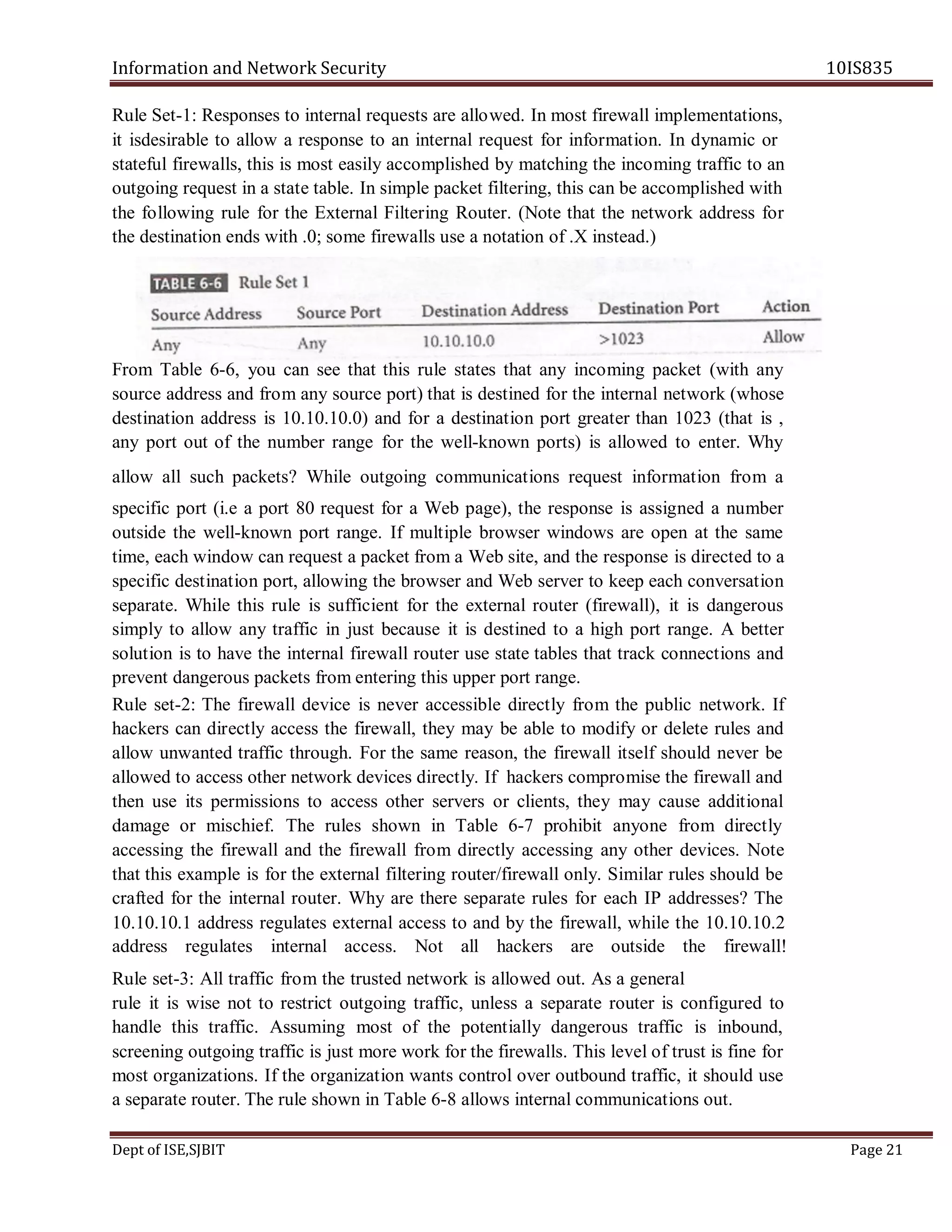
they interact. For the purpose of this discussion, assume a network configuration as
illustrated in Fig 6-14, with an internal and an external filtering firewall. In the exercise,
the rules for both firewalls will be discussed, and a recap at the end of the exercise will show the
complete rule sets for each filtering firewall.
Some firewalls can filter packets by the name of a particular protocol as opposed to the
protocol‟ s usual port numbers. For instance, Telnet protocol packets usually go to TCP
port 23, but can sometimes be directed to another much higher port number in an attempt
to conceal the activity. The System or well-known ports are those from 0 through 1023,
User or registered ports are those from 1024 through 491, and Dynamic or Private
Ports are those from 492 through 65535.
The following example uses the port numbers associated with several well-known
protocols to build a rule base. The port numbers to be used are listed in Table 6-5. Note
that this is not an exhaustive list.
Information and Network Security 10IS835
Dept of ISE,SJBIT Page 21
Rule Set-1: Responses to internal requests are allowed. In most firewall implementations,
it isdesirable to allow a response to an internal request for information. In dynamic or
stateful firewalls, this is most easily accomplished by matching the incoming traffic to an
outgoing request in a state table. In simple packet filtering, this can be accomplished with
the following rule for the External Filtering Router. (Note that the network address for
the destination ends with .0; some firewalls use a notation of .X instead.)
From Table 6-6, you can see that this rule states that any incoming packet (with any
source address and from any source port) that is destined for the internal network (whose
destination address is 10.10.10.0) and for a destination port greater than 1023 (that is ,
any port out of the number range for the well-known ports) is allowed to enter. Why
allow all such packets? While outgoing communications request information from a
specific port (i.e a port 80 request for a Web page), the response is assigned a number
outside the well-known port range. If multiple browser windows are open at the same
time, each window can request a packet from a Web site, and the response is directed to a
specific destination port, allowing the browser and Web server to keep each conversation
separate. While this rule is sufficient for the external router (firewall), it is dangerous
simply to allow any traffic in just because it is destined to a high port range. A better
solution is to have the internal firewall router use state tables that track connections and
prevent dangerous packets from entering this upper port range.
Rule set-2: The firewall device is never accessible directly from the public network. If
hackers can directly access the firewall, they may be able to modify or delete rules and
allow unwanted traffic through. For the same reason, the firewall itself should never be
allowed to access other network devices directly. If hackers compromise the firewall and
then use its permissions to access other servers or clients, they may cause additional
damage or mischief. The rules shown in Table 6-7 prohibit anyone from directly
accessing the firewall and the firewall from directly accessing any other devices. Note
that this example is for the external filtering router/firewall only. Similar rules should be
crafted for the internal router. Why are there separate rules for each IP addresses? The
10.10.10.1 address regulates external access to and by the firewall, while the 10.10.10.2
address regulates internal access. Not all hackers are outside the firewall!
Rule set-3: All traffic from the trusted network is allowed out. As a general
rule it is wise not to restrict outgoing traffic, unless a separate router is configured to
handle this traffic. Assuming most of the potentially dangerous traffic is inbound,
screening outgoing traffic is just more work for the firewalls. This level of trust is fine for
most organizations. If the organization wants control over outbound traffic, it should use
a separate router. The rule shown in Table 6-8 allows internal communications out.
Information and Network Security 10IS835
Dept of ISE,SJBIT Page 22
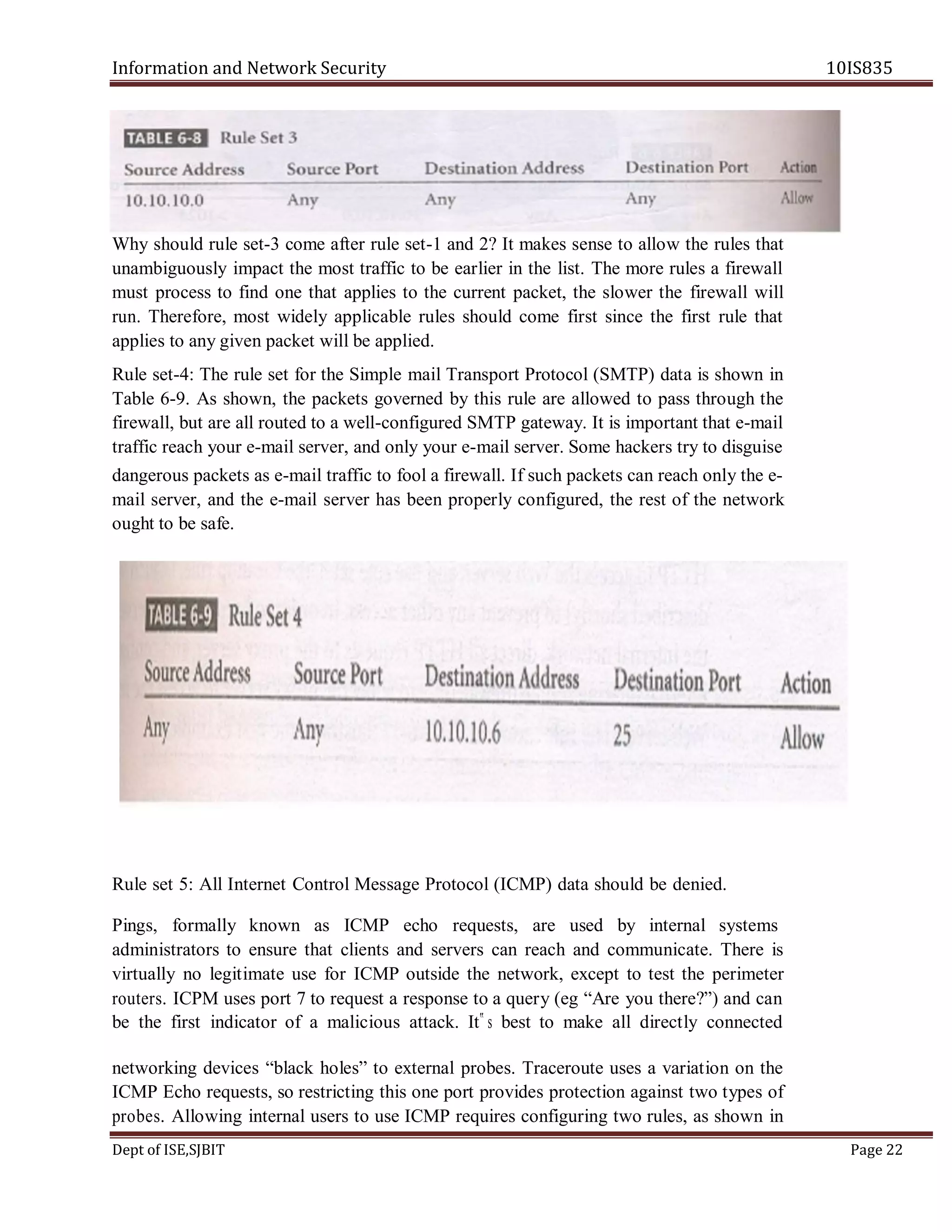
Why should rule set-3 come after rule set-1 and 2? It makes sense to allow the rules that
unambiguously impact the most traffic to be earlier in the list. The more rules a firewall
must process to find one that applies to the current packet, the slower the firewall will
run. Therefore, most widely applicable rules should come first since the first rule that
applies to any given packet will be applied.
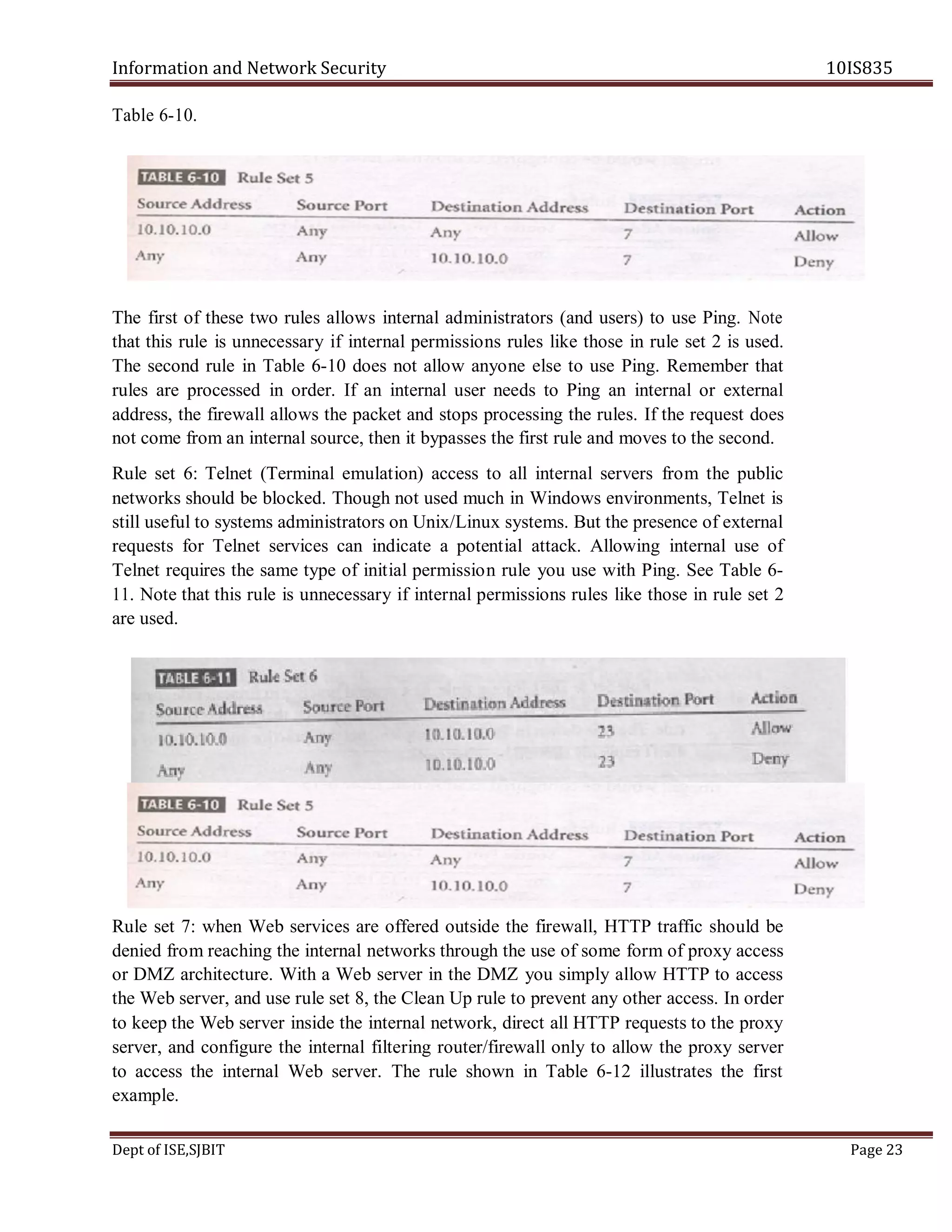
Rule set-4: The rule set for the Simple mail Transport Protocol (SMTP) data is shown in
Table 6-9. As shown, the packets governed by this rule are allowed to pass through the
firewall, but are all routed to a well-configured SMTP gateway. It is important that e-mail
traffic reach your e-mail server, and only your e-mail server. Some hackers try to disguise
dangerous packets as e-mail traffic to fool a firewall. If such packets can reach only the e-
mail server, and the e-mail server has been properly configured, the rest of the network
ought to be safe.
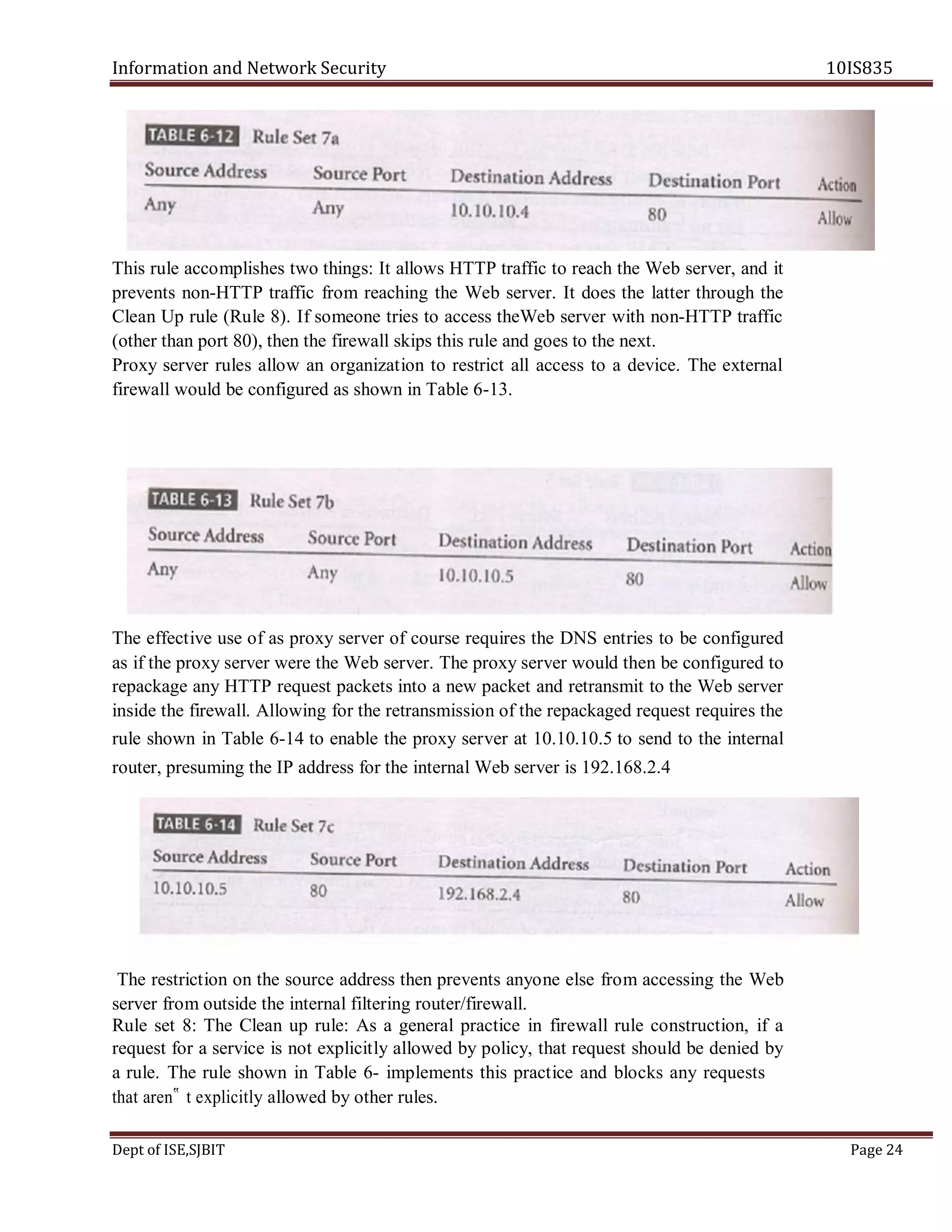
Rule set 5: All Internet Control Message Protocol (ICMP) data should be denied.
Pings, formally known as ICMP echo requests, are used by internal systems
administrators to ensure that clients and servers can reach and communicate. There is
virtually no legitimate use for ICMP outside the network, except to test the perimeter
routers. ICPM uses port 7 to request a response to a query (eg “Are you there?”) and can
be the first indicator of a malicious attack. It‟ s best to make all directly connected
networking devices “black holes” to external probes. Traceroute uses a variation on the
ICMP Echo requests, so restricting this one port provides protection against two types of
probes. Allowing internal users to use ICMP requires configuring two rules, as shown in
Information and Network Security 10IS835
Dept of ISE,SJBIT Page 23
Table 6-10.
The first of these two rules allows internal administrators (and users) to use Ping. Note
that this rule is unnecessary if internal permissions rules like those in rule set 2 is used.
The second rule in Table 6-10 does not allow anyone else to use Ping. Remember that
rules are processed in order. If an internal user needs to Ping an internal or external
address, the firewall allows the packet and stops processing the rules. If the request does
not come from an internal source, then it bypasses the first rule and moves to the second.
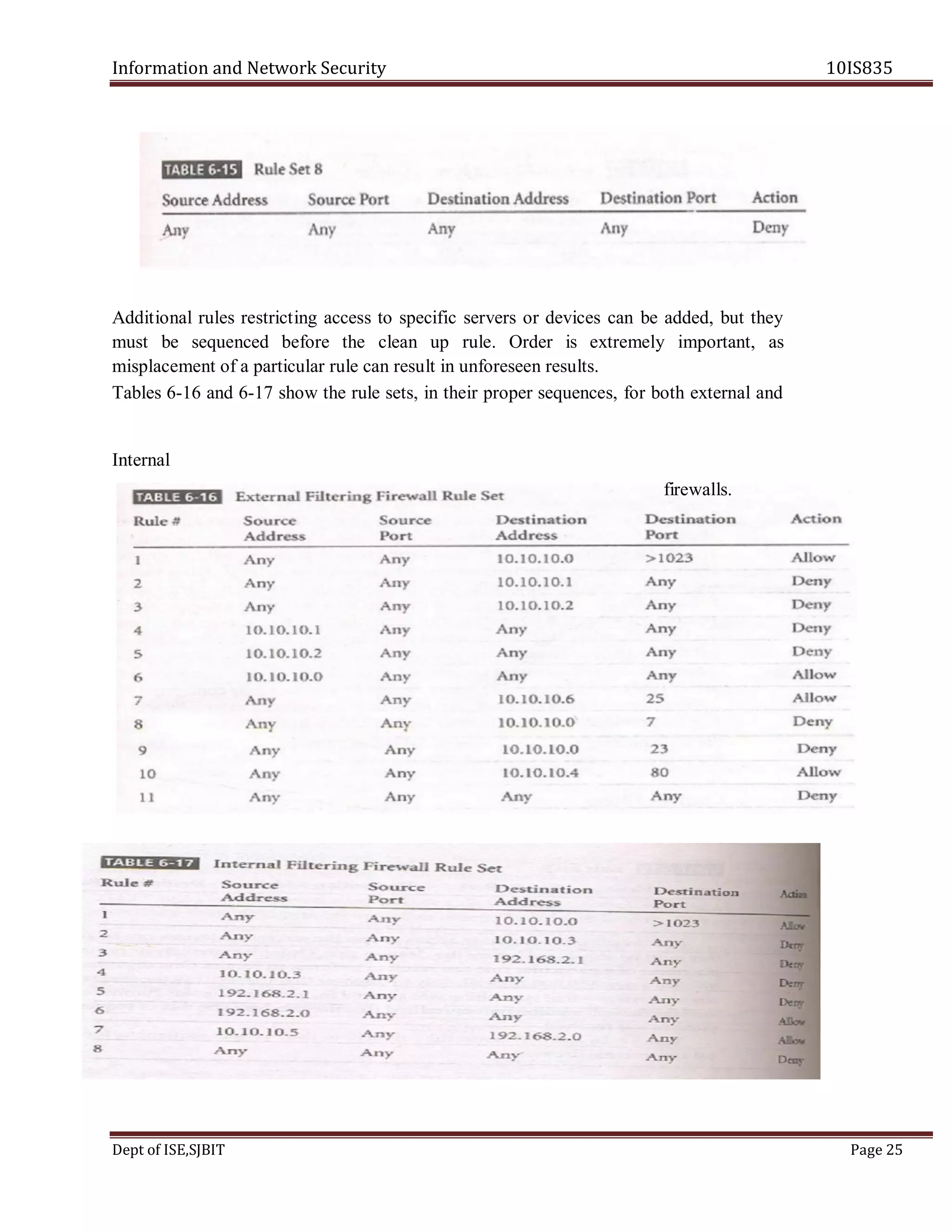
Rule set 6: Telnet (Terminal emulation) access to all internal servers from the public
networks should be blocked. Though not used much in Windows environments, Telnet is
still useful to systems administrators on Unix/Linux systems. But the presence of external
requests for Telnet services can indicate a potential attack. Allowing internal use of
Telnet requires the same type of initial permission rule you use with Ping. See Table 6-
11. Note that this rule is unnecessary if internal permissions rules like those in rule set 2
are used.
Rule set 7: when Web services are offered outside the firewall, HTTP traffic should be
denied from reaching the internal networks through the use of some form of proxy access
or DMZ architecture. With a Web server in the DMZ you simply allow HTTP to access
the Web server, and use rule set 8, the Clean Up rule to prevent any other access. In order
to keep the Web server inside the internal network, direct all HTTP requests to the proxy
server, and configure the internal filtering router/firewall only to allow the proxy server
to access the internal Web server. The rule shown in Table 6-12 illustrates the first
example.
Information and Network Security 10IS835
Dept of ISE,SJBIT Page 24
This rule accomplishes two things: It allows HTTP traffic to reach the Web server, and it
prevents non-HTTP traffic from reaching the Web server. It does the latter through the
Clean Up rule (Rule 8). If someone tries to access theWeb server with non-HTTP traffic
(other than port 80), then the firewall skips this rule and goes to the next.
Proxy server rules allow an organization to restrict all access to a device. The external
firewall would be configured as shown in Table 6-13.
The effective use of as proxy server of course requires the DNS entries to be configured
as if the proxy server were the Web server. The proxy server would then be configured to
repackage any HTTP request packets into a new packet and retransmit to the Web server
inside the firewall. Allowing for the retransmission of the repackaged request requires the
rule shown in Table 6-14 to enable the proxy server at 10.10.10.5 to send to the internal
router, presuming the IP address for the internal Web server is 192.168.2.4
The restriction on the source address then prevents anyone else from accessing the Web
server from outside the internal filtering router/firewall.
Rule set 8: The Clean up rule: As a general practice in firewall rule construction, if a
request for a service is not explicitly allowed by policy, that request should be denied by
a rule. The rule shown in Table 6- implements this practice and blocks any requests
that aren‟ t explicitly allowed by other rules.
Information and Network Security 10IS835
Dept of ISE,SJBIT Page 25
Additional rules restricting access to specific servers or devices can be added, but they
must be sequenced before the clean up rule. Order is extremely important, as
misplacement of a particular rule can result in unforeseen results.
Tables 6-16 and 6-17 show the rule sets, in their proper sequences, for both external and
Internal
firewalls.
Information and Network Security 10IS835
Dept of ISE,SJBIT Page 26
Note that the rule allowing responses to internal communications comes first (appearing in
Table 6-16 as Rule #1), followed by the four rules prohibiting direct communications to or
from the firewall (Rules #2-5 in Table 6-16). After this comes the rule stating that all outgoing
internal communications are allowed, followed by the rules governing access to the SMTP
server, and denial of Ping, Telnet access, and access to the HTTP server. If heavy traffic to the
HTTP server is expected, move the HTTP server rule closer to the top (For example, into the
position of Rule #2), which would expedite rule processing for external communications.
The final rule in Table 6-16 denies any other types of communications.
Note the similarities and differences in the two rule sets. The internal filtering
router/firewall rule set, shown in Table 6-17, has to both protect against traffic to and allow
traffic from the internal network (192.168.2.0). Most of the rules in Table 6-17 are similar to
those in Table 6-16: allowing responses to internal communications (Rule #1); denying
communications to/from the firewall itself (rule # 2-5); and allowing all outbound
internal traffic (Rule #6). Note that there is no permissible traffic from the DMZ systems,
except as in Rule #1.
Why isnt there a comparable rule for the 192.168.2.1 subnet? Because this is an
unrouteable network, external communications are handled by the NAT server, which maps
internal (192.168.2.0) addresses to external (10.10.10.0) addresses. This prevents a hacker from
compromising one of the internal boxes and accessing the internal network with it. The
exception is the proxy server (Rule #7 in Table 6-17), which should be very carefully
configured. If the organization does not need the proxy server, as in cases where all externally
accessible services are provided from machines in the DMZ, tehn rule #7 is not needed. Note
that there are no Ping and Telnet rules in Table 6-17. This is because the external firewall
filters these external requests out. The last rule, rule#8 provides cleanup.
2 b what is VPN and explain the different techniques used to implement the VPN Virtual
Private Network (VPNs) (Jun-2012)(10 marks)
Virtual Private Networks are implementations of cryptographic technology (which you
learn about in Chapter 8 of this book). A Virtual Private Network (VPN) is a private and
secure network connection between systems that uses the data communication
capability of an unsecured and public network. The Virtual Private Network Consortium
Information and Network Security 10IS835
Dept of ISE,SJBIT Page 27
(VPN ( www.vpnc.org) defines a VPN as "a private data network that makes use of the Public
telecommunication infrastructure, maintaining privacy through the use of a tunneling protocol
and security procedures. VPNs are commonly used to extend securely an organinization's
internal network connections to remote locations beyond the trusted network.
The VPNC defines three VPN technologies: trusted VPNs, secure VPNs, and hybrid VPNs A
trusted VPN, also known as legacy VPN, uses leased circuits from a service provider and
conducts packet switching over these leased circuits . The organization must trust the service
provider, who provides contractual assurance that no one else is allowed to use these circuits
and that the circuits are properly maintained and protected-hence the name trusted VPN.
Secure VPNs use security protocols and encrypt traffic transmitted across unsecured public
networks like the internet . A hybrid VPN combines the two providing encrypted
transmissions (as in secure VPN ) over some or all of a trusted VPN network.
A VPN that proposes to offer a secure and reliable capability while relying on public
networks must accomplish the following, regardless of the specific technologies and
protocols being used:
• . Encapsulating of incoming and outgoing data, wherein the native protocol of the
client is embedded within the frames of a protocol that can be routed over the
public network as well as be usable by the server network environment.
• Encryption of incoming and outgoing data to keep the data contents private while in
transit over the public network but usable by the client and server computers and/or
the local networks on both ends of the VPN connection.
• Authentication of the remote computer and, perhaps, the remote user as well.
• Authentication and the subsequent authorization of the user to perform specific
options are predicated on accurate and reliable identification of the remote system
and/or user.
In the most common implementation, a VPN allows a user to turn the Internet in private
Information and Network Security 10IS835
Dept of ISE,SJBIT Page 28
network. As you know, the Internet is anything but private. However, using the tunneling
approach an individual or organization can set up tunneling points across the Internet and send
encrypted data back and forth, using the IP-packet-within-an-IP-packet method to transmit
data safely and securely. VPNs are simple to set up and maintain usually require only
that the tunneling points be dual-horned-that is, connecting a private network to the
Internet or to another outside connection point. There is VPN support built into most
Microsoft server software, including NT and 2000, as well as client support for VPN
services built into XP. While true private network services connections can cost hundreds
of thousands of dollars to lease,configure, and maintain, a VPN can cost next nothing.
There are a number of ways to implement a VPN. IPSec, the dominant protocol used in
VPNs, uses either transport mode or tunnel mode. IPSec can be used as a stand alone protocol,
or coupled with the Layer 2 Tunneling Protocol (L2TP).
Transport Mode
In transport mode, the data within an IP packet is encrypted) but the header
information is not. This allows the user to establish a secure link directly with the remote
host, encrypting only the data contains of the packet. The downside to this
implementation is that packet eavesdroppers can still determine the destination system.
Once an attacker knows the destination, he or she may be able to compromise one of the
end nodes and acquire the packet information from it. On the other hand, transport mode
eliminates the need for special servers and tunneling software, and allows the end users to
transmit traffic from anywhere. This is especially useful for traveling or telecommuting
employees.
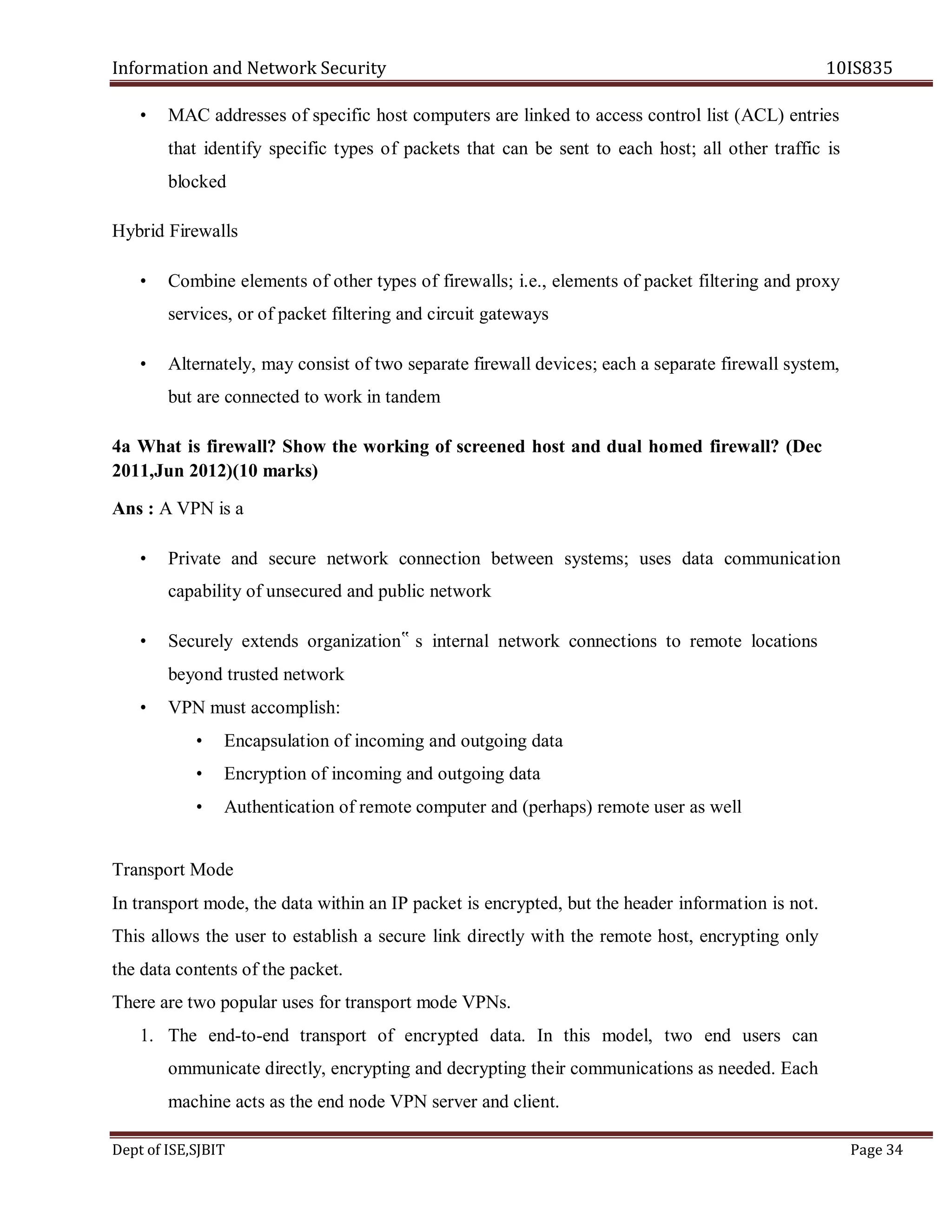
There are two popular uses for transport mode VPNs . The first is the end-to-end
transport of encrypted data. In this model, two end users can communicate directly,
encrypting and decrypting their communications as needed. Each machine acts as the
end node VPN server and client In the second, a remote access worker or teleworker
connects to an office network over the Internet by connecting to a VPN server on the
Information and Network Security 10IS835
Dept of ISE,SJBIT Page 29
perimeter. This allows the teleworker's system to work as if it were part of the local area
network. The VPN server in this example acts as on intermediate node, encrypting traffic
from the secure intranet and transmitting it to the remote client, and decrypting traffic
from the remote client and transmitting it to its final destination.
This model frequently allows the remote system to act as its own VPN server, which is a
weakness, since most work-at-home employees are not provided with the same level of
physical and logical security they would be if they worked in the office.
OFFLINE
VPN vs. Dial-Up
Modern organizations can no longer afford to have their knowledge workers
"chained” to hardwired local networks and resources. The increase in broadband home
services and public Wi-Fi networks has increased use of VPN technologies, enabling
remote connections to the organization's network to be established from remote
locations, as when, for example, employees work from home or are traveling on
business trips. Road warriors can now access their corporate e-mail and local network
resources from wherever they happen to be. Remote access falls into three
broad categories:
1) connections with full network
access, where the remote computer acts as if it were a node on the organization's n
work;
2) feature-based connections, where users need access to specific, discrete
network features like e-mail or file transfers; and 3) connections that allow remote
Information and Network Security 10IS835
Dept of ISE,SJBIT Page 30
control of a personal computer, usually in the worker's permanent office. It is the first
category of connections that now use VPN instead of the traditional dial-up access
based on dedicated inbound phone lines.
In the past, mobile workers used Remote Access Servers (RAS) over dial-up or ISDN
leased lines to connect to company networks from remote locations (that is, when they
were working from home or traveling). All things considered, RAS was probably more
secure than the current practice of using a VPN, as the connection was made on a t
private network. However, RAS is expensive because it depends on dedicated phone
circuits specialized equipment, and aging infrastructure.
The alternative is VPN, which makes use of the public Internet. It is a solution that
offers industrial-grade security. VPN today uses two different approaches to the
technolgy-IPSec and Secure Sockets Layer (SSL). IPSec is more secure but is more
expensive and requires more effort to administer. SSL is already available on most
common Internet browsers and offers broader compatibility without requiring special
software on the client computer. While SSL-based VPN has a certain attractiveness on
account of its wide application cability and lower cost, it is not a perfect solution. The
fact that it can be used nearly any where makes losses from user lapses and purposeful
abuse more likely.
Tunnel Mode
In tunnel mode, the organization establishes two perimeter tunnel servers. These
servers serve as the encryption points, encrypting all traffic that will traverse an
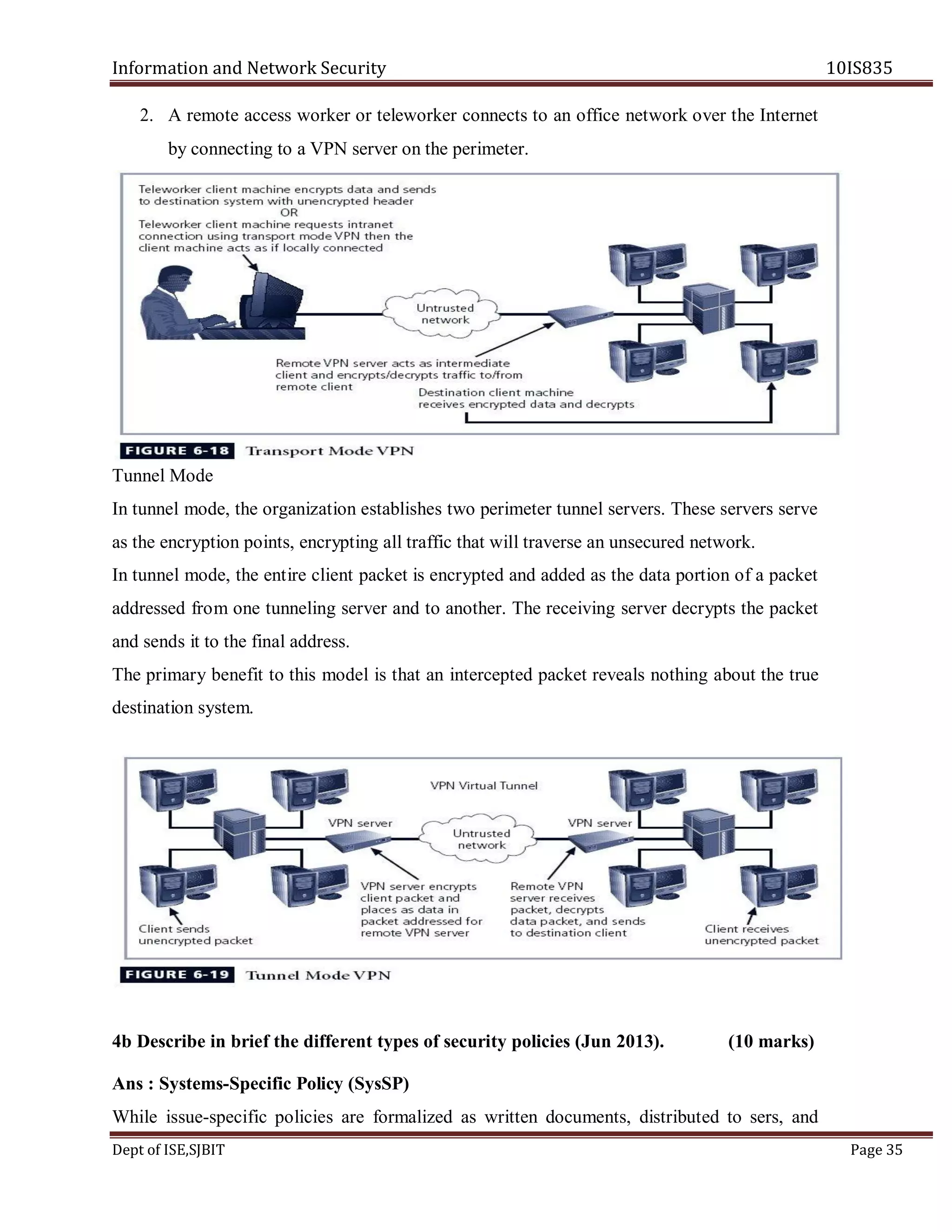
unsecured network. In tunnel mode, the entire client packet is encrypted and added as the
data of a packet addressed from one tunneling server and to another. The receiving ser
Information and Network Security 10IS835
Dept of ISE,SJBIT Page 31
decrypts the packet and sends it to the final address. The primary benefit to this model is
that an intercepted packet reveals nothing about the true destination system.
One example of a tunnel mode VPN is provided with Microsoft's Internet Security and
Acceleration (ISA) Server. With ISA Server, an organization can establish a gateway-to-
gateway tunnel, encapsulating data within the tunnel. ISA can use the Point to Point nneling
Protocol (PPTP), Layer 2 Tunneling Protocol (L2TP), or Internet Securi1 Protocol (IPSec)
technologies. Additional detail on these protocols is provided in Chapter 8. Figure 6-19 shows
an example of tunnel mode VPN implementation. On the client end, a user with Windows
2000 or XP can establish a VPN by configuring his or her system connect to a VPN server.
The process is straightforward. First, connect to the Internet through an ISP or direct network
connection. Second, establish the link with the remote VPN server. Figure 6-20 shows the
connection screens used to configure the VPN link. .
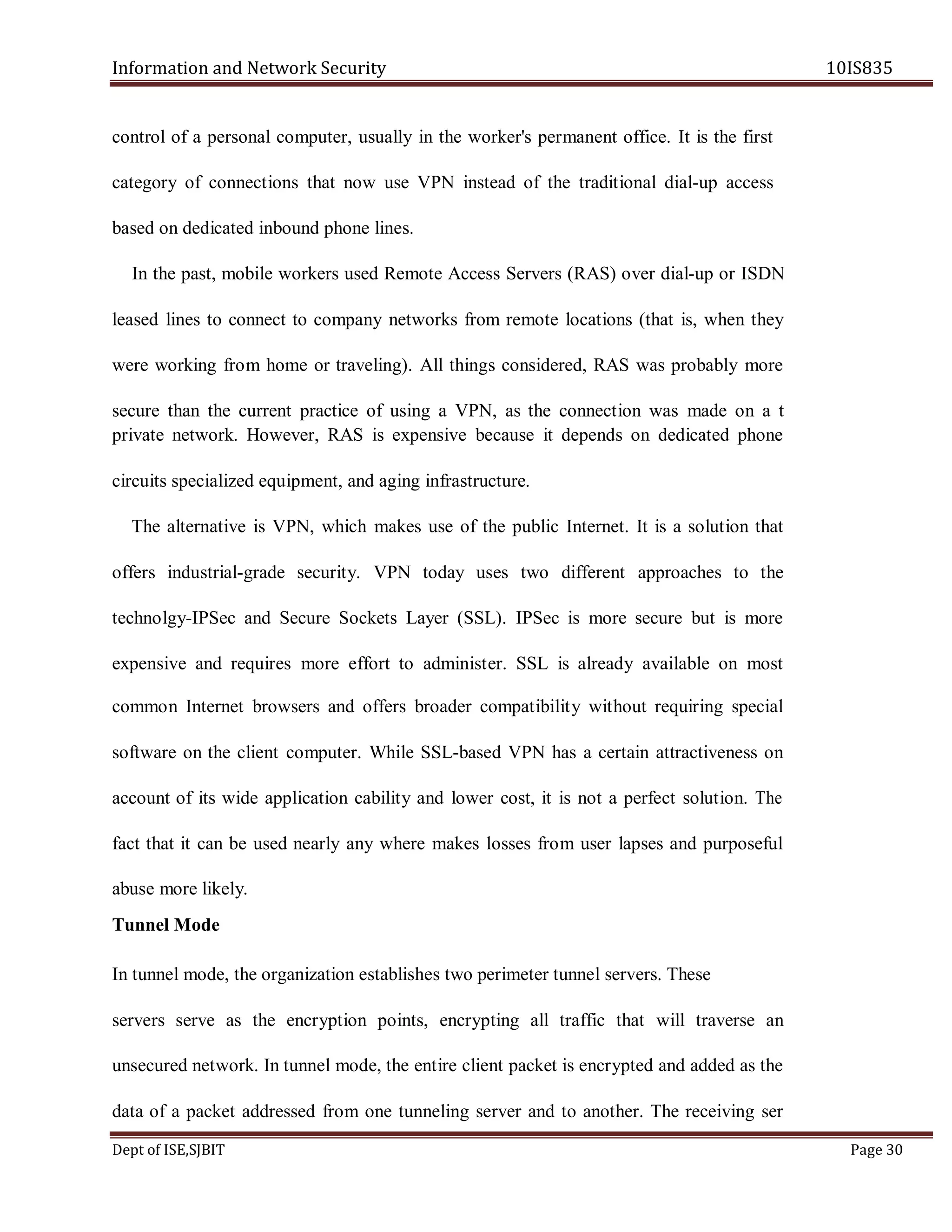
3 a. Explain the screened subnet firewall.(Dec 2012)(10 Marks)
Ans: Dominant architecture used today is the screened subnet firewall
• Commonly consists of two or more internal bastion hosts behind packet filtering router,
with each host protecting trusted network:
– Connections from outside (untrusted network) routed through external filtering
router
– Connections from outside (untrusted network) are routed into and out of routing
firewall to separate network segment known as DMZ
– Connections into trusted internal network allowed only from DMZ bastion host
servers
• Screened subnet performs two functions:
– Protects DMZ systems and information from outside threats
– Protects the internal networks by limiting how external connections can gain
access to internal systems
Information and Network Security 10IS835
Dept of ISE,SJBIT Page 32
3b. What is firewall? Explain categories of firewalls based on processing mode. (Jun 2011)
(10 Marks)
Ans: A firewall in an information security program is similar to a building‟ s firewall in that
it prevents specific types of information from moving between the outside orld,known as the
untrusted network(eg., the Internet), and the inside world, known as the trusted etwork.
The FIVE processing modes are:
1. Packet Filtering
2. Application Gateways
3. Circuit Gateways
4. MAC layer firewalls
5. Hybrids
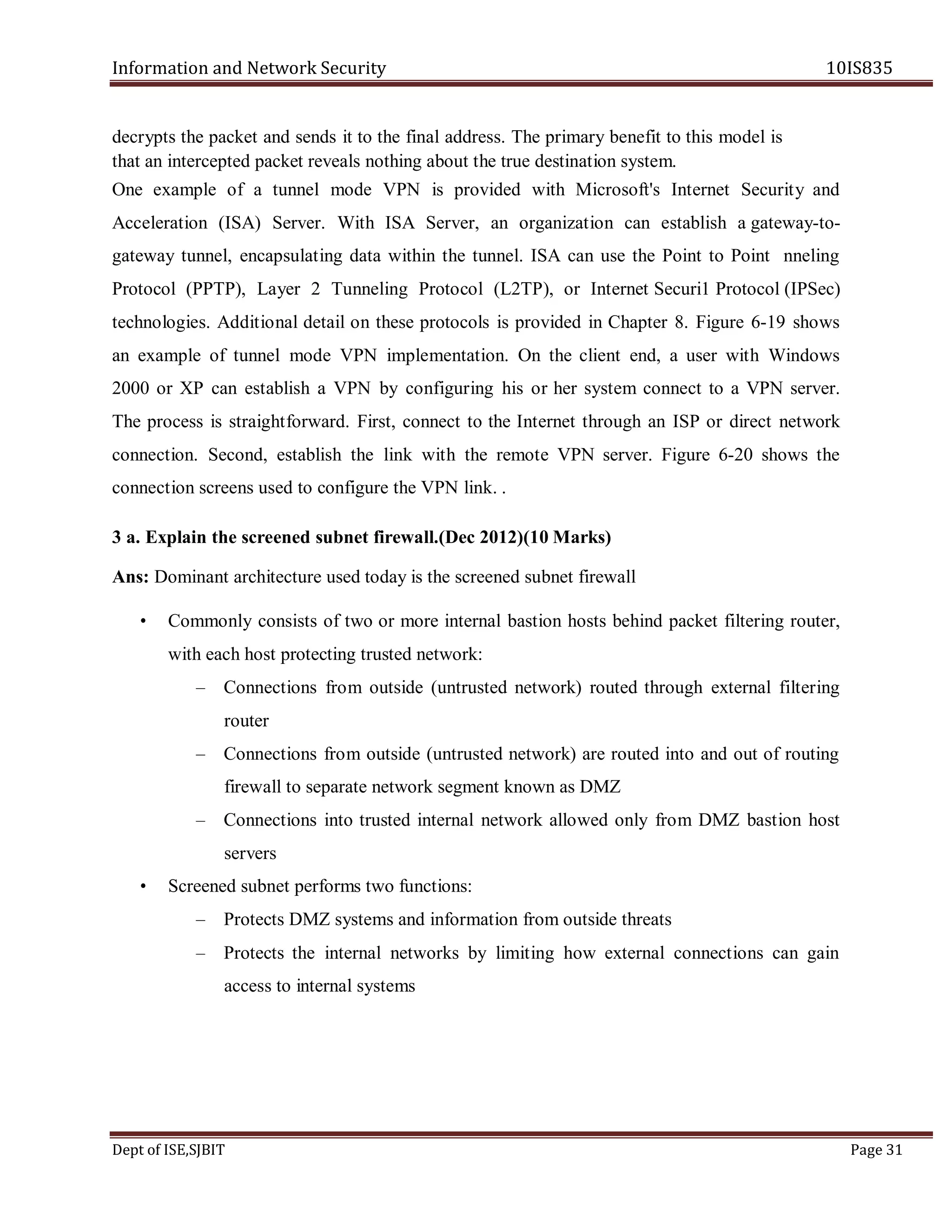
I. Packet Filtering
Packet filtering firewall or simply filtering firewall examine the header
information of data packets that come into a network. A packet filtering firewall installed
on a TCP/IP based network typically functions at the Ip level and determines whether to drop a
packet (Deny) or forward it to the next network connection (Allow) based on the rules
programmed into the firewall.
Information and Network Security 10IS835
Dept of ISE,SJBIT Page 33
Application Gateways
• Frequently installed on a dedicated computer; also known as a proxy server
• Since proxy server is often placed in unsecured area of the network (e.g., DMZ), it is
exposed to higher levels of risk from less trusted networks
• Additional filtering routers can be implemented behind the proxy server, further
protecting internal systems
Circuit Gateways
• Circuit gateway firewall operates at transport layer
• Like filtering firewalls, do not usually look at data traffic flowing between two networks,
but prevent direct connections between one network and another
• Accomplished by creating tunnels connecting specific processes or systems on each side
of the firewall, and allow only authorized traffic in the tunnels
MAC Layer Firewalls
• Designed to operate at the media access control layer of OSI network model
• Able to consider specific host computer‟ s identity in its filtering decisions
Information and Network Security 10IS835
Dept of ISE,SJBIT Page 34
• MAC addresses of specific host computers are linked to access control list (ACL) entries
that identify specific types of packets that can be sent to each host; all other traffic is
blocked
Hybrid Firewalls
• Combine elements of other types of firewalls; i.e., elements of packet filtering and proxy
services, or of packet filtering and circuit gateways
• Alternately, may consist of two separate firewall devices; each a separate firewall system,
but are connected to work in tandem
4a What is firewall? Show the working of screened host and dual homed firewall? (Dec
2011,Jun 2012)(10 marks)
Ans : A VPN is a
• Private and secure network connection between systems; uses data communication
capability of unsecured and public network
• Securely extends organization‟ s internal network connections to remote locations
beyond trusted network
• VPN must accomplish:
• Encapsulation of incoming and outgoing data
• Encryption of incoming and outgoing data
• Authentication of remote computer and (perhaps) remote user as well
Transport Mode
In transport mode, the data within an IP packet is encrypted, but the header information is not.
This allows the user to establish a secure link directly with the remote host, encrypting only
the data contents of the packet.
There are two popular uses for transport mode VPNs.
1. The end-to-end transport of encrypted data. In this model, two end users can
ommunicate directly, encrypting and decrypting their communications as needed. Each
machine acts as the end node VPN server and client.
Information and Network Security 10IS835
Dept of ISE,SJBIT Page 35
2. A remote access worker or teleworker connects to an office network over the Internet
by connecting to a VPN server on the perimeter.
Tunnel Mode
In tunnel mode, the organization establishes two perimeter tunnel servers. These servers serve
as the encryption points, encrypting all traffic that will traverse an unsecured network.
In tunnel mode, the entire client packet is encrypted and added as the data portion of a packet
addressed from one tunneling server and to another. The receiving server decrypts the packet
and sends it to the final address.
The primary benefit to this model is that an intercepted packet reveals nothing about the true
destination system.
4b Describe in brief the different types of security policies (Jun 2013). (10 marks)
Ans : Systems-Specific Policy (SysSP)
While issue-specific policies are formalized as written documents, distributed to sers, and
Information and Network Security 10IS835
Dept of ISE,SJBIT Page 36
agreed to in writing, SysSPs are frequently codified as standards and procedures to be used
When configuring or maintaining systems
Systems-specific policies fall into two groups:
– Access control lists (ACLs) consist of the access control lists, matrices, and
capability tables governing the rights and privileges of a particular user to a
particular system. An ACL is a list of access rights used by file storage systems, object
brokers, or other network communications devices to determine which individuals or
groups may access an object that it controls.(Object Brokers are system components that
handle message requests between the software components of a system)
– A similar list, which is also associated with users and groups, is called a Capability
This specifies which subjects and objects a user or group can access. Capability
tables are frequently complex matrices, rather than simple lists or tables.
– Configuration rules: comprise the specific configuration codes entered into security
systems to guide the execution of the system when information is passing through it
Issue-Specific Security Policy (ISSP)
– As various technologies and processes are implemented, certain guidelines are needed to
use them properly
– The ISSP:
– addresses specific areas of technology like
–Electronic mail
–Use of the Internet
– Specific minimum configurations of computers to defend against worms
viruses.
– Prohibitions against hacking or testing organization security controls.
– Home use of company-owned computer equipment.
Table.
and
Information and Network Security 10IS835
Dept of ISE,SJBIT Page 37
– Use of personal equipment on company networks
– Use of telecommunications technologies (FAX and Phone)
– Use of photocopy equipment. requires frequent updates contains an issue
UNIT 3
SECURITY TECHNOLOGY – 2
1a What is VPN? Explain the two modes of VPN. (Dec 2011,Jun 2012)(10 marks)
Virtual Private Networks are implementations of cryptographic technology (which you
learn about in Chapter 8 of this book). A Virtual Private Network (VPN) is a private and
secure network connection between systems that uses the data communication
capability of an unsecured and public network. The Virtual Private Network Consortium
(VPN ( www.vpnc.org) defines a VPN as "a private data network that makes use of the Public
telecommunication infrastructure, maintaining privacy through the use of a tunneling protocol
and security procedures. VPNs are commonly used to extend securely an organinization's
internal network connections to remote locations beyond the trusted network.
The VPNC defines three VPN technologies: trusted VPNs, secure VPNs, and hybrid VPNs A
trusted VPN, also known as legacy VPN, uses leased circuits from a service provider and
conducts packet switching over these leased circuits . The organization must trust the service
provider, who provides contractual assurance that no one else is allowed to use these circuits
and that the circuits are properly maintained and protected-hence the name trusted VPN.
Secure VPNs use security protocols and encrypt traffic transmitted across unsecured public
networks like the internet . A hybrid VPN combines the two providing encrypted
transmissions (as in secure VPN ) over some or all of a trusted VPN network.
A VPN that proposes to offer a secure and reliable capability while relying on public
networks must accomplish the following, regardless of the specific technologies and
protocols being used:
Information and Network Security 10IS835
Dept of ISE,SJBIT Page 38
• . Encapsulating of incoming and outgoing data, wherein the native protocol of the
client is embedded within the frames of a protocol that can be routed over the
public network as well as be usable by the server network environment.
• Encryption of incoming and outgoing data to keep the data contents private while in
transit over the public network but usable by the client and server computers and/or
the local networks on both ends of the VPN connection.
• Authentication of the remote computer and, perhaps, the remote user as well.
• Authentication and the subsequent authorization of the user to perform specific
options are predicated on accurate and reliable identification of the remote system
and/or user.
In the most common implementation, a VPN allows a user to turn the Internet in private
network. As you know, the Internet is anything but private. However, using the tunneling
approach an individual or organization can set up tunneling points across the Internet and send
encrypted data back and forth, using the IP-packet-within-an-IP-packet method to transmit
data safely and securely. VPNs are simple to set up and maintain usually require only
that the tunneling points be dual-horned-that is, connecting a private network to the
Internet or to another outside connection point. There is VPN support built into most
Microsoft server software, including NT and 2000, as well as client support for VPN
services built into XP. While true private network services connections can cost hundreds
of thousands of dollars to lease,configure, and maintain, a VPN can cost next nothing.
There are a number of ways to implement a VPN. IPSec, the dominant protocol used in
VPNs, uses either transport mode or tunnel mode. IPSec can be used as a stand alone protocol,
or coupled with the Layer 2 Tunneling Protocol (L2TP).
Transport Mode
In transport mode, the data within an IP packet is encrypted) but the header
information is not. This allows the user to establish a secure link directly with the remote
host, encrypting only the data contains of the packet. The downside to this
implementation is that packet eavesdroppers can still determine the destination system.
Information and Network Security 10IS835
Dept of ISE,SJBIT Page 39
Once an attacker knows the destination, he or she may be able to compromise one of the
end nodes and acquire the packet information from it. On the other hand, transport mode
eliminates the need for special servers and tunneling software, and allows the end users to
transmit traffic from anywhere. This is especially useful for traveling or telecommuting
employees.
There are two popular uses for transport mode VPNs . The first is the end-to-end
transport of encrypted data. In this model, two end users can communicate directly,
encrypting and decrypting their communications as needed. Each machine acts as the
end node VPN server and client In the second, a remote access worker or teleworker
connects to an office network over the Internet by connecting to a VPN server on the
perimeter. This allows the teleworker's system to work as if it were part of the local area
network. The VPN server in this example acts as on intermediate node, encrypting traffic
from the secure intranet and transmitting it to the remote client, and decrypting traffic
from the remote client and transmitting it to its final destination.
This model frequently allows the remote system to act as its own VPN server, which is a
weakness, since most work-at-home employees are not provided with the same level of
physical and logical security they would be if they worked in the office.
OFFLINE
VPN vs. Dial-Up
Modern organizations can no longer afford to have their knowledge workers
"chained” to hardwired local networks and resources. The increase in broadband home
services and public Wi-Fi networks has increased use of VPN technologies, enabling
Information and Network Security 10IS835
Dept of ISE,SJBIT Page 40
remote connections to the organization's network to be established from remote
locations, as when, for example, employees work from home or are traveling on
business trips. Road warriors can now access their corporate e-mail and local network
resources from wherever they happen to be. Remote access falls into three
broad categories:
1) connections with full network
access, where the remote computer acts as if it were a node on the organization's n
work;
2) feature-based connections, where users need access to specific, discrete
network features like e-mail or file transfers; and 3) connections that allow remote
control of a personal computer, usually in the worker's permanent office. It is the first
category of connections that now use VPN instead of the traditional dial-up access
based on dedicated inbound phone lines.
In the past, mobile workers used Remote Access Servers (RAS) over dial-up or ISDN
leased lines to connect to company networks from remote locations (that is, when they
were working from home or traveling). All things considered, RAS was probably more
secure than the current practice of using a VPN, as the connection was made on a t
private network. However, RAS is expensive because it depends on dedicated phone
circuits specialized equipment, and aging infrastructure.
The alternative is VPN, which makes use of the public Internet. It is a solution that
offers industrial-grade security. VPN today uses two different approaches to the
technolgy-IPSec and Secure Sockets Layer (SSL). IPSec is more secure but is more
expensive and requires more effort to administer. SSL is already available on most
Information and Network Security 10IS835
Dept of ISE,SJBIT Page 41
common Internet browsers and offers broader compatibility without requiring special
software on the client computer. While SSL-based VPN has a certain attractiveness on
account of its wide application cability and lower cost, it is not a perfect solution. The
fact that it can be used nearly any where makes losses from user lapses and purposeful
abuse more likely.
Tunnel Mode
In tunnel mode, the organization establishes two perimeter tunnel servers. These
servers serve as the encryption points, encrypting all traffic that will traverse an
unsecured network. In tunnel mode, the entire client packet is encrypted and added as the
data of a packet addressed from one tunneling server and to another. The receiving ser
decrypts the packet and sends it to the final address. The primary benefit to this model is
that an intercepted packet reveals nothing about the true destination system.
One example of a tunnel mode VPN is provided with Microsoft's Internet Security and
Acceleration (ISA) Server. With ISA Server, an organization can establish a gateway-to-
gateway tunnel, encapsulating data within the tunnel. ISA can use the Point to Point nneling
Protocol (PPTP), Layer 2 Tunneling Protocol (L2TP), or Internet Securi1 Protocol (IPSec)
technologies. Additional detail on these protocols is provided in Chapter 8. Figure 6-19 shows
an example of tunnel mode VPN implementation. On the client end, a user with Windows
2000 or XP can establish a VPN by configuring his or her system connect to a VPN server.
The process is straightforward. First, connect to the Internet through an ISP or direct network
connection. Second, establish the link with the remote VPN server. Figure 6-20 shows the
connection screens used to configure the VPN link. .
1b Differentiate between network based IDS and Host Based IDS emphasizing on
their advantages and disadvantages . (Jun 2013,Dec 2011)(8 marks)
A network-based IDS (NIDS)
Information and Network Security 10IS835
Dept of ISE,SJBIT Page 42
Advantages and Disadvantages of NIDSs: The following is a summary, taken from Bace and
Mell, of the advantages and disadvantages of NIDSs:
Advantages:
1. Good network design and placement of NIDS devices can enable an organization to use a few
devices to monitor a large network.
2. NIDSs are usually passive devices and can be deployed into existing networks with little or no
disruption to normal network operations.
3. NIDSs are not usually susceptible to direct attack and, in fact, may not be detectable by
attackers.
Disadvantages:
1. A NIDS can become overwhelmed by network volume and fail to recognize attacks it
ight otherwise have detected. Some IDS vendors are accommodating the need for ever faster
network performance by improving the processing of detection algorithms in dedicated
hardware circuits to gain a performance advantage. Additional efforts to optimize rule set
processing may also reduce overall effectiveness in detecting attacks.
2. NIDSs require access to all traffic to be monitored. The broad use of switched
Ethernet networks has replaced the ubiquity of shared collision domain hubs. Since many
switches have limited or no monitoring port capability, some networks are not capable of
providing aggregate data for analysis by a NIDS. Even when switches do provide
monitoring ports, they may not be able to mirror aJl activity with a consistent and reliable
time sequence.
3. NIDSs cannot analyze encrypted packets, making some of the network traffic invisible to
the process. The increasing use of encryption that hides the contents of some or all of the
packet by some network services (such as SSL, SSH, and VPN) limits the effectiveness of
NIDSs.
4. NIDSs cannot reliably ascertain if an attack was successful or not. This requires the
network administrator to be engaged in an ongoing effort to evaluate the results of the lugs
of suspicious network activity.
5. Some forms of attack are not easily discerned by NIDSs, specifically those
involving fragmented packets. In fact, some NIDSs are particularly susceptible to
Information and Network Security 10IS835
Dept of ISE,SJBIT Page 43
malformed packets and may become unstable and stop functioning.
Host-Based IDS
Advantages and Disadvantages of HIDSs: The following is a summary, taken from Bace
and Mell, of the advantages and disadvantages of HIDSs: Advantages:
1. A HIDS can detect local events on host systems and also detect attacks that may
elude a network-based IDS.
2. A HIDS functions on the host system, where encrypted traffic will have been decrypted
and is available for processing.
3. The use of switched network protocols does not affect a HIDS.
4. A HIDS can detect inconsistencies in how applications and systems programs were used
by examining the records stored in audit logs. This can enable it to detect some types of
attacks, including Trojan Horse programs.6
Disadvantages:
1. HIDSs pose more management issues since they are configured and managed on
each monitored host. This means that it will require more management effort to install,
configure, and operate a HIDS than a comparably sized NIDS solution.
2. A HIDS is vulnerable both to direct attacks and to attacks against the host operating
system. Either circumstance can result in the compromise and/or loss of HIDS functionality.
3. A HIDS is not optimized to detect multi-host scanning, nor is it able to detect the scanning
of non-host network devices, such as routers or switches. Unless complex correlation
analysis is provided, the HIDS will not be aware of attacks that span multiple devices in the
network.
4. A HIDS is susceptible to some denial-of-service attacks.
5. A HIDS can use large amounts of disk space to retain the host as audit logs; and to
function properly, it may require disk capacity to be added to the system.
6. A HIDS can inflict a performance overhead on its host systems, and in some cases may
reduce system performance below acceptable levels.7
2 a With the help of schematic diagram explain the centralized control strategy
implementation
Information and Network Security 10IS835
Dept of ISE,SJBIT Page 44
of IDS. (Jun 2013). (6 marks)
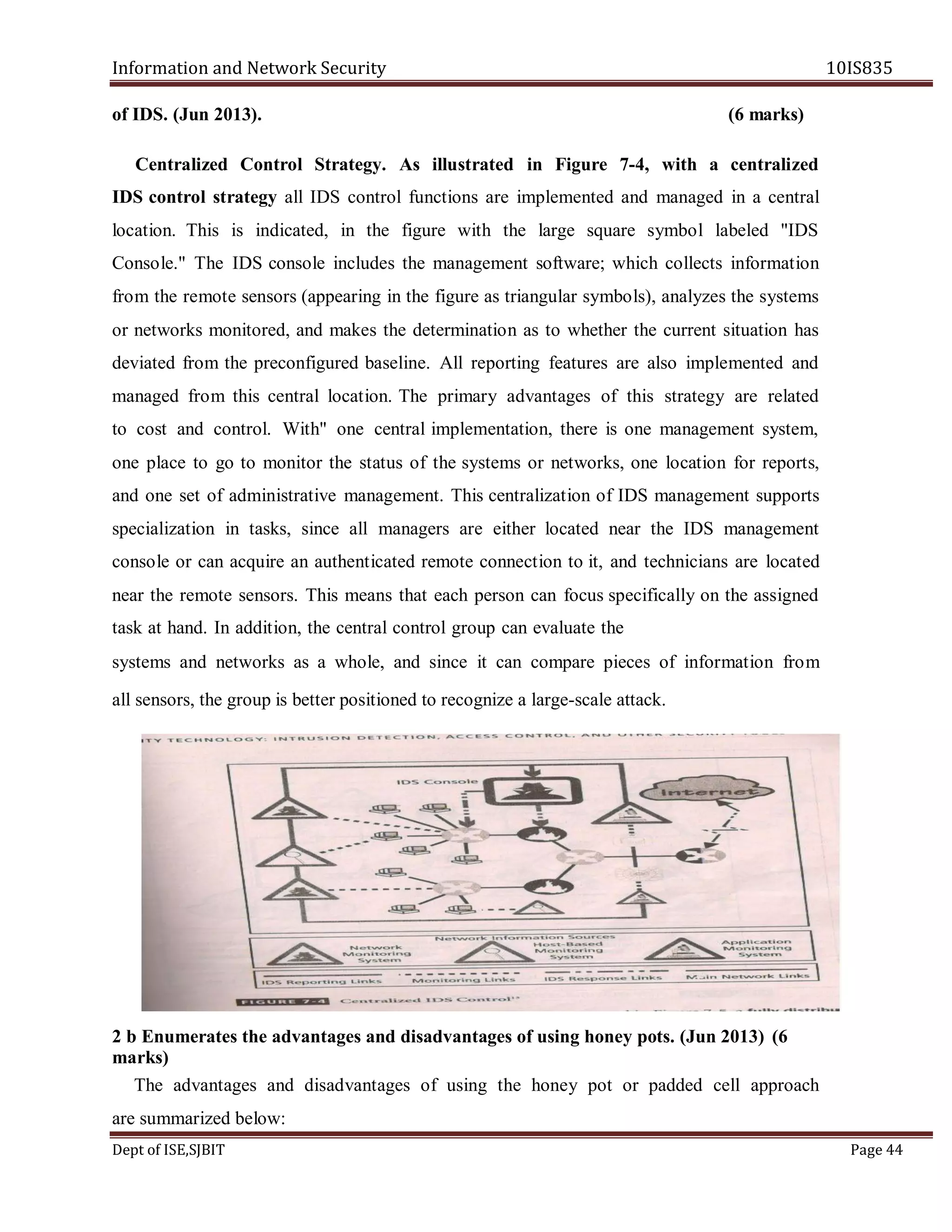
Centralized Control Strategy. As illustrated in Figure 7-4, with a centralized
IDS control strategy all IDS control functions are implemented and managed in a central
location. This is indicated, in the figure with the large square symbol labeled "IDS
Console." The IDS console includes the management software; which collects information
from the remote sensors (appearing in the figure as triangular symbols), analyzes the systems
or networks monitored, and makes the determination as to whether the current situation has
deviated from the preconfigured baseline. All reporting features are also implemented and
managed from this central location. The primary advantages of this strategy are related
to cost and control. With" one central implementation, there is one management system,
one place to go to monitor the status of the systems or networks, one location for reports,
and one set of administrative management. This centralization of IDS management supports
specialization in tasks, since all managers are either located near the IDS management
console or can acquire an authenticated remote connection to it, and technicians are located
near the remote sensors. This means that each person can focus specifically on the assigned
task at hand. In addition, the central control group can evaluate the
systems and networks as a whole, and since it can compare pieces of information from
all sensors, the group is better positioned to recognize a large-scale attack.
2 b Enumerates the advantages and disadvantages of using honey pots. (Jun 2013) (6
marks)
The advantages and disadvantages of using the honey pot or padded cell approach
are summarized below:
Information and Network Security 10IS835
Dept of ISE,SJBIT Page 45
Advantages:
• Attackers can be diverted to targets that they cannot damage.
• Administrators have time to decide how to respond to an attacker.
• Attackers actions can be easily and more extensively monitored and the records can
be used to refine threat models and improve system protections.
• Honey pots may be effective at catching insiders who are snooping around a network.
Disadvantages:
• The legal implications of using such devices are not well defined.
• Honey pots and padded cells have not yet been shown to be generally useful
security technologies.
• An expert attacker, once diverted into a decoy system, may become angry and
launch a more hostile attack against an organization's systems.
• Administrators and security managers will need a high level of expertise to use
these systems.
3 a. How does a signature-based IDPs differ from a behavior based IDPs ? (Jun 2011)
(10 Marks)
Ans : A signature-based IDS or knowledge-based IDS examines data traffic for something
that matches the signatures, which comprise preconfigured, predetermined attack patterns.
The problem with this approach is that the signatures must be continually updated, as new
attack strategies emerge. A weakness of this method is the time frame over which attacks
occur. If attackers are slow and methodical, they may slip undetected through the IDS, as their
actions may not match a signature that includes factors based on duration of the events.
The statistical anomaly-based IDS (stat IDS) or behavior-based IDS first collects data from
normal traffic and establishes a baseline. It then periodically samples network activity, based
on statistical methods, and compares the samples to the baseline. When the activity falls
outside the baseline parameters (known as the clipping level), the IDS notifies the
Information and Network Security 10IS835
Dept of ISE,SJBIT Page 46
administrator. The advantage of this approach is that the system is able to detect new types of
attacks, because it looks for abnormal activity of any type.
3 b. Explain the venerability scanners.(Dec 2012)(10 Marks)
Ans: Vulnerability scanners, which are variants of port scanners, are capable of scanning
networks for very detailed information. As a class, they identify exposed user names and
groups, show open network shares, and expose configuration problems and other server
vulnerabilities.Vulnerability scanner is GFI LAN guard Network Security Scanner (NSS),
which is available as & freeware for noncommercial use. Another example of a vulnerability
scanner is Nessus, which is a professional & freeware utility that uses IP packets to
determine the hosts available on the network, the services (ports) they a re offering, the
operating system and as version they are running, the type of packet filters and firewalls in
use, and dozens of other characteristics of the network.
4 a. Explain network based intrusion detection and prevention system (Jun2012) (10 Marks)
Ans : A network intrusion detection systems (NIDS) analyzes network traffic for attacks.
 It examines individual packets within the data stream to identify threats from
authorized users, back-door attacks and hackers who have thwarted the control
systems to exploit network connections and access valuable data.
 NIDS add a new level of visibility into the nature and characteristics of the network.
They provide vital information that can be used to:
◦ Increase the value and efficacy of the control systems like firewalls and routers
◦ Produces hard evidence for the altering of the enterprise security policy
◦ Provides decision support for network management
◦ Network-based IDS is a real-time monitoring system of the network based on
external traffic signatures (mostly signatures of known exploits) as they enter a
secure private network
◦ Unlike firewalls, IDS sensors capture, store, and report on signatures without
altering them.
◦ It also monitors internal traffic as it tries to move outside the private network.
◦ Parameters used to monitor traffic signatures in and out of the private network
Information and Network Security 10IS835
Dept of ISE,SJBIT Page 47
are base on either TCP or UDP structures.
◦ IDS sensors are either based on software or hardware.
4 b. Describe the need of operating system detection tools. (Jun 2011) (10 Marks)
Ans: Detecting a target computer's operating system is, very valuable to an attacker, because
once the as is known, all of the vulnerabilities to which it is susceptible can easily be
determined. There are many tools that use networking protocols to determine a remote
computer's as. One specific tool worth mentioning is XProbe, which uses ICMP to determine
the remote OS. This tool can be found at http://wMi..sys-stcurity.cor/1/lrtmllprojectslX.html.
When it's run, XProbe sends a lot of different ICMP queries against the target host. As reply
packets are received, XProbe matches these responses from the target's TCP/IP stack
with its own internal database of known responses. As most ass have a unique way of
responding to ICMP requests, Xprobe is very reliable in finding matches and thus
detecting the operating systems of remote computers. System and network administrators
should take note of this, and plan to restrict the use of ICMP through their organization's
firewalls and, when possible, within its internal networks.
5 a. Define the following terms related to IDS :
i. Alert
ii. False attack stimulus
iii. False negative
Information and Network Security 10IS835
Dept of ISE,SJBIT Page 48
iv. False positive
True attack stimulus
An indication that a system has just been attacked and/or continues to be under attack.
IDSs create alerts of alarms to notify administrators that an attack is or was or occurring
and may have been successful.
An event that triggers alarms and causes a false positive when no actual attacks are in
progress. Testing scenarios that evaluate the configuration of IDSs may use false attack
stimuli to determine if the IDSs can distinguish between these stimuli and real attacks.
The failure of an IDS system to react to an actual attack event. Of all failures, this is the
most grievous, for the very purpose of an IDS is to detect attacks.
An alarm or alert that indicates that an attack is in progress or that an attack has
successfully occurred when in fact there was no such attack.
An event that triggers alarms and causes an IDS to react as if a real attack is in
progress.
5 b. Discuss the reasons for acquisition and use of IDSs by organizations.
(6 Marks)
Ans: According to the NIST's documentation on industry best practices, there are several
compelling reasons to acquire and use an IDS:
1. To prevent problem behaviors by increasing the perceived risk of discovery and punishment
for those who would attack or otherwise abuse the system
2. To detect attacks and other security violations that are not prevented by other security
measures
3. To detect and deal with the preambles to attacks (commonly experienced as network probes
and other 'doorknob rattling' activities)
4. To document the existing threat to an organization.
5. To act as quality control for security design and administration, especially of large and
complex enterprises.
6. To provide useful information about intrusions that do take place, allowing improved
diagnosis, recovery, and correction of causative factors.
v. (Dec 2011) (5 Marks)
(Dec 2011)
Information and Network Security 10IS835
Dept of ISE,SJBIT Page 49
6a Explain the functionality of a network based IDPS. What are its advantages and
disadvantages.(Dec 2012) (10 marks)
Ans: A honeypot is a system designed to look like something that an intruder can hack. They are
built for many purposes but the overriding one is to deceive attackers and learn about their tools
and methods.
A honeynet is the
 Network of honeypots
 Supplemented by firewalls and intrusion detection systems – Honey wall
A padded cell is a honey pot that has been protected so that that it cannot be easily
compromised.
6 b Explain the different ways in which authentication is carried out to achieve access
control(Jun 2013 ) (10 marks)
Effectiveness of Biometrics
Biometric technologies are evaluated on three basis criteria: first, the reject rate, which is the
percentage of supplicants who are in fact authorized users but are denied access; second, the
false accept rate, which is the percentage of supplicants who are unauthorized users but are
granted access; finally, the crossover error rate, which is the level at which the number of false
rejections equals the false acceptances. Each of these is examined in detail in the following
sections.
False Reject Rate
The false reject rate is the percentage of or value associated with the rate at which supplicants
who are authentic users are denied or prevented access to authorized areas as a result of a failure
in the biometric device. This error rate is also known as a Type I error. While a nuisance to
supplicants who are authorized users, this error rate is probably the one that least concerns
security professionals since rejection of an authorized individual represents no threat to security ,
but is simply an impedance to authenticated use. As a result, the false reject rate is often ignored
Information and Network Security 10IS835
Dept of ISE,SJBIT Page 50
until it increases to a level high enough to irritate supplicants who, subsequently , begin
complaining. Most people have experienced the frustration of having a frequently used credit
card or ATM card fail to perform because of problems with the magnetic strip. In the field of
biometrics, similar problems can occur when a system fails to pick up the various information
points it uses to authenticate a prospective user properly.
False Accept Rate
The false accept rate is the percentage of or value associated with the rate at which supplicants
who are not legitimate users are allowed access to systems or areas as a result of a failure in the
biometric device. This error rate is also known as a Type II error. This type of error is
unacceptable to security professionals, as it represents a clear breach of access.
Crossover Error Rate(CER)
The crossover error rate(CER) is the level at which the number of false rejections equals the
false acceptances, also known as the equal error rate. This is possibly the most common and
important overall measure of the accuracy of a biometric system. Most biometric systems can be
adjusted to compensate for both false positive and false negative errors. Adjustment to one
extreme creates a system that requires perfect matches and results in high false rejects, but
almost no false accepts. Adjustment to the other extreme produces low false rejects, but almost
no false accepts. The trick is to find the balance between providing the requisite level of security
and minimizing the frustration level of authentic users. Thus, the optimal setting is found to be
somewhere near the point at which these two error rates are equal-that is, at the crossover error
rate or CER. CERs are used to compare various biometrics and may vary by manufacturer. A
biometric device that provides a CER of 1% is a device for which the failure rate for false
rejection and the failure rate for false acceptance are identical, at 1% failure of each type. A
device with a CER of 1% is considered superior to a device with a CER of 5% .
Information and Network Security 10IS835
Dept of ISE,SJBIT Page 51
Acceptability of Biometrics
As you've learned, a balance must be struck between how acceptable a security system is to its
users and how effective it is in maintaining security. Many the biometric systems that are highly
reliable and effective are considered somewhat intrusive to users. As a result, many information
security professionals, in an effort to avoid confrontation and possible user boycott of the
biometric controls, don't implement them. Table 7-3 shows how certain biometrics rank in terms
of effectiveness and acceptance. Interestingly, the order of effectiveness is nearly exactly
opposite the order of acceptance.
almost no false accepts. Adjustment to the other extreme produces low false rejects, but almost
no false accepts. The trick is to find the balance between providing the requisite level of security
and minimizing the frustration level of authentic users. Thus, the optimal setting is found to be
somewhere near the point at which these two error rates are equal-that is, at the crossover error
rate or CER. CERs are used to compare various biometrics and may vary by manufacturer. A
biometric device that provides a CER of 1% is a device for which the failure rate for false
rejection and the failure rate for false acceptance are identical, at 1% failure of each type. A
device with a CER of 1% is considered superior to a device with a CER of 5% .
Acceptability of Biometrics
As you've learned, a balance must be struck between how acceptable a security system is to its
users and how effective it is in maintaining security. Many the biometric systems that are highly
reliable and effective are considered somewhat intrusive to users. As a result, many information
security professionals, in an effort to avoid confrontation and possible user boycott of the
biometric controls, don't implement them. Table 7-3 shows how certain biometrics rank in terms
of effectiveness and acceptance. Interestingly, the order of effectiveness is nearly exactly
opposite the order of acceptance.
Information and Network Security 10IS835
Dept of ISE,SJBIT Page 52
UNIT 4
CRYPTOGRAPHY
1 a What is an intrusion? Briefly write about eight IDPS terminologies. (Dec 2012)
(10 marks)
Information security intrusion detection systems (IDSs) were first commercially available in the
late 1990s. An IDS works like a burglar alarm in that it detects a violation of its configuration
(analogous to an opened or broken window) and activates an alarm. This alarm can be audible
and/or visual (producing noise and lights, respectively), or it can be silent (taking the form of an
e-mail message or pager alert). With almost all IDSs, system administrators can choose the
configuration of the various alerts and the associated alarm levels for each type of alert. Many
IDSs enable administrators to configure the systems to notify them directly of trouble via e-mail
or pagers. The systems can also be configured-again like a burglar alarm-to notify an external
security service organization of a "break-in." The configurations that enable IDSs to provide
such customized levels of detection and response are quite complex. A valuable source of
information for more detailed study about IDS is National Institute of Standards and Technology
(NIST) Special Publication 800-31, "Intrusion Detection Systems;' written by Rebecca Bace and
Peter Mell and available through the NISI's Computer Security Resource Center at
http://csrc.nist.gov.
IDS Terminology
In order to understand IDS operational behavior, you must first become familiar with some
terminology that is unique to the field of IDSs. The following is a compilation of relevant IDS-
related terms and definitions that were drawn from the marketing literature of a well-known
information security company, TruSecure, but are representative across the industry:
Alert or Alarm: An indication that a system has just been attacked and/or continues to be under
attack. IDSs create alerts of alarms to notify administrators that an attack is or was or occurring
and may have been successful. Alerts and alarms may take the form of audible signals, e-
mail messages, pager notifications, pop-up windows, or log entries (these are merely written,
i.e., they do not involve taking any action).
False Attack Stimulus: An event that triggers alarms and causes a false positive when no actua
Information and Network Security 10IS835
Dept of ISE,SJBIT Page 53
attacks are in progress. Testing scenarios that evaluate the configuration of IDSs may use false
attack stimuli to determine if the IDSs can distinguish between these stimuli and real attacks.
False Negative: The failure of an IDS system to react to an actual attack event. Of all failures,
this is the most grievous, for the very purpose of an IDS is to detect attacks.
False Positive: An alarm or alert that indicates that an attack is in progress or that an attack has
successfully occurred when in fact there was no such attack. A false positive alert can sometimes
be produced when an IDS mistakes normal system operations/activity for an attack. False
positives tend to make users insensitive to alarms, and will reduce their quickness and degree of
reaction to actual intrusion events through the process of desensitization to alarms and alerts.
This can make users less inclined, and therefore slow, to react when an actual intrusion occurs.
Noise: The ongoing activity from alarm events that are accurate and noteworthy but not
necessarily significant as potentially successful attacks. Unsuccessful attacks are the most
common source of noise in IDSs, and some of these may not even be attacks at all, but rather
employees or the other users of the local network simply experimenting with scanning and
enumeration tools without any intent to do harm. The issue faced regarding noise is that most of
the intrusion events detected are not malicious and have no significant chance of causing a loss.
Site Policy: The rules and configuration guidelines governing the implementation and operation
of IDSs within the organization.
Site Policy Awareness: An IDSs ability to dynamically modify its site policies in reaction or
response to environmental activity. A so-called Smart ID can adapt its reaction activities based
on both guidance learned over the time from the administrator and circumstances present in the
local environment. Using a device of this nature, the IDs administrator acquires logs of events
that fit a specific profile instead of being alerted about minor changes, such as when a file is
changed or a user login fails. Another advantage of using a Smart IDS is that the IDS knows
when it does not need to alert the administrator-this would be the case when an attack using a
known and documented exploit is made against systems that the IDS knows are patched against
that specific kind of attack. When the IDS can accept multiple response profiles based on
changing attack scenarios and environmental values, it can be made much more useful.
True Attack Stimulus: An event that triggers alarms and causes an IDS to react as if a real
attack is in progress. The event may be an actual attack, in which an attacker is at work on a
system compromise attempt, or it may be a drill, in which security personnel are using hacker
Information and Network Security 10IS835
Dept of ISE,SJBIT Page 54
tools to conduct tests of a network segment.
Confidence Value: A value associated with an IDS's ability to detect and identify an attack
correctly. The confidence value an organization places in the IDS is based on experience and
past performance measurements. The confidence value, which is a type of fuzzy logic, provides
an additional piece of information to assist the administrator in determining whether an attack
alert is indicating that an actual attack in progress, or whether the IDS is reacting to false attack
stimuli and creating a false positive. For example, if a system deemed capable of reporting a
denial-of-service attack with 90% confidence sends an alert, there is a high probability that an
actual attack is occurring.
Alarm Filtering: The process of classifying the attack alerts that an IDS produces in order to
distinguish/sort false positives from actual attacks more efficiently. Once an IDS has been
installed and configured, the administrator can set up alarm filtering by first running the system
for a while to track what types of false positives it generates and then adjusting the classification
of certain alarms. For example, the administrator may set the IDS to discard certain alarms that
he or she knows are produced by false attack stimuli or normal network operations. Alarm filters
are similar to packet filters in that they can filter items by their source or destination IP
addresses, but they have the additional capability of being able to filter by operating systems,
confidence values, alarm type, or alarm severity.
Alarm Clustering : A consolidation of almost identical alarms into a single higher-level alarm.
This consolidation will reduce the total number of alarms generated, thereby reducing
administrative overhead, and will also indicate a relationship between the individual alarm
elements.
Alarm Compaction: Alarm clustering that is based on frequency, similarity in attack signature,
similarity in attack target, or other similarities. Like the previous form of alarm clustering, this
will reduce the total number of alarms generated, thereby reducing administrative overhead, and
will also indicate a relationship between the individual alarm elements when they have specific
similar attributes.
Information and Network Security 10IS835
Dept of ISE,SJBIT Page 55
2 b what is an encryption? Discuss the asymmetric and symmetric methods. (Dec 2012)
(10 marks)
Basic Encryption Definitions
To understand the fundamentals of cryptography, you must become familiar with the following
definitions:
• Algorithm: The programmatic steps used to convert an unencrypted message into an
encrypted sequence of bits that represent the message; sometimes used as a reference to
the programs that enable the cryptographic processes
• Cipher or cryptosystem: An encryption method or process encompassing the algorithm,
key(s) or cryptovariable(s), and procedures used to perform encryption and decryption
• Ciphertext or cryptogram: The unintelligible encrypted or encoded message resulting
from an encryption
• Code: The process of converting components (words or phrases) of an unencrypted
message into encrypted components
• Decipher: To decrypt or convert ciphertext into the equivalent plaintext
• Encipher: To encrypt or convert plaintext into the equivalent ciphertext
• Key or cryptovariable: The information used in conjunction with an algorithm to create the
ciphertext from the plaintext or derive the plaintext from the ciphertext; the key can be a
series of bits used by a computer program, or it can be a passphrase used by humans that is then
converted into a series of bits for use in the computer program
• Keyspace: The entire range of values that can possibly be used to construct an individual
key
• Link encryption: A series of encryptions and decryptions between a number of systems,
wherein each system in a network decrypts the message sent to it and then reencrypts it using
different keys and sends it to the next neighbor, and this process continues until the message
reaches the final destination
• Plaintext or cleartext: The original unencrypted message that is encrypted; also the name
Information and Network Security 10IS835
Dept of ISE,SJBIT Page 56
given to the results of a message that has been successfully decrypted
• Steganography: The process of hiding messages-for example, messages can be hidden
within the digital encoding of a picture or graphic
• Work factor: The amount of effort (usually in hours) required to perform cryptanalysis
on an encoded message so that it may be decrypted when the key or algorithm (or both) are
unknown
3 a what are the fundamental differences between asymmetric and symmetric encryption
(Jun 2013) (6 marks)
Asymmetric Encryption. Another category of encryption techniques is asymmetric
encryption. Whereas the symmetric encryption systems are based on using a single key to both
encrypt and decrypt a message, asymmetric encryption uses two different
but related keys, and either key can be used to encrypt or decrypt the message. If, however, Key
A is used to encrypt the message, only Key B can decrypt it, and if Key B is used to encrypt a
message, only Key A can decrypt it. Asymmetric ~ncryption can be used to provide elegant
solutions to problems of secrecy and verification. This technique has its highest value when one
key is used as a private key, which means that it is kept secret (much like the key of symmetric
encryption), known only to the owner of the key pair, and the other key serves as a public key,
which means that it is stored in a public location where anyone can use it. This is why the more
common name for asymmetric encryption is public key encryption. Consider the following
example, illustrated in Figure 8-4. Alex at XYZ Corporation wants to send an encrypted
message to Rachel at ABC Corporation. Alex goes to a public key registry and obtains Rachel's
public key. Remember that the foundation of asymmetric encryption is that the same key
cannot be used to both encrypt and decrypt the same message. So. when Rachel's public
key is used to encrypt the message, only Rachel's private key can be used to decrypt the
message and that private key is held by Rachel alone. Similarly, if Rachel wants to respond to
Alex's message, she goes to the registry where Alex's public key is held, and uses it to encrypt
her message, which of course can only be read by Alex's private key. This approach, which
keeps private keys secret and encourages the sharing of public keys in reliable directories, is an
Information and Network Security 10IS835
Dept of ISE,SJBIT Page 57
elegant solution to the key management problems found in symmetric key applications.
61
Asymmetric algorithms are based on one-way functions. A one-way function is simple to
compute in one direction, but complex to compute in the opposite. This is the foundation of
public-key encryption. Public-key encryption is based on a hash value, which, as you learned
earlier in this chapter, is calculated from an input number using a hashing algorithm. This hash
value is essential summary of the original input values. It is virtually impossible to derive the
original values without knowing how the values were used to create the hash value. For example.
if you multiply 45 by 235 you get 10,575. This is simple enough. But if you are simply given the
number 10,575, can you determine which two numbers were multiplied to determine this
number? Now assume that each multiplier is 200 digits long and prime. The resulting
multiplicative product would be up to 400 digits long. Imagine the time you'd need to factor that
out There is a shortcut, however. In mathematics, it is known as a trapdoor (which is different
from the software trapdoor). A mathematical trapdoor is a "secret mechanism that enables you
to easily accomplish the reverse function in a one-way function."4 With a trapdoor, you can use
a key to encrypt or decrypt the ciphertext, but not both, thus requiring two keys. The public key
becomes be the true key, and the private key is to be derived from the public key using the
trapdoor.
One of the most popular public key cryptosystems is RSA, whose name is derived from
Rivest-Shamir-Adleman, the algorithm's developers. The RSA algorithm was the first public
Information and Network Security 10IS835
Dept of ISE,SJBIT Page 58
key encryption algorithm developed (in 1977) and published for commercial use. It is very
popular and has been embedded in both Microsoft's and Netscape's Web browsers to enable them
to provide security for e-commerce applications. The patented RSA algorithm has in fact become
the de facto standard for public use encryption applications. To see how this algorithm works,
see the Technical Details box "RSA Algorithm."
3 b Explain the different categories of attacks on cryptosystem. (Jun 2013) (8 marks)
Man-in-the-Middle Attack
A man-in-the-middle attack, as discussed in Chapter 2, is designed to intercept the transmission
of a public key or even to insert a known key structure in place of the requested public key.
Thus, attackers attempt to place themselves between the sender and receiver, and once they've
intercepted the request for key exchanges, they send each participant a valid public key, which is
known only to them. From the perspective of the victims of such attacks, their encrypted
communication appears to be occurring normally, but in fact the attacker is receiving
eacencrypted message and decoding it (with the key given to the sending party), and then
encrypting signatures can prevent the traditional man-in-the-middle attack, as the attacker
cannot duplicate Correlation Attacks As the complexities of encryption methods have
increased, so too have the tools and methods of brute-force methods that attempt to deduce
statistical relationships between the structure of the cryptanalysis, both of which are advanced
methods of breaking codes that are beyond the scope as DES. If these advanced approaches can
calculate the value of the public key, and if this can be defense against this kind of attack is the
selection of strong cryptosystems that have stood the test the frequency of changing keys.
Dictionary Attacks
In a dictionary attack, the attacker encrypts every word in a dictionary using the same
cryptosystem as used by the target. The attacker does this in an attempt to locate a match
between the target ciphertext and the list of encrypted words from the same cryptosystem.
Dictionary attacks can be successful when the ciphertext consists of relatively few characters, as
for example files which contain encrypted usernames and passwords. If an attacker acquires a
system password file, the individual can run hundreds of thousands of potential passwords from
Information and Network Security 10IS835
Dept of ISE,SJBIT Page 59
the dictionary he or she has prepared against the stolen list. Most computer systems use a well-
known one-way hash function to store passwords in such files, but this can almost always allow
the attacker to find at least a few matches in any stolen password file. After a match is located,
the attacker has essentially identified a potential valid password for the system under attack.
Timing Attacks
In a timing attack, the attacker eavesdrops during the victim's session and uses
outside the organization's systems. Information in transit through public or leased networks
statisticalanalysis of the user's typing patterns and inter-keystroke timings to discern sensitive
session information. While timing analysis may not directly result in the decryption of sensitive
data, it can be used to gain information about the encryption key and perhaps the cryptosystem in
use. It may also eliminate' some algorithms as possible candidates, thus narrowing the attacker's
search. In this narrower field of options, the attacker can increase the odds of eventual success.
Once the attacker has successfully broken an encryption, he or she may launch a replay attack,
which is an attempt to resubmit a recording of the deciphered authentication to gain entry into a
secure source. Defending From Attacks Encryption is a very useful tool in protecting the
confidentiality of information that is in storage and/or transmission. However, it is just
that-another tool in the information security administrator's arsenal of weapons
against threats to information security. Frequently, unenlightened individuals describe
information security exclusively in terms of encryption (and possibly firewalls and antivirus
software). But encryption is simply the process of hiding the true meaning of information.
Over the millennia, mankind has developed dramatically more sophisticated means of
hiding information from those who should not see it. No matter how sophisticated
encryption and cryptosystems have become, however, they have retained the same flaw that the
first systems contained thousands of years ago: If you discover the key, that is, the method used
to perform the encryption, you can determine the message. Thus, key management is not so
much the management of technology but rather the management of people. Encryption can,
however, protect information when it is most vulnerable-that is, when it is example of
information that is outside the organization's control. With loss of control can come spoof, and
otherwise skulk around. As such, encryption is a vital piece of the security puzzle.
Information and Network Security 10IS835
Dept of ISE,SJBIT Page 60
3 c Define the following with relation to cryptography (Jun 2013) (6 marks)
To understand the fundamentals of cryptography, you must become familiar with the following
definitions:
• Algorithm: The programmatic steps used to convert an unencrypted message into an
encrypted sequence of bits that represent the message; sometimes used as a reference to
the programs that enable the cryptographic processes
• Cipher or cryptosystem: An encryption method or process encompassing the algorithm,
key(s) or cryptovariable(s), and procedures used to perform encryption and decryption
• Ciphertext or cryptogram: The unintelligible encrypted or encoded message resulting
from an encryption
• Code: The process of converting components (words or phrases) of an unencrypted message
into encrypted components
• Decipher: To decrypt or convert ciphertext into the equivalent plaintext
• Encipher: To encrypt or convert plaintext into the equivalent ciphertext
• Key or cryptovariable: The information used in conjunction with an algorithm to create the
ciphertext from the plaintext or derive the plaintext from the ciphertext; the key can be a
series of bits used by a computer program, or it can be a passphrase used by humans that is then
converted into a series of bits for use in the computer program
• Keyspace: The entire range of values that can possibly be used to construct an individual
key
• Link encryption: A series of encryptions and decryptions between a number of systems,
wherein each system in a network decrypts the message sent to it and then reencrypts it using
different keys and sends it to the next neighbor, and this process continues until the message
reaches the final destination
• Plaintext or cleartext: The original unencrypted message that is encrypted; also the name
given to the results of a message that has been successfully decrypted
• Steganography: The process of hiding messages-for example, messages can be hidden
within the digital encoding of a picture or graphic
Information and Network Security 10IS835
Dept of ISE,SJBIT Page 61
• Work factor: The amount of effort (usually in hours) required to perform cryptanalysis
on an encoded message so that it may be decrypted when the key or algorithm (or both) are
unknown.
4 a. What are the difference between digital signature and digital certificate ?
(Jun 2011) (10 Marks)
Ans: A digital signature is the cryptographic technique analogous to hand-written signatures.
An interesting thing happens when the asymmetric process is reversed, that is the private key is
used to encrypt a short message. The public key can be used to decrypt it, and the fact that the
message was sent by the organization that owns the private key cannot be refuted. This is known
as non-repudiation, which is the foundation of digital signatures. Digital Signatures are encrypted
messages that are independently verified by a central facility (registry) as authentic. In this
• sender digitally signs document, establishing he is document owner/creator.
• verifiable, nonforgeable: recipient can prove to someone that Bob, and no one else , must
have signed document .
A digital certificate is an electronic document, similar to a digital signature, attacked to a file
certifying that this file is from the organization it claims to be from and has not been modified
from the originating format. A Certificate Authority is an agency that manages the issuance of
certificates and serves as the electronic notary public to verify their worth and integrity.
4 b. Explain the two methods of encrypting plaintext.(Jun 2011) (10 Marks)
A plaintext can be encrypted through one of two methods, the bit stream method or the block
cipher method. With the bit stream method, each bit in the plaintext is transformed into a cipher
bit one bit at a time. In the case of the block cipher method, the message is divided into
blocks, for example, sets of 8-,16-,32-, or 64-bit blocks, and then each block of plaintext
bits is transformed into an encrypted block of cipher bits using an algorithm and a key. Bit
stream methods most commonly use algorithm functions like the exclusive OR operation
(XOR), whereas block methods can use substitution, transposition, XOR, or some
combination of these operations, as described in the following sections. As you read on, you
should note that most encryption methods using computer systems will operate on data at the
level of its binary digits (bits), but Some operations may operate at the byte or character level.
Information and Network Security 10IS835
Dept of ISE,SJBIT Page 62
5 a. List out the elements of cryptosystems and explain transposition cipher technique
(Jun 2012)(10Marks)
Ans: Cryptosystems are made up of a number of elements or components. These are usually
lgorithms and data handling techniques as well as procedures and process steps, which
are combined in multiple ways to meet a given organization's need to ensure
confidentiality and provide specialized authentication and authorization for its business
processes. In the sections that follow, you will first read about the technical aspects of
a number of cryptographic techniques, often called ciphers. The chapter will continue with an
exploration of some of the tools commonly used to implement cryptographic systems in the
world of business. The discussion will then proceed to the security protocols used to bring
communications security to the Internet and the world of e-commerce. Finally, the chapter will
conclude with a discussion of the attacks that are often found being used against
cryptosystems.
Transposition Cipher
The next type of cipher operation is the transposition. Just like the substitution
transposition cipher is simple to understand, but it can, if properly used, produce ciphertext.
5 b. Who can attack cryptosystems? Discuss different categories of attacks on
cryptosystems (July 2011) (10 Marks)
Ans:
Information and Network Security 10IS835
Dept of ISE,SJBIT Page 63
7 a Discuss in brief the specific security mechanisms.(Jun 2012) (10
marks)
Encipherment: The use of mathematical algorithms to transform data into a form
that is not readily intelligible. The transformation and subsequent
recovery of the data depend on an algorithm and zero or more
encryption keys.
Digital Signature: Data appended to, or a cryptographic transformation of, a data
unit that allows a recipient of the data unit to prove the source and
integrity of the data unit and protect against forgery.
Access Control: A variety of mechanisms that enforce access rights to resources.
Data Integrity: A variety of mechanisms used to assure the integrity of a data unit or
stream of data units.
Authentication Exchange: A mechanism intended to ensure the identity of an entity
by means of information exchange.
Traffic Padding: The insertion of bits into gaps in a data stream to frustrate traffic
analysis attempts.
Routing Control: Enables selection of particular physically secure routes for certain
data and allows routing changes, especially when a breach of
security is suspected.
Notarization: The use of a trusted third party to assure certain properties of a data
exchange.
PERVASIVE SECURITY MECHANISMS
Mechanisms that are not specific to any particular OSI security service or protocol layer.
Trusted Functionality: That which is perceived to be correct with respect to some
criteria (e.g., as established by a security policy).
Security Label: The marking bound to a resource (which may be a data unit) that
names or designates the security attributes of that resource.
Event Detection: Detection of security-relevant events.
Security Audit Trail: Data collected and potentially used to facilitate a security
audit, which is an independent review and examination of
Information and Network Security 10IS835
Dept of ISE,SJBIT Page 64
system records and activities.
Security Recovery: Deals with requests from mechanisms, such as event handling
and management functions, and takes recovery actions.
PART B
UNIT 5
INTRODUCTION TO NETWORK SECURITY, AUTHENTICATION APPLICATIONS
1a what is meant by information security? Discuss the three aspects of
information security.(Dec 2011)(10 marks)
Information Security: “Measures adopted to prevent the unauthorized use, misuse,
modification, Denial of use of knowledge, Facts, data or Capabilities”. From the above
definition, Information Security does guarantees protection.
5 b Briefly explain the four types of security attacks? That are normally encountered.also
distinguish between active and passive attacks. December 2010 10 marks
Sl.No Passive Attacks Active Attacks
1 Very Difficult to Detect and Very easy to Detect and Very
Measures are Available to difficult to Prevent.
prevent their Success
2 The Attacker merely needs to be The Attacker needs to gain
able to observe Transmissions. Physical control of a portion of
the link and be able to Insert and
Capture Transmission.
Information and Network Security 10IS835
Dept of ISE,SJBIT Page 65
3 The Entity is unaware of the The Entity gets aware of it, when
Attack. attacked.
4 Don‟ t involve any modification Involve modification of the.
of the contents of original original contents
message.
5 No Such changes The Attacks may be
Masquerade
Modification
Replay
DOS
Security Attacks:
Security attacks, used both in X.800 and RFC 2828, are classified as passive attacks and
active attacks.
A passive attack attempts to learn or make use of information from the system but does not
affect system resources.
An active attack attempts to alter system resources or affect their operation.
Passive Attacks:
Passive attacks are in the nature of eavesdropping on, or monitoring of, transmissions. The
goal of the opponent is to obtain information that is being transmitted. Two types of passive
attacks are release of message contents and traffic analysis.
The release of message contents is easily understood (Figure 1.3a). A telephone
conversation, an electronic mail message, and a transferred file may contain sensitive or
Information and Network Security 10IS835
Dept of ISE,SJBIT Page 66
confidential information. To prevent an opponent from learning the contents of these
transmissions.
A second type of passive attack, traffic analysis, is subtler (Figure 1.3b). Suppose that we
had a way of masking the contents of messages or other information traffic so that opponents,
even if they captured the message, could not extract the information from the message. The
common technique for masking contents is encryption. If we had encryption protection in
place, an opponent might still be able to observe the pattern of these messages. The opponent
could determine the location and identity of communicating hosts and could observe the
frequency and length of messages being exchanged. This information might be useful in
guessing the nature of the communication that was taking place.
Passive attacks are very difficult to detect because they do not involve any alteration of the
data. Typically, the message traffic is sent and received in an apparently normal fashion and
neither the sender nor receiver is aware that a third party has read the messages or observed
the traffic pattern. However, it is feasible to prevent the success of these attacks, usually by
means of encryption. Thus, the emphasis in dealing with passive attacks is on prevention
rather than detection.
1 b Briefly explain the four types of security attacks? That are normally encountered.
alsoDistinguish between active and passive attacks. (Dec 2011) (10 marks)
Active Attacks:
Active attacks involve some modification of the data stream or the creation of a false stream
and can be subdivided into four categories: Masquerade, Replay, Modification of messages,
and Denial of service.
A masquerade takes place when one entity pretends to be a different entity (Figure 1.4a). A
Information and Network Security 10IS835
Dept of ISE,SJBIT Page 67
masquerade attack usually includes one of the other forms of active attack. For example,
authentication sequences can be captured and replayed after a valid authentication sequence
has taken place, thus enabling an authorized entity with few privileges to obtain extra
privileges by impersonating an entity that has those privileges.
Replay involves the passive capture of a data unit and its subsequent retransmission to
produce an unauthorized effect (Figure 1.4b).
Modification of messages simply means that some portion of a legitimate message is
altered, or that messages are delayed or reordered, to produce an unauthorized effect (Figure
1.4c). For example, a message meaning "Allow John Smith to read confidential file
accounts" is modified to mean "Allow Fred Brown to read confidential file accounts."
The denial of service prevents or inhibits the normal use or management of communications
facilities (Figure 1.4d). This attack may have a specific target; for example, an entity may
suppress all messages directed to a particular destination (e.g., the security audit service).
Another form of service denial is the disruption of an entire network, either by disabling the
network or by overloading it with messages so as to degrade performance.
Information and Network Security 10IS835
Dept of ISE,SJBIT Page 68
2 b with the help of neat diagram explain the general format of a X.509 public key
certificate.(Jun 2013)(10 marks)
X.509 Authentication Service:
ITU-T recommendation X.509 is part of the X.500 series of recommendations that define a
directory service. The directory is a server or distributed set of servers that maintains a
database of information about users.
Information and Network Security 10IS835
Dept of ISE,SJBIT Page 69
• X.509 defines a framework for the provision of authentication services by the X.500
directory to its users. The directory may serve as a repository of public-key
certificates.
• X.509 defines alternative authentication protocols based on the use of public-key
certificates.
• X.509 is an important standard because the certificate structure and authentication
protocols defined in X.509 are used in a variety of contexts.
• X.509 is based on the use of public-key cryptography and digital signatures.
The digital signature scheme is assumed to require the use of a hash function. Again, the standard
does not dictate a specific hash algorithm.
The Figure 1.3 illustrates the generation of a public-key certificate.
Figure 1.3. Public-Key Certificate Use
Information and Network Security 10IS835
Dept of ISE,SJBIT Page 70
3 c. Write the summary of Kerberos version five message exchange. (Jun 2012) (6 Marks)
Kerberos Version 4:
Version 4 of Kerberos makes use of DES, to provide the authentication service. Viewing the
protocol as a whole, it is difficult to see the need for the many elements contained therein.
Therefore, we adopt a strategy used by Bill Bryant of Project Athena and build up to the full
protocol by looking first at several hypothetical dialogues. Each successive dialogue adds
additional complexity to counter security vulnerabilities revealed in the preceding dialogue.
A Simple Authentication Dialogue:
In any network environment, any client can apply to any server for service. The obvious security
risk is that of impersonation. An opponent can pretend to be another client and obtain
unauthorized privileges on server machines. To counter this threat, servers must be
able to confirm the identities of clients who request service.
Each server can be required to undertake this task for each client/server interaction, but in an
open environment, this places a substantial burden on each server.
An alternative is to use an authentication server (AS) that knows the passwords of all users
and stores these in a centralized database. In addition, the AS shares a unique secret key with
each server. These keys have been distributed physically or in some other secure manner.
[The portion to the left of the colon indicates the sender and receiver; the portion to the right
indicates the contents of the message, the symbol || indicates concatenation.]
(1) C →AS: IDC||PC||IDV
(2) AS→ C: Ticket
(3) C →V: IDC||Ticket
Ticket = E(Kv, [IDC||ADC||IDV])
where
C = client
Information and Network Security 10IS835
Dept of ISE,SJBIT Page 71
AS = authentication server
V =server
IDC = identifier of user on C
IDV = identifier of V
PC = password of user on C
ADC = network address of C
Kv = secret encryption key shared by AS and V
In this scenario, the user logs on to a workstation and requests access to server V. The client
module C in the user's workstation requests the user's password and then sends a message to
the AS that includes the user's ID, the server's ID, and the user's password. The AS checks its
database to see if the user has supplied the proper password for this user ID and whether this
user is permitted access to server V. If both tests are passed, the AS accepts the user as
authentic and must now convince the server that this user is authentic. To do so, the AS
creates a ticket that contains the user's ID and network address and the server's ID. This ticket
is encrypted using the secret key shared by the AS and this server. This ticket is then sent
back to C. Because the ticket is encrypted, it cannot be altered by C or by an opponent.
With this ticket, C can now apply to V for service. C sends a message to V containing C's ID
and the ticket. V decrypts the ticket and verifies that the user ID in the ticket is the same as
the unencrypted user ID in the message. If these two match, the server considers the user
authenticated and grants the requested service.
A More Secure Authentication Dialogue:
First, we would like to minimize the number of times that a user has to enter a password.
Suppose each ticket can be used only once. If user C logs on to a workstation in the morning
and wishes to check his or her mail at a mail server, C must supply a password to get a ticket
for the mail server. If C wishes to check the mail several times during the day, each attempt
requires reentering the password. We can improve matters by saying that tickets are reusable.
For a single logon session, the workstation can store the mail server ticket after it is received
and use it on behalf of the user for multiple accesses to the mail server
The second problem is that the earlier scenario involved a plaintext transmission of the
password [message (1)]. An eavesdropper could capture the password and use any service
Information and Network Security 10IS835
Dept of ISE,SJBIT Page 72
accessible to the victim.
To solve these additional problems, we introduce a scheme for avoiding plaintext passwords
and a new server, known as the ticket-granting server (TGS). The new but still hypothetical
scenario is as follows:
Once per user logon session:
(1) C→ AS IDC||IDtgs
(2) AS→ C: E(Kc, Tickettgs)
Once per type of service:
(3) C →TGS IDC||IDV||Tickettgs
(4) TGS→ C Ticketv
Once per service session:
(5) C→ V IDC||Ticketv
Tickettgs = E(Ktgs, [IDC||ADC||IDtgs||TS1||Lifetime1])
Ticketv = E(Kv, [IDC||ADC||IDv||TS2||Lifetime2])
The new service, TGS, issues tickets to users who have been authenticated to AS. Thus, the
user first requests a ticket-granting ticket (Tickettgs) from the AS. The client module in the
user workstation saves this ticket. Each time the user requires access to a new service, the
client applies to the TGS, using the ticket to authenticate itself. The TGS then grants a ticket
for the particular service. The client saves each service-granting ticket and uses it to
authenticate its user to a server each time a particular service is requested. Let us look at the
Information and Network Security 10IS835
Dept of ISE,SJBIT Page 73
details of this scheme.
1. The client requests a ticket-granting ticket on behalf of the user by sending its user's
ID and password to the AS, together with the TGS ID, indicating a request to use the
TGS service.
2. The AS responds with a ticket that is encrypted with a key that is derived from the
user's password. When this response arrives at the client, the client prompts the user
for his or her password, generates the key, and attempts to decrypt the incoming
message. If the correct password is supplied, the ticket is successfully recovered.
The Version 4 Authentication Dialogue:
The first problem is the lifetime associated with the ticket-granting ticket. If this lifetime is
very short (e.g., minutes), then the user will be repeatedly asked for a password. If the
lifetime is long (e.g., hours), then an opponent has a greater opportunity for replay.
The second problem is that there may be a requirement for servers to authenticate themselves
to users. Without such authentication, an opponent could sabotage the configuration so that
messages to a server were directed to another location. The false server would then be in a
position to act as a real server and capture any information from the user and deny the true
service to the user.
The following Table which shows the actual Kerberos protocol
(1) C→ AS IDc||IDtgs||TS1
(2) AS →C E(Kc,[Kc,tgs||IDtgs||TS2||Lifetime2||Tickettgs])
Tickettgs = E(Ktgs, [Kc,tgs||IDc||ADc||IDtgs||TS2||Lifetime2])
(a) Authentication Service Exchange to obtain ticket-granting ticket
Information and Network Security 10IS835
Dept of ISE,SJBIT Page 74
(3) C →TGS IDv||Tickettgs||Authenticatorc
(4) TGS→ C E(Kc,tgs, [Kc,v||IDv||TS4||Ticketv])
Tickettgs = E(Ktgs, [Kc,tgs||IDC||ADC||IDtgs||TS2||Lifetime2])
Ticketv = E(Kv, [Kc,v||IDC||ADC||IDv||TS4||Lifetime4])
Authenticatorc = E(Kc,tgs, [IDC||ADC||TS3])
(b) Ticket-Granting Service Exchange to obtain service-granting ticket
(5) C →V Ticketv||Authenticatorc
(6) V→ C E(Kc,v, [TS5 + 1]) (for mutual authentication)
Ticketv = E(Kv, [Kc,v||IDc||ADc||IDv||TS4||Lifetime4])
Authenticatorc = E(Kc,v,[IDc||ADC||TS5])
(c) Client/Server Authentication Exchange to obtain service
Figure 1.1. Overview of Kerberos
Kerberos Realms and Multiple Kerberi:
A full-service Kerberos environment consisting of a Kerberos server, a number of clients,
Information and Network Security 10IS835
Dept of ISE,SJBIT Page 75
and a number of application servers requires the following:
1. The Kerberos server must have the user ID and hashed passwords of all participating
users in its database. All users are registered with the Kerberos server.
2. The Kerberos server must share a secret key with each server. All servers are
registered with the Kerberos server.
3. The Kerberos server in each interoperating realm shares a secret key with the server
in the other realm. The two Kerberos servers are registered with each other.
Such an environment is referred to as a Kerberos realm. A Kerberos realm is a set of
managed nodes that share the same Kerberos database. Networks of clients and servers under
different administrative organizations typically constitute different realms. The scheme
requires that the Kerberos server in one realm trust the Kerberos server in the other realm to
authenticate its users.
Furthermore, the participating servers in the second realm must also be willing to trust the
Kerberos server in the first realm. With these ground rules in place, we can describe the
mechanism as shown in the Figure 1.2
5 a. Describe the various security attacks and specific mechanisms covered by X.800
(Dec 2011) (14 Marks)
Ans : Passive Attacks
Passive attacks are in the nature of eavesdropping on, or monitoring of, transmissions.The
goal of the opponent is to obtain information that is being transmitted.Two types of passive
attacks are release of message contents and traffic analysis. The release of message eontents is
easily understood . A telephone conversation, an electronic mail message, and a transferred file
may contain sensitive or confidential information
Active Attacks
Information and Network Security 10IS835
Dept of ISE,SJBIT Page 76
Active attacks involve some modification of the data stream or the creation of a false stream and
can be subdivided into four categories: masquerade, replay, modification of messages, and denial
af service. A masquerade takes pIace when one entity pretends to be a different entity . A
masquerade attack usually inc1udes one of the other forms of active attack. For exampIe,
authentication sequences can be captured and repIayed after a valid authentication sequence has
taken pIace, thus enabiing an authorized entity with few privileges to obtain extra privileges by
impersonating an entity that has those privileges. Replay involves the passive capture of a data
unit and its ubsequent retransmission to produce an unauthorized effect. Modification of
messages simpIy means that some portion of a Iegitimate message is altered, or that messages
are deIayed or reordered, to produce an unauthorized effect . For example, a message meaning
"Allow John Smith to read confidenti al file accounts" is modified to mean "Allow Fred Brown
to read confidential file accounts. "
5 b Explain the different authentication procedures in X.509 certificate.(Dec 2011,Jun
2012) (10 marks)
• Ans: CCITT recommendation defining a directory service.
Defines a framework for the authentication services
The X.500 directory serving as a repository of public-key certificates
Defines alternative authentication protocols
Information and Network Security 10IS835
Dept of ISE,SJBIT Page 77
5 c. Write the summary of Kerberos version five message exchange. (June 2010)
(6 Marks)
Ans: Kerberos Version 5 is specified in RFC 10 and provides a number of improvements over
version 4.
1.PCBC encryption: Version 5 provides explicit integrity mechanisms, allowing the standard
CBC mode to be used for encryption. In particular, a checksum or hash code is attached
to the message prior to encryption using CBC.
2. Session keys: In version 5, it is possible for a client and server to negotiate a subsession
key, which is to be used only for that one connection. A new access by the client would result
in the use of a new subsession key.
3. Password attacks: The message from the AS to the client includes material encrypted with a
key based on the client's password. An opponent can capture this message and attempt to
decrypt it by trying various passwords. If the result of a test decryption is of the proper
form, then the opponent has discovered the client's password and may subsequently use it
to gain authentication credentials from Kerberos. This is the same type of password attack,
with the same kinds of countermeasures being applicable.
4. Double encryption: the tickets provided to clients are encrypted twice, once with the secret
key of the target server and then again with a secret key known to the client. The second
encryption is not necessary and is computationally wasteful.
4 a. With a neat diagram, explain network security model ( Jun 2013,Dec 2012)(07 Marks)
Ans :
Information and Network Security 10IS835
Dept of ISE,SJBIT Page 78
The general model shows that there are four basic tasks in designing a particular security
service:
1. Design an algorithm for performing the security-related transformation. The algorithm
should be such that an opponent cannot defeat its purpose.
2. Generate the secret information to be used with the algorithm.
3. Develop methods for the distribution and sharing of the secret information.
4. Specify a protocol to be used by the two principals that makes use of the security
algorithm and the secret information to achieve a particular security service.
5 b. List out the difference between Kerberos version 4 and version 5. (July 2011,Jun 2013)
(8 Marks)
Information and Network Security 10IS835
Dept of ISE,SJBIT Page 79
6a Discuss the simple authentication dialogue in Kerberos vertion 4(Jun 2012) (10
marks)
A Simple Authentication Dialogue:
In any network environment, any client can apply to any server for service. The obvious
security risk is that of impersonation. An opponent can pretend to be another client and
obtain unauthorized privileges on server machines. To counter this threat, servers must be
able to confirm the identities of clients who request service.
Each server can be required to undertake this task for each client/server interaction, but in an
open environment, this places a substantial burden on each server.
An alternative is to use an authentication server (AS) that knows the passwords of all users
and stores these in a centralized database. In addition, the AS shares a unique secret key with
each server. These keys have been distributed physically or in some other secure manner.
[The portion to the left of the colon indicates the sender and receiver; the portion to the right
indicates the contents of the message, the symbol || indicates concatenation.]
(1) C →AS: IDC||PC||IDV
(2) AS→ C: Ticket
(3) C →V: IDC||Ticket
Information and Network Security 10IS835
Dept of ISE,SJBIT Page 80
Ticket = E(Kv, [IDC||ADC||IDV])
where
C = client
AS = authentication server
V =server
IDC = identifier of user on C
IDV = identifier of V
PC = password of user on C
ADC = network address of C
Kv = secret encryption key shared by AS and V
In this scenario, the user logs on to a workstation and requests access to server V. The client
module C in the user's workstation requests the user's password and then sends a message to
the AS that includes the user's ID, the server's ID, and the user's password. The AS checks its
database to see if the user has supplied the proper password for this user ID and whether this
user is permitted access to server V. If both tests are passed, the AS accepts the user as
authentic and must now convince the server that this user is authentic. To do so, the AS
creates a ticket that contains the user's ID and network address and the server's ID. This ticket
is encrypted using the secret key shared by the AS and this server. This ticket is then sent
back to C. Because the ticket is encrypted, it cannot be altered by C or by an opponent.
With this ticket, C can now apply to V for service. C sends a message to V containing C's ID
and the ticket. V decrypts the ticket and verifies that the user ID in the ticket is the same as
the unencrypted user ID in the message. If these two match, the server considers the user
authenticated and grants the requested service.
Information and Network Security 10IS835
Dept of ISE,SJBIT Page 81
UNIT 6
ELECTRONIC MAIL SECURITY
1 b With a flowchart explain the process of transmission and reception of PGP
message.(Dec 2011 ) (10 marks )
Figure 1.2 shows the relationship among the four services so far discussed. On transmission,
if it is required, a signature is generated using a hash code of the uncompressed plaintext.
Then the plaintext, plus signature if present, is compressed. Next, if confidentiality is
reqired, the block (compressed plaintext or compressed signature plus plaintext) is
encrypted and prepended with the public-key-encrypted symmetric encryption key. Finally,
the entire block is converted to radix-64 format.
On reception, the incoming block is first converted back from radix-64 format to binary.
Then, if the message is encrypted, the recipient recovers the session key and decrypts the
message. The resulting block is then decompressed. If the message is signed, the recipient
recovers the transmitted hash code and compares it to its own calculation of the hash code.
Figure 1.2. Transmission and Reception of PGP Messages
Information and Network Security 10IS835
Dept of ISE,SJBIT Page 82
2 a Explain the PGP message generation and reception process.(Jun 2013,Dec 2012)
(10 marks)
Each session key is associated with a single message and is used only for the purpose of
encrypting and decrypting that message. The message encryption/decryption is done with a
symmetric encryption algorithm. CAST-128 and IDEA use 128-bit keys; 3DES
uses a 168-bit key. For the CAST-128, Random 128-bit numbers are generated using CAST-128
itself. The input to the random number generator consists of a 128-bit key and two 64-bit blocks
that are treated as plaintext to be encrypted. Using cipher feedback mode, the CAST-128
encryptor produces two 64-bit cipher text blocks, which are concatenated to form the 128-bit
session key.
The "plaintext" input to the random number generator, consisting of two 64-bit blocks, is
itself derived from a stream of 128-bit randomized numbers. These numbers are based on
keystroke input from the user. Both the keystroke timing and the actual keys struck are used
to generate the randomized stream. Thus, if the user hits arbitrary keys at his or her normal
pace, a reasonably "random" input will be generated. This random input is also combined
with previous session key output from CAST-128 to form the key input to the generator.
The result, given the effective scrambling of CAST-128, is to produce a sequence of session
keys that is effectively unpredictable.
Figure 1.2 shows the relationship among the four services so far discussed. On transmission,
if it is required, a signature is generated using a hash code of the uncompressed plaintext.
Then the plaintext, plus signature if present, is compressed. Next, if confidentiality is
requied, the block (compressed plaintext or compressed signature plus plaintext) is
encrypted and prepended with the public-key-encrypted symmetric encryption key. Finally,
the entire block is converted to radix-64 format.
On reception, the incoming block is first converted back from radix-64 format to binary.
Then if the message is encrypted, the recipient recovers the session key and decrypts the
message. The resulting block is then decompressed. If the message is signed, the recipient
recovers the transmitted hash code and compares it to its own calculation of the hash code.
Information and Network Security 10IS835
Dept of ISE,SJBIT Page 83
Figure 1.2. Transmission and Reception of PGP Messages
2 b Explain the different MIME Content types.(Jun 2013). (10 marks)
MIME is an extension to the RFC 822 framework that is intended to address ome o f the
problems and limitations of the use of SMTP (Simple Mail Transfer Protocol) or some other
mail transfer protocol and RFC 822 for electronic mail. The following are the limitations of the
SMTP/822 scheme:
1.SMTP cannot transmit executable files or other binary objects. A number of hemes are in use
for converting binary files into a text form that can be used by SMTP mail systems,
including the popular UNIX UUencode/UUdecode scheme. However, none of these is a
standard or even a de facto standard.
2. SMTP cannot transmit text data that includes national language characters because these are
represented by 8-bit codes with values of 128 decimal or higher, and SMTP is limited to 7-bit
ASCII.
3. SMTP servers may reject mail message over a certain size.
4. SMTP gateways that translate between ASCII and the character code EBCDIC do not use a
consistent set of mappings, resulting in translation problems.
5. SMTP gateways to X.400 electronic mail networks cannot handle nontextual data included in
X.400 messages.
6. Some SMTP implementations do not adhere completely to the SMTP standards defined in
RFC 821. Common problems include:
• Deletion, addition, or reordering of carriage return and linefeed
• Truncating or wrapping lines longer than 76 characters
• Removal of trailing white space (tab and space characters)
• Padding of lines in a message to the same length
• Conversion of tab characters into multiple space characters
Information and Network Security 10IS835
Dept of ISE,SJBIT Page 84
MIME is intended to resolve these problems in a manner that is compatible with existing RFC
822 implementations. The specification is provided in RFCs 2045 through 2049.
The MIME specification includes the following elements
1. Five new message header fields are defined, which may be included in an RFC 822
header. These fields provide information about the body of the message.
2. A number of content formats are defined, thus standardizing representations that support
multimedia electronic mail.
3. Transfer encodings are defined that enable the conversion of any content format into a
form that is protected from alteration by the mail system.
In this subsection, we introduce the five message header fields. The next two subsections
deal with content formats and transfer encodings.
The five header fields defined in MIME are as follows:
MIME-Version: Must have the parameter value 1.0. This field indicates that the message
conforms to RFCs 2045 and 2046.
Content-Type: Describes the data contained in the body with sufficient detail that the
receiving user agent can pick an appropriate agent or mechanism to represent the data to the
user or otherwise deal with the data in an appropriate manner.
Content-Transfer-Encoding: Indicates the type of transformation that has been used to
represent the body of the message in a way that is acceptable for mail transport.
Content-ID: Used to identify MIME entities uniquely in multiple contexts.
Content-Description: A text description of the object with the body; this is useful when the
object is not readable (e.g., audio data).
MIME Content Types:
Information and Network Security 10IS835
Dept of ISE,SJBIT Page 85
The bulk of the MIME specification is concerned with the definition of a variety of content
types. This reflects the need to provide standardized ways of dealing with a wide variety of
information representations in a multimedia environment.
Table 1.3 lists the content types specified in RFC 2046. There are seven different major types of
content and a total of subtypes. In general, a content type declares the general type of data,
and the subtype specifies a particular format for that type of data.
3a. With a neat diagram, explain the digital signature service provided by PGP
(Jun 2013)(10 Marks)
Ans : Figure illustrates the digital signature service provided by PGP and the sequence is as
follows:
Information and Network Security 10IS835
Dept of ISE,SJBIT Page 86
1. The sender creates a message.
2. SHA-1 is used to generate a 160-bit hash code of the message.
3. The hash code is encrypted with RSA using the sender's private key, and the result is
prepended to the message.
4. The receiver uses RSA with the sender's public key to decrypt and recover the hash code.
The receiver generates a new hash code for the message and compares it with the decrypted
hash code. If the two match, the message is accepted as authentic.
The combination of SHA-1 and RSA provides an effective digital signature scheme. Because
of the strength of RSA, the recipient is assured that only the possessor of the matching
private key can generate the signature. Because of the strength of SHA-1, the recipient is assured
that no one else could generate a new message that matches the hash code and, hence, the
signature of the original message.
3b. Explain the different MIME content types.(Jun 2012) (10Marks)
Ans : There are seven different major types content and a total of subtypes. In general, a
content type declares the general type of a, and the subtype specifies a particular format for that
type of data.
Information and Network Security 10IS835
Dept of ISE,SJBIT Page 87
4a. Explain PGP message generation and PGP message reception techniques.
(Jun 2011)(10 Marks)
Ans: 1. Signing the message
PGP retrieves the sender's private key from the private-key ring using your_userid as
an index. If your_userid was not provided in the command, the first private key on the
ring is retrieved. PGP prompts the user for the passphrase to recover the unencrypted
private key. The signature component of the message is constructed.
2. Encrypting the message
PGP generates a session key and encrypts the message.PGP retrieves the recipient's
public key from the public-key ring using her_userid as an index. The session key component of
the message is constructed.
PGP Message reception technique
1. Decrypting the message
PGP retrieves the receiver's private key from the private-key ring, using the Key ID field
Information and Network Security 10IS835
Dept of ISE,SJBIT Page 88
in the session key component of the message as an index. PGP prompts the user for the
passphrase to recover the unencrypted private key PGP then recovers the session key and
decrypts the message.
2. Authenticating the message
PGP retrieves the sender's public key from the public-key ring, using the Key ID field
in the signature key component of the message as an index. PGP recovers the transmitted
message digest.PGP computes the message digest for the received message and compares it to
the transmitted message digest to authenticate.
4b.Describe S/MIME Functionality.(Jun 2011) (5 Marks)
Ans : S/MIME provides the following functions:
Enveloped data: This consists of encrypted content of any type and encrypted-content
encryption keys for one or more recipients.
Signed data: A digital signature is formed by taking the message digest of the content to be
Information and Network Security 10IS835
Dept of ISE,SJBIT Page 89
signed and then encrypting that with the private key of the signer. The content plus signature
are then encoded using base64 encoding. A signed data message can only be viewed by a
recipient with S/MIME capability.
Clear-signed data: As with signed data, a digital signature of the content is formed.
However, in this case, only the digital signature is encoded using base64. As a result,
recipients without S/MIME capability can view the message content, although they cannot
verify the signature.
Signed and enveloped data: Signed-only and encrypted-only entities may be nested, so that
encrypted data may be signed and signed data or clear-signed data may be encrypted.
5a.Explain S/MIME certificate processing method. (Jun 2011) (5 Marks)
Ans : S/MIME uses public-key certificates that conform to version 3 of X.509. The
key management scheme used by S/MIME is in some ways a hybrid between a strict
X.509 certification hierarchy and PGP's web of trust. As with the PGP model, S/MIME
managers and/or users must configure each client with a list of trusted keys and with
certificate revocation lists. That is, the responsibility is local for maintaining the certificates
needed to verify incoming signatures and to encrypt outgoing messages. On the other
hand, the certificates are signed by certification authorities.
5b. Describe the steps involved in providing authentication and confidentiality by PGP,
withsuitable illusions.(Dec 2011)(Jun 2013,Jun 2012) (10 Marks)
Ans :
Information and Network Security 10IS835
Dept of ISE,SJBIT Page 90
1. The sender creates a message.
2. SHA-1 is used to generate a 160-bit hash code of the message.
3. The hash code is encrypted with RSA using the sender's private key, and the result is
prepended to the message.
4. The receiver uses RSA with the sender's public key to decrypt and recover the hash code. The
receiver generates a new hash code for the message and compares it with the decrypted hash
code. If the two match, the message is accepted as authentic.
6a .Discuss the limitations of SMTP and how MIME overcomes these Limitation
(Dec 2011,Dec 2012)(10 Marks)
The following are the limitations of the SMTP/822 scheme:
1.SMTP cannot transmit executable files or other binary objects. A number of schemes are in
use for converting binary files into a text form that can be used by SMTP mail systems,
including the popular UNIX UUencode/UUdecode scheme. However, none of these is a
standard or even a de facto standard.
2. SMTP cannot transmit text data that includes national language characters because these
are represented by 8-bit codes with values of 128 decimal or higher, and SMTP is limited to
7-bit ASCII.
3. SMTP servers may reject mail message over a certain size.
4. SMTP gateways that translate between ASCII and the character code EBCDIC do not use
a consistent set of mappings, resulting in translation problems.
6b what are the various message header fields and content types in MIME,explain in brief
(Jun 2013) (10 marks)
The MIME specification includes the following elements
1. Five new message header fields are defined, which may be included in an RFC 822
header. These fields provide information about the body of the message.
2. A number of content formats are defined, thus standardizing representations that support
multimedia electronic mail.
3. Transfer encodings are defined that enable the conversion of any content format into a
Information and Network Security 10IS835
Dept of ISE,SJBIT Page 91
form that is protected from alteration by the mail system.
In this subsection, we introduce the five message header fields. The next two subsections
deal with content formats and transfer encodings.
The five header fields defined in MIME are as follows:
MIME-Version: Must have the parameter value 1.0. This field indicates that the message
conforms to RFCs 2045 and 2046.
Content-Type: Describes the data contained in the body with sufficient detail that the
receiving user agent can pick an appropriate agent or mechanism to represent the data to the
user or otherwise deal with the data in an appropriate manner.
Content-Transfer-Encoding: Indicates the type of transformation that has been used to
represent the body of the message in a way that is acceptable for mail transport.
Content-ID: Used to identify MIME entities uniquely in multiple contexts.
Content-Description: A text description of the object with the body; this is useful when the
object is not readable (e.g., audio data).
MIME Content Types:
The bulk of the MIME specification is concerned with the definition of a variety of content
types. This reflects the need to provide standardized ways of dealing with a wide variety of
information representations in a multimedia environment.
Table 1.3 lists the content types specified in RFC 2046. There are seven different major types
of content and a total of subtypes. In general, a content type declares the general type of
data, and the subtype specifies a particular format for that type of data.
Information and Network Security 10IS835
Dept of ISE,SJBIT Page 92
Table 1.3. MIME Content Types
Type Subtype Description
Text Plain Unformatted text; may be ASCII or ISO 8859.
Enriched Provides greater format flexibility
Multipart Mixed The different parts are independent but are to be transmitted together.
They should be presented to the receiver in the order that they
appear in
the mail message.
Parallel Differs from Mixed only in that no order is defined for delivering the
parts
to the receiver.
Alternative The different parts are alternative versions of the same information.
They
are ordered in increasing faithfulness to the original, and the
recipient's
mail system should display the "best" version to the user.
Digest Similar to Mixed, but the default type/subtype of each part is
message/rfc822.
Message rfc822 The body is itself an encapsulated message that conforms to RFC
822.
Partial Used to allow fragmentation of large mail items, in a way that is
transparent to the
recipient.
External- Contains a pointer to an object that exists elsewhere.
body
UNIT 7
IP SECURITY
1 a Give a general structure of IPSEC Authentication header. Describe how anti reply
service is supported. (Dec 2011,Jun 2012) (10
marks)
Authentication Header:
The Authentication Header provides support for data integrity and authentication of IP
packets. The data integrity feature ensures that undetected modification to a packet's content in
transit is not possible. The authentication feature enables an end system or network device to
Information and Network Security 10IS835
Dept of ISE,SJBIT Page 93
authenticate the user or application and filter traffic accordingly; it also prevents the
address spoofing attacks observed in today's Internet. The AH also guards against the replay
attack.
Authentication is based on the use of a message authentication code (MAC), hence the two
parties must share a secret key.
99
Figure 1.3 IPSec Authentication Header
The Authentication Header consists of the following fields (Figure 1.3):
• Next Header (8 bits): Identifies the type of header immediately following this
header.
• Payload Length (8 bits): Length of Authentication Header in 32-bit words, minus 2.
For example, the default length of the authentication data field is 96 bits, or three 32- bit words.
With a three-word fixed header, there are a total of six words in the header, and the Payload
Length field has a value of 4.
• Reserved (16 bits): For future use.
• Security Parameters Index (32 bits): Identifies a security association.
Information and Network Security 10IS835
Dept of ISE,SJBIT Page 94
• Sequence Number (32 bits): A monotonically increasing counter value, discussed
later.
• Authentication Data (variable): A variable-length field (must be an integral number of
32-bit words) that contains the Integrity Check Value (ICV), or MAC, for this packet,
discussed later.
Anti-Replay Service:
A replay attack is one in which an attacker obtains a copy of an authenticated packet and
later transmits it to the intended destination. The receipt of duplicate, authenticated IP
packets may disrupt service in some way or may have some other undesired consequence.The
Sequence Number field is designed to thwart such attacks When a new S is established, the
sender initializes a sequence number counter to 0. Each time that a packet is sent on this SA,
the sender increments the counter and places the value in the Sequence Number field. Thus, the
first value to be used is 1. If anti-replay is enabled (the default), the sender must not allow the
sequence number to cycle past 2 32
- 1 back to zero. Otherwise, there would be multiple valid
packets with the same sequence number. If the limit of 2 -1 is reached, the sender should
terminate this SA and negotiate a new SA with a new key. Because IP is a connectionless,
unreliable service, the protocol does not guarantee that packets will be delivered in order
and does not guarantee that all packets will be delivered. Therefore, the IPSec authentication
document dictates that the receiver should implement a window of size W, with a default of
W = 64. The right edge of the window represents the highest sequence number, N, so far
received for a valid packet. For any packet with a sequence number in the range from N -
W + 1 to N that has been correctly received (i.e., properly authenticated), the corresponding
slot in the window is marked (Figure 1.4). Inbound processing proceeds as follows when a
packet is received
1 b With a neat diagram explain the basic combination of security association. (Dec 2011)
10 marks
Basic Combinations of Security Associations:
The IPSec Architecture document lists four examples of combinations of SAs that must be
32
Information and Network Security 10IS835
Dept of ISE,SJBIT Page 95
supported by compliant IPSec hosts (e.g.workstation, server) or security gateways (e.g.
firewall, router). These are illustrated in Figure 1.10. The lower part of each case in the figure
represents the physical connectivity of the elements; the upper part represents logical
connectivity via one or more nested SAs. Each SA can be either AH or ESP. For host-to-host
SAs, the mode may be either transport or tunnel; otherwise it must be tunnel mode.
Figure 1.10 Basic Combinations of Security Associations
In Case 1, all security is provided between end systems that implement IPSec. For any two end
systems to communicate via an SA, they must share the appropriate secret keys. Among
the possible combinations:
a. AH in transport mode
b. ESP in transport mode
c. ESP followed by AH in transport mode (an ESP SA inside an AH SA)
d. Any one of a, b, or c inside an AH or ESP in tunnel mode
Information and Network Security 10IS835
Dept of ISE,SJBIT Page 96
We have already discussed how these various combinations can be used to support
authentication, encryption, authentication before encryption, and authentication after encryption
For Case 2, security is provided only between gateways (routers, firewalls, etc.) and no hosts
implement IPSec. This case illustrates simple virtual private network support. The security
architecture document specifies that only a single tunnel SA is needed for this case. The tunnel
could support AH, ESP, or ESP with the authentication option. Nested tunnels are not required
because the IPSec services apply to the entire inner packet. Case 3 builds on Case 2 by adding
end-to-end security. The same combinations discussed for cases 1 and 2 are allowed here. The
gateway-to-gateway tunnel provides either authentication or confidentiality or both for all traffic
between end systems. When the gateway-to-gateway tunnel is ESP, it also provides a limited
form of traffic confidentiality. Individual hosts can implement any additional. IPSec services
required for given applications or given users by means of end-to-end SAs. Case 4 provides
support for a remote host that uses the Internet to reach an organization's firewall and then to
gain access to some server or workstation behind the firewall. Only tunnel mode is required
between the remote host and the firewall. As in Case 1, one or two SAs may be used between
the remote host and the local host.
2 a Mention the application of IPSEC. (Jun 2013,Dec 2012)(4 marks)
Applications of IPSec:
SA Selectors:
IPSec provides the user with considerable flexibility in the way in which IPSec services are
applied to IP traffic. SAs can be combined in a number of ways to yield the desired user
configuration. Furthermore, IPSec provides a high degree of granularity in discriminating
between traffic that is afforded IPSec protection and traffic that is allowed to bypass IPSec, in
the former case relating IPSec provides the capability to secure communications across a
LAN, across private and public WANs, and across the Internet. Examples of its use include the
following:
• Secure branch office connectivity over the Internet: A company can build a secure virtual
private network over the Internet or over a public WAN. This enables a business to rely
Information and Network Security 10IS835
Dept of ISE,SJBIT Page 97
heavily on the Internet and reduce its need for private networks, saving costs and network
management overhead.
• Secure remote access over the Internet: An end user whose system is equipped
with IP security protocols can make a local call to an Internet service provider (ISP) and gain
secure access to a company network. This reduces the cost of toll charges for traveling
employees and telecommuters.
• Establishing extranet and intranet connectivity with partners: IPSec can be used to
secure communication with other organizations, ensuring authentication and
confidentiality and providing a key exchange mechanism.
• Enhancing electronic commerce security: Even though some Web and electronic
commerce applications have built-in security protocols, the use of IPSec enhances that
security.
2 b Explain the security association selector that determine the security policy database
entry.
(Jun 2013) (6marks)
Entry. IP traffic to specific SAs. The means by which IP traffic is related to specific SAs (or
no SA in the case of traffic allowed to bypass IPSec) is the nominal Security Policy
Database (SPD). In its simplest form, an SPD contains entries, each of which defines a subset
of IP traffic and points to an SA for that traffic. In more complex environments, there may
be multiple entries that potentially relate to a single SA or multiple SAs associated with a
single SPD entry. The reader is referred to the relevant IPSec documents for a full discussion.
Each SPD entry is defined by a set of IP and upper-layer protocol field values, called
selectors. In effect, these selectors are used to filter outgoing traffic in order to map it into a
particular SA. Outbound processing obeys the following general sequence for each IP packet:
• Compare the values of the appropriate fields in the packet (the selector fields) against
the SPD to find a matching SPD entry, which will point to zero or more SAs.
Information and Network Security 10IS835
Dept of ISE,SJBIT Page 98
• Determine the SA if any for this packet and its associated SPI.
• Do the required IPSec processing (i.e., AH or ESP processing).
The following selectors determine an SPD entry:
• Destination IP Address: This may be a single IP address, an enumerated list or
range of addresses, or a wildcard (mask) address. The latter two are required to
support more than one destination system sharing the same SA (e.g., behind a
firewall).
• Source IP Address: This may be a single IP address, an enumerated list or range of
addressee, or a wildcard (mask) address. The latter two are required to support more
than one source system sharing the same SA (e.g., behind a firewall).
• User ID: A user identifier from the operating system. This is not a field in the IP or
upper-layer headers but is available if IPSec is running on the same operating system
as the user.
• Data Sensitivity Level: Used for systems providing information flow security (e.g.,
Secret or Unclassified).
• Transport Layer Protocol: Obtained from the IPv4 Protocol or IPv6 Next Header
field. This may be an individual protocol number, a list of protocol numbers, or a
range of protocol numbers.
• Source and Destination Ports: These may be individual TCP or UDP port values, an
enumerated list of ports, or a wildcard port.
2 c Draw a neat diagram IPSEC ESP format and explain . (Jun 2011)(10 marks)
ESP Format:
Information and Network Security 10IS835
Dept of ISE,SJBIT Page 99
Figure 1.7. IPSec ESP format
Figure 1.7 shows the format of an ESP packet. It contains the following fields:
• Security Parameters Index (32 bits): Identifies a security association.
• Sequence Number (32 bits): A monotonically increasing counter value; this provides
an anti-replay function, as discussed for AH.
• Payload Data (variable): This is a transport-level segment (transport mode) or IP
packet (tunnel mode) that is protected by encryption.
• Padding (0255 bytes): The purpose of this field is discussed later.
• Pad Length (8 bits): Indicates the number of pad bytes immediately preceding this
field.
• Next Header (8 bits): Identifies the type of data contained in the payload data field by
identifying the first header in that payload
Information and Network Security 10IS835
Dept of ISE,SJBIT Page 100
• Authentication Data (variable): A variable-length field (must be an integral number of
32-bit words) that contains the Integrity. Check Value computed over the ESP packet
minus the Authentication Data field.
3a Mention the important features of OAKLEY algorithm. (Jun 2013) (10 marks)
Features of Oakley:
The Oakley algorithm is characterized by five important features:
1. It employs a mechanism known as cookies to thwart clogging attacks.
2. It enables the two parties to negotiate a group; this, in essence, specifies the global
parameters of the Diffie-Hellman key exchange.
3. It uses nonces to ensure against replay attacks.
4. It enables the exchange of Diffie-Hellman public key values.
5. It authenticates the Diffie-Hellman exchange to thwart man-in-the-middle attacks.
3b. Explain the format of an ESP packet in IP security.(Dec 2012 ,Jun 2013) (07 Marks)
Ans:
Information and Network Security 10IS835
Dept of ISE,SJBIT Page 101
Figure shows the format of an ESP packet. It contains the following fields:
• Security Parameters Index (32 bits): Identifies a security association.
• Sequence Number (32 bits): A monotonically increasing counter value; this provides
an anti-replay function, as discussed for AH.
• Payload Data (variable): This is a transport-level segment (transport mode) or IP
packet (tunnel mode) that is protected by encryption.
• Padding (0255 bytes): The purpose of this field is discussed later.
• Pad Length (8 bits): Indicates the number of pad bytes immediately preceding this
field.
• Next Header (8 bits): Identifies the type of data contained in the payload data field by
identifying the first header in that payload
• Authentication Data (variable): A variable-length field (must be an integral number of
32-bit words) that contains the Integrity. Check Value computed over the ESP packet
minus the Authentication Data field.
3c. Why does ESP include a padding field?(Jun 2011) (3 Marks)
Ans : The Padding field serves several purposes:
• If an encryption algorithm requires the plaintext to be a multiple of some number of
Bytes, the Padding field is used to expand the plaintext to the required length.
• The ESP format requires that the Pad Length and Next Header fields be right aligned
within a 32-bit word. Equivalently, the ciphertext must be an integer multiple of 32
bits. The Padding field is used to assure this alignment.
• Additional padding may be added to provide partial traffic flow confidentiality by
concealing the actual length of the payload.
4a. Give an example of an aggressive Oakley key.(Jun 2012) (10 Marks)
Ans : Oakley is a refinement of the Diffie-Hellman key exchange algorithm. Recall that
Diffie-Hellman involves the following interaction between users A and B. There is prior
agreement on two global parameters: q, a large prime number; and a a primitive root of q. A
Information and Network Security 10IS835
Dept of ISE,SJBIT Page 102
selects a random integer XA as its private key, and transmits to B its public keyY A = aXA
mod q. Similarly, B selects a random integer XB as its private key and transmits to A its public
key
YB = a XB
mod q. Each side can now compute the secret session key:
The Diffie-Hellman algorithm has two attractive features:
• Secret keys are created only when needed. There is no need to store secret keys
for a long period of time, exposing them to increased vulnerability.
• The exchange requires no preexisting infrastructure other than an agreement on
the global parameters.
However, there are a number of weaknesses to Diffie-Hellman.
• It does not provide any information about the identities of the parties.
• It is subject to a man-in-the-middle attack, in which a third party C impersonates B
while communicating with A and impersonates A while communicating with B. Both
A and B end up negotiating a key with C, which can then listen to and pass on traffic.
4b. Describe SA parameters and SA selectors in detail.(Jun 2012) (10 Marks)
Ans : A security association is uniquely identified by three parameters:
Security Parameters Index (SPI): A bit string assigned to this SA and having local
significance only. The SPI is carried in AH and ESP headers to enable the receiving system
to select the SA under which a received packet will be processed.
IP Destination Address: Currently, only unicast addresses are allowed; this is the address of
the destination endpoint of the SA, which may be an end user system or a network system
such as a firewall or router.
Security Protocol Identifier: This indicates whether the association is an AH or ESP security
association.
Hence, in any IP packet, the security association is uniquely identified by the Destination
Information and Network Security 10IS835
Dept of ISE,SJBIT Page 103
Address in the IPv4 or IPv6 header and the SPI in the enclosed extension header
SA Selectors:
The following selectors determine an SPD entry:
• Destination IP Address: This may be a single IP address, an enumerated list or
range of addresses, or a wildcard (mask) address. The latter two are required to
support more than one destination system sharing the same SA
• Source IP Address: This may be a single IP address, an enumerated list or range of
addressee, or a wildcard (mask) address. The latter two are required to support more
than one source system sharing the same SA (e.g., behind a firewall).
• User ID: A user identifier from the operating system. This is not a field in the IP or
upper-layer headers but is available if IPSec is running on the same operating system
as the user.
• Data Sensitivity Level: Used for systems providing information flow security
• Transport Layer Protocol: Obtained from the IPv4 Protocol or IPv6 Next Header
field. This may be an individual protocol number, a list of protocol numbers, or a
range of protocol numbers.
• Source and Destination Ports: These may be individual TCP or UDP port values, an
enumerated list of ports, or a wildcard port.
5 a. Describe the benefits of IPSec.(Dec 2011) (5 Marks)
Ans : The following are the benefits of IPSec:
When IPSec is implemented in a firewall or router, it provides strong security that can
be applied to all traffic crossing the perimeter. Traffic within a company or
workgroup does not incur the overhead of security-related processing.
• IPSec in a firewall is resistant to bypass if all traffic from the outside must use IP, and
the firewall is the only means of entrance from the Internet into the organization.
• IPSec is below the transport layer (TCP, UDP) and so is transparent to applications.
There is no need to change software on a user or server system when IPSec is
implemented in the firewall or router. Even if IPSec is implemented in end systems,
upper-layer software, including applications, is not affected.
• IPSec can be transparent to end users. There is no need to train users on security
Information and Network Security 10IS835
Dept of ISE,SJBIT Page 104
mechanisms, issue keying material on a per-user basis, or revoke keying material
when users leave the organization.
• IPSec can provide security for individual users if needed. This is useful for offsite
workers and for setting up a secure virtual subnetwork within an organization for
sensitive applications.
5b . Describe the transport and tunnel modes used for IPSec AH authentication
bringing out their scope relevant to IPV4.(Dec 2011)
(5 Marks)
Ans :
The Authentication Header consists of the following fields :
• Next Header (8 bits): Identifies the type of header immediately following this
header.
• Payload Length (8 bits): Length of Authentication Header in 32-bit words, minus 2.
• Reserved (16 bits): For future use.
• Security Parameters Index (32 bits): Identifies a security association.
• Sequence Number (32 bits): A monotonically increasing counter value.
• Authentication Data (variable): A variable-length field (must be an integral number
of 32-bit words) that contains the Integrity Check Value (ICV), or MAC, for this
packet, .
Information and Network Security 10IS835
Dept of ISE,SJBIT Page 105
UNIT 8
WEB SECURITY
1 a What is SET? Discuss the requirements and key features of SET. (Dec 2012)
(10 marks)
SET Overview:
A good way to begin our discussion of SET is to look at the business requirements for SET,
its key features, and the participants in SET transactions.
Requirements:
The SET specification lists the following business requirements for secure payment
processing with credit cards over the Internet and other networks:
• Provide confidentiality of payment and ordering information: It is necessary to
assure cardholders that this information is safe and accessible only to the intended
recipient. Confidentiality also reduces the risk of fraud by either party to the
transaction or by malicious third parties. SET uses encryption to provide
confidentiality.
• Ensure the integrity of all transmitted data: That is, ensure that no changes in
content occur during transmission of SET messages. Digital signatures are used to
provide integrity.
• Provide authentication that a cardholder is a legitimate user of a credit card
account: A mechanism that links a cardholder to a specific account number reduces
the incidence of fraud and the overall cost of payment processing. Digital signatures
and certificates are used to verify that a cardholder is a legitimate user of a valid
Information and Network Security 10IS835
Dept of ISE,SJBIT Page 106
account.
• Provide authentication that a merchant can accept credit card transactions
through its relationship with a financial institution: This is the complement to the
preceding requirement. Cardholders need to be able to identify merchants with whom
they can conduct secure transactions. Again, digital signatures and certificates are
used.
• Ensure the use of the best security practices and system design techniques to
protect all legitimate parties in an electronic commerce transaction: SET is a
well-tested specification based on highly secure cryptographic algorithms and
protocols.
• Create a protocol that neither depends on transport security mechanisms nor
prevents their use: SET can securely operate over a "raw" TCP/IP stack. However,
SET does not interfere with the use of other security mechanisms, such as IPSec and
SSL/TLS.
• Facilitate and encourage interoperability among software and network
providers: The SET protocols and formats are independent of hardware platform,
operating system, and Web software.
Key Features of SET
To meet the requirements just outlined, SET incorporates the following features:
• Confidentiality of information: Cardholder account and payment information is
secured as it travels across the network. An interesting and important feature of SET
is that it prevents the merchant from learning the cardholder's credit card number; this
Information and Network Security 10IS835
Dept of ISE,SJBIT Page 107
is only provided to the issuing bank. Conventional encryption by DES is used to
providec onfidentiality.
• Integrity of data: Payment information sent from cardholders to merchants includes
order information, personal data, and payment instructions. SET guarantees that these
message contents are not altered in transit. RSA digital signatures, using SHA-1 hash
codes, provide message integrity. Certain messages are also protected by HMAC
using SHA-1.
• Cardholder account authentication: SET enables merchants to verify that a
cardholder is a legitimate user of a valid card account number. SET uses X.509v3
digital certificates with RSA signatures for this purpose.
• Merchant authentication: SET enables cardholders to verify that a merchant has a
relationship with a financial institution allowing it to accept payment cards. SET uses
X.509v3 digital certificates with RSA signatures for this purpose.
Note that unlike IPSec and SSL/TLS, SET provides only one choice for each cryptographic
algorithm. This makes sense, because SET is a single application with a single set of
requirements, whereas IPSec and SSL/TLS are intended to support a range of applications.
1 b write short notes on SSL handshake protocol. (Dec 2012) (10 marks)
Handshake Protocol:
The most complex part of SSL is the Handshake Protocol. This protocol allows the server
and client to authenticate each other and to negotiate an encryption and MAC algorithm and
cryptographic keys to be used to protect data sent in an SSL record. The Handshake Protocol
is used before any application data is transmitted.
The Handshake Protocol consists of a series of messages exchanged by client and server. All
Information and Network Security 10IS835
Dept of ISE,SJBIT Page 108
of these have the format shown in Figure 1.5c. Each message has three fields:
• Type (1 byte): Indicates one of 10 messages.
• Length (3 bytes): The length of the message in bytes.
• Content (≥ 0 bytes): The parameters associated with this message
Figure 1.6 shows the initial exchange needed to establish a logical connection between client
and server. The exchange can be viewed as having four phases.
Figure 1.6. Handshake Protocol Action
b. SSL Alert Protocol
Alert Protocol:
The Alert Protocol is used to convey SSL-related alerts to the peer entity. As with other
Information and Network Security 10IS835
Dept of ISE,SJBIT Page 109
applications that use SSL, alert messages are compressed and encrypted, as specified by the
current state. Each message in this protocol consists of two bytes (Figure 17.5b). The first
byte takes the value warning(1) or fatal(2) to convey the severity of the message. If the level
is fatal, SSL immediately terminates the connection. Other connections on the same session
may continue, but no new connections on this session may be established. The second byte
contains a code that indicates the specific alert.
First, we list those alerts that are always fatal (definitions from the SSL specification):
• unexpected_message: An inappropriate message was received.
• bad_record_mac: An incorrect MAC was received.
• decompression_failure: The decompression function received improper input (e.g.,
unable to decompress or decompress to greater than maximum allowable length).
• handshake_failure: Sender was unable to negotiate an acceptable set of security
parameters given the options available.
• illegal_parameter: A field in a handshake message was out of range or inconsistent
with other fields. The remainder of the alerts are the following:
• close_notify: Notifies the recipient that the sender will not send any more messages
on this connection. Each party is required to send a close_notify alert before closing
the write side of a connection.
• no_certificate: May be sent in response to a certificate request if no appropriate
certificate is available.
• bad_certificate: A received certificate was corrupt (e.g., contained a signature that
did not verify).
Information and Network Security 10IS835
Dept of ISE,SJBIT Page 110
• unsupported_certificate: The type of the received certificate is not supported.
• certificate_revoked: A certificate has been revoked by its signer.
• certificate_expired: A certificate has expired.
• certificate_unknown: Some other unspecified issue arose in processing the
certificate, rendering it unacceptable.
2 a Explain the parameter that define the session state and connection state in SSL.(Jun
2013) (10 marks)
A session state is defined by the following parameters (definitions taken from the SSL
specification):
• Session identifier: An arbitrary byte sequence chosen by the server to identify an
active or resumable session state.
• Peer certificate: An X509.v3 certificate of the peer. This element of the state may be
null.
• Compression method: The algorithm used to compress data prior to encryption.
• Cipher spec: Specifies the bulk data encryption algorithm (such as null, AES, etc.)
and a hash algorithm (such as MD5 or SHA-1) used for MAC calculation. It also
defines cryptographic attributes such as the hash_size.
• Master secret: 48-byte secret shared between the client and server.
• Is resumable: A flag indicating whether the session can be used to initiate new
connections.
A connection state is defined by the following parameters:
Information and Network Security 10IS835
Dept of ISE,SJBIT Page 111
• Server and client random: Byte sequences that are chosen by the server and client
for each connection.
• Server write MAC secret: The secret key used in MAC operations on data sent by
the server.
• Client write MAC secret: The secret key used in MAC operations on data sent by
the client.
• Server write key: The conventional encryption key for data encrypted by the server
and decrypted by the client.
• Client write key: The conventional encryption key for data encrypted by the client
and decrypted by the server.
• Initialization vectors: When a block cipher in CBC mode is used, an initialization
vector (IV) is maintained for each key. This field is first initialized by the SSL
Handshake Protocol. Thereafter the final ciphertext block from each record is
preserved for use as the IV with the following record.
• Sequence numbers: Each party maintains separate sequence numbers for transmitted
and received messages for each connection. When a party sends or receives a change
cipher spec message, the appropriate sequence number is set to zero. Sequence
numbers may not exceed 264
- 1.
2 b Describe the SET participants. (Jun 2013 ) (5 marks)
SET Participants:
Figure 1.8 indicates the participants in the SET system, which include the following:
Information and Network Security 10IS835
Dept of ISE,SJBIT Page 112
Figure 1.8 Secure Electronic Commerce Components
Cardholder: In the electronic environment, consumers and corporate purchasers interact
with merchants from personal computers over the Internet. A cardholder is an authorized
holder of a payment card (e.g., MasterCard, Visa) that has been issued by an issuer.
Merchant: A merchant is a person or organization that has goods or services to sell to the
cardholder. Typically, these goods and services are offered via a Web site or by electronic
mail. A merchant that accepts payment cards must have a relationship with an acquirer.
Issuer: This is a financial institution, such as a bank, that provides the cardholder with the
payment card. Typically, accounts are applied for and opened by mail or in person.
Ultimately, it is the issuer that is responsible for the payment of the debt of the cardholder.
Acquirer: This is a financial institution that establishes an account with a merchant and
Information and Network Security 10IS835
Dept of ISE,SJBIT Page 113
processes payment card authorizations and payments. Merchants will usually accept more
than one credit card brand but do not want to deal with multiple bankcard associations or
with multiple individual issuers. The acquirer provides authorization to the merchant that a
given card account is active and that the proposed purchase does not exceed the credit limit.
The acquirer also provides electronic transfer of payments to the merchant's account.
Subsequently, the acquirer is reimbursed by the issuer over some sort of payment network for
electronic funds transfer.
Payment gateway: This is a function operated by the acquirer or a designated third party that
processes merchant payment messages. The payment gateway interfaces between SET and
the existing bankcard payment networks for authorization and payment functions. The
merchant exchanges SET messages with the payment gateway over the Internet, while the
payment gateway has some direct or network connection to the acquirer's financial
processing system.
Certification authority (CA): This is an entity that is trusted to issue X.509v3 public-key
certificates for cardholders, merchants, and payment gateways. The success of SET will
depend on the existence of a CA infrastructure available for this purpose. As was discussed
in previous chapters, a hierarchy of CAs is used, so that participants need not be directly
certified by a root authority.
2c Explain the construction of Dual signature in SET with neat diagram. Also show
itsverification with merchant and the bank. (Jun 2013) (5 marks)
Before looking at the details of the SET protocol, let us discuss an important innovation
introduced in SET: the dual signature. The purpose of the dual signature is to link two
Information and Network Security 10IS835
Dept of ISE,SJBIT Page 114
messages that are intended for two different recipients. In this case, the customer wants to
send the order information (OI) to the merchant and the payment information (PI) to the
bank. The merchant does not need to know the customer's credit card number, and the bank
does not need to know the details of the customer's order. The customer is afforded extra
protection in terms of privacy by keeping these two items separate. However, the two items
must be linked in a way that can be used to resolve disputes if necessary. The link is needed
so that the customer can prove that this payment is intended for this order and not for some
other goods or service.
To see the need for the link, suppose that the customers send the merchant two messages: a
signed OI and a signed PI, and the merchant passes the PI on to the bank. If the merchant can
capture another OI from this customer, the merchant could claim that this OI goes with the PI
rather than the original OI. The linkage prevents this.
Figure 1.9 shows the use of a dual signature to meet the requirement of the preceding
paragraph. The customer takes the hash (using SHA-1) of the PI and the hash of the OI.
These two hashes are then concatenated and the hash of the result is taken. Finally, the
customer encrypts the final hash with his or her private signature key, creating the dual
signature. The operation can be summarized as
DS = E(PRc, [H(H(PI)||H(OI)])
where PRc is the customer's private signature key. Now suppose that the merchant is in
possession of the dual signature (DS), the OI, and the message digest for the PI (PIMD). The
merchant also has the public key of the customer, taken from the customer's certificate. Then
the merchant can compute the quantities
H(PIMS||H[OI]); D(PUc, DS)
Information and Network Security 10IS835
Dept of ISE,SJBIT Page 115
where PUc is the customer's public signature key. If these two quantities are equal, then the
merchant has verified the signature. Similarly, if the bank is in possession of DS, PI, the
message digest for OI (OIMD), and the customer's public key, then the bank can compute
H(H[OI]||OIMD); D(PUc, DS)
Figure 1.9 Construction of Dual Signature
Again, if these two quantities are equal, then the bank has verified the signature. In summary,
1. The merchant has received OI and verified the signature.
2. The bank has received PI and verified the signature.
3. The customer has linked the OI and PI and can prove the linkage.
For example, suppose the merchant wishes to substitute another OI in this transaction, to its
advantage. It would then have to find another OI whose hash matches the existing OIMD.
With SHA-1, this is deemed not to be feasible. Thus, the merchant cannot link another OI
with this PI.
Payment Processing:
Information and Network Security 10IS835
Dept of ISE,SJBIT Page 116
Table 1.3 lists the transaction types supported by SET. In what follows we look in some
detail at the following transactions:
3a. Explain the dual signature in SET protocol. What is its purpose?(June2011)
(10Marks)
Ans : The purpose of the dual signature is to link two
messages that are intended for two different recipients. In this case, the customer wants to
send the order information (OI) to the merchant and the payment information (PI) to the
bank. The merchant does not need to know the customer's credit card number, and the bank
does not need to know the details of the customer's order. The customer is afforded extra
protection in terms of privacy by keeping these two items separate. However, the two items
must be linked in a way that can be used to resolve disputes if necessary. The link is needed
so that the customer can prove that this payment is intended for this order and not for some
other goods or service.
To see the need for the link, suppose that the customers send the merchant two messages: a
signed OI and a signed PI, and the merchant passes the PI on to the bank. If the merchant can
capture another OI from this customer, the merchant could claim that this OI goes with the PI
rather than the original OI. The linkage prevents this.
Figure shows the use of a dual signature to meet the requirement of the preceding
paragraph. The customer takes the hash (using SHA-1) of the PI and the hash of the OI.
These two hashes are then concatenated and the hash of the result is taken. Finally, the
customer encrypts the final hash with his or her private signature key, creating the dual
signature. The operation can be summarized as
DS = E(PRc, [H(H(PI)||H(OI)])
where PRc is the customer's private signature key. Now suppose that the merchant is in
possession of the dual signature (DS), the OI, and the message digest for the PI (PIMD). The
merchant also has the public key of the customer, taken from the customer's certificate. Then
the merchant can compute the quantities
H(PIMS||H[OI]); D(PUc, DS)
where PUc is the customer's public signature key. If these two quantities are equal, then the
Information and Network Security 10IS835
Dept of ISE,SJBIT Page 117
merchant has verified the signature. Similarly, if the bank is in possession of DS, PI, the
message digest for OI (OIMD), and the customer's public key, then the bank can compute
H(H[OI]||OIMD); D(PUc, DS)
3 b. Explain the different alert codes of TLS protocols.(Jun 2011) (10 Marks)
Ans: TLS supports all of the alert codes defined in SSLv3 with the exception of no certificate. A
number of additional codes are defined in TLS; of these, the following are always fatal:
decryption_failed: A ciphertext decrypted in an invalid way; either it was not an even
multiple of the block length or its padding values, when checked, were incorrect.
record_overflow: A TLS record was received with a payload (ciphertext) whose length
exceeds 214 + 2048 bytes, or the ciphertext decrypted to a length of greater than 214 + 1024
bytes.
unknown_ca: A valid certificate chain or partial chain was received, but the certificate was
not accepted because the CA certificate could not be located or could not be matched with a
known, trusted CA.
access_denied: A valid certificate was received, but when access control was applied, the
sender decided not to proceed with the negotiation.
decode_error: A message could not be decoded because a field was out of its specified
range or the length of the message was incorrect.
export_restriction: A negotiation not in compliance with export restrictions on key length
was detected.
protocol_version: The protocol version the client attempted to negotiate is recognized but
Information and Network Security 10IS835
Dept of ISE,SJBIT Page 118
not supported.
insufficient_security: Returned instead of handshake_failure when a negotiation has failed
specifically because the server requires ciphers more secure than those supported by the
client.
internal_error: An internal error unrelated to the peer or the correctness of the protocol
makes it impossible to continue. The remainder of the new alerts include the following:
decrypt_error: A handshake cryptographic operation failed, including being unable to
verify a signature, decrypt a key exchange, or validate a finished message.
user_canceled: This handshake is being canceled for some reason unrelated to a protocol
failure.
no_renegotiation: Sent by a client in response to a hello request or by the server in response
to a client hello after initial handshaking. Either of these messages would normally result in
renegotiation, but this alert indicates that the sender is not able to renegotiate. This message
is always a warning.
4 a. Explain SSL handshake protocol with a neat diagram.(Jun 2011) (10Marks)
Ans : The most complex part of SSL is the Handshake Protocol. This protocol allows the server
and client to authenticate each other and to negotiate an encryption and MAC algorithm and
cryptographic keys to be used to protect data sent in an SSL record. The Handshake Protocol
is used before any application data is transmitted.
The Handshake Protocol consists of a series of messages exchanged by client and server. All
of these have the format shown in Figure 1.5c. Each message has three fields:
• Type (1 byte): Indicates one of 10 messages.
• Length (3 bytes): The length of the message in bytes.
• Content (≥ 0 bytes): The parameters associated with this message
Figure shows the initial exchange needed to establish a logical connection between client
and server. The exchange can be viewed as having four phases.
Information and Network Security 10IS835
Dept of ISE,SJBIT Page 119
4b. List out the key features of secure transaction and explain in detail.(Jun 2013)
(10 Marks)
To meet the requirements just outlined, SET incorporates the following features:
• Confidentiality of information: Cardholder account and payment information is
secured as it travels across the network. An interesting and important feature of SET
is that it prevents the merchant from learning the cardholder's credit card number; this
is only provided to the issuing bank. Conventional encryption by DES is used to
provide confidentiality.
Integrity of data: Payment information sent from cardholders to merchants includes order
information, personal data, and payment instructions. SET guarantees that these message
contents are not altered in transit. RSA digital signatures, using SHA-1 hash codes, provide
message integrity. Certain messages are also protected by HMAC using SHA-1.
Information and Network Security 10IS835
Dept of ISE,SJBIT Page 120
• Cardholder account authentication: SET enables merchants to verify that a cardholder
is a legitimate user of a valid card account number. SET uses X.509v3 digital certificates with
RSA signatures for this purpose.
• Merchant authentication: SET enables cardholders to verify that a merchant has a
relationship with a financial institution allowing it to accept payment cards. SET uses
X.509v3 digital certificates with RSA signatures for this purpose.
8 a. Discuss the SSL protocol stack.(Dec 2011) (10 Marks)
Ans:
The SSL Record Protocol provides basic security services to various higher-layer protocols.
In particular, the Hypertext Transfer Protocol (HTTP), which provides the transfer service for
Web client/server interaction, can operate on top of SSL. Three higher-layer protocols are
defined as part of SSL: the Handshake Protocol, The Change Cipher Spec Protocol, and the
Alert Protocol. These SSL-specific protocols are used in the management of SSL exchanges
and are examined later in this section.
Two important SSL concepts are the SSL session and the SSL connection, which are defined
in the specification as follows:
• Connection: A connection is a transport (in the OSI layering model definition) that provides
a suitable type of service. For SSL, such connections are peer-to-peer relationships. The
connections are transient. Every connection is associated with one
session.
Information and Network Security 10IS835
Dept of ISE,SJBIT Page 121
• Session: An SSL session is an association between a client and a server. Sessions are created
by the Handshake Protocol. Sessions define a set of cryptographic security parameters, which
can be shared among multiple connections. Sessions are used to avoid the expensive
negotiation of new security parameters for each connection.
8 b.What are the service provided by SSL record protocol? Describe the operation of
this protocol.(Jun 2013) ( 08 Marks)
Ans : The SSL Record Protocol provides two services for SSL connections:
• Confidentiality: The Handshake Protocol defines a shared secret key that is used for
conventional encryption of SSL payloads.
• Message Integrity: The Handshake Protocol also defines a shared secret key that is used to
form a message authentication code (MAC).
Figure indicates the overall operation of the SSL Record Protocol. The Record Protocol takes
an application message to be transmitted, fragments the data into manageable blocks,
optionally compresses the data, applies a MAC, encrypts, adds a header, and transmits the
resulting unit in a TCP segment. Received data are decrypted, verified, decompressed, and
reassembled and then delivered to higher-level users.
The first step is fragmentation. Each upper-layer message is fragmented into blocks of 214
bytes (16384 bytes) or less. Next, compression is optionally applied. Compression must be
lossless and may not increase the content length by more than 1024 bytes.[2] In SSLv3 (as
well as the current version of TLS), no compression algorithm is specified, so the default
Information and Network Security 10IS835
Dept of ISE,SJBIT Page 122
compression algorithm is null. The next step in processing is to compute a message
authentication code over the compressed data.

Ise viii-information and network security [10 is835]-solution

  • 1.
    Information and NetworkSecurity 10IS835 Dept of ISE,SJBIT Page 1 VTU QUESTION PAPER SOLUTION PART A UNIT 1 Planning for Security 1 a Discuss the system specific security policy .How managerial guidelines and technical specification can be used in SysSP? (Dec 2011,Jun 2013) Systems-Specific Policy (SysSP) While issue-specific policies are formalized as written documents, distributed to sers, and agreed to in writing, SysSPs are frequently codified as standards and procedures to be used When configuring or maintaining systems Systems-specific policies fall into two groups: – Access control lists (ACLs) consist of the access control lists, matrices, and capability tables governing the rights and privileges of a particular user to a particular system. An ACL is a list of access rights used by file storage systems, object brokers, or other network communications devices to determine which individuals or groups may access an object that it controls.(Object Brokers are system components that handle message requests between the software components of a system) – A similar list, which is also associated with users and groups, is called a Capability This specifies which subjects and objects a user or group can access. Capability tables are frequently complex matrices, rather than simple lists or tables. – Configuration rules: comprise the specific configuration codes entered into security systems to guide the execution of the system when information is passing through it. 1 b. Who is responsible for policy management? How a policy is managed. Explain? Responsible individual .(Dec 2011,Dec 2012) (10 marks) – The policy champion and manager is called the policy administrator. – Policy administrator is a mid-level staff member and is responsible for the 10 marks Table.
  • 2.
    Information and NetworkSecurity 10IS835 Dept of ISE,SJBIT Page 2 revision, distribution, and storage of the policy. – It is good practice to actively solicit input both from the technically dept security experts and from the business-focused managers in each community of interest when making revisions to security policies. – This individual should also notify all affected members of the organization when the is modified. – The policy administrator must be clearly identified on the policy document as the point of contact for additional information or for revision suggestions to the policy. 2 a. Explain issue-specific Security policy?(Jun-2012) (10 marks) Issue-Specific Security Policy (ISSP) – As various technologies and processes are implemented, certain guidelines are needed to use them properly – The ISSP: – addresses specific areas of technology like –Electronic mail –Use of the Internet – Specific minimum configurations of computers to defend against worms viruses. – Prohibitions against hacking or testing organization security controls. – Home use of company-owned computer equipment. – Use of personal equipment on company networks – Use of telecommunications technologies (FAX and Phone) – Use of photocopy equipment. requires frequent updates contains an issue creation, information policy primary and
  • 3.
    Information and NetworkSecurity 10IS835 Dept of ISE,SJBIT Page 3 statement on the organization‟s position on an issue There are a number of approaches to take when creating and managing ISSPs within Independent ISSP documents, each tailored to a specific issue. A single comprehensive ISSP document covering all issues. A modular ISSP document that unifies policy creation and administration, while maintaining each specific issue„s requirements. – The independent document approach to take when creating and managing ISSPs has a scattershot effect. – Each department responsible for a particular application of technology creates a governing its use, management, and control. – This approach to creating ISSPs may fail to cover all of the necessary issues, and can to poor policy distribution, management, and enforcement. – The single comprehensive policy approach is centrally managed and controlled. – With formal procedures for the management of ISSPs in place , the Comprehensive approach establishes guidelines for overall coverage of necessary issues and identifies processes for the dissemination, enforcement, and review of these guidelines. – Usually, these policies are developed by those responsible for managing the technology resources. The optimal balance between the independent and comprehensive ISSP approaches is modular approach. It is also certainly managed and controlled but tailored to the individual technology issues. – The modular approach provides a balance between issue orientation and – an – Orgni Three approaches: typically Policy lead policy clearly information – the –
  • 4.
    Information and NetworkSecurity 10IS835 Dept of ISE,SJBIT Page 4 management. – The policies created with this approach comprise individual modules, each created updated by individuals responsible for the issues addressed. – These individuals report to a central policy administration group that incorporates issues into an overall comprehensive policy. Example ISSP Structure – Statement of Policy – Authorized Access and Usage of Equipment – Prohibited Usage of Equipment – Systems Management – Violations of Policy – Policy Review and Modification – Limitations of Liability 2 b. Draw a systematic diagram showing the major steps in contingency Planning. Explain in Detail. Business impact analysis.(Jun-2012)(10 marks) Contingency Planning (CP) policy and specific
  • 5.
    Information and NetworkSecurity 10IS835 Dept of ISE,SJBIT Page 5 – Incident Response Planning (IRP) – Disaster Recovery Planning (DRP) – Business Continuity Planning (BCP) • The primary functions of these three planning types: – IRP focuses on immediate response, but if the attack escalates or is disastrous the process changes to disaster recovery and BCP. – DRP typically focuses on restoring systems after disasters occur, and as such is closely associated with BCP. – BCP occurs concurrently with DRP when the damage is major or long term, requiring more than simple restoration of information and information resources. Components of CP • An incident is any clearly identified attack on the organization‟ s information assets that would threaten the asset‟s confidentiality, integrity, or availability. • An Incidence Response Plan (IRP) deals with the identification, classification, response, and recovery from an incident. • A Disaster Recovery Plan(DRP) deals with the preparation for and recovery from a disaster, whether natural or man-made. • A Business Continuity Plan(BCP) ensures that critical business functions continue, if Contingency Planning Team i. Champion: The CP project must have a high level manager to support, promote , and endorse the findings of the project. ii. Project Manager: A champion provides the strategic vision and the linkage to the
  • 6.
    Information and NetworkSecurity 10IS835 Dept of ISE,SJBIT Page 6 power structure of the organization. iii. Team members: The team members for this project should be the managers or their representatives from the various communities of interest: Business, Information technology, and information security. Business Impact Analysis • The first phase in the development of the CP process is the Business Impact Analysis. • A BIA is an investigation and assessment of the impact that various attacks can have on the organization. • It begins with the prioritized list of threats and vulnerabilities identified in the risk management. • The BIA therefore adds insight into what the organization must do to respond to attack, minimize the damage from the attack, recover from the effects, and return to normal operations. Begin with Business Impact Analysis (BIA) if the attack succeeds, what do we do then? Obviously the organization‟ s security team does everything In its power to stop these attacks, but some attacks, such as natural disasters, deviations from service providers, acts of human failure or error, and deliberate acts of sabotage and vandalism, may be unstoppable. • The CP team conducts the BIA in the following stages: Threat attack identification Business unit analysis Attack success scenarios Potential damage assessment Subordinate plan classification
  • 7.
    Information and NetworkSecurity 10IS835 Dept of ISE,SJBIT Page 7 3 a. Explain the Pipkin’s three categories of incident indicators. (Jun 2013) (12 Marks) Ans : There are a number of occurrences that could signal the presence of an incident candidate. Donald Pipkin, an IT security expert identifies THREE categories of incident indicators: POSSIBLE, PROBABLE and DEFINITE Possible Indicators • Presence of unfamiliar files. If users report discovering files in their home directories or on their office computers, or administrators find files that do not seem to have been placed in a logical location or that were not created by an authorized user, the presence of these files may signal the occurrence of an incident. • Possible Indicators Presence or execution of unknown program or process: If users or administrators detect unfamiliar programs running or processes executing on office machines or network servers, this could be an incident. Probable Indicators a) Activities at unexpected times. If traffic levels on the organization‟ s network exceed the measured baseline values, there is a probability that an incident is underway. If systems are accessing drives, such as floppies, and CD –ROMS, when the end user is not using them, is an incident. b) Presence of new accounts Periodic review of user accounts can reveal an account that the administrator does not remember creating, or accounts that are not logged in the administrator‟ s journal. Even one unlogged new account is a candidate incident. c) Reported Attacks If users of the system report a suspected attack, there is a high probability that an incident
  • 8.
    Information and NetworkSecurity 10IS835 Dept of ISE,SJBIT Page 8 is underway or has already occurred. d) Notification from IDS If the organization has installed host-based or network based intrusion detection system and if they are correctly configures, the notification from the IDS could indicate a strong likelihood that an incident is in progress. Definite Indicators Definite indicators are the activities which clearly signal that an incident is in progress or has occurred. • USE OF DORMANT ACCOUNTS Many network servers maintain default accounts that came with the systems from the manufacturer. Although industry best practices indicate that these accounts should be changed or removed; some organizations ignore these practices by making the default accounts inactive. • In addition, systems may have any number of accounts that are not actively used, such as those of previous employees, employees on extended vacation or sabbatical, or dummy accounts set up to support system testing. • If any of these dormant accounts suddenly become active without a change in status for the underlying user, this indicates incident occurred. 3 b. Explain the ISO/IEC 270 01 : 2005 plan-DO-Check-Act cycle. (Jun 2012,Dec 2012) (8 Marks) Ans :
  • 9.
    Information and NetworkSecurity 10IS835 Dept of ISE,SJBIT Page 9 4 a. Define policy and explain issue specific security policy. (Jun 2011) (10 Marks) Ans : A policy is a plan or course of action used by an organization to convey instructions from its senior-most management to those who make decisions, take actions, and perform other duties on behalf of the organization. The ISSP : addresses specific areas of technology like –Electronic mail –Use of the Internet – Specific minimum configurations of computers to defend against worms viruses. – Prohibitions against hacking or testing organization security controls. – Home use of company-owned computer equipment. – Use of personal equipment on company networks – Use of telecommunications technologies (FAX and Phone) – Use of photocopy equipment. requires frequent updates contains an issue statement on the organization‟s position on an issue There are a number of approaches to take when creating and managing ISSPs within organization. Three approaches: Independent ISSP documents, each tailored to a specific issue. A single comprehensive ISSP document covering all issues. A modular ISSP document that unifies policy creation and administration, while maintaining each specific issue„s requirements. – The independent document approach to take when creating and managing ISSPs has a scattershot effect. – Each department responsible for a particular application of technology creates a and – an – typically
  • 10.
    Information and NetworkSecurity 10IS835 Dept of ISE,SJBIT Page 10 governing its use, management, and control. – This approach to creating ISSPs may fail to cover all of the necessary issues, and can lead to poor policy distribution, management, and enforcement. – The single comprehensive policy approach is centrally managed and controlled. – With formal procedures for the management of ISSPs in place , the comprehensive pproach establishes guidelines for overall coverage of necessary issues and identifies processes for the dissemination, enforcement, and review of these guidelines. – Usually, these policies are developed by those responsible for managing the technology resources. – The optimal balance between the independent and comprehensive ISSP approaches is the modular approach.It is also certainly managed and controlled but tailored to the individual technology issues. – The modular approach provides a balance between issue orientation and policy management. – The policies created with this approach comprise individual modules, each created and updated by individuals responsible for the issues addressed. – These individuals report to a central policy administration group that incorporates specific issues into an overall comprehensive policy. 4 b. Explain the importance of incident response planning strategy. (Jun 2011,jun 2012) (10 marks) Incident response planning covers the identification of, classification of, and response to an incident. • What is incident? What is incident Response? • An incident is an attack against an information asset that poses a clear threat to the confidentiality, integrity, or availability of information resources. • If an action that threatens information occurs and is completed, the action is classified as an incident. an incident. policy policy a clearly information • Ans :
  • 11.
    Information and NetworkSecurity 10IS835 Dept of ISE,SJBIT Page 11 • Attacks are only classified as incidents if they have the following characteristics: 1) . They are directed against information assets. 2) . They have a realistic chance of success. 3) . They could threaten the confidentiality, integrity, or availability of information resources. Incident Response-IR IR is therefore the set of activities taken to plan for, detect, and correct the impact of an incident on information assets. • IR is more reactive than proactive. • IR consists of the following FOUR phases: 1. Planning 2. Detection 3. Reaction 4. Recovery Incident Planning • Planning for incidents is the first step in the overall process of incident response planning. • Planning for an incident requires a detailed understanding of the scenarios developed for the BIA. • With this information in hand, the planning team can develop a series of predefined responses that guide the organizations‟ incident response (IR) team and information security staff. • This assumes TWO things The organization has an IR team and The organization can detect the incident. • The IR team consists of those individuals who must be present to handle the systems and functional areas that can minimize the impact of an incident as it takes place.
  • 12.
    Information and NetworkSecurity 10IS835 Dept of ISE,SJBIT Page 12 • IR team verifies the threat, determines the appropriate response, ands co-ordinates the actions necessary to deal with the situation. # Format and Content -The IR plan must be organized in such a way to support, rather than impede, quick and easy access to require information, such as to create a directory of incidents with tabbed sections for each incident. -To respond to an incident, the responder simply opens the binder, flips to the appropriate section, and follows the clearly outlined procedures for an assigned role. # Storage • Where is the IR plan stored? • Note that the information in the IR plan should be protected as sensitive information. • If attackers gain knowledge of how a company responds to a particular incident, they can improve their chances of success in the attacks. • The document could be stored adjacent to the administrators workstation, or in a book case in the server room. # Testing • A plan untested is not a useful plan • “ Train as you fight, and fight as you train” • Even if an organization has what appears on paper to be an effective IR plan, the procedures that come from the plan has been practiced and tested. 5 a. Define the terms: Policy, Standards and practices in the context of information security.Draw a schematic diagram depicting the inter-relationship between the above. (Dec 2011,) (6 Marks) A policy is a plan or course of action used by an organization to convey instructions from its senior-most management to those who make decisions, take actions, and perform other duties on behalf of the organization. Standards, on the other hand, are more detailed statements of what must be done to Ans :
  • 13.
    Information and NetworkSecurity 10IS835 Dept of ISE,SJBIT Page 13 comply with policy. Standards may be published, scrutinized, and ratified by a group, as in formal or de jury standards. Practices, procedures, and guidelines effectively explain how to comply with 5 b. What are the policies that must be defined by the management (of organizations) as per NIST SP 800-14 ? Describe briefly the specific areas covered by any two of these policies. (Dec 2011) Ans: NIST SP 800-14 • Security Supports the Mission of the Organization • Security is an Integral Element of Sound Management • Security Should Be Cost-Effective • Systems Owners Have Security Responsibilities Outside Their Own Organizations • Security Responsibilities and Accountability Should Be Made Explicit • Security Requires a Comprehensive and Integrated Approach • Security Should Be Periodically Reassessed • Security is Constrained by Societal Factors • 33 Principles enumerated Security Supports the Mission of the Organization • Failure to develop an information security system based on the organization‟s mission, policy. (7 Marks)
  • 14.
    Information and NetworkSecurity 10IS835 Dept of ISE,SJBIT Page 14 vision and culture guarantees the failure of the information security program. Security is an Integral Element of Sound Management • Effective management includes planning, organizing, leading, and controlling. • Security enhances these areas by supporting the planning function when information security policies provide input into the organization initiatives. • Information security specifically supports the controlling function, as security controls support sound management by means of the enforcement of both managerial and security policies. 5c. What are the components of contingency planning? Describe briefly the important steps involved in the recovery process after the extent of damage caused by an incident has been assessed. (Dec 2011) 7 marks Ans: Components of CP • An incident is any clearly identified attack on the organization‟ s information assets that would threaten the asset‟s confidentiality, integrity, or availability. • An Incidence Response Plan (IRP) deals with the identification, classification, response,and recovery from an incident. • A Disaster Recovery Plan(DRP) deals with the preparation for and recovery from a disaster, whether natural or man-made. • A Business Continuity Plan(BCP) ensures that critical business functions continue, 1 b Explain the steps which are unique to security system development life cycle.(Jun 2013 (10 marks)
  • 15.
    Information and NetworkSecurity 10IS835 Dept of ISE,SJBIT Page 15 Systems Design • At this point in the Security SDLC, the analysis phase is complete and the design phase begins – many work products have been created • Designing a plan for security begins by creating or validating a security blueprint • Then use the blueprint to plan the tasks to be accomplished and the order in which to proceed • Setting priorities can follow the recommendations of published sources, or from published standards provided by government agencies, or private consultants UNIT 2 SECURITY TECHNOLOGY: FIREWALLS AND VPNS 1a Explain the major steps specified in BSS7799:2 document. How these steps help in security planning (Dec 2012) (10 marks) • One of the most widely referenced and often discussed security models is the Information Technology – Code of Practice for Information Security Management, which was originally published as British Standard BS 7799 • This Code of Practice was adopted as an international standard by the International Organization for Standardization (ISO) and the International Electro technical Commission (IEC) as ISO/IEC 17799 in 2000 as a framework for information security. Content Outline The Sections of ISO/IEC 17799 1) Organizational Security Policy
  • 16.
    Information and NetworkSecurity 10IS835 Dept of ISE,SJBIT Page 16 2) Organizational Security Infrastructure 3) Asset Classification and Control. 4) Personnel Security 5) Physical and Environmental Security 6) Communications and Operations Management 7) System Access Control 8) System Development and Maintenance. 9) Business Continuity Planning 10) Compliance • The stated purpose of ISO/IEC 17799 is to “give recommendations for information security management for use by those who are responsible for initiating, implementing, or maintaining security in their organization. • It is intended to provide a common basis for developing organizational security standards and effective security management practice and to provide confidence in inter-organizational dealings. • This International Standard is actually drawn from only the first volume of the two- volume British Standard 7799. • Volume 2 of BS7799 picks up where ISO/IEC 17799 leaves off. • Where Volume 1 of BS7799 and ISO/IEC 17799 are focused on a broad overview of the various areas of security, providing information on 127 controls over ten broad areas. • Volume 2 of BS7799 provides information on how to implement Volume 1 and ISO/IEC 17799 and how to set up an information security management system (ISMS). • Several countries have not adopted 17799 claiming there are fundamental problems: – The global information security community has not defined any justification for a code of practice as identified in the ISO/IEC 17799
  • 17.
    Information and NetworkSecurity 10IS835 Dept of ISE,SJBIT Page 17 – 17799 lacks “the necessary measurement precision of a technical standard” – There is no reason to believe that 17799 is more useful than any other approach currently available – 17799 is not as complete as other frameworks available – 17799 is perceived to have been hurriedly prepared given the tremendous impact ts adoption could have on industry information security control • Organizational Security Policy is needed to provide management direction and support Objectives: – Organizational Security Policy – Organizational Security Infrastructure – Asset Classification and Control – Personnel Security – Physical and Environmental Security – Communications and Operations Management – System Access Control – System Development and Maintenance – B usiness Continuity Planning – Compliance 1 b What is firewall? Show the working of screened host and dual homed firewall? (December 2012,Jun 2013)(10 marks) Firewalls A firewall in an information security program is similar to a buildings firewall in that it prevents specific types of information from moving between the outside world, known as the untrusted network(eg., the Internet), and the inside world, known as the trusted network. • The firewall may be a separate computer system, a software service running on an existing router or server, or a separate network containing a number of supporting devices. Screened Host Firewalls This architecture combines the packet filtering router with a separate, dedicated firewall, such as an application proxy server. This approach allows the router to
  • 18.
    Information and NetworkSecurity 10IS835 Dept of ISE,SJBIT Page 18 pre-screen packets to minimize the network traffic and loads on the internal proxy.The application proxy examines an application layer protocol, such as HTTP, and perform the proxy services. This separate host is often referred to as a bastion host; it can be a rich target for external attacks, and should be very thoroughly secured.Evn though the bastion host/application proxy actually contains only cached copies of the internal Web documents, it can still present a promising target, because compromise of the bastion host can disclose the configuration of internal networks and possibly provide external sources with internal information. Since the bastion host stands as a sloe defender on the network perimeter, it is also commonly referred to as the Sacrificial Host. To its advantage, this configuration requires the external attack to compromise two separate systems, before the attack can access internal data. Inthis way, the bastion host protects the data more fully than the router alone. Fig 6-11 shows a typical configuration of a screened host architectural approach. Dual-Homed Host Firewalls The next step up in firewall architectural complexity is the dual-homed host. When this architectural approach is used, the bastion host contains two NICs (Network Interface Cards) rather than one, as in the bastion host configuration. One NIC is connected to the external network, and one is connected to the internal network, providing an additional layer of protection. With TWO NICs , all traffic must physically go through the firewall to move between the internal and external networks. Implementation of this architecture often makes use of NATs. NAT is a method of mapping real, valid, external IP addresses to special ranges of non-routable internal IP addresses, thereby creating yet another barrier to intrusion from external attackers. The internal addresses used by NAT consist of three different ranges. Organizations that need Class A addresses can use the 10.x.x.x range, which has over 16.5 million usable addresses. Organization‟ s that need Class B addresses can use the 192.168.x.x range, which has over 65,500 addresses. Finally , organiazations with smaller needs , such as those needing onlya few Class C addresses, can use the c172.16.0.0 to 172.16..0 range, which hs over 16 Class C addresses or about 4000 usable addresses. See table 6-4 for a recap of the IP address ranges reseved fro non-public networks. Messages sent with internal addresses within these three internal use addresses is directly connected to the external network, and avoids the NAT server, its traffic cannot be routed on the public network. Taking advantage of this , NAT prevents external attacks from reaching internal machines with addresses in specified ranges.If the NAT server is a multi-homed bastion host, it translates between the true, external IP addresses assigned to the organization by public network naming authorities ansd the internally assigned, non- routable IP addresses. NAT translates by dynamically assigning addresses to internal communications and tracking the conversions with sessions to determine which incoming
  • 19.
    Information and NetworkSecurity 10IS835 Dept of ISE,SJBIT Page 19 message is a response to which outgoing traffic. Fig 6-12 shows a typical configuration of a dual homed host firewall that uses NAT and proxy access to protect the internal network. Another benefit of a dual-homed host is its ability to translate between many different protocols at their respective data link layers, including Ethernet , Token Ring, Fiber Distributed Data interface (FDDI) , and Asynchronous Transfer Method (ATM). On the downside, if this dual-homed host is compromised, it can disable the connection to the external network, and as traffic volume increases, it can become over- loaded. Compared to more complex solutions, however, this architecture provides strong overall protection with minimal expense. 2a Explain the FIREWALL RULES.( Jun-2012) (10 marks) Firewalls operate by examining a data packet and performing a comparison with some
  • 20.
    Information and NetworkSecurity 10IS835 Dept of ISE,SJBIT Page 20 predetermined logical rules. The logic is based on a set of guidelines programmed in by a firewall administrator, or created dynamically and based on outgoing requests for information. This logical set is most commonly referred to as firewall rules, rule base, or firewall logic. Most firewalls use packet header information to determine whether a specific packet should be allowed to pass through or should be dropped. In order to better understand more complex rules, it is important to be able to create simple rules and understand how they interact. For the purpose of this discussion, assume a network configuration as illustrated in Fig 6-14, with an internal and an external filtering firewall. In the exercise, the rules for both firewalls will be discussed, and a recap at the end of the exercise will show the complete rule sets for each filtering firewall. Some firewalls can filter packets by the name of a particular protocol as opposed to the protocol‟ s usual port numbers. For instance, Telnet protocol packets usually go to TCP port 23, but can sometimes be directed to another much higher port number in an attempt to conceal the activity. The System or well-known ports are those from 0 through 1023, User or registered ports are those from 1024 through 491, and Dynamic or Private Ports are those from 492 through 65535. The following example uses the port numbers associated with several well-known protocols to build a rule base. The port numbers to be used are listed in Table 6-5. Note that this is not an exhaustive list.
  • 21.
    Information and NetworkSecurity 10IS835 Dept of ISE,SJBIT Page 21 Rule Set-1: Responses to internal requests are allowed. In most firewall implementations, it isdesirable to allow a response to an internal request for information. In dynamic or stateful firewalls, this is most easily accomplished by matching the incoming traffic to an outgoing request in a state table. In simple packet filtering, this can be accomplished with the following rule for the External Filtering Router. (Note that the network address for the destination ends with .0; some firewalls use a notation of .X instead.) From Table 6-6, you can see that this rule states that any incoming packet (with any source address and from any source port) that is destined for the internal network (whose destination address is 10.10.10.0) and for a destination port greater than 1023 (that is , any port out of the number range for the well-known ports) is allowed to enter. Why allow all such packets? While outgoing communications request information from a specific port (i.e a port 80 request for a Web page), the response is assigned a number outside the well-known port range. If multiple browser windows are open at the same time, each window can request a packet from a Web site, and the response is directed to a specific destination port, allowing the browser and Web server to keep each conversation separate. While this rule is sufficient for the external router (firewall), it is dangerous simply to allow any traffic in just because it is destined to a high port range. A better solution is to have the internal firewall router use state tables that track connections and prevent dangerous packets from entering this upper port range. Rule set-2: The firewall device is never accessible directly from the public network. If hackers can directly access the firewall, they may be able to modify or delete rules and allow unwanted traffic through. For the same reason, the firewall itself should never be allowed to access other network devices directly. If hackers compromise the firewall and then use its permissions to access other servers or clients, they may cause additional damage or mischief. The rules shown in Table 6-7 prohibit anyone from directly accessing the firewall and the firewall from directly accessing any other devices. Note that this example is for the external filtering router/firewall only. Similar rules should be crafted for the internal router. Why are there separate rules for each IP addresses? The 10.10.10.1 address regulates external access to and by the firewall, while the 10.10.10.2 address regulates internal access. Not all hackers are outside the firewall! Rule set-3: All traffic from the trusted network is allowed out. As a general rule it is wise not to restrict outgoing traffic, unless a separate router is configured to handle this traffic. Assuming most of the potentially dangerous traffic is inbound, screening outgoing traffic is just more work for the firewalls. This level of trust is fine for most organizations. If the organization wants control over outbound traffic, it should use a separate router. The rule shown in Table 6-8 allows internal communications out.
  • 22.
    Information and NetworkSecurity 10IS835 Dept of ISE,SJBIT Page 22 Why should rule set-3 come after rule set-1 and 2? It makes sense to allow the rules that unambiguously impact the most traffic to be earlier in the list. The more rules a firewall must process to find one that applies to the current packet, the slower the firewall will run. Therefore, most widely applicable rules should come first since the first rule that applies to any given packet will be applied. Rule set-4: The rule set for the Simple mail Transport Protocol (SMTP) data is shown in Table 6-9. As shown, the packets governed by this rule are allowed to pass through the firewall, but are all routed to a well-configured SMTP gateway. It is important that e-mail traffic reach your e-mail server, and only your e-mail server. Some hackers try to disguise dangerous packets as e-mail traffic to fool a firewall. If such packets can reach only the e- mail server, and the e-mail server has been properly configured, the rest of the network ought to be safe. Rule set 5: All Internet Control Message Protocol (ICMP) data should be denied. Pings, formally known as ICMP echo requests, are used by internal systems administrators to ensure that clients and servers can reach and communicate. There is virtually no legitimate use for ICMP outside the network, except to test the perimeter routers. ICPM uses port 7 to request a response to a query (eg “Are you there?”) and can be the first indicator of a malicious attack. It‟ s best to make all directly connected networking devices “black holes” to external probes. Traceroute uses a variation on the ICMP Echo requests, so restricting this one port provides protection against two types of probes. Allowing internal users to use ICMP requires configuring two rules, as shown in
  • 23.
    Information and NetworkSecurity 10IS835 Dept of ISE,SJBIT Page 23 Table 6-10. The first of these two rules allows internal administrators (and users) to use Ping. Note that this rule is unnecessary if internal permissions rules like those in rule set 2 is used. The second rule in Table 6-10 does not allow anyone else to use Ping. Remember that rules are processed in order. If an internal user needs to Ping an internal or external address, the firewall allows the packet and stops processing the rules. If the request does not come from an internal source, then it bypasses the first rule and moves to the second. Rule set 6: Telnet (Terminal emulation) access to all internal servers from the public networks should be blocked. Though not used much in Windows environments, Telnet is still useful to systems administrators on Unix/Linux systems. But the presence of external requests for Telnet services can indicate a potential attack. Allowing internal use of Telnet requires the same type of initial permission rule you use with Ping. See Table 6- 11. Note that this rule is unnecessary if internal permissions rules like those in rule set 2 are used. Rule set 7: when Web services are offered outside the firewall, HTTP traffic should be denied from reaching the internal networks through the use of some form of proxy access or DMZ architecture. With a Web server in the DMZ you simply allow HTTP to access the Web server, and use rule set 8, the Clean Up rule to prevent any other access. In order to keep the Web server inside the internal network, direct all HTTP requests to the proxy server, and configure the internal filtering router/firewall only to allow the proxy server to access the internal Web server. The rule shown in Table 6-12 illustrates the first example.
  • 24.
    Information and NetworkSecurity 10IS835 Dept of ISE,SJBIT Page 24 This rule accomplishes two things: It allows HTTP traffic to reach the Web server, and it prevents non-HTTP traffic from reaching the Web server. It does the latter through the Clean Up rule (Rule 8). If someone tries to access theWeb server with non-HTTP traffic (other than port 80), then the firewall skips this rule and goes to the next. Proxy server rules allow an organization to restrict all access to a device. The external firewall would be configured as shown in Table 6-13. The effective use of as proxy server of course requires the DNS entries to be configured as if the proxy server were the Web server. The proxy server would then be configured to repackage any HTTP request packets into a new packet and retransmit to the Web server inside the firewall. Allowing for the retransmission of the repackaged request requires the rule shown in Table 6-14 to enable the proxy server at 10.10.10.5 to send to the internal router, presuming the IP address for the internal Web server is 192.168.2.4 The restriction on the source address then prevents anyone else from accessing the Web server from outside the internal filtering router/firewall. Rule set 8: The Clean up rule: As a general practice in firewall rule construction, if a request for a service is not explicitly allowed by policy, that request should be denied by a rule. The rule shown in Table 6- implements this practice and blocks any requests that aren‟ t explicitly allowed by other rules.
  • 25.
    Information and NetworkSecurity 10IS835 Dept of ISE,SJBIT Page 25 Additional rules restricting access to specific servers or devices can be added, but they must be sequenced before the clean up rule. Order is extremely important, as misplacement of a particular rule can result in unforeseen results. Tables 6-16 and 6-17 show the rule sets, in their proper sequences, for both external and Internal firewalls.
  • 26.
    Information and NetworkSecurity 10IS835 Dept of ISE,SJBIT Page 26 Note that the rule allowing responses to internal communications comes first (appearing in Table 6-16 as Rule #1), followed by the four rules prohibiting direct communications to or from the firewall (Rules #2-5 in Table 6-16). After this comes the rule stating that all outgoing internal communications are allowed, followed by the rules governing access to the SMTP server, and denial of Ping, Telnet access, and access to the HTTP server. If heavy traffic to the HTTP server is expected, move the HTTP server rule closer to the top (For example, into the position of Rule #2), which would expedite rule processing for external communications. The final rule in Table 6-16 denies any other types of communications. Note the similarities and differences in the two rule sets. The internal filtering router/firewall rule set, shown in Table 6-17, has to both protect against traffic to and allow traffic from the internal network (192.168.2.0). Most of the rules in Table 6-17 are similar to those in Table 6-16: allowing responses to internal communications (Rule #1); denying communications to/from the firewall itself (rule # 2-5); and allowing all outbound internal traffic (Rule #6). Note that there is no permissible traffic from the DMZ systems, except as in Rule #1. Why isnt there a comparable rule for the 192.168.2.1 subnet? Because this is an unrouteable network, external communications are handled by the NAT server, which maps internal (192.168.2.0) addresses to external (10.10.10.0) addresses. This prevents a hacker from compromising one of the internal boxes and accessing the internal network with it. The exception is the proxy server (Rule #7 in Table 6-17), which should be very carefully configured. If the organization does not need the proxy server, as in cases where all externally accessible services are provided from machines in the DMZ, tehn rule #7 is not needed. Note that there are no Ping and Telnet rules in Table 6-17. This is because the external firewall filters these external requests out. The last rule, rule#8 provides cleanup. 2 b what is VPN and explain the different techniques used to implement the VPN Virtual Private Network (VPNs) (Jun-2012)(10 marks) Virtual Private Networks are implementations of cryptographic technology (which you learn about in Chapter 8 of this book). A Virtual Private Network (VPN) is a private and secure network connection between systems that uses the data communication capability of an unsecured and public network. The Virtual Private Network Consortium
  • 27.
    Information and NetworkSecurity 10IS835 Dept of ISE,SJBIT Page 27 (VPN ( www.vpnc.org) defines a VPN as "a private data network that makes use of the Public telecommunication infrastructure, maintaining privacy through the use of a tunneling protocol and security procedures. VPNs are commonly used to extend securely an organinization's internal network connections to remote locations beyond the trusted network. The VPNC defines three VPN technologies: trusted VPNs, secure VPNs, and hybrid VPNs A trusted VPN, also known as legacy VPN, uses leased circuits from a service provider and conducts packet switching over these leased circuits . The organization must trust the service provider, who provides contractual assurance that no one else is allowed to use these circuits and that the circuits are properly maintained and protected-hence the name trusted VPN. Secure VPNs use security protocols and encrypt traffic transmitted across unsecured public networks like the internet . A hybrid VPN combines the two providing encrypted transmissions (as in secure VPN ) over some or all of a trusted VPN network. A VPN that proposes to offer a secure and reliable capability while relying on public networks must accomplish the following, regardless of the specific technologies and protocols being used: • . Encapsulating of incoming and outgoing data, wherein the native protocol of the client is embedded within the frames of a protocol that can be routed over the public network as well as be usable by the server network environment. • Encryption of incoming and outgoing data to keep the data contents private while in transit over the public network but usable by the client and server computers and/or the local networks on both ends of the VPN connection. • Authentication of the remote computer and, perhaps, the remote user as well. • Authentication and the subsequent authorization of the user to perform specific options are predicated on accurate and reliable identification of the remote system and/or user. In the most common implementation, a VPN allows a user to turn the Internet in private
  • 28.
    Information and NetworkSecurity 10IS835 Dept of ISE,SJBIT Page 28 network. As you know, the Internet is anything but private. However, using the tunneling approach an individual or organization can set up tunneling points across the Internet and send encrypted data back and forth, using the IP-packet-within-an-IP-packet method to transmit data safely and securely. VPNs are simple to set up and maintain usually require only that the tunneling points be dual-horned-that is, connecting a private network to the Internet or to another outside connection point. There is VPN support built into most Microsoft server software, including NT and 2000, as well as client support for VPN services built into XP. While true private network services connections can cost hundreds of thousands of dollars to lease,configure, and maintain, a VPN can cost next nothing. There are a number of ways to implement a VPN. IPSec, the dominant protocol used in VPNs, uses either transport mode or tunnel mode. IPSec can be used as a stand alone protocol, or coupled with the Layer 2 Tunneling Protocol (L2TP). Transport Mode In transport mode, the data within an IP packet is encrypted) but the header information is not. This allows the user to establish a secure link directly with the remote host, encrypting only the data contains of the packet. The downside to this implementation is that packet eavesdroppers can still determine the destination system. Once an attacker knows the destination, he or she may be able to compromise one of the end nodes and acquire the packet information from it. On the other hand, transport mode eliminates the need for special servers and tunneling software, and allows the end users to transmit traffic from anywhere. This is especially useful for traveling or telecommuting employees. There are two popular uses for transport mode VPNs . The first is the end-to-end transport of encrypted data. In this model, two end users can communicate directly, encrypting and decrypting their communications as needed. Each machine acts as the end node VPN server and client In the second, a remote access worker or teleworker connects to an office network over the Internet by connecting to a VPN server on the
  • 29.
    Information and NetworkSecurity 10IS835 Dept of ISE,SJBIT Page 29 perimeter. This allows the teleworker's system to work as if it were part of the local area network. The VPN server in this example acts as on intermediate node, encrypting traffic from the secure intranet and transmitting it to the remote client, and decrypting traffic from the remote client and transmitting it to its final destination. This model frequently allows the remote system to act as its own VPN server, which is a weakness, since most work-at-home employees are not provided with the same level of physical and logical security they would be if they worked in the office. OFFLINE VPN vs. Dial-Up Modern organizations can no longer afford to have their knowledge workers "chained” to hardwired local networks and resources. The increase in broadband home services and public Wi-Fi networks has increased use of VPN technologies, enabling remote connections to the organization's network to be established from remote locations, as when, for example, employees work from home or are traveling on business trips. Road warriors can now access their corporate e-mail and local network resources from wherever they happen to be. Remote access falls into three broad categories: 1) connections with full network access, where the remote computer acts as if it were a node on the organization's n work; 2) feature-based connections, where users need access to specific, discrete network features like e-mail or file transfers; and 3) connections that allow remote
  • 30.
    Information and NetworkSecurity 10IS835 Dept of ISE,SJBIT Page 30 control of a personal computer, usually in the worker's permanent office. It is the first category of connections that now use VPN instead of the traditional dial-up access based on dedicated inbound phone lines. In the past, mobile workers used Remote Access Servers (RAS) over dial-up or ISDN leased lines to connect to company networks from remote locations (that is, when they were working from home or traveling). All things considered, RAS was probably more secure than the current practice of using a VPN, as the connection was made on a t private network. However, RAS is expensive because it depends on dedicated phone circuits specialized equipment, and aging infrastructure. The alternative is VPN, which makes use of the public Internet. It is a solution that offers industrial-grade security. VPN today uses two different approaches to the technolgy-IPSec and Secure Sockets Layer (SSL). IPSec is more secure but is more expensive and requires more effort to administer. SSL is already available on most common Internet browsers and offers broader compatibility without requiring special software on the client computer. While SSL-based VPN has a certain attractiveness on account of its wide application cability and lower cost, it is not a perfect solution. The fact that it can be used nearly any where makes losses from user lapses and purposeful abuse more likely. Tunnel Mode In tunnel mode, the organization establishes two perimeter tunnel servers. These servers serve as the encryption points, encrypting all traffic that will traverse an unsecured network. In tunnel mode, the entire client packet is encrypted and added as the data of a packet addressed from one tunneling server and to another. The receiving ser
  • 31.
    Information and NetworkSecurity 10IS835 Dept of ISE,SJBIT Page 31 decrypts the packet and sends it to the final address. The primary benefit to this model is that an intercepted packet reveals nothing about the true destination system. One example of a tunnel mode VPN is provided with Microsoft's Internet Security and Acceleration (ISA) Server. With ISA Server, an organization can establish a gateway-to- gateway tunnel, encapsulating data within the tunnel. ISA can use the Point to Point nneling Protocol (PPTP), Layer 2 Tunneling Protocol (L2TP), or Internet Securi1 Protocol (IPSec) technologies. Additional detail on these protocols is provided in Chapter 8. Figure 6-19 shows an example of tunnel mode VPN implementation. On the client end, a user with Windows 2000 or XP can establish a VPN by configuring his or her system connect to a VPN server. The process is straightforward. First, connect to the Internet through an ISP or direct network connection. Second, establish the link with the remote VPN server. Figure 6-20 shows the connection screens used to configure the VPN link. . 3 a. Explain the screened subnet firewall.(Dec 2012)(10 Marks) Ans: Dominant architecture used today is the screened subnet firewall • Commonly consists of two or more internal bastion hosts behind packet filtering router, with each host protecting trusted network: – Connections from outside (untrusted network) routed through external filtering router – Connections from outside (untrusted network) are routed into and out of routing firewall to separate network segment known as DMZ – Connections into trusted internal network allowed only from DMZ bastion host servers • Screened subnet performs two functions: – Protects DMZ systems and information from outside threats – Protects the internal networks by limiting how external connections can gain access to internal systems
  • 32.
    Information and NetworkSecurity 10IS835 Dept of ISE,SJBIT Page 32 3b. What is firewall? Explain categories of firewalls based on processing mode. (Jun 2011) (10 Marks) Ans: A firewall in an information security program is similar to a building‟ s firewall in that it prevents specific types of information from moving between the outside orld,known as the untrusted network(eg., the Internet), and the inside world, known as the trusted etwork. The FIVE processing modes are: 1. Packet Filtering 2. Application Gateways 3. Circuit Gateways 4. MAC layer firewalls 5. Hybrids I. Packet Filtering Packet filtering firewall or simply filtering firewall examine the header information of data packets that come into a network. A packet filtering firewall installed on a TCP/IP based network typically functions at the Ip level and determines whether to drop a packet (Deny) or forward it to the next network connection (Allow) based on the rules programmed into the firewall.
  • 33.
    Information and NetworkSecurity 10IS835 Dept of ISE,SJBIT Page 33 Application Gateways • Frequently installed on a dedicated computer; also known as a proxy server • Since proxy server is often placed in unsecured area of the network (e.g., DMZ), it is exposed to higher levels of risk from less trusted networks • Additional filtering routers can be implemented behind the proxy server, further protecting internal systems Circuit Gateways • Circuit gateway firewall operates at transport layer • Like filtering firewalls, do not usually look at data traffic flowing between two networks, but prevent direct connections between one network and another • Accomplished by creating tunnels connecting specific processes or systems on each side of the firewall, and allow only authorized traffic in the tunnels MAC Layer Firewalls • Designed to operate at the media access control layer of OSI network model • Able to consider specific host computer‟ s identity in its filtering decisions
  • 34.
    Information and NetworkSecurity 10IS835 Dept of ISE,SJBIT Page 34 • MAC addresses of specific host computers are linked to access control list (ACL) entries that identify specific types of packets that can be sent to each host; all other traffic is blocked Hybrid Firewalls • Combine elements of other types of firewalls; i.e., elements of packet filtering and proxy services, or of packet filtering and circuit gateways • Alternately, may consist of two separate firewall devices; each a separate firewall system, but are connected to work in tandem 4a What is firewall? Show the working of screened host and dual homed firewall? (Dec 2011,Jun 2012)(10 marks) Ans : A VPN is a • Private and secure network connection between systems; uses data communication capability of unsecured and public network • Securely extends organization‟ s internal network connections to remote locations beyond trusted network • VPN must accomplish: • Encapsulation of incoming and outgoing data • Encryption of incoming and outgoing data • Authentication of remote computer and (perhaps) remote user as well Transport Mode In transport mode, the data within an IP packet is encrypted, but the header information is not. This allows the user to establish a secure link directly with the remote host, encrypting only the data contents of the packet. There are two popular uses for transport mode VPNs. 1. The end-to-end transport of encrypted data. In this model, two end users can ommunicate directly, encrypting and decrypting their communications as needed. Each machine acts as the end node VPN server and client.
  • 35.
    Information and NetworkSecurity 10IS835 Dept of ISE,SJBIT Page 35 2. A remote access worker or teleworker connects to an office network over the Internet by connecting to a VPN server on the perimeter. Tunnel Mode In tunnel mode, the organization establishes two perimeter tunnel servers. These servers serve as the encryption points, encrypting all traffic that will traverse an unsecured network. In tunnel mode, the entire client packet is encrypted and added as the data portion of a packet addressed from one tunneling server and to another. The receiving server decrypts the packet and sends it to the final address. The primary benefit to this model is that an intercepted packet reveals nothing about the true destination system. 4b Describe in brief the different types of security policies (Jun 2013). (10 marks) Ans : Systems-Specific Policy (SysSP) While issue-specific policies are formalized as written documents, distributed to sers, and
  • 36.
    Information and NetworkSecurity 10IS835 Dept of ISE,SJBIT Page 36 agreed to in writing, SysSPs are frequently codified as standards and procedures to be used When configuring or maintaining systems Systems-specific policies fall into two groups: – Access control lists (ACLs) consist of the access control lists, matrices, and capability tables governing the rights and privileges of a particular user to a particular system. An ACL is a list of access rights used by file storage systems, object brokers, or other network communications devices to determine which individuals or groups may access an object that it controls.(Object Brokers are system components that handle message requests between the software components of a system) – A similar list, which is also associated with users and groups, is called a Capability This specifies which subjects and objects a user or group can access. Capability tables are frequently complex matrices, rather than simple lists or tables. – Configuration rules: comprise the specific configuration codes entered into security systems to guide the execution of the system when information is passing through it Issue-Specific Security Policy (ISSP) – As various technologies and processes are implemented, certain guidelines are needed to use them properly – The ISSP: – addresses specific areas of technology like –Electronic mail –Use of the Internet – Specific minimum configurations of computers to defend against worms viruses. – Prohibitions against hacking or testing organization security controls. – Home use of company-owned computer equipment. Table. and
  • 37.
    Information and NetworkSecurity 10IS835 Dept of ISE,SJBIT Page 37 – Use of personal equipment on company networks – Use of telecommunications technologies (FAX and Phone) – Use of photocopy equipment. requires frequent updates contains an issue UNIT 3 SECURITY TECHNOLOGY – 2 1a What is VPN? Explain the two modes of VPN. (Dec 2011,Jun 2012)(10 marks) Virtual Private Networks are implementations of cryptographic technology (which you learn about in Chapter 8 of this book). A Virtual Private Network (VPN) is a private and secure network connection between systems that uses the data communication capability of an unsecured and public network. The Virtual Private Network Consortium (VPN ( www.vpnc.org) defines a VPN as "a private data network that makes use of the Public telecommunication infrastructure, maintaining privacy through the use of a tunneling protocol and security procedures. VPNs are commonly used to extend securely an organinization's internal network connections to remote locations beyond the trusted network. The VPNC defines three VPN technologies: trusted VPNs, secure VPNs, and hybrid VPNs A trusted VPN, also known as legacy VPN, uses leased circuits from a service provider and conducts packet switching over these leased circuits . The organization must trust the service provider, who provides contractual assurance that no one else is allowed to use these circuits and that the circuits are properly maintained and protected-hence the name trusted VPN. Secure VPNs use security protocols and encrypt traffic transmitted across unsecured public networks like the internet . A hybrid VPN combines the two providing encrypted transmissions (as in secure VPN ) over some or all of a trusted VPN network. A VPN that proposes to offer a secure and reliable capability while relying on public networks must accomplish the following, regardless of the specific technologies and protocols being used:
  • 38.
    Information and NetworkSecurity 10IS835 Dept of ISE,SJBIT Page 38 • . Encapsulating of incoming and outgoing data, wherein the native protocol of the client is embedded within the frames of a protocol that can be routed over the public network as well as be usable by the server network environment. • Encryption of incoming and outgoing data to keep the data contents private while in transit over the public network but usable by the client and server computers and/or the local networks on both ends of the VPN connection. • Authentication of the remote computer and, perhaps, the remote user as well. • Authentication and the subsequent authorization of the user to perform specific options are predicated on accurate and reliable identification of the remote system and/or user. In the most common implementation, a VPN allows a user to turn the Internet in private network. As you know, the Internet is anything but private. However, using the tunneling approach an individual or organization can set up tunneling points across the Internet and send encrypted data back and forth, using the IP-packet-within-an-IP-packet method to transmit data safely and securely. VPNs are simple to set up and maintain usually require only that the tunneling points be dual-horned-that is, connecting a private network to the Internet or to another outside connection point. There is VPN support built into most Microsoft server software, including NT and 2000, as well as client support for VPN services built into XP. While true private network services connections can cost hundreds of thousands of dollars to lease,configure, and maintain, a VPN can cost next nothing. There are a number of ways to implement a VPN. IPSec, the dominant protocol used in VPNs, uses either transport mode or tunnel mode. IPSec can be used as a stand alone protocol, or coupled with the Layer 2 Tunneling Protocol (L2TP). Transport Mode In transport mode, the data within an IP packet is encrypted) but the header information is not. This allows the user to establish a secure link directly with the remote host, encrypting only the data contains of the packet. The downside to this implementation is that packet eavesdroppers can still determine the destination system.
  • 39.
    Information and NetworkSecurity 10IS835 Dept of ISE,SJBIT Page 39 Once an attacker knows the destination, he or she may be able to compromise one of the end nodes and acquire the packet information from it. On the other hand, transport mode eliminates the need for special servers and tunneling software, and allows the end users to transmit traffic from anywhere. This is especially useful for traveling or telecommuting employees. There are two popular uses for transport mode VPNs . The first is the end-to-end transport of encrypted data. In this model, two end users can communicate directly, encrypting and decrypting their communications as needed. Each machine acts as the end node VPN server and client In the second, a remote access worker or teleworker connects to an office network over the Internet by connecting to a VPN server on the perimeter. This allows the teleworker's system to work as if it were part of the local area network. The VPN server in this example acts as on intermediate node, encrypting traffic from the secure intranet and transmitting it to the remote client, and decrypting traffic from the remote client and transmitting it to its final destination. This model frequently allows the remote system to act as its own VPN server, which is a weakness, since most work-at-home employees are not provided with the same level of physical and logical security they would be if they worked in the office. OFFLINE VPN vs. Dial-Up Modern organizations can no longer afford to have their knowledge workers "chained” to hardwired local networks and resources. The increase in broadband home services and public Wi-Fi networks has increased use of VPN technologies, enabling
  • 40.
    Information and NetworkSecurity 10IS835 Dept of ISE,SJBIT Page 40 remote connections to the organization's network to be established from remote locations, as when, for example, employees work from home or are traveling on business trips. Road warriors can now access their corporate e-mail and local network resources from wherever they happen to be. Remote access falls into three broad categories: 1) connections with full network access, where the remote computer acts as if it were a node on the organization's n work; 2) feature-based connections, where users need access to specific, discrete network features like e-mail or file transfers; and 3) connections that allow remote control of a personal computer, usually in the worker's permanent office. It is the first category of connections that now use VPN instead of the traditional dial-up access based on dedicated inbound phone lines. In the past, mobile workers used Remote Access Servers (RAS) over dial-up or ISDN leased lines to connect to company networks from remote locations (that is, when they were working from home or traveling). All things considered, RAS was probably more secure than the current practice of using a VPN, as the connection was made on a t private network. However, RAS is expensive because it depends on dedicated phone circuits specialized equipment, and aging infrastructure. The alternative is VPN, which makes use of the public Internet. It is a solution that offers industrial-grade security. VPN today uses two different approaches to the technolgy-IPSec and Secure Sockets Layer (SSL). IPSec is more secure but is more expensive and requires more effort to administer. SSL is already available on most
  • 41.
    Information and NetworkSecurity 10IS835 Dept of ISE,SJBIT Page 41 common Internet browsers and offers broader compatibility without requiring special software on the client computer. While SSL-based VPN has a certain attractiveness on account of its wide application cability and lower cost, it is not a perfect solution. The fact that it can be used nearly any where makes losses from user lapses and purposeful abuse more likely. Tunnel Mode In tunnel mode, the organization establishes two perimeter tunnel servers. These servers serve as the encryption points, encrypting all traffic that will traverse an unsecured network. In tunnel mode, the entire client packet is encrypted and added as the data of a packet addressed from one tunneling server and to another. The receiving ser decrypts the packet and sends it to the final address. The primary benefit to this model is that an intercepted packet reveals nothing about the true destination system. One example of a tunnel mode VPN is provided with Microsoft's Internet Security and Acceleration (ISA) Server. With ISA Server, an organization can establish a gateway-to- gateway tunnel, encapsulating data within the tunnel. ISA can use the Point to Point nneling Protocol (PPTP), Layer 2 Tunneling Protocol (L2TP), or Internet Securi1 Protocol (IPSec) technologies. Additional detail on these protocols is provided in Chapter 8. Figure 6-19 shows an example of tunnel mode VPN implementation. On the client end, a user with Windows 2000 or XP can establish a VPN by configuring his or her system connect to a VPN server. The process is straightforward. First, connect to the Internet through an ISP or direct network connection. Second, establish the link with the remote VPN server. Figure 6-20 shows the connection screens used to configure the VPN link. . 1b Differentiate between network based IDS and Host Based IDS emphasizing on their advantages and disadvantages . (Jun 2013,Dec 2011)(8 marks) A network-based IDS (NIDS)
  • 42.
    Information and NetworkSecurity 10IS835 Dept of ISE,SJBIT Page 42 Advantages and Disadvantages of NIDSs: The following is a summary, taken from Bace and Mell, of the advantages and disadvantages of NIDSs: Advantages: 1. Good network design and placement of NIDS devices can enable an organization to use a few devices to monitor a large network. 2. NIDSs are usually passive devices and can be deployed into existing networks with little or no disruption to normal network operations. 3. NIDSs are not usually susceptible to direct attack and, in fact, may not be detectable by attackers. Disadvantages: 1. A NIDS can become overwhelmed by network volume and fail to recognize attacks it ight otherwise have detected. Some IDS vendors are accommodating the need for ever faster network performance by improving the processing of detection algorithms in dedicated hardware circuits to gain a performance advantage. Additional efforts to optimize rule set processing may also reduce overall effectiveness in detecting attacks. 2. NIDSs require access to all traffic to be monitored. The broad use of switched Ethernet networks has replaced the ubiquity of shared collision domain hubs. Since many switches have limited or no monitoring port capability, some networks are not capable of providing aggregate data for analysis by a NIDS. Even when switches do provide monitoring ports, they may not be able to mirror aJl activity with a consistent and reliable time sequence. 3. NIDSs cannot analyze encrypted packets, making some of the network traffic invisible to the process. The increasing use of encryption that hides the contents of some or all of the packet by some network services (such as SSL, SSH, and VPN) limits the effectiveness of NIDSs. 4. NIDSs cannot reliably ascertain if an attack was successful or not. This requires the network administrator to be engaged in an ongoing effort to evaluate the results of the lugs of suspicious network activity. 5. Some forms of attack are not easily discerned by NIDSs, specifically those involving fragmented packets. In fact, some NIDSs are particularly susceptible to
  • 43.
    Information and NetworkSecurity 10IS835 Dept of ISE,SJBIT Page 43 malformed packets and may become unstable and stop functioning. Host-Based IDS Advantages and Disadvantages of HIDSs: The following is a summary, taken from Bace and Mell, of the advantages and disadvantages of HIDSs: Advantages: 1. A HIDS can detect local events on host systems and also detect attacks that may elude a network-based IDS. 2. A HIDS functions on the host system, where encrypted traffic will have been decrypted and is available for processing. 3. The use of switched network protocols does not affect a HIDS. 4. A HIDS can detect inconsistencies in how applications and systems programs were used by examining the records stored in audit logs. This can enable it to detect some types of attacks, including Trojan Horse programs.6 Disadvantages: 1. HIDSs pose more management issues since they are configured and managed on each monitored host. This means that it will require more management effort to install, configure, and operate a HIDS than a comparably sized NIDS solution. 2. A HIDS is vulnerable both to direct attacks and to attacks against the host operating system. Either circumstance can result in the compromise and/or loss of HIDS functionality. 3. A HIDS is not optimized to detect multi-host scanning, nor is it able to detect the scanning of non-host network devices, such as routers or switches. Unless complex correlation analysis is provided, the HIDS will not be aware of attacks that span multiple devices in the network. 4. A HIDS is susceptible to some denial-of-service attacks. 5. A HIDS can use large amounts of disk space to retain the host as audit logs; and to function properly, it may require disk capacity to be added to the system. 6. A HIDS can inflict a performance overhead on its host systems, and in some cases may reduce system performance below acceptable levels.7 2 a With the help of schematic diagram explain the centralized control strategy implementation
  • 44.
    Information and NetworkSecurity 10IS835 Dept of ISE,SJBIT Page 44 of IDS. (Jun 2013). (6 marks) Centralized Control Strategy. As illustrated in Figure 7-4, with a centralized IDS control strategy all IDS control functions are implemented and managed in a central location. This is indicated, in the figure with the large square symbol labeled "IDS Console." The IDS console includes the management software; which collects information from the remote sensors (appearing in the figure as triangular symbols), analyzes the systems or networks monitored, and makes the determination as to whether the current situation has deviated from the preconfigured baseline. All reporting features are also implemented and managed from this central location. The primary advantages of this strategy are related to cost and control. With" one central implementation, there is one management system, one place to go to monitor the status of the systems or networks, one location for reports, and one set of administrative management. This centralization of IDS management supports specialization in tasks, since all managers are either located near the IDS management console or can acquire an authenticated remote connection to it, and technicians are located near the remote sensors. This means that each person can focus specifically on the assigned task at hand. In addition, the central control group can evaluate the systems and networks as a whole, and since it can compare pieces of information from all sensors, the group is better positioned to recognize a large-scale attack. 2 b Enumerates the advantages and disadvantages of using honey pots. (Jun 2013) (6 marks) The advantages and disadvantages of using the honey pot or padded cell approach are summarized below:
  • 45.
    Information and NetworkSecurity 10IS835 Dept of ISE,SJBIT Page 45 Advantages: • Attackers can be diverted to targets that they cannot damage. • Administrators have time to decide how to respond to an attacker. • Attackers actions can be easily and more extensively monitored and the records can be used to refine threat models and improve system protections. • Honey pots may be effective at catching insiders who are snooping around a network. Disadvantages: • The legal implications of using such devices are not well defined. • Honey pots and padded cells have not yet been shown to be generally useful security technologies. • An expert attacker, once diverted into a decoy system, may become angry and launch a more hostile attack against an organization's systems. • Administrators and security managers will need a high level of expertise to use these systems. 3 a. How does a signature-based IDPs differ from a behavior based IDPs ? (Jun 2011) (10 Marks) Ans : A signature-based IDS or knowledge-based IDS examines data traffic for something that matches the signatures, which comprise preconfigured, predetermined attack patterns. The problem with this approach is that the signatures must be continually updated, as new attack strategies emerge. A weakness of this method is the time frame over which attacks occur. If attackers are slow and methodical, they may slip undetected through the IDS, as their actions may not match a signature that includes factors based on duration of the events. The statistical anomaly-based IDS (stat IDS) or behavior-based IDS first collects data from normal traffic and establishes a baseline. It then periodically samples network activity, based on statistical methods, and compares the samples to the baseline. When the activity falls outside the baseline parameters (known as the clipping level), the IDS notifies the
  • 46.
    Information and NetworkSecurity 10IS835 Dept of ISE,SJBIT Page 46 administrator. The advantage of this approach is that the system is able to detect new types of attacks, because it looks for abnormal activity of any type. 3 b. Explain the venerability scanners.(Dec 2012)(10 Marks) Ans: Vulnerability scanners, which are variants of port scanners, are capable of scanning networks for very detailed information. As a class, they identify exposed user names and groups, show open network shares, and expose configuration problems and other server vulnerabilities.Vulnerability scanner is GFI LAN guard Network Security Scanner (NSS), which is available as & freeware for noncommercial use. Another example of a vulnerability scanner is Nessus, which is a professional & freeware utility that uses IP packets to determine the hosts available on the network, the services (ports) they a re offering, the operating system and as version they are running, the type of packet filters and firewalls in use, and dozens of other characteristics of the network. 4 a. Explain network based intrusion detection and prevention system (Jun2012) (10 Marks) Ans : A network intrusion detection systems (NIDS) analyzes network traffic for attacks.  It examines individual packets within the data stream to identify threats from authorized users, back-door attacks and hackers who have thwarted the control systems to exploit network connections and access valuable data.  NIDS add a new level of visibility into the nature and characteristics of the network. They provide vital information that can be used to: ◦ Increase the value and efficacy of the control systems like firewalls and routers ◦ Produces hard evidence for the altering of the enterprise security policy ◦ Provides decision support for network management ◦ Network-based IDS is a real-time monitoring system of the network based on external traffic signatures (mostly signatures of known exploits) as they enter a secure private network ◦ Unlike firewalls, IDS sensors capture, store, and report on signatures without altering them. ◦ It also monitors internal traffic as it tries to move outside the private network. ◦ Parameters used to monitor traffic signatures in and out of the private network
  • 47.
    Information and NetworkSecurity 10IS835 Dept of ISE,SJBIT Page 47 are base on either TCP or UDP structures. ◦ IDS sensors are either based on software or hardware. 4 b. Describe the need of operating system detection tools. (Jun 2011) (10 Marks) Ans: Detecting a target computer's operating system is, very valuable to an attacker, because once the as is known, all of the vulnerabilities to which it is susceptible can easily be determined. There are many tools that use networking protocols to determine a remote computer's as. One specific tool worth mentioning is XProbe, which uses ICMP to determine the remote OS. This tool can be found at http://wMi..sys-stcurity.cor/1/lrtmllprojectslX.html. When it's run, XProbe sends a lot of different ICMP queries against the target host. As reply packets are received, XProbe matches these responses from the target's TCP/IP stack with its own internal database of known responses. As most ass have a unique way of responding to ICMP requests, Xprobe is very reliable in finding matches and thus detecting the operating systems of remote computers. System and network administrators should take note of this, and plan to restrict the use of ICMP through their organization's firewalls and, when possible, within its internal networks. 5 a. Define the following terms related to IDS : i. Alert ii. False attack stimulus iii. False negative
  • 48.
    Information and NetworkSecurity 10IS835 Dept of ISE,SJBIT Page 48 iv. False positive True attack stimulus An indication that a system has just been attacked and/or continues to be under attack. IDSs create alerts of alarms to notify administrators that an attack is or was or occurring and may have been successful. An event that triggers alarms and causes a false positive when no actual attacks are in progress. Testing scenarios that evaluate the configuration of IDSs may use false attack stimuli to determine if the IDSs can distinguish between these stimuli and real attacks. The failure of an IDS system to react to an actual attack event. Of all failures, this is the most grievous, for the very purpose of an IDS is to detect attacks. An alarm or alert that indicates that an attack is in progress or that an attack has successfully occurred when in fact there was no such attack. An event that triggers alarms and causes an IDS to react as if a real attack is in progress. 5 b. Discuss the reasons for acquisition and use of IDSs by organizations. (6 Marks) Ans: According to the NIST's documentation on industry best practices, there are several compelling reasons to acquire and use an IDS: 1. To prevent problem behaviors by increasing the perceived risk of discovery and punishment for those who would attack or otherwise abuse the system 2. To detect attacks and other security violations that are not prevented by other security measures 3. To detect and deal with the preambles to attacks (commonly experienced as network probes and other 'doorknob rattling' activities) 4. To document the existing threat to an organization. 5. To act as quality control for security design and administration, especially of large and complex enterprises. 6. To provide useful information about intrusions that do take place, allowing improved diagnosis, recovery, and correction of causative factors. v. (Dec 2011) (5 Marks) (Dec 2011)
  • 49.
    Information and NetworkSecurity 10IS835 Dept of ISE,SJBIT Page 49 6a Explain the functionality of a network based IDPS. What are its advantages and disadvantages.(Dec 2012) (10 marks) Ans: A honeypot is a system designed to look like something that an intruder can hack. They are built for many purposes but the overriding one is to deceive attackers and learn about their tools and methods. A honeynet is the  Network of honeypots  Supplemented by firewalls and intrusion detection systems – Honey wall A padded cell is a honey pot that has been protected so that that it cannot be easily compromised. 6 b Explain the different ways in which authentication is carried out to achieve access control(Jun 2013 ) (10 marks) Effectiveness of Biometrics Biometric technologies are evaluated on three basis criteria: first, the reject rate, which is the percentage of supplicants who are in fact authorized users but are denied access; second, the false accept rate, which is the percentage of supplicants who are unauthorized users but are granted access; finally, the crossover error rate, which is the level at which the number of false rejections equals the false acceptances. Each of these is examined in detail in the following sections. False Reject Rate The false reject rate is the percentage of or value associated with the rate at which supplicants who are authentic users are denied or prevented access to authorized areas as a result of a failure in the biometric device. This error rate is also known as a Type I error. While a nuisance to supplicants who are authorized users, this error rate is probably the one that least concerns security professionals since rejection of an authorized individual represents no threat to security , but is simply an impedance to authenticated use. As a result, the false reject rate is often ignored
  • 50.
    Information and NetworkSecurity 10IS835 Dept of ISE,SJBIT Page 50 until it increases to a level high enough to irritate supplicants who, subsequently , begin complaining. Most people have experienced the frustration of having a frequently used credit card or ATM card fail to perform because of problems with the magnetic strip. In the field of biometrics, similar problems can occur when a system fails to pick up the various information points it uses to authenticate a prospective user properly. False Accept Rate The false accept rate is the percentage of or value associated with the rate at which supplicants who are not legitimate users are allowed access to systems or areas as a result of a failure in the biometric device. This error rate is also known as a Type II error. This type of error is unacceptable to security professionals, as it represents a clear breach of access. Crossover Error Rate(CER) The crossover error rate(CER) is the level at which the number of false rejections equals the false acceptances, also known as the equal error rate. This is possibly the most common and important overall measure of the accuracy of a biometric system. Most biometric systems can be adjusted to compensate for both false positive and false negative errors. Adjustment to one extreme creates a system that requires perfect matches and results in high false rejects, but almost no false accepts. Adjustment to the other extreme produces low false rejects, but almost no false accepts. The trick is to find the balance between providing the requisite level of security and minimizing the frustration level of authentic users. Thus, the optimal setting is found to be somewhere near the point at which these two error rates are equal-that is, at the crossover error rate or CER. CERs are used to compare various biometrics and may vary by manufacturer. A biometric device that provides a CER of 1% is a device for which the failure rate for false rejection and the failure rate for false acceptance are identical, at 1% failure of each type. A device with a CER of 1% is considered superior to a device with a CER of 5% .
  • 51.
    Information and NetworkSecurity 10IS835 Dept of ISE,SJBIT Page 51 Acceptability of Biometrics As you've learned, a balance must be struck between how acceptable a security system is to its users and how effective it is in maintaining security. Many the biometric systems that are highly reliable and effective are considered somewhat intrusive to users. As a result, many information security professionals, in an effort to avoid confrontation and possible user boycott of the biometric controls, don't implement them. Table 7-3 shows how certain biometrics rank in terms of effectiveness and acceptance. Interestingly, the order of effectiveness is nearly exactly opposite the order of acceptance. almost no false accepts. Adjustment to the other extreme produces low false rejects, but almost no false accepts. The trick is to find the balance between providing the requisite level of security and minimizing the frustration level of authentic users. Thus, the optimal setting is found to be somewhere near the point at which these two error rates are equal-that is, at the crossover error rate or CER. CERs are used to compare various biometrics and may vary by manufacturer. A biometric device that provides a CER of 1% is a device for which the failure rate for false rejection and the failure rate for false acceptance are identical, at 1% failure of each type. A device with a CER of 1% is considered superior to a device with a CER of 5% . Acceptability of Biometrics As you've learned, a balance must be struck between how acceptable a security system is to its users and how effective it is in maintaining security. Many the biometric systems that are highly reliable and effective are considered somewhat intrusive to users. As a result, many information security professionals, in an effort to avoid confrontation and possible user boycott of the biometric controls, don't implement them. Table 7-3 shows how certain biometrics rank in terms of effectiveness and acceptance. Interestingly, the order of effectiveness is nearly exactly opposite the order of acceptance.
  • 52.
    Information and NetworkSecurity 10IS835 Dept of ISE,SJBIT Page 52 UNIT 4 CRYPTOGRAPHY 1 a What is an intrusion? Briefly write about eight IDPS terminologies. (Dec 2012) (10 marks) Information security intrusion detection systems (IDSs) were first commercially available in the late 1990s. An IDS works like a burglar alarm in that it detects a violation of its configuration (analogous to an opened or broken window) and activates an alarm. This alarm can be audible and/or visual (producing noise and lights, respectively), or it can be silent (taking the form of an e-mail message or pager alert). With almost all IDSs, system administrators can choose the configuration of the various alerts and the associated alarm levels for each type of alert. Many IDSs enable administrators to configure the systems to notify them directly of trouble via e-mail or pagers. The systems can also be configured-again like a burglar alarm-to notify an external security service organization of a "break-in." The configurations that enable IDSs to provide such customized levels of detection and response are quite complex. A valuable source of information for more detailed study about IDS is National Institute of Standards and Technology (NIST) Special Publication 800-31, "Intrusion Detection Systems;' written by Rebecca Bace and Peter Mell and available through the NISI's Computer Security Resource Center at http://csrc.nist.gov. IDS Terminology In order to understand IDS operational behavior, you must first become familiar with some terminology that is unique to the field of IDSs. The following is a compilation of relevant IDS- related terms and definitions that were drawn from the marketing literature of a well-known information security company, TruSecure, but are representative across the industry: Alert or Alarm: An indication that a system has just been attacked and/or continues to be under attack. IDSs create alerts of alarms to notify administrators that an attack is or was or occurring and may have been successful. Alerts and alarms may take the form of audible signals, e- mail messages, pager notifications, pop-up windows, or log entries (these are merely written, i.e., they do not involve taking any action). False Attack Stimulus: An event that triggers alarms and causes a false positive when no actua
  • 53.
    Information and NetworkSecurity 10IS835 Dept of ISE,SJBIT Page 53 attacks are in progress. Testing scenarios that evaluate the configuration of IDSs may use false attack stimuli to determine if the IDSs can distinguish between these stimuli and real attacks. False Negative: The failure of an IDS system to react to an actual attack event. Of all failures, this is the most grievous, for the very purpose of an IDS is to detect attacks. False Positive: An alarm or alert that indicates that an attack is in progress or that an attack has successfully occurred when in fact there was no such attack. A false positive alert can sometimes be produced when an IDS mistakes normal system operations/activity for an attack. False positives tend to make users insensitive to alarms, and will reduce their quickness and degree of reaction to actual intrusion events through the process of desensitization to alarms and alerts. This can make users less inclined, and therefore slow, to react when an actual intrusion occurs. Noise: The ongoing activity from alarm events that are accurate and noteworthy but not necessarily significant as potentially successful attacks. Unsuccessful attacks are the most common source of noise in IDSs, and some of these may not even be attacks at all, but rather employees or the other users of the local network simply experimenting with scanning and enumeration tools without any intent to do harm. The issue faced regarding noise is that most of the intrusion events detected are not malicious and have no significant chance of causing a loss. Site Policy: The rules and configuration guidelines governing the implementation and operation of IDSs within the organization. Site Policy Awareness: An IDSs ability to dynamically modify its site policies in reaction or response to environmental activity. A so-called Smart ID can adapt its reaction activities based on both guidance learned over the time from the administrator and circumstances present in the local environment. Using a device of this nature, the IDs administrator acquires logs of events that fit a specific profile instead of being alerted about minor changes, such as when a file is changed or a user login fails. Another advantage of using a Smart IDS is that the IDS knows when it does not need to alert the administrator-this would be the case when an attack using a known and documented exploit is made against systems that the IDS knows are patched against that specific kind of attack. When the IDS can accept multiple response profiles based on changing attack scenarios and environmental values, it can be made much more useful. True Attack Stimulus: An event that triggers alarms and causes an IDS to react as if a real attack is in progress. The event may be an actual attack, in which an attacker is at work on a system compromise attempt, or it may be a drill, in which security personnel are using hacker
  • 54.
    Information and NetworkSecurity 10IS835 Dept of ISE,SJBIT Page 54 tools to conduct tests of a network segment. Confidence Value: A value associated with an IDS's ability to detect and identify an attack correctly. The confidence value an organization places in the IDS is based on experience and past performance measurements. The confidence value, which is a type of fuzzy logic, provides an additional piece of information to assist the administrator in determining whether an attack alert is indicating that an actual attack in progress, or whether the IDS is reacting to false attack stimuli and creating a false positive. For example, if a system deemed capable of reporting a denial-of-service attack with 90% confidence sends an alert, there is a high probability that an actual attack is occurring. Alarm Filtering: The process of classifying the attack alerts that an IDS produces in order to distinguish/sort false positives from actual attacks more efficiently. Once an IDS has been installed and configured, the administrator can set up alarm filtering by first running the system for a while to track what types of false positives it generates and then adjusting the classification of certain alarms. For example, the administrator may set the IDS to discard certain alarms that he or she knows are produced by false attack stimuli or normal network operations. Alarm filters are similar to packet filters in that they can filter items by their source or destination IP addresses, but they have the additional capability of being able to filter by operating systems, confidence values, alarm type, or alarm severity. Alarm Clustering : A consolidation of almost identical alarms into a single higher-level alarm. This consolidation will reduce the total number of alarms generated, thereby reducing administrative overhead, and will also indicate a relationship between the individual alarm elements. Alarm Compaction: Alarm clustering that is based on frequency, similarity in attack signature, similarity in attack target, or other similarities. Like the previous form of alarm clustering, this will reduce the total number of alarms generated, thereby reducing administrative overhead, and will also indicate a relationship between the individual alarm elements when they have specific similar attributes.
  • 55.
    Information and NetworkSecurity 10IS835 Dept of ISE,SJBIT Page 55 2 b what is an encryption? Discuss the asymmetric and symmetric methods. (Dec 2012) (10 marks) Basic Encryption Definitions To understand the fundamentals of cryptography, you must become familiar with the following definitions: • Algorithm: The programmatic steps used to convert an unencrypted message into an encrypted sequence of bits that represent the message; sometimes used as a reference to the programs that enable the cryptographic processes • Cipher or cryptosystem: An encryption method or process encompassing the algorithm, key(s) or cryptovariable(s), and procedures used to perform encryption and decryption • Ciphertext or cryptogram: The unintelligible encrypted or encoded message resulting from an encryption • Code: The process of converting components (words or phrases) of an unencrypted message into encrypted components • Decipher: To decrypt or convert ciphertext into the equivalent plaintext • Encipher: To encrypt or convert plaintext into the equivalent ciphertext • Key or cryptovariable: The information used in conjunction with an algorithm to create the ciphertext from the plaintext or derive the plaintext from the ciphertext; the key can be a series of bits used by a computer program, or it can be a passphrase used by humans that is then converted into a series of bits for use in the computer program • Keyspace: The entire range of values that can possibly be used to construct an individual key • Link encryption: A series of encryptions and decryptions between a number of systems, wherein each system in a network decrypts the message sent to it and then reencrypts it using different keys and sends it to the next neighbor, and this process continues until the message reaches the final destination • Plaintext or cleartext: The original unencrypted message that is encrypted; also the name
  • 56.
    Information and NetworkSecurity 10IS835 Dept of ISE,SJBIT Page 56 given to the results of a message that has been successfully decrypted • Steganography: The process of hiding messages-for example, messages can be hidden within the digital encoding of a picture or graphic • Work factor: The amount of effort (usually in hours) required to perform cryptanalysis on an encoded message so that it may be decrypted when the key or algorithm (or both) are unknown 3 a what are the fundamental differences between asymmetric and symmetric encryption (Jun 2013) (6 marks) Asymmetric Encryption. Another category of encryption techniques is asymmetric encryption. Whereas the symmetric encryption systems are based on using a single key to both encrypt and decrypt a message, asymmetric encryption uses two different but related keys, and either key can be used to encrypt or decrypt the message. If, however, Key A is used to encrypt the message, only Key B can decrypt it, and if Key B is used to encrypt a message, only Key A can decrypt it. Asymmetric ~ncryption can be used to provide elegant solutions to problems of secrecy and verification. This technique has its highest value when one key is used as a private key, which means that it is kept secret (much like the key of symmetric encryption), known only to the owner of the key pair, and the other key serves as a public key, which means that it is stored in a public location where anyone can use it. This is why the more common name for asymmetric encryption is public key encryption. Consider the following example, illustrated in Figure 8-4. Alex at XYZ Corporation wants to send an encrypted message to Rachel at ABC Corporation. Alex goes to a public key registry and obtains Rachel's public key. Remember that the foundation of asymmetric encryption is that the same key cannot be used to both encrypt and decrypt the same message. So. when Rachel's public key is used to encrypt the message, only Rachel's private key can be used to decrypt the message and that private key is held by Rachel alone. Similarly, if Rachel wants to respond to Alex's message, she goes to the registry where Alex's public key is held, and uses it to encrypt her message, which of course can only be read by Alex's private key. This approach, which keeps private keys secret and encourages the sharing of public keys in reliable directories, is an
  • 57.
    Information and NetworkSecurity 10IS835 Dept of ISE,SJBIT Page 57 elegant solution to the key management problems found in symmetric key applications. 61 Asymmetric algorithms are based on one-way functions. A one-way function is simple to compute in one direction, but complex to compute in the opposite. This is the foundation of public-key encryption. Public-key encryption is based on a hash value, which, as you learned earlier in this chapter, is calculated from an input number using a hashing algorithm. This hash value is essential summary of the original input values. It is virtually impossible to derive the original values without knowing how the values were used to create the hash value. For example. if you multiply 45 by 235 you get 10,575. This is simple enough. But if you are simply given the number 10,575, can you determine which two numbers were multiplied to determine this number? Now assume that each multiplier is 200 digits long and prime. The resulting multiplicative product would be up to 400 digits long. Imagine the time you'd need to factor that out There is a shortcut, however. In mathematics, it is known as a trapdoor (which is different from the software trapdoor). A mathematical trapdoor is a "secret mechanism that enables you to easily accomplish the reverse function in a one-way function."4 With a trapdoor, you can use a key to encrypt or decrypt the ciphertext, but not both, thus requiring two keys. The public key becomes be the true key, and the private key is to be derived from the public key using the trapdoor. One of the most popular public key cryptosystems is RSA, whose name is derived from Rivest-Shamir-Adleman, the algorithm's developers. The RSA algorithm was the first public
  • 58.
    Information and NetworkSecurity 10IS835 Dept of ISE,SJBIT Page 58 key encryption algorithm developed (in 1977) and published for commercial use. It is very popular and has been embedded in both Microsoft's and Netscape's Web browsers to enable them to provide security for e-commerce applications. The patented RSA algorithm has in fact become the de facto standard for public use encryption applications. To see how this algorithm works, see the Technical Details box "RSA Algorithm." 3 b Explain the different categories of attacks on cryptosystem. (Jun 2013) (8 marks) Man-in-the-Middle Attack A man-in-the-middle attack, as discussed in Chapter 2, is designed to intercept the transmission of a public key or even to insert a known key structure in place of the requested public key. Thus, attackers attempt to place themselves between the sender and receiver, and once they've intercepted the request for key exchanges, they send each participant a valid public key, which is known only to them. From the perspective of the victims of such attacks, their encrypted communication appears to be occurring normally, but in fact the attacker is receiving eacencrypted message and decoding it (with the key given to the sending party), and then encrypting signatures can prevent the traditional man-in-the-middle attack, as the attacker cannot duplicate Correlation Attacks As the complexities of encryption methods have increased, so too have the tools and methods of brute-force methods that attempt to deduce statistical relationships between the structure of the cryptanalysis, both of which are advanced methods of breaking codes that are beyond the scope as DES. If these advanced approaches can calculate the value of the public key, and if this can be defense against this kind of attack is the selection of strong cryptosystems that have stood the test the frequency of changing keys. Dictionary Attacks In a dictionary attack, the attacker encrypts every word in a dictionary using the same cryptosystem as used by the target. The attacker does this in an attempt to locate a match between the target ciphertext and the list of encrypted words from the same cryptosystem. Dictionary attacks can be successful when the ciphertext consists of relatively few characters, as for example files which contain encrypted usernames and passwords. If an attacker acquires a system password file, the individual can run hundreds of thousands of potential passwords from
  • 59.
    Information and NetworkSecurity 10IS835 Dept of ISE,SJBIT Page 59 the dictionary he or she has prepared against the stolen list. Most computer systems use a well- known one-way hash function to store passwords in such files, but this can almost always allow the attacker to find at least a few matches in any stolen password file. After a match is located, the attacker has essentially identified a potential valid password for the system under attack. Timing Attacks In a timing attack, the attacker eavesdrops during the victim's session and uses outside the organization's systems. Information in transit through public or leased networks statisticalanalysis of the user's typing patterns and inter-keystroke timings to discern sensitive session information. While timing analysis may not directly result in the decryption of sensitive data, it can be used to gain information about the encryption key and perhaps the cryptosystem in use. It may also eliminate' some algorithms as possible candidates, thus narrowing the attacker's search. In this narrower field of options, the attacker can increase the odds of eventual success. Once the attacker has successfully broken an encryption, he or she may launch a replay attack, which is an attempt to resubmit a recording of the deciphered authentication to gain entry into a secure source. Defending From Attacks Encryption is a very useful tool in protecting the confidentiality of information that is in storage and/or transmission. However, it is just that-another tool in the information security administrator's arsenal of weapons against threats to information security. Frequently, unenlightened individuals describe information security exclusively in terms of encryption (and possibly firewalls and antivirus software). But encryption is simply the process of hiding the true meaning of information. Over the millennia, mankind has developed dramatically more sophisticated means of hiding information from those who should not see it. No matter how sophisticated encryption and cryptosystems have become, however, they have retained the same flaw that the first systems contained thousands of years ago: If you discover the key, that is, the method used to perform the encryption, you can determine the message. Thus, key management is not so much the management of technology but rather the management of people. Encryption can, however, protect information when it is most vulnerable-that is, when it is example of information that is outside the organization's control. With loss of control can come spoof, and otherwise skulk around. As such, encryption is a vital piece of the security puzzle.
  • 60.
    Information and NetworkSecurity 10IS835 Dept of ISE,SJBIT Page 60 3 c Define the following with relation to cryptography (Jun 2013) (6 marks) To understand the fundamentals of cryptography, you must become familiar with the following definitions: • Algorithm: The programmatic steps used to convert an unencrypted message into an encrypted sequence of bits that represent the message; sometimes used as a reference to the programs that enable the cryptographic processes • Cipher or cryptosystem: An encryption method or process encompassing the algorithm, key(s) or cryptovariable(s), and procedures used to perform encryption and decryption • Ciphertext or cryptogram: The unintelligible encrypted or encoded message resulting from an encryption • Code: The process of converting components (words or phrases) of an unencrypted message into encrypted components • Decipher: To decrypt or convert ciphertext into the equivalent plaintext • Encipher: To encrypt or convert plaintext into the equivalent ciphertext • Key or cryptovariable: The information used in conjunction with an algorithm to create the ciphertext from the plaintext or derive the plaintext from the ciphertext; the key can be a series of bits used by a computer program, or it can be a passphrase used by humans that is then converted into a series of bits for use in the computer program • Keyspace: The entire range of values that can possibly be used to construct an individual key • Link encryption: A series of encryptions and decryptions between a number of systems, wherein each system in a network decrypts the message sent to it and then reencrypts it using different keys and sends it to the next neighbor, and this process continues until the message reaches the final destination • Plaintext or cleartext: The original unencrypted message that is encrypted; also the name given to the results of a message that has been successfully decrypted • Steganography: The process of hiding messages-for example, messages can be hidden within the digital encoding of a picture or graphic
  • 61.
    Information and NetworkSecurity 10IS835 Dept of ISE,SJBIT Page 61 • Work factor: The amount of effort (usually in hours) required to perform cryptanalysis on an encoded message so that it may be decrypted when the key or algorithm (or both) are unknown. 4 a. What are the difference between digital signature and digital certificate ? (Jun 2011) (10 Marks) Ans: A digital signature is the cryptographic technique analogous to hand-written signatures. An interesting thing happens when the asymmetric process is reversed, that is the private key is used to encrypt a short message. The public key can be used to decrypt it, and the fact that the message was sent by the organization that owns the private key cannot be refuted. This is known as non-repudiation, which is the foundation of digital signatures. Digital Signatures are encrypted messages that are independently verified by a central facility (registry) as authentic. In this • sender digitally signs document, establishing he is document owner/creator. • verifiable, nonforgeable: recipient can prove to someone that Bob, and no one else , must have signed document . A digital certificate is an electronic document, similar to a digital signature, attacked to a file certifying that this file is from the organization it claims to be from and has not been modified from the originating format. A Certificate Authority is an agency that manages the issuance of certificates and serves as the electronic notary public to verify their worth and integrity. 4 b. Explain the two methods of encrypting plaintext.(Jun 2011) (10 Marks) A plaintext can be encrypted through one of two methods, the bit stream method or the block cipher method. With the bit stream method, each bit in the plaintext is transformed into a cipher bit one bit at a time. In the case of the block cipher method, the message is divided into blocks, for example, sets of 8-,16-,32-, or 64-bit blocks, and then each block of plaintext bits is transformed into an encrypted block of cipher bits using an algorithm and a key. Bit stream methods most commonly use algorithm functions like the exclusive OR operation (XOR), whereas block methods can use substitution, transposition, XOR, or some combination of these operations, as described in the following sections. As you read on, you should note that most encryption methods using computer systems will operate on data at the level of its binary digits (bits), but Some operations may operate at the byte or character level.
  • 62.
    Information and NetworkSecurity 10IS835 Dept of ISE,SJBIT Page 62 5 a. List out the elements of cryptosystems and explain transposition cipher technique (Jun 2012)(10Marks) Ans: Cryptosystems are made up of a number of elements or components. These are usually lgorithms and data handling techniques as well as procedures and process steps, which are combined in multiple ways to meet a given organization's need to ensure confidentiality and provide specialized authentication and authorization for its business processes. In the sections that follow, you will first read about the technical aspects of a number of cryptographic techniques, often called ciphers. The chapter will continue with an exploration of some of the tools commonly used to implement cryptographic systems in the world of business. The discussion will then proceed to the security protocols used to bring communications security to the Internet and the world of e-commerce. Finally, the chapter will conclude with a discussion of the attacks that are often found being used against cryptosystems. Transposition Cipher The next type of cipher operation is the transposition. Just like the substitution transposition cipher is simple to understand, but it can, if properly used, produce ciphertext. 5 b. Who can attack cryptosystems? Discuss different categories of attacks on cryptosystems (July 2011) (10 Marks) Ans:
  • 63.
    Information and NetworkSecurity 10IS835 Dept of ISE,SJBIT Page 63 7 a Discuss in brief the specific security mechanisms.(Jun 2012) (10 marks) Encipherment: The use of mathematical algorithms to transform data into a form that is not readily intelligible. The transformation and subsequent recovery of the data depend on an algorithm and zero or more encryption keys. Digital Signature: Data appended to, or a cryptographic transformation of, a data unit that allows a recipient of the data unit to prove the source and integrity of the data unit and protect against forgery. Access Control: A variety of mechanisms that enforce access rights to resources. Data Integrity: A variety of mechanisms used to assure the integrity of a data unit or stream of data units. Authentication Exchange: A mechanism intended to ensure the identity of an entity by means of information exchange. Traffic Padding: The insertion of bits into gaps in a data stream to frustrate traffic analysis attempts. Routing Control: Enables selection of particular physically secure routes for certain data and allows routing changes, especially when a breach of security is suspected. Notarization: The use of a trusted third party to assure certain properties of a data exchange. PERVASIVE SECURITY MECHANISMS Mechanisms that are not specific to any particular OSI security service or protocol layer. Trusted Functionality: That which is perceived to be correct with respect to some criteria (e.g., as established by a security policy). Security Label: The marking bound to a resource (which may be a data unit) that names or designates the security attributes of that resource. Event Detection: Detection of security-relevant events. Security Audit Trail: Data collected and potentially used to facilitate a security audit, which is an independent review and examination of
  • 64.
    Information and NetworkSecurity 10IS835 Dept of ISE,SJBIT Page 64 system records and activities. Security Recovery: Deals with requests from mechanisms, such as event handling and management functions, and takes recovery actions. PART B UNIT 5 INTRODUCTION TO NETWORK SECURITY, AUTHENTICATION APPLICATIONS 1a what is meant by information security? Discuss the three aspects of information security.(Dec 2011)(10 marks) Information Security: “Measures adopted to prevent the unauthorized use, misuse, modification, Denial of use of knowledge, Facts, data or Capabilities”. From the above definition, Information Security does guarantees protection. 5 b Briefly explain the four types of security attacks? That are normally encountered.also distinguish between active and passive attacks. December 2010 10 marks Sl.No Passive Attacks Active Attacks 1 Very Difficult to Detect and Very easy to Detect and Very Measures are Available to difficult to Prevent. prevent their Success 2 The Attacker merely needs to be The Attacker needs to gain able to observe Transmissions. Physical control of a portion of the link and be able to Insert and Capture Transmission.
  • 65.
    Information and NetworkSecurity 10IS835 Dept of ISE,SJBIT Page 65 3 The Entity is unaware of the The Entity gets aware of it, when Attack. attacked. 4 Don‟ t involve any modification Involve modification of the. of the contents of original original contents message. 5 No Such changes The Attacks may be Masquerade Modification Replay DOS Security Attacks: Security attacks, used both in X.800 and RFC 2828, are classified as passive attacks and active attacks. A passive attack attempts to learn or make use of information from the system but does not affect system resources. An active attack attempts to alter system resources or affect their operation. Passive Attacks: Passive attacks are in the nature of eavesdropping on, or monitoring of, transmissions. The goal of the opponent is to obtain information that is being transmitted. Two types of passive attacks are release of message contents and traffic analysis. The release of message contents is easily understood (Figure 1.3a). A telephone conversation, an electronic mail message, and a transferred file may contain sensitive or
  • 66.
    Information and NetworkSecurity 10IS835 Dept of ISE,SJBIT Page 66 confidential information. To prevent an opponent from learning the contents of these transmissions. A second type of passive attack, traffic analysis, is subtler (Figure 1.3b). Suppose that we had a way of masking the contents of messages or other information traffic so that opponents, even if they captured the message, could not extract the information from the message. The common technique for masking contents is encryption. If we had encryption protection in place, an opponent might still be able to observe the pattern of these messages. The opponent could determine the location and identity of communicating hosts and could observe the frequency and length of messages being exchanged. This information might be useful in guessing the nature of the communication that was taking place. Passive attacks are very difficult to detect because they do not involve any alteration of the data. Typically, the message traffic is sent and received in an apparently normal fashion and neither the sender nor receiver is aware that a third party has read the messages or observed the traffic pattern. However, it is feasible to prevent the success of these attacks, usually by means of encryption. Thus, the emphasis in dealing with passive attacks is on prevention rather than detection. 1 b Briefly explain the four types of security attacks? That are normally encountered. alsoDistinguish between active and passive attacks. (Dec 2011) (10 marks) Active Attacks: Active attacks involve some modification of the data stream or the creation of a false stream and can be subdivided into four categories: Masquerade, Replay, Modification of messages, and Denial of service. A masquerade takes place when one entity pretends to be a different entity (Figure 1.4a). A
  • 67.
    Information and NetworkSecurity 10IS835 Dept of ISE,SJBIT Page 67 masquerade attack usually includes one of the other forms of active attack. For example, authentication sequences can be captured and replayed after a valid authentication sequence has taken place, thus enabling an authorized entity with few privileges to obtain extra privileges by impersonating an entity that has those privileges. Replay involves the passive capture of a data unit and its subsequent retransmission to produce an unauthorized effect (Figure 1.4b). Modification of messages simply means that some portion of a legitimate message is altered, or that messages are delayed or reordered, to produce an unauthorized effect (Figure 1.4c). For example, a message meaning "Allow John Smith to read confidential file accounts" is modified to mean "Allow Fred Brown to read confidential file accounts." The denial of service prevents or inhibits the normal use or management of communications facilities (Figure 1.4d). This attack may have a specific target; for example, an entity may suppress all messages directed to a particular destination (e.g., the security audit service). Another form of service denial is the disruption of an entire network, either by disabling the network or by overloading it with messages so as to degrade performance.
  • 68.
    Information and NetworkSecurity 10IS835 Dept of ISE,SJBIT Page 68 2 b with the help of neat diagram explain the general format of a X.509 public key certificate.(Jun 2013)(10 marks) X.509 Authentication Service: ITU-T recommendation X.509 is part of the X.500 series of recommendations that define a directory service. The directory is a server or distributed set of servers that maintains a database of information about users.
  • 69.
    Information and NetworkSecurity 10IS835 Dept of ISE,SJBIT Page 69 • X.509 defines a framework for the provision of authentication services by the X.500 directory to its users. The directory may serve as a repository of public-key certificates. • X.509 defines alternative authentication protocols based on the use of public-key certificates. • X.509 is an important standard because the certificate structure and authentication protocols defined in X.509 are used in a variety of contexts. • X.509 is based on the use of public-key cryptography and digital signatures. The digital signature scheme is assumed to require the use of a hash function. Again, the standard does not dictate a specific hash algorithm. The Figure 1.3 illustrates the generation of a public-key certificate. Figure 1.3. Public-Key Certificate Use
  • 70.
    Information and NetworkSecurity 10IS835 Dept of ISE,SJBIT Page 70 3 c. Write the summary of Kerberos version five message exchange. (Jun 2012) (6 Marks) Kerberos Version 4: Version 4 of Kerberos makes use of DES, to provide the authentication service. Viewing the protocol as a whole, it is difficult to see the need for the many elements contained therein. Therefore, we adopt a strategy used by Bill Bryant of Project Athena and build up to the full protocol by looking first at several hypothetical dialogues. Each successive dialogue adds additional complexity to counter security vulnerabilities revealed in the preceding dialogue. A Simple Authentication Dialogue: In any network environment, any client can apply to any server for service. The obvious security risk is that of impersonation. An opponent can pretend to be another client and obtain unauthorized privileges on server machines. To counter this threat, servers must be able to confirm the identities of clients who request service. Each server can be required to undertake this task for each client/server interaction, but in an open environment, this places a substantial burden on each server. An alternative is to use an authentication server (AS) that knows the passwords of all users and stores these in a centralized database. In addition, the AS shares a unique secret key with each server. These keys have been distributed physically or in some other secure manner. [The portion to the left of the colon indicates the sender and receiver; the portion to the right indicates the contents of the message, the symbol || indicates concatenation.] (1) C →AS: IDC||PC||IDV (2) AS→ C: Ticket (3) C →V: IDC||Ticket Ticket = E(Kv, [IDC||ADC||IDV]) where C = client
  • 71.
    Information and NetworkSecurity 10IS835 Dept of ISE,SJBIT Page 71 AS = authentication server V =server IDC = identifier of user on C IDV = identifier of V PC = password of user on C ADC = network address of C Kv = secret encryption key shared by AS and V In this scenario, the user logs on to a workstation and requests access to server V. The client module C in the user's workstation requests the user's password and then sends a message to the AS that includes the user's ID, the server's ID, and the user's password. The AS checks its database to see if the user has supplied the proper password for this user ID and whether this user is permitted access to server V. If both tests are passed, the AS accepts the user as authentic and must now convince the server that this user is authentic. To do so, the AS creates a ticket that contains the user's ID and network address and the server's ID. This ticket is encrypted using the secret key shared by the AS and this server. This ticket is then sent back to C. Because the ticket is encrypted, it cannot be altered by C or by an opponent. With this ticket, C can now apply to V for service. C sends a message to V containing C's ID and the ticket. V decrypts the ticket and verifies that the user ID in the ticket is the same as the unencrypted user ID in the message. If these two match, the server considers the user authenticated and grants the requested service. A More Secure Authentication Dialogue: First, we would like to minimize the number of times that a user has to enter a password. Suppose each ticket can be used only once. If user C logs on to a workstation in the morning and wishes to check his or her mail at a mail server, C must supply a password to get a ticket for the mail server. If C wishes to check the mail several times during the day, each attempt requires reentering the password. We can improve matters by saying that tickets are reusable. For a single logon session, the workstation can store the mail server ticket after it is received and use it on behalf of the user for multiple accesses to the mail server The second problem is that the earlier scenario involved a plaintext transmission of the password [message (1)]. An eavesdropper could capture the password and use any service
  • 72.
    Information and NetworkSecurity 10IS835 Dept of ISE,SJBIT Page 72 accessible to the victim. To solve these additional problems, we introduce a scheme for avoiding plaintext passwords and a new server, known as the ticket-granting server (TGS). The new but still hypothetical scenario is as follows: Once per user logon session: (1) C→ AS IDC||IDtgs (2) AS→ C: E(Kc, Tickettgs) Once per type of service: (3) C →TGS IDC||IDV||Tickettgs (4) TGS→ C Ticketv Once per service session: (5) C→ V IDC||Ticketv Tickettgs = E(Ktgs, [IDC||ADC||IDtgs||TS1||Lifetime1]) Ticketv = E(Kv, [IDC||ADC||IDv||TS2||Lifetime2]) The new service, TGS, issues tickets to users who have been authenticated to AS. Thus, the user first requests a ticket-granting ticket (Tickettgs) from the AS. The client module in the user workstation saves this ticket. Each time the user requires access to a new service, the client applies to the TGS, using the ticket to authenticate itself. The TGS then grants a ticket for the particular service. The client saves each service-granting ticket and uses it to authenticate its user to a server each time a particular service is requested. Let us look at the
  • 73.
    Information and NetworkSecurity 10IS835 Dept of ISE,SJBIT Page 73 details of this scheme. 1. The client requests a ticket-granting ticket on behalf of the user by sending its user's ID and password to the AS, together with the TGS ID, indicating a request to use the TGS service. 2. The AS responds with a ticket that is encrypted with a key that is derived from the user's password. When this response arrives at the client, the client prompts the user for his or her password, generates the key, and attempts to decrypt the incoming message. If the correct password is supplied, the ticket is successfully recovered. The Version 4 Authentication Dialogue: The first problem is the lifetime associated with the ticket-granting ticket. If this lifetime is very short (e.g., minutes), then the user will be repeatedly asked for a password. If the lifetime is long (e.g., hours), then an opponent has a greater opportunity for replay. The second problem is that there may be a requirement for servers to authenticate themselves to users. Without such authentication, an opponent could sabotage the configuration so that messages to a server were directed to another location. The false server would then be in a position to act as a real server and capture any information from the user and deny the true service to the user. The following Table which shows the actual Kerberos protocol (1) C→ AS IDc||IDtgs||TS1 (2) AS →C E(Kc,[Kc,tgs||IDtgs||TS2||Lifetime2||Tickettgs]) Tickettgs = E(Ktgs, [Kc,tgs||IDc||ADc||IDtgs||TS2||Lifetime2]) (a) Authentication Service Exchange to obtain ticket-granting ticket
  • 74.
    Information and NetworkSecurity 10IS835 Dept of ISE,SJBIT Page 74 (3) C →TGS IDv||Tickettgs||Authenticatorc (4) TGS→ C E(Kc,tgs, [Kc,v||IDv||TS4||Ticketv]) Tickettgs = E(Ktgs, [Kc,tgs||IDC||ADC||IDtgs||TS2||Lifetime2]) Ticketv = E(Kv, [Kc,v||IDC||ADC||IDv||TS4||Lifetime4]) Authenticatorc = E(Kc,tgs, [IDC||ADC||TS3]) (b) Ticket-Granting Service Exchange to obtain service-granting ticket (5) C →V Ticketv||Authenticatorc (6) V→ C E(Kc,v, [TS5 + 1]) (for mutual authentication) Ticketv = E(Kv, [Kc,v||IDc||ADc||IDv||TS4||Lifetime4]) Authenticatorc = E(Kc,v,[IDc||ADC||TS5]) (c) Client/Server Authentication Exchange to obtain service Figure 1.1. Overview of Kerberos Kerberos Realms and Multiple Kerberi: A full-service Kerberos environment consisting of a Kerberos server, a number of clients,
  • 75.
    Information and NetworkSecurity 10IS835 Dept of ISE,SJBIT Page 75 and a number of application servers requires the following: 1. The Kerberos server must have the user ID and hashed passwords of all participating users in its database. All users are registered with the Kerberos server. 2. The Kerberos server must share a secret key with each server. All servers are registered with the Kerberos server. 3. The Kerberos server in each interoperating realm shares a secret key with the server in the other realm. The two Kerberos servers are registered with each other. Such an environment is referred to as a Kerberos realm. A Kerberos realm is a set of managed nodes that share the same Kerberos database. Networks of clients and servers under different administrative organizations typically constitute different realms. The scheme requires that the Kerberos server in one realm trust the Kerberos server in the other realm to authenticate its users. Furthermore, the participating servers in the second realm must also be willing to trust the Kerberos server in the first realm. With these ground rules in place, we can describe the mechanism as shown in the Figure 1.2 5 a. Describe the various security attacks and specific mechanisms covered by X.800 (Dec 2011) (14 Marks) Ans : Passive Attacks Passive attacks are in the nature of eavesdropping on, or monitoring of, transmissions.The goal of the opponent is to obtain information that is being transmitted.Two types of passive attacks are release of message contents and traffic analysis. The release of message eontents is easily understood . A telephone conversation, an electronic mail message, and a transferred file may contain sensitive or confidential information Active Attacks
  • 76.
    Information and NetworkSecurity 10IS835 Dept of ISE,SJBIT Page 76 Active attacks involve some modification of the data stream or the creation of a false stream and can be subdivided into four categories: masquerade, replay, modification of messages, and denial af service. A masquerade takes pIace when one entity pretends to be a different entity . A masquerade attack usually inc1udes one of the other forms of active attack. For exampIe, authentication sequences can be captured and repIayed after a valid authentication sequence has taken pIace, thus enabiing an authorized entity with few privileges to obtain extra privileges by impersonating an entity that has those privileges. Replay involves the passive capture of a data unit and its ubsequent retransmission to produce an unauthorized effect. Modification of messages simpIy means that some portion of a Iegitimate message is altered, or that messages are deIayed or reordered, to produce an unauthorized effect . For example, a message meaning "Allow John Smith to read confidenti al file accounts" is modified to mean "Allow Fred Brown to read confidential file accounts. " 5 b Explain the different authentication procedures in X.509 certificate.(Dec 2011,Jun 2012) (10 marks) • Ans: CCITT recommendation defining a directory service. Defines a framework for the authentication services The X.500 directory serving as a repository of public-key certificates Defines alternative authentication protocols
  • 77.
    Information and NetworkSecurity 10IS835 Dept of ISE,SJBIT Page 77 5 c. Write the summary of Kerberos version five message exchange. (June 2010) (6 Marks) Ans: Kerberos Version 5 is specified in RFC 10 and provides a number of improvements over version 4. 1.PCBC encryption: Version 5 provides explicit integrity mechanisms, allowing the standard CBC mode to be used for encryption. In particular, a checksum or hash code is attached to the message prior to encryption using CBC. 2. Session keys: In version 5, it is possible for a client and server to negotiate a subsession key, which is to be used only for that one connection. A new access by the client would result in the use of a new subsession key. 3. Password attacks: The message from the AS to the client includes material encrypted with a key based on the client's password. An opponent can capture this message and attempt to decrypt it by trying various passwords. If the result of a test decryption is of the proper form, then the opponent has discovered the client's password and may subsequently use it to gain authentication credentials from Kerberos. This is the same type of password attack, with the same kinds of countermeasures being applicable. 4. Double encryption: the tickets provided to clients are encrypted twice, once with the secret key of the target server and then again with a secret key known to the client. The second encryption is not necessary and is computationally wasteful. 4 a. With a neat diagram, explain network security model ( Jun 2013,Dec 2012)(07 Marks) Ans :
  • 78.
    Information and NetworkSecurity 10IS835 Dept of ISE,SJBIT Page 78 The general model shows that there are four basic tasks in designing a particular security service: 1. Design an algorithm for performing the security-related transformation. The algorithm should be such that an opponent cannot defeat its purpose. 2. Generate the secret information to be used with the algorithm. 3. Develop methods for the distribution and sharing of the secret information. 4. Specify a protocol to be used by the two principals that makes use of the security algorithm and the secret information to achieve a particular security service. 5 b. List out the difference between Kerberos version 4 and version 5. (July 2011,Jun 2013) (8 Marks)
  • 79.
    Information and NetworkSecurity 10IS835 Dept of ISE,SJBIT Page 79 6a Discuss the simple authentication dialogue in Kerberos vertion 4(Jun 2012) (10 marks) A Simple Authentication Dialogue: In any network environment, any client can apply to any server for service. The obvious security risk is that of impersonation. An opponent can pretend to be another client and obtain unauthorized privileges on server machines. To counter this threat, servers must be able to confirm the identities of clients who request service. Each server can be required to undertake this task for each client/server interaction, but in an open environment, this places a substantial burden on each server. An alternative is to use an authentication server (AS) that knows the passwords of all users and stores these in a centralized database. In addition, the AS shares a unique secret key with each server. These keys have been distributed physically or in some other secure manner. [The portion to the left of the colon indicates the sender and receiver; the portion to the right indicates the contents of the message, the symbol || indicates concatenation.] (1) C →AS: IDC||PC||IDV (2) AS→ C: Ticket (3) C →V: IDC||Ticket
  • 80.
    Information and NetworkSecurity 10IS835 Dept of ISE,SJBIT Page 80 Ticket = E(Kv, [IDC||ADC||IDV]) where C = client AS = authentication server V =server IDC = identifier of user on C IDV = identifier of V PC = password of user on C ADC = network address of C Kv = secret encryption key shared by AS and V In this scenario, the user logs on to a workstation and requests access to server V. The client module C in the user's workstation requests the user's password and then sends a message to the AS that includes the user's ID, the server's ID, and the user's password. The AS checks its database to see if the user has supplied the proper password for this user ID and whether this user is permitted access to server V. If both tests are passed, the AS accepts the user as authentic and must now convince the server that this user is authentic. To do so, the AS creates a ticket that contains the user's ID and network address and the server's ID. This ticket is encrypted using the secret key shared by the AS and this server. This ticket is then sent back to C. Because the ticket is encrypted, it cannot be altered by C or by an opponent. With this ticket, C can now apply to V for service. C sends a message to V containing C's ID and the ticket. V decrypts the ticket and verifies that the user ID in the ticket is the same as the unencrypted user ID in the message. If these two match, the server considers the user authenticated and grants the requested service.
  • 81.
    Information and NetworkSecurity 10IS835 Dept of ISE,SJBIT Page 81 UNIT 6 ELECTRONIC MAIL SECURITY 1 b With a flowchart explain the process of transmission and reception of PGP message.(Dec 2011 ) (10 marks ) Figure 1.2 shows the relationship among the four services so far discussed. On transmission, if it is required, a signature is generated using a hash code of the uncompressed plaintext. Then the plaintext, plus signature if present, is compressed. Next, if confidentiality is reqired, the block (compressed plaintext or compressed signature plus plaintext) is encrypted and prepended with the public-key-encrypted symmetric encryption key. Finally, the entire block is converted to radix-64 format. On reception, the incoming block is first converted back from radix-64 format to binary. Then, if the message is encrypted, the recipient recovers the session key and decrypts the message. The resulting block is then decompressed. If the message is signed, the recipient recovers the transmitted hash code and compares it to its own calculation of the hash code. Figure 1.2. Transmission and Reception of PGP Messages
  • 82.
    Information and NetworkSecurity 10IS835 Dept of ISE,SJBIT Page 82 2 a Explain the PGP message generation and reception process.(Jun 2013,Dec 2012) (10 marks) Each session key is associated with a single message and is used only for the purpose of encrypting and decrypting that message. The message encryption/decryption is done with a symmetric encryption algorithm. CAST-128 and IDEA use 128-bit keys; 3DES uses a 168-bit key. For the CAST-128, Random 128-bit numbers are generated using CAST-128 itself. The input to the random number generator consists of a 128-bit key and two 64-bit blocks that are treated as plaintext to be encrypted. Using cipher feedback mode, the CAST-128 encryptor produces two 64-bit cipher text blocks, which are concatenated to form the 128-bit session key. The "plaintext" input to the random number generator, consisting of two 64-bit blocks, is itself derived from a stream of 128-bit randomized numbers. These numbers are based on keystroke input from the user. Both the keystroke timing and the actual keys struck are used to generate the randomized stream. Thus, if the user hits arbitrary keys at his or her normal pace, a reasonably "random" input will be generated. This random input is also combined with previous session key output from CAST-128 to form the key input to the generator. The result, given the effective scrambling of CAST-128, is to produce a sequence of session keys that is effectively unpredictable. Figure 1.2 shows the relationship among the four services so far discussed. On transmission, if it is required, a signature is generated using a hash code of the uncompressed plaintext. Then the plaintext, plus signature if present, is compressed. Next, if confidentiality is requied, the block (compressed plaintext or compressed signature plus plaintext) is encrypted and prepended with the public-key-encrypted symmetric encryption key. Finally, the entire block is converted to radix-64 format. On reception, the incoming block is first converted back from radix-64 format to binary. Then if the message is encrypted, the recipient recovers the session key and decrypts the message. The resulting block is then decompressed. If the message is signed, the recipient recovers the transmitted hash code and compares it to its own calculation of the hash code.
  • 83.
    Information and NetworkSecurity 10IS835 Dept of ISE,SJBIT Page 83 Figure 1.2. Transmission and Reception of PGP Messages 2 b Explain the different MIME Content types.(Jun 2013). (10 marks) MIME is an extension to the RFC 822 framework that is intended to address ome o f the problems and limitations of the use of SMTP (Simple Mail Transfer Protocol) or some other mail transfer protocol and RFC 822 for electronic mail. The following are the limitations of the SMTP/822 scheme: 1.SMTP cannot transmit executable files or other binary objects. A number of hemes are in use for converting binary files into a text form that can be used by SMTP mail systems, including the popular UNIX UUencode/UUdecode scheme. However, none of these is a standard or even a de facto standard. 2. SMTP cannot transmit text data that includes national language characters because these are represented by 8-bit codes with values of 128 decimal or higher, and SMTP is limited to 7-bit ASCII. 3. SMTP servers may reject mail message over a certain size. 4. SMTP gateways that translate between ASCII and the character code EBCDIC do not use a consistent set of mappings, resulting in translation problems. 5. SMTP gateways to X.400 electronic mail networks cannot handle nontextual data included in X.400 messages. 6. Some SMTP implementations do not adhere completely to the SMTP standards defined in RFC 821. Common problems include: • Deletion, addition, or reordering of carriage return and linefeed • Truncating or wrapping lines longer than 76 characters • Removal of trailing white space (tab and space characters) • Padding of lines in a message to the same length • Conversion of tab characters into multiple space characters
  • 84.
    Information and NetworkSecurity 10IS835 Dept of ISE,SJBIT Page 84 MIME is intended to resolve these problems in a manner that is compatible with existing RFC 822 implementations. The specification is provided in RFCs 2045 through 2049. The MIME specification includes the following elements 1. Five new message header fields are defined, which may be included in an RFC 822 header. These fields provide information about the body of the message. 2. A number of content formats are defined, thus standardizing representations that support multimedia electronic mail. 3. Transfer encodings are defined that enable the conversion of any content format into a form that is protected from alteration by the mail system. In this subsection, we introduce the five message header fields. The next two subsections deal with content formats and transfer encodings. The five header fields defined in MIME are as follows: MIME-Version: Must have the parameter value 1.0. This field indicates that the message conforms to RFCs 2045 and 2046. Content-Type: Describes the data contained in the body with sufficient detail that the receiving user agent can pick an appropriate agent or mechanism to represent the data to the user or otherwise deal with the data in an appropriate manner. Content-Transfer-Encoding: Indicates the type of transformation that has been used to represent the body of the message in a way that is acceptable for mail transport. Content-ID: Used to identify MIME entities uniquely in multiple contexts. Content-Description: A text description of the object with the body; this is useful when the object is not readable (e.g., audio data). MIME Content Types:
  • 85.
    Information and NetworkSecurity 10IS835 Dept of ISE,SJBIT Page 85 The bulk of the MIME specification is concerned with the definition of a variety of content types. This reflects the need to provide standardized ways of dealing with a wide variety of information representations in a multimedia environment. Table 1.3 lists the content types specified in RFC 2046. There are seven different major types of content and a total of subtypes. In general, a content type declares the general type of data, and the subtype specifies a particular format for that type of data. 3a. With a neat diagram, explain the digital signature service provided by PGP (Jun 2013)(10 Marks) Ans : Figure illustrates the digital signature service provided by PGP and the sequence is as follows:
  • 86.
    Information and NetworkSecurity 10IS835 Dept of ISE,SJBIT Page 86 1. The sender creates a message. 2. SHA-1 is used to generate a 160-bit hash code of the message. 3. The hash code is encrypted with RSA using the sender's private key, and the result is prepended to the message. 4. The receiver uses RSA with the sender's public key to decrypt and recover the hash code. The receiver generates a new hash code for the message and compares it with the decrypted hash code. If the two match, the message is accepted as authentic. The combination of SHA-1 and RSA provides an effective digital signature scheme. Because of the strength of RSA, the recipient is assured that only the possessor of the matching private key can generate the signature. Because of the strength of SHA-1, the recipient is assured that no one else could generate a new message that matches the hash code and, hence, the signature of the original message. 3b. Explain the different MIME content types.(Jun 2012) (10Marks) Ans : There are seven different major types content and a total of subtypes. In general, a content type declares the general type of a, and the subtype specifies a particular format for that type of data.
  • 87.
    Information and NetworkSecurity 10IS835 Dept of ISE,SJBIT Page 87 4a. Explain PGP message generation and PGP message reception techniques. (Jun 2011)(10 Marks) Ans: 1. Signing the message PGP retrieves the sender's private key from the private-key ring using your_userid as an index. If your_userid was not provided in the command, the first private key on the ring is retrieved. PGP prompts the user for the passphrase to recover the unencrypted private key. The signature component of the message is constructed. 2. Encrypting the message PGP generates a session key and encrypts the message.PGP retrieves the recipient's public key from the public-key ring using her_userid as an index. The session key component of the message is constructed. PGP Message reception technique 1. Decrypting the message PGP retrieves the receiver's private key from the private-key ring, using the Key ID field
  • 88.
    Information and NetworkSecurity 10IS835 Dept of ISE,SJBIT Page 88 in the session key component of the message as an index. PGP prompts the user for the passphrase to recover the unencrypted private key PGP then recovers the session key and decrypts the message. 2. Authenticating the message PGP retrieves the sender's public key from the public-key ring, using the Key ID field in the signature key component of the message as an index. PGP recovers the transmitted message digest.PGP computes the message digest for the received message and compares it to the transmitted message digest to authenticate. 4b.Describe S/MIME Functionality.(Jun 2011) (5 Marks) Ans : S/MIME provides the following functions: Enveloped data: This consists of encrypted content of any type and encrypted-content encryption keys for one or more recipients. Signed data: A digital signature is formed by taking the message digest of the content to be
  • 89.
    Information and NetworkSecurity 10IS835 Dept of ISE,SJBIT Page 89 signed and then encrypting that with the private key of the signer. The content plus signature are then encoded using base64 encoding. A signed data message can only be viewed by a recipient with S/MIME capability. Clear-signed data: As with signed data, a digital signature of the content is formed. However, in this case, only the digital signature is encoded using base64. As a result, recipients without S/MIME capability can view the message content, although they cannot verify the signature. Signed and enveloped data: Signed-only and encrypted-only entities may be nested, so that encrypted data may be signed and signed data or clear-signed data may be encrypted. 5a.Explain S/MIME certificate processing method. (Jun 2011) (5 Marks) Ans : S/MIME uses public-key certificates that conform to version 3 of X.509. The key management scheme used by S/MIME is in some ways a hybrid between a strict X.509 certification hierarchy and PGP's web of trust. As with the PGP model, S/MIME managers and/or users must configure each client with a list of trusted keys and with certificate revocation lists. That is, the responsibility is local for maintaining the certificates needed to verify incoming signatures and to encrypt outgoing messages. On the other hand, the certificates are signed by certification authorities. 5b. Describe the steps involved in providing authentication and confidentiality by PGP, withsuitable illusions.(Dec 2011)(Jun 2013,Jun 2012) (10 Marks) Ans :
  • 90.
    Information and NetworkSecurity 10IS835 Dept of ISE,SJBIT Page 90 1. The sender creates a message. 2. SHA-1 is used to generate a 160-bit hash code of the message. 3. The hash code is encrypted with RSA using the sender's private key, and the result is prepended to the message. 4. The receiver uses RSA with the sender's public key to decrypt and recover the hash code. The receiver generates a new hash code for the message and compares it with the decrypted hash code. If the two match, the message is accepted as authentic. 6a .Discuss the limitations of SMTP and how MIME overcomes these Limitation (Dec 2011,Dec 2012)(10 Marks) The following are the limitations of the SMTP/822 scheme: 1.SMTP cannot transmit executable files or other binary objects. A number of schemes are in use for converting binary files into a text form that can be used by SMTP mail systems, including the popular UNIX UUencode/UUdecode scheme. However, none of these is a standard or even a de facto standard. 2. SMTP cannot transmit text data that includes national language characters because these are represented by 8-bit codes with values of 128 decimal or higher, and SMTP is limited to 7-bit ASCII. 3. SMTP servers may reject mail message over a certain size. 4. SMTP gateways that translate between ASCII and the character code EBCDIC do not use a consistent set of mappings, resulting in translation problems. 6b what are the various message header fields and content types in MIME,explain in brief (Jun 2013) (10 marks) The MIME specification includes the following elements 1. Five new message header fields are defined, which may be included in an RFC 822 header. These fields provide information about the body of the message. 2. A number of content formats are defined, thus standardizing representations that support multimedia electronic mail. 3. Transfer encodings are defined that enable the conversion of any content format into a
  • 91.
    Information and NetworkSecurity 10IS835 Dept of ISE,SJBIT Page 91 form that is protected from alteration by the mail system. In this subsection, we introduce the five message header fields. The next two subsections deal with content formats and transfer encodings. The five header fields defined in MIME are as follows: MIME-Version: Must have the parameter value 1.0. This field indicates that the message conforms to RFCs 2045 and 2046. Content-Type: Describes the data contained in the body with sufficient detail that the receiving user agent can pick an appropriate agent or mechanism to represent the data to the user or otherwise deal with the data in an appropriate manner. Content-Transfer-Encoding: Indicates the type of transformation that has been used to represent the body of the message in a way that is acceptable for mail transport. Content-ID: Used to identify MIME entities uniquely in multiple contexts. Content-Description: A text description of the object with the body; this is useful when the object is not readable (e.g., audio data). MIME Content Types: The bulk of the MIME specification is concerned with the definition of a variety of content types. This reflects the need to provide standardized ways of dealing with a wide variety of information representations in a multimedia environment. Table 1.3 lists the content types specified in RFC 2046. There are seven different major types of content and a total of subtypes. In general, a content type declares the general type of data, and the subtype specifies a particular format for that type of data.
  • 92.
    Information and NetworkSecurity 10IS835 Dept of ISE,SJBIT Page 92 Table 1.3. MIME Content Types Type Subtype Description Text Plain Unformatted text; may be ASCII or ISO 8859. Enriched Provides greater format flexibility Multipart Mixed The different parts are independent but are to be transmitted together. They should be presented to the receiver in the order that they appear in the mail message. Parallel Differs from Mixed only in that no order is defined for delivering the parts to the receiver. Alternative The different parts are alternative versions of the same information. They are ordered in increasing faithfulness to the original, and the recipient's mail system should display the "best" version to the user. Digest Similar to Mixed, but the default type/subtype of each part is message/rfc822. Message rfc822 The body is itself an encapsulated message that conforms to RFC 822. Partial Used to allow fragmentation of large mail items, in a way that is transparent to the recipient. External- Contains a pointer to an object that exists elsewhere. body UNIT 7 IP SECURITY 1 a Give a general structure of IPSEC Authentication header. Describe how anti reply service is supported. (Dec 2011,Jun 2012) (10 marks) Authentication Header: The Authentication Header provides support for data integrity and authentication of IP packets. The data integrity feature ensures that undetected modification to a packet's content in transit is not possible. The authentication feature enables an end system or network device to
  • 93.
    Information and NetworkSecurity 10IS835 Dept of ISE,SJBIT Page 93 authenticate the user or application and filter traffic accordingly; it also prevents the address spoofing attacks observed in today's Internet. The AH also guards against the replay attack. Authentication is based on the use of a message authentication code (MAC), hence the two parties must share a secret key. 99 Figure 1.3 IPSec Authentication Header The Authentication Header consists of the following fields (Figure 1.3): • Next Header (8 bits): Identifies the type of header immediately following this header. • Payload Length (8 bits): Length of Authentication Header in 32-bit words, minus 2. For example, the default length of the authentication data field is 96 bits, or three 32- bit words. With a three-word fixed header, there are a total of six words in the header, and the Payload Length field has a value of 4. • Reserved (16 bits): For future use. • Security Parameters Index (32 bits): Identifies a security association.
  • 94.
    Information and NetworkSecurity 10IS835 Dept of ISE,SJBIT Page 94 • Sequence Number (32 bits): A monotonically increasing counter value, discussed later. • Authentication Data (variable): A variable-length field (must be an integral number of 32-bit words) that contains the Integrity Check Value (ICV), or MAC, for this packet, discussed later. Anti-Replay Service: A replay attack is one in which an attacker obtains a copy of an authenticated packet and later transmits it to the intended destination. The receipt of duplicate, authenticated IP packets may disrupt service in some way or may have some other undesired consequence.The Sequence Number field is designed to thwart such attacks When a new S is established, the sender initializes a sequence number counter to 0. Each time that a packet is sent on this SA, the sender increments the counter and places the value in the Sequence Number field. Thus, the first value to be used is 1. If anti-replay is enabled (the default), the sender must not allow the sequence number to cycle past 2 32 - 1 back to zero. Otherwise, there would be multiple valid packets with the same sequence number. If the limit of 2 -1 is reached, the sender should terminate this SA and negotiate a new SA with a new key. Because IP is a connectionless, unreliable service, the protocol does not guarantee that packets will be delivered in order and does not guarantee that all packets will be delivered. Therefore, the IPSec authentication document dictates that the receiver should implement a window of size W, with a default of W = 64. The right edge of the window represents the highest sequence number, N, so far received for a valid packet. For any packet with a sequence number in the range from N - W + 1 to N that has been correctly received (i.e., properly authenticated), the corresponding slot in the window is marked (Figure 1.4). Inbound processing proceeds as follows when a packet is received 1 b With a neat diagram explain the basic combination of security association. (Dec 2011) 10 marks Basic Combinations of Security Associations: The IPSec Architecture document lists four examples of combinations of SAs that must be 32
  • 95.
    Information and NetworkSecurity 10IS835 Dept of ISE,SJBIT Page 95 supported by compliant IPSec hosts (e.g.workstation, server) or security gateways (e.g. firewall, router). These are illustrated in Figure 1.10. The lower part of each case in the figure represents the physical connectivity of the elements; the upper part represents logical connectivity via one or more nested SAs. Each SA can be either AH or ESP. For host-to-host SAs, the mode may be either transport or tunnel; otherwise it must be tunnel mode. Figure 1.10 Basic Combinations of Security Associations In Case 1, all security is provided between end systems that implement IPSec. For any two end systems to communicate via an SA, they must share the appropriate secret keys. Among the possible combinations: a. AH in transport mode b. ESP in transport mode c. ESP followed by AH in transport mode (an ESP SA inside an AH SA) d. Any one of a, b, or c inside an AH or ESP in tunnel mode
  • 96.
    Information and NetworkSecurity 10IS835 Dept of ISE,SJBIT Page 96 We have already discussed how these various combinations can be used to support authentication, encryption, authentication before encryption, and authentication after encryption For Case 2, security is provided only between gateways (routers, firewalls, etc.) and no hosts implement IPSec. This case illustrates simple virtual private network support. The security architecture document specifies that only a single tunnel SA is needed for this case. The tunnel could support AH, ESP, or ESP with the authentication option. Nested tunnels are not required because the IPSec services apply to the entire inner packet. Case 3 builds on Case 2 by adding end-to-end security. The same combinations discussed for cases 1 and 2 are allowed here. The gateway-to-gateway tunnel provides either authentication or confidentiality or both for all traffic between end systems. When the gateway-to-gateway tunnel is ESP, it also provides a limited form of traffic confidentiality. Individual hosts can implement any additional. IPSec services required for given applications or given users by means of end-to-end SAs. Case 4 provides support for a remote host that uses the Internet to reach an organization's firewall and then to gain access to some server or workstation behind the firewall. Only tunnel mode is required between the remote host and the firewall. As in Case 1, one or two SAs may be used between the remote host and the local host. 2 a Mention the application of IPSEC. (Jun 2013,Dec 2012)(4 marks) Applications of IPSec: SA Selectors: IPSec provides the user with considerable flexibility in the way in which IPSec services are applied to IP traffic. SAs can be combined in a number of ways to yield the desired user configuration. Furthermore, IPSec provides a high degree of granularity in discriminating between traffic that is afforded IPSec protection and traffic that is allowed to bypass IPSec, in the former case relating IPSec provides the capability to secure communications across a LAN, across private and public WANs, and across the Internet. Examples of its use include the following: • Secure branch office connectivity over the Internet: A company can build a secure virtual private network over the Internet or over a public WAN. This enables a business to rely
  • 97.
    Information and NetworkSecurity 10IS835 Dept of ISE,SJBIT Page 97 heavily on the Internet and reduce its need for private networks, saving costs and network management overhead. • Secure remote access over the Internet: An end user whose system is equipped with IP security protocols can make a local call to an Internet service provider (ISP) and gain secure access to a company network. This reduces the cost of toll charges for traveling employees and telecommuters. • Establishing extranet and intranet connectivity with partners: IPSec can be used to secure communication with other organizations, ensuring authentication and confidentiality and providing a key exchange mechanism. • Enhancing electronic commerce security: Even though some Web and electronic commerce applications have built-in security protocols, the use of IPSec enhances that security. 2 b Explain the security association selector that determine the security policy database entry. (Jun 2013) (6marks) Entry. IP traffic to specific SAs. The means by which IP traffic is related to specific SAs (or no SA in the case of traffic allowed to bypass IPSec) is the nominal Security Policy Database (SPD). In its simplest form, an SPD contains entries, each of which defines a subset of IP traffic and points to an SA for that traffic. In more complex environments, there may be multiple entries that potentially relate to a single SA or multiple SAs associated with a single SPD entry. The reader is referred to the relevant IPSec documents for a full discussion. Each SPD entry is defined by a set of IP and upper-layer protocol field values, called selectors. In effect, these selectors are used to filter outgoing traffic in order to map it into a particular SA. Outbound processing obeys the following general sequence for each IP packet: • Compare the values of the appropriate fields in the packet (the selector fields) against the SPD to find a matching SPD entry, which will point to zero or more SAs.
  • 98.
    Information and NetworkSecurity 10IS835 Dept of ISE,SJBIT Page 98 • Determine the SA if any for this packet and its associated SPI. • Do the required IPSec processing (i.e., AH or ESP processing). The following selectors determine an SPD entry: • Destination IP Address: This may be a single IP address, an enumerated list or range of addresses, or a wildcard (mask) address. The latter two are required to support more than one destination system sharing the same SA (e.g., behind a firewall). • Source IP Address: This may be a single IP address, an enumerated list or range of addressee, or a wildcard (mask) address. The latter two are required to support more than one source system sharing the same SA (e.g., behind a firewall). • User ID: A user identifier from the operating system. This is not a field in the IP or upper-layer headers but is available if IPSec is running on the same operating system as the user. • Data Sensitivity Level: Used for systems providing information flow security (e.g., Secret or Unclassified). • Transport Layer Protocol: Obtained from the IPv4 Protocol or IPv6 Next Header field. This may be an individual protocol number, a list of protocol numbers, or a range of protocol numbers. • Source and Destination Ports: These may be individual TCP or UDP port values, an enumerated list of ports, or a wildcard port. 2 c Draw a neat diagram IPSEC ESP format and explain . (Jun 2011)(10 marks) ESP Format:
  • 99.
    Information and NetworkSecurity 10IS835 Dept of ISE,SJBIT Page 99 Figure 1.7. IPSec ESP format Figure 1.7 shows the format of an ESP packet. It contains the following fields: • Security Parameters Index (32 bits): Identifies a security association. • Sequence Number (32 bits): A monotonically increasing counter value; this provides an anti-replay function, as discussed for AH. • Payload Data (variable): This is a transport-level segment (transport mode) or IP packet (tunnel mode) that is protected by encryption. • Padding (0255 bytes): The purpose of this field is discussed later. • Pad Length (8 bits): Indicates the number of pad bytes immediately preceding this field. • Next Header (8 bits): Identifies the type of data contained in the payload data field by identifying the first header in that payload
  • 100.
    Information and NetworkSecurity 10IS835 Dept of ISE,SJBIT Page 100 • Authentication Data (variable): A variable-length field (must be an integral number of 32-bit words) that contains the Integrity. Check Value computed over the ESP packet minus the Authentication Data field. 3a Mention the important features of OAKLEY algorithm. (Jun 2013) (10 marks) Features of Oakley: The Oakley algorithm is characterized by five important features: 1. It employs a mechanism known as cookies to thwart clogging attacks. 2. It enables the two parties to negotiate a group; this, in essence, specifies the global parameters of the Diffie-Hellman key exchange. 3. It uses nonces to ensure against replay attacks. 4. It enables the exchange of Diffie-Hellman public key values. 5. It authenticates the Diffie-Hellman exchange to thwart man-in-the-middle attacks. 3b. Explain the format of an ESP packet in IP security.(Dec 2012 ,Jun 2013) (07 Marks) Ans:
  • 101.
    Information and NetworkSecurity 10IS835 Dept of ISE,SJBIT Page 101 Figure shows the format of an ESP packet. It contains the following fields: • Security Parameters Index (32 bits): Identifies a security association. • Sequence Number (32 bits): A monotonically increasing counter value; this provides an anti-replay function, as discussed for AH. • Payload Data (variable): This is a transport-level segment (transport mode) or IP packet (tunnel mode) that is protected by encryption. • Padding (0255 bytes): The purpose of this field is discussed later. • Pad Length (8 bits): Indicates the number of pad bytes immediately preceding this field. • Next Header (8 bits): Identifies the type of data contained in the payload data field by identifying the first header in that payload • Authentication Data (variable): A variable-length field (must be an integral number of 32-bit words) that contains the Integrity. Check Value computed over the ESP packet minus the Authentication Data field. 3c. Why does ESP include a padding field?(Jun 2011) (3 Marks) Ans : The Padding field serves several purposes: • If an encryption algorithm requires the plaintext to be a multiple of some number of Bytes, the Padding field is used to expand the plaintext to the required length. • The ESP format requires that the Pad Length and Next Header fields be right aligned within a 32-bit word. Equivalently, the ciphertext must be an integer multiple of 32 bits. The Padding field is used to assure this alignment. • Additional padding may be added to provide partial traffic flow confidentiality by concealing the actual length of the payload. 4a. Give an example of an aggressive Oakley key.(Jun 2012) (10 Marks) Ans : Oakley is a refinement of the Diffie-Hellman key exchange algorithm. Recall that Diffie-Hellman involves the following interaction between users A and B. There is prior agreement on two global parameters: q, a large prime number; and a a primitive root of q. A
  • 102.
    Information and NetworkSecurity 10IS835 Dept of ISE,SJBIT Page 102 selects a random integer XA as its private key, and transmits to B its public keyY A = aXA mod q. Similarly, B selects a random integer XB as its private key and transmits to A its public key YB = a XB mod q. Each side can now compute the secret session key: The Diffie-Hellman algorithm has two attractive features: • Secret keys are created only when needed. There is no need to store secret keys for a long period of time, exposing them to increased vulnerability. • The exchange requires no preexisting infrastructure other than an agreement on the global parameters. However, there are a number of weaknesses to Diffie-Hellman. • It does not provide any information about the identities of the parties. • It is subject to a man-in-the-middle attack, in which a third party C impersonates B while communicating with A and impersonates A while communicating with B. Both A and B end up negotiating a key with C, which can then listen to and pass on traffic. 4b. Describe SA parameters and SA selectors in detail.(Jun 2012) (10 Marks) Ans : A security association is uniquely identified by three parameters: Security Parameters Index (SPI): A bit string assigned to this SA and having local significance only. The SPI is carried in AH and ESP headers to enable the receiving system to select the SA under which a received packet will be processed. IP Destination Address: Currently, only unicast addresses are allowed; this is the address of the destination endpoint of the SA, which may be an end user system or a network system such as a firewall or router. Security Protocol Identifier: This indicates whether the association is an AH or ESP security association. Hence, in any IP packet, the security association is uniquely identified by the Destination
  • 103.
    Information and NetworkSecurity 10IS835 Dept of ISE,SJBIT Page 103 Address in the IPv4 or IPv6 header and the SPI in the enclosed extension header SA Selectors: The following selectors determine an SPD entry: • Destination IP Address: This may be a single IP address, an enumerated list or range of addresses, or a wildcard (mask) address. The latter two are required to support more than one destination system sharing the same SA • Source IP Address: This may be a single IP address, an enumerated list or range of addressee, or a wildcard (mask) address. The latter two are required to support more than one source system sharing the same SA (e.g., behind a firewall). • User ID: A user identifier from the operating system. This is not a field in the IP or upper-layer headers but is available if IPSec is running on the same operating system as the user. • Data Sensitivity Level: Used for systems providing information flow security • Transport Layer Protocol: Obtained from the IPv4 Protocol or IPv6 Next Header field. This may be an individual protocol number, a list of protocol numbers, or a range of protocol numbers. • Source and Destination Ports: These may be individual TCP or UDP port values, an enumerated list of ports, or a wildcard port. 5 a. Describe the benefits of IPSec.(Dec 2011) (5 Marks) Ans : The following are the benefits of IPSec: When IPSec is implemented in a firewall or router, it provides strong security that can be applied to all traffic crossing the perimeter. Traffic within a company or workgroup does not incur the overhead of security-related processing. • IPSec in a firewall is resistant to bypass if all traffic from the outside must use IP, and the firewall is the only means of entrance from the Internet into the organization. • IPSec is below the transport layer (TCP, UDP) and so is transparent to applications. There is no need to change software on a user or server system when IPSec is implemented in the firewall or router. Even if IPSec is implemented in end systems, upper-layer software, including applications, is not affected. • IPSec can be transparent to end users. There is no need to train users on security
  • 104.
    Information and NetworkSecurity 10IS835 Dept of ISE,SJBIT Page 104 mechanisms, issue keying material on a per-user basis, or revoke keying material when users leave the organization. • IPSec can provide security for individual users if needed. This is useful for offsite workers and for setting up a secure virtual subnetwork within an organization for sensitive applications. 5b . Describe the transport and tunnel modes used for IPSec AH authentication bringing out their scope relevant to IPV4.(Dec 2011) (5 Marks) Ans : The Authentication Header consists of the following fields : • Next Header (8 bits): Identifies the type of header immediately following this header. • Payload Length (8 bits): Length of Authentication Header in 32-bit words, minus 2. • Reserved (16 bits): For future use. • Security Parameters Index (32 bits): Identifies a security association. • Sequence Number (32 bits): A monotonically increasing counter value. • Authentication Data (variable): A variable-length field (must be an integral number of 32-bit words) that contains the Integrity Check Value (ICV), or MAC, for this packet, .
  • 105.
    Information and NetworkSecurity 10IS835 Dept of ISE,SJBIT Page 105 UNIT 8 WEB SECURITY 1 a What is SET? Discuss the requirements and key features of SET. (Dec 2012) (10 marks) SET Overview: A good way to begin our discussion of SET is to look at the business requirements for SET, its key features, and the participants in SET transactions. Requirements: The SET specification lists the following business requirements for secure payment processing with credit cards over the Internet and other networks: • Provide confidentiality of payment and ordering information: It is necessary to assure cardholders that this information is safe and accessible only to the intended recipient. Confidentiality also reduces the risk of fraud by either party to the transaction or by malicious third parties. SET uses encryption to provide confidentiality. • Ensure the integrity of all transmitted data: That is, ensure that no changes in content occur during transmission of SET messages. Digital signatures are used to provide integrity. • Provide authentication that a cardholder is a legitimate user of a credit card account: A mechanism that links a cardholder to a specific account number reduces the incidence of fraud and the overall cost of payment processing. Digital signatures and certificates are used to verify that a cardholder is a legitimate user of a valid
  • 106.
    Information and NetworkSecurity 10IS835 Dept of ISE,SJBIT Page 106 account. • Provide authentication that a merchant can accept credit card transactions through its relationship with a financial institution: This is the complement to the preceding requirement. Cardholders need to be able to identify merchants with whom they can conduct secure transactions. Again, digital signatures and certificates are used. • Ensure the use of the best security practices and system design techniques to protect all legitimate parties in an electronic commerce transaction: SET is a well-tested specification based on highly secure cryptographic algorithms and protocols. • Create a protocol that neither depends on transport security mechanisms nor prevents their use: SET can securely operate over a "raw" TCP/IP stack. However, SET does not interfere with the use of other security mechanisms, such as IPSec and SSL/TLS. • Facilitate and encourage interoperability among software and network providers: The SET protocols and formats are independent of hardware platform, operating system, and Web software. Key Features of SET To meet the requirements just outlined, SET incorporates the following features: • Confidentiality of information: Cardholder account and payment information is secured as it travels across the network. An interesting and important feature of SET is that it prevents the merchant from learning the cardholder's credit card number; this
  • 107.
    Information and NetworkSecurity 10IS835 Dept of ISE,SJBIT Page 107 is only provided to the issuing bank. Conventional encryption by DES is used to providec onfidentiality. • Integrity of data: Payment information sent from cardholders to merchants includes order information, personal data, and payment instructions. SET guarantees that these message contents are not altered in transit. RSA digital signatures, using SHA-1 hash codes, provide message integrity. Certain messages are also protected by HMAC using SHA-1. • Cardholder account authentication: SET enables merchants to verify that a cardholder is a legitimate user of a valid card account number. SET uses X.509v3 digital certificates with RSA signatures for this purpose. • Merchant authentication: SET enables cardholders to verify that a merchant has a relationship with a financial institution allowing it to accept payment cards. SET uses X.509v3 digital certificates with RSA signatures for this purpose. Note that unlike IPSec and SSL/TLS, SET provides only one choice for each cryptographic algorithm. This makes sense, because SET is a single application with a single set of requirements, whereas IPSec and SSL/TLS are intended to support a range of applications. 1 b write short notes on SSL handshake protocol. (Dec 2012) (10 marks) Handshake Protocol: The most complex part of SSL is the Handshake Protocol. This protocol allows the server and client to authenticate each other and to negotiate an encryption and MAC algorithm and cryptographic keys to be used to protect data sent in an SSL record. The Handshake Protocol is used before any application data is transmitted. The Handshake Protocol consists of a series of messages exchanged by client and server. All
  • 108.
    Information and NetworkSecurity 10IS835 Dept of ISE,SJBIT Page 108 of these have the format shown in Figure 1.5c. Each message has three fields: • Type (1 byte): Indicates one of 10 messages. • Length (3 bytes): The length of the message in bytes. • Content (≥ 0 bytes): The parameters associated with this message Figure 1.6 shows the initial exchange needed to establish a logical connection between client and server. The exchange can be viewed as having four phases. Figure 1.6. Handshake Protocol Action b. SSL Alert Protocol Alert Protocol: The Alert Protocol is used to convey SSL-related alerts to the peer entity. As with other
  • 109.
    Information and NetworkSecurity 10IS835 Dept of ISE,SJBIT Page 109 applications that use SSL, alert messages are compressed and encrypted, as specified by the current state. Each message in this protocol consists of two bytes (Figure 17.5b). The first byte takes the value warning(1) or fatal(2) to convey the severity of the message. If the level is fatal, SSL immediately terminates the connection. Other connections on the same session may continue, but no new connections on this session may be established. The second byte contains a code that indicates the specific alert. First, we list those alerts that are always fatal (definitions from the SSL specification): • unexpected_message: An inappropriate message was received. • bad_record_mac: An incorrect MAC was received. • decompression_failure: The decompression function received improper input (e.g., unable to decompress or decompress to greater than maximum allowable length). • handshake_failure: Sender was unable to negotiate an acceptable set of security parameters given the options available. • illegal_parameter: A field in a handshake message was out of range or inconsistent with other fields. The remainder of the alerts are the following: • close_notify: Notifies the recipient that the sender will not send any more messages on this connection. Each party is required to send a close_notify alert before closing the write side of a connection. • no_certificate: May be sent in response to a certificate request if no appropriate certificate is available. • bad_certificate: A received certificate was corrupt (e.g., contained a signature that did not verify).
  • 110.
    Information and NetworkSecurity 10IS835 Dept of ISE,SJBIT Page 110 • unsupported_certificate: The type of the received certificate is not supported. • certificate_revoked: A certificate has been revoked by its signer. • certificate_expired: A certificate has expired. • certificate_unknown: Some other unspecified issue arose in processing the certificate, rendering it unacceptable. 2 a Explain the parameter that define the session state and connection state in SSL.(Jun 2013) (10 marks) A session state is defined by the following parameters (definitions taken from the SSL specification): • Session identifier: An arbitrary byte sequence chosen by the server to identify an active or resumable session state. • Peer certificate: An X509.v3 certificate of the peer. This element of the state may be null. • Compression method: The algorithm used to compress data prior to encryption. • Cipher spec: Specifies the bulk data encryption algorithm (such as null, AES, etc.) and a hash algorithm (such as MD5 or SHA-1) used for MAC calculation. It also defines cryptographic attributes such as the hash_size. • Master secret: 48-byte secret shared between the client and server. • Is resumable: A flag indicating whether the session can be used to initiate new connections. A connection state is defined by the following parameters:
  • 111.
    Information and NetworkSecurity 10IS835 Dept of ISE,SJBIT Page 111 • Server and client random: Byte sequences that are chosen by the server and client for each connection. • Server write MAC secret: The secret key used in MAC operations on data sent by the server. • Client write MAC secret: The secret key used in MAC operations on data sent by the client. • Server write key: The conventional encryption key for data encrypted by the server and decrypted by the client. • Client write key: The conventional encryption key for data encrypted by the client and decrypted by the server. • Initialization vectors: When a block cipher in CBC mode is used, an initialization vector (IV) is maintained for each key. This field is first initialized by the SSL Handshake Protocol. Thereafter the final ciphertext block from each record is preserved for use as the IV with the following record. • Sequence numbers: Each party maintains separate sequence numbers for transmitted and received messages for each connection. When a party sends or receives a change cipher spec message, the appropriate sequence number is set to zero. Sequence numbers may not exceed 264 - 1. 2 b Describe the SET participants. (Jun 2013 ) (5 marks) SET Participants: Figure 1.8 indicates the participants in the SET system, which include the following:
  • 112.
    Information and NetworkSecurity 10IS835 Dept of ISE,SJBIT Page 112 Figure 1.8 Secure Electronic Commerce Components Cardholder: In the electronic environment, consumers and corporate purchasers interact with merchants from personal computers over the Internet. A cardholder is an authorized holder of a payment card (e.g., MasterCard, Visa) that has been issued by an issuer. Merchant: A merchant is a person or organization that has goods or services to sell to the cardholder. Typically, these goods and services are offered via a Web site or by electronic mail. A merchant that accepts payment cards must have a relationship with an acquirer. Issuer: This is a financial institution, such as a bank, that provides the cardholder with the payment card. Typically, accounts are applied for and opened by mail or in person. Ultimately, it is the issuer that is responsible for the payment of the debt of the cardholder. Acquirer: This is a financial institution that establishes an account with a merchant and
  • 113.
    Information and NetworkSecurity 10IS835 Dept of ISE,SJBIT Page 113 processes payment card authorizations and payments. Merchants will usually accept more than one credit card brand but do not want to deal with multiple bankcard associations or with multiple individual issuers. The acquirer provides authorization to the merchant that a given card account is active and that the proposed purchase does not exceed the credit limit. The acquirer also provides electronic transfer of payments to the merchant's account. Subsequently, the acquirer is reimbursed by the issuer over some sort of payment network for electronic funds transfer. Payment gateway: This is a function operated by the acquirer or a designated third party that processes merchant payment messages. The payment gateway interfaces between SET and the existing bankcard payment networks for authorization and payment functions. The merchant exchanges SET messages with the payment gateway over the Internet, while the payment gateway has some direct or network connection to the acquirer's financial processing system. Certification authority (CA): This is an entity that is trusted to issue X.509v3 public-key certificates for cardholders, merchants, and payment gateways. The success of SET will depend on the existence of a CA infrastructure available for this purpose. As was discussed in previous chapters, a hierarchy of CAs is used, so that participants need not be directly certified by a root authority. 2c Explain the construction of Dual signature in SET with neat diagram. Also show itsverification with merchant and the bank. (Jun 2013) (5 marks) Before looking at the details of the SET protocol, let us discuss an important innovation introduced in SET: the dual signature. The purpose of the dual signature is to link two
  • 114.
    Information and NetworkSecurity 10IS835 Dept of ISE,SJBIT Page 114 messages that are intended for two different recipients. In this case, the customer wants to send the order information (OI) to the merchant and the payment information (PI) to the bank. The merchant does not need to know the customer's credit card number, and the bank does not need to know the details of the customer's order. The customer is afforded extra protection in terms of privacy by keeping these two items separate. However, the two items must be linked in a way that can be used to resolve disputes if necessary. The link is needed so that the customer can prove that this payment is intended for this order and not for some other goods or service. To see the need for the link, suppose that the customers send the merchant two messages: a signed OI and a signed PI, and the merchant passes the PI on to the bank. If the merchant can capture another OI from this customer, the merchant could claim that this OI goes with the PI rather than the original OI. The linkage prevents this. Figure 1.9 shows the use of a dual signature to meet the requirement of the preceding paragraph. The customer takes the hash (using SHA-1) of the PI and the hash of the OI. These two hashes are then concatenated and the hash of the result is taken. Finally, the customer encrypts the final hash with his or her private signature key, creating the dual signature. The operation can be summarized as DS = E(PRc, [H(H(PI)||H(OI)]) where PRc is the customer's private signature key. Now suppose that the merchant is in possession of the dual signature (DS), the OI, and the message digest for the PI (PIMD). The merchant also has the public key of the customer, taken from the customer's certificate. Then the merchant can compute the quantities H(PIMS||H[OI]); D(PUc, DS)
  • 115.
    Information and NetworkSecurity 10IS835 Dept of ISE,SJBIT Page 115 where PUc is the customer's public signature key. If these two quantities are equal, then the merchant has verified the signature. Similarly, if the bank is in possession of DS, PI, the message digest for OI (OIMD), and the customer's public key, then the bank can compute H(H[OI]||OIMD); D(PUc, DS) Figure 1.9 Construction of Dual Signature Again, if these two quantities are equal, then the bank has verified the signature. In summary, 1. The merchant has received OI and verified the signature. 2. The bank has received PI and verified the signature. 3. The customer has linked the OI and PI and can prove the linkage. For example, suppose the merchant wishes to substitute another OI in this transaction, to its advantage. It would then have to find another OI whose hash matches the existing OIMD. With SHA-1, this is deemed not to be feasible. Thus, the merchant cannot link another OI with this PI. Payment Processing:
  • 116.
    Information and NetworkSecurity 10IS835 Dept of ISE,SJBIT Page 116 Table 1.3 lists the transaction types supported by SET. In what follows we look in some detail at the following transactions: 3a. Explain the dual signature in SET protocol. What is its purpose?(June2011) (10Marks) Ans : The purpose of the dual signature is to link two messages that are intended for two different recipients. In this case, the customer wants to send the order information (OI) to the merchant and the payment information (PI) to the bank. The merchant does not need to know the customer's credit card number, and the bank does not need to know the details of the customer's order. The customer is afforded extra protection in terms of privacy by keeping these two items separate. However, the two items must be linked in a way that can be used to resolve disputes if necessary. The link is needed so that the customer can prove that this payment is intended for this order and not for some other goods or service. To see the need for the link, suppose that the customers send the merchant two messages: a signed OI and a signed PI, and the merchant passes the PI on to the bank. If the merchant can capture another OI from this customer, the merchant could claim that this OI goes with the PI rather than the original OI. The linkage prevents this. Figure shows the use of a dual signature to meet the requirement of the preceding paragraph. The customer takes the hash (using SHA-1) of the PI and the hash of the OI. These two hashes are then concatenated and the hash of the result is taken. Finally, the customer encrypts the final hash with his or her private signature key, creating the dual signature. The operation can be summarized as DS = E(PRc, [H(H(PI)||H(OI)]) where PRc is the customer's private signature key. Now suppose that the merchant is in possession of the dual signature (DS), the OI, and the message digest for the PI (PIMD). The merchant also has the public key of the customer, taken from the customer's certificate. Then the merchant can compute the quantities H(PIMS||H[OI]); D(PUc, DS) where PUc is the customer's public signature key. If these two quantities are equal, then the
  • 117.
    Information and NetworkSecurity 10IS835 Dept of ISE,SJBIT Page 117 merchant has verified the signature. Similarly, if the bank is in possession of DS, PI, the message digest for OI (OIMD), and the customer's public key, then the bank can compute H(H[OI]||OIMD); D(PUc, DS) 3 b. Explain the different alert codes of TLS protocols.(Jun 2011) (10 Marks) Ans: TLS supports all of the alert codes defined in SSLv3 with the exception of no certificate. A number of additional codes are defined in TLS; of these, the following are always fatal: decryption_failed: A ciphertext decrypted in an invalid way; either it was not an even multiple of the block length or its padding values, when checked, were incorrect. record_overflow: A TLS record was received with a payload (ciphertext) whose length exceeds 214 + 2048 bytes, or the ciphertext decrypted to a length of greater than 214 + 1024 bytes. unknown_ca: A valid certificate chain or partial chain was received, but the certificate was not accepted because the CA certificate could not be located or could not be matched with a known, trusted CA. access_denied: A valid certificate was received, but when access control was applied, the sender decided not to proceed with the negotiation. decode_error: A message could not be decoded because a field was out of its specified range or the length of the message was incorrect. export_restriction: A negotiation not in compliance with export restrictions on key length was detected. protocol_version: The protocol version the client attempted to negotiate is recognized but
  • 118.
    Information and NetworkSecurity 10IS835 Dept of ISE,SJBIT Page 118 not supported. insufficient_security: Returned instead of handshake_failure when a negotiation has failed specifically because the server requires ciphers more secure than those supported by the client. internal_error: An internal error unrelated to the peer or the correctness of the protocol makes it impossible to continue. The remainder of the new alerts include the following: decrypt_error: A handshake cryptographic operation failed, including being unable to verify a signature, decrypt a key exchange, or validate a finished message. user_canceled: This handshake is being canceled for some reason unrelated to a protocol failure. no_renegotiation: Sent by a client in response to a hello request or by the server in response to a client hello after initial handshaking. Either of these messages would normally result in renegotiation, but this alert indicates that the sender is not able to renegotiate. This message is always a warning. 4 a. Explain SSL handshake protocol with a neat diagram.(Jun 2011) (10Marks) Ans : The most complex part of SSL is the Handshake Protocol. This protocol allows the server and client to authenticate each other and to negotiate an encryption and MAC algorithm and cryptographic keys to be used to protect data sent in an SSL record. The Handshake Protocol is used before any application data is transmitted. The Handshake Protocol consists of a series of messages exchanged by client and server. All of these have the format shown in Figure 1.5c. Each message has three fields: • Type (1 byte): Indicates one of 10 messages. • Length (3 bytes): The length of the message in bytes. • Content (≥ 0 bytes): The parameters associated with this message Figure shows the initial exchange needed to establish a logical connection between client and server. The exchange can be viewed as having four phases.
  • 119.
    Information and NetworkSecurity 10IS835 Dept of ISE,SJBIT Page 119 4b. List out the key features of secure transaction and explain in detail.(Jun 2013) (10 Marks) To meet the requirements just outlined, SET incorporates the following features: • Confidentiality of information: Cardholder account and payment information is secured as it travels across the network. An interesting and important feature of SET is that it prevents the merchant from learning the cardholder's credit card number; this is only provided to the issuing bank. Conventional encryption by DES is used to provide confidentiality. Integrity of data: Payment information sent from cardholders to merchants includes order information, personal data, and payment instructions. SET guarantees that these message contents are not altered in transit. RSA digital signatures, using SHA-1 hash codes, provide message integrity. Certain messages are also protected by HMAC using SHA-1.
  • 120.
    Information and NetworkSecurity 10IS835 Dept of ISE,SJBIT Page 120 • Cardholder account authentication: SET enables merchants to verify that a cardholder is a legitimate user of a valid card account number. SET uses X.509v3 digital certificates with RSA signatures for this purpose. • Merchant authentication: SET enables cardholders to verify that a merchant has a relationship with a financial institution allowing it to accept payment cards. SET uses X.509v3 digital certificates with RSA signatures for this purpose. 8 a. Discuss the SSL protocol stack.(Dec 2011) (10 Marks) Ans: The SSL Record Protocol provides basic security services to various higher-layer protocols. In particular, the Hypertext Transfer Protocol (HTTP), which provides the transfer service for Web client/server interaction, can operate on top of SSL. Three higher-layer protocols are defined as part of SSL: the Handshake Protocol, The Change Cipher Spec Protocol, and the Alert Protocol. These SSL-specific protocols are used in the management of SSL exchanges and are examined later in this section. Two important SSL concepts are the SSL session and the SSL connection, which are defined in the specification as follows: • Connection: A connection is a transport (in the OSI layering model definition) that provides a suitable type of service. For SSL, such connections are peer-to-peer relationships. The connections are transient. Every connection is associated with one session.
  • 121.
    Information and NetworkSecurity 10IS835 Dept of ISE,SJBIT Page 121 • Session: An SSL session is an association between a client and a server. Sessions are created by the Handshake Protocol. Sessions define a set of cryptographic security parameters, which can be shared among multiple connections. Sessions are used to avoid the expensive negotiation of new security parameters for each connection. 8 b.What are the service provided by SSL record protocol? Describe the operation of this protocol.(Jun 2013) ( 08 Marks) Ans : The SSL Record Protocol provides two services for SSL connections: • Confidentiality: The Handshake Protocol defines a shared secret key that is used for conventional encryption of SSL payloads. • Message Integrity: The Handshake Protocol also defines a shared secret key that is used to form a message authentication code (MAC). Figure indicates the overall operation of the SSL Record Protocol. The Record Protocol takes an application message to be transmitted, fragments the data into manageable blocks, optionally compresses the data, applies a MAC, encrypts, adds a header, and transmits the resulting unit in a TCP segment. Received data are decrypted, verified, decompressed, and reassembled and then delivered to higher-level users. The first step is fragmentation. Each upper-layer message is fragmented into blocks of 214 bytes (16384 bytes) or less. Next, compression is optionally applied. Compression must be lossless and may not increase the content length by more than 1024 bytes.[2] In SSLv3 (as well as the current version of TLS), no compression algorithm is specified, so the default
  • 122.
    Information and NetworkSecurity 10IS835 Dept of ISE,SJBIT Page 122 compression algorithm is null. The next step in processing is to compute a message authentication code over the compressed data.