Principles of Information Security,
Fifth Edition
Chapter 10
Implementing Information Security
Lesson 2 – Need of
Project Management
Learning Objectives
• Upon completion of this material, you should be
able to:
– Explain how an organization’s information security
blueprint becomes a project plan
– Discuss the many organizational considerations that
a project plan must address
– Explain the significance of the project manager’s role
in the success of an information security project
– Describe the need for professional project
management for complex projects
Principles of Information Security, Fifth Edition 2
Learning Objectives (cont’d)
– Describe technical strategies and models for
implementing a project plan
– List and discuss the nontechnical problems that
organizations face in times of rapid change
Principles of Information Security, Fifth Edition 3
The Need for Project Management
• Project management requires a unique set of skills
and thorough understanding of a broad body of
specialized knowledge.
• Most information security projects require a trained
project manager (a CISO) or skilled IT manager
trained in project management techniques.
Principles of Information Security, Fifth Edition 4
The Need for Project Management
(cont’d)
• Supervised implementation
– Some organizations may designate a champion from
general management community of interest to
supervise implementation of information security
project plan.
– An alternative is to designate a senior IT manager or
CIO to lead implementation.
– Best solution is to designate a suitable person from
information security community of interest.
– In final analysis, each organization must find project
leadership best suited to its specific needs.
Principles of Information Security, Fifth Edition 5
The Need for Project Management
(cont’d)
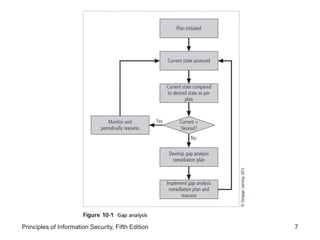
• Executing the plan
– A negative feedback loop ensures that project
progress is measured periodically.
• When significant deviation occurs, corrective action is
taken.
– Often, a project manager can adjust one of three
planning parameters for the task being corrected:
• Effort and money allocated
• Elapsed time/Scheduling impact
• Quality or quantity of deliverable
Principles of Information Security, Fifth Edition 6
Principles of Information Security, Fifth Edition 7
The Need for Project Management
(cont’d)
• Project wrap-up
– Project wrap-up is usually handled as procedural
task and assigned to mid-level IT or information
security manager.
– Collect documentation, finalize status reports, and
deliver final report and presentation at wrap-up
meeting
– Goal of wrap-up is to resolve any pending issues,
critique overall project effort, and draw conclusions
about how to improve process.
Principles of Information Security, Fifth Edition 8
Security Project Management
Certifications
• GIAC certified project manager
– Offered by SANS Institute; focuses on security
professionals/managers with project management
responsibilities
• IT security project management
– Offered by EC Council as a milestone in its Certified
E-Business Professional program
• Certified security project manager
– Security Industry Association focused on physical
security; also incorporates information security
Principles of Information Security, Fifth Edition 9
Technical Aspects of Implementation
• Some aspects of implementation process are
technical and deal with the application of
technology.
– Others deal with human interface to technical
systems.
Principles of Information Security, Fifth Edition 10
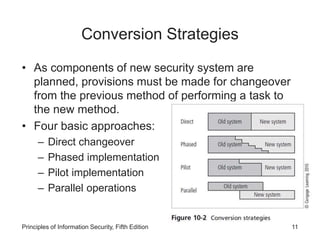
Conversion Strategies
• As components of new security system are
planned, provisions must be made for changeover
from the previous method of performing a task to
the new method.
• Four basic approaches:
– Direct changeover
– Phased implementation
– Pilot implementation
– Parallel operations
Principles of Information Security, Fifth Edition 11
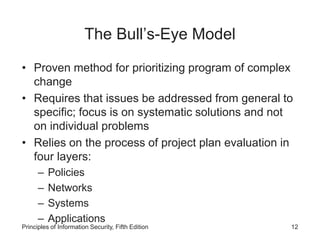
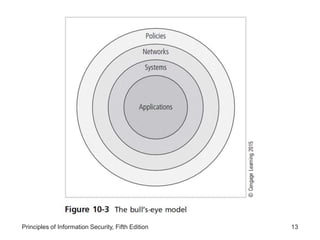
The Bull’s-Eye Model
• Proven method for prioritizing program of complex
change
• Requires that issues be addressed from general to
specific; focus is on systematic solutions and not
on individual problems
• Relies on the process of project plan evaluation in
four layers:
– Policies
– Networks
– Systems
– Applications
Principles of Information Security, Fifth Edition 12
Principles of Information Security, Fifth Edition 13
To Outsource or Not
• Just as some organizations outsource IT
operations, organizations can outsource part or all
of their information security programs.
• When an organization outsources most/all IT
services, information security should be part of
contract arrangement with the supplier.
• Organizations of all sizes frequently outsource
network monitoring functions.
Principles of Information Security, Fifth Edition 14
Technology Governance and Change
Control
• Technology governance guides how frequently
technical systems are updated and how updates
are approved/funded.
• By managing the process of change, the
organization can:
– Improve communication, enhance coordination,
reduce unintended consequences, improve quality of
service, and ensure groups are complying with
policies
Principles of Information Security, Fifth Edition 15
Nontechnical Aspects of
Implementation
• Some aspects of implementation are not technical
in nature, instead dealing with the human interface
to technical systems.
• Include creating a culture of change management
and considerations for the organizations facing
change.
Principles of Information Security, Fifth Edition 16
The Culture of Change Management
• Prospect of change can cause employees to
consciously or unconsciously resist the change.
• The stress of change can increase the probability
of mistakes or create vulnerabilities in systems.
• Change management can lower resistance to
change and build resilience.
• Lewin change model:
– Unfreezing
– Moving
– Refreezing
Principles of Information Security, Fifth Edition 17
Considerations for Organizational
Change
• Steps can be taken to make employees more
amenable to change:
– Reducing resistance to change from the start
– Developing a culture that supports change
Principles of Information Security, Fifth Edition 18
Considerations for Organizational
Change (cont’d)
• Reducing resistance to change from the start
– The more ingrained the existing methods and
behaviors, the more difficult the change.
– Best to improve interaction between affected
members of organization and project planners in
early project phases
– Three-step process for project managers:
communicate, educate, and involve
– Joint application development
Principles of Information Security, Fifth Edition 19
Considerations for Organizational
Change (cont’d)
• Developing a culture that supports change
– Ideal organization fosters resilience to change
– Resilience: An organization understands change is a
necessary part of the organizational culture, and
embracing change is more productive than fighting it.
– To develop such a culture, the organization must
successfully accomplish many projects that require
change.
Principles of Information Security, Fifth Edition 20

Lesson 2

  • 1.
    Principles of InformationSecurity, Fifth Edition Chapter 10 Implementing Information Security Lesson 2 – Need of Project Management
  • 2.
    Learning Objectives • Uponcompletion of this material, you should be able to: – Explain how an organization’s information security blueprint becomes a project plan – Discuss the many organizational considerations that a project plan must address – Explain the significance of the project manager’s role in the success of an information security project – Describe the need for professional project management for complex projects Principles of Information Security, Fifth Edition 2
  • 3.
    Learning Objectives (cont’d) –Describe technical strategies and models for implementing a project plan – List and discuss the nontechnical problems that organizations face in times of rapid change Principles of Information Security, Fifth Edition 3
  • 4.
    The Need forProject Management • Project management requires a unique set of skills and thorough understanding of a broad body of specialized knowledge. • Most information security projects require a trained project manager (a CISO) or skilled IT manager trained in project management techniques. Principles of Information Security, Fifth Edition 4
  • 5.
    The Need forProject Management (cont’d) • Supervised implementation – Some organizations may designate a champion from general management community of interest to supervise implementation of information security project plan. – An alternative is to designate a senior IT manager or CIO to lead implementation. – Best solution is to designate a suitable person from information security community of interest. – In final analysis, each organization must find project leadership best suited to its specific needs. Principles of Information Security, Fifth Edition 5
  • 6.
    The Need forProject Management (cont’d) • Executing the plan – A negative feedback loop ensures that project progress is measured periodically. • When significant deviation occurs, corrective action is taken. – Often, a project manager can adjust one of three planning parameters for the task being corrected: • Effort and money allocated • Elapsed time/Scheduling impact • Quality or quantity of deliverable Principles of Information Security, Fifth Edition 6
  • 7.
    Principles of InformationSecurity, Fifth Edition 7
  • 8.
    The Need forProject Management (cont’d) • Project wrap-up – Project wrap-up is usually handled as procedural task and assigned to mid-level IT or information security manager. – Collect documentation, finalize status reports, and deliver final report and presentation at wrap-up meeting – Goal of wrap-up is to resolve any pending issues, critique overall project effort, and draw conclusions about how to improve process. Principles of Information Security, Fifth Edition 8
  • 9.
    Security Project Management Certifications •GIAC certified project manager – Offered by SANS Institute; focuses on security professionals/managers with project management responsibilities • IT security project management – Offered by EC Council as a milestone in its Certified E-Business Professional program • Certified security project manager – Security Industry Association focused on physical security; also incorporates information security Principles of Information Security, Fifth Edition 9
  • 10.
    Technical Aspects ofImplementation • Some aspects of implementation process are technical and deal with the application of technology. – Others deal with human interface to technical systems. Principles of Information Security, Fifth Edition 10
  • 11.
    Conversion Strategies • Ascomponents of new security system are planned, provisions must be made for changeover from the previous method of performing a task to the new method. • Four basic approaches: – Direct changeover – Phased implementation – Pilot implementation – Parallel operations Principles of Information Security, Fifth Edition 11
  • 12.
    The Bull’s-Eye Model •Proven method for prioritizing program of complex change • Requires that issues be addressed from general to specific; focus is on systematic solutions and not on individual problems • Relies on the process of project plan evaluation in four layers: – Policies – Networks – Systems – Applications Principles of Information Security, Fifth Edition 12
  • 13.
    Principles of InformationSecurity, Fifth Edition 13
  • 14.
    To Outsource orNot • Just as some organizations outsource IT operations, organizations can outsource part or all of their information security programs. • When an organization outsources most/all IT services, information security should be part of contract arrangement with the supplier. • Organizations of all sizes frequently outsource network monitoring functions. Principles of Information Security, Fifth Edition 14
  • 15.
    Technology Governance andChange Control • Technology governance guides how frequently technical systems are updated and how updates are approved/funded. • By managing the process of change, the organization can: – Improve communication, enhance coordination, reduce unintended consequences, improve quality of service, and ensure groups are complying with policies Principles of Information Security, Fifth Edition 15
  • 16.
    Nontechnical Aspects of Implementation •Some aspects of implementation are not technical in nature, instead dealing with the human interface to technical systems. • Include creating a culture of change management and considerations for the organizations facing change. Principles of Information Security, Fifth Edition 16
  • 17.
    The Culture ofChange Management • Prospect of change can cause employees to consciously or unconsciously resist the change. • The stress of change can increase the probability of mistakes or create vulnerabilities in systems. • Change management can lower resistance to change and build resilience. • Lewin change model: – Unfreezing – Moving – Refreezing Principles of Information Security, Fifth Edition 17
  • 18.
    Considerations for Organizational Change •Steps can be taken to make employees more amenable to change: – Reducing resistance to change from the start – Developing a culture that supports change Principles of Information Security, Fifth Edition 18
  • 19.
    Considerations for Organizational Change(cont’d) • Reducing resistance to change from the start – The more ingrained the existing methods and behaviors, the more difficult the change. – Best to improve interaction between affected members of organization and project planners in early project phases – Three-step process for project managers: communicate, educate, and involve – Joint application development Principles of Information Security, Fifth Edition 19
  • 20.
    Considerations for Organizational Change(cont’d) • Developing a culture that supports change – Ideal organization fosters resilience to change – Resilience: An organization understands change is a necessary part of the organizational culture, and embracing change is more productive than fighting it. – To develop such a culture, the organization must successfully accomplish many projects that require change. Principles of Information Security, Fifth Edition 20