Lighting Revealing Eye in Digital Photography   DE002A
Lights… camera… action… Good lighting  not only ensures a successful photo, but also  conveys mood, emotion, and depth .  The  direction, quality, and intensity of the light  each have a  dramatic effect  on your pictures.   Revealing Eye in Digital Photography   DE002A
Direction of Light When it comes to the direction of light, there are 360 degrees of possibilities. When the light isn't working for you, change it by  moving your position , your  subject's position , or the  light itself , if possible.  Revealing Eye in Digital Photography   DE002A
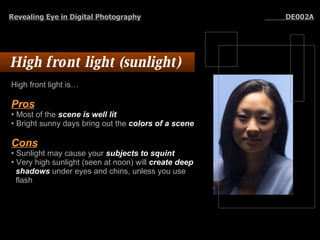
High front light (sunlight)  High front light is…  Pros   Most of the  scene is well lit   Bright sunny days bring out the  colors of a scene Cons   Sunlight may cause your  subjects to squint   Very high sunlight (seen at noon) will  create   deep shadows  under eyes and chins, unless you use flash Revealing Eye in Digital Photography   DE002A
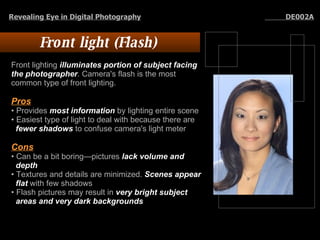
Front light (Flash)  Front lighting  illuminates portion of subject facing the photographer . Camera's flash is the most common type of front lighting.  Pros   Provides  most information  by lighting entire scene Easiest type of light to deal with because there are fewer shadows  to confuse camera's light meter Cons Can be a bit boring—pictures  lack volume and depth   Textures and details are minimized.  Scenes appear flat  with few shadows Flash pictures may result in  very bright subject areas and very dark backgrounds Revealing Eye in Digital Photography   DE002A
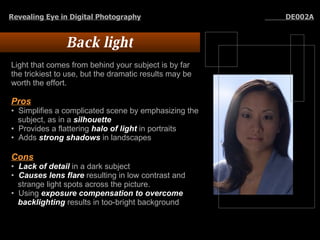
Back light Light that comes from behind your subject is by far the trickiest to use, but the dramatic results may be worth the effort.  Pros Simplifies a complicated scene by emphasizing the subject, as in a  silhouette   Provides a flattering  halo of light  in portraits  Adds  strong shadows  in landscapes  Cons   Lack of detail  in a dark subject  Causes lens flare  resulting in low contrast and strange light spots across the picture.  Using  exposure compensation to overcome backlighting  results in too-bright background Revealing Eye in Digital Photography   DE002A
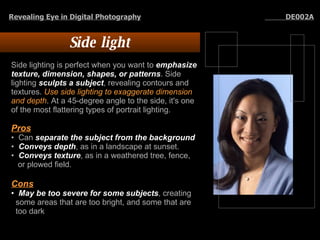
Side light Side lighting is perfect when you want to  emphasize texture, dimension, shapes, or patterns . Side lighting  sculpts a subject , revealing contours and textures.  Use side lighting to exaggerate dimension and depth . At a 45-degree angle to the side, it's one of the most flattering types of portrait lighting.  Pros   Can  separate the subject from the background Conveys depth , as in a landscape at sunset.  Conveys texture , as in a weathered tree, fence, or plowed field.  Cons   May be too severe for some subjects , creating some areas that are too bright, and some that are too dark Revealing Eye in Digital Photography   DE002A
Tips for back lighting… Prevent lens flare  - shield camera with hat, hand, or book Turn the flash off  - use low exposure for dramatic silhouette - perfect for sunset with tree, boat or person in foreground. Use “backlight” button  to properly expose your subject. Your background may get too light or even washed out.  Use white reflector  (poster board works) to reflect light back onto your subject. Useful for close-ups like flowers.  Move in closer  - fill the frame with your backlit subject, so the brighter surrounding light doesn't confuse camera. Revealing Eye in Digital Photography   DE002A
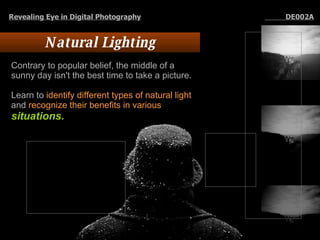
Natural Lighting Contrary to popular belief, the middle of a sunny day isn't the best time to take a picture.  Learn to  identify different types of natural light  and  recognize their benefits in various  situations.   Revealing Eye in Digital Photography   DE002A
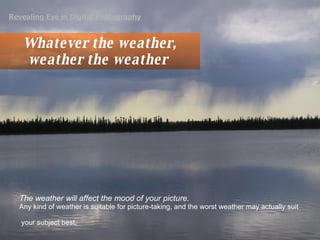
Whatever the weather, weather the weather  The weather will affect the mood of your picture.   Any kind of weather is suitable for picture-taking, and the worst weather may actually suit your subject best. Revealing Eye in Digital Photography   DE002A
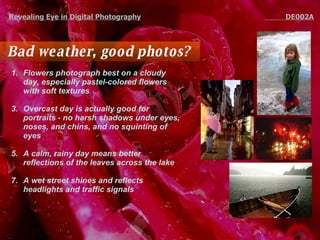
Bad weather, good photos?  Flowers photograph best on a cloudy day, especially pastel-colored flowers with soft textures Overcast day is actually good for portraits - no harsh shadows under eyes, noses, and chins, and no squinting of eyes  A calm, rainy day means better reflections of the leaves across the lake A wet street shines and reflects headlights and traffic signals Revealing Eye in Digital Photography   DE002A
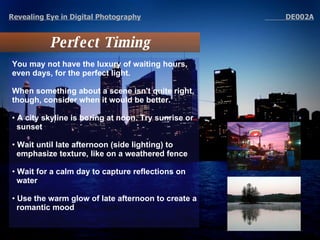
Perfect Timing Revealing Eye in Digital Photography   DE002A You may not have the luxury of waiting hours, even days, for the perfect light.  When something about a scene isn't quite right, though, consider when it would be better. A city skyline is boring at noon. Try sunrise or sunset  Wait until late afternoon (side lighting) to emphasize texture, like on a weathered fence Wait for a calm day to capture reflections on water Use the warm glow of late afternoon to create a romantic mood
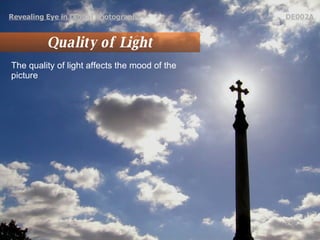
Quality of Light The quality of light affects the mood of the picture  Revealing Eye in Digital Photography   DE002A
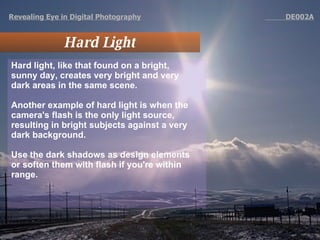
Revealing Eye in Digital Photography   DE002A Hard Light Hard light, like that found on a bright, sunny day, creates very bright and very dark areas in the same scene.  Another example of hard light is when the camera's flash is the only light source, resulting in bright subjects against a very dark background.  Use the dark shadows as design elements or soften them with flash if you're within range.
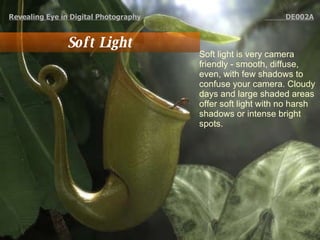
Revealing Eye in Digital Photography   DE002A Soft Light Soft light is very camera friendly - smooth, diffuse, even, with few shadows to confuse your camera. Cloudy days and large shaded areas offer soft light with no harsh shadows or intense bright spots.
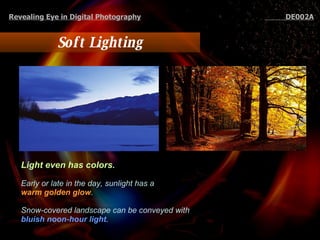
Soft Lighting Revealing Eye in Digital Photography   DE002A Light even has colors . Early or late in the day, sunlight has a  warm golden glow . Snow-covered landscape can be conveyed with  bluish noon-hour light .
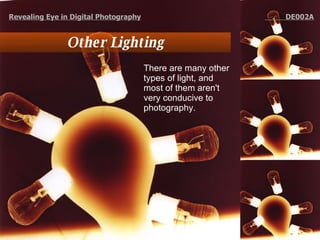
Other Lighting There are many other types of light, and most of them aren't very conducive to photography.  Revealing Eye in Digital Photography   DE002A
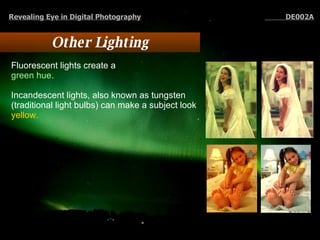
Other Lighting Fluorescent lights create a  green hue.   Incandescent lights, also known as tungsten (traditional light bulbs) can make a subject look  yellow.   Revealing Eye in Digital Photography   DE002A
Flash Lighting Lucky for us, an automatic flash is included on just about every digital camera sold today.  That doesn't mean the camera is fail-proof.  You still need to know how and when to use these features.  Revealing Eye in Digital Photography   DE002A
General Flash Tips Stay within flash range. Check your camera manual for the recommended range  Batteries that are approaching exhaustion will not give full flash power even if the camera is still working.  Prevent red eye by asking your subjects to look slightly away from the camera, and turn on all the room lights to shrink their pupils. Revealing Eye in Digital Photography   DE002A
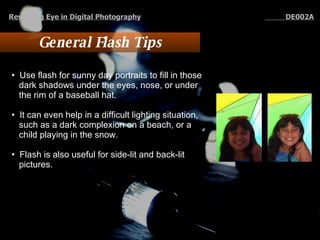
General Flash Tips Use flash for sunny day portraits to fill in those dark shadows under the eyes, nose, or under the rim of a baseball hat.  It can even help in a difficult lighting situation, such as a dark complexion on a beach, or a child playing in the snow.  Flash is also useful for side-lit and back-lit pictures.  Revealing Eye in Digital Photography   DE002A
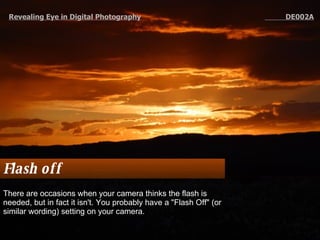
Flash off There are occasions when your camera thinks the flash is needed, but in fact it isn't. You probably have a "Flash Off" (or similar wording) setting on your camera.  Revealing Eye in Digital Photography   DE002A
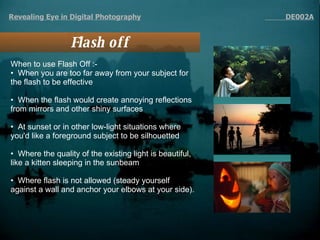
Flash off When to use Flash Off :- When you are too far away from your subject for the flash to be effective When the flash would create annoying reflections from mirrors and other shiny surfaces At sunset or in other low-light situations where you'd like a foreground subject to be silhouetted Where the quality of the existing light is beautiful, like a kitten sleeping in the sunbeam Where flash is not allowed (steady yourself against a wall and anchor your elbows at your side).  Revealing Eye in Digital Photography   DE002A

Lesson 1c Lighting

  • 1.
    Lighting Revealing Eyein Digital Photography DE002A
  • 2.
    Lights… camera… action…Good lighting not only ensures a successful photo, but also conveys mood, emotion, and depth . The direction, quality, and intensity of the light each have a dramatic effect on your pictures. Revealing Eye in Digital Photography DE002A
  • 3.
    Direction of LightWhen it comes to the direction of light, there are 360 degrees of possibilities. When the light isn't working for you, change it by moving your position , your subject's position , or the light itself , if possible. Revealing Eye in Digital Photography DE002A
  • 4.
    High front light(sunlight) High front light is… Pros Most of the scene is well lit Bright sunny days bring out the colors of a scene Cons Sunlight may cause your subjects to squint Very high sunlight (seen at noon) will create deep shadows under eyes and chins, unless you use flash Revealing Eye in Digital Photography DE002A
  • 5.
    Front light (Flash) Front lighting illuminates portion of subject facing the photographer . Camera's flash is the most common type of front lighting. Pros Provides most information by lighting entire scene Easiest type of light to deal with because there are fewer shadows to confuse camera's light meter Cons Can be a bit boring—pictures lack volume and depth Textures and details are minimized. Scenes appear flat with few shadows Flash pictures may result in very bright subject areas and very dark backgrounds Revealing Eye in Digital Photography DE002A
  • 6.
    Back light Lightthat comes from behind your subject is by far the trickiest to use, but the dramatic results may be worth the effort. Pros Simplifies a complicated scene by emphasizing the subject, as in a silhouette Provides a flattering halo of light in portraits Adds strong shadows in landscapes Cons Lack of detail in a dark subject Causes lens flare resulting in low contrast and strange light spots across the picture. Using exposure compensation to overcome backlighting results in too-bright background Revealing Eye in Digital Photography DE002A
  • 7.
    Side light Sidelighting is perfect when you want to emphasize texture, dimension, shapes, or patterns . Side lighting sculpts a subject , revealing contours and textures. Use side lighting to exaggerate dimension and depth . At a 45-degree angle to the side, it's one of the most flattering types of portrait lighting. Pros Can separate the subject from the background Conveys depth , as in a landscape at sunset. Conveys texture , as in a weathered tree, fence, or plowed field. Cons May be too severe for some subjects , creating some areas that are too bright, and some that are too dark Revealing Eye in Digital Photography DE002A
  • 8.
    Tips for backlighting… Prevent lens flare - shield camera with hat, hand, or book Turn the flash off - use low exposure for dramatic silhouette - perfect for sunset with tree, boat or person in foreground. Use “backlight” button to properly expose your subject. Your background may get too light or even washed out. Use white reflector (poster board works) to reflect light back onto your subject. Useful for close-ups like flowers. Move in closer - fill the frame with your backlit subject, so the brighter surrounding light doesn't confuse camera. Revealing Eye in Digital Photography DE002A
  • 9.
    Natural Lighting Contraryto popular belief, the middle of a sunny day isn't the best time to take a picture. Learn to identify different types of natural light and recognize their benefits in various situations. Revealing Eye in Digital Photography DE002A
  • 10.
    Whatever the weather,weather the weather The weather will affect the mood of your picture. Any kind of weather is suitable for picture-taking, and the worst weather may actually suit your subject best. Revealing Eye in Digital Photography DE002A
  • 11.
    Bad weather, goodphotos? Flowers photograph best on a cloudy day, especially pastel-colored flowers with soft textures Overcast day is actually good for portraits - no harsh shadows under eyes, noses, and chins, and no squinting of eyes A calm, rainy day means better reflections of the leaves across the lake A wet street shines and reflects headlights and traffic signals Revealing Eye in Digital Photography DE002A
  • 12.
    Perfect Timing RevealingEye in Digital Photography DE002A You may not have the luxury of waiting hours, even days, for the perfect light. When something about a scene isn't quite right, though, consider when it would be better. A city skyline is boring at noon. Try sunrise or sunset Wait until late afternoon (side lighting) to emphasize texture, like on a weathered fence Wait for a calm day to capture reflections on water Use the warm glow of late afternoon to create a romantic mood
  • 13.
    Quality of LightThe quality of light affects the mood of the picture Revealing Eye in Digital Photography DE002A
  • 14.
    Revealing Eye inDigital Photography DE002A Hard Light Hard light, like that found on a bright, sunny day, creates very bright and very dark areas in the same scene. Another example of hard light is when the camera's flash is the only light source, resulting in bright subjects against a very dark background. Use the dark shadows as design elements or soften them with flash if you're within range.
  • 15.
    Revealing Eye inDigital Photography DE002A Soft Light Soft light is very camera friendly - smooth, diffuse, even, with few shadows to confuse your camera. Cloudy days and large shaded areas offer soft light with no harsh shadows or intense bright spots.
  • 16.
    Soft Lighting RevealingEye in Digital Photography DE002A Light even has colors . Early or late in the day, sunlight has a warm golden glow . Snow-covered landscape can be conveyed with bluish noon-hour light .
  • 17.
    Other Lighting Thereare many other types of light, and most of them aren't very conducive to photography. Revealing Eye in Digital Photography DE002A
  • 18.
    Other Lighting Fluorescentlights create a green hue. Incandescent lights, also known as tungsten (traditional light bulbs) can make a subject look yellow. Revealing Eye in Digital Photography DE002A
  • 19.
    Flash Lighting Luckyfor us, an automatic flash is included on just about every digital camera sold today. That doesn't mean the camera is fail-proof. You still need to know how and when to use these features. Revealing Eye in Digital Photography DE002A
  • 20.
    General Flash TipsStay within flash range. Check your camera manual for the recommended range Batteries that are approaching exhaustion will not give full flash power even if the camera is still working. Prevent red eye by asking your subjects to look slightly away from the camera, and turn on all the room lights to shrink their pupils. Revealing Eye in Digital Photography DE002A
  • 21.
    General Flash TipsUse flash for sunny day portraits to fill in those dark shadows under the eyes, nose, or under the rim of a baseball hat. It can even help in a difficult lighting situation, such as a dark complexion on a beach, or a child playing in the snow. Flash is also useful for side-lit and back-lit pictures. Revealing Eye in Digital Photography DE002A
  • 22.
    Flash off Thereare occasions when your camera thinks the flash is needed, but in fact it isn't. You probably have a "Flash Off" (or similar wording) setting on your camera. Revealing Eye in Digital Photography DE002A
  • 23.
    Flash off Whento use Flash Off :- When you are too far away from your subject for the flash to be effective When the flash would create annoying reflections from mirrors and other shiny surfaces At sunset or in other low-light situations where you'd like a foreground subject to be silhouetted Where the quality of the existing light is beautiful, like a kitten sleeping in the sunbeam Where flash is not allowed (steady yourself against a wall and anchor your elbows at your side). Revealing Eye in Digital Photography DE002A