WorkshoponStudio PhotographyBySuvajitjeet_sen@yahoo.co.in17th July 2010Bangalore
TopicsPrinciples of Artificial LightingBasic Studio LightingPortrait lightingStudio lighting and Exposure
Principles of artificial lightingWhy use artificial light?Lack of adequate natural lightTake control of the lightMake a photograph; don’t just take it.Shooting with artificial light is like:		“Sculpting with LIGHT”
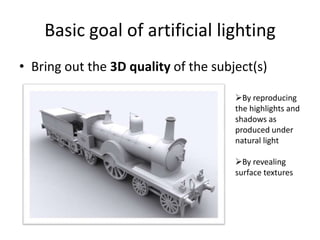
Basic goal of artificial lightingBring out the 3D quality of the subject(s)By reproducing the highlights and shadows as produced under natural light
By revealing surface texturesBasic Studio LightingCategories of studio lightBasic four light setupStudio lighting tools
Categories of studio lightContinuous+ Cheap   + See what the light is doing     -  Produces more heat than light   -  Not balanced to daylightFlash+ Balanced to daylight (5500K)+ Saves power
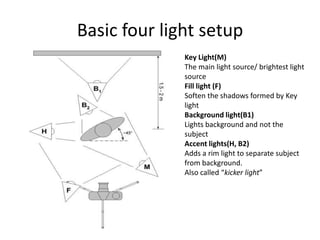
Basic four light setupKey Light(M)The main light source/ brightest light sourceFill light (F)Soften the shadows formed by Key lightBackground light(B1)Lights background and not the subjectAccent lights(H, B2)Adds a rim light to separate subject from background.Also called “kicker light”
Steps in preparing lighting setupDecide on general effectvisualize; determine type/direction/angle of light2. Add the key light(s)- create dominant set of highlight & shadows3. Place the fill lights- Adjust light ratio to obtain desired effect4. Separate subject from background      - Add background light     - Add kicker light (optional)     - Subject should not be close to background (min 5 feet)     - Lights should not add to any secondary highlight or shadows5. Make final adjustments- take sample shot, analyze and readjust      - look out for unwanted highlights/shadows, catchlights
Studio equipmentsLight Source Studio lightsTripods/StandsTriggersLight ModifiersDiffusersUmbrellaSoft Box (normal, strip, octabox)DeflectorsReflectorsSnootGridBarn doorColor gelsLight meterAccessoriesBackdropProps
Portrait lightingRembrandtLoopButterflySplitBroad Short
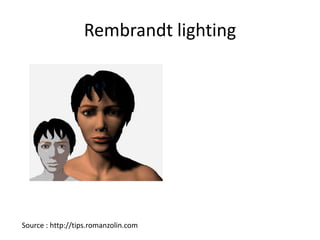
Rembrandt lightingSource : http://tips.romanzolin.com
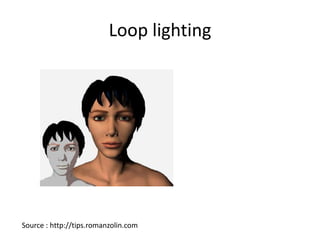
Loop lightingSource : http://tips.romanzolin.com
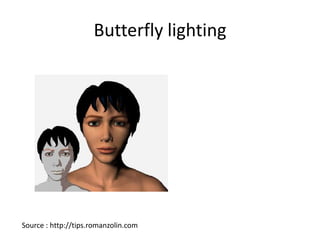
Butterfly lightingSource : http://tips.romanzolin.com
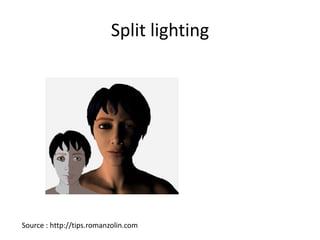
Split lightingSource : http://tips.romanzolin.com
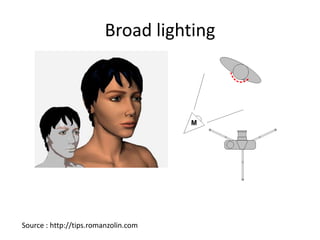
Broad lightingSource : http://tips.romanzolin.com
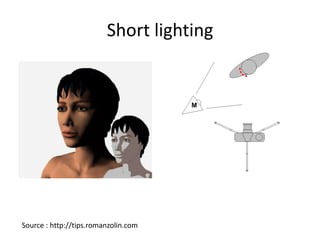
Short lightingSource : http://tips.romanzolin.com
Exposure in studio lightingShutter speed in camera has no control on exposure as your camera cannot shoot faster than your camera SYNC speed, it is 1/200.Exposure can be controlled by :1. The power of the light2. Aperture of the lens3. ISO setting
How to control studio light powerControls on Light system ( Full, ½, ¼, 1/8 )Distance of light from subject. Inverse Square Law applies here ( so if you move your subject from 3 feet away to 6 feet away, your light power will reduce by 4 times or you will need four times more light)
Aperture and f stopsFor aperture control under studio lights, same principle applies.Exposure halves by increase in each f-stop f/8, Full power @ ISO 200 will give same exposure as f/5.6, ½ power @ ISO 200The full f stops are2.8 4 5.6 8 11 16 22
Referenceswww.studiolighting.netwww.strobist.com

Studio Photography Basics

  • 1.
  • 2.
    TopicsPrinciples of ArtificialLightingBasic Studio LightingPortrait lightingStudio lighting and Exposure
  • 3.
    Principles of artificiallightingWhy use artificial light?Lack of adequate natural lightTake control of the lightMake a photograph; don’t just take it.Shooting with artificial light is like: “Sculpting with LIGHT”
  • 4.
    Basic goal ofartificial lightingBring out the 3D quality of the subject(s)By reproducing the highlights and shadows as produced under natural light
  • 5.
    By revealing surfacetexturesBasic Studio LightingCategories of studio lightBasic four light setupStudio lighting tools
  • 6.
    Categories of studiolightContinuous+ Cheap + See what the light is doing - Produces more heat than light - Not balanced to daylightFlash+ Balanced to daylight (5500K)+ Saves power
  • 7.
    Basic four lightsetupKey Light(M)The main light source/ brightest light sourceFill light (F)Soften the shadows formed by Key lightBackground light(B1)Lights background and not the subjectAccent lights(H, B2)Adds a rim light to separate subject from background.Also called “kicker light”
  • 8.
    Steps in preparinglighting setupDecide on general effectvisualize; determine type/direction/angle of light2. Add the key light(s)- create dominant set of highlight & shadows3. Place the fill lights- Adjust light ratio to obtain desired effect4. Separate subject from background - Add background light - Add kicker light (optional) - Subject should not be close to background (min 5 feet) - Lights should not add to any secondary highlight or shadows5. Make final adjustments- take sample shot, analyze and readjust - look out for unwanted highlights/shadows, catchlights
  • 9.
    Studio equipmentsLight SourceStudio lightsTripods/StandsTriggersLight ModifiersDiffusersUmbrellaSoft Box (normal, strip, octabox)DeflectorsReflectorsSnootGridBarn doorColor gelsLight meterAccessoriesBackdropProps
  • 10.
  • 11.
    Rembrandt lightingSource :http://tips.romanzolin.com
  • 12.
    Loop lightingSource :http://tips.romanzolin.com
  • 13.
    Butterfly lightingSource :http://tips.romanzolin.com
  • 14.
    Split lightingSource :http://tips.romanzolin.com
  • 15.
    Broad lightingSource :http://tips.romanzolin.com
  • 16.
    Short lightingSource :http://tips.romanzolin.com
  • 17.
    Exposure in studiolightingShutter speed in camera has no control on exposure as your camera cannot shoot faster than your camera SYNC speed, it is 1/200.Exposure can be controlled by :1. The power of the light2. Aperture of the lens3. ISO setting
  • 18.
    How to controlstudio light powerControls on Light system ( Full, ½, ¼, 1/8 )Distance of light from subject. Inverse Square Law applies here ( so if you move your subject from 3 feet away to 6 feet away, your light power will reduce by 4 times or you will need four times more light)
  • 19.
    Aperture and fstopsFor aperture control under studio lights, same principle applies.Exposure halves by increase in each f-stop f/8, Full power @ ISO 200 will give same exposure as f/5.6, ½ power @ ISO 200The full f stops are2.8 4 5.6 8 11 16 22
  • 20.