
Section 4.1
Maximum and Minimum Values
V63.0121.041, Calculus I
New York University
November 8, 2010
Announcements
Announcements
V63.0121.041, Calculus I (NYU) Section 4.1 Maximum and Minimum Values November 8, 2010 2 / 34
Objectives
Understand and be able to
explain the statement of the
Extreme Value Theorem.
Understand and be able to
explain the statement of
Fermat’s Theorem.
Use the Closed Interval
Method to find the extreme
values of a function defined
on a closed interval.
V63.0121.041, Calculus I (NYU) Section 4.1 Maximum and Minimum Values November 8, 2010 3 / 34
Notes
Notes
Notes
1
Section 4.1 : Maximum and Minimum ValuesV63.0121.041, Calculus I November 8, 2010
Outline
Introduction
The Extreme Value Theorem
Fermat’s Theorem (not the last one)
Tangent: Fermat’s Last Theorem
The Closed Interval Method
Examples
V63.0121.041, Calculus I (NYU) Section 4.1 Maximum and Minimum Values November 8, 2010 4 / 34
Optimize
Why go to the extremes?
Rationally speaking, it is
advantageous to find the
extreme values of a function
(maximize profit, minimize
costs, etc.)
Many laws of science are
derived from minimizing
principles.
Maupertuis’ principle:
“Action is minimized
through the wisdom of
God.”
Pierre-Louis Maupertuis
(1698–1759)V63.0121.041, Calculus I (NYU) Section 4.1 Maximum and Minimum Values November 8, 2010 6 / 34
Notes
Notes
Notes
2
Section 4.1 : Maximum and Minimum ValuesV63.0121.041, Calculus I November 8, 2010
Design
Image credit: Jason Tromm
V63.0121.041, Calculus I (NYU) Section 4.1 Maximum and Minimum Values November 8, 2010 7 / 34
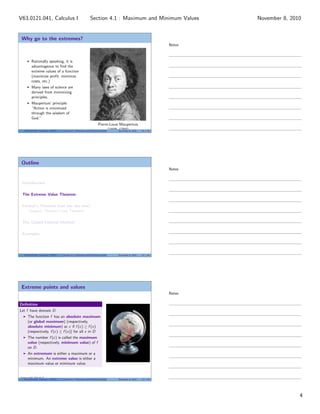
Why go to the extremes?
Rationally speaking, it is
advantageous to find the
extreme values of a function
(maximize profit, minimize
costs, etc.)
Many laws of science are
derived from minimizing
principles.
Maupertuis’ principle:
“Action is minimized
through the wisdom of
God.”
Pierre-Louis Maupertuis
(1698–1759)V63.0121.041, Calculus I (NYU) Section 4.1 Maximum and Minimum Values November 8, 2010 8 / 34
Optics
Image credit: jacreative
V63.0121.041, Calculus I (NYU) Section 4.1 Maximum and Minimum Values November 8, 2010 9 / 34
Notes
Notes
Notes
3
Section 4.1 : Maximum and Minimum ValuesV63.0121.041, Calculus I November 8, 2010
Why go to the extremes?
Rationally speaking, it is
advantageous to find the
extreme values of a function
(maximize profit, minimize
costs, etc.)
Many laws of science are
derived from minimizing
principles.
Maupertuis’ principle:
“Action is minimized
through the wisdom of
God.”
Pierre-Louis Maupertuis
(1698–1759)V63.0121.041, Calculus I (NYU) Section 4.1 Maximum and Minimum Values November 8, 2010 10 / 34
Outline
Introduction
The Extreme Value Theorem
Fermat’s Theorem (not the last one)
Tangent: Fermat’s Last Theorem
The Closed Interval Method
Examples
V63.0121.041, Calculus I (NYU) Section 4.1 Maximum and Minimum Values November 8, 2010 11 / 34
Extreme points and values
Definition
Let f have domain D.
The function f has an absolute maximum
(or global maximum) (respectively,
absolute minimum) at c if f (c) ≥ f (x)
(respectively, f (c) ≤ f (x)) for all x in D
The number f (c) is called the maximum
value (respectively, minimum value) of f
on D.
An extremum is either a maximum or a
minimum. An extreme value is either a
maximum value or minimum value.
Image credit: Patrick Q
V63.0121.041, Calculus I (NYU) Section 4.1 Maximum and Minimum Values November 8, 2010 12 / 34
Notes
Notes
Notes
4
Section 4.1 : Maximum and Minimum ValuesV63.0121.041, Calculus I November 8, 2010
The Extreme Value Theorem
Theorem (The Extreme Value Theorem)
Let f be a function which is continuous on the closed interval [a, b]. Then
f attains an absolute maximum value f (c) and an absolute minimum
value f (d) at numbers c and d in [a, b].
a b
c
maximum
maximum
value
f (c)
d
minimum
minimum
value
f (d)
V63.0121.041, Calculus I (NYU) Section 4.1 Maximum and Minimum Values November 8, 2010 13 / 34
No proof of EVT forthcoming
This theorem is very hard to prove without using technical facts
about continuous functions and closed intervals.
But we can show the importance of each of the hypotheses.
V63.0121.041, Calculus I (NYU) Section 4.1 Maximum and Minimum Values November 8, 2010 14 / 34
Bad Example #1
Example
Consider the function
f (x) =
x 0 ≤ x < 1
x − 2 1 ≤ x ≤ 2.
|
1
Then although values of f (x) get arbitrarily close to 1 and never bigger
than 1, 1 is not the maximum value of f on [0, 1] because it is never
achieved. This does not violate EVT because f is not continuous.
V63.0121.041, Calculus I (NYU) Section 4.1 Maximum and Minimum Values November 8, 2010 15 / 34
Notes
Notes
Notes
5
Section 4.1 : Maximum and Minimum ValuesV63.0121.041, Calculus I November 8, 2010
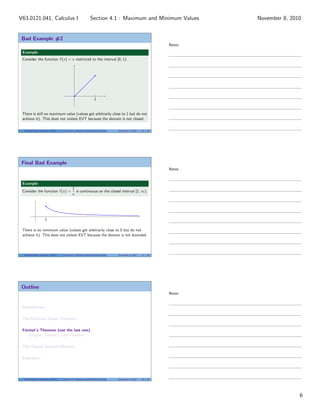
Bad Example #2
Example
Consider the function f (x) = x restricted to the interval [0, 1).
|
1
There is still no maximum value (values get arbitrarily close to 1 but do not
achieve it). This does not violate EVT because the domain is not closed.
V63.0121.041, Calculus I (NYU) Section 4.1 Maximum and Minimum Values November 8, 2010 16 / 34
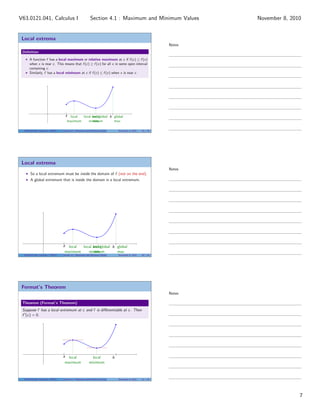
Final Bad Example
Example
Consider the function f (x) =
1
x
is continuous on the closed interval [1, ∞).
1
There is no minimum value (values get arbitrarily close to 0 but do not
achieve it). This does not violate EVT because the domain is not bounded.
V63.0121.041, Calculus I (NYU) Section 4.1 Maximum and Minimum Values November 8, 2010 17 / 34
Outline
Introduction
The Extreme Value Theorem
Fermat’s Theorem (not the last one)
Tangent: Fermat’s Last Theorem
The Closed Interval Method
Examples
V63.0121.041, Calculus I (NYU) Section 4.1 Maximum and Minimum Values November 8, 2010 18 / 34
Notes
Notes
Notes
6
Section 4.1 : Maximum and Minimum ValuesV63.0121.041, Calculus I November 8, 2010
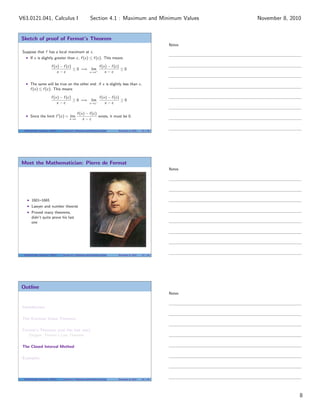
Local extrema
Definition
A function f has a local maximum or relative maximum at c if f (c) ≥ f (x)
when x is near c. This means that f (c) ≥ f (x) for all x in some open interval
containing c.
Similarly, f has a local minimum at c if f (c) ≤ f (x) when x is near c.
|
a
|
blocal
maximum
local
minimum
global
max
local and global
min
V63.0121.041, Calculus I (NYU) Section 4.1 Maximum and Minimum Values November 8, 2010 19 / 34
Local extrema
So a local extremum must be inside the domain of f (not on the end).
A global extremum that is inside the domain is a local extremum.
|
a
|
blocal
maximum
local
minimum
global
max
local and global
min
V63.0121.041, Calculus I (NYU) Section 4.1 Maximum and Minimum Values November 8, 2010 20 / 34
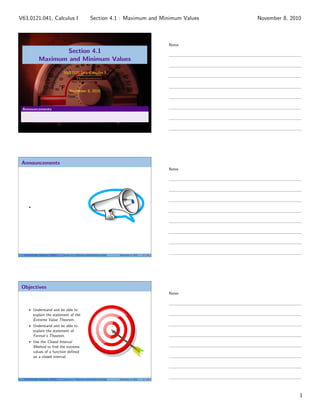
Fermat’s Theorem
Theorem (Fermat’s Theorem)
Suppose f has a local extremum at c and f is differentiable at c. Then
f (c) = 0.
|
a
|
blocal
maximum
local
minimum
V63.0121.041, Calculus I (NYU) Section 4.1 Maximum and Minimum Values November 8, 2010 21 / 34
Notes
Notes
Notes
7
Section 4.1 : Maximum and Minimum ValuesV63.0121.041, Calculus I November 8, 2010
Sketch of proof of Fermat’s Theorem
Suppose that f has a local maximum at c.
If x is slightly greater than c, f (x) ≤ f (c). This means
f (x) − f (c)
x − c
≤ 0 =⇒ lim
x→c+
f (x) − f (c)
x − c
≤ 0
The same will be true on the other end: if x is slightly less than c,
f (x) ≤ f (c). This means
f (x) − f (c)
x − c
≥ 0 =⇒ lim
x→c−
f (x) − f (c)
x − c
≥ 0
Since the limit f (c) = lim
x→c
f (x) − f (c)
x − c
exists, it must be 0.
V63.0121.041, Calculus I (NYU) Section 4.1 Maximum and Minimum Values November 8, 2010 22 / 34
Meet the Mathematician: Pierre de Fermat
1601–1665
Lawyer and number theorist
Proved many theorems,
didn’t quite prove his last
one
V63.0121.041, Calculus I (NYU) Section 4.1 Maximum and Minimum Values November 8, 2010 23 / 34
Outline
Introduction
The Extreme Value Theorem
Fermat’s Theorem (not the last one)
Tangent: Fermat’s Last Theorem
The Closed Interval Method
Examples
V63.0121.041, Calculus I (NYU) Section 4.1 Maximum and Minimum Values November 8, 2010 25 / 34
Notes
Notes
Notes
8
Section 4.1 : Maximum and Minimum ValuesV63.0121.041, Calculus I November 8, 2010
Flowchart for placing extrema
Thanks to Fermat
Suppose f is a continuous function on the closed, bounded interval [a, b],
and c is a global maximum point.
start
Is c an
endpoint?
c = a or
c = b
c is a
local max
Is f
diff’ble at
c?
f is not
diff at c
f (c) = 0
no
yes
no
yes
V63.0121.041, Calculus I (NYU) Section 4.1 Maximum and Minimum Values November 8, 2010 26 / 34
The Closed Interval Method
This means to find the maximum value of f on [a, b], we need to:
Evaluate f at the endpoints a and b
Evaluate f at the critical points or critical numbers x where either
f (x) = 0 or f is not differentiable at x.
The points with the largest function value are the global maximum
points
The points with the smallest or most negative function value are the
global minimum points.
V63.0121.041, Calculus I (NYU) Section 4.1 Maximum and Minimum Values November 8, 2010 27 / 34
Outline
Introduction
The Extreme Value Theorem
Fermat’s Theorem (not the last one)
Tangent: Fermat’s Last Theorem
The Closed Interval Method
Examples
V63.0121.041, Calculus I (NYU) Section 4.1 Maximum and Minimum Values November 8, 2010 28 / 34
Notes
Notes
Notes
9
Section 4.1 : Maximum and Minimum ValuesV63.0121.041, Calculus I November 8, 2010
Extreme values of a linear function
Example
Find the extreme values of f (x) = 2x − 5 on [−1, 2].
Solution
Since f (x) = 2, which is never zero, we have no critical points and we
need only investigate the endpoints:
f (−1) = 2(−1) − 5 = −7
f (2) = 2(2) − 5 = −1
So
The absolute minimum (point) is at −1; the minimum value is −7.
The absolute maximum (point) is at 2; the maximum value is −1.
V63.0121.041, Calculus I (NYU) Section 4.1 Maximum and Minimum Values November 8, 2010 29 / 34
Extreme values of a quadratic function
Example
Find the extreme values of f (x) = x2
− 1 on [−1, 2].
Solution
We have f (x) = 2x, which is zero when x = 0. So our points to check
are:
f (−1) = 0
f (0) = − 1 (absolute min)
f (2) = 3 (absolute max)
V63.0121.041, Calculus I (NYU) Section 4.1 Maximum and Minimum Values November 8, 2010 30 / 34
Extreme values of a cubic function
Example
Find the extreme values of f (x) = 2x3
− 3x2
+ 1 on [−1, 2].
Solution
V63.0121.041, Calculus I (NYU) Section 4.1 Maximum and Minimum Values November 8, 2010 31 / 34
Notes
Notes
Notes
10
Section 4.1 : Maximum and Minimum ValuesV63.0121.041, Calculus I November 8, 2010
Extreme values of an algebraic function
Example
Find the extreme values of f (x) = x2/3
(x + 2) on [−1, 2].
Solution
V63.0121.041, Calculus I (NYU) Section 4.1 Maximum and Minimum Values November 8, 2010 32 / 34
Extreme values of another algebraic function
Example
Find the extreme values of f (x) = 4 − x2 on [−2, 1].
Solution
V63.0121.041, Calculus I (NYU) Section 4.1 Maximum and Minimum Values November 8, 2010 33 / 34
Summary
The Extreme Value Theorem: a continuous function on a closed
interval must achieve its max and min
Fermat’s Theorem: local extrema are critical points
The Closed Interval Method: an algorithm for finding global extrema
V63.0121.041, Calculus I (NYU) Section 4.1 Maximum and Minimum Values November 8, 2010 34 / 34
Notes
Notes
Notes
11
Section 4.1 : Maximum and Minimum ValuesV63.0121.041, Calculus I November 8, 2010

Lesson 18: Maximum and Minimum Values (Section 041 handout)

  • 1.
    Section 4.1 Maximum andMinimum Values V63.0121.041, Calculus I New York University November 8, 2010 Announcements Announcements V63.0121.041, Calculus I (NYU) Section 4.1 Maximum and Minimum Values November 8, 2010 2 / 34 Objectives Understand and be able to explain the statement of the Extreme Value Theorem. Understand and be able to explain the statement of Fermat’s Theorem. Use the Closed Interval Method to find the extreme values of a function defined on a closed interval. V63.0121.041, Calculus I (NYU) Section 4.1 Maximum and Minimum Values November 8, 2010 3 / 34 Notes Notes Notes 1 Section 4.1 : Maximum and Minimum ValuesV63.0121.041, Calculus I November 8, 2010
  • 2.
    Outline Introduction The Extreme ValueTheorem Fermat’s Theorem (not the last one) Tangent: Fermat’s Last Theorem The Closed Interval Method Examples V63.0121.041, Calculus I (NYU) Section 4.1 Maximum and Minimum Values November 8, 2010 4 / 34 Optimize Why go to the extremes? Rationally speaking, it is advantageous to find the extreme values of a function (maximize profit, minimize costs, etc.) Many laws of science are derived from minimizing principles. Maupertuis’ principle: “Action is minimized through the wisdom of God.” Pierre-Louis Maupertuis (1698–1759)V63.0121.041, Calculus I (NYU) Section 4.1 Maximum and Minimum Values November 8, 2010 6 / 34 Notes Notes Notes 2 Section 4.1 : Maximum and Minimum ValuesV63.0121.041, Calculus I November 8, 2010
  • 3.
    Design Image credit: JasonTromm V63.0121.041, Calculus I (NYU) Section 4.1 Maximum and Minimum Values November 8, 2010 7 / 34 Why go to the extremes? Rationally speaking, it is advantageous to find the extreme values of a function (maximize profit, minimize costs, etc.) Many laws of science are derived from minimizing principles. Maupertuis’ principle: “Action is minimized through the wisdom of God.” Pierre-Louis Maupertuis (1698–1759)V63.0121.041, Calculus I (NYU) Section 4.1 Maximum and Minimum Values November 8, 2010 8 / 34 Optics Image credit: jacreative V63.0121.041, Calculus I (NYU) Section 4.1 Maximum and Minimum Values November 8, 2010 9 / 34 Notes Notes Notes 3 Section 4.1 : Maximum and Minimum ValuesV63.0121.041, Calculus I November 8, 2010
  • 4.
    Why go tothe extremes? Rationally speaking, it is advantageous to find the extreme values of a function (maximize profit, minimize costs, etc.) Many laws of science are derived from minimizing principles. Maupertuis’ principle: “Action is minimized through the wisdom of God.” Pierre-Louis Maupertuis (1698–1759)V63.0121.041, Calculus I (NYU) Section 4.1 Maximum and Minimum Values November 8, 2010 10 / 34 Outline Introduction The Extreme Value Theorem Fermat’s Theorem (not the last one) Tangent: Fermat’s Last Theorem The Closed Interval Method Examples V63.0121.041, Calculus I (NYU) Section 4.1 Maximum and Minimum Values November 8, 2010 11 / 34 Extreme points and values Definition Let f have domain D. The function f has an absolute maximum (or global maximum) (respectively, absolute minimum) at c if f (c) ≥ f (x) (respectively, f (c) ≤ f (x)) for all x in D The number f (c) is called the maximum value (respectively, minimum value) of f on D. An extremum is either a maximum or a minimum. An extreme value is either a maximum value or minimum value. Image credit: Patrick Q V63.0121.041, Calculus I (NYU) Section 4.1 Maximum and Minimum Values November 8, 2010 12 / 34 Notes Notes Notes 4 Section 4.1 : Maximum and Minimum ValuesV63.0121.041, Calculus I November 8, 2010
  • 5.
    The Extreme ValueTheorem Theorem (The Extreme Value Theorem) Let f be a function which is continuous on the closed interval [a, b]. Then f attains an absolute maximum value f (c) and an absolute minimum value f (d) at numbers c and d in [a, b]. a b c maximum maximum value f (c) d minimum minimum value f (d) V63.0121.041, Calculus I (NYU) Section 4.1 Maximum and Minimum Values November 8, 2010 13 / 34 No proof of EVT forthcoming This theorem is very hard to prove without using technical facts about continuous functions and closed intervals. But we can show the importance of each of the hypotheses. V63.0121.041, Calculus I (NYU) Section 4.1 Maximum and Minimum Values November 8, 2010 14 / 34 Bad Example #1 Example Consider the function f (x) = x 0 ≤ x < 1 x − 2 1 ≤ x ≤ 2. | 1 Then although values of f (x) get arbitrarily close to 1 and never bigger than 1, 1 is not the maximum value of f on [0, 1] because it is never achieved. This does not violate EVT because f is not continuous. V63.0121.041, Calculus I (NYU) Section 4.1 Maximum and Minimum Values November 8, 2010 15 / 34 Notes Notes Notes 5 Section 4.1 : Maximum and Minimum ValuesV63.0121.041, Calculus I November 8, 2010
  • 6.
    Bad Example #2 Example Considerthe function f (x) = x restricted to the interval [0, 1). | 1 There is still no maximum value (values get arbitrarily close to 1 but do not achieve it). This does not violate EVT because the domain is not closed. V63.0121.041, Calculus I (NYU) Section 4.1 Maximum and Minimum Values November 8, 2010 16 / 34 Final Bad Example Example Consider the function f (x) = 1 x is continuous on the closed interval [1, ∞). 1 There is no minimum value (values get arbitrarily close to 0 but do not achieve it). This does not violate EVT because the domain is not bounded. V63.0121.041, Calculus I (NYU) Section 4.1 Maximum and Minimum Values November 8, 2010 17 / 34 Outline Introduction The Extreme Value Theorem Fermat’s Theorem (not the last one) Tangent: Fermat’s Last Theorem The Closed Interval Method Examples V63.0121.041, Calculus I (NYU) Section 4.1 Maximum and Minimum Values November 8, 2010 18 / 34 Notes Notes Notes 6 Section 4.1 : Maximum and Minimum ValuesV63.0121.041, Calculus I November 8, 2010
  • 7.
    Local extrema Definition A functionf has a local maximum or relative maximum at c if f (c) ≥ f (x) when x is near c. This means that f (c) ≥ f (x) for all x in some open interval containing c. Similarly, f has a local minimum at c if f (c) ≤ f (x) when x is near c. | a | blocal maximum local minimum global max local and global min V63.0121.041, Calculus I (NYU) Section 4.1 Maximum and Minimum Values November 8, 2010 19 / 34 Local extrema So a local extremum must be inside the domain of f (not on the end). A global extremum that is inside the domain is a local extremum. | a | blocal maximum local minimum global max local and global min V63.0121.041, Calculus I (NYU) Section 4.1 Maximum and Minimum Values November 8, 2010 20 / 34 Fermat’s Theorem Theorem (Fermat’s Theorem) Suppose f has a local extremum at c and f is differentiable at c. Then f (c) = 0. | a | blocal maximum local minimum V63.0121.041, Calculus I (NYU) Section 4.1 Maximum and Minimum Values November 8, 2010 21 / 34 Notes Notes Notes 7 Section 4.1 : Maximum and Minimum ValuesV63.0121.041, Calculus I November 8, 2010
  • 8.
    Sketch of proofof Fermat’s Theorem Suppose that f has a local maximum at c. If x is slightly greater than c, f (x) ≤ f (c). This means f (x) − f (c) x − c ≤ 0 =⇒ lim x→c+ f (x) − f (c) x − c ≤ 0 The same will be true on the other end: if x is slightly less than c, f (x) ≤ f (c). This means f (x) − f (c) x − c ≥ 0 =⇒ lim x→c− f (x) − f (c) x − c ≥ 0 Since the limit f (c) = lim x→c f (x) − f (c) x − c exists, it must be 0. V63.0121.041, Calculus I (NYU) Section 4.1 Maximum and Minimum Values November 8, 2010 22 / 34 Meet the Mathematician: Pierre de Fermat 1601–1665 Lawyer and number theorist Proved many theorems, didn’t quite prove his last one V63.0121.041, Calculus I (NYU) Section 4.1 Maximum and Minimum Values November 8, 2010 23 / 34 Outline Introduction The Extreme Value Theorem Fermat’s Theorem (not the last one) Tangent: Fermat’s Last Theorem The Closed Interval Method Examples V63.0121.041, Calculus I (NYU) Section 4.1 Maximum and Minimum Values November 8, 2010 25 / 34 Notes Notes Notes 8 Section 4.1 : Maximum and Minimum ValuesV63.0121.041, Calculus I November 8, 2010
  • 9.
    Flowchart for placingextrema Thanks to Fermat Suppose f is a continuous function on the closed, bounded interval [a, b], and c is a global maximum point. start Is c an endpoint? c = a or c = b c is a local max Is f diff’ble at c? f is not diff at c f (c) = 0 no yes no yes V63.0121.041, Calculus I (NYU) Section 4.1 Maximum and Minimum Values November 8, 2010 26 / 34 The Closed Interval Method This means to find the maximum value of f on [a, b], we need to: Evaluate f at the endpoints a and b Evaluate f at the critical points or critical numbers x where either f (x) = 0 or f is not differentiable at x. The points with the largest function value are the global maximum points The points with the smallest or most negative function value are the global minimum points. V63.0121.041, Calculus I (NYU) Section 4.1 Maximum and Minimum Values November 8, 2010 27 / 34 Outline Introduction The Extreme Value Theorem Fermat’s Theorem (not the last one) Tangent: Fermat’s Last Theorem The Closed Interval Method Examples V63.0121.041, Calculus I (NYU) Section 4.1 Maximum and Minimum Values November 8, 2010 28 / 34 Notes Notes Notes 9 Section 4.1 : Maximum and Minimum ValuesV63.0121.041, Calculus I November 8, 2010
  • 10.
    Extreme values ofa linear function Example Find the extreme values of f (x) = 2x − 5 on [−1, 2]. Solution Since f (x) = 2, which is never zero, we have no critical points and we need only investigate the endpoints: f (−1) = 2(−1) − 5 = −7 f (2) = 2(2) − 5 = −1 So The absolute minimum (point) is at −1; the minimum value is −7. The absolute maximum (point) is at 2; the maximum value is −1. V63.0121.041, Calculus I (NYU) Section 4.1 Maximum and Minimum Values November 8, 2010 29 / 34 Extreme values of a quadratic function Example Find the extreme values of f (x) = x2 − 1 on [−1, 2]. Solution We have f (x) = 2x, which is zero when x = 0. So our points to check are: f (−1) = 0 f (0) = − 1 (absolute min) f (2) = 3 (absolute max) V63.0121.041, Calculus I (NYU) Section 4.1 Maximum and Minimum Values November 8, 2010 30 / 34 Extreme values of a cubic function Example Find the extreme values of f (x) = 2x3 − 3x2 + 1 on [−1, 2]. Solution V63.0121.041, Calculus I (NYU) Section 4.1 Maximum and Minimum Values November 8, 2010 31 / 34 Notes Notes Notes 10 Section 4.1 : Maximum and Minimum ValuesV63.0121.041, Calculus I November 8, 2010
  • 11.
    Extreme values ofan algebraic function Example Find the extreme values of f (x) = x2/3 (x + 2) on [−1, 2]. Solution V63.0121.041, Calculus I (NYU) Section 4.1 Maximum and Minimum Values November 8, 2010 32 / 34 Extreme values of another algebraic function Example Find the extreme values of f (x) = 4 − x2 on [−2, 1]. Solution V63.0121.041, Calculus I (NYU) Section 4.1 Maximum and Minimum Values November 8, 2010 33 / 34 Summary The Extreme Value Theorem: a continuous function on a closed interval must achieve its max and min Fermat’s Theorem: local extrema are critical points The Closed Interval Method: an algorithm for finding global extrema V63.0121.041, Calculus I (NYU) Section 4.1 Maximum and Minimum Values November 8, 2010 34 / 34 Notes Notes Notes 11 Section 4.1 : Maximum and Minimum ValuesV63.0121.041, Calculus I November 8, 2010