Educational Technology 2
Lesson 17 Educational Technology 2 Practicum
Lesson 18 Tablets for Textbook in School
Autor, Vina Mae L.
Baquilar, Shamae E.
Caberto, Rica Danielle R.
Quiambao, Joseph Ian T.
Quico, Janella G.
Pagtalunan, Judy Ann P.
Bulacan State University
College of Education
City of Malolos
Much like field studies in teacher
education, Educational Technology 2
offers students the experiential
process of adapting to technology
integration within a student-centered
paradigm. This is the practicum
phase of the course which can be
done, as seen fit by the teacher,
either at the end of the more
theoretical lessons or interested
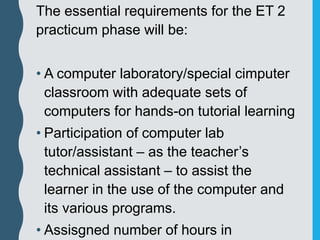
•The practicum phase
consists of hands-on
computer tutorials which the
student teacher or
professional teacher-trainee
will need to make him/her
capable
The essential requirements for the ET 2
practicum phase will be:
• A computer laboratory/special cimputer
classroom with adequate sets of
computers for hands-on tutorial learning
• Participation of computer lab
tutor/assistant – as the teacher’s
technical assistant – to assist the
learner in the use of the computer and
its various programs.
• Assisgned number of hours in
• The practicum phase consists in:
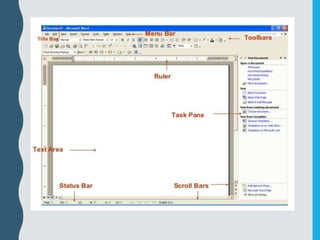
1. Basic Microsoft Word (6 hrs)
The tutorial familiarizes each individual
learner to the basics of Microsoft word.
Tutorial coverage:
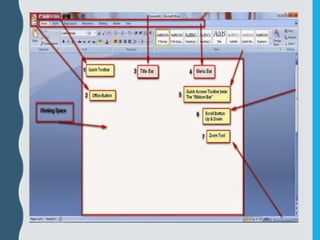
• Microsoft word menus and toolbars
• Creating, formatting, editing and saving
documents
• Assigning page layouts
• Insertng tabs and tables
• Templates and wizards
• Printing
Upon successful completion, the
learner shall be able to:
•Create, open and save word
documents and files
•Insert graphics, tables and charts in
document
•Manage files and folder
•Apply format on the text, sentences
and paragraphs
2. Microsoft Powerpoint (6 hrs)
The tutorial is a familiarization on
the basics of Microsoft Powerpoint. It
will train the learner to prepare
Powerpoint presentations to enhance
the teaching of subjects
Coverage:
• Powerpoint fundamentals
• Enhancement of Powerpoint
presentation with the use of graphics,
charts, audio and video.
At the end of the tutorial, the
learner will be able to:
•Create and open Powerpoint
presentations
•Insert objects (cliparts), pictures,
graphics, charts, audio and video
to create effective presentations
•Use the templates to enhance
presentations
•3. internet as tool of inquiry (4
hrs)
The tutorial will facilitate the
finding of sources of information
appropriate to a learning task.
Course coverage:
•Accessing the internet
•Use of internet tools
At the end of the tutorial, the learner will be
able to:
• Search and retrieve information from the
web
• Acquire skills in locating appropriate
information on the internet.
• Acquire ability to use internet tools such as
search engines
• Gain knowledge of search techniques
such as browsing through an information
tree
• Learn the ablity to execute the search
In sum, Educational Technology 2
promises to bring the student teacher
and the professional teacher and the
professional teacher trainee to the
challenge of a new age – integrating
technology in the teaching – learning
process, the risk pace of technology
advancement and innovation continues,
but ET 2 is a preparation to bring our
teachers to move ahead with their use of
technology in the classroom
TABLETS
FOR
TEXTBOOKL E S S O N 1 8
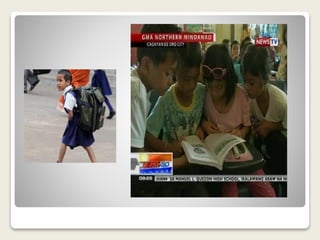
 For Philippine schools, even for private
Tablet-for – learning is still futuristic.
 Books are still the primary medium of
instruction in most schools.
DIS ADVANTAGES OF USING
BOOKS
- For school-graders the load of books and
workbooks for every subject are
backbreaking due to their weight and size.
- One-book for every student is still goal
not reality.
- The errors in public school textbooks have
also been exposed errors resulting from
wrong information, technical mistakes and
editorial lapses.
TODAY
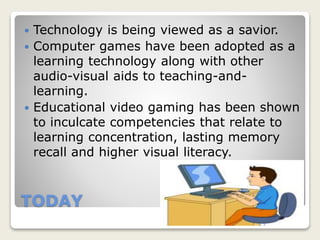
 Technology is being viewed as a savior.
 Computer games have been adopted as a
learning technology along with other
audio-visual aids to teaching-and-
learning.
 Educational video gaming has been shown
to inculcate competencies that relate to
learning concentration, lasting memory
recall and higher visual literacy.
De La Salle Experience
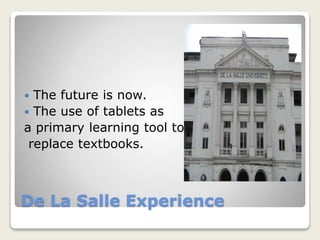
 The future is now.
 The use of tablets as
a primary learning tool to
replace textbooks.
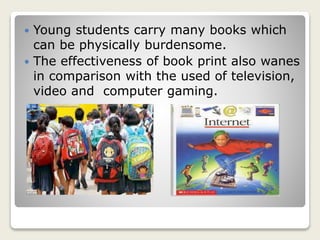
 Young students carry many books which
can be physically burdensome.
 The effectiveness of book print also wanes
in comparison with the used of television,
video and computer gaming.
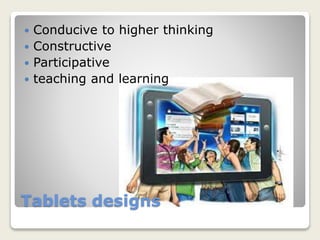
Tablets designs
 Conducive to higher thinking
 Constructive
 Participative
 teaching and learning
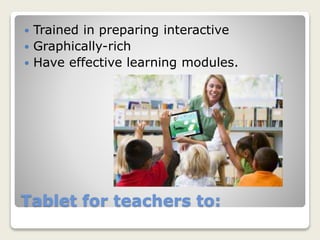
Tablet for teachers to:
 Trained in preparing interactive
 Graphically-rich
 Have effective learning modules.
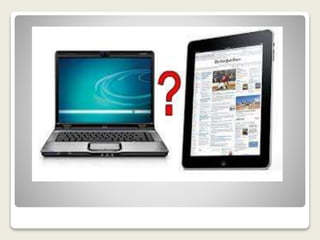
Which would you like ?
LAPTOP iPAD/TABLET
 Portable with hardware
included in product
 Full keyboard for easy,
accurate encoding
 Full screen for viewing,
browsing, enjoying
entertainment content
 Heavy weight (3-9 lbs.)
 Small, portable and light (1
lb.)
 Full control of screen and
applications
 Touch screen with stylus or
fingers
 Can store all your music,
photos, videos
 Built-in flash camera
 Built-in eReader to read books
 Durable but touch screen can
scratch, damage screen
display
TABLET FOR SCHOOLS
Use of tablets in public schools in the
country may be difficult considering
certain factors:
 Cost of one tablet for one student is not
within budget capability or beyond
capability of government which cannot
even fully comply with one book for one
student.
 Books have more durability compared with
electronic gadgets due to handling, energy
charging, heat and moist.
 Technical expertise for learning software is
not widely available.
 Swift evolution of content in learning may
outrun the tedious preparation of software
is making the product irrelevant to the
dynamism of educational programs.
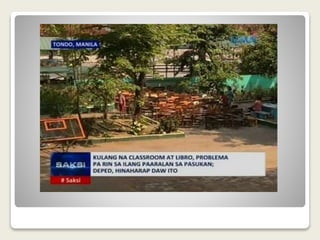
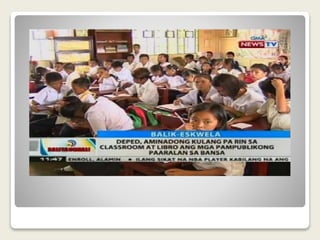
Conditions in Philippine education
 Youths in far-flung areas not reached
 Number of classrooms and facilities
inadequate
 Quality of work life of teachers below
standards
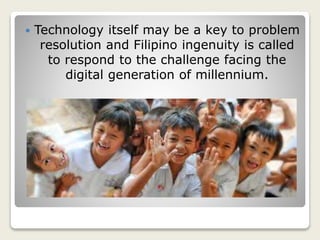
 Technology itself may be a key to problem
resolution and Filipino ingenuity is called
to respond to the challenge facing the
digital generation of millennium.

Lesson 17 and Lesson 18

  • 1.
    Educational Technology 2 Lesson17 Educational Technology 2 Practicum Lesson 18 Tablets for Textbook in School Autor, Vina Mae L. Baquilar, Shamae E. Caberto, Rica Danielle R. Quiambao, Joseph Ian T. Quico, Janella G. Pagtalunan, Judy Ann P. Bulacan State University College of Education City of Malolos
  • 3.
    Much like fieldstudies in teacher education, Educational Technology 2 offers students the experiential process of adapting to technology integration within a student-centered paradigm. This is the practicum phase of the course which can be done, as seen fit by the teacher, either at the end of the more theoretical lessons or interested
  • 4.
    •The practicum phase consistsof hands-on computer tutorials which the student teacher or professional teacher-trainee will need to make him/her capable
  • 6.
    The essential requirementsfor the ET 2 practicum phase will be: • A computer laboratory/special cimputer classroom with adequate sets of computers for hands-on tutorial learning • Participation of computer lab tutor/assistant – as the teacher’s technical assistant – to assist the learner in the use of the computer and its various programs. • Assisgned number of hours in
  • 7.
    • The practicumphase consists in: 1. Basic Microsoft Word (6 hrs) The tutorial familiarizes each individual learner to the basics of Microsoft word. Tutorial coverage: • Microsoft word menus and toolbars • Creating, formatting, editing and saving documents • Assigning page layouts • Insertng tabs and tables • Templates and wizards • Printing
  • 8.
    Upon successful completion,the learner shall be able to: •Create, open and save word documents and files •Insert graphics, tables and charts in document •Manage files and folder •Apply format on the text, sentences and paragraphs
  • 10.
    2. Microsoft Powerpoint(6 hrs) The tutorial is a familiarization on the basics of Microsoft Powerpoint. It will train the learner to prepare Powerpoint presentations to enhance the teaching of subjects Coverage: • Powerpoint fundamentals • Enhancement of Powerpoint presentation with the use of graphics, charts, audio and video.
  • 11.
    At the endof the tutorial, the learner will be able to: •Create and open Powerpoint presentations •Insert objects (cliparts), pictures, graphics, charts, audio and video to create effective presentations •Use the templates to enhance presentations
  • 13.
    •3. internet astool of inquiry (4 hrs) The tutorial will facilitate the finding of sources of information appropriate to a learning task. Course coverage: •Accessing the internet •Use of internet tools
  • 14.
    At the endof the tutorial, the learner will be able to: • Search and retrieve information from the web • Acquire skills in locating appropriate information on the internet. • Acquire ability to use internet tools such as search engines • Gain knowledge of search techniques such as browsing through an information tree • Learn the ablity to execute the search
  • 15.
    In sum, EducationalTechnology 2 promises to bring the student teacher and the professional teacher and the professional teacher trainee to the challenge of a new age – integrating technology in the teaching – learning process, the risk pace of technology advancement and innovation continues, but ET 2 is a preparation to bring our teachers to move ahead with their use of technology in the classroom
  • 17.
  • 18.
     For Philippineschools, even for private Tablet-for – learning is still futuristic.  Books are still the primary medium of instruction in most schools.
  • 19.
    DIS ADVANTAGES OFUSING BOOKS - For school-graders the load of books and workbooks for every subject are backbreaking due to their weight and size. - One-book for every student is still goal not reality. - The errors in public school textbooks have also been exposed errors resulting from wrong information, technical mistakes and editorial lapses.
  • 21.
    TODAY  Technology isbeing viewed as a savior.  Computer games have been adopted as a learning technology along with other audio-visual aids to teaching-and- learning.  Educational video gaming has been shown to inculcate competencies that relate to learning concentration, lasting memory recall and higher visual literacy.
  • 22.
    De La SalleExperience  The future is now.  The use of tablets as a primary learning tool to replace textbooks.
  • 23.
     Young studentscarry many books which can be physically burdensome.  The effectiveness of book print also wanes in comparison with the used of television, video and computer gaming.
  • 24.
    Tablets designs  Conduciveto higher thinking  Constructive  Participative  teaching and learning
  • 25.
    Tablet for teachersto:  Trained in preparing interactive  Graphically-rich  Have effective learning modules.
  • 26.
    Which would youlike ? LAPTOP iPAD/TABLET  Portable with hardware included in product  Full keyboard for easy, accurate encoding  Full screen for viewing, browsing, enjoying entertainment content  Heavy weight (3-9 lbs.)  Small, portable and light (1 lb.)  Full control of screen and applications  Touch screen with stylus or fingers  Can store all your music, photos, videos  Built-in flash camera  Built-in eReader to read books  Durable but touch screen can scratch, damage screen display
  • 28.
    TABLET FOR SCHOOLS Useof tablets in public schools in the country may be difficult considering certain factors:  Cost of one tablet for one student is not within budget capability or beyond capability of government which cannot even fully comply with one book for one student.
  • 29.
     Books havemore durability compared with electronic gadgets due to handling, energy charging, heat and moist.  Technical expertise for learning software is not widely available.  Swift evolution of content in learning may outrun the tedious preparation of software is making the product irrelevant to the dynamism of educational programs.
  • 31.
    Conditions in Philippineeducation  Youths in far-flung areas not reached  Number of classrooms and facilities inadequate  Quality of work life of teachers below standards
  • 34.
     Technology itselfmay be a key to problem resolution and Filipino ingenuity is called to respond to the challenge facing the digital generation of millennium.