Cherilyn A. Neyra
Lyra R. Pelonis
Ege Mahilum
Philippine Electronics And Communication
Institute of Technology
Butuan City
For Philippine schools, even for
private ones catering to children of
well-to-do families, the so-called
Tablet-for- learning is still futuristic.
The recognized impact of technology
in education, the future may not be
too far away.
Today,
books are still the primary medium of
instruction in most
schools. It is doubtful if these will totally be
replaced by digital technology reading tools
but, there are now perceptions that virtual
literacy may very well ease out textual print
literacy. The disadvantages of using
books for learning are being debated upon.
For school- graders, the load of books and
workbooks for every subject are
backbreaking due to their weight and size.
In developing countries, one-book for every
student is still a goal, not a reality.
Today
technology is being viewed as a savior.
Given the fact that students are enamored
by computer games which take much of
their time at home, educators have begun
to think that the computer screen can very
well serve as a powerful educational
medium. Classroom instruction which rides
the vehicle of gaming admittedly makes
learning more effective and more fun.
In De La Salle School, the future is
now. Administrators, teachers, parents
and other stakeholders have met to
discuss the use of Tablets as a primary
learning tool to replace the textbooks. In
developed countries gaming is today is
accepted as a learning technology, and
surveys have shown its effectiveness is
terms of mental concentration memory
retention and close-to-life experiential
learning.
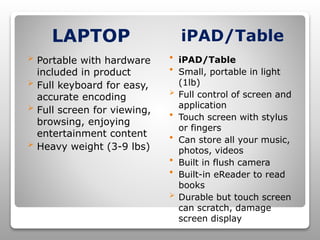
LAPTOP
iPAD/Table
LAPTOP iPAD/Table
 Portable with hardware
included in product
 Full keyboard for easy,
accurate encoding
 Full screen for viewing,
browsing, enjoying
entertainment content
 Heavy weight (3-9 lbs)
 iPAD/Table
 Small, portable in light
(1lb)
 Full control of screen and
application
 Touch screen with stylus
or fingers
 Can store all your music,
photos, videos
 Built in flush camera
 Built-in eReader to read
books
 Durable but touch screen
can scratch, damage
screen display
Technology itself may be a key to problem resolution
in Filipino ingenuity is called to respond to the
challenge facing the digital generation of the
millennium.
Tablets for Schools
Use of Tablets in public schools in the country may
bone tablet for one student is not with in budget capability or
beyond capability of government which cannot even fully e
difficult considering certain factors: (a) Cost of comply with one
book for one student. (b) Books have more durability compared
with electronic gadgets to handling, energy charging, heat and
moist. (c) technical expertise for the learning software is not widely
available.
THANK YOU.

Lesson 18..ppt ege mahilum,

  • 1.
    Cherilyn A. Neyra LyraR. Pelonis Ege Mahilum Philippine Electronics And Communication Institute of Technology Butuan City
  • 2.
    For Philippine schools,even for private ones catering to children of well-to-do families, the so-called Tablet-for- learning is still futuristic. The recognized impact of technology in education, the future may not be too far away.
  • 3.
    Today, books are stillthe primary medium of instruction in most schools. It is doubtful if these will totally be replaced by digital technology reading tools but, there are now perceptions that virtual literacy may very well ease out textual print literacy. The disadvantages of using books for learning are being debated upon. For school- graders, the load of books and workbooks for every subject are backbreaking due to their weight and size. In developing countries, one-book for every student is still a goal, not a reality.
  • 4.
    Today technology is beingviewed as a savior. Given the fact that students are enamored by computer games which take much of their time at home, educators have begun to think that the computer screen can very well serve as a powerful educational medium. Classroom instruction which rides the vehicle of gaming admittedly makes learning more effective and more fun.
  • 6.
    In De LaSalle School, the future is now. Administrators, teachers, parents and other stakeholders have met to discuss the use of Tablets as a primary learning tool to replace the textbooks. In developed countries gaming is today is accepted as a learning technology, and surveys have shown its effectiveness is terms of mental concentration memory retention and close-to-life experiential learning.
  • 7.
  • 8.
    LAPTOP iPAD/Table  Portablewith hardware included in product  Full keyboard for easy, accurate encoding  Full screen for viewing, browsing, enjoying entertainment content  Heavy weight (3-9 lbs)  iPAD/Table  Small, portable in light (1lb)  Full control of screen and application  Touch screen with stylus or fingers  Can store all your music, photos, videos  Built in flush camera  Built-in eReader to read books  Durable but touch screen can scratch, damage screen display
  • 9.
    Technology itself maybe a key to problem resolution in Filipino ingenuity is called to respond to the challenge facing the digital generation of the millennium. Tablets for Schools Use of Tablets in public schools in the country may bone tablet for one student is not with in budget capability or beyond capability of government which cannot even fully e difficult considering certain factors: (a) Cost of comply with one book for one student. (b) Books have more durability compared with electronic gadgets to handling, energy charging, heat and moist. (c) technical expertise for the learning software is not widely available.
  • 10.