Solutions to Worksheet for Section 2.7
                             Related Rates
                                     V63.0121, Calculus I
                                         Summer 2010


1. A 10 ft ladder leans against the side of a building. If the top of the ladder begins to slide down
   the wall at the rate of 2 ft/sec, how fast is the bottom of the ladder sliding away from the wall
   when the top of the ladder is 8 ft off the ground?

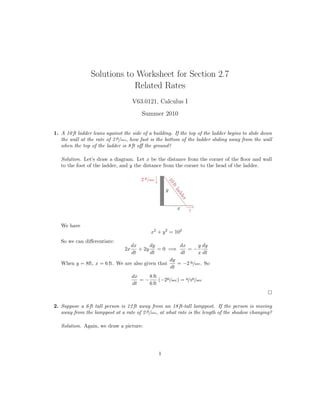
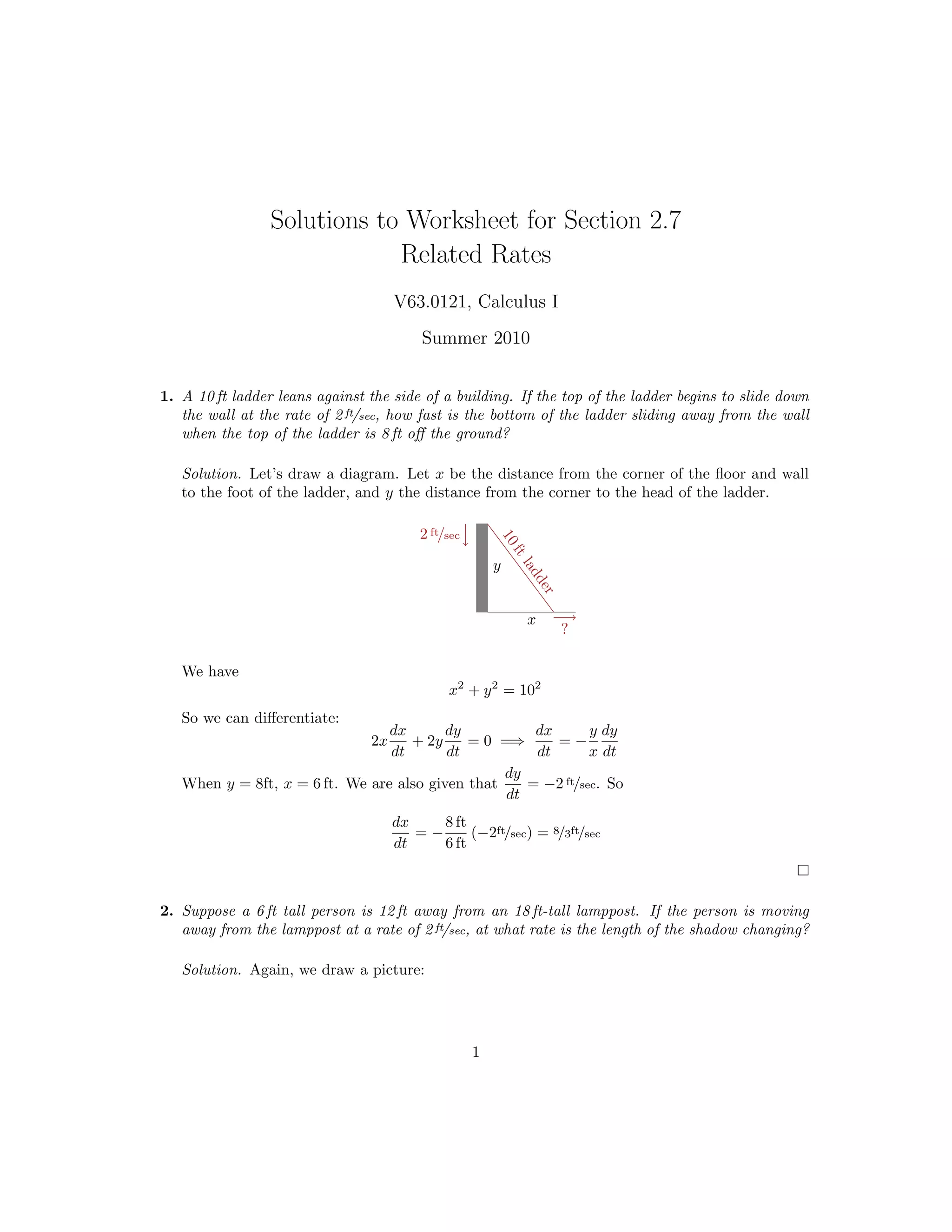
   Solution. Let’s draw a diagram. Let x be the distance from the corner of the floor and wall
   to the foot of the ladder, and y the distance from the corner to the head of the ladder.

                                         2 ft/sec
                                                        10
                                                            ft


                                                        y
                                                             lad
                                                                 de
                                                                     r


                                                                 x
                                                                         ?

   We have
                                              x2 + y 2 = 102
   So we can differentiate:
                                 dx       dy          dx       y dy
                                2x  + 2y     = 0 =⇒      =−
                                 dt       dt          dt       x dt
                                                  dy
   When y = 8ft, x = 6 ft. We are also given that    = −2 ft/sec. So
                                                  dt
                                     dx    8 ft
                                        =−      (−2ft/sec) = 8/3ft/sec
                                     dt    6 ft


2. Suppose a 6 ft tall person is 12 ft away from an 18 ft-tall lamppost. If the person is moving
   away from the lamppost at a rate of 2 ft/sec, at what rate is the length of the shadow changing?

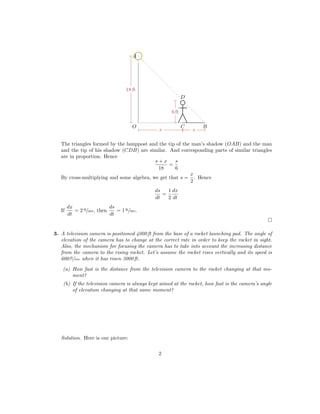
   Solution. Again, we draw a picture:


                                                    1
A


                                    18 ft
                                                            D

                                                     6 ft

                                       O                    C       B
                                               x                s

   The triangles formed by the lamppost and the tip of the man’s shadow (OAB) and the man
   and the tip of his shadow (CDB) are similar. And corresponding parts of similar triangles
   are in proportion. Hence
                                           s+x      s
                                                 =
                                            18     6
                                                          x
   By cross-multiplying and some algebra, we get that s = . Hence
                                                          2
                                             ds   1 dx
                                                =
                                             dt   2 dt
        dx                  ds
   If      = 2 ft/sec, then    = 1 ft/sec.
        dt                  dt


3. A television camera is positioned 4000 ft from the base of a rocket launching pad. The angle of
   elevation of the camera has to change at the correct rate in order to keep the rocket in sight.
   Also, the mechanism for focusing the camera has to take into account the increasing distance
   from the camera to the rising rocket. Let’s assume the rocket rises vertically and its speed is
   600 ft/sec when it has risen 3000 ft.
    (a) How fast is the distance from the television camera to the rocket changing at that mo-
        ment?
    (b) If the television camera is always kept aimed at the rocket, how fast is the camera’s angle
        of elevation changing at that same moment?


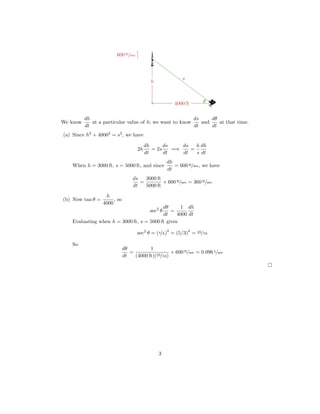
   Solution. Here is our picture:


                                               2
600 ft/sec


                                                            s
                                            h


                                                         4000 ft     θ


          dh                                             ds     dθ
We know      at a particular value of h; we want to know    and    at that time.
          dt                                             dt     dt
(a) Since h2 + 40002 = s2 , we have

                                          dh      ds    ds   h dh
                                     2h      = 2s    =⇒    =
                                          dt      dt    dt   s dt
                                                     dh
    When h = 3000 ft, s = 5000 ft, and since            = 600 ft/sec, we have
                                                     dt
                                   ds   3000 ft
                                      =         × 600 ft/sec = 360 ft/sec
                                   dt   5000 ft
                   h
(b) Now tan θ =        , so
                  4000
                                           dθ       1 dh
                                            sec2 θ
                                               =
                                           dt     4000 dt
    Evaluating when h = 3000 ft, s = 5000 ft gives
                                                     2          2
                                     sec2 θ = (s/h) = (5/3) = 25/16

    So
                              dθ          1
                                 =                  × 600 ft/sec = 0.096 1/sec
                              dt   (4000 ft)(25/16)


                                                3

Lesson 13: Related Rates (worksheet solutions)

  • 1.
    Solutions to Worksheetfor Section 2.7 Related Rates V63.0121, Calculus I Summer 2010 1. A 10 ft ladder leans against the side of a building. If the top of the ladder begins to slide down the wall at the rate of 2 ft/sec, how fast is the bottom of the ladder sliding away from the wall when the top of the ladder is 8 ft off the ground? Solution. Let’s draw a diagram. Let x be the distance from the corner of the floor and wall to the foot of the ladder, and y the distance from the corner to the head of the ladder. 2 ft/sec 10 ft y lad de r x ? We have x2 + y 2 = 102 So we can differentiate: dx dy dx y dy 2x + 2y = 0 =⇒ =− dt dt dt x dt dy When y = 8ft, x = 6 ft. We are also given that = −2 ft/sec. So dt dx 8 ft =− (−2ft/sec) = 8/3ft/sec dt 6 ft 2. Suppose a 6 ft tall person is 12 ft away from an 18 ft-tall lamppost. If the person is moving away from the lamppost at a rate of 2 ft/sec, at what rate is the length of the shadow changing? Solution. Again, we draw a picture: 1
  • 2.
    A 18 ft D 6 ft O C B x s The triangles formed by the lamppost and the tip of the man’s shadow (OAB) and the man and the tip of his shadow (CDB) are similar. And corresponding parts of similar triangles are in proportion. Hence s+x s = 18 6 x By cross-multiplying and some algebra, we get that s = . Hence 2 ds 1 dx = dt 2 dt dx ds If = 2 ft/sec, then = 1 ft/sec. dt dt 3. A television camera is positioned 4000 ft from the base of a rocket launching pad. The angle of elevation of the camera has to change at the correct rate in order to keep the rocket in sight. Also, the mechanism for focusing the camera has to take into account the increasing distance from the camera to the rising rocket. Let’s assume the rocket rises vertically and its speed is 600 ft/sec when it has risen 3000 ft. (a) How fast is the distance from the television camera to the rocket changing at that mo- ment? (b) If the television camera is always kept aimed at the rocket, how fast is the camera’s angle of elevation changing at that same moment? Solution. Here is our picture: 2
  • 3.
    600 ft/sec s h 4000 ft θ dh ds dθ We know at a particular value of h; we want to know and at that time. dt dt dt (a) Since h2 + 40002 = s2 , we have dh ds ds h dh 2h = 2s =⇒ = dt dt dt s dt dh When h = 3000 ft, s = 5000 ft, and since = 600 ft/sec, we have dt ds 3000 ft = × 600 ft/sec = 360 ft/sec dt 5000 ft h (b) Now tan θ = , so 4000 dθ 1 dh sec2 θ = dt 4000 dt Evaluating when h = 3000 ft, s = 5000 ft gives 2 2 sec2 θ = (s/h) = (5/3) = 25/16 So dθ 1 = × 600 ft/sec = 0.096 1/sec dt (4000 ft)(25/16) 3