Lecture 12:
Catchment and
Stream Pattern
Md. Arifur Rahman Bhuiyan
Assistant professor
Department of Environmental Science
Bangladesh University of Professionals
Key Discussion Points
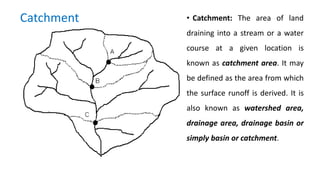
• Catchment: The area of land
draining into a stream or a water
course at a given location is
known as catchment area. It may
be defined as the area from which
the surface runoff is derived. It is
also known as watershed area,
drainage area, drainage basin or
simply basin or catchment.
Catchment
Catchment
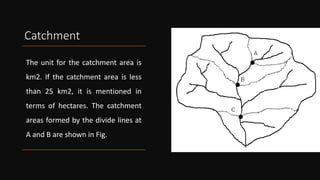
The unit for the catchment area is
km2. If the catchment area is less
than 25 km2, it is mentioned in
terms of hectares. The catchment
areas formed by the divide lines at
A and B are shown in Fig.
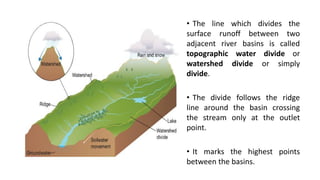
• The line which divides the
surface runoff between two
adjacent river basins is called
topographic water divide or
watershed divide or simply
divide.
• The divide follows the ridge
line around the basin crossing
the stream only at the outlet
point.
• It marks the highest points
between the basins.
https://www.youtube.com/watch?v=B6Nt-_NSFG4
https://www.youtube.com/watch?v=VqQJ0n-_sAE
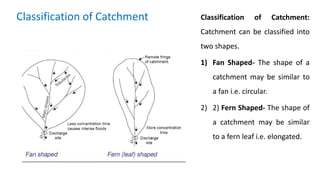
Classification of Catchment:
Catchment can be classified into
two shapes.
1) Fan Shaped- The shape of a
catchment may be similar to
a fan i.e. circular.
2) 2) Fern Shaped- The shape of
a catchment may be similar
to a fern leaf i.e. elongated.
Classification of Catchment
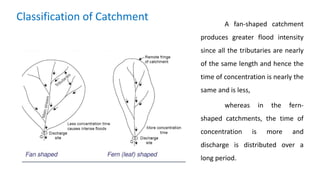
A fan-shaped catchment
produces greater flood intensity
since all the tributaries are nearly
of the same length and hence the
time of concentration is nearly the
same and is less,
whereas in the fern-
shaped catchments, the time of
concentration is more and
discharge is distributed over a
long period.
Classification of Catchment
Stream Pattern
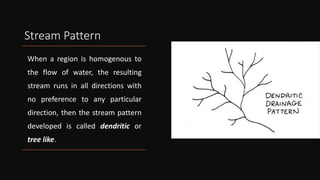
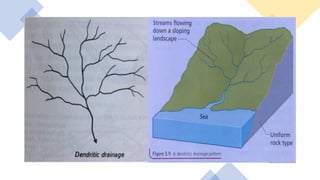
When a region is homogenous to
the flow of water, the resulting
stream runs in all directions with
no preference to any particular
direction, then the stream pattern
developed is called dendritic or
tree like.
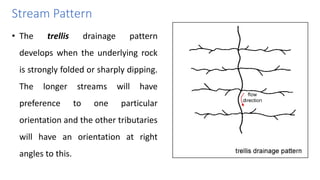
• The trellis drainage pattern
develops when the underlying rock
is strongly folded or sharply dipping.
The longer streams will have
preference to one particular
orientation and the other tributaries
will have an orientation at right
angles to this.
Stream Pattern
Stream Pattern
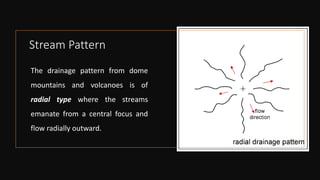
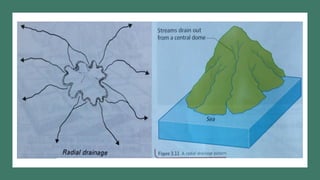
The drainage pattern from dome
mountains and volcanoes is of
radial type where the streams
emanate from a central focus and
flow radially outward.
Stream Pattern
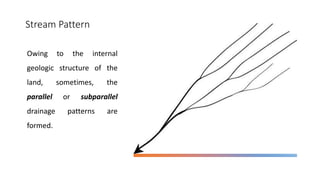
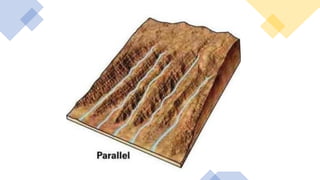
Owing to the internal
geologic structure of the
land, sometimes, the
parallel or subparallel
drainage patterns are
formed.
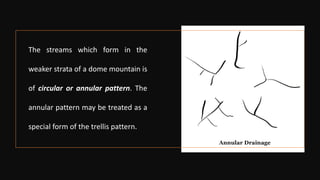
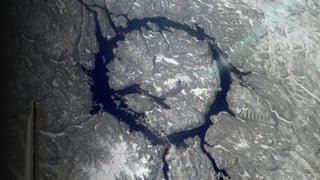
The streams which form in the
weaker strata of a dome mountain is
of circular or annular pattern. The
annular pattern may be treated as a
special form of the trellis pattern.
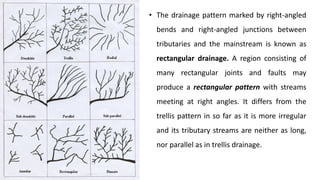
• The drainage pattern marked by right-angled
bends and right-angled junctions between
tributaries and the mainstream is known as
rectangular drainage. A region consisting of
many rectangular joints and faults may
produce a rectangular pattern with streams
meeting at right angles. It differs from the
trellis pattern in so far as it is more irregular
and its tributary streams are neither as long,
nor parallel as in trellis drainage.
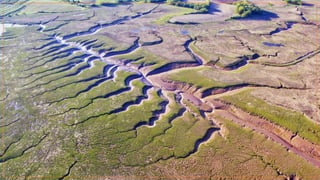
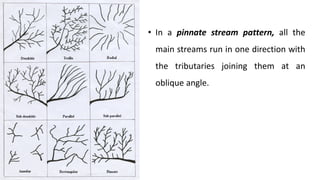
• In a pinnate stream pattern, all the
main streams run in one direction with
the tributaries joining them at an
oblique angle.
THANK YOU!

Lesson 12_Catchment and Stream Pattern.pdf

  • 1.
  • 2.
    Md. Arifur RahmanBhuiyan Assistant professor Department of Environmental Science Bangladesh University of Professionals
  • 3.
  • 4.
    • Catchment: Thearea of land draining into a stream or a water course at a given location is known as catchment area. It may be defined as the area from which the surface runoff is derived. It is also known as watershed area, drainage area, drainage basin or simply basin or catchment. Catchment
  • 5.
    Catchment The unit forthe catchment area is km2. If the catchment area is less than 25 km2, it is mentioned in terms of hectares. The catchment areas formed by the divide lines at A and B are shown in Fig.
  • 6.
    • The linewhich divides the surface runoff between two adjacent river basins is called topographic water divide or watershed divide or simply divide. • The divide follows the ridge line around the basin crossing the stream only at the outlet point. • It marks the highest points between the basins.
  • 7.
  • 8.
    Classification of Catchment: Catchmentcan be classified into two shapes. 1) Fan Shaped- The shape of a catchment may be similar to a fan i.e. circular. 2) 2) Fern Shaped- The shape of a catchment may be similar to a fern leaf i.e. elongated. Classification of Catchment
  • 9.
    A fan-shaped catchment producesgreater flood intensity since all the tributaries are nearly of the same length and hence the time of concentration is nearly the same and is less, whereas in the fern- shaped catchments, the time of concentration is more and discharge is distributed over a long period. Classification of Catchment
  • 10.
    Stream Pattern When aregion is homogenous to the flow of water, the resulting stream runs in all directions with no preference to any particular direction, then the stream pattern developed is called dendritic or tree like.
  • 12.
    • The trellisdrainage pattern develops when the underlying rock is strongly folded or sharply dipping. The longer streams will have preference to one particular orientation and the other tributaries will have an orientation at right angles to this. Stream Pattern
  • 14.
    Stream Pattern The drainagepattern from dome mountains and volcanoes is of radial type where the streams emanate from a central focus and flow radially outward.
  • 16.
    Stream Pattern Owing tothe internal geologic structure of the land, sometimes, the parallel or subparallel drainage patterns are formed.
  • 18.
    The streams whichform in the weaker strata of a dome mountain is of circular or annular pattern. The annular pattern may be treated as a special form of the trellis pattern.
  • 20.
    • The drainagepattern marked by right-angled bends and right-angled junctions between tributaries and the mainstream is known as rectangular drainage. A region consisting of many rectangular joints and faults may produce a rectangular pattern with streams meeting at right angles. It differs from the trellis pattern in so far as it is more irregular and its tributary streams are neither as long, nor parallel as in trellis drainage.
  • 21.
    • In apinnate stream pattern, all the main streams run in one direction with the tributaries joining them at an oblique angle.
  • 22.