Workteams – Lesson 1
The success of an organisation often depends on the
quality and effectiveness of its teams. While individual
initiative is important, managers recognise the benefits
of collective performance and look for ways to combine
the different talents of employees to harness the
synergy of a high-performance team.
Quality teams
   Teams can be brought together on a short- or long-
    term basis depending on the reason for their
    formation, and they vary in size depending on the
    type and location of the organisation.
   When forming teams for specific projects,
    consideration must be given to the availability of
    physical and human resources to ensure that the
    best possible outcome is achieved.
   Some common types of organisational teams are
    outlined in figure 6.1 on page 324
Quality teams
   Teams can operate as a group of individuals
    or as a united team. Which road they take
    and how successful they are, depends on
    management attitudes, support, training
    and the initial direction provided.
   The performance of members who operate
    as a group rather than a united team is
    often characterised by significant
    differences. These differences are outlined
    in figure 6.2 on page 326
Quality teams
   To assist teams in achieving peak
    performance, there are eight
    fundamental questions that should be
    addressed continuously throughout
    the life of the project, as outlined in
    figure 6.3 on page 327.
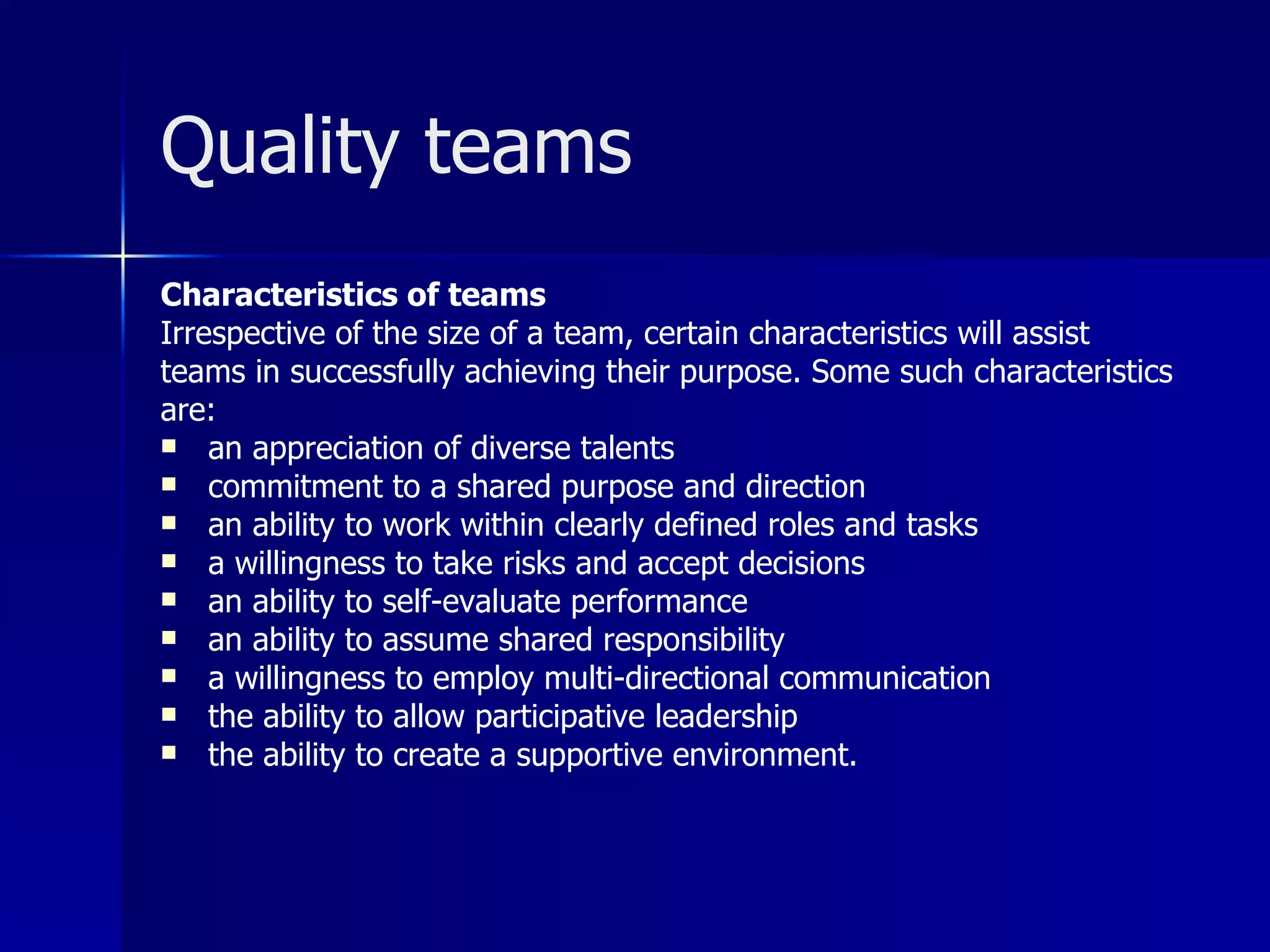
Quality teams
Characteristics of teams
Irrespective of the size of a team, certain characteristics will assist
teams in successfully achieving their purpose. Some such characteristics
are:
 an appreciation of diverse talents
 commitment to a shared purpose and direction
 an ability to work within clearly defined roles and tasks
 a willingness to take risks and accept decisions
 an ability to self-evaluate performance
 an ability to assume shared responsibility
 a willingness to employ multi-directional communication
 the ability to allow participative leadership
 the ability to create a supportive environment.
Questions
   Look at the list of characteristics of a
    successful team. Individually, select the
    three characteristics you consider to be
    most important.
   Then form groups of two or three and
    compare your lists.
   Now produce a team list of the best three
   Type a paragraph explaining reasons for
    your selection

Lesson 1

  • 1.
    Workteams – Lesson1 The success of an organisation often depends on the quality and effectiveness of its teams. While individual initiative is important, managers recognise the benefits of collective performance and look for ways to combine the different talents of employees to harness the synergy of a high-performance team.
  • 2.
    Quality teams  Teams can be brought together on a short- or long- term basis depending on the reason for their formation, and they vary in size depending on the type and location of the organisation.  When forming teams for specific projects, consideration must be given to the availability of physical and human resources to ensure that the best possible outcome is achieved.  Some common types of organisational teams are outlined in figure 6.1 on page 324
  • 3.
    Quality teams  Teams can operate as a group of individuals or as a united team. Which road they take and how successful they are, depends on management attitudes, support, training and the initial direction provided.  The performance of members who operate as a group rather than a united team is often characterised by significant differences. These differences are outlined in figure 6.2 on page 326
  • 4.
    Quality teams  To assist teams in achieving peak performance, there are eight fundamental questions that should be addressed continuously throughout the life of the project, as outlined in figure 6.3 on page 327.
  • 5.
    Quality teams Characteristics ofteams Irrespective of the size of a team, certain characteristics will assist teams in successfully achieving their purpose. Some such characteristics are:  an appreciation of diverse talents  commitment to a shared purpose and direction  an ability to work within clearly defined roles and tasks  a willingness to take risks and accept decisions  an ability to self-evaluate performance  an ability to assume shared responsibility  a willingness to employ multi-directional communication  the ability to allow participative leadership  the ability to create a supportive environment.
  • 6.
    Questions  Look at the list of characteristics of a successful team. Individually, select the three characteristics you consider to be most important.  Then form groups of two or three and compare your lists.  Now produce a team list of the best three  Type a paragraph explaining reasons for your selection