
McGraw-Hill/Irwin Copyright © 2009 by The McGraw-Hill Companies, Inc.  All rights reserved.
Learning Objectives L01:  How teams contribute to  organization’s effectiveness. L02:  Distinguish new team environment from traditional work groups. L03:  How do groups become teams?
Learning Objectives L04:  Why do groups sometimes fail? L05:  How to build an effective team. L06:  List methods for managing a team’s relationships with other teams. L07:  Identify ways to manage conflict.
The Contributions of Teams Teams can be powerfully effective as a building block for organization structure. increase productivity, improve quality, enhance speed, and reduce costs. powerful forces for innovation and change. provide benefits for members useful learning, feedback, growth, and development mechanisms.
The New Team Environment Team   small number of people with  complementary skills  committed to a  common purpose and  set of performance goals hold themselves  mutually accountable Working group   collection of people who  work in the same area  or come together to  undertake a task  do not necessarily have a common purpose
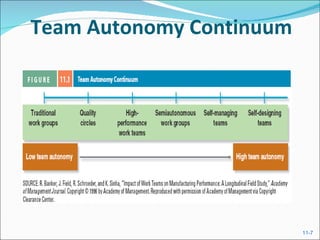
Different Types of Organizational Teams Project and Development Teams  - teams that work on long-term projects but disband once the work is completed Quality Circles - voluntary groups of people drawn from various production teams who make suggestions about quality Self-Managed Teams - Autonomous work groups in which workers are trained to do all or most of the jobs in a unit, have no immediate supervisor, and make decisions previously made by first-line supervisors
Team Autonomy Continuum
How Groups Become Real Teams Forming  - Group members lay ground rules for what types of behavior are acceptable. Storming  - Hostilities and conflict arise; people jock for positions of power and status. Norming  - Group members agree on shared goals; norms and closer relationships develop. Performing  - Group channels its energies into performing tasks.
Why do groups sometimes fail? Ineffective communication Lack of effective chartering, visioning, and goal setting Lack of clarity about roles Keeping morale and momentum high Keeping productivity high Lack of trust
Building Team Effectiveness The productive output of the team meets or exceeds the standards of quantity and quality. Team members realize satisfaction of their personal needs. Team members remain committed to working together again. Effective teams: focus on performance need feedback on their performance Have skilled members
Managers motivate effective teamwork Social loafing  - working less hard and being less productive when in a group Social loafing occurs when: individuals believe their contributions are not important others will do the work for them their lack of effort will go undetected they will be the lone sucker if they work hard but others don’t Social facilitation effect  - working harder when in a group than when working alone
Roles & Cohesiveness for team effectiveness Roles  - different sets of expectations for how different individuals should behave Task Specialist  - An individual who has more advanced job-related skills and abilities than other group members possess Team Maintenance Specialist  - Individual who develops and maintains team harmony Cohesiveness  - The degree to which a group is attractive to its members, members are motivated to remain in the group, and members influence one another
Building Cohesiveness and  High-Performance Norms Recruit members with similar attitudes, values, and backgrounds. Maintain high entrance and socialization standards. Keep the team small. Help the team succeed, and publicize its successes. Be a participative leader. Present a challenge from outside the team. Tie rewards to team performance.
Managing Lateral Relationships Gatekeeper  - a team member who stays abreast of current information and informs the group of important developments
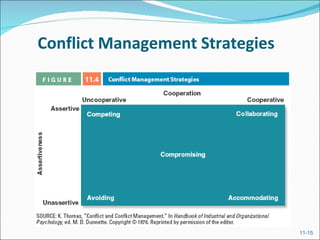
Conflict Management Strategies
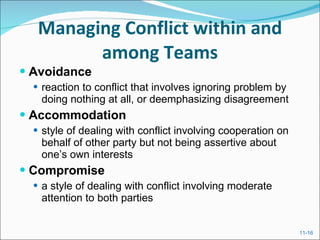
Managing Conflict within and among Teams Avoidance reaction to conflict that involves ignoring problem by doing nothing at all, or deemphasizing disagreement Accommodation style of dealing with conflict involving cooperation on behalf of other party but not being assertive about one’s own interests Compromise a style of dealing with conflict involving moderate attention to both parties
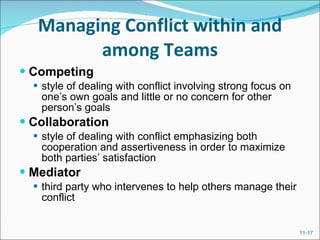
Managing Conflict within and among Teams Competing   style of dealing with conflict involving strong focus on one’s own goals and little or no concern for other person’s goals Collaboration style of dealing with conflict emphasizing both cooperation and assertiveness in order to maximize both parties’ satisfaction Mediator third party who intervenes to help others manage their conflict
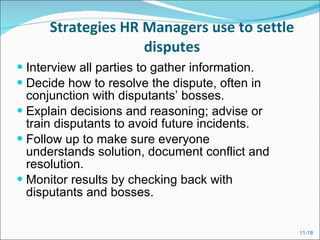
Strategies HR Managers use to settle disputes Interview all parties to gather information. Decide how to resolve the dispute, often in conjunction with disputants’ bosses. Explain decisions and reasoning; advise or train disputants to avoid future incidents. Follow up to make sure everyone understands solution, document conflict and resolution. Monitor results by checking back with disputants and bosses.
 
YOU should be able to L01: Discuss how teams can contribute to an organization’s effectiveness. L02: Distinguish the new team environment from that of traditional work groups. L03: Summarize how groups become teams.
YOU should be able to L04: Explain why groups sometimes fail. L05: Describe how to build an effective team. L06: List methods for managing a team’s relationships with other teams. L07: Identify ways to manage conflict.
 
Test Your Knowledge Explain at least four ways that teams can help organizations.
Test Your Knowledge Sebastian Stabilio just joined a team of people from throughout his organization whose primary task is to recommend valuable uses for the scrap generated in the manufacturing process.  The team meets twice per week; otherwise members work within the usual organizational structure.  The team, not permanent, which Sebastian has joined, would be considered a:  A) work team.  B) working group.  C) project group.  D) project team.  E) parallel team.
Test Your Knowledge Describe the process by which groups become real teams.
Test Your Knowledge Read the Starbucks story on page 252. Describe the Jumpstart team’s common purpose. How does the establishment of a permanent location contribute to the achievement of this purpose? How might the performance of the Jumpstart UNO program be measured? Write a few possible performance goals the team could use.
Test Your Knowledge Prior to hiring a consultant to assist with a departmental reorganization, the departmental manager was required to get the project (and the project's expense) approved by two other departments: accounting and human resources.  This type of requirement facilitates ______ relationships in the organization.  A) service  B) advisory  C) audit  D) stabilization  E) liaison
Test Your Knowledge Discuss the conflict management strategies.  When are each most appropriate?

BUS137 Chapter 11

  • 1.
    McGraw-Hill/Irwin Copyright ©2009 by The McGraw-Hill Companies, Inc. All rights reserved.
  • 2.
    Learning Objectives L01: How teams contribute to organization’s effectiveness. L02: Distinguish new team environment from traditional work groups. L03: How do groups become teams?
  • 3.
    Learning Objectives L04: Why do groups sometimes fail? L05: How to build an effective team. L06: List methods for managing a team’s relationships with other teams. L07: Identify ways to manage conflict.
  • 4.
    The Contributions ofTeams Teams can be powerfully effective as a building block for organization structure. increase productivity, improve quality, enhance speed, and reduce costs. powerful forces for innovation and change. provide benefits for members useful learning, feedback, growth, and development mechanisms.
  • 5.
    The New TeamEnvironment Team small number of people with complementary skills committed to a common purpose and set of performance goals hold themselves mutually accountable Working group collection of people who work in the same area or come together to undertake a task do not necessarily have a common purpose
  • 6.
    Different Types ofOrganizational Teams Project and Development Teams - teams that work on long-term projects but disband once the work is completed Quality Circles - voluntary groups of people drawn from various production teams who make suggestions about quality Self-Managed Teams - Autonomous work groups in which workers are trained to do all or most of the jobs in a unit, have no immediate supervisor, and make decisions previously made by first-line supervisors
  • 7.
  • 8.
    How Groups BecomeReal Teams Forming - Group members lay ground rules for what types of behavior are acceptable. Storming - Hostilities and conflict arise; people jock for positions of power and status. Norming - Group members agree on shared goals; norms and closer relationships develop. Performing - Group channels its energies into performing tasks.
  • 9.
    Why do groupssometimes fail? Ineffective communication Lack of effective chartering, visioning, and goal setting Lack of clarity about roles Keeping morale and momentum high Keeping productivity high Lack of trust
  • 10.
    Building Team EffectivenessThe productive output of the team meets or exceeds the standards of quantity and quality. Team members realize satisfaction of their personal needs. Team members remain committed to working together again. Effective teams: focus on performance need feedback on their performance Have skilled members
  • 11.
    Managers motivate effectiveteamwork Social loafing - working less hard and being less productive when in a group Social loafing occurs when: individuals believe their contributions are not important others will do the work for them their lack of effort will go undetected they will be the lone sucker if they work hard but others don’t Social facilitation effect - working harder when in a group than when working alone
  • 12.
    Roles & Cohesivenessfor team effectiveness Roles - different sets of expectations for how different individuals should behave Task Specialist - An individual who has more advanced job-related skills and abilities than other group members possess Team Maintenance Specialist - Individual who develops and maintains team harmony Cohesiveness - The degree to which a group is attractive to its members, members are motivated to remain in the group, and members influence one another
  • 13.
    Building Cohesiveness and High-Performance Norms Recruit members with similar attitudes, values, and backgrounds. Maintain high entrance and socialization standards. Keep the team small. Help the team succeed, and publicize its successes. Be a participative leader. Present a challenge from outside the team. Tie rewards to team performance.
  • 14.
    Managing Lateral RelationshipsGatekeeper - a team member who stays abreast of current information and informs the group of important developments
  • 15.
  • 16.
    Managing Conflict withinand among Teams Avoidance reaction to conflict that involves ignoring problem by doing nothing at all, or deemphasizing disagreement Accommodation style of dealing with conflict involving cooperation on behalf of other party but not being assertive about one’s own interests Compromise a style of dealing with conflict involving moderate attention to both parties
  • 17.
    Managing Conflict withinand among Teams Competing style of dealing with conflict involving strong focus on one’s own goals and little or no concern for other person’s goals Collaboration style of dealing with conflict emphasizing both cooperation and assertiveness in order to maximize both parties’ satisfaction Mediator third party who intervenes to help others manage their conflict
  • 18.
    Strategies HR Managersuse to settle disputes Interview all parties to gather information. Decide how to resolve the dispute, often in conjunction with disputants’ bosses. Explain decisions and reasoning; advise or train disputants to avoid future incidents. Follow up to make sure everyone understands solution, document conflict and resolution. Monitor results by checking back with disputants and bosses.
  • 19.
  • 20.
    YOU should beable to L01: Discuss how teams can contribute to an organization’s effectiveness. L02: Distinguish the new team environment from that of traditional work groups. L03: Summarize how groups become teams.
  • 21.
    YOU should beable to L04: Explain why groups sometimes fail. L05: Describe how to build an effective team. L06: List methods for managing a team’s relationships with other teams. L07: Identify ways to manage conflict.
  • 22.
  • 23.
    Test Your KnowledgeExplain at least four ways that teams can help organizations.
  • 24.
    Test Your KnowledgeSebastian Stabilio just joined a team of people from throughout his organization whose primary task is to recommend valuable uses for the scrap generated in the manufacturing process. The team meets twice per week; otherwise members work within the usual organizational structure. The team, not permanent, which Sebastian has joined, would be considered a: A) work team. B) working group. C) project group. D) project team. E) parallel team.
  • 25.
    Test Your KnowledgeDescribe the process by which groups become real teams.
  • 26.
    Test Your KnowledgeRead the Starbucks story on page 252. Describe the Jumpstart team’s common purpose. How does the establishment of a permanent location contribute to the achievement of this purpose? How might the performance of the Jumpstart UNO program be measured? Write a few possible performance goals the team could use.
  • 27.
    Test Your KnowledgePrior to hiring a consultant to assist with a departmental reorganization, the departmental manager was required to get the project (and the project's expense) approved by two other departments: accounting and human resources. This type of requirement facilitates ______ relationships in the organization. A) service B) advisory C) audit D) stabilization E) liaison
  • 28.
    Test Your KnowledgeDiscuss the conflict management strategies. When are each most appropriate?