1


BUILDING TEAMS THROUGH
PROJECT CHARTERS
Chartering empowers team members, both individually, and
collectively
Chartering the Team
2
    Table of Contents
       Background
       Developing Project Teams
       Stages of Team Development
       Stage 1: Chartering the Team
       Stage 2: Building the Team
       Stage 3: Sustaining the Team’s Performance
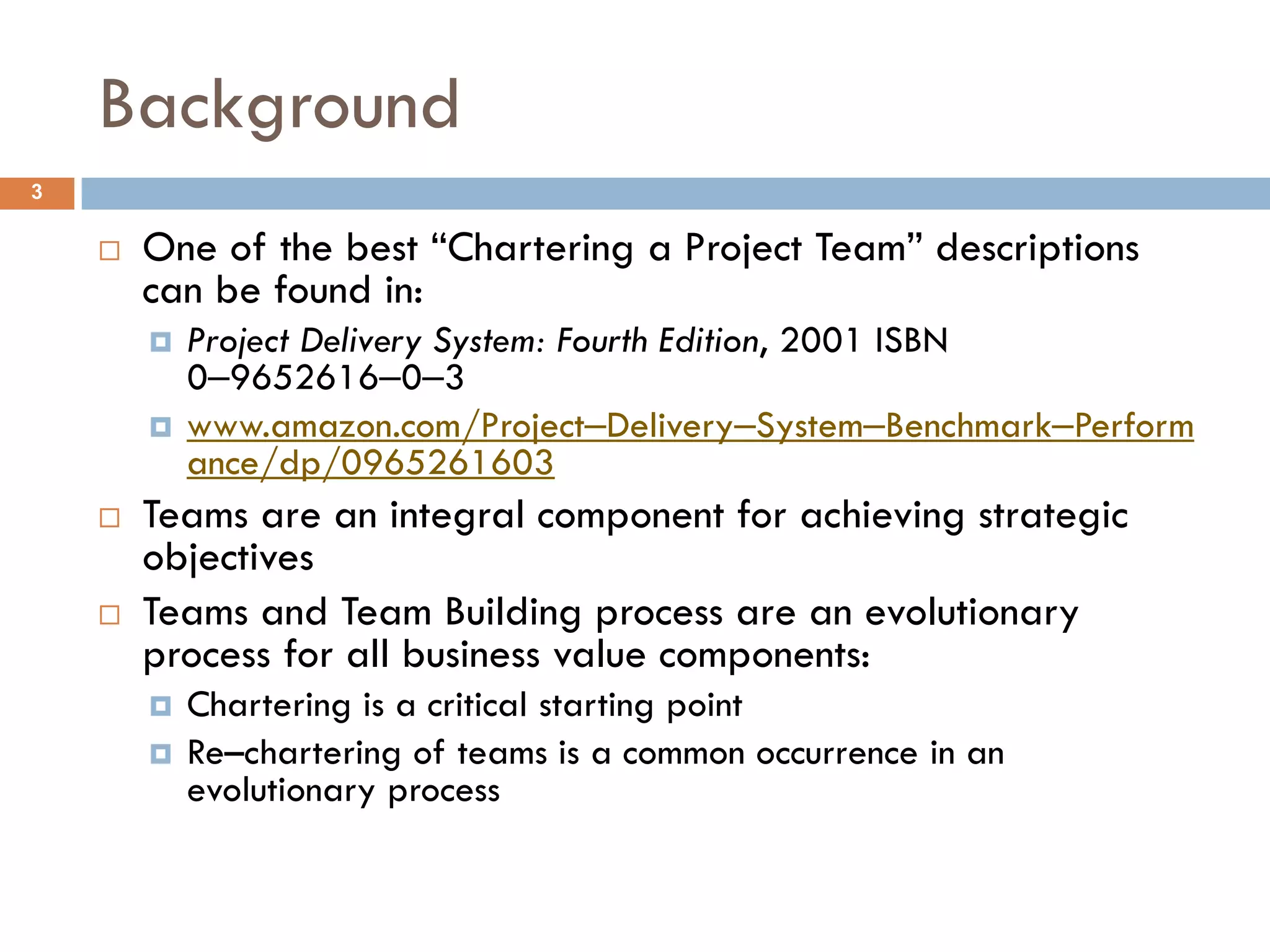
Background
3

       One of the best “Chartering a Project Team” descriptions
        can be found in:
           Project Delivery System: Fourth Edition, 2001 ISBN
            0‒9652616‒0‒3
           www.amazon.com/Project‒Delivery‒System‒Benchmark‒Perform
            ance/dp/0965261603
       Teams are an integral component for achieving strategic
        objectives
       Teams and Team Building process are an evolutionary
        process for all business value components:
           Chartering is a critical starting point
           Re–chartering of teams is a common occurrence in an
            evolutionary process
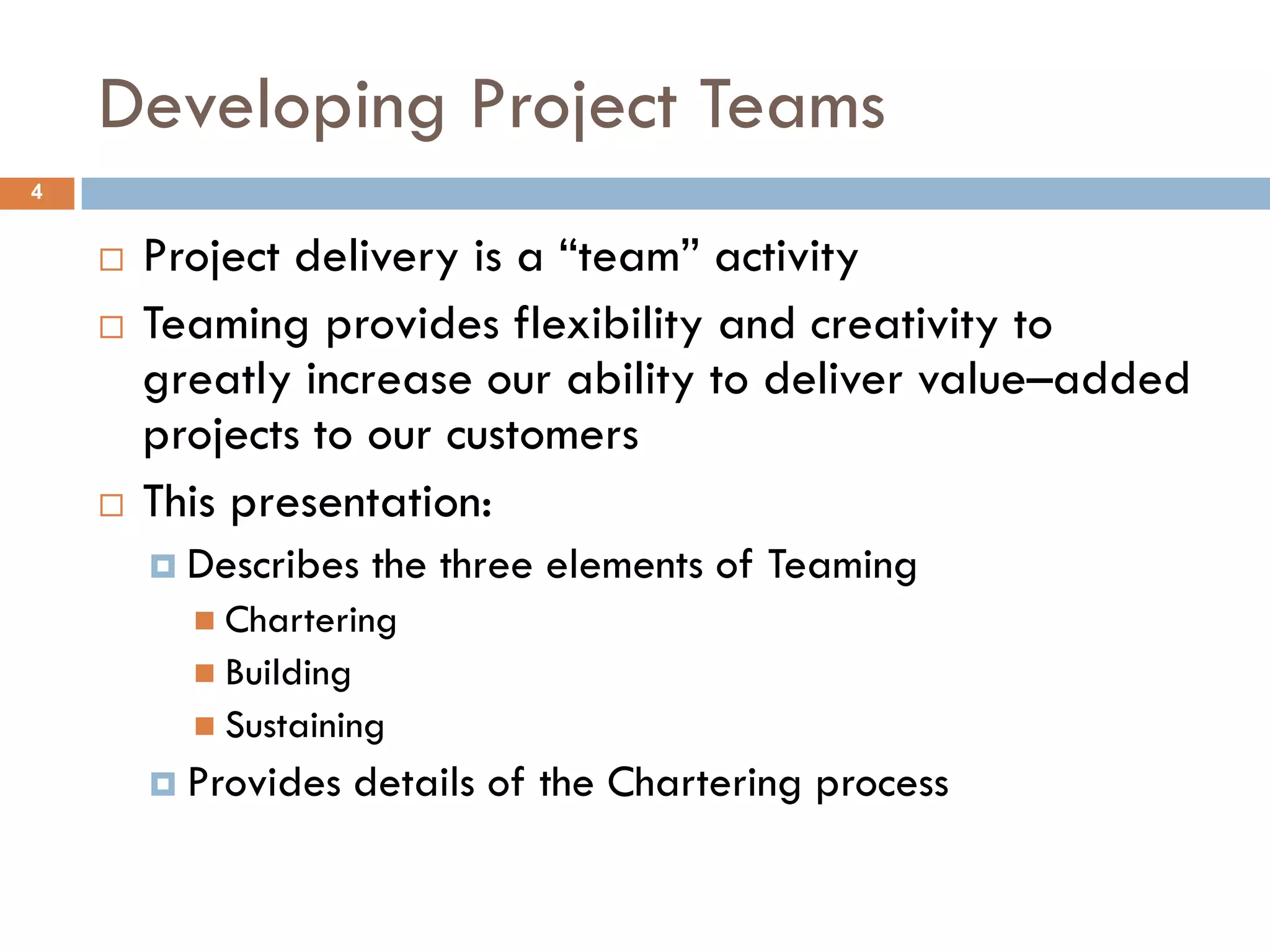
Developing Project Teams
4


       Project delivery is a “team” activity
       Teaming provides flexibility and creativity to
        greatly increase our ability to deliver value–added
        projects to our customers
       This presentation:
         Describes     the three elements of Teaming
           Chartering
           Building
           Sustaining
         Provides     details of the Chartering process
What is a Team?
5


       “A team is a group of people who hold each other
        mutually accountable for a common purpose to produce
        a specific outcome”‒ The Wisdom of Teams, Jon
        Katzenberg, Harvard Business Press, 1992
       In the project delivery context the “project team”
        consists of:
         Key staff members
         A project “score keeper”
         A project “spokesperson”

       The team uses a standard set of processes to develop
        and deliver the desired products and services
Chartering the Team
6


       The Project Team Members charter the team and build
        it into an effective work delivery system.
       The Team Members and their Coaches sustain a high
        level of team performance throughout the project.
       The Customer, Stakeholders, and Management interact
        with the Team Members and their Coaches during the
        course of the project to define requirements a receive
        specific components from the team’s efforts.
       Even though the Customer, Management, and the
        Stakeholders are not members of the team they are
        members of a broader definition of the “team” and are
        involved in certain functions of the teaming process.
Why Charter the Project Team?
7


       Achieve high‒quality performance
         Define clear goals
         Establish initial agreement regarding purpose, individual
          agendas, address interpersonal conflicts, assignment of
          resources, and clarify expectations
         Produce a shared vision of the project
         Create team behaviors that are stronger than individual
          behaviors
         Establish operating guidelines that govern team and
          individual behaviors
         Set the stage for success
Why Charter the Project Team?
8


       Empower team members
       Staff is “empowered” when they have been given a
        clear understanding of:
         Desired results
         Parameters within which the results are to be
          accomplished
         Resources available to help achieve the desired results
         Expected standards of performance
         Consequences associated with various levels of
          performance
Why Charter the Project Team?
9


       Monitor performance
         Charter  contains a baseline against which the team can
         assess it performance on an ongoing basis
           Teams can know they are not achieving at their desired level
           Teams can recognize when they are faltering and can
            implement the self‒correcting mechanisms to resolve
            problems
         Charter   provides the foundation essential for
           Monitoring performance
           Diagnosing problems
           Evaluating and implementing solutions
Chartering the Team
10


        Project planning is the single most important activity
         that will influence the success of the project
        Planning is divided into three (3) essential
         components:
          Charter the project team
          Plan the project

          Endorse the project
Stages of Team Development
11


        A common, agreed upon set of goals, measures and
         rules
        A commitment to the required goals and tasks and to
         each other
        Interdependent work: each person’s work linked to
         the others
        Collective and individual accountabilities
        Acceptable team behaviors
        Adequate resources to perform the work as a team
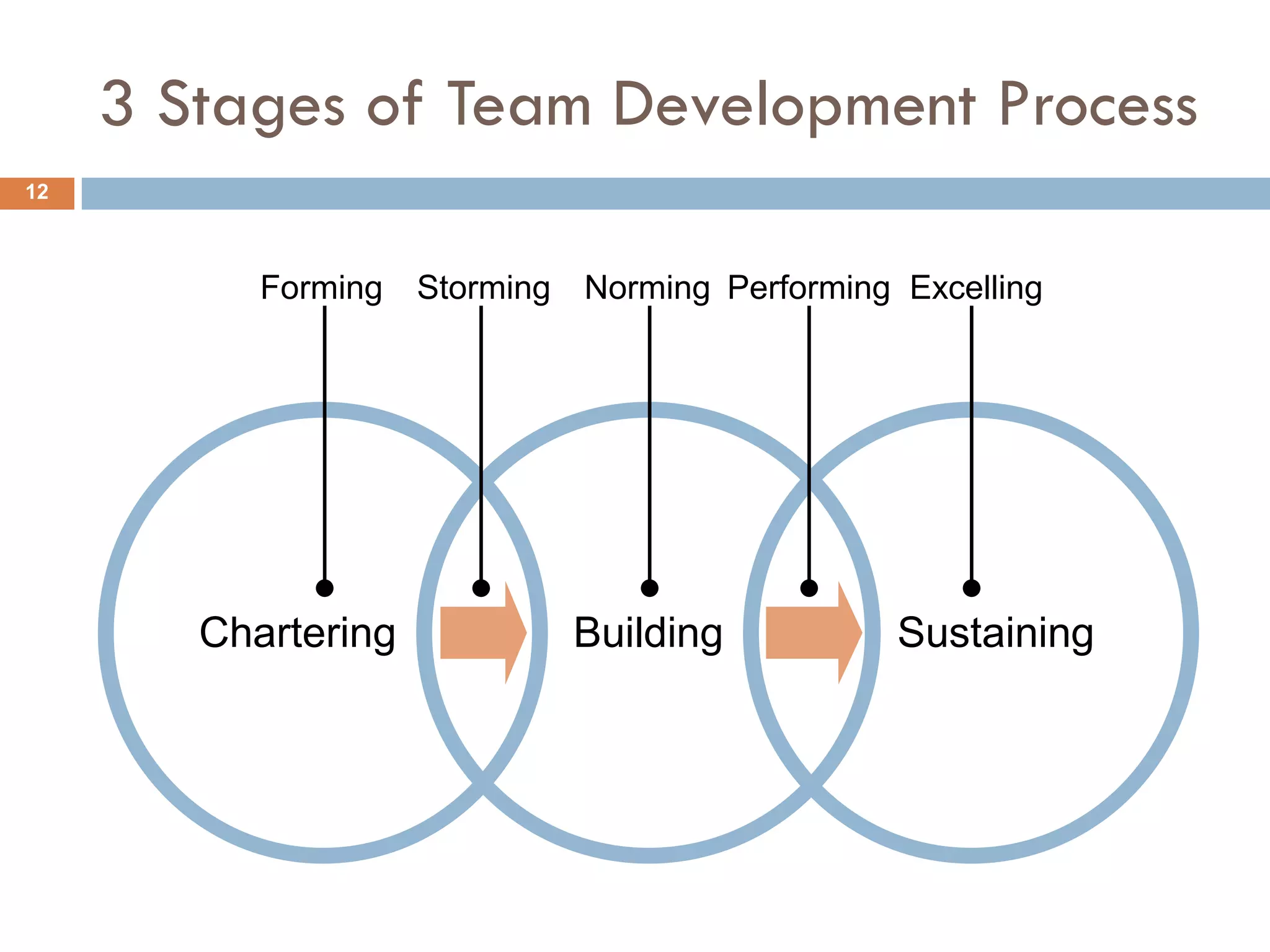
3 Stages of Team Development Process
12


           Forming   Storming Norming Performing Excelling


        Chartering            Building           Sustaining
13   Chartering the Team
     Building a project charter is a critical success
     factor for any endeavor.
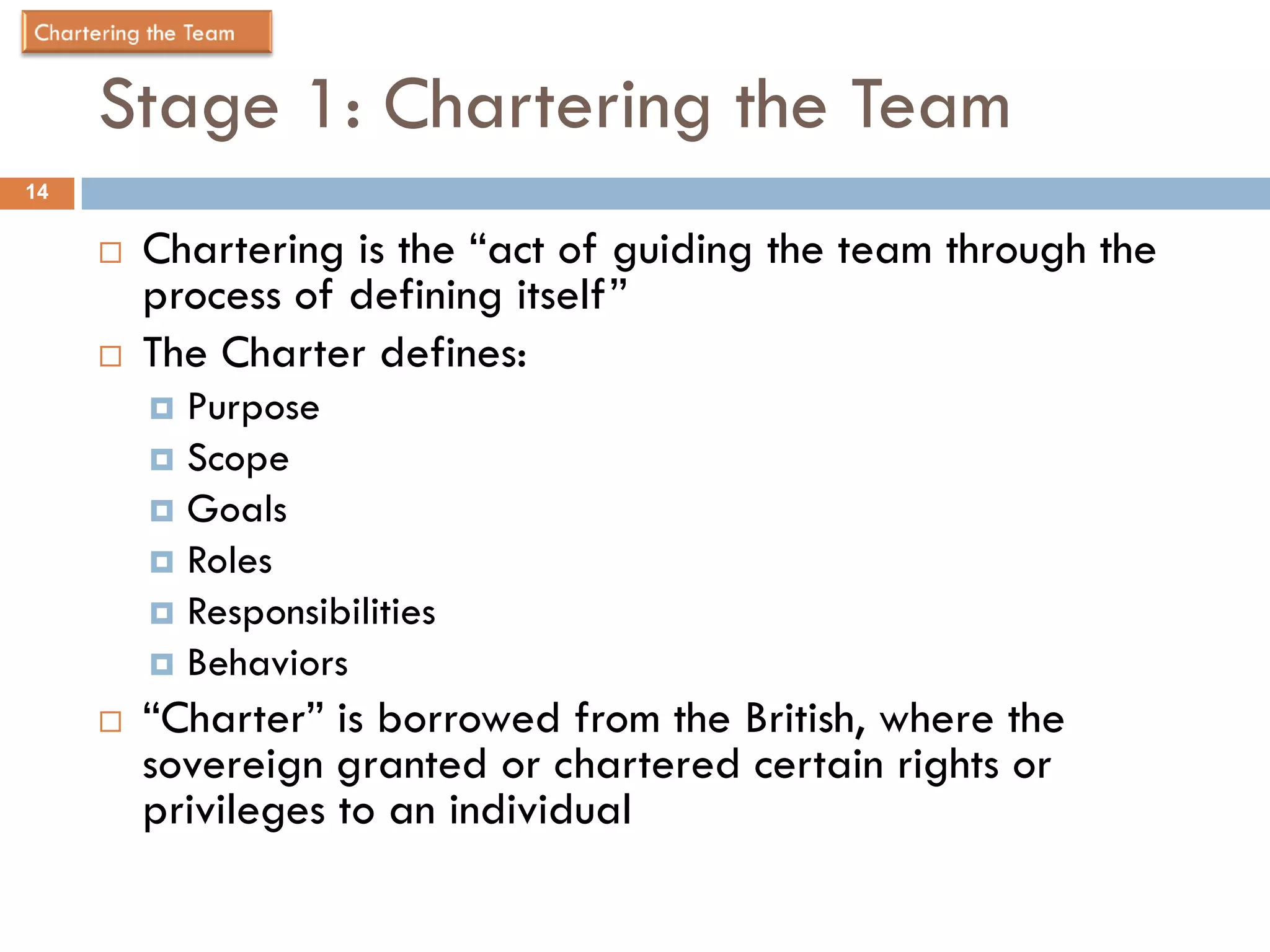
Stage 1: Chartering the Team
14


        Chartering is the “act of guiding the team through the
         process of defining itself”
        The Charter defines:
          Purpose
          Scope
          Goals
          Roles
          Responsibilities
          Behaviors
        “Charter” is borrowed from the British, where the
         sovereign granted or chartered certain rights or
         privileges to an individual
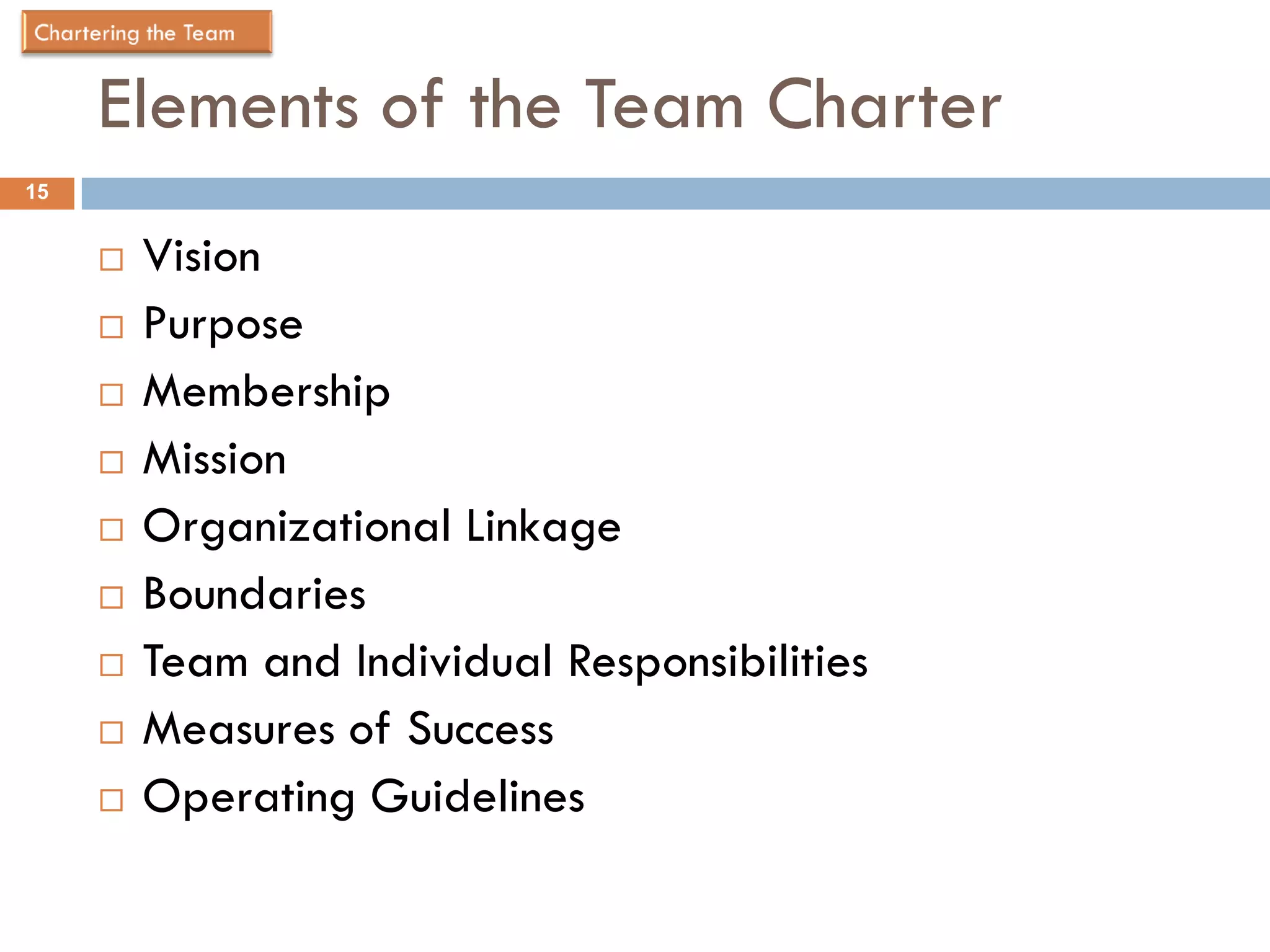
Elements of the Team Charter
15


        Vision
        Purpose
        Membership
        Mission
        Organizational Linkage
        Boundaries
        Team and Individual Responsibilities
        Measures of Success
        Operating Guidelines
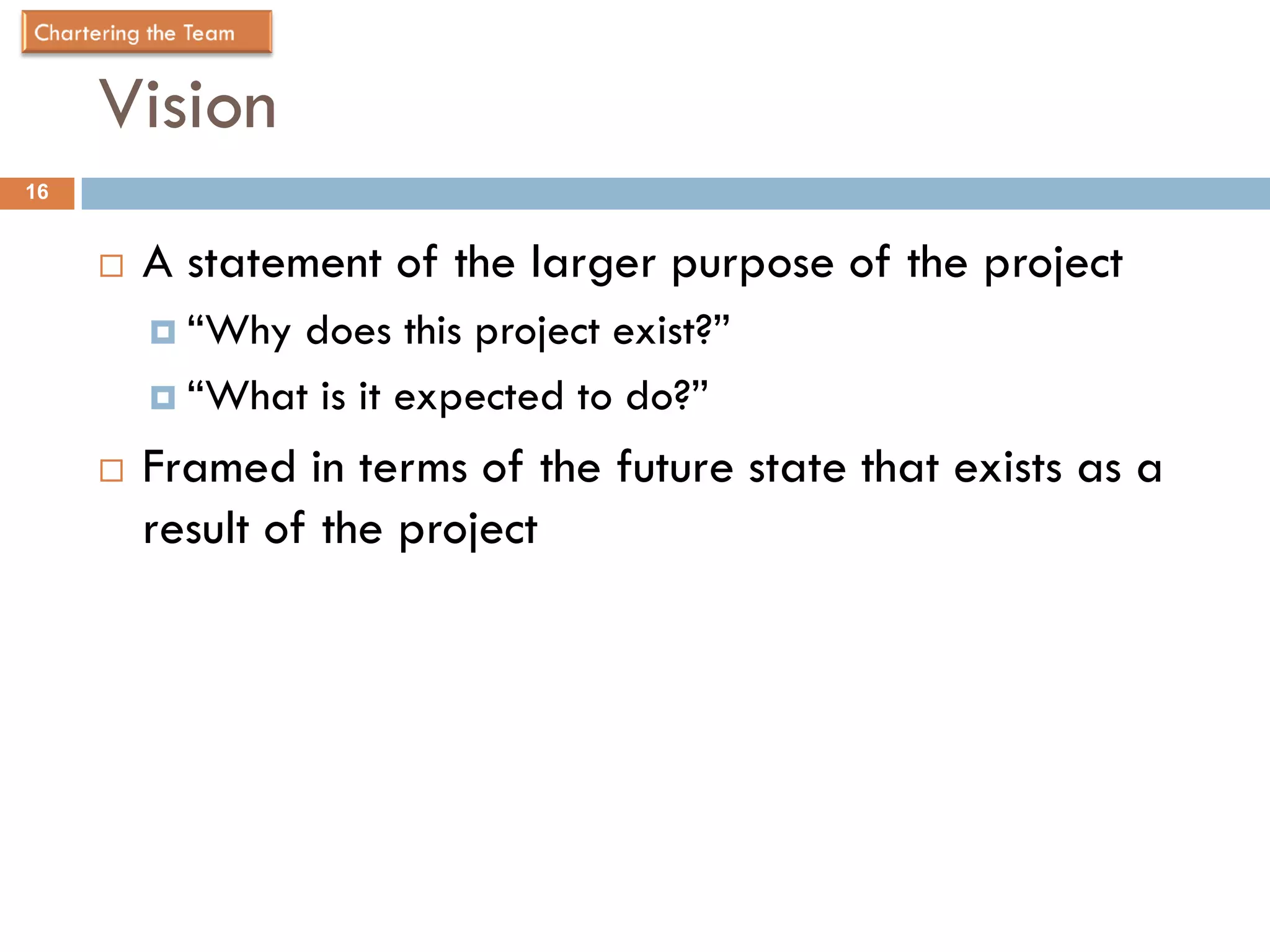
Vision
16


        A statement of the larger purpose of the project
          “Why does this project exist?”
          “What is it expected to do?”

        Framed in terms of the future state that exists as a
         result of the project
Purpose
17


        The purpose answers the questions:
          “Why does this team exists?”
          “Why is it formed?”

          “What is it expected to do?”

        Purpose should be stated in a single sentence or
         short paragraph
        Typically derived from the project definition as it
         appears in some form of a contract
        Closely linked to the Project Vision
Membership
18


        Membership is not just providing expertise
        Membership carries with it defined responsibilities
         and a degree of commitment to the team and to the
         team members
        Membership must be clear:
          Individual must know when they are on a team
          What the scope of their membership is in terms of roles,
           responsibilities, and length of commitment
Mission
19


        Mission is an extension of the team’s purpose
        It expands the purpose, with a broadly measurable
         result
Organizational Linkage
20


        Is a description of the formal link between the team
         and the enterprise
        It answers the questions:
          “To  whom does the team report?”
          “Is the team part of a formal structure?”

          “How does the team relate to that structure?”

          “How is it linked for purposed of resources,
           communication, authority, and approval?”
Boundaries
21


        Define the scope of the project team’s formal
         authority
        Define the area of influence or what it may do with
         permission
        Describe the shared responsibilities or areas in
         which team members are expected to initiate action
         to support others
        Define the limits of the project team’s authority
Team and Individual Responsibilities
22


        Define the scope of primary responsibility
            Responsibilities held by the entire team
            Each team member is equally responsible for their attainment
        Each member also has responsibilities
        Overall responsibilities are reviewed and measured by
         individuals who can represent the customer and the enterprise’s
         management
        Individual team responsibilities are typically reviewed and
         measured internally by the project manager and other team
         members
Measures of Success
23


        Must not be subjective or unclear
        Must be defined in terms of specific results that are
         measurable against agreed‒upon criteria
        May be established in terms of quality, quantity, time, cost, or
         a combination of these criteria
        The greater clarity of the criteria, the greater the probability
         that the team members, individually and collectively, will
         achieve them
Operating Guidelines
24


        Describe how the team will govern itself
        Are created to answer the questions:
          “How  will the team make decisions?”
          “How will the team communicate internally and
           externally?”
          “How will it resolve conflict?”

          “How will it make change?”
25   Building the Team
Stage 2: Building the Team
26


        Four major areas of skill development are focused
         on building the team:
          Problem  solving skills
          Process improvement skills

          Interpersonal skills

          Decision making skills
Problem Solving Skills
27


        The must identify and solve problems encountered
         during the project delivery process
        Problem solving skills involve a wide variety of
         techniques and tools
Process Improvement Skills
28


        The Charter and the Work Plan “may” appear to
         be complete when first developed and delivered to
         the Customer, Stakeholders, and Management
          Inconsistencies,   redundancies, and other flaws will
           surface
        Process improvement is an essential part of the
         team’s daily work as well
Interpersonal Skills
29


        Team must analyze their behavior against the following
         “rules of conduct”
          Team goals are higher priority than personal goals
          Base decision on what is right not who is right
          No inequity among the team members, all contribute and
           listen
          Flexibility is critical, no fixed positions
          Decisions based on facts and good judgment, no opinions or
           generalizations
          Perfection is the enemy of the common good
          Strive for consensus not unanimity
30   Sustaining the Team
Stage 3: Sustaining the Team
31


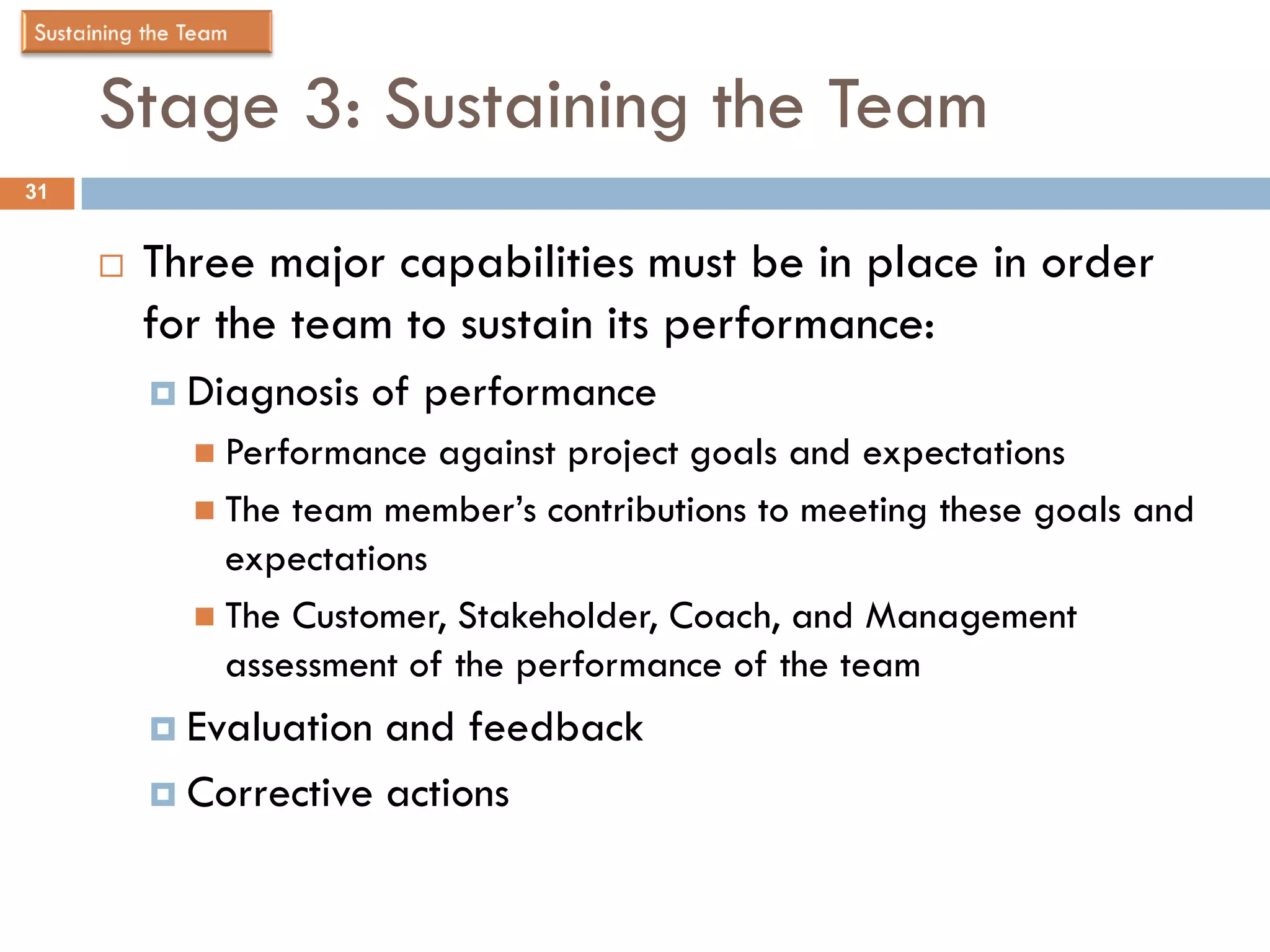
        Three major capabilities must be in place in order
         for the team to sustain its performance:
          Diagnosis   of performance
            Performance  against project goals and expectations
            The team member’s contributions to meeting these goals and
             expectations
            The Customer, Stakeholder, Coach, and Management
             assessment of the performance of the team
          Evaluation and feedback
          Corrective actions

Chartering the Team

  • 1.
    1 BUILDING TEAMS THROUGH PROJECTCHARTERS Chartering empowers team members, both individually, and collectively
  • 2.
    Chartering the Team 2 Table of Contents  Background  Developing Project Teams  Stages of Team Development  Stage 1: Chartering the Team  Stage 2: Building the Team  Stage 3: Sustaining the Team’s Performance
  • 3.
    Background 3  One of the best “Chartering a Project Team” descriptions can be found in:  Project Delivery System: Fourth Edition, 2001 ISBN 0‒9652616‒0‒3  www.amazon.com/Project‒Delivery‒System‒Benchmark‒Perform ance/dp/0965261603  Teams are an integral component for achieving strategic objectives  Teams and Team Building process are an evolutionary process for all business value components:  Chartering is a critical starting point  Re–chartering of teams is a common occurrence in an evolutionary process
  • 4.
    Developing Project Teams 4  Project delivery is a “team” activity  Teaming provides flexibility and creativity to greatly increase our ability to deliver value–added projects to our customers  This presentation:  Describes the three elements of Teaming  Chartering  Building  Sustaining  Provides details of the Chartering process
  • 5.
    What is aTeam? 5  “A team is a group of people who hold each other mutually accountable for a common purpose to produce a specific outcome”‒ The Wisdom of Teams, Jon Katzenberg, Harvard Business Press, 1992  In the project delivery context the “project team” consists of:  Key staff members  A project “score keeper”  A project “spokesperson”  The team uses a standard set of processes to develop and deliver the desired products and services
  • 6.
    Chartering the Team 6  The Project Team Members charter the team and build it into an effective work delivery system.  The Team Members and their Coaches sustain a high level of team performance throughout the project.  The Customer, Stakeholders, and Management interact with the Team Members and their Coaches during the course of the project to define requirements a receive specific components from the team’s efforts.  Even though the Customer, Management, and the Stakeholders are not members of the team they are members of a broader definition of the “team” and are involved in certain functions of the teaming process.
  • 7.
    Why Charter theProject Team? 7  Achieve high‒quality performance  Define clear goals  Establish initial agreement regarding purpose, individual agendas, address interpersonal conflicts, assignment of resources, and clarify expectations  Produce a shared vision of the project  Create team behaviors that are stronger than individual behaviors  Establish operating guidelines that govern team and individual behaviors  Set the stage for success
  • 8.
    Why Charter theProject Team? 8  Empower team members  Staff is “empowered” when they have been given a clear understanding of:  Desired results  Parameters within which the results are to be accomplished  Resources available to help achieve the desired results  Expected standards of performance  Consequences associated with various levels of performance
  • 9.
    Why Charter theProject Team? 9  Monitor performance  Charter contains a baseline against which the team can assess it performance on an ongoing basis  Teams can know they are not achieving at their desired level  Teams can recognize when they are faltering and can implement the self‒correcting mechanisms to resolve problems  Charter provides the foundation essential for  Monitoring performance  Diagnosing problems  Evaluating and implementing solutions
  • 10.
    Chartering the Team 10  Project planning is the single most important activity that will influence the success of the project  Planning is divided into three (3) essential components:  Charter the project team  Plan the project  Endorse the project
  • 11.
    Stages of TeamDevelopment 11  A common, agreed upon set of goals, measures and rules  A commitment to the required goals and tasks and to each other  Interdependent work: each person’s work linked to the others  Collective and individual accountabilities  Acceptable team behaviors  Adequate resources to perform the work as a team
  • 12.
    3 Stages ofTeam Development Process 12 Forming Storming Norming Performing Excelling Chartering Building Sustaining
  • 13.
    13 Chartering the Team Building a project charter is a critical success factor for any endeavor.
  • 14.
    Stage 1: Charteringthe Team 14  Chartering is the “act of guiding the team through the process of defining itself”  The Charter defines:  Purpose  Scope  Goals  Roles  Responsibilities  Behaviors  “Charter” is borrowed from the British, where the sovereign granted or chartered certain rights or privileges to an individual
  • 15.
    Elements of theTeam Charter 15  Vision  Purpose  Membership  Mission  Organizational Linkage  Boundaries  Team and Individual Responsibilities  Measures of Success  Operating Guidelines
  • 16.
    Vision 16  A statement of the larger purpose of the project  “Why does this project exist?”  “What is it expected to do?”  Framed in terms of the future state that exists as a result of the project
  • 17.
    Purpose 17  The purpose answers the questions:  “Why does this team exists?”  “Why is it formed?”  “What is it expected to do?”  Purpose should be stated in a single sentence or short paragraph  Typically derived from the project definition as it appears in some form of a contract  Closely linked to the Project Vision
  • 18.
    Membership 18  Membership is not just providing expertise  Membership carries with it defined responsibilities and a degree of commitment to the team and to the team members  Membership must be clear:  Individual must know when they are on a team  What the scope of their membership is in terms of roles, responsibilities, and length of commitment
  • 19.
    Mission 19  Mission is an extension of the team’s purpose  It expands the purpose, with a broadly measurable result
  • 20.
    Organizational Linkage 20  Is a description of the formal link between the team and the enterprise  It answers the questions:  “To whom does the team report?”  “Is the team part of a formal structure?”  “How does the team relate to that structure?”  “How is it linked for purposed of resources, communication, authority, and approval?”
  • 21.
    Boundaries 21  Define the scope of the project team’s formal authority  Define the area of influence or what it may do with permission  Describe the shared responsibilities or areas in which team members are expected to initiate action to support others  Define the limits of the project team’s authority
  • 22.
    Team and IndividualResponsibilities 22  Define the scope of primary responsibility  Responsibilities held by the entire team  Each team member is equally responsible for their attainment  Each member also has responsibilities  Overall responsibilities are reviewed and measured by individuals who can represent the customer and the enterprise’s management  Individual team responsibilities are typically reviewed and measured internally by the project manager and other team members
  • 23.
    Measures of Success 23  Must not be subjective or unclear  Must be defined in terms of specific results that are measurable against agreed‒upon criteria  May be established in terms of quality, quantity, time, cost, or a combination of these criteria  The greater clarity of the criteria, the greater the probability that the team members, individually and collectively, will achieve them
  • 24.
    Operating Guidelines 24  Describe how the team will govern itself  Are created to answer the questions:  “How will the team make decisions?”  “How will the team communicate internally and externally?”  “How will it resolve conflict?”  “How will it make change?”
  • 25.
    25 Building the Team
  • 26.
    Stage 2: Buildingthe Team 26  Four major areas of skill development are focused on building the team:  Problem solving skills  Process improvement skills  Interpersonal skills  Decision making skills
  • 27.
    Problem Solving Skills 27  The must identify and solve problems encountered during the project delivery process  Problem solving skills involve a wide variety of techniques and tools
  • 28.
    Process Improvement Skills 28  The Charter and the Work Plan “may” appear to be complete when first developed and delivered to the Customer, Stakeholders, and Management  Inconsistencies, redundancies, and other flaws will surface  Process improvement is an essential part of the team’s daily work as well
  • 29.
    Interpersonal Skills 29  Team must analyze their behavior against the following “rules of conduct”  Team goals are higher priority than personal goals  Base decision on what is right not who is right  No inequity among the team members, all contribute and listen  Flexibility is critical, no fixed positions  Decisions based on facts and good judgment, no opinions or generalizations  Perfection is the enemy of the common good  Strive for consensus not unanimity
  • 30.
    30 Sustaining the Team
  • 31.
    Stage 3: Sustainingthe Team 31  Three major capabilities must be in place in order for the team to sustain its performance:  Diagnosis of performance  Performance against project goals and expectations  The team member’s contributions to meeting these goals and expectations  The Customer, Stakeholder, Coach, and Management assessment of the performance of the team  Evaluation and feedback  Corrective actions