PORTABLE OXYGEN CONCENTRATOR USING
PRESSURE SWING ADSORPTION & MEMBRANE
GAS SEPERATION METHOD
PRESENTED by,
RESHMA K KATHIRESH
1
CONTENTS
 OBJECTIVES
 INTRODUCTION
 LITERATURE SURVEY
 BLOCK DIAGRAM
 COMPONENTS IN BLOCK DIAGRAM
 CIRCUIT DIAGRAM
 WORKING
 REFERENCE
2
OBJECTIVES
Designed to provide oxygen for patients who require long-term domiciliary oxygen.
3
INTRODUCTION
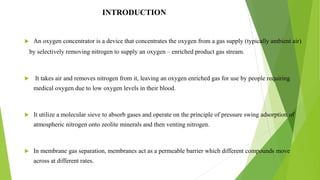
 An oxygen concentrator is a device that concentrates the oxygen from a gas supply (typically ambient air)
by selectively removing nitrogen to supply an oxygen – enriched product gas stream.
 It takes air and removes nitrogen from it, leaving an oxygen enriched gas for use by people requiring
medical oxygen due to low oxygen levels in their blood.
 It utilize a molecular sieve to absorb gases and operate on the principle of pressure swing adsorption of
atmospheric nitrogen onto zeolite minerals and then venting nitrogen.
 In membrane gas separation, membranes act as a permeable barrier which different compounds move
across at different rates.
4
LITERATURE SURVEY
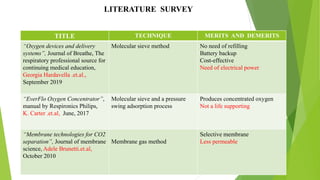
TITLE TECHNIQUE MERITS AND DEMERITS
“Oxygen devices and delivery
systems”, Journal of Breathe, The
respiratory professional source for
continuing medical education,
Georgia Hardavella .et.al.,
September 2019
Molecular sieve method No need of refilling
Battery backup
Cost-effective
Need of electrical power
“EverFlo Oxygen Concentrator”,
manual by Respironics Philips,
K. Carter .et.al, June, 2017
Molecular sieve and a pressure
swing adsorption process
Produces concentrated oxygen
Not a life supporting
“Membrane technologies for CO2
separation”, Journal of membrane
science, Adele Brunetti.et.al,
October 2010
Membrane gas method
Selective membrane
Less permeable
5
“Current development in oxygen
concentrator technology ”, Journal
of National Library of Medicine ,
N.D.Harris , July, 2009
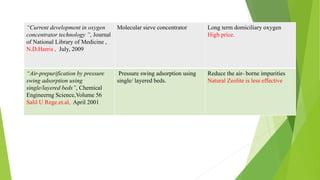
Molecular sieve concentrator Long term domiciliary oxygen
High price.
“Air-prepurification by pressure
swing adsorption using
single/layered beds”, Chemical
Engineerng Science,Volume 56
Salil U Rege.et.al, April 2001
Pressure swing adsorption using
single/ layered beds.
Reduce the air- borne impurities
Natural Zeolite is less effective
6
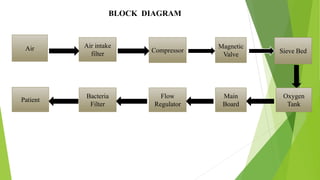
BLOCK DIAGRAM
.
7
Air Air intake
filter
Compressor
Magnetic
Valve
Sieve Bed
Oxygen
Tank
Main
Board
Flow
Regulator
Bacteria
Filter
Patient
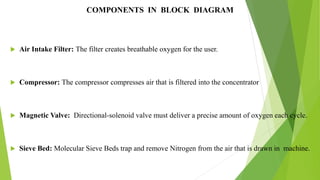
COMPONENTS IN BLOCK DIAGRAM
 Air Intake Filter: The filter creates breathable oxygen for the user.
 Compressor: The compressor compresses air that is filtered into the concentrator
 Magnetic Valve: Directional-solenoid valve must deliver a precise amount of oxygen each cycle.
 Sieve Bed: Molecular Sieve Beds trap and remove Nitrogen from the air that is drawn in machine.
8
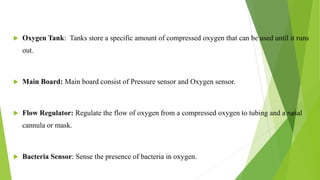
 Oxygen Tank: Tanks store a specific amount of compressed oxygen that can be used until it runs
out.
 Main Board: Main board consist of Pressure sensor and Oxygen sensor.
 Flow Regulator: Regulate the flow of oxygen from a compressed oxygen to tubing and a nasal
cannula or mask.
 Bacteria Sensor: Sense the presence of bacteria in oxygen.
9
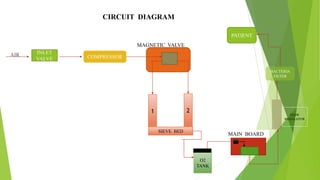
CIRCUIT DIAGRAM
MAGNETIC VALVE
AIR
10
INLET
VALVE COMPRESSOR
1 2
SIEVE BED
O2
TANK
BACTERIA
FILTER
PATIENT
FLOW
REGULATOR
MAIN BOARD
WORKING
 The room air is drawn into the unit.
 The compressed air is routed to the sieve beds through an electronically controlled Solenoid Valve
Assembly.
 The valve is de-energized allowing compressed air to flow through both sieve beds until pressure
sensor builds up to switching pressure.
 At switching pressure the valve closes off input and allowing compressed air to cycle through one
of the sieve beds.
11
 The concentrated Oxygen is stored in the oxygen tank.
 The product tank pressure is continuously monitored using a pressure sensor.
 The stored Oxygen is delivered to patient through a pressure regulator, an externally adjustable
flow meter and a microbial filter.
12
REFERENCE
 "The History of Oxygen Concentrators & Their Future!". DME Library. 11 May 2016. Retrieved 26 April
2018.
 "A Short History of Long Term Oxygen Therapy". Inspired Respiratory Care. Retrieved 26 April 2018.
 "History of Oxygen Concentrators". Inogen.com. Retrieved 26 April 2018.
 Waters, Allison (7 November 2012). "Choosing the Best Portable Oxygen Concentrator: Start with the
Flow". POC News & More. Retrieved 30 July 2014.
13
Thank You
14

Oxygen concentrator

  • 1.
    PORTABLE OXYGEN CONCENTRATORUSING PRESSURE SWING ADSORPTION & MEMBRANE GAS SEPERATION METHOD PRESENTED by, RESHMA K KATHIRESH 1
  • 2.
    CONTENTS  OBJECTIVES  INTRODUCTION LITERATURE SURVEY  BLOCK DIAGRAM  COMPONENTS IN BLOCK DIAGRAM  CIRCUIT DIAGRAM  WORKING  REFERENCE 2
  • 3.
    OBJECTIVES Designed to provideoxygen for patients who require long-term domiciliary oxygen. 3
  • 4.
    INTRODUCTION  An oxygenconcentrator is a device that concentrates the oxygen from a gas supply (typically ambient air) by selectively removing nitrogen to supply an oxygen – enriched product gas stream.  It takes air and removes nitrogen from it, leaving an oxygen enriched gas for use by people requiring medical oxygen due to low oxygen levels in their blood.  It utilize a molecular sieve to absorb gases and operate on the principle of pressure swing adsorption of atmospheric nitrogen onto zeolite minerals and then venting nitrogen.  In membrane gas separation, membranes act as a permeable barrier which different compounds move across at different rates. 4
  • 5.
    LITERATURE SURVEY TITLE TECHNIQUEMERITS AND DEMERITS “Oxygen devices and delivery systems”, Journal of Breathe, The respiratory professional source for continuing medical education, Georgia Hardavella .et.al., September 2019 Molecular sieve method No need of refilling Battery backup Cost-effective Need of electrical power “EverFlo Oxygen Concentrator”, manual by Respironics Philips, K. Carter .et.al, June, 2017 Molecular sieve and a pressure swing adsorption process Produces concentrated oxygen Not a life supporting “Membrane technologies for CO2 separation”, Journal of membrane science, Adele Brunetti.et.al, October 2010 Membrane gas method Selective membrane Less permeable 5
  • 6.
    “Current development inoxygen concentrator technology ”, Journal of National Library of Medicine , N.D.Harris , July, 2009 Molecular sieve concentrator Long term domiciliary oxygen High price. “Air-prepurification by pressure swing adsorption using single/layered beds”, Chemical Engineerng Science,Volume 56 Salil U Rege.et.al, April 2001 Pressure swing adsorption using single/ layered beds. Reduce the air- borne impurities Natural Zeolite is less effective 6
  • 7.
    BLOCK DIAGRAM . 7 Air Airintake filter Compressor Magnetic Valve Sieve Bed Oxygen Tank Main Board Flow Regulator Bacteria Filter Patient
  • 8.
    COMPONENTS IN BLOCKDIAGRAM  Air Intake Filter: The filter creates breathable oxygen for the user.  Compressor: The compressor compresses air that is filtered into the concentrator  Magnetic Valve: Directional-solenoid valve must deliver a precise amount of oxygen each cycle.  Sieve Bed: Molecular Sieve Beds trap and remove Nitrogen from the air that is drawn in machine. 8
  • 9.
     Oxygen Tank:Tanks store a specific amount of compressed oxygen that can be used until it runs out.  Main Board: Main board consist of Pressure sensor and Oxygen sensor.  Flow Regulator: Regulate the flow of oxygen from a compressed oxygen to tubing and a nasal cannula or mask.  Bacteria Sensor: Sense the presence of bacteria in oxygen. 9
  • 10.
    CIRCUIT DIAGRAM MAGNETIC VALVE AIR 10 INLET VALVECOMPRESSOR 1 2 SIEVE BED O2 TANK BACTERIA FILTER PATIENT FLOW REGULATOR MAIN BOARD
  • 11.
    WORKING  The roomair is drawn into the unit.  The compressed air is routed to the sieve beds through an electronically controlled Solenoid Valve Assembly.  The valve is de-energized allowing compressed air to flow through both sieve beds until pressure sensor builds up to switching pressure.  At switching pressure the valve closes off input and allowing compressed air to cycle through one of the sieve beds. 11
  • 12.
     The concentratedOxygen is stored in the oxygen tank.  The product tank pressure is continuously monitored using a pressure sensor.  The stored Oxygen is delivered to patient through a pressure regulator, an externally adjustable flow meter and a microbial filter. 12
  • 13.
    REFERENCE  "The Historyof Oxygen Concentrators & Their Future!". DME Library. 11 May 2016. Retrieved 26 April 2018.  "A Short History of Long Term Oxygen Therapy". Inspired Respiratory Care. Retrieved 26 April 2018.  "History of Oxygen Concentrators". Inogen.com. Retrieved 26 April 2018.  Waters, Allison (7 November 2012). "Choosing the Best Portable Oxygen Concentrator: Start with the Flow". POC News & More. Retrieved 30 July 2014. 13
  • 14.