David M. Lengyel
Exploration Systems Mission Directorate
 Risk & Knowledge Management Officer
           PM Challenge 2011
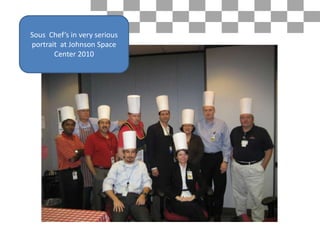
Sous Chef’s in very serious
portrait at Johnson Space
       Center 2010
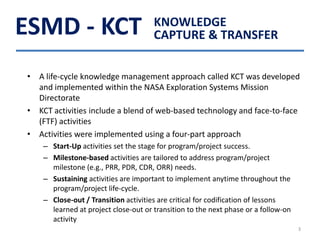
ESMD - KCT                            KNOWLEDGE
                                      CAPTURE & TRANSFER


• A life-cycle knowledge management approach called KCT was developed
  and implemented within the NASA Exploration Systems Mission
  Directorate
• KCT activities include a blend of web-based technology and face-to-face
  (FTF) activities
• Activities were implemented using a four-part approach
    – Start-Up activities set the stage for program/project success.
    – Milestone-based activities are tailored to address program/project
      milestone (e.g., PRR, PDR, CDR, ORR) needs.
    – Sustaining activities are important to implement anytime throughout the
      program/project life-cycle.
    – Close-out / Transition activities are critical for codification of lessons
      learned at project close-out or transition to the next phase or a follow-on
      activity
                                                                                    3
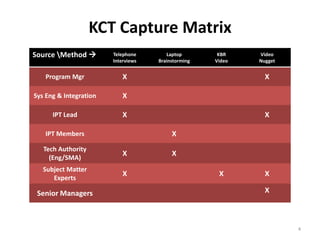
KCT Capture Matrix
Source Method         Telephone       Laptop        KBR    Video
                        Interviews   Brainstorming   Video   Nugget


   Program Mgr              X                                  X

Sys Eng & Integration       X

      IPT Lead              X                                  X

   IPT Members                            X
   Tech Authority
                            X             X
     (Eng/SMA)
   Subject Matter
      Experts
                            X                         X        X

 Senior Managers                                               X


                                                                      4
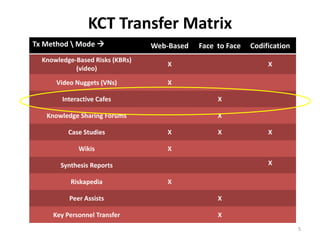
KCT Transfer Matrix
Tx Method  Mode                Web-Based   Face to Face   Codification
  Knowledge-Based Risks (KBRs)
                                     X                           X
            (video)
      Video Nuggets (VNs)            X

        Interactive Cafes                         X

   Knowledge Sharing Forums                       X

          Case Studies               X            X              X

             Wikis                   X

       Synthesis Reports                                         X

           Riskapedia                X

          Peer Assists                            X

     Key Personnel Transfer                       X
                                                                           5
Background
• Over the last five years, ESMD has used several means of
  structured discussion and modeling techniques for innovation
  including, TRIZ, Process 2.0 and Knowledge Cafes

• Knowledge Cafes have proven to be an effective technique not
  only to innovate but also to socialize ideas within a large group to
  create buy-in to move forward with those ideas

• It is said that innovation takes place at interfaces between
  disciplines. A key feature of Café technique is the discussion that
  ensues between experts from different technical domains as they
  move from one table (and topic) to another.


                                                                         6
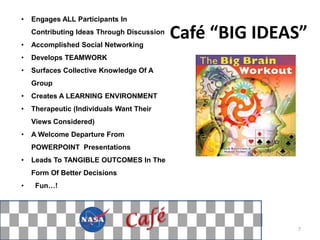
•   Engages ALL Participants In


•
    Contributing Ideas Through Discussion
    Accomplished Social Networking
                                            Café “BIG IDEAS”
•   Develops TEAMWORK
•   Surfaces Collective Knowledge Of A
    Group
•   Creates A LEARNING ENVIRONMENT
•   Therapeutic (Individuals Want Their
    Views Considered)
•   A Welcome Departure From
    POWERPOINT Presentations
•   Leads To TANGIBLE OUTCOMES In The
    Form Of Better Decisions
•    Fun…!


                                                          7
Café Outcomes
•    A synthesized list of ideas on each topic area
•    A deeper personal understanding of your own ideas / issues
    / problems
•    A deeper understanding of others’ views on ideas / issues /
    problems
•    Innovative ideas (designs, processes, decision paths, etc.)
•    A well-socialized and synthesized path forward for making
    decisions


                                                                   8
Café Resource Requirements
•   A group of people with a COMMON INTEREST or PROBLEM to solve
•   Main facilitator or MATRE DE
•   Small group facilitators or SOUS CHEFS
•   A large room
•   Enough Tables to accommodate topic areas (no more than 8 preferred)
•   Chairs to accommodate 5 people per table
•   Ambience: Table clothes, CHEF HATS, REFRESHMENTS, MUSIC, etc.
•   Paper, pens, pencils
•   Whiteboard, butcher block paper or projector / PC – for final discussion


                                                                           9
How Do You Run a Café?
Cafes can be run in several variants – ESMD| achieved success with the
    following method:
•      The café runs from 4-10 hours total (depends on number of topics)
•      Works best with 30-40 people
•      Maitre-d’ introduces the overall theme / topics and explains the process
•      Large group breaks into small group discussions at tables
•      Sous chefs facilitate table discussions
•      Individuals rotate among tables after 30-40 minutes
•      Small group discussions end after all tables are visited by individuals
•      Sous chefs synthesize discussions across all groups (usually overnight)
•      Sous chefs facilitate discussion across large group on day 2
•      Maitre-d’ concludes large group discussion with PATH FORWARD


                                                                                  10
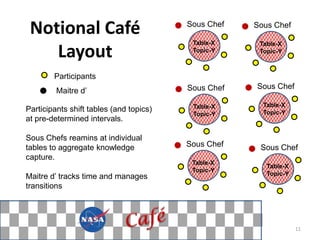
Notional Café                           Sous Chef   Sous Chef

                                          Table-X     Table-X
    Layout                                Topic-Y     Topic-Y


        Participants
                                         Sous Chef   Sous Chef
         Maitre d’
                                          Table-X      Table-X
Participants shift tables (and topics)                 Topic-Y
                                          Topic-Y
at pre-determined intervals.

Sous Chefs reamins at individual
tables to aggregate knowledge            Sous Chef    Sous Chef
capture.
                                          Table-X
                                                        Table-X
                                          Topic-Y
                                                        Topic-Y
Maitre d’ tracks time and manages
transitions


                                                                  11
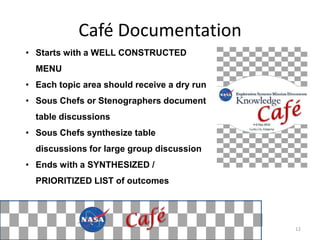
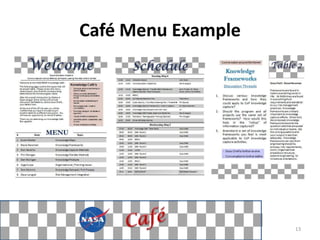
Café Documentation
• Starts with a WELL CONSTRUCTED
  MENU
• Each topic area should receive a dry run
• Sous Chefs or Stenographers document
  table discussions
• Sous Chefs synthesize table
  discussions for large group discussion
• Ends with a SYNTHESIZED /
  PRIORITIZED LIST of outcomes


                                             12
Café Menu Example


                    13
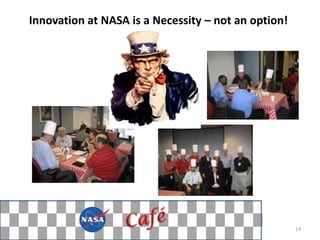
Innovation at NASA is a Necessity – not an option!


                                                     14

Lengyel.david

  • 1.
    David M. Lengyel ExplorationSystems Mission Directorate Risk & Knowledge Management Officer PM Challenge 2011
  • 2.
    Sous Chef’s invery serious portrait at Johnson Space Center 2010
  • 3.
    ESMD - KCT KNOWLEDGE CAPTURE & TRANSFER • A life-cycle knowledge management approach called KCT was developed and implemented within the NASA Exploration Systems Mission Directorate • KCT activities include a blend of web-based technology and face-to-face (FTF) activities • Activities were implemented using a four-part approach – Start-Up activities set the stage for program/project success. – Milestone-based activities are tailored to address program/project milestone (e.g., PRR, PDR, CDR, ORR) needs. – Sustaining activities are important to implement anytime throughout the program/project life-cycle. – Close-out / Transition activities are critical for codification of lessons learned at project close-out or transition to the next phase or a follow-on activity 3
  • 4.
    KCT Capture Matrix SourceMethod  Telephone Laptop KBR Video Interviews Brainstorming Video Nugget Program Mgr X X Sys Eng & Integration X IPT Lead X X IPT Members X Tech Authority X X (Eng/SMA) Subject Matter Experts X X X Senior Managers X 4
  • 5.
    KCT Transfer Matrix TxMethod Mode  Web-Based Face to Face Codification Knowledge-Based Risks (KBRs) X X (video) Video Nuggets (VNs) X Interactive Cafes X Knowledge Sharing Forums X Case Studies X X X Wikis X Synthesis Reports X Riskapedia X Peer Assists X Key Personnel Transfer X 5
  • 6.
    Background • Over thelast five years, ESMD has used several means of structured discussion and modeling techniques for innovation including, TRIZ, Process 2.0 and Knowledge Cafes • Knowledge Cafes have proven to be an effective technique not only to innovate but also to socialize ideas within a large group to create buy-in to move forward with those ideas • It is said that innovation takes place at interfaces between disciplines. A key feature of Café technique is the discussion that ensues between experts from different technical domains as they move from one table (and topic) to another. 6
  • 7.
    Engages ALL Participants In • Contributing Ideas Through Discussion Accomplished Social Networking Café “BIG IDEAS” • Develops TEAMWORK • Surfaces Collective Knowledge Of A Group • Creates A LEARNING ENVIRONMENT • Therapeutic (Individuals Want Their Views Considered) • A Welcome Departure From POWERPOINT Presentations • Leads To TANGIBLE OUTCOMES In The Form Of Better Decisions • Fun…! 7
  • 8.
    Café Outcomes • A synthesized list of ideas on each topic area • A deeper personal understanding of your own ideas / issues / problems • A deeper understanding of others’ views on ideas / issues / problems • Innovative ideas (designs, processes, decision paths, etc.) • A well-socialized and synthesized path forward for making decisions 8
  • 9.
    Café Resource Requirements • A group of people with a COMMON INTEREST or PROBLEM to solve • Main facilitator or MATRE DE • Small group facilitators or SOUS CHEFS • A large room • Enough Tables to accommodate topic areas (no more than 8 preferred) • Chairs to accommodate 5 people per table • Ambience: Table clothes, CHEF HATS, REFRESHMENTS, MUSIC, etc. • Paper, pens, pencils • Whiteboard, butcher block paper or projector / PC – for final discussion 9
  • 10.
    How Do YouRun a Café? Cafes can be run in several variants – ESMD| achieved success with the following method: • The café runs from 4-10 hours total (depends on number of topics) • Works best with 30-40 people • Maitre-d’ introduces the overall theme / topics and explains the process • Large group breaks into small group discussions at tables • Sous chefs facilitate table discussions • Individuals rotate among tables after 30-40 minutes • Small group discussions end after all tables are visited by individuals • Sous chefs synthesize discussions across all groups (usually overnight) • Sous chefs facilitate discussion across large group on day 2 • Maitre-d’ concludes large group discussion with PATH FORWARD 10
  • 11.
    Notional Café Sous Chef Sous Chef Table-X Table-X Layout Topic-Y Topic-Y Participants Sous Chef Sous Chef Maitre d’ Table-X Table-X Participants shift tables (and topics) Topic-Y Topic-Y at pre-determined intervals. Sous Chefs reamins at individual tables to aggregate knowledge Sous Chef Sous Chef capture. Table-X Table-X Topic-Y Topic-Y Maitre d’ tracks time and manages transitions 11
  • 12.
    Café Documentation • Startswith a WELL CONSTRUCTED MENU • Each topic area should receive a dry run • Sous Chefs or Stenographers document table discussions • Sous Chefs synthesize table discussions for large group discussion • Ends with a SYNTHESIZED / PRIORITIZED LIST of outcomes 12
  • 13.
  • 14.
    Innovation at NASAis a Necessity – not an option! 14