LEMON BUTTERFLY
( PAPILIO DEMOLEUS)
SYNOPSIS
Introduction
Scientific classification
Physical description
Identification
Egg stage
Larva stage
Pupal stage
Adults
Life – cycle
 parasitism and predation
 Economic significance
Control of Papilio demoleus
INTRODUCTION
Papilio demoleus also called as the lemon butterfly is a common and
widespread swallowtailbutterfly.
Common names include – lime butterfly, lemon butterfly, lime swallowtail
and chequered swallowtail.
These names come from the host plants which are usually citrus species
such ascultivated lime.
Like most swallowtailbutterflies, it does not have aprominent tail.
Thisbutterfly is a pest and invasive species, found from asiato australia.
It has alsospread to various islandsin the western hemisphere.
PAPILIO DEMOLEUS
SCIENTIFIC CLASSIFICATION
Kingdom- Animalia
Phylum - Arthropoda
Class - Insecta
Order – Lepidoptera
Family – Papilionidae
Genus – Papilio
Species – demoleus
BINOMIAL NAME- Papilio demoleus , Linnaeus 1758
PHYSICAL DESCRIPTION
 The butterfly is tailless andhas awingspan of 80-100mm.
 Background colour is black and has a broad , irregular yellow band on its
wings.
 The upper hindwing has ared tornal spot with blue edging around it.
 As the caterpillar ages, its hunger for leaf tissue continues to grow.
 Antennae dark reddish brown, with head thorax and abdomen dusky
blackwith lateral longitudinal lines on the last.
IDENTIFICATION
 Eggs are small in size, round and pale in colour.
The caterpillar is yellowish green with a few oblique brownish strips.
It alsohas ahorn likestructure on the dorsal side of the body.
The adult is a large beautiful butterfly with green coloured wings having
blackspots.
The most significant feature of identification is the red tornal spot with blue
edging and the adult forms have orange spots.
EGG, LARVA AND ADULT STAGES
EGG STAGE
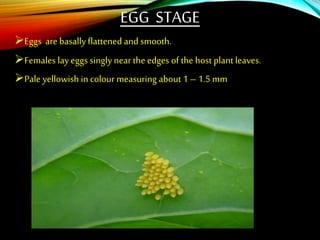
Eggs are basallyflattened and smooth.
Females lay eggs singly near the edges of the host plant leaves.
Pale yellowish in colour measuring about 1 – 1.5 mm
LARVA STAGE
first larva instars are black with a black head, with two sub-dorsal rows of short
fleshyspines.
2nd ,3rd and4th instarshavea dark brown,glossyheadcapsule.
The anterior, middle, and posterior parts have broad transverse off- white bands
givinglarva abirddroppingcamouflagepattern.
Thereisanadditionalrowofpairedfleshyspinesonthethorax.
Theheadisbrown,smoothwithglossyshorthairs.
Fifthinstarsare cylindricallyshapedandtaperedanteriorly.
Two pairs of fleshy spines are located posteriorly and again immediately behind
thehead.
THIRD, FOURTH, FIFTH INSTARS
FEATURES OF FIFTH INSTARS
The spines are very short, and gradually change from yellowish-
orange to green.
They have rows of orange or pink spots edged with black laterally and
sub- dorsally with black transverse markings located anteriorly, with
more scattered blackmarkings laterallyat the rear end.
There is a white sub- lateral line along the abdominal area just above
the legs.
The fleshy spinesare orange.
The head is large and brown with a dull orange inverted V mark.
PUPAL STAGE
The pupae are stout, rugose and about 30 mm long.
They are attached to thicker stems of the host plants, or to adjacent sticks
and rocks.
The color is dimorphic ,typical for many swallowtails, being either pale
green or pink- brown with other variable cryptic markings.
The green form is usuallymarked dorsally with yellow.
The pupal duration is variable, about 30 days in spring, 18 days in summer,
or sometimes even longer with one record of about 280 days.
PUPASTAGE
ADULTS
 The adults range in wingspan from 80-100mm.The hindwing has no
tail.
The upper portion of the forewing is largely black and the outer wing
margin hasa series of irregular yellow spots.
Two yellow spots are seen on the upper end at the discal cell with
several scattered yellow spots in the apicalregion.
The upper hind wing has a red tornal spot and the discal black band is
dusted with yellow scales.
The adults fly in every month but are more abundant after monsoons.
ADULT
LIFE- CYCLE
The females lays eggs nearly 100-150 eggs singly or in groups.
Number of generations per year- 8
Duration of egg stage – 3 to 6 days.
Duration of larvastage – 12 to 22 days
Duration of pupa stage-8 to 23 days
Duration of adult stage – 4 to 6 days.
PARASITISM AND PREDATION
Despite their two- winged camouflage scheme , some caterpillars of
Papilio demoleus are found by parasitic wasps which lay dozens of
eggs in them.
The parasitic wasplarva eat the caterpillar from the inside.
Initially the vital organs are avoided, but by the time the caterpillar is
ready to pupate even the vital organs are consumed.
Shortly before, or soon after the caterpillar pupates, the parasitoids
emerges from their host thus killingit.
ECONOMICSIGNIFICANCE
The lime butterfly is an economic pest on many cultivated citrus
species in India andmiddle east.
Due to its capability for rapid population growth under favourable
circumstances and its having been recorded to have five generations in
a year in temperate regions of China, it is considered a serious
potential threat.
 The caterpillars can completely defoliate young citrus trees (below 2
feet) and devastate citrus nurseries. In mature trees, caterpillars may
prefer young leaves andleaf flush..
CONTROL OF PAPILIO DEMOLEUS
Spray trees with endosulfan 35 EC/ methamidophos 60SL ( 200ml/ 100
L of water).
Spraying 3% neem extract is alsoeffective.
Trichogramma species..are effective egg parasitoids.
Hand picking of larvae.
Lemon butterfly

Lemon butterfly

  • 1.
  • 2.
    SYNOPSIS Introduction Scientific classification Physical description Identification Eggstage Larva stage Pupal stage Adults Life – cycle  parasitism and predation  Economic significance Control of Papilio demoleus
  • 3.
    INTRODUCTION Papilio demoleus alsocalled as the lemon butterfly is a common and widespread swallowtailbutterfly. Common names include – lime butterfly, lemon butterfly, lime swallowtail and chequered swallowtail. These names come from the host plants which are usually citrus species such ascultivated lime. Like most swallowtailbutterflies, it does not have aprominent tail. Thisbutterfly is a pest and invasive species, found from asiato australia. It has alsospread to various islandsin the western hemisphere.
  • 4.
  • 5.
    SCIENTIFIC CLASSIFICATION Kingdom- Animalia Phylum- Arthropoda Class - Insecta Order – Lepidoptera Family – Papilionidae Genus – Papilio Species – demoleus BINOMIAL NAME- Papilio demoleus , Linnaeus 1758
  • 6.
    PHYSICAL DESCRIPTION  Thebutterfly is tailless andhas awingspan of 80-100mm.  Background colour is black and has a broad , irregular yellow band on its wings.  The upper hindwing has ared tornal spot with blue edging around it.  As the caterpillar ages, its hunger for leaf tissue continues to grow.  Antennae dark reddish brown, with head thorax and abdomen dusky blackwith lateral longitudinal lines on the last.
  • 7.
    IDENTIFICATION  Eggs aresmall in size, round and pale in colour. The caterpillar is yellowish green with a few oblique brownish strips. It alsohas ahorn likestructure on the dorsal side of the body. The adult is a large beautiful butterfly with green coloured wings having blackspots. The most significant feature of identification is the red tornal spot with blue edging and the adult forms have orange spots.
  • 8.
    EGG, LARVA ANDADULT STAGES
  • 9.
    EGG STAGE Eggs arebasallyflattened and smooth. Females lay eggs singly near the edges of the host plant leaves. Pale yellowish in colour measuring about 1 – 1.5 mm
  • 10.
    LARVA STAGE first larvainstars are black with a black head, with two sub-dorsal rows of short fleshyspines. 2nd ,3rd and4th instarshavea dark brown,glossyheadcapsule. The anterior, middle, and posterior parts have broad transverse off- white bands givinglarva abirddroppingcamouflagepattern. Thereisanadditionalrowofpairedfleshyspinesonthethorax. Theheadisbrown,smoothwithglossyshorthairs. Fifthinstarsare cylindricallyshapedandtaperedanteriorly. Two pairs of fleshy spines are located posteriorly and again immediately behind thehead.
  • 11.
  • 12.
    FEATURES OF FIFTHINSTARS The spines are very short, and gradually change from yellowish- orange to green. They have rows of orange or pink spots edged with black laterally and sub- dorsally with black transverse markings located anteriorly, with more scattered blackmarkings laterallyat the rear end. There is a white sub- lateral line along the abdominal area just above the legs. The fleshy spinesare orange. The head is large and brown with a dull orange inverted V mark.
  • 13.
    PUPAL STAGE The pupaeare stout, rugose and about 30 mm long. They are attached to thicker stems of the host plants, or to adjacent sticks and rocks. The color is dimorphic ,typical for many swallowtails, being either pale green or pink- brown with other variable cryptic markings. The green form is usuallymarked dorsally with yellow. The pupal duration is variable, about 30 days in spring, 18 days in summer, or sometimes even longer with one record of about 280 days.
  • 14.
  • 15.
    ADULTS  The adultsrange in wingspan from 80-100mm.The hindwing has no tail. The upper portion of the forewing is largely black and the outer wing margin hasa series of irregular yellow spots. Two yellow spots are seen on the upper end at the discal cell with several scattered yellow spots in the apicalregion. The upper hind wing has a red tornal spot and the discal black band is dusted with yellow scales. The adults fly in every month but are more abundant after monsoons.
  • 16.
  • 17.
    LIFE- CYCLE The femaleslays eggs nearly 100-150 eggs singly or in groups. Number of generations per year- 8 Duration of egg stage – 3 to 6 days. Duration of larvastage – 12 to 22 days Duration of pupa stage-8 to 23 days Duration of adult stage – 4 to 6 days.
  • 19.
    PARASITISM AND PREDATION Despitetheir two- winged camouflage scheme , some caterpillars of Papilio demoleus are found by parasitic wasps which lay dozens of eggs in them. The parasitic wasplarva eat the caterpillar from the inside. Initially the vital organs are avoided, but by the time the caterpillar is ready to pupate even the vital organs are consumed. Shortly before, or soon after the caterpillar pupates, the parasitoids emerges from their host thus killingit.
  • 20.
    ECONOMICSIGNIFICANCE The lime butterflyis an economic pest on many cultivated citrus species in India andmiddle east. Due to its capability for rapid population growth under favourable circumstances and its having been recorded to have five generations in a year in temperate regions of China, it is considered a serious potential threat.  The caterpillars can completely defoliate young citrus trees (below 2 feet) and devastate citrus nurseries. In mature trees, caterpillars may prefer young leaves andleaf flush..
  • 21.
    CONTROL OF PAPILIODEMOLEUS Spray trees with endosulfan 35 EC/ methamidophos 60SL ( 200ml/ 100 L of water). Spraying 3% neem extract is alsoeffective. Trichogramma species..are effective egg parasitoids. Hand picking of larvae.