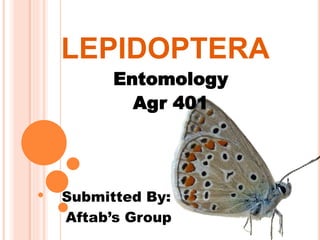
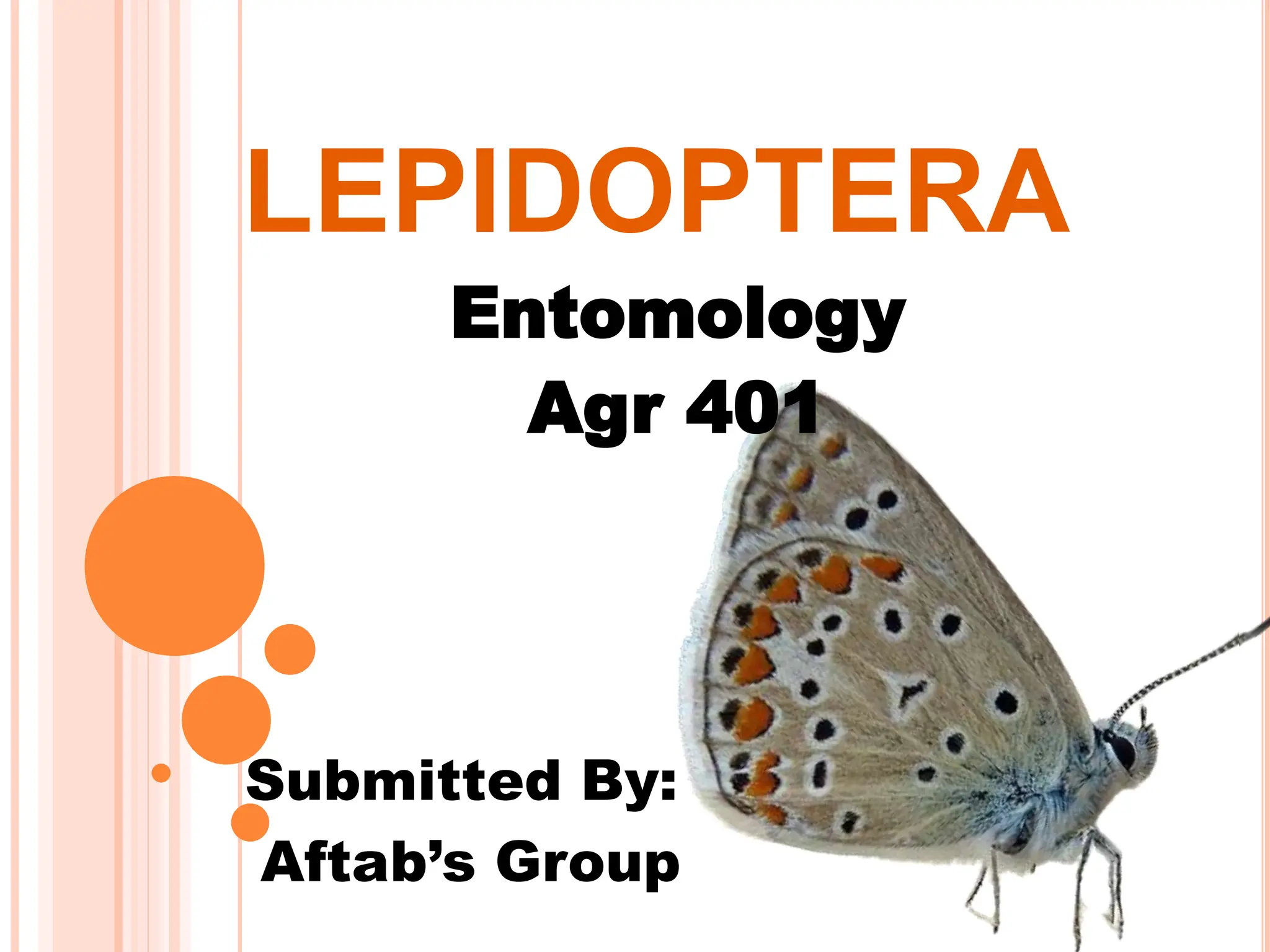
LEPIDOPTERA
Entomology
Agr 401
Submitted By:
Aftab’s Group
INTRODUCTION
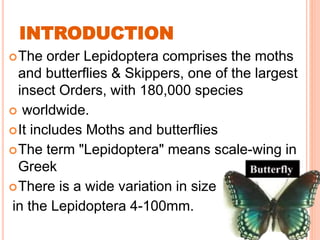
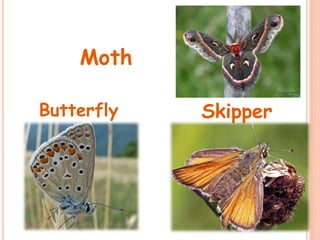
The order Lepidoptera comprises the moths
and butterflies & Skippers, one of the largest
insect Orders, with 180,000 species
 worldwide.
It includes Moths and butterflies
The term "Lepidoptera" means scale-wing in
Greek
There is a wide variation in size
in the Lepidoptera 4-100mm.
CHARACTERISTICS
Body, wings, appendages, are densely clothed
with overlapping scales, which give colour,
rigidity and strength.
Mouthparts in adults are of siphoning type.
Mandibles are absent.
The suctorial proboscis is coiled up like a watch
spring and kept beneath the head when not in
use.
Wings are membranous and are covered with
overlapping pigmented scales.
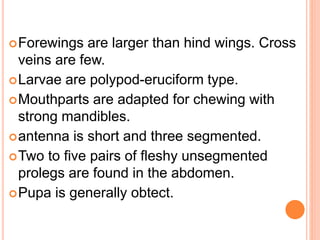
Forewings are larger than hind wings. Cross
veins are few.
Larvae are polypod-eruciform type.
Mouthparts are adapted for chewing with
strong mandibles.
antenna is short and three segmented.
Two to five pairs of fleshy unsegmented
prolegs are found in the abdomen.
Pupa is generally obtect.
Butterfly Skipper
Moth
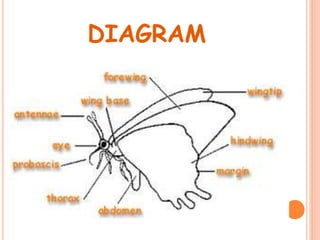
DIAGRAM
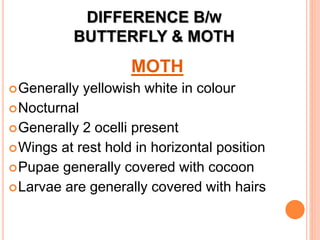
DIFFERENCE B/W
BUTTERFLY & MOTH
MOTH
Generally yellowish white in colour
Nocturnal
Generally 2 ocelli present
Wings at rest hold in horizontal position
Pupae generally covered with cocoon
Larvae are generally covered with hairs
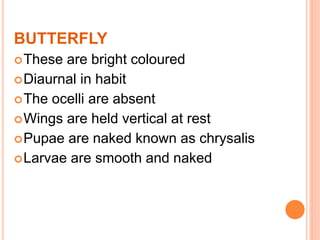
BUTTERFLY
These are bright coloured
Diaurnal in habit
The ocelli are absent
Wings are held vertical at rest
Pupae are naked known as chrysalis
Larvae are smooth and naked
LIFE CYCLE
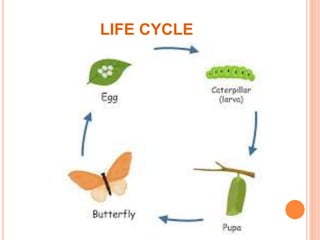
The life cycle of a butterfly includes four
stages: egg, caterpillar or larva, pupa, and
adult.
The pupa stage is when butterflies
undergo a complete metamorphosis.
The time needed to complete the
metamorphosis varies in each species.
LIFE CYCLE
 A female may lay only a few eggs or tens
of thousands.
 After the caterpillars hatch, they usually
develop through 4 to 7 instars over a
period of a few weeks.
 When the caterpillar is ready to pupate
they generally find shelter to spin their
cocoons
LIFE CYCLE
REPRODUCTION
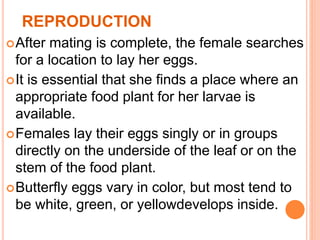
After mating is complete, the female searches
for a location to lay her eggs.
It is essential that she finds a place where an
appropriate food plant for her larvae is
available.
Females lay their eggs singly or in groups
directly on the underside of the leaf or on the
stem of the food plant.
Butterfly eggs vary in color, but most tend to
be white, green, or yellowdevelops inside.
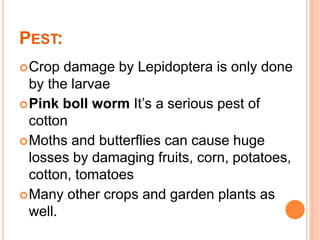
PEST:
Crop damage by Lepidoptera is only done
by the larvae
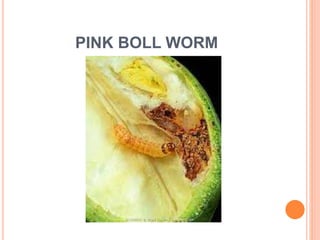
Pink boll worm It’s a serious pest of
cotton
Moths and butterflies can cause huge
losses by damaging fruits, corn, potatoes,
cotton, tomatoes
Many other crops and garden plants as
well.
PINK BOLL WORM
ECONOMIC IMPORTANCE
Butterflies and moth affect the economy
negatively
because they are pests in agriculture
major pests includes tortricidae, noctuidae
and pyralidae.
 Some species are valuable economic
resource.
Domesticated silkworm moth (bombyx
mori), the larvae of which form silken
cocoons.
ECONOMIC IMPORTANCE
Biological control of weed
Pyralid cactus most succesfully
suppressed million of acres of prickly
pear cactus
Alligator weed stem borer ( arcola
malloi) was used to control the aquatic
plant known as alligator weed
ECONOMIC IMPORTANCE:
Pollination
Moths (Lepidoptera) are the major
nocturnal pollinators of flowers.
While feeding on nectar, butterflies and
moths will unwittingly pick up pollen on
their legs, proboscis, or bodies and
transfer it from flower to flower
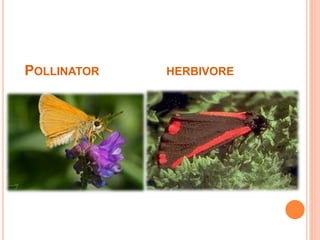
POLLINATOR HERBIVORE
THE END
THANKS

LEPIDOPTERA Order presentation By Aftab Ahmed Rahimoo

  • 1.
  • 2.
    INTRODUCTION The order Lepidopteracomprises the moths and butterflies & Skippers, one of the largest insect Orders, with 180,000 species  worldwide. It includes Moths and butterflies The term "Lepidoptera" means scale-wing in Greek There is a wide variation in size in the Lepidoptera 4-100mm.
  • 3.
    CHARACTERISTICS Body, wings, appendages,are densely clothed with overlapping scales, which give colour, rigidity and strength. Mouthparts in adults are of siphoning type. Mandibles are absent. The suctorial proboscis is coiled up like a watch spring and kept beneath the head when not in use. Wings are membranous and are covered with overlapping pigmented scales.
  • 4.
    Forewings are largerthan hind wings. Cross veins are few. Larvae are polypod-eruciform type. Mouthparts are adapted for chewing with strong mandibles. antenna is short and three segmented. Two to five pairs of fleshy unsegmented prolegs are found in the abdomen. Pupa is generally obtect.
  • 5.
  • 6.
  • 7.
    DIFFERENCE B/W BUTTERFLY &MOTH MOTH Generally yellowish white in colour Nocturnal Generally 2 ocelli present Wings at rest hold in horizontal position Pupae generally covered with cocoon Larvae are generally covered with hairs
  • 8.
    BUTTERFLY These are brightcoloured Diaurnal in habit The ocelli are absent Wings are held vertical at rest Pupae are naked known as chrysalis Larvae are smooth and naked
  • 9.
    LIFE CYCLE The lifecycle of a butterfly includes four stages: egg, caterpillar or larva, pupa, and adult. The pupa stage is when butterflies undergo a complete metamorphosis. The time needed to complete the metamorphosis varies in each species.
  • 10.
    LIFE CYCLE  Afemale may lay only a few eggs or tens of thousands.  After the caterpillars hatch, they usually develop through 4 to 7 instars over a period of a few weeks.  When the caterpillar is ready to pupate they generally find shelter to spin their cocoons
  • 11.
  • 12.
    REPRODUCTION After mating iscomplete, the female searches for a location to lay her eggs. It is essential that she finds a place where an appropriate food plant for her larvae is available. Females lay their eggs singly or in groups directly on the underside of the leaf or on the stem of the food plant. Butterfly eggs vary in color, but most tend to be white, green, or yellowdevelops inside.
  • 13.
    PEST: Crop damage byLepidoptera is only done by the larvae Pink boll worm It’s a serious pest of cotton Moths and butterflies can cause huge losses by damaging fruits, corn, potatoes, cotton, tomatoes Many other crops and garden plants as well.
  • 14.
  • 15.
    ECONOMIC IMPORTANCE Butterflies andmoth affect the economy negatively because they are pests in agriculture major pests includes tortricidae, noctuidae and pyralidae.  Some species are valuable economic resource. Domesticated silkworm moth (bombyx mori), the larvae of which form silken cocoons.
  • 16.
    ECONOMIC IMPORTANCE Biological controlof weed Pyralid cactus most succesfully suppressed million of acres of prickly pear cactus Alligator weed stem borer ( arcola malloi) was used to control the aquatic plant known as alligator weed
  • 17.
    ECONOMIC IMPORTANCE: Pollination Moths (Lepidoptera)are the major nocturnal pollinators of flowers. While feeding on nectar, butterflies and moths will unwittingly pick up pollen on their legs, proboscis, or bodies and transfer it from flower to flower
  • 18.
  • 19.