RICE WEEVIL
By
Dr. S N Bhalerao
Kingdom : Animalia
Phylum : Arthropoda
Class : Insecta
Order : Coleoptera
Family : Curculionidae
Genus : Sitophilus
Species : Oryzae
CLASSIFICATION
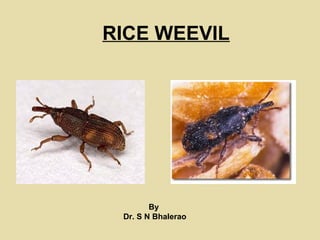
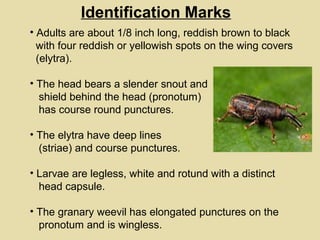
• Adults are about 1/8 inch long, reddish brown to black
with four reddish or yellowish spots on the wing covers
(elytra).
• The head bears a slender snout and
shield behind the head (pronotum)
has course round punctures.
• The elytra have deep lines
(striae) and course punctures.
• Larvae are legless, white and rotund with a distinct
head capsule.
• The granary weevil has elongated punctures on the
pronotum and is wingless.
Identification Marks
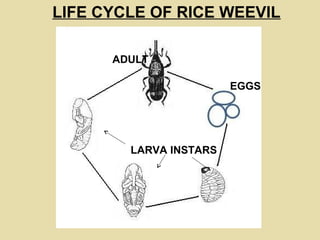
LIFE CYCLE OF RICE WEEVIL
ADULT
LARVA INSTARS
EGGS
ADULT
Life Cycle
• The female lives 4 to 5 months, and lays a total of
300 to 400 eggs.
• Like the granary weevil, she bores a small hole in
the kernel with her mandibles, lays an egg in it,
and covers the hole with a gelatinous fluid.
• The small, white, legless larva, with a brownish-
black head, has 3-4 instars. In warm weather, the
combined stages from egg to pupa may take as
few as 26 days.
• After emergence, the adult stays in the kernel for 3
or 4 days, hardening and maturing, then bores its
way out.
• This weevil is basically a grain pest, but has been
reared from solidified farinaceous products stitch
as macaroni or caked flour.
• The most favorable temperatures for development
are 27 to 30° C.
• Approximately below 7° C, the beetle is dormant.
• It usually dies after 2 weeks of freezing
temperatures, or after an hour at 49° C.
• The adults bore into the grain and lay their eggs in
the grain.
• The larva feeds inside a kernel of grain in which
both larva and pupa completes their development.
• Both larvae and adults eat similar food.
NATURE OF DAMAGE
• The adult can crawl or fly about and feed
on various products.
• They have been reported to occur on
beans, nuts, cereals wheat products,
and grapes and damage them.
• They have also been observed sucking
the juice from apples and pears,
gradually forming cavities in which they
concealed themselves.
Control Measures
• Control of these insects involves inspection and
removal of infested food products.
• Discarding the heavily infested material, repackaging
material in new containers, and vacuuming kitchen
cabinets.
• Rice weevils in all stages of development can be
killed by freezing infected food below 0o
F for a period
of three or more days.
• These Rice weevils can also be removed by heating
to 140o
F for a period of 15 minutes.
…
Control Measures
• Control of these insects involves inspection and
removal of infested food products.
• Discarding the heavily infested material, repackaging
material in new containers, and vacuuming kitchen
cabinets.
• Rice weevils in all stages of development can be
killed by freezing infected food below 0o
F for a period
of three or more days.
• These Rice weevils can also be removed by heating
to 140o
F for a period of 15 minutes.
…

Rice weevil

  • 1.
  • 2.
    Kingdom : Animalia Phylum: Arthropoda Class : Insecta Order : Coleoptera Family : Curculionidae Genus : Sitophilus Species : Oryzae CLASSIFICATION
  • 3.
    • Adults areabout 1/8 inch long, reddish brown to black with four reddish or yellowish spots on the wing covers (elytra). • The head bears a slender snout and shield behind the head (pronotum) has course round punctures. • The elytra have deep lines (striae) and course punctures. • Larvae are legless, white and rotund with a distinct head capsule. • The granary weevil has elongated punctures on the pronotum and is wingless. Identification Marks
  • 4.
    LIFE CYCLE OFRICE WEEVIL ADULT LARVA INSTARS EGGS ADULT
  • 5.
    Life Cycle • Thefemale lives 4 to 5 months, and lays a total of 300 to 400 eggs. • Like the granary weevil, she bores a small hole in the kernel with her mandibles, lays an egg in it, and covers the hole with a gelatinous fluid. • The small, white, legless larva, with a brownish- black head, has 3-4 instars. In warm weather, the combined stages from egg to pupa may take as few as 26 days. • After emergence, the adult stays in the kernel for 3 or 4 days, hardening and maturing, then bores its way out.
  • 6.
    • This weevilis basically a grain pest, but has been reared from solidified farinaceous products stitch as macaroni or caked flour. • The most favorable temperatures for development are 27 to 30° C. • Approximately below 7° C, the beetle is dormant. • It usually dies after 2 weeks of freezing temperatures, or after an hour at 49° C.
  • 7.
    • The adultsbore into the grain and lay their eggs in the grain. • The larva feeds inside a kernel of grain in which both larva and pupa completes their development. • Both larvae and adults eat similar food. NATURE OF DAMAGE
  • 8.
    • The adultcan crawl or fly about and feed on various products. • They have been reported to occur on beans, nuts, cereals wheat products, and grapes and damage them. • They have also been observed sucking the juice from apples and pears, gradually forming cavities in which they concealed themselves.
  • 9.
    Control Measures • Controlof these insects involves inspection and removal of infested food products. • Discarding the heavily infested material, repackaging material in new containers, and vacuuming kitchen cabinets. • Rice weevils in all stages of development can be killed by freezing infected food below 0o F for a period of three or more days. • These Rice weevils can also be removed by heating to 140o F for a period of 15 minutes. …
  • 10.
    Control Measures • Controlof these insects involves inspection and removal of infested food products. • Discarding the heavily infested material, repackaging material in new containers, and vacuuming kitchen cabinets. • Rice weevils in all stages of development can be killed by freezing infected food below 0o F for a period of three or more days. • These Rice weevils can also be removed by heating to 140o F for a period of 15 minutes. …