“If the lawhas made you a witness, remain a man of science. You have
no victim to avenge, no guilty or innocent person to convict or save –
you must bear testimony within the limits of science”
Dr. P.C. H. Brouardel,
French Medico-Legalist
3.
IDC
Forensic –derived from the Latin word “forensis” meaning forum or
court law.
Forensic Medicine – is the branch of medicine that deals with the
application of medical knowledge to the purpose of law and in the
administration of justice. It is the application of the basic clinical,
medical and paramedical sciences to elucidate forensic matters.
Medical Jurisprudence – knowledge of law in relation to the practice
of medicine.
Rules of Court (Sec. 5, Rule 138)-Medical Jurisprudence is one of the
subjects in the law course before admission to the bar examination
Definition of Terms
4.
IDC
History of LegalMedicine
Paulus Zacchias ( 1584 – 1659 ) is the ‘ Father of
Forensic Medicine”. He was the first to describe the
importance and application of medicine to the proper
administration of justice.
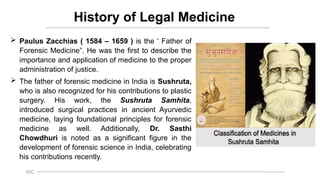
The father of forensic medicine in India is Sushruta,
who is also recognized for his contributions to plastic
surgery. His work, the Sushruta Samhita,
introduced surgical practices in ancient Ayurvedic
medicine, laying foundational principles for forensic
medicine as well. Additionally, Dr. Sasthi
Chowdhuri is noted as a significant figure in the
development of forensic science in India, celebrating
his contributions recently.
5.
Development of ForensicMedicine in India
• The first medical school was established in Calcutta in 1822 that was
later on rehabilitated into a medical college in the year 1835.
Following medical school established in Madras in 1835, which was
transformed into a college in 1850.
• In Bombay first medical college was established in the year 1850. In
1857 AD, the first distinct lead in medical jurisprudence was created
in Madras medical college. Dr. Urguhart, a private practitioner and
coroner of Madras was the first professor. The books that were
followed were brought from England.
6.
IDC
The Scopeof forensic medicine is quite broad and
encompassing. It is the application of medical and
paramedical sciences as demanded by law and
administration of justice.
• Encompasses a variety of fields in forensic science
such as pathology, anthropology, odontology,
toxicology, entomology, psychiatry and others.
• Deals with the activities or acts punishable under the
law.
Scope of Forensic Medicine
7.
IDC
It includeslifting of trace evidences from the blood, nails, hairs,
clothing, semen, a vaginal swab, tissue culture, gastric levage
It also include how to document this evidence for the court, face a
lawyer’s cross-examination, understand court proceedings and
interpret various sections and sub-sections of Criminal Procedure.
Examples are
1. Wounds
2. Drunkenness
3. Sexual offenses
4. Age determination
CLINICAL FORENSIC MEDICINE
8.
IDC
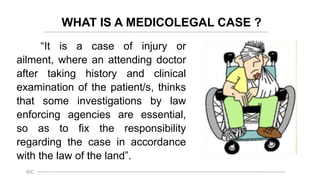
“It is acase of injury or
ailment, where an attending doctor
after taking history and clinical
examination of the patient/s, thinks
that some investigations by law
enforcing agencies are essential,
so as to fix the responsibility
regarding the case in accordance
with the law of the land”.
WHAT IS A MEDICOLEGAL CASE ?
9.
IDC
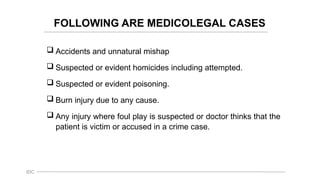
Accidents andunnatural mishap
Suspected or evident homicides including attempted.
Suspected or evident poisoning.
Burn injury due to any cause.
Any injury where foul play is suspected or doctor thinks that the
patient is victim or accused in a crime case.
FOLLOWING ARE MEDICOLEGAL CASES
10.
IDC
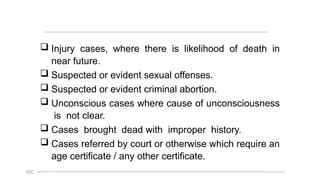
Injury cases,where there is likelihood of death in
near future.
Suspected or evident sexual offenses.
Suspected or evident criminal abortion.
Unconscious cases where cause of unconsciousness
is not clear.
Cases brought dead with improper history.
Cases referred by court or otherwise which require an
age certificate / any other certificate.
11.
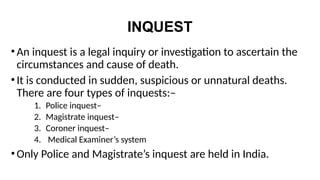
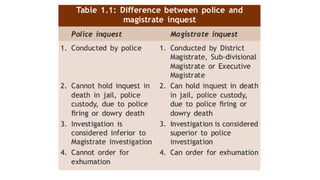
INQUEST
• An inquestis a legal inquiry or investigation to ascertain the
circumstances and cause of death.
• It is conducted in sudden, suspicious or unnatural deaths.
There are four types of inquests:–
1. Police inquest–
2. Magistrate inquest–
3. Coroner inquest–
4. Medical Examiner’s system
• Only Police and Magistrate’s inquest are held in India.
12.
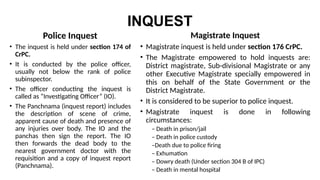
INQUEST
Police Inquest
• Theinquest is held under section 174 of
CrPC.
• It is conducted by the police officer,
usually not below the rank of police
subinspector.
• The officer conducting the inquest is
called as “Investigating Officer” (IO).
• The Panchnama (inquest report) includes
the description of scene of crime,
apparent cause of death and presence of
any injuries over body. The IO and the
panchas then sign the report. The IO
then forwards the dead body to the
nearest government doctor with the
requisition and a copy of inquest report
(Panchnama).
Magistrate Inquest
• Magistrate inquest is held under section 176 CrPC.
• The Magistrate empowered to hold inquests are:
District magistrate, Sub-divisional Magistrate or any
other Executive Magistrate specially empowered in
this on behalf of the State Government or the
District Magistrate.
• It is considered to be superior to police inquest.
• Magistrate inquest is done in following
circumstances:
– Death in prison/jail
– Death in police custody
–Death due to police firing
– Exhumation
– Dowry death (Under section 304 B of IPC)
– Death in mental hospital
14.
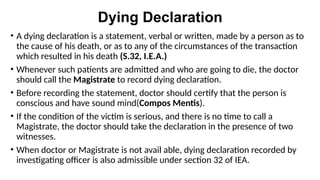
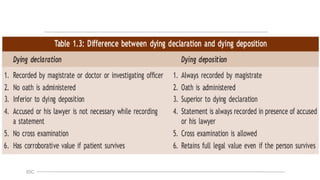
Dying Declaration
• Adying declaration is a statement, verbal or written, made by a person as to
the cause of his death, or as to any of the circumstances of the transaction
which resulted in his death (S.32, I.E.A.)
• Whenever such patients are admitted and who are going to die, the doctor
should call the Magistrate to record dying declaration.
• Before recording the statement, doctor should certify that the person is
conscious and have sound mind(Compos Mentis).
• If the condition of the victim is serious, and there is no time to call a
Magistrate, the doctor should take the declaration in the presence of two
witnesses.
• When doctor or Magistrate is not avail able, dying declaration recorded by
investigating officer is also admissible under section 32 of IEA.
15.
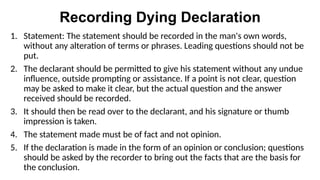
Recording Dying Declaration
1.Statement: The statement should be recorded in the man's own words,
without any alteration of terms or phrases. Leading questions should not be
put.
2. The declarant should be permitted to give his statement without any undue
influence, outside prompting or assistance. If a point is not clear, question
may be asked to make it clear, but the actual question and the answer
received should be recorded.
3. It should then be read over to the declarant, and his signature or thumb
impression is taken.
4. The statement made must be of fact and not opinion.
5. If the declaration is made in the form of an opinion or conclusion; questions
should be asked by the recorder to bring out the facts that are the basis for
the conclusion.
16.
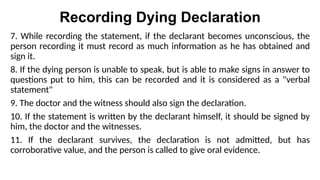
Recording Dying Declaration
7.While recording the statement, if the declarant becomes unconscious, the
person recording it must record as much information as he has obtained and
sign it.
8. If the dying person is unable to speak, but is able to make signs in answer to
questions put to him, this can be recorded and it is considered as a "verbal
statement"
9. The doctor and the witness should also sign the declaration.
10. If the statement is written by the declarant himself, it should be signed by
him, the doctor and the witnesses.
11. If the declarant survives, the declaration is not admitted, but has
corroborative value, and the person is called to give oral evidence.
17.
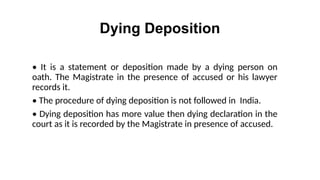
Dying Deposition
• Itis a statement or deposition made by a dying person on
oath. The Magistrate in the presence of accused or his lawyer
records it.
• The procedure of dying deposition is not followed in India.
• Dying deposition has more value then dying declaration in the
court as it is recorded by the Magistrate in presence of accused.
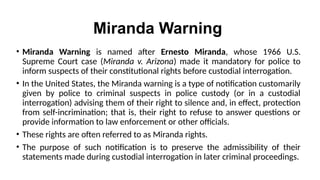
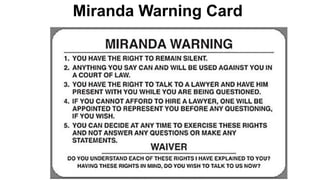
Miranda Warning
• MirandaWarning is named after Ernesto Miranda, whose 1966 U.S.
Supreme Court case (Miranda v. Arizona) made it mandatory for police to
inform suspects of their constitutional rights before custodial interrogation.
• In the United States, the Miranda warning is a type of notification customarily
given by police to criminal suspects in police custody (or in a custodial
interrogation) advising them of their right to silence and, in effect, protection
from self-incrimination; that is, their right to refuse to answer questions or
provide information to law enforcement or other officials.
• These rights are often referred to as Miranda rights.
• The purpose of such notification is to preserve the admissibility of their
statements made during custodial interrogation in later criminal proceedings.
Procedure in Court
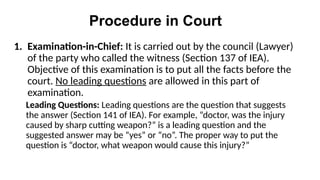
1.Examination-in-Chief: It is carried out by the council (Lawyer)
of the party who called the witness (Section 137 of IEA).
Objective of this examination is to put all the facts before the
court. No leading questions are allowed in this part of
examination.
Leading Questions: Leading questions are the question that suggests
the answer (Section 141 of IEA). For example, “doctor, was the injury
caused by sharp cutting weapon?” is a leading question and the
suggested answer may be “yes” or “no”. The proper way to put the
question is “doctor, what weapon would cause this injury?”
23.
Procedure in Court
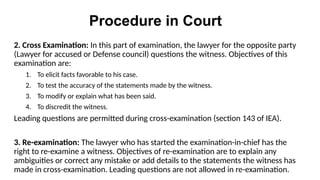
2.Cross Examination: In this part of examination, the lawyer for the opposite party
(Lawyer for accused or Defense council) questions the witness. Objectives of this
examination are:
1. To elicit facts favorable to his case.
2. To test the accuracy of the statements made by the witness.
3. To modify or explain what has been said.
4. To discredit the witness.
Leading questions are permitted during cross-examination (section 143 of IEA).
3. Re-examination: The lawyer who has started the examination-in-chief has the
right to re-examine a witness. Objectives of re-examination are to explain any
ambiguities or correct any mistake or add details to the statements the witness has
made in cross-examination. Leading questions are not allowed in re-examination.
24.
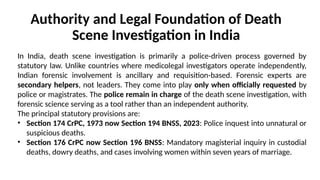
Authority and LegalFoundation of Death
Scene Investigation in India
In India, death scene investigation is primarily a police-driven process governed by
statutory law. Unlike countries where medicolegal investigators operate independently,
Indian forensic involvement is ancillary and requisition-based. Forensic experts are
secondary helpers, not leaders. They come into play only when officially requested by
police or magistrates. The police remain in charge of the death scene investigation, with
forensic science serving as a tool rather than an independent authority.
The principal statutory provisions are:
• Section 174 CrPC, 1973 now Section 194 BNSS, 2023: Police inquest into unnatural or
suspicious deaths.
• Section 176 CrPC now Section 196 BNSS: Mandatory magisterial inquiry in custodial
deaths, dowry deaths, and cases involving women within seven years of marriage.
25.
⚖️Assessment of theDeath Scene under
Indian Law
• The Investigating Officer (IO) of the police is the primary authority
responsible for assessing the death scene in India.
• Unlike some countries where forensic investigators lead the process, here
the police officer directs the initial evaluation.
• The IO’s main goal is to classify the death as:
i. Natural (illness, age-related, etc.)
ii. Accidental
iii. Suicidal
iv. Homicidal
• This classification guides whether further forensic or judicial processes are
required.
26.
⚖️Assessment of theDeath Scene under
Indian Law
📝 Key Responsibilities
The IO must:
• Secure the scene → prevent tampering or contamination of evidence.
• Observe body position and surroundings → note how the body lies,
nearby objects, and environmental clues.
• Identify potential weapons or implements → anything that could have
caused injury or death.
• Note signs of struggle or disturbance → overturned furniture, broken
items, or evidence of body movement.
27.
⚖️Request and Roleof Forensic Experts in
India
• In India, forensic experts are not automatically present at every death scene.
• Their participation is discretionary—they are summoned only if the Investigating
Officer (IO) or a Magistrate decides that scientific expertise is needed.
• This makes forensic involvement requisition-based, meaning it depends on a formal
request rather than being routine.
• Forensic experts are typically brought in for cases that demand specialized scientific
analysis, such as:
• Homicide cases → to reconstruct the crime scene, analyze weapons, or interpret injury patterns.
• Suspicious deaths → when the cause or circumstances are unclear.
• Mass disasters → for identification of victims and evidence recovery.
• Exhumation cases → when a buried body must be examined under legal order.
• Skeletal or decomposed remains → requiring anthropology or advanced forensic techniques.
28.
⚖️Request and Roleof Forensic Experts in
India
🧪 What Forensic Experts do
Once requisitioned, forensic teams (from State Forensic Science Laboratories or
Central Forensic Science Laboratories) assist by:
• Guiding evidence collection and ensuring scientific handling. Conducting specialized
examinations (ballistics, serology, anthropology, toxicology).
• Helping with scene reconstruction to understand how events unfolded.
⚠️Key distinction
Unlike some countries where forensic investigators are part of the first response
team, in India they act as scientific advisors and examiners, not as scene
commanders. The police remain in charge of scene control, documentation, and
legal responsibility.
29.
Command, Control, andDocumentation of
Scene Entry
• Indian law does not require a formal command post or a dedicated scene
logbook, but the investigative record is maintained through existing police and
inquest documents rather than a single, codified scene log.
• Equivalent records and their roles
• Case Diary (Section 172 CrPC / 193 BNSS) — the IO’s contemporaneous record of actions,
observations, and decisions; it functions as the primary narrative of the investigation.
• Station Diary (Roznamcha) — the station-level register that records arrivals, departures,
and administrative entries relevant to the case.
• Inquest Panchanama — the formal inquest report that documents the scene, exhibits, and
statements of panch (witness) attendees.
• Courts use these documents to assess credibility, chronology, and procedural
integrity; consistent, contemporaneous entries help justify investigative choices
and link physical evidence to the scene and suspects.
30.
Crowd and MediaManagement at Death
Scenes
•Crowd and media management is an operational
responsibility of police. Although not codified in CrPC, it is
governed by police acts, standing orders, and Supreme Court
guidelines on media conduct.
•Key principles include:
• Establishing inner and outer cordons
• Restricting photography and videography
• Preventing media trial and disclosure of sensitive details Improper
media handling has been held to violate the right to fair
investigation and fair trial
31.
Documentation of theDeath Scene in
Indian Practice
• Documentation in India relies on:
• Written records (inquest, case diary)
• Photography and videography (increasingly mandated)
• Sketches prepared by police or crime scene units
• Videography is compulsory in custodial deaths, encounter cases, and sensitive
investigations as per judicial directives.
Witness Development In India-information is collected through:
• Witness statements under Section 161 CrPC / 180 BNSS
• Neighbourhood inquiries
• Beat constable reports
32.
Indexing of DeathInvestigation Records
• In India, indexing refers to the systematic compilation of all official documents
generated during a death investigation.
• Indexing in India occurs through compilation of:
1. FIR (First Information Report): The initial police record that sets the investigation in
motion.
2. Inquest Report: Prepared during the police or magistrate inquest, describing the body,
scene, and apparent cause of death.
3. Case Diary: Daily notes of the investigating officer under Section 172 CrPC / 193 BNSS,
recording observations and actions.
4. Postmortem Report: Medical examination findings by a registered doctor, detailing injuries,
cause, and manner of death.
5. Forensic Laboratory Reports: Scientific analyses (ballistics, toxicology, serology, etc.)
linking evidence to the crime.
6. Charge Sheet: The final police document submitted to court, formally accusing the
suspect(s).
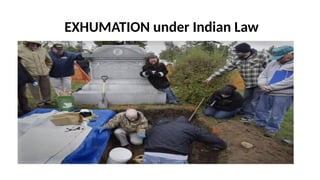
EXHUMATION under IndianLaw
•Exhumation means the lawful disinterment or digging out a
body from a grave, which has already been buried.(Cr.P.C.
176)
•In India, this process is strictly regulated:
• It cannot be done by police alone.
• A written order from an Executive Magistrate is mandatory before
any exhumation.
• This ensures judicial oversight and prevents misuse or
unauthorized disturbance of graves.
35.
Required Presence DuringExhumation
• The law requires that exhumation be conducted in the presence of
multiple authorities to maintain transparency and credibility:
• Executive Magistrate → issues the order and supervises legality.
• Medical Officer → performs medical examination and documents injuries.
• Investigating Officer → connects findings to the ongoing criminal
investigation.
• Panch witnesses → independent local witnesses who attest to the fairness
of the process.
• This multi-person presence ensures that the procedure is lawful,
scientific, and impartial.
36.
Objectives of Exhumation
•Exhumation serves specific investigative purposes:
• Determination of cause of death → e.g., poisoning, trauma, or natural
causes.
• Identification of the deceased → especially in cases of unknown or
disputed identity.
• Injury documentation → to verify ante-mortem vs post-mortem injuries,
or weapon involvement.
#19 In 1966, the case Miranda v. Arizona established that suspects must be informed of their constitutional rights before police interrogation.
Ernesto Miranda was arrested and questioned by police without being told:
that he had the right to remain silent, or
that he had the right to consult a lawyer.
He confessed during interrogation, but the Supreme Court later ruled that:
Statements made without informing a suspect of their rights are not admissible in court.
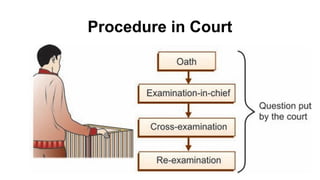
#21 When a doctor is called in the court of law as a witness, he has to take oath before tendering his evidence. The evidence is recorded in the following sequence (Section 138 of IEA.
#23 There is no time limit for cross-examination. Well-known author and eminent medicolegal expert, Prof. Dr B. V. Subrahmanyam was crossed-examined for two complete days.
Re-examination: No new things or new subject may be introduced by the witness without the consent of the judge or the Defense counsel. If new subject have been introduced in re-examination, the lawyer of opposing party has the right to re-cross-examine a witness on the new matter.
#32 Why Chronological Consistency Matters
Each document is time-stamped and sequentially linked to the investigation.
Courts demand coherence across all records — contradictions in dates, times, or findings can weaken or collapse the prosecution case.
For example:
If the postmortem report suggests a time of death inconsistent with the FIR or inquest report, defense can argue investigative lapses.
If the chain of custody in forensic reports doesn’t align with the case diary, evidence may be discredited.