Computer and Network Security (UCS523)
(Unit-V:- Wireless Network Security)
(UG Course)
Network Security
(UG Course)
Dr. Navneet Sharma
Assistant professor, ECED
Thapar Institute of Engineering and Technology, Patiala, Punjab, India
Email:- navneet.sharma@thapar.edu
Outline
 IEEE 802.11i Wireless LAN Security
 Wireless Application Protocol Overview
 Wireless Transport Layer Security
 WAP End-to-End Security
Wireless Network Security
IEEE 802.11
 IEEE 802 committee for LAN standards.
 IEEE 802.11 formed in 1990’s.
 For developing a protocol & transmission specifications for wireless LANs (WLANs)
 Since then demand for WLANs, at different frequencies and data rates, has
exploded.
 Hence seen ever-expanding list of standards issued
Wireless Network Security
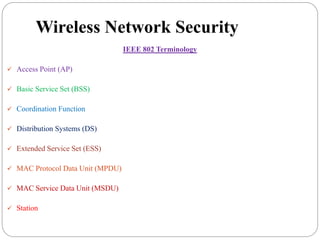
IEEE 802 Terminology
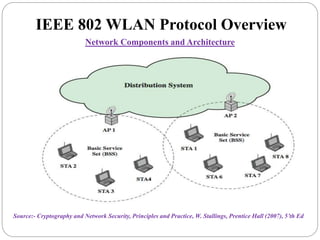
 Access Point (AP)
 Basic Service Set (BSS)
 Coordination Function
 Distribution Systems (DS)
 Extended Service Set (ESS)
 MAC Protocol Data Unit (MPDU)
 MAC Service Data Unit (MSDU)
 Station
Wireless Network Security
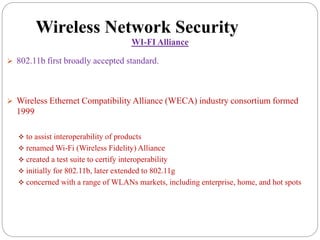
WI-FI Alliance
 802.11b first broadly accepted standard.
 Wireless Ethernet Compatibility Alliance (WECA) industry consortium formed
1999
 to assist interoperability of products
 renamed Wi-Fi (Wireless Fidelity) Alliance
 created a test suite to certify interoperability
 initially for 802.11b, later extended to 802.11g
 concerned with a range of WLANs markets, including enterprise, home, and hot spots
Wireless Network Security
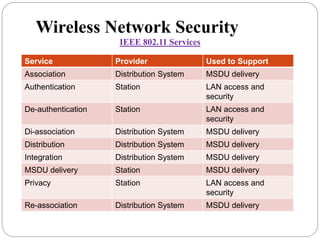
IEEE 802.11 Services
Service Provider Used to Support
Association Distribution System MSDU delivery
Authentication Station LAN access and
security
De-authentication Station LAN access and
security
Di-association Distribution System MSDU delivery
Distribution Distribution System MSDU delivery
Integration Distribution System MSDU delivery
MSDU delivery Station MSDU delivery
Privacy Station LAN access and
security
Re-association Distribution System MSDU delivery
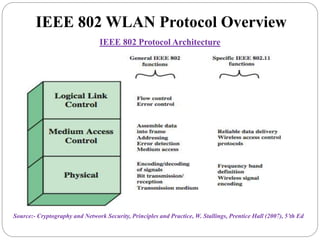
IEEE 802 WLAN Protocol Overview
IEEE 802 Protocol Architecture
Source:- Cryptography and Network Security, Principles and Practice, W. Stallings, Prentice Hall (2007), 5’th Ed
IEEE 802 WLAN Protocol Overview
Network Components and Architecture
Source:- Cryptography and Network Security, Principles and Practice, W. Stallings, Prentice Hall (2007), 5’th Ed
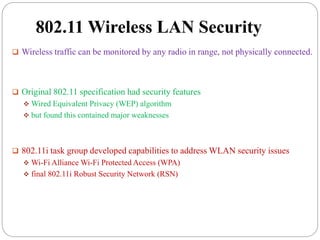
802.11 Wireless LAN Security
 Wireless traffic can be monitored by any radio in range, not physically connected.
 Original 802.11 specification had security features
 Wired Equivalent Privacy (WEP) algorithm
 but found this contained major weaknesses
 802.11i task group developed capabilities to address WLAN security issues
 Wi-Fi Alliance Wi-Fi Protected Access (WPA)
 final 802.11i Robust Security Network (RSN)
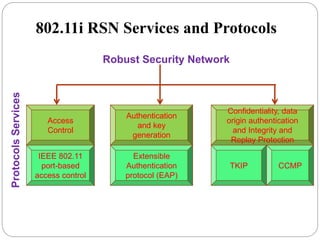
802.11i RSN Services and Protocols
Access
Control
Authentication
and key
generation
Confidentiality, data
origin authentication
and Integrity and
Replay Protection
IEEE 802.11
port-based
access control
Extensible
Authentication
protocol (EAP)
TKIP CCMP
Robust Security Network
Protocols
Services
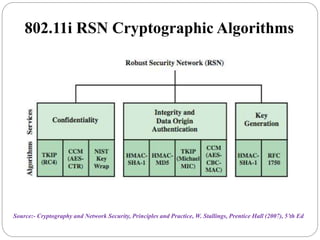
802.11i RSN Cryptographic Algorithms
Source:- Cryptography and Network Security, Principles and Practice, W. Stallings, Prentice Hall (2007), 5’th Ed
Computer and Network Security (UCS523)
(Unit-V:- Wireless Network Security)
(802.11i Phases of Operation)
(UG Course)
Network Security
(UG Course)
Dr. Navneet Sharma
Assistant professor, ECED
Thapar Institute of Engineering and Technology, Patiala, Punjab, India
Email:- navneet.sharma@thapar.edu
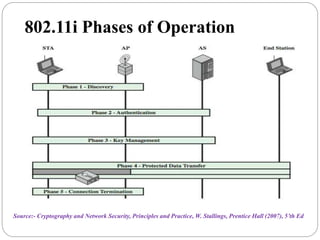
802.11i Phases of Operation
Source:- Cryptography and Network Security, Principles and Practice, W. Stallings, Prentice Hall (2007), 5’th Ed
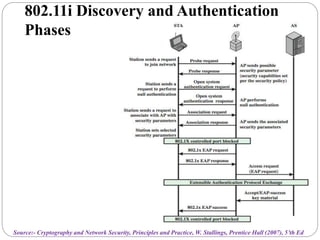
802.11i Discovery and Authentication
Phases
Source:- Cryptography and Network Security, Principles and Practice, W. Stallings, Prentice Hall (2007), 5’th Ed
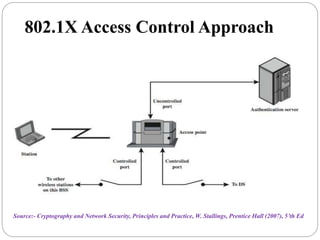
802.1X Access Control Approach
Source:- Cryptography and Network Security, Principles and Practice, W. Stallings, Prentice Hall (2007), 5’th Ed
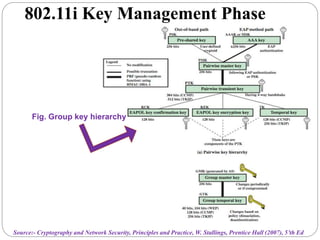
802.11i Key Management Phase
Source:- Cryptography and Network Security, Principles and Practice, W. Stallings, Prentice Hall (2007), 5’th Ed
Fig. Group key hierarchy
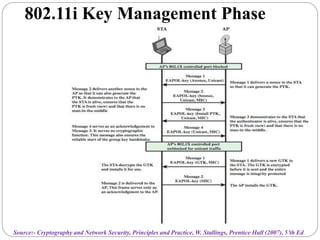
802.11i Key Management Phase
Source:- Cryptography and Network Security, Principles and Practice, W. Stallings, Prentice Hall (2007), 5’th Ed
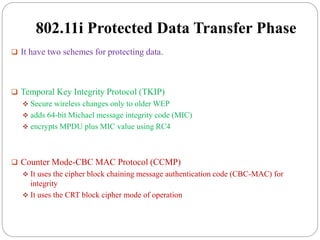
802.11i Protected Data Transfer Phase
 It have two schemes for protecting data.
 Temporal Key Integrity Protocol (TKIP)
 Secure wireless changes only to older WEP
 adds 64-bit Michael message integrity code (MIC)
 encrypts MPDU plus MIC value using RC4
 Counter Mode-CBC MAC Protocol (CCMP)
 It uses the cipher block chaining message authentication code (CBC-MAC) for
integrity
 It uses the CRT block cipher mode of operation
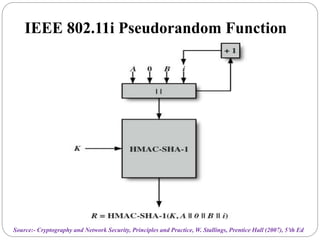
IEEE 802.11i Pseudorandom Function
Source:- Cryptography and Network Security, Principles and Practice, W. Stallings, Prentice Hall (2007), 5’th Ed
Computer and Network Security (UCS523)
(Unit-V:- Wireless Network Security)
{ Wireless Application Protocol (WAP) }
(UG Course)
Network Security
(UG Course)
Dr. Navneet Sharma
Assistant professor, ECED
Thapar Institute of Engineering and Technology, Patiala, Punjab, India
Email:- navneet.sharma@thapar.edu
Wireless Application Protocol (WAP)
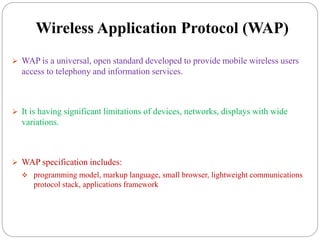
 WAP is a universal, open standard developed to provide mobile wireless users
access to telephony and information services.
 It is having significant limitations of devices, networks, displays with wide
variations.
 WAP specification includes:
 programming model, markup language, small browser, lightweight communications
protocol stack, applications framework
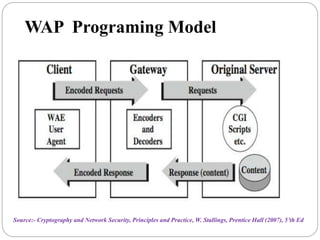
WAP Programing Model
Source:- Cryptography and Network Security, Principles and Practice, W. Stallings, Prentice Hall (2007), 5’th Ed
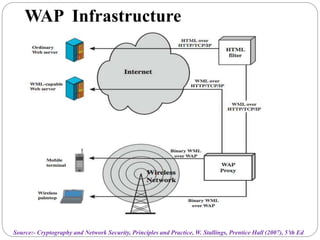
WAP Infrastructure
Source:- Cryptography and Network Security, Principles and Practice, W. Stallings, Prentice Hall (2007), 5’th Ed
Wireless Mark-up Language
 It describes content and format for data display on devices with limited
bandwidth, screen size, and user input capability.
 Include features of this language are :
 text / image formatting and layout commands
 deck/card organizational metaphor
 support for navigation among cards and decks
 A card is one or more units of interaction.
 A deck is similar to an HTML page.
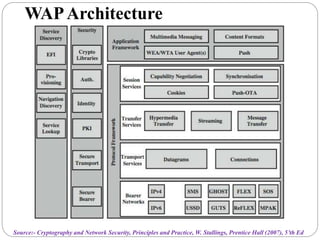
WAPArchitecture
Source:- Cryptography and Network Security, Principles and Practice, W. Stallings, Prentice Hall (2007), 5’th Ed
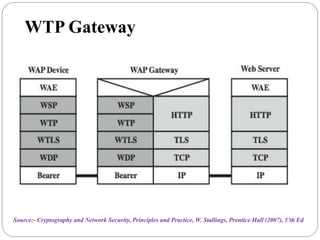
WTP Gateway
Source:- Cryptography and Network Security, Principles and Practice, W. Stallings, Prentice Hall (2007), 5’th Ed
WAP Protocol
 Wireless Session Protocol (WSP)
o It provides applications two session services
o It is connection-oriented and connectionless
o WSP is based on HTTP with optimizations
 Wireless Transaction Protocol (WTP)
o WTP manages transactions of requests / responses between a user agent & an
application server
o It also provides an efficient reliable transport service
 Wireless Datagram Protocol (WDP)
o It adapts higher-layer WAP protocol to communications
Computer and Network Security (UCS523)
(Unit-V:- Wireless Network Security)
{ Wireless Transport layer Security (WTLS) }
(UG Course)
Network Security
(UG Course)
Dr. Navneet Sharma
Assistant professor, ECED
Thapar Institute of Engineering and Technology, Patiala, Punjab, India
Email:- navneet.sharma@thapar.edu
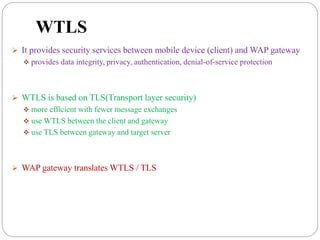
WTLS
 It provides security services between mobile device (client) and WAP gateway
 provides data integrity, privacy, authentication, denial-of-service protection
 WTLS is based on TLS(Transport layer security)
 more efficient with fewer message exchanges
 use WTLS between the client and gateway
 use TLS between gateway and target server
 WAP gateway translates WTLS / TLS
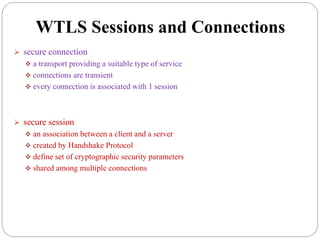
WTLS Sessions and Connections
 secure connection
 a transport providing a suitable type of service
 connections are transient
 every connection is associated with 1 session
 secure session
 an association between a client and a server
 created by Handshake Protocol
 define set of cryptographic security parameters
 shared among multiple connections
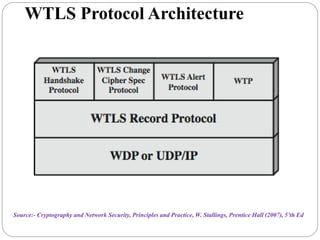
WTLS Protocol Architecture
Source:- Cryptography and Network Security, Principles and Practice, W. Stallings, Prentice Hall (2007), 5’th Ed
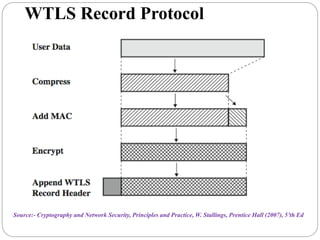
WTLS Record Protocol
Source:- Cryptography and Network Security, Principles and Practice, W. Stallings, Prentice Hall (2007), 5’th Ed
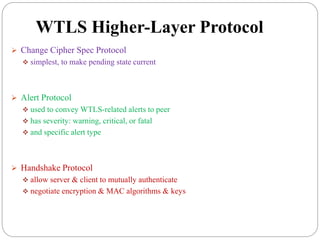
WTLS Higher-Layer Protocol
 Change Cipher Spec Protocol
 simplest, to make pending state current
 Alert Protocol
 used to convey WTLS-related alerts to peer
 has severity: warning, critical, or fatal
 and specific alert type
 Handshake Protocol
 allow server & client to mutually authenticate
 negotiate encryption & MAC algorithms & keys
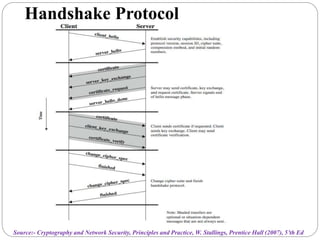
Handshake Protocol
Source:- Cryptography and Network Security, Principles and Practice, W. Stallings, Prentice Hall (2007), 5’th Ed
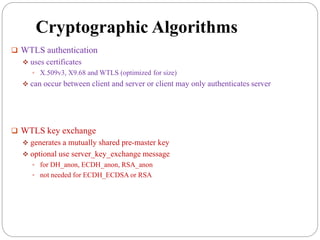
Cryptographic Algorithms
 WTLS authentication
 uses certificates
 X.509v3, X9.68 and WTLS (optimized for size)
 can occur between client and server or client may only authenticates server
 WTLS key exchange
 generates a mutually shared pre-master key
 optional use server_key_exchange message
 for DH_anon, ECDH_anon, RSA_anon
 not needed for ECDH_ECDSA or RSA
Cryptographic Algorithms
 Pseudorandom Function (PRF)
 HMAC based, used for a number of purposes
 only one hash alg, agreed during handshake
 Master Key Generation
 of shared master secret
 master_secret = PRF( pre_master_secret, "master secret”,ClientHello.random ||
ServerHello.random )
 then derive MAC and encryption keys
 Encryption with RC5, DES, 3DES, IDEA
Computer and Network Security (UCS523)
(Unit-V:- Wireless Network Security)
(WAP End- to-End Security)
(UG Course)
Network Security
(UG Course)
Dr. Navneet Sharma
Assistant professor, ECED
Thapar Institute of Engineering and Technology, Patiala, Punjab, India
Email:- navneet.sharma@thapar.edu
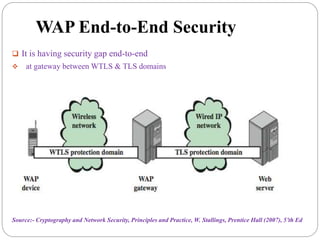
WAP End-to-End Security
 It is having security gap end-to-end
 at gateway between WTLS & TLS domains
Source:- Cryptography and Network Security, Principles and Practice, W. Stallings, Prentice Hall (2007), 5’th Ed
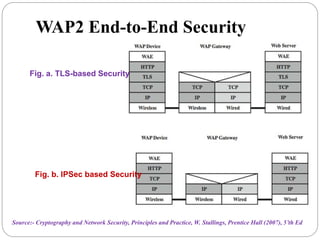
WAP2 End-to-End Security
Fig. a. TLS-based Security
Fig. b. IPSec based Security
Source:- Cryptography and Network Security, Principles and Practice, W. Stallings, Prentice Hall (2007), 5’th Ed
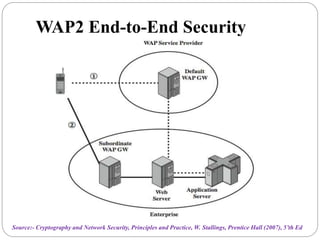
WAP2 End-to-End Security
Source:- Cryptography and Network Security, Principles and Practice, W. Stallings, Prentice Hall (2007), 5’th Ed
Summary
 This module have considered:
 IEEE 802.11 Wireless LANs
 protocol overview and security
 Wireless Application Protocol (WAP)
 protocol overview
 Wireless Transport Layer Security (WTLS)
 Wireless End-to-End Security

lecture_5.pptx

  • 1.
    Computer and NetworkSecurity (UCS523) (Unit-V:- Wireless Network Security) (UG Course) Network Security (UG Course) Dr. Navneet Sharma Assistant professor, ECED Thapar Institute of Engineering and Technology, Patiala, Punjab, India Email:- navneet.sharma@thapar.edu
  • 2.
    Outline  IEEE 802.11iWireless LAN Security  Wireless Application Protocol Overview  Wireless Transport Layer Security  WAP End-to-End Security
  • 3.
    Wireless Network Security IEEE802.11  IEEE 802 committee for LAN standards.  IEEE 802.11 formed in 1990’s.  For developing a protocol & transmission specifications for wireless LANs (WLANs)  Since then demand for WLANs, at different frequencies and data rates, has exploded.  Hence seen ever-expanding list of standards issued
  • 4.
    Wireless Network Security IEEE802 Terminology  Access Point (AP)  Basic Service Set (BSS)  Coordination Function  Distribution Systems (DS)  Extended Service Set (ESS)  MAC Protocol Data Unit (MPDU)  MAC Service Data Unit (MSDU)  Station
  • 5.
    Wireless Network Security WI-FIAlliance  802.11b first broadly accepted standard.  Wireless Ethernet Compatibility Alliance (WECA) industry consortium formed 1999  to assist interoperability of products  renamed Wi-Fi (Wireless Fidelity) Alliance  created a test suite to certify interoperability  initially for 802.11b, later extended to 802.11g  concerned with a range of WLANs markets, including enterprise, home, and hot spots
  • 6.
    Wireless Network Security IEEE802.11 Services Service Provider Used to Support Association Distribution System MSDU delivery Authentication Station LAN access and security De-authentication Station LAN access and security Di-association Distribution System MSDU delivery Distribution Distribution System MSDU delivery Integration Distribution System MSDU delivery MSDU delivery Station MSDU delivery Privacy Station LAN access and security Re-association Distribution System MSDU delivery
  • 7.
    IEEE 802 WLANProtocol Overview IEEE 802 Protocol Architecture Source:- Cryptography and Network Security, Principles and Practice, W. Stallings, Prentice Hall (2007), 5’th Ed
  • 8.
    IEEE 802 WLANProtocol Overview Network Components and Architecture Source:- Cryptography and Network Security, Principles and Practice, W. Stallings, Prentice Hall (2007), 5’th Ed
  • 9.
    802.11 Wireless LANSecurity  Wireless traffic can be monitored by any radio in range, not physically connected.  Original 802.11 specification had security features  Wired Equivalent Privacy (WEP) algorithm  but found this contained major weaknesses  802.11i task group developed capabilities to address WLAN security issues  Wi-Fi Alliance Wi-Fi Protected Access (WPA)  final 802.11i Robust Security Network (RSN)
  • 10.
    802.11i RSN Servicesand Protocols Access Control Authentication and key generation Confidentiality, data origin authentication and Integrity and Replay Protection IEEE 802.11 port-based access control Extensible Authentication protocol (EAP) TKIP CCMP Robust Security Network Protocols Services
  • 11.
    802.11i RSN CryptographicAlgorithms Source:- Cryptography and Network Security, Principles and Practice, W. Stallings, Prentice Hall (2007), 5’th Ed
  • 12.
    Computer and NetworkSecurity (UCS523) (Unit-V:- Wireless Network Security) (802.11i Phases of Operation) (UG Course) Network Security (UG Course) Dr. Navneet Sharma Assistant professor, ECED Thapar Institute of Engineering and Technology, Patiala, Punjab, India Email:- navneet.sharma@thapar.edu
  • 13.
    802.11i Phases ofOperation Source:- Cryptography and Network Security, Principles and Practice, W. Stallings, Prentice Hall (2007), 5’th Ed
  • 14.
    802.11i Discovery andAuthentication Phases Source:- Cryptography and Network Security, Principles and Practice, W. Stallings, Prentice Hall (2007), 5’th Ed
  • 15.
    802.1X Access ControlApproach Source:- Cryptography and Network Security, Principles and Practice, W. Stallings, Prentice Hall (2007), 5’th Ed
  • 16.
    802.11i Key ManagementPhase Source:- Cryptography and Network Security, Principles and Practice, W. Stallings, Prentice Hall (2007), 5’th Ed Fig. Group key hierarchy
  • 17.
    802.11i Key ManagementPhase Source:- Cryptography and Network Security, Principles and Practice, W. Stallings, Prentice Hall (2007), 5’th Ed
  • 18.
    802.11i Protected DataTransfer Phase  It have two schemes for protecting data.  Temporal Key Integrity Protocol (TKIP)  Secure wireless changes only to older WEP  adds 64-bit Michael message integrity code (MIC)  encrypts MPDU plus MIC value using RC4  Counter Mode-CBC MAC Protocol (CCMP)  It uses the cipher block chaining message authentication code (CBC-MAC) for integrity  It uses the CRT block cipher mode of operation
  • 19.
    IEEE 802.11i PseudorandomFunction Source:- Cryptography and Network Security, Principles and Practice, W. Stallings, Prentice Hall (2007), 5’th Ed
  • 20.
    Computer and NetworkSecurity (UCS523) (Unit-V:- Wireless Network Security) { Wireless Application Protocol (WAP) } (UG Course) Network Security (UG Course) Dr. Navneet Sharma Assistant professor, ECED Thapar Institute of Engineering and Technology, Patiala, Punjab, India Email:- navneet.sharma@thapar.edu
  • 21.
    Wireless Application Protocol(WAP)  WAP is a universal, open standard developed to provide mobile wireless users access to telephony and information services.  It is having significant limitations of devices, networks, displays with wide variations.  WAP specification includes:  programming model, markup language, small browser, lightweight communications protocol stack, applications framework
  • 22.
    WAP Programing Model Source:-Cryptography and Network Security, Principles and Practice, W. Stallings, Prentice Hall (2007), 5’th Ed
  • 23.
    WAP Infrastructure Source:- Cryptographyand Network Security, Principles and Practice, W. Stallings, Prentice Hall (2007), 5’th Ed
  • 24.
    Wireless Mark-up Language It describes content and format for data display on devices with limited bandwidth, screen size, and user input capability.  Include features of this language are :  text / image formatting and layout commands  deck/card organizational metaphor  support for navigation among cards and decks  A card is one or more units of interaction.  A deck is similar to an HTML page.
  • 25.
    WAPArchitecture Source:- Cryptography andNetwork Security, Principles and Practice, W. Stallings, Prentice Hall (2007), 5’th Ed
  • 26.
    WTP Gateway Source:- Cryptographyand Network Security, Principles and Practice, W. Stallings, Prentice Hall (2007), 5’th Ed
  • 27.
    WAP Protocol  WirelessSession Protocol (WSP) o It provides applications two session services o It is connection-oriented and connectionless o WSP is based on HTTP with optimizations  Wireless Transaction Protocol (WTP) o WTP manages transactions of requests / responses between a user agent & an application server o It also provides an efficient reliable transport service  Wireless Datagram Protocol (WDP) o It adapts higher-layer WAP protocol to communications
  • 28.
    Computer and NetworkSecurity (UCS523) (Unit-V:- Wireless Network Security) { Wireless Transport layer Security (WTLS) } (UG Course) Network Security (UG Course) Dr. Navneet Sharma Assistant professor, ECED Thapar Institute of Engineering and Technology, Patiala, Punjab, India Email:- navneet.sharma@thapar.edu
  • 29.
    WTLS  It providessecurity services between mobile device (client) and WAP gateway  provides data integrity, privacy, authentication, denial-of-service protection  WTLS is based on TLS(Transport layer security)  more efficient with fewer message exchanges  use WTLS between the client and gateway  use TLS between gateway and target server  WAP gateway translates WTLS / TLS
  • 30.
    WTLS Sessions andConnections  secure connection  a transport providing a suitable type of service  connections are transient  every connection is associated with 1 session  secure session  an association between a client and a server  created by Handshake Protocol  define set of cryptographic security parameters  shared among multiple connections
  • 31.
    WTLS Protocol Architecture Source:-Cryptography and Network Security, Principles and Practice, W. Stallings, Prentice Hall (2007), 5’th Ed
  • 32.
    WTLS Record Protocol Source:-Cryptography and Network Security, Principles and Practice, W. Stallings, Prentice Hall (2007), 5’th Ed
  • 33.
    WTLS Higher-Layer Protocol Change Cipher Spec Protocol  simplest, to make pending state current  Alert Protocol  used to convey WTLS-related alerts to peer  has severity: warning, critical, or fatal  and specific alert type  Handshake Protocol  allow server & client to mutually authenticate  negotiate encryption & MAC algorithms & keys
  • 34.
    Handshake Protocol Source:- Cryptographyand Network Security, Principles and Practice, W. Stallings, Prentice Hall (2007), 5’th Ed
  • 35.
    Cryptographic Algorithms  WTLSauthentication  uses certificates  X.509v3, X9.68 and WTLS (optimized for size)  can occur between client and server or client may only authenticates server  WTLS key exchange  generates a mutually shared pre-master key  optional use server_key_exchange message  for DH_anon, ECDH_anon, RSA_anon  not needed for ECDH_ECDSA or RSA
  • 36.
    Cryptographic Algorithms  PseudorandomFunction (PRF)  HMAC based, used for a number of purposes  only one hash alg, agreed during handshake  Master Key Generation  of shared master secret  master_secret = PRF( pre_master_secret, "master secret”,ClientHello.random || ServerHello.random )  then derive MAC and encryption keys  Encryption with RC5, DES, 3DES, IDEA
  • 37.
    Computer and NetworkSecurity (UCS523) (Unit-V:- Wireless Network Security) (WAP End- to-End Security) (UG Course) Network Security (UG Course) Dr. Navneet Sharma Assistant professor, ECED Thapar Institute of Engineering and Technology, Patiala, Punjab, India Email:- navneet.sharma@thapar.edu
  • 38.
    WAP End-to-End Security It is having security gap end-to-end  at gateway between WTLS & TLS domains Source:- Cryptography and Network Security, Principles and Practice, W. Stallings, Prentice Hall (2007), 5’th Ed
  • 39.
    WAP2 End-to-End Security Fig.a. TLS-based Security Fig. b. IPSec based Security Source:- Cryptography and Network Security, Principles and Practice, W. Stallings, Prentice Hall (2007), 5’th Ed
  • 40.
    WAP2 End-to-End Security Source:-Cryptography and Network Security, Principles and Practice, W. Stallings, Prentice Hall (2007), 5’th Ed
  • 41.
    Summary  This modulehave considered:  IEEE 802.11 Wireless LANs  protocol overview and security  Wireless Application Protocol (WAP)  protocol overview  Wireless Transport Layer Security (WTLS)  Wireless End-to-End Security