SELF
by GROUP 1
UNDErstanding the self
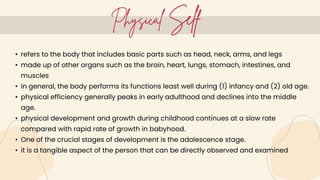
• refers to the body that includes basic parts such as head, neck, arms, and legs
• made up of other organs such as the brain, heart, lungs, stomach, intestines, and
muscles
• in general, the body performs its functions least well during (1) infancy and (2) old age.
• physical efficiency generally peaks in early adulthood and declines into the middle
age.
• physical development and growth during childhood continues at a slow rate
compared with rapid rate of growth in babyhood.
• One of the crucial stages of development is the adolescence stage.
• it is a tangible aspect of the person that can be directly observed and examined
PHYSICAL
SELF
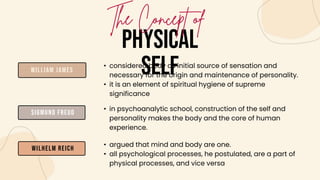
William James
Sigmund Freud
Wilhelm Reich
• considered body as initial source of sensation and
necessary for the origin and maintenance of personality.
• it is an element of spiritual hygiene of supreme
significance
• in psychoanalytic school, construction of the self and
personality makes the body and the core of human
experience.
• argued that mind and body are one.
• all psychological processes, he postulated, are a part of
physical processes, and vice versa
Erik Erikson
Carl Jung
B.F. Skinner
There is entire discipline devoted to Physical Self "Hath-yoga", or the Yoga of the body.
The Indian tradition views growth and enlightenment as the whole body event, which is
not possible until one has a pure and strong body.
• the role of bodily organs is especially important in early
developmental stages of a person's life. Later in life, the
development of physical as well as intellectual skills help
determine whether the individual will achieve a sense of
competence and ability to choose demanding roles in a
complex society.
• argued that the physical body and the external world
can be known only as psychological experiences
• says that the role of the body is of primary
importance
PHYSICAL
SELF
Heredity (nature)
Environment (nurture)
• The development of the individual is caused by two interacting forces: heredity
and environment.
• the transmission of traits or characteristics from parents
to offspring.
• the sum total of the forces or experiences that a person
undergoes from conception to old age.
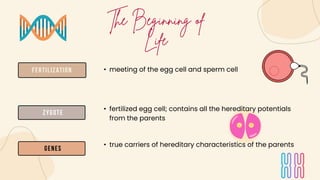
Fertilization
Zygote
Genes
• meeting of the egg cell and sperm cell
• fertilized egg cell; contains all the hereditary potentials
from the parents
• true carriers of hereditary characteristics of the parents
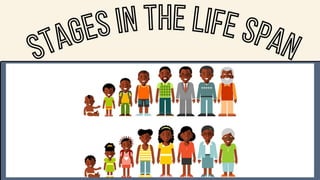
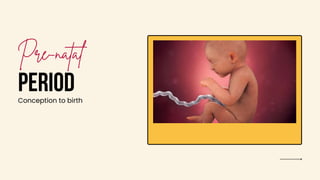
PERIOD
Conception to birth
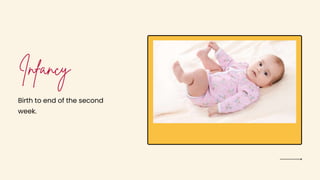
Birth to end of the second
week.
End of the second week to
end of the second year.
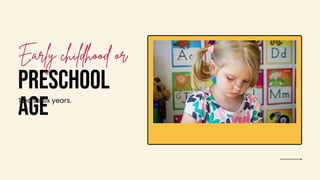
PRESCHOOL
AGE
Two to six years.
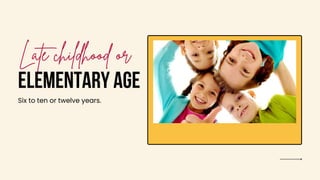
ELEMENTARY AGE
Six to ten or twelve years.
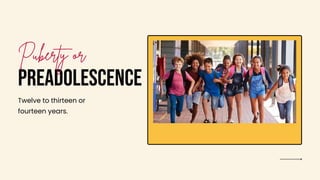
PREADOLESCENCE
Twelve to thirteen or
fourteen years.
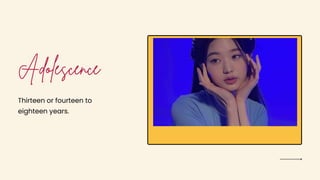
Thirteen or fourteen to
eighteen years.
Eighteen to forty years.
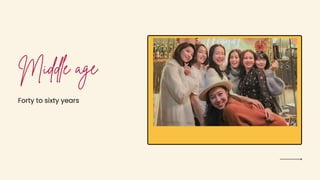
Forty to sixty years
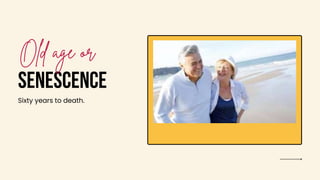
SENESCENCE
Sixty years to death.
• As a biological entity, the body has a functional
role, but as a social entity it is the most visible
way of expressing and presenting someone's
identity.
• Research found that a person who is perceived
as attractive makes more money than a person
of below-average looks.
• In politics, voters who are not actively engaged in
social and political issues choose candidates
based on "looks" 90% of the time.
• May be attributed to a cognitive bias called the "halo
effect,"
• A cognitive bias is an error in reasoning, evaluating,
remembering, or any other mental process that is often
a result of holding on to one's preferences and beliefs
regardless of contrary information.
• The "halo effect" refers to the tendency of people to rate
attractive individuals more favorable for their personality
traits or characteristics as compared to those who are
less attractive.
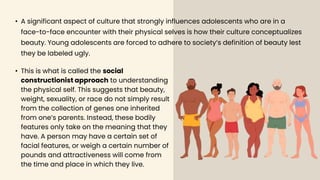
• A significant aspect of culture that strongly influences adolescents who are in a
face-to-face encounter with their physical selves is how their culture conceptualizes
beauty. Young adolescents are forced to adhere to society’s definition of beauty lest
they be labeled ugly.
• This is what is called the social
constructionist approach to understanding
the physical self. This suggests that beauty,
weight, sexuality, or race do not simply result
from the collection of genes one inherited
from one’s parents. Instead, these bodily
features only take on the meaning that they
have. A person may have a certain set of
facial features, or weigh a certain number of
pounds and attractiveness will come from
the time and place in which they live.
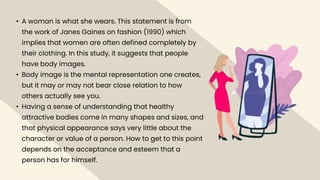
• A woman is what she wears. This statement is from
the work of Janes Gaines on fashion (1990) which
implies that women are often defined completely by
their clothing. In this study, it suggests that people
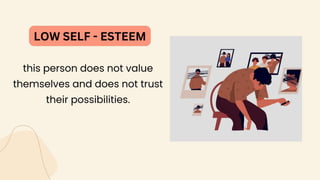
have body images.
• Body image is the mental representation one creates,
but it may or may not bear close relation to how
others actually see you.
• Having a sense of understanding that healthy
attractive bodies come in many shapes and sizes, and
that physical appearance says very little about the
character or value of a person. How to get to this point
depends on the acceptance and esteem that a
person has for himself.
BEAUTY
• defined not with proportions, but rather with
similarity between the left and right sides of the
face.
Symmetry
• Biologists had also hypothesized that we prefer
faces that epitomize the 'manliness' or
'femininity' of their gender.
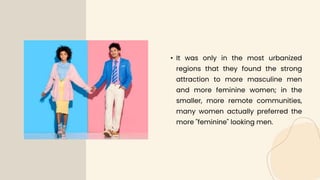
• It was only in the most urbanized
regions that they found the strong
attraction to more masculine men
and more feminine women; in the
smaller, more remote communities,
many women actually preferred the
more "feminine" looking men.
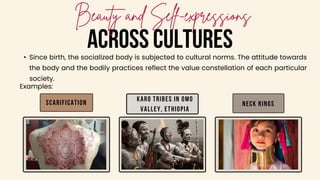
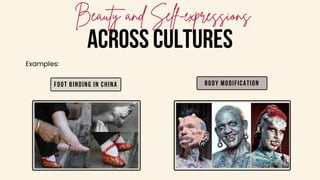
ACROSS CULTURES
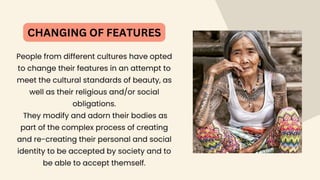
• Since birth, the socialized body is subjected to cultural norms. The attitude towards
the body and the bodily practices reflect the value constellation of each particular
society.
Karo tribes in Omo
Valley, Ethiopia
Neck rings
Examples:
Scarification
ACROSS CULTURES
Examples:
Body Modification
Foot binding in China
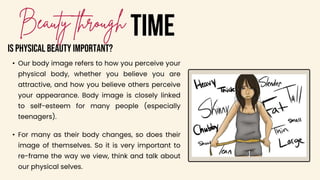
• Our body image refers to how you perceive your
physical body, whether you believe you are
attractive, and how you believe others perceive
your appearance. Body image is closely linked
to self-esteem for many people (especially
teenagers).
TIME
IS PHYSICAL BEAUTY IMPORTANT?
• For many as their body changes, so does their
image of themselves. So it is very important to
re-frame the way we view, think and talk about
our physical selves.
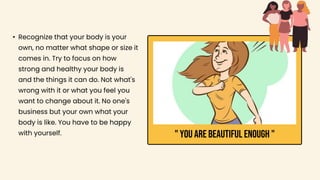
• Recognize that your body is your
own, no matter what shape or size it
comes in. Try to focus on how
strong and healthy your body is
and the things it can do. Not what's
wrong with it or what you feel you
want to change about it. No one's
business but your own what your
body is like. You have to be happy
with yourself. " YOU ARE BEAUTIFUL ENOUGH "
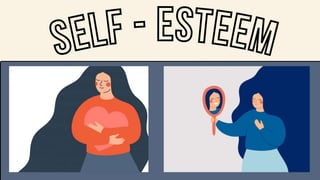
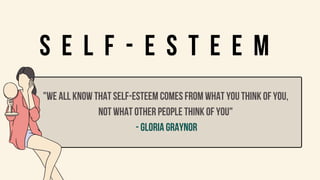
S E L F - E S T E E M
"We all know that self-esteem comes from what youthink of you,
not what other people think of you"
- Gloria Graynor
IMAGE
• Cleaning your body every day.
Personal Hygiene
• Behaviors that must be practiced in daily
life.
IMAGE
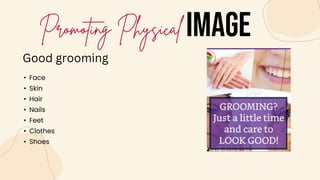
• Face
• Skin
• Hair
• Nails
• Feet
• Clothes
• Shoes
Good grooming
IMAGE
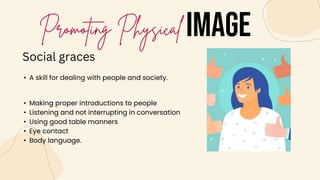
• A skill for dealing with people and society.
Social graces
• Making proper introductions to people
• Listening and not interrupting in conversation
• Using good table manners
• Eye contact
• Body language.
IMAGE
• Proper alignment of your body when standing
or sitting.

Proper bearing and posture
IMAGE
• State of complete physical, mental, and social
well-being and not merely the absence of
disease or infirmity.
Health
UNDERSTANDING THE SELF
listening!
Group 1

Physical Self - UTS.pptx

  • 1.
  • 2.
    • refers tothe body that includes basic parts such as head, neck, arms, and legs • made up of other organs such as the brain, heart, lungs, stomach, intestines, and muscles • in general, the body performs its functions least well during (1) infancy and (2) old age. • physical efficiency generally peaks in early adulthood and declines into the middle age. • physical development and growth during childhood continues at a slow rate compared with rapid rate of growth in babyhood. • One of the crucial stages of development is the adolescence stage. • it is a tangible aspect of the person that can be directly observed and examined
  • 3.
    PHYSICAL SELF William James Sigmund Freud WilhelmReich • considered body as initial source of sensation and necessary for the origin and maintenance of personality. • it is an element of spiritual hygiene of supreme significance • in psychoanalytic school, construction of the self and personality makes the body and the core of human experience. • argued that mind and body are one. • all psychological processes, he postulated, are a part of physical processes, and vice versa
  • 4.
    Erik Erikson Carl Jung B.F.Skinner There is entire discipline devoted to Physical Self "Hath-yoga", or the Yoga of the body. The Indian tradition views growth and enlightenment as the whole body event, which is not possible until one has a pure and strong body. • the role of bodily organs is especially important in early developmental stages of a person's life. Later in life, the development of physical as well as intellectual skills help determine whether the individual will achieve a sense of competence and ability to choose demanding roles in a complex society. • argued that the physical body and the external world can be known only as psychological experiences • says that the role of the body is of primary importance
  • 5.
    PHYSICAL SELF Heredity (nature) Environment (nurture) •The development of the individual is caused by two interacting forces: heredity and environment. • the transmission of traits or characteristics from parents to offspring. • the sum total of the forces or experiences that a person undergoes from conception to old age.
  • 6.
    Fertilization Zygote Genes • meeting ofthe egg cell and sperm cell • fertilized egg cell; contains all the hereditary potentials from the parents • true carriers of hereditary characteristics of the parents
  • 8.
  • 9.
    Birth to endof the second week.
  • 10.
    End of thesecond week to end of the second year.
  • 11.
  • 12.
    ELEMENTARY AGE Six toten or twelve years.
  • 13.
  • 14.
    Thirteen or fourteento eighteen years.
  • 15.
  • 16.
  • 17.
  • 18.
    • As abiological entity, the body has a functional role, but as a social entity it is the most visible way of expressing and presenting someone's identity. • Research found that a person who is perceived as attractive makes more money than a person of below-average looks. • In politics, voters who are not actively engaged in social and political issues choose candidates based on "looks" 90% of the time.
  • 19.
    • May beattributed to a cognitive bias called the "halo effect," • A cognitive bias is an error in reasoning, evaluating, remembering, or any other mental process that is often a result of holding on to one's preferences and beliefs regardless of contrary information. • The "halo effect" refers to the tendency of people to rate attractive individuals more favorable for their personality traits or characteristics as compared to those who are less attractive.
  • 20.
    • A significantaspect of culture that strongly influences adolescents who are in a face-to-face encounter with their physical selves is how their culture conceptualizes beauty. Young adolescents are forced to adhere to society’s definition of beauty lest they be labeled ugly. • This is what is called the social constructionist approach to understanding the physical self. This suggests that beauty, weight, sexuality, or race do not simply result from the collection of genes one inherited from one’s parents. Instead, these bodily features only take on the meaning that they have. A person may have a certain set of facial features, or weigh a certain number of pounds and attractiveness will come from the time and place in which they live.
  • 21.
    • A womanis what she wears. This statement is from the work of Janes Gaines on fashion (1990) which implies that women are often defined completely by their clothing. In this study, it suggests that people have body images. • Body image is the mental representation one creates, but it may or may not bear close relation to how others actually see you. • Having a sense of understanding that healthy attractive bodies come in many shapes and sizes, and that physical appearance says very little about the character or value of a person. How to get to this point depends on the acceptance and esteem that a person has for himself.
  • 22.
    BEAUTY • defined notwith proportions, but rather with similarity between the left and right sides of the face. Symmetry • Biologists had also hypothesized that we prefer faces that epitomize the 'manliness' or 'femininity' of their gender.
  • 23.
    • It wasonly in the most urbanized regions that they found the strong attraction to more masculine men and more feminine women; in the smaller, more remote communities, many women actually preferred the more "feminine" looking men.
  • 24.
    ACROSS CULTURES • Sincebirth, the socialized body is subjected to cultural norms. The attitude towards the body and the bodily practices reflect the value constellation of each particular society. Karo tribes in Omo Valley, Ethiopia Neck rings Examples: Scarification
  • 25.
  • 26.
    • Our bodyimage refers to how you perceive your physical body, whether you believe you are attractive, and how you believe others perceive your appearance. Body image is closely linked to self-esteem for many people (especially teenagers). TIME IS PHYSICAL BEAUTY IMPORTANT? • For many as their body changes, so does their image of themselves. So it is very important to re-frame the way we view, think and talk about our physical selves.
  • 27.
    • Recognize thatyour body is your own, no matter what shape or size it comes in. Try to focus on how strong and healthy your body is and the things it can do. Not what's wrong with it or what you feel you want to change about it. No one's business but your own what your body is like. You have to be happy with yourself. " YOU ARE BEAUTIFUL ENOUGH "
  • 29.
    S E LF - E S T E E M "We all know that self-esteem comes from what youthink of you, not what other people think of you" - Gloria Graynor
  • 37.
    IMAGE • Cleaning yourbody every day. Personal Hygiene • Behaviors that must be practiced in daily life.
  • 38.
    IMAGE • Face • Skin •Hair • Nails • Feet • Clothes • Shoes Good grooming
  • 39.
    IMAGE • A skillfor dealing with people and society. Social graces • Making proper introductions to people • Listening and not interrupting in conversation • Using good table manners • Eye contact • Body language.
  • 40.
    IMAGE • Proper alignmentof your body when standing or sitting. Proper bearing and posture
  • 41.
    IMAGE • State ofcomplete physical, mental, and social well-being and not merely the absence of disease or infirmity. Health
  • 42.