Robert Collins
CSE486


                     Lecture 11:
                 LoG and DoG Filters
Robert Collins
CSE486
                       Today’s Topics

       Laplacian of Gaussian (LoG) Filter
        - useful for finding edges
        - also useful for finding blobs!

       approximation using Difference of Gaussian (DoG)
Robert Collins

                 Recall: First Derivative Filters
CSE486


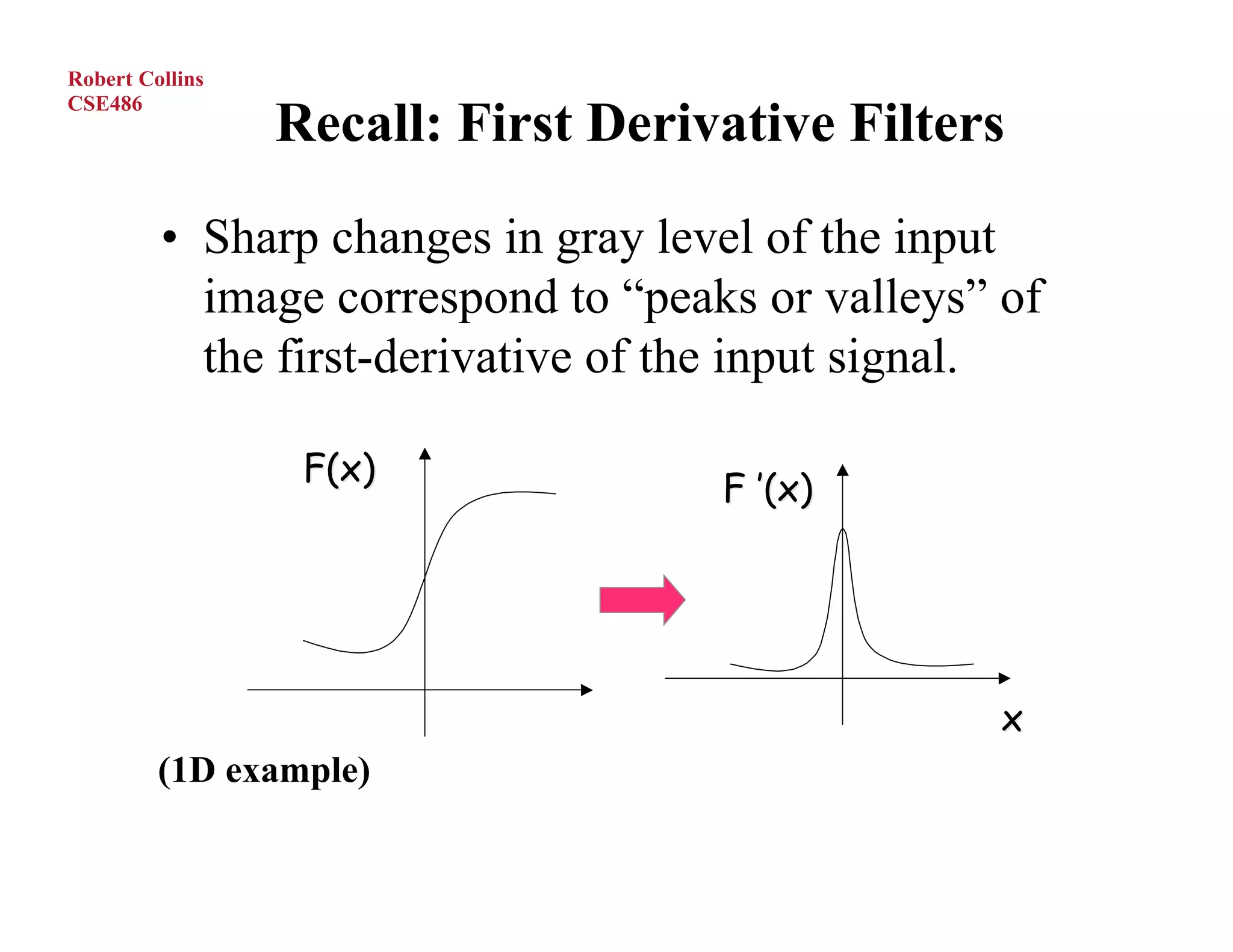
         • Sharp changes in gray level of the input
           image correspond to “peaks or valleys” of
           the first-derivative of the input signal.

                  F(x)
                                    F ’(x)


                                                  x
         (1D example)

O.Camps, PSU
Robert Collins
CSE486
                 Second-Derivative Filters

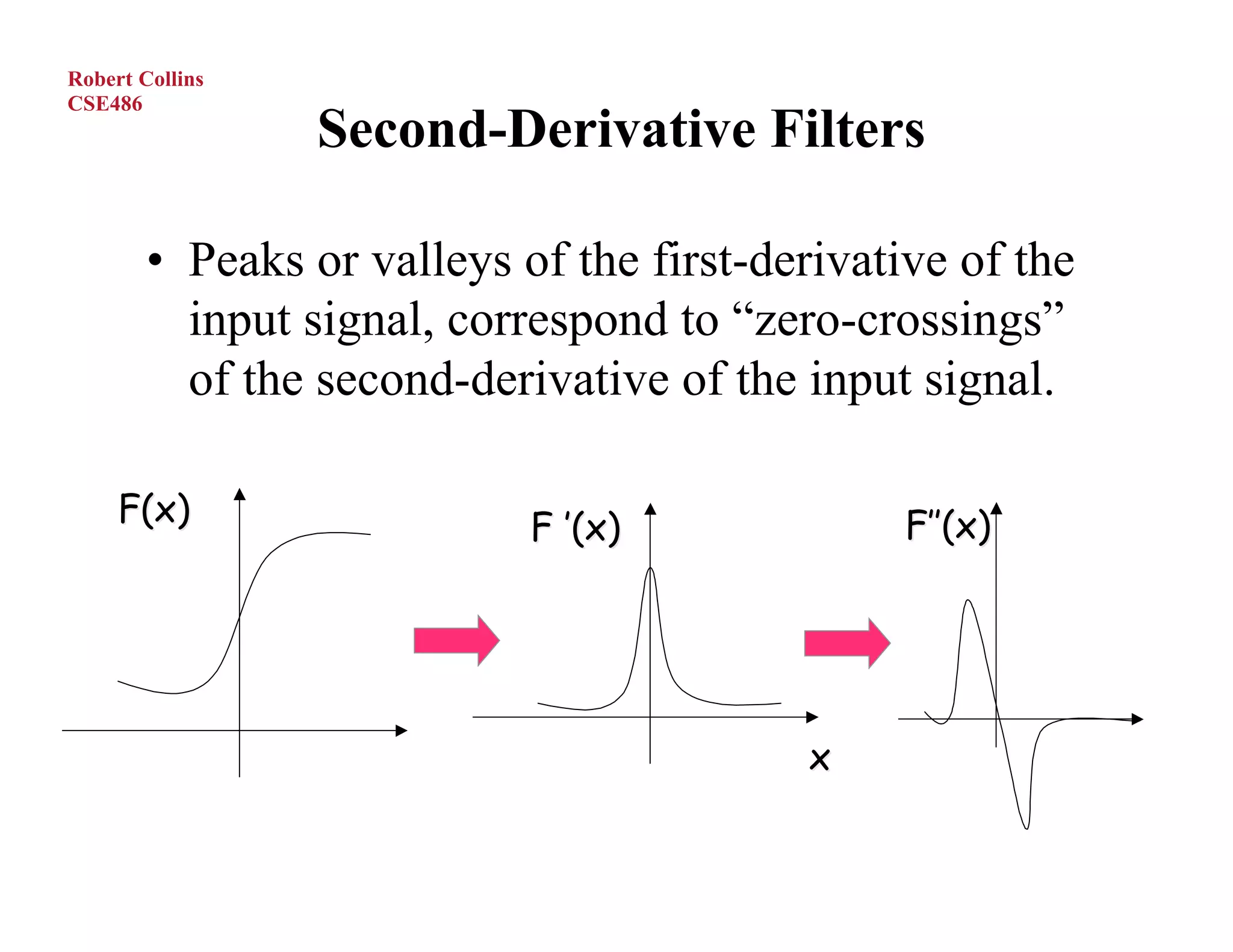
        • Peaks or valleys of the first-derivative of the
          input signal, correspond to “zero-crossings”
          of the second-derivative of the input signal.

     F(x)                   F ’(x)              F’’(x)


                                          x

O.Camps, PSU
Robert Collins
CSE486
                   Numerical Derivatives
                       See also T&V, Appendix A.2

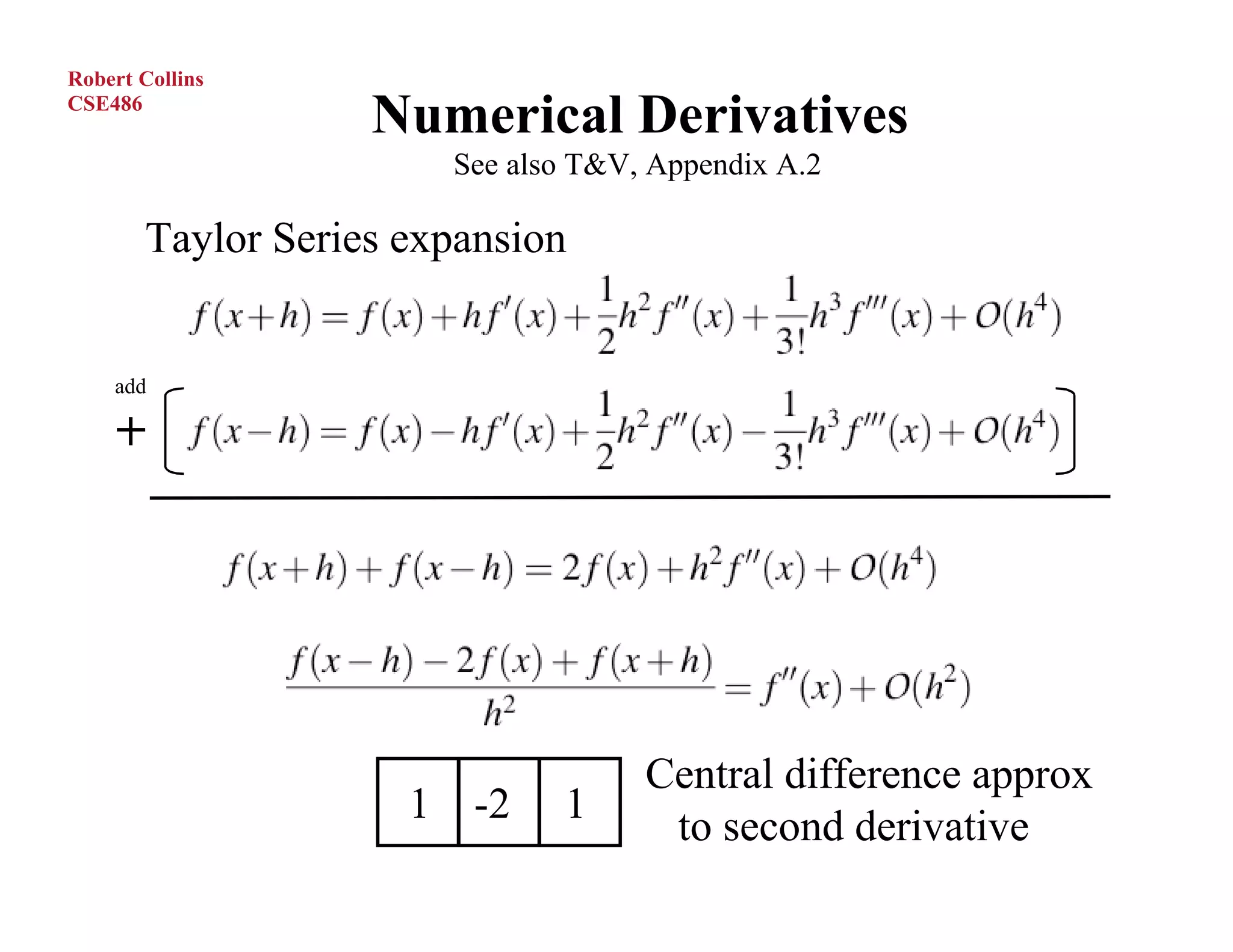
       Taylor Series expansion


    add


                                    Central difference approx
                     1 -2     1
                                     to second derivative
Robert Collins
CSE486
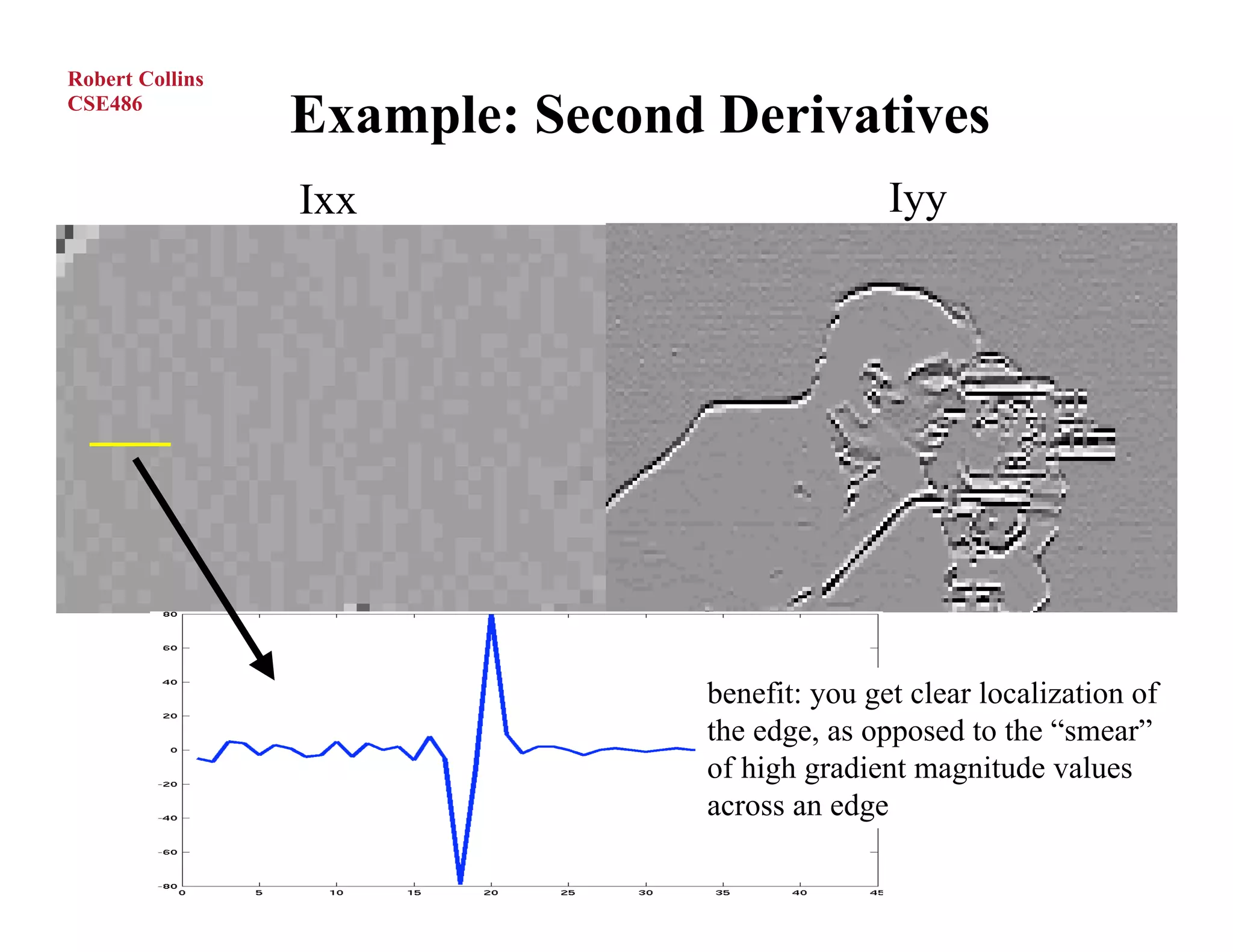
                 Example: Second Derivatives
                                                  Ixx=d2I(x,y)/dx2

                        [ 1 -2 1 ]
    I(x,y)
                        2nd Partial deriv wrt x


                                1
                               -2
                                1                 Iyy=d2I(x,y)/dy2
                        2nd Partial deriv wrt y
Robert Collins
CSE486
                 Example: Second Derivatives
                 Ixx                            Iyy


                                 benefit: you get clear localization of
                                 the edge, as opposed to the “smear”
                                 of high gradient magnitude values
                                 across an edge
Robert Collins
CSE486
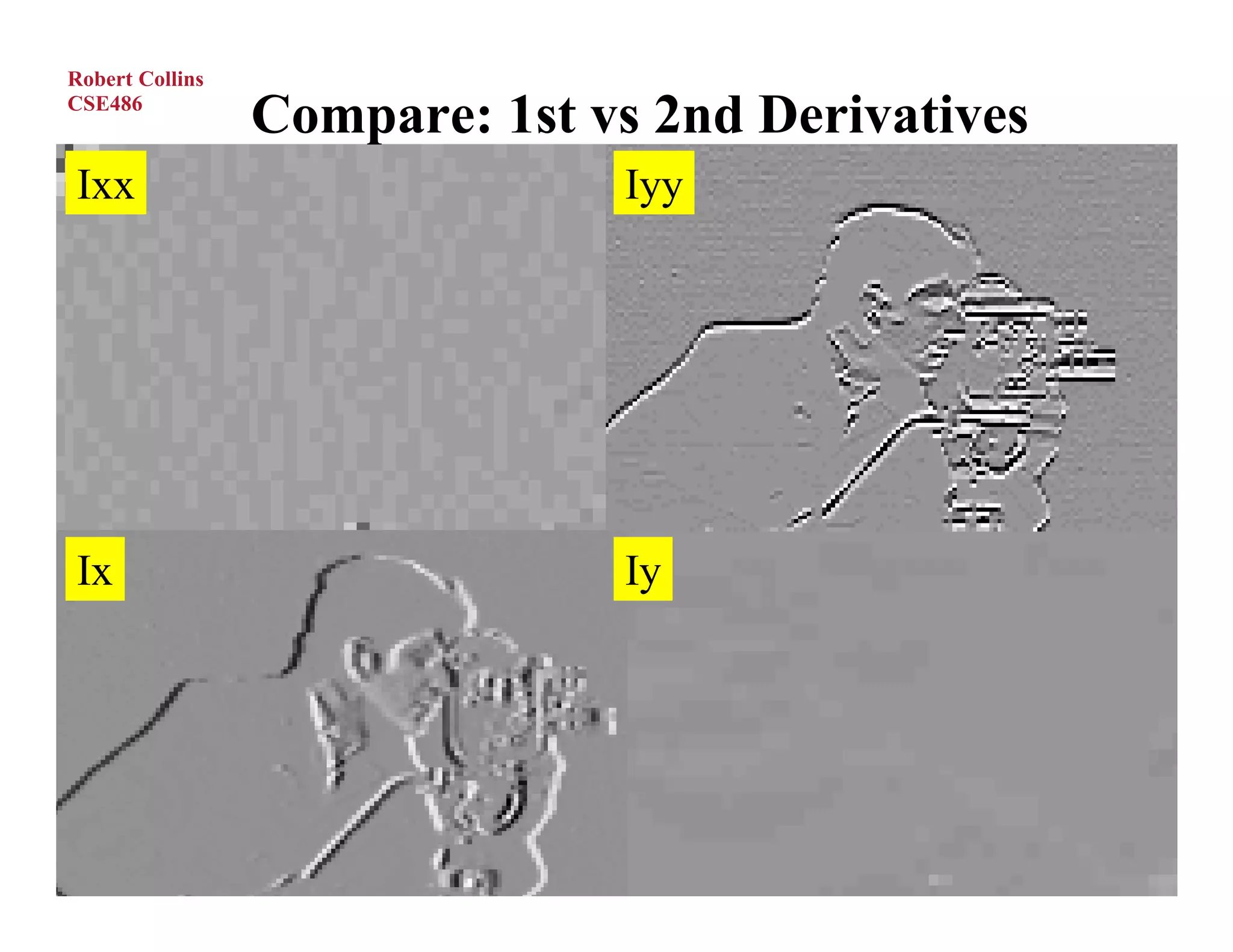
                 Compare: 1st vs 2nd Derivatives
Ixx                            Iyy


Ix                             Iy
Robert Collins
CSE486
                    Finding Zero-Crossings
       An alternative approx to finding edges as peaks in
       first deriv is to find zero-crossings in second deriv.
       In 1D, convolve with [1 -2 1] and look for pixels
       where response is (nearly) zero?
       Problem: when first deriv is zero, so is second. I.e.
       the filter [1 -2 1] also produces zero when convolved
       with regions of constant intensity.

       So, in 1D, convolve with [1 -2 1] and look for pixels
       where response is nearly zero AND magnitude of
       first derivative is “large enough”.
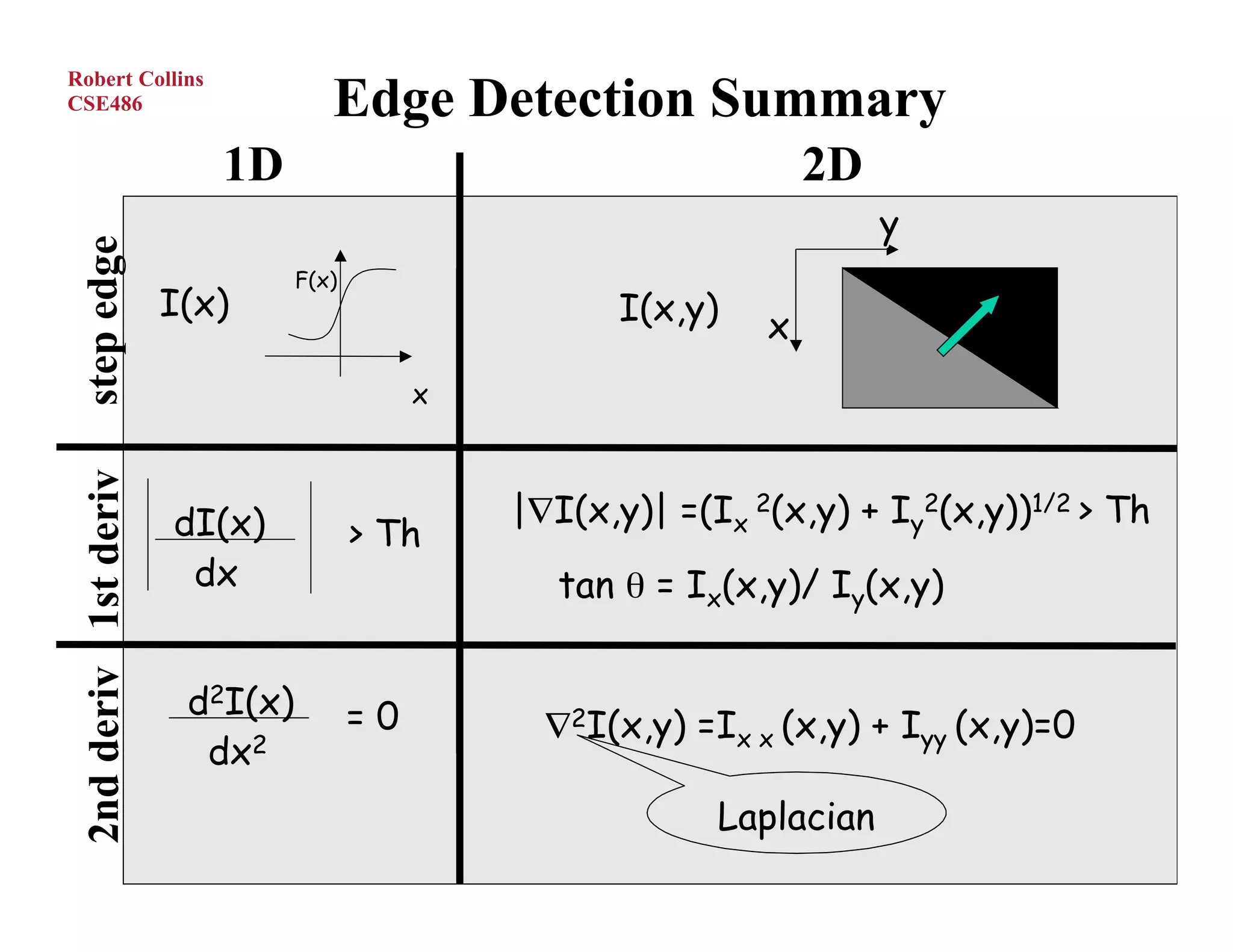
Edge Detection Summary
Robert Collins
CSE486


                          1D                                       2D
                                                                        y
 step edge


                               F(x)
                       I(x)                          I(x,y)    x
                                           x
 2nd deriv 1st deriv


                       dI(x)                   |∇I(x,y)| =(Ix 2(x,y) + Iy2(x,y))1/2 > Th
                                      > Th
                        dx                       tan θ = Ix(x,y)/ Iy(x,y)


                        d2I(x)        =0         ∇2I(x,y) =Ix x (x,y) + Iyy (x,y)=0
                         dx2
                                                            Laplacian
Robert Collins
CSE486
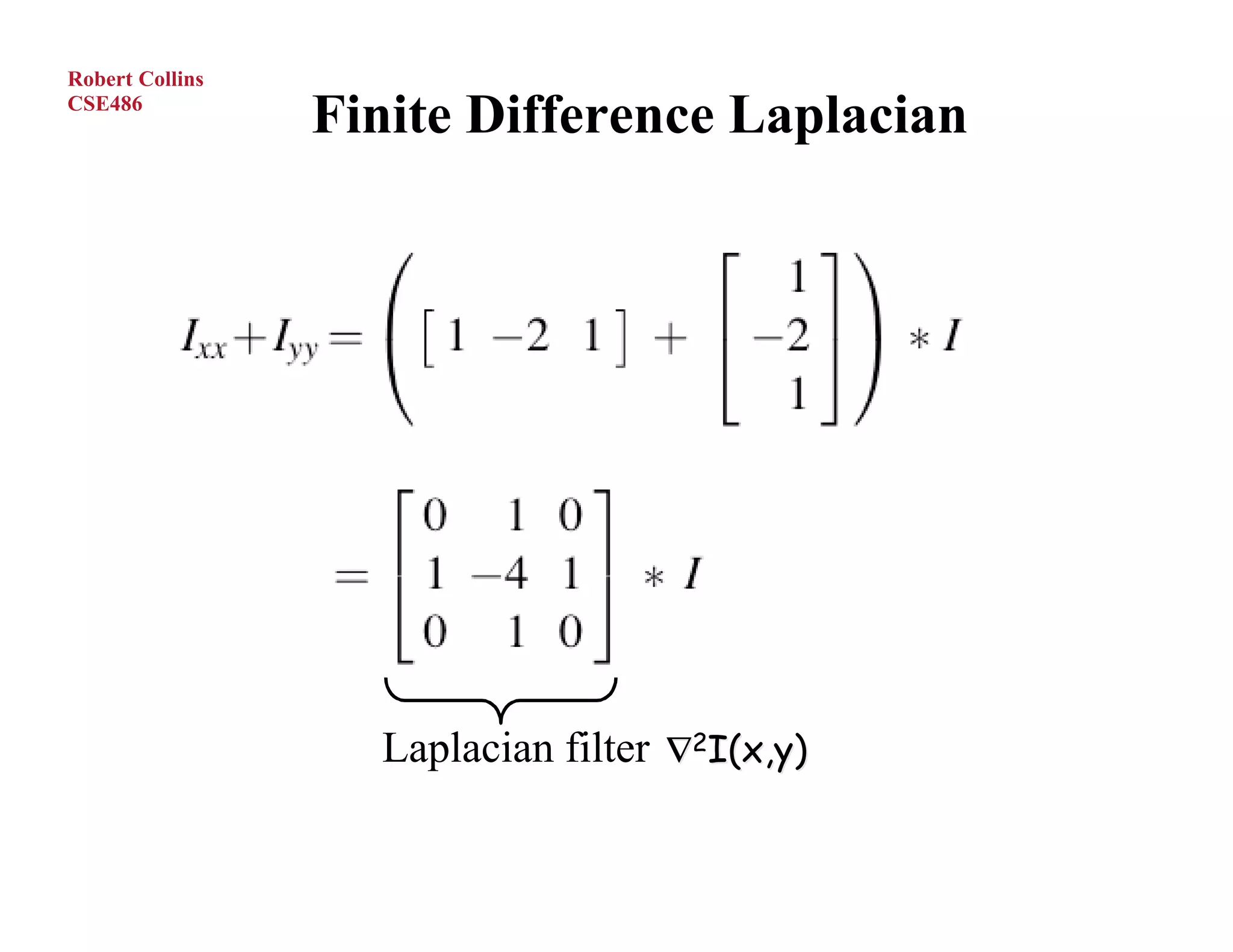
                 Finite Difference Laplacian


                   Laplacian filter ∇2I(x,y)
Robert Collins
CSE486
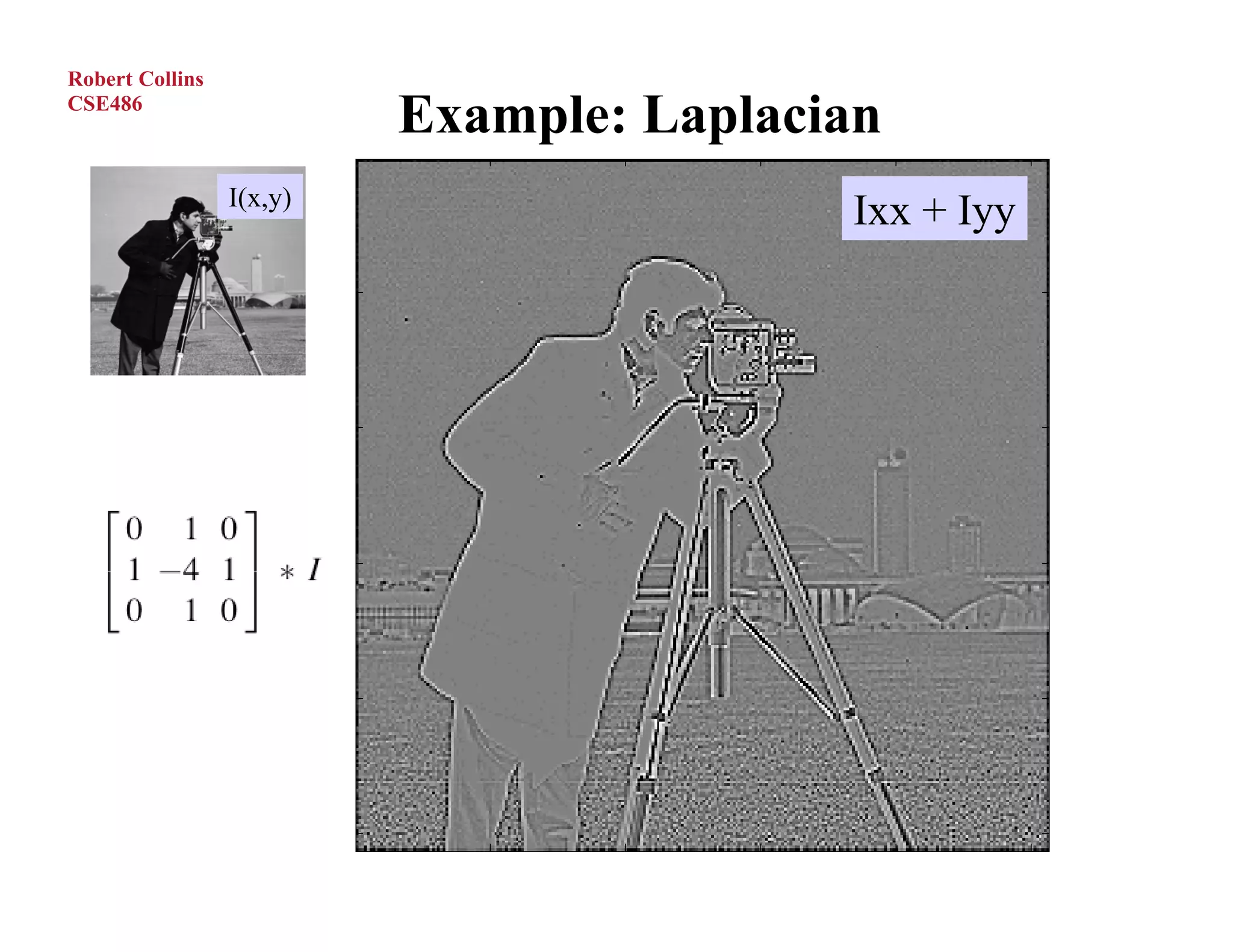
                          Example: Laplacian
                 I(x,y)
                                          Ixx + Iyy
Robert Collins
CSE486
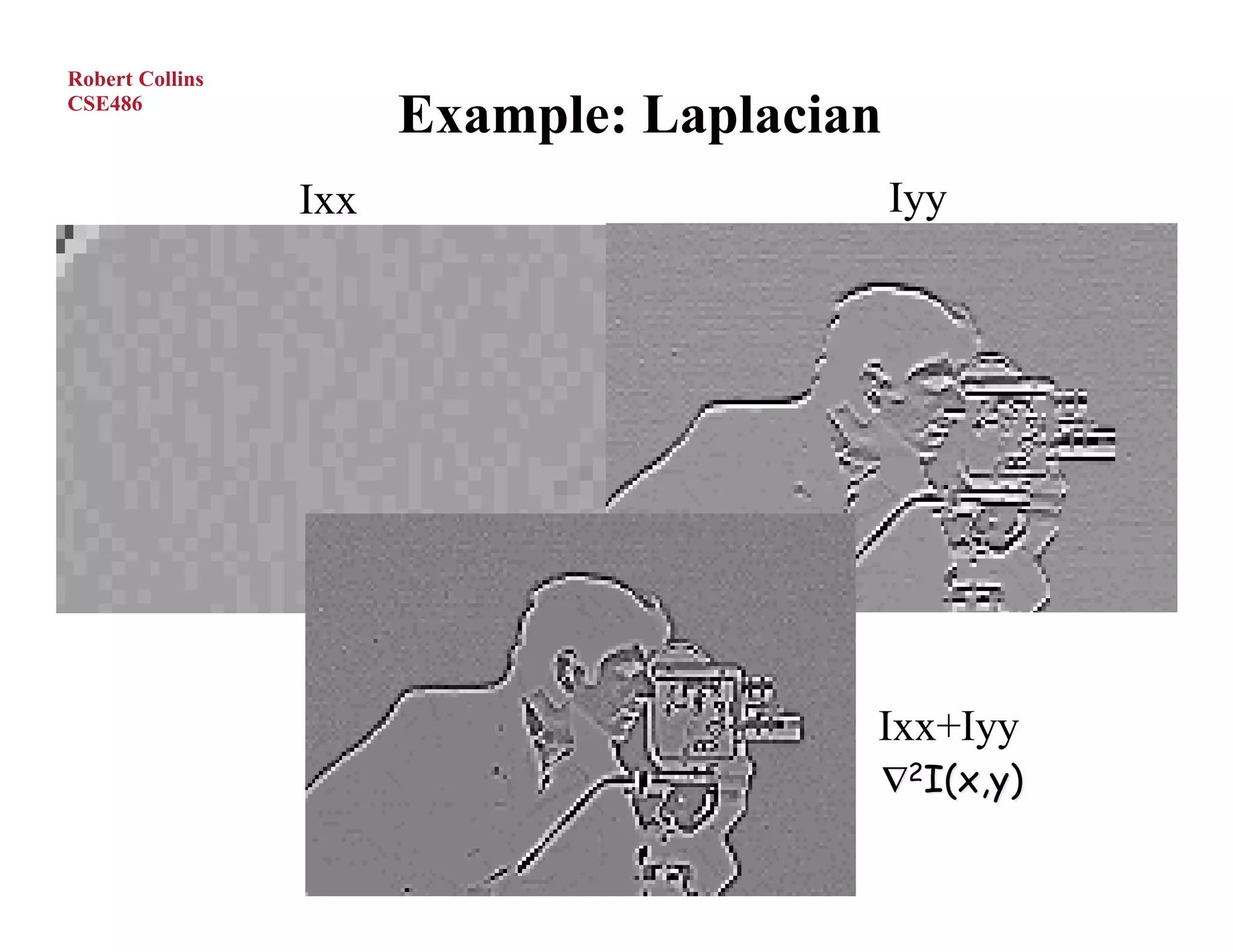
                       Example: Laplacian
                 Ixx                        Iyy


                                        Ixx+Iyy
                                        ∇2I(x,y)
Robert Collins
CSE486
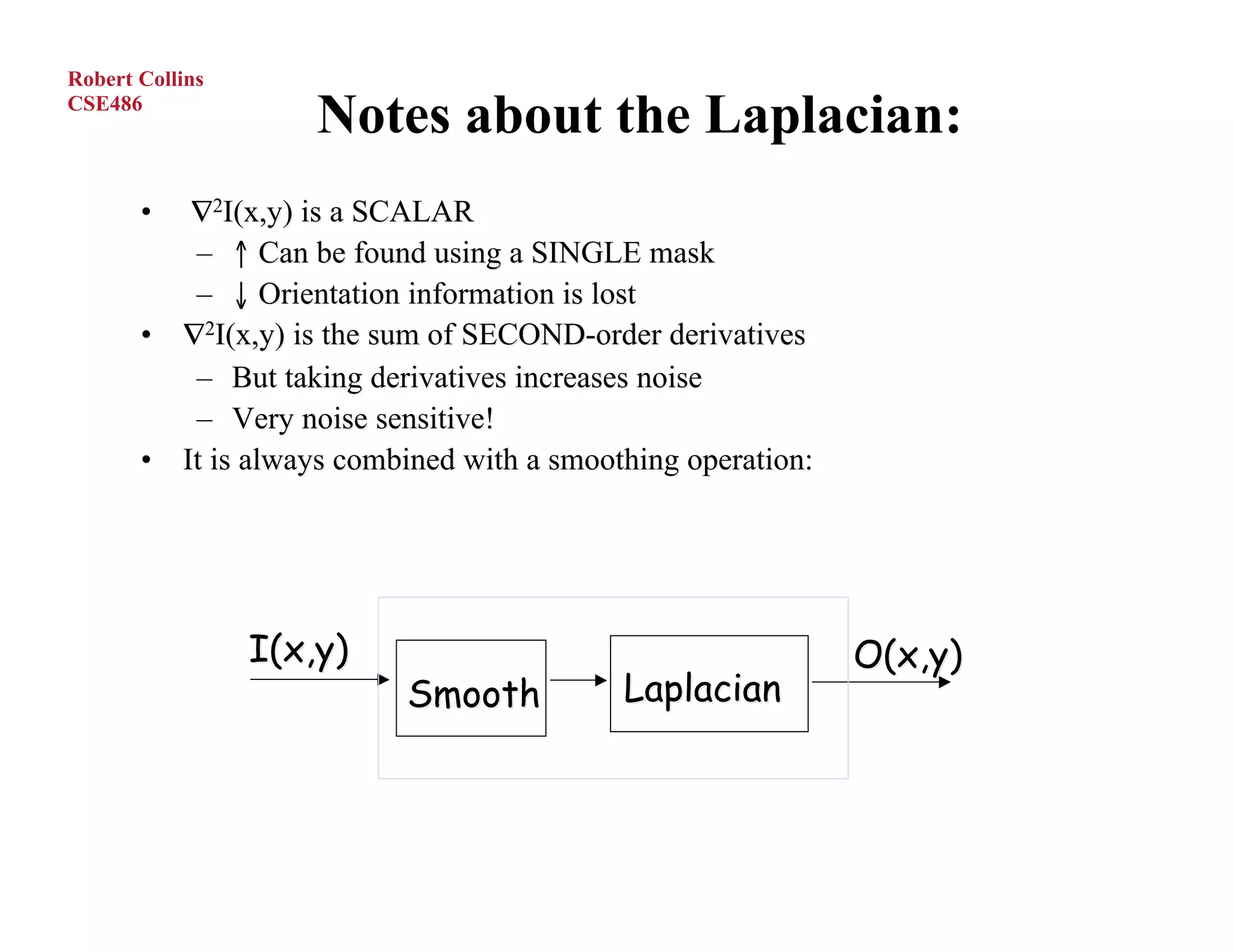
                     Notes about the Laplacian:
       •  ∇2I(x,y) is a SCALAR
          – ↑ Can be found using a SINGLE mask
          – ↓ Orientation information is lost
       • ∇2I(x,y) is the sum of SECOND-order derivatives
          – But taking derivatives increases noise
          – Very noise sensitive!
       • It is always combined with a smoothing operation:


                 I(x,y)                                      O(x,y)
                           Smooth          Laplacian


O.Camps, PSU
Robert Collins
CSE486
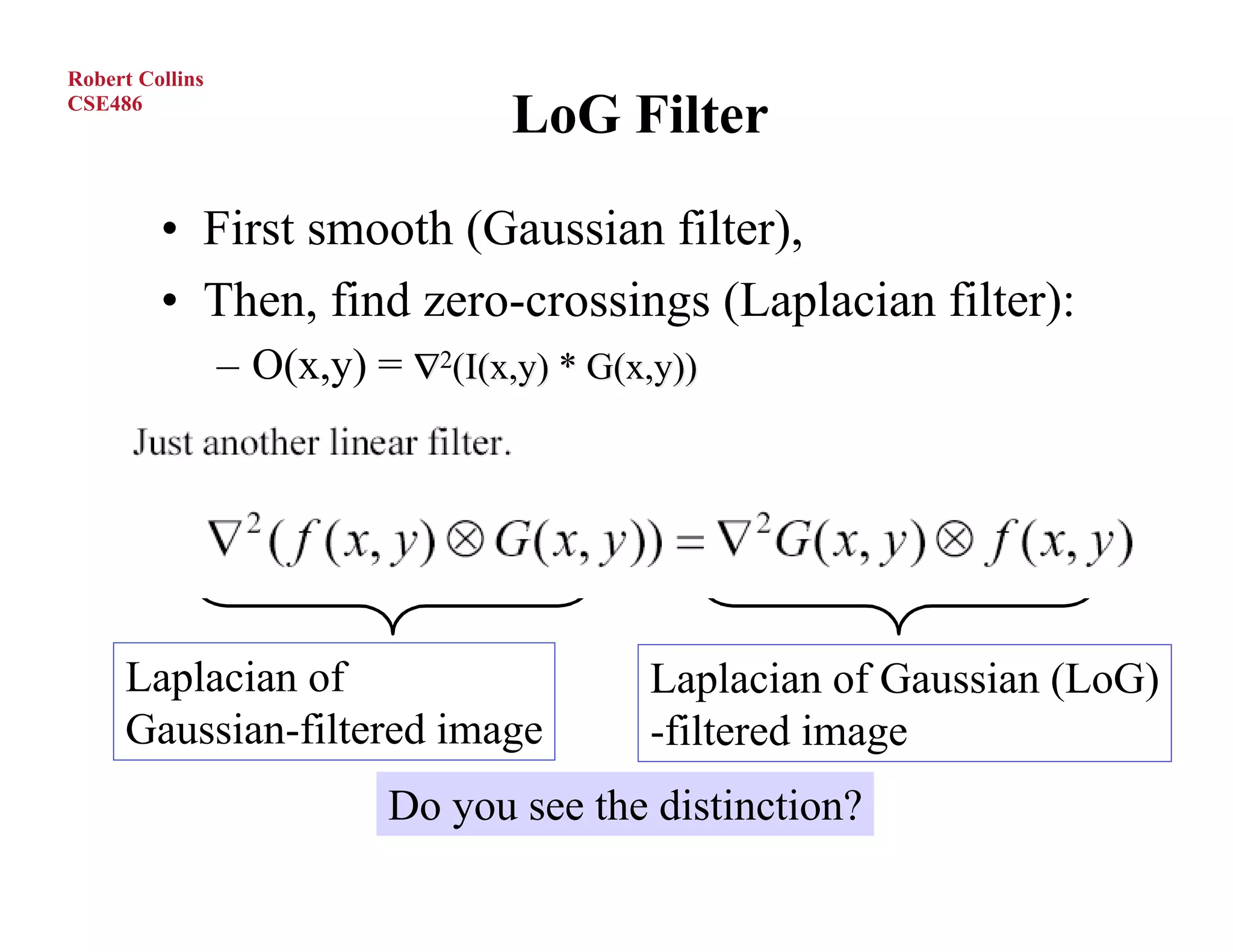
                                   LoG Filter
         • First smooth (Gaussian filter),
         • Then, find zero-crossings (Laplacian filter):
                 – O(x,y) = ∇2(I(x,y) * G(x,y))


     Laplacian of                          Laplacian of Gaussian (LoG)
     Gaussian-filtered image               -filtered image
                           Do you see the distinction?
O.Camps, PSU
Robert Collins
CSE486
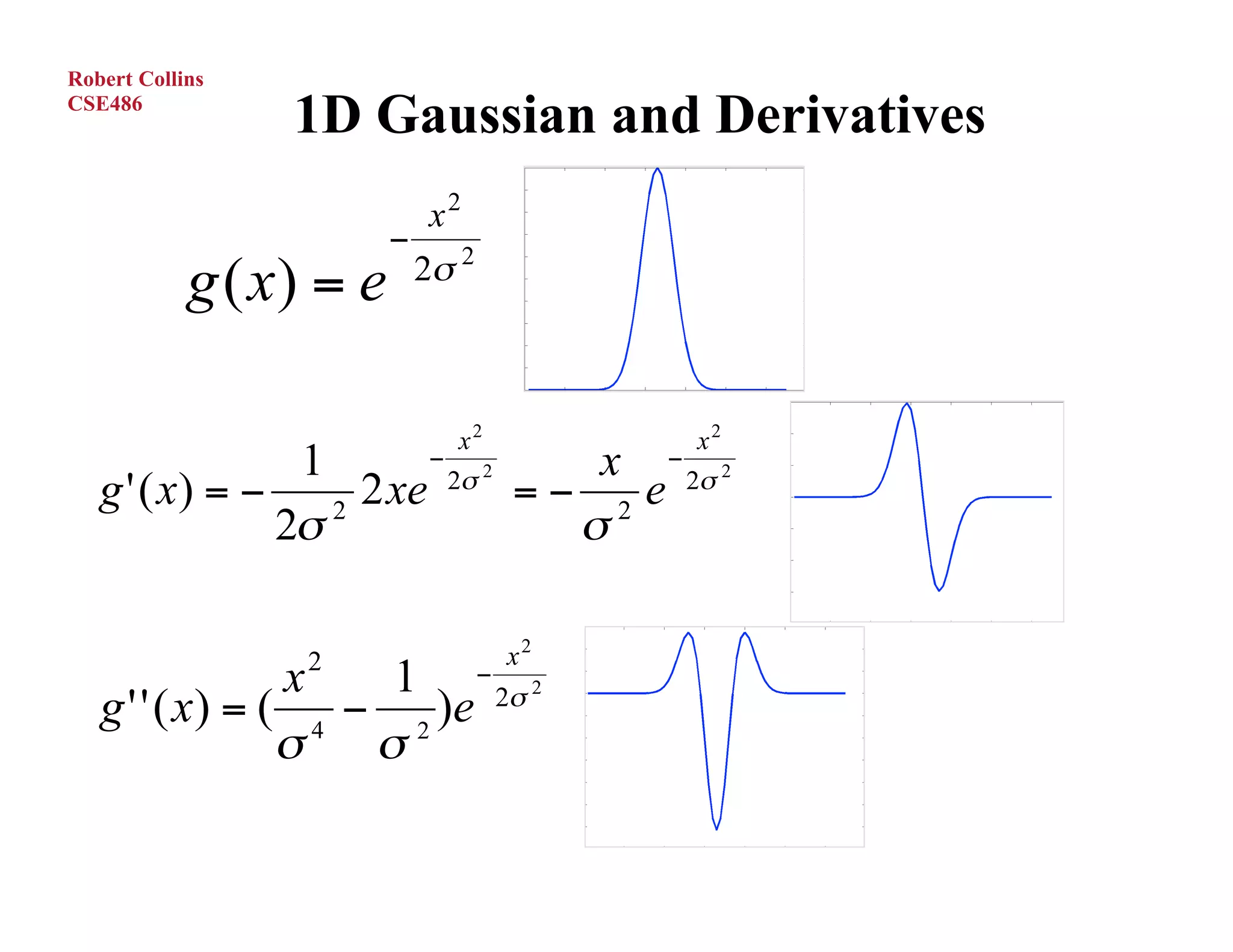
                 1D Gaussian and Derivatives
                              x2
                         −
                             2σ 2
            g ( x) = e

                                x2              x2
                1             − 2       x     − 2
   g ' ( x) = − 2 2 xe         2σ
                                     =− 2 e    2σ
               2σ                      σ

                  2                  x2
                  x    1 − 2σ 2
   g ' ' ( x ) = ( 4 − 2 )e
                  σ3 σ

O.Camps, PSU
Robert Collins
CSE486
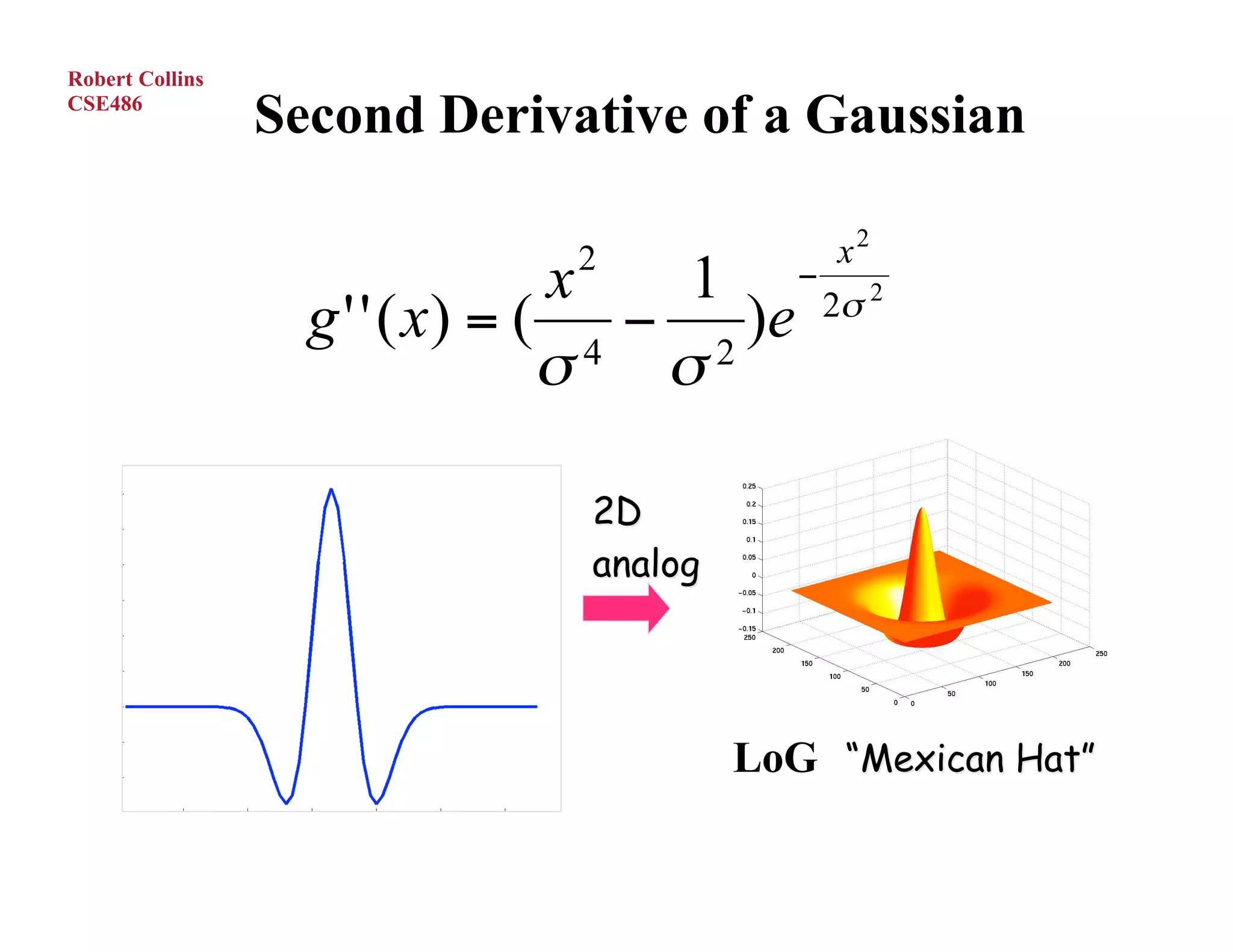
                 Second Derivative of a Gaussian

                                2               x2
                                  x    1      − 2
                   g ' ' ( x ) = ( 4 − 2 )e
                                    3
                                               2σ
                                  σ   σ

                                 2D
                                 analog


                                          LoG “Mexican Hat”

O.Camps, PSU
Robert Collins
CSE486
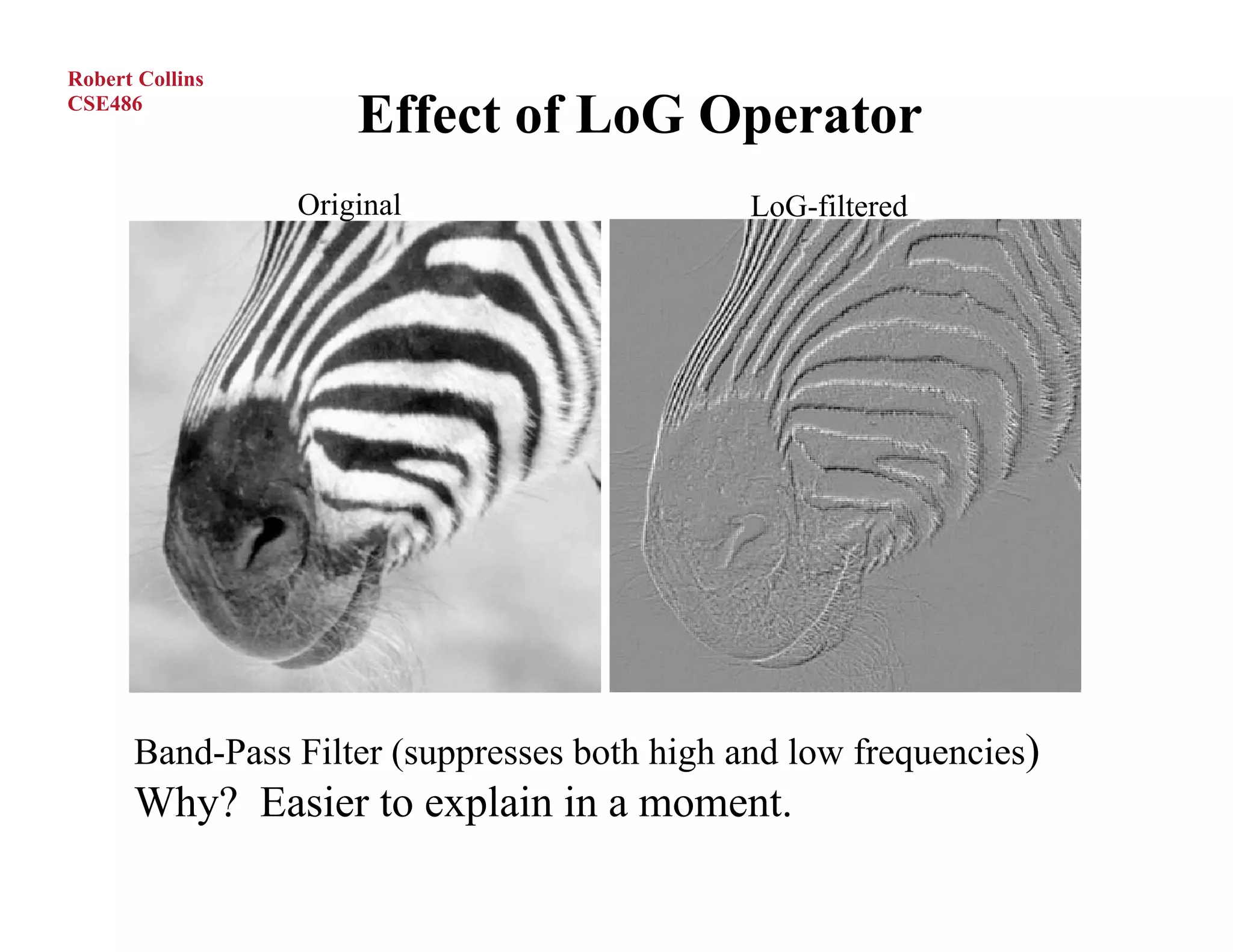
                     Effect of LoG Operator
                 Original                     LoG-filtered


      Band-Pass Filter (suppresses both high and low frequencies)
      Why? Easier to explain in a moment.
Robert Collins
CSE486
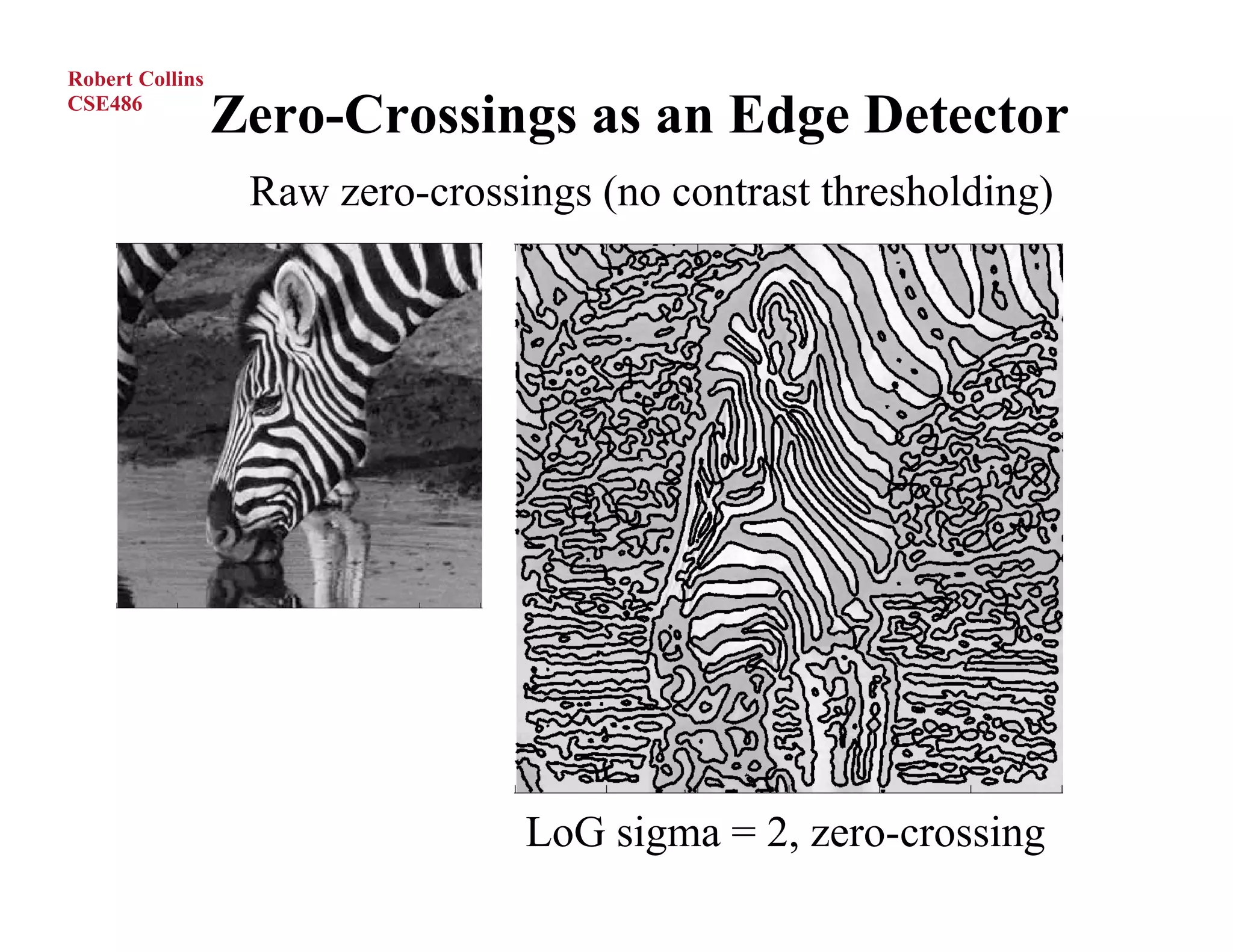
                 Zero-Crossings as an Edge Detector
                  Raw zero-crossings (no contrast thresholding)


                                 LoG sigma = 2, zero-crossing
Robert Collins
CSE486
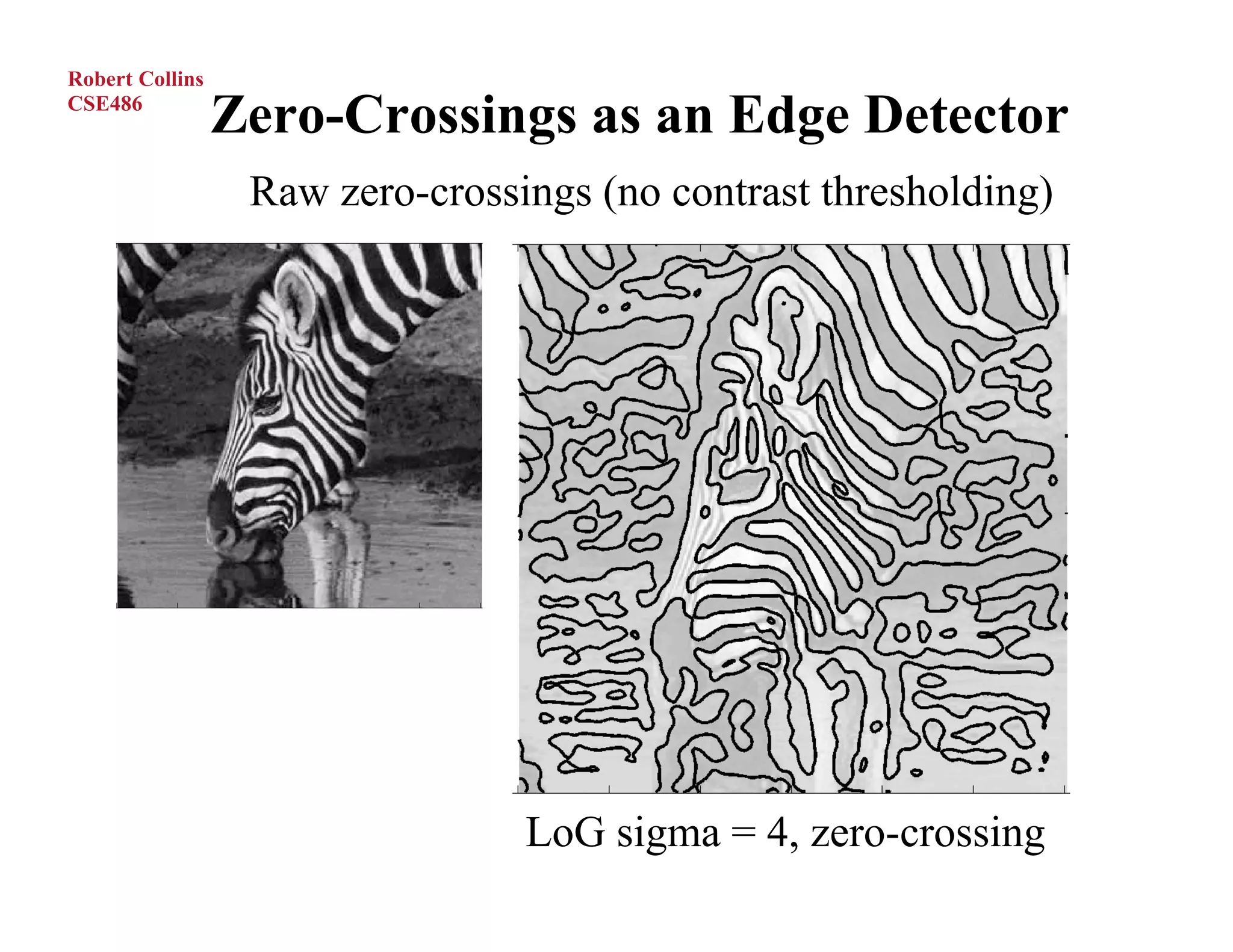
                 Zero-Crossings as an Edge Detector
                  Raw zero-crossings (no contrast thresholding)


                                 LoG sigma = 4, zero-crossing
Robert Collins
CSE486
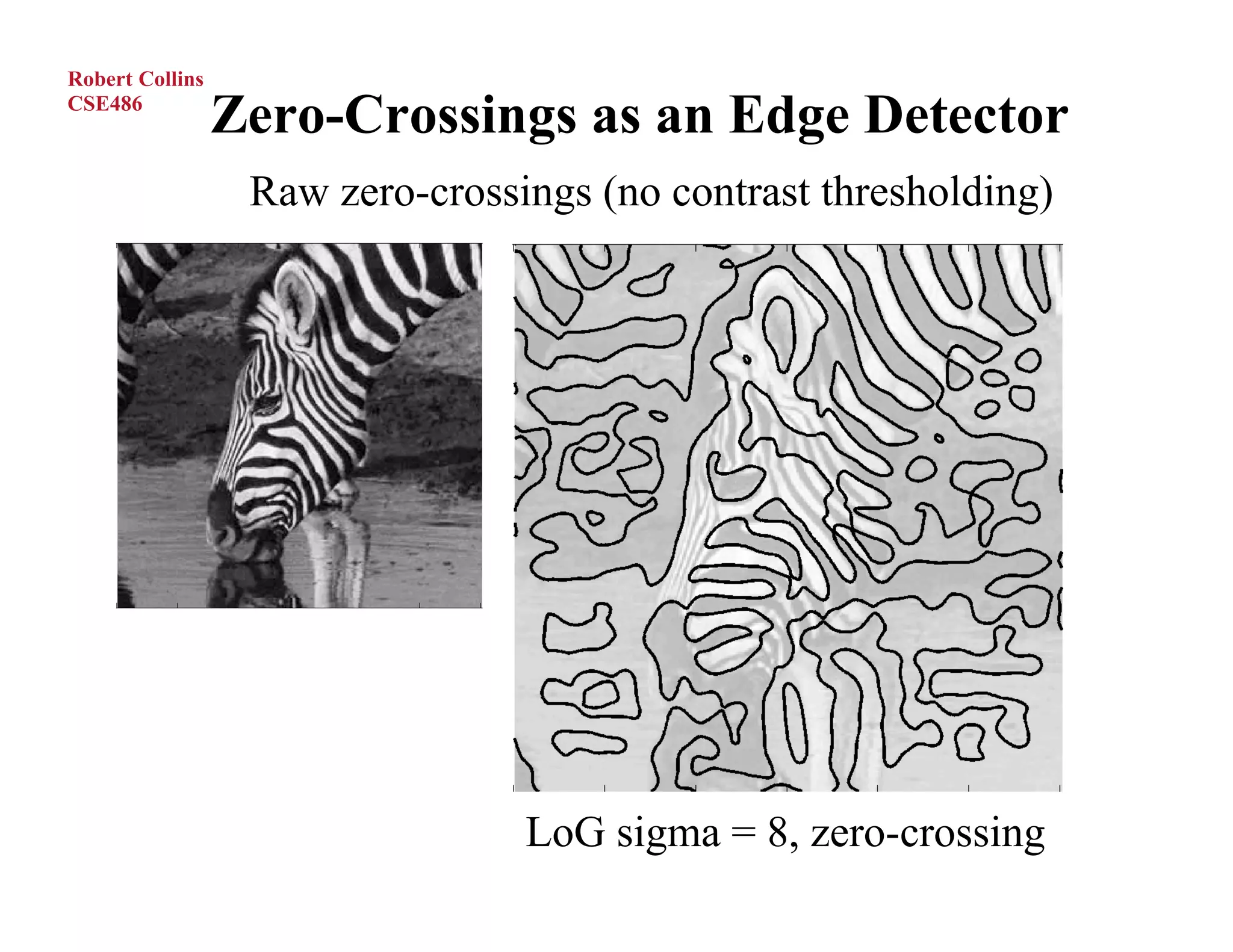
                 Zero-Crossings as an Edge Detector
                  Raw zero-crossings (no contrast thresholding)


                                 LoG sigma = 8, zero-crossing
Robert Collins
CSE486
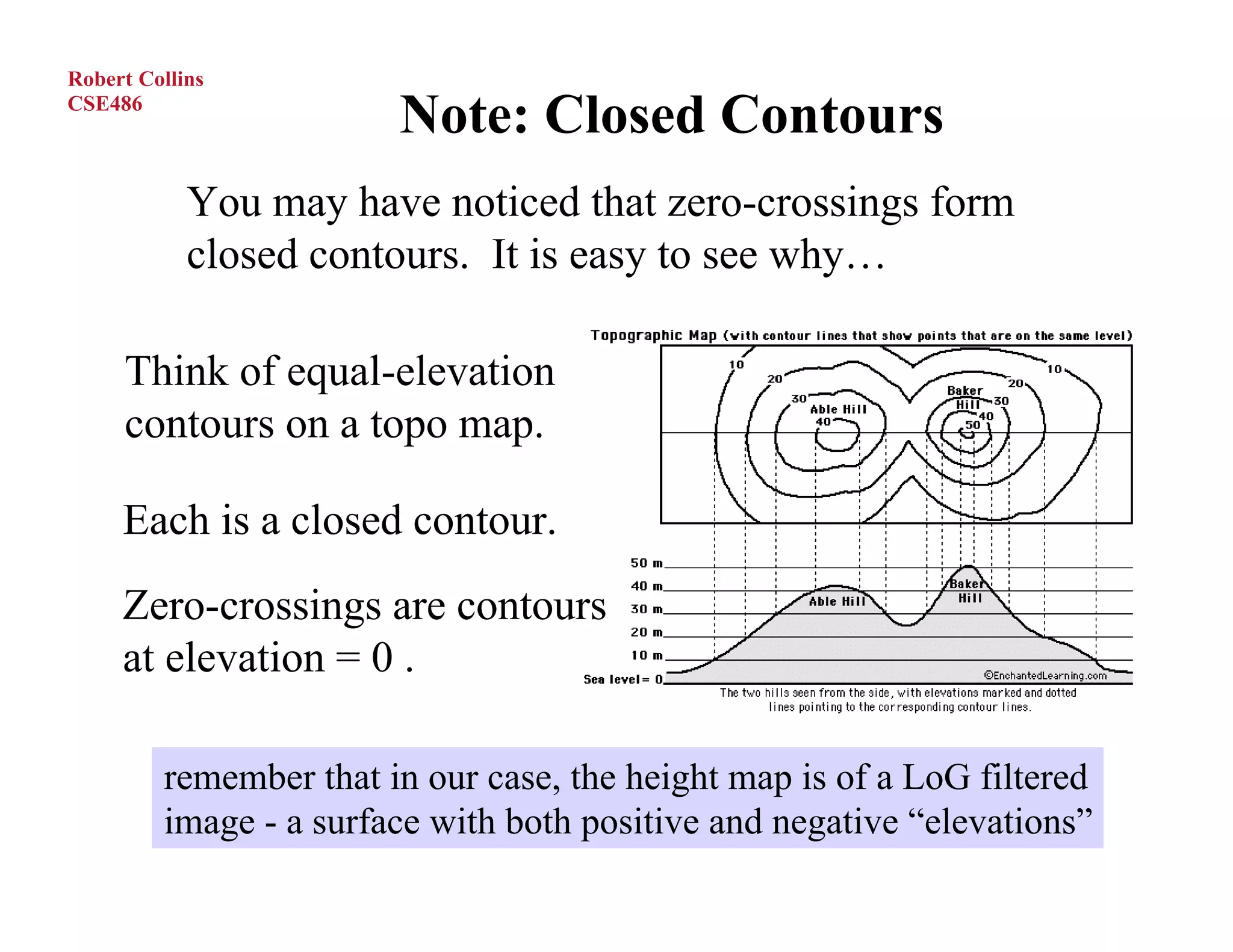
                        Note: Closed Contours
            You may have noticed that zero-crossings form
            closed contours. It is easy to see why…

     Think of equal-elevation
     contours on a topo map.

     Each is a closed contour.
     Zero-crossings are contours
     at elevation = 0 .

         remember that in our case, the height map is of a LoG filtered
         image - a surface with both positive and negative “elevations”
Robert Collins
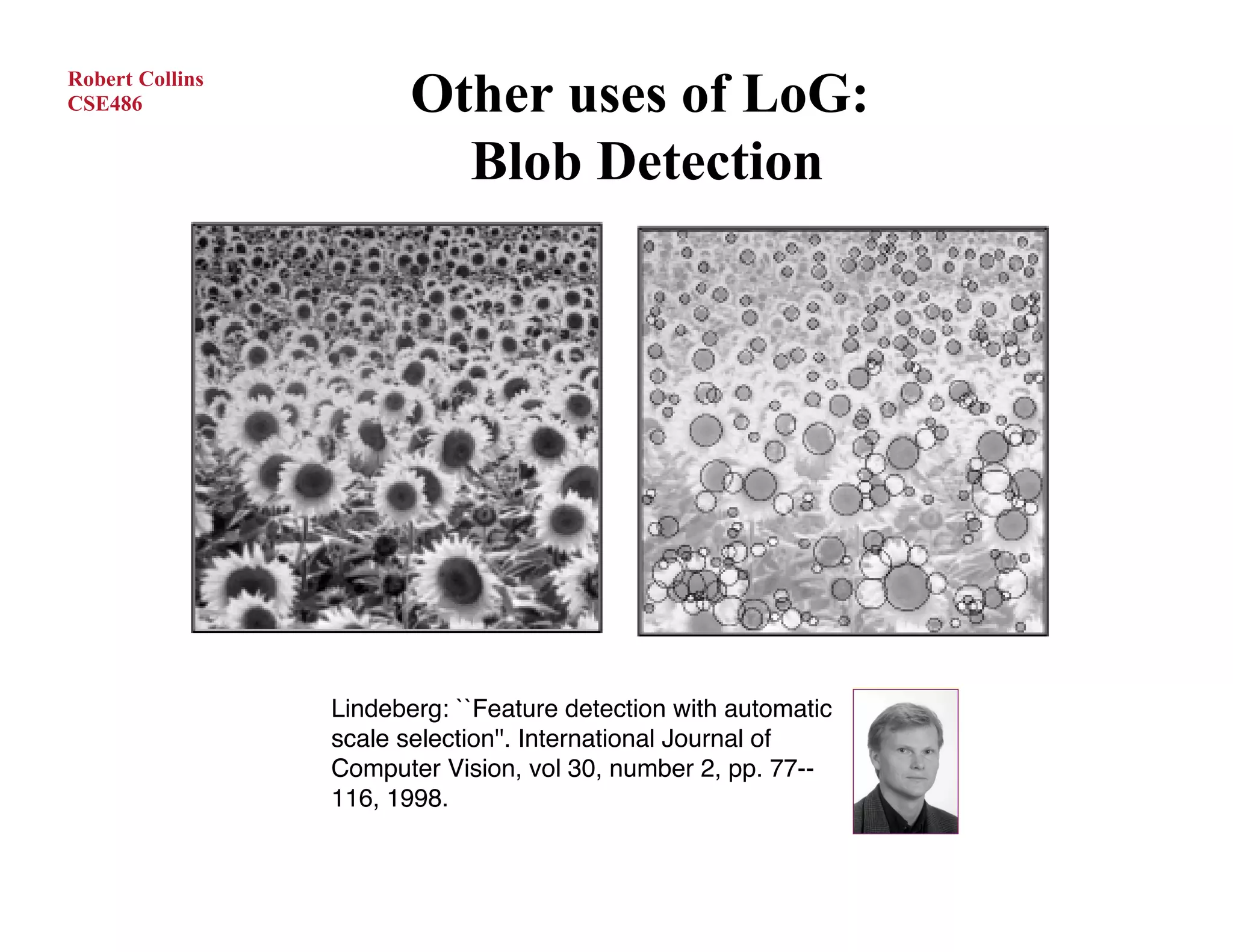
CSE486                  Other uses of LoG:
                          Blob Detection


                 Lindeberg: ``Feature detection with automatic
                 scale selection''. International Journal of
                 Computer Vision, vol 30, number 2, pp. 77--
                 116, 1998.
Robert Collins
CSE486
                 Pause to Think for a Moment:


                 How can an edge finder also be used to
                 find blobs in an image?
Robert Collins
CSE486
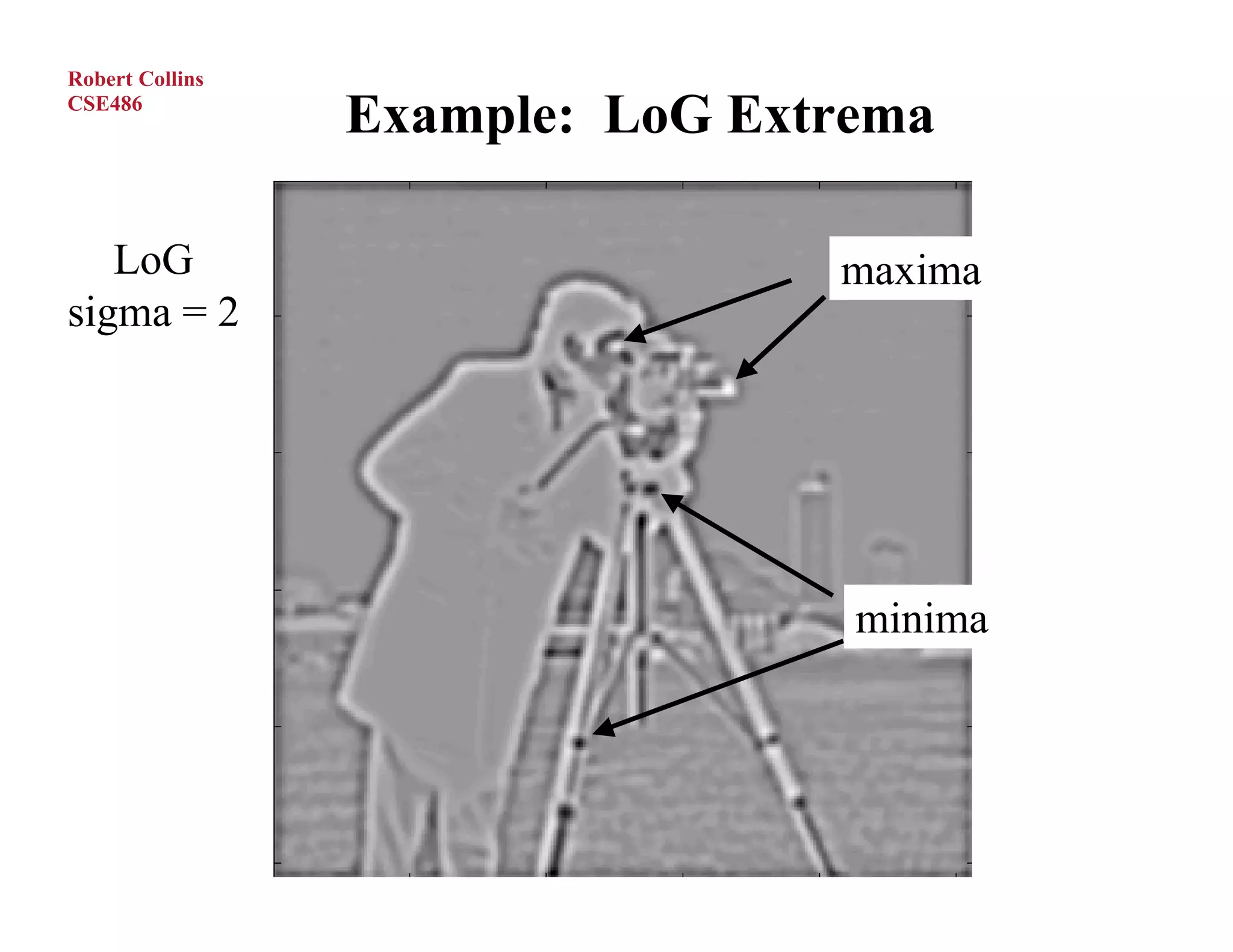
                 Example: LoG Extrema

   LoG                           maxima
sigma = 2


                                  minima
Robert Collins
CSE486
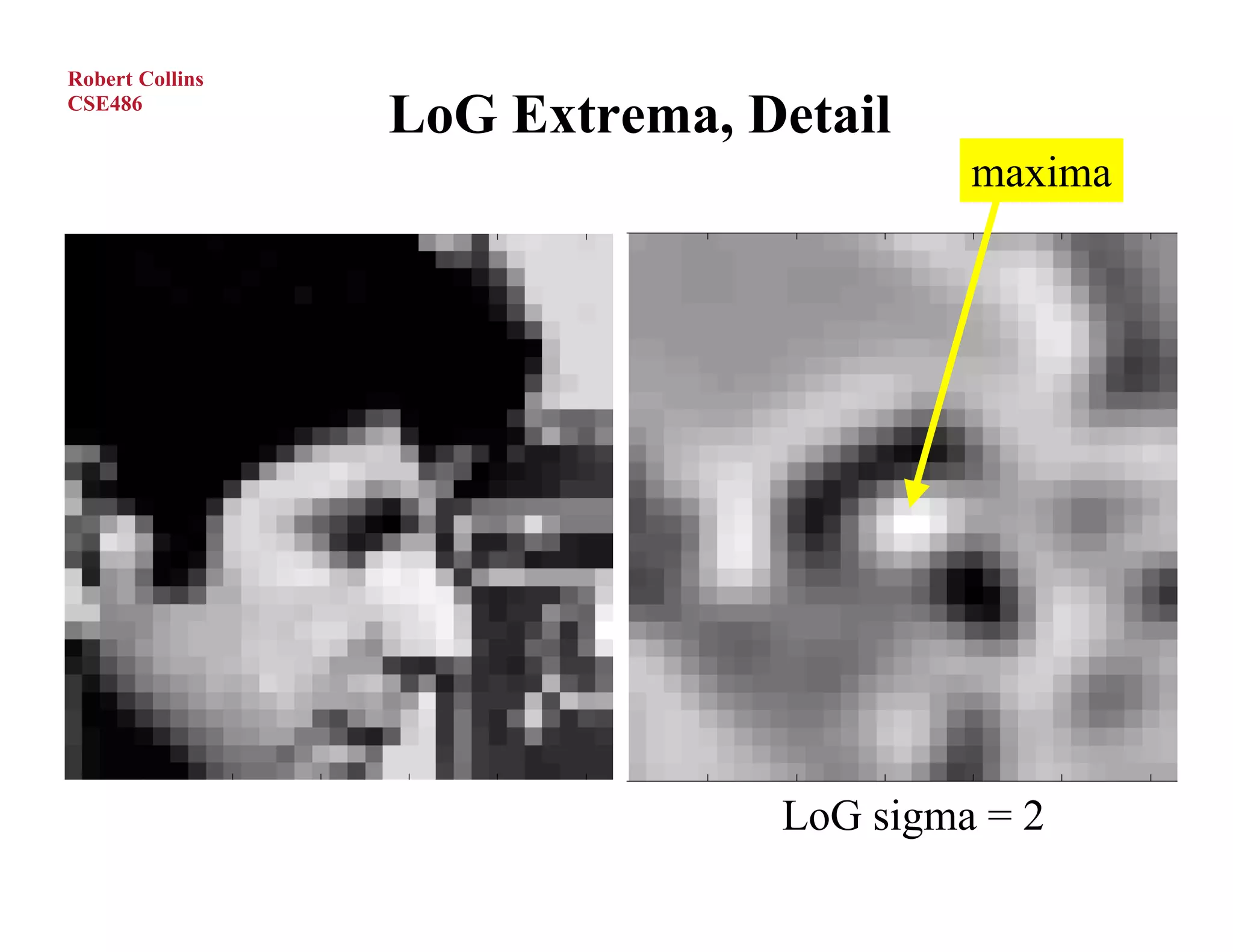
                 LoG Extrema, Detail
                                        maxima


                               LoG sigma = 2
Robert Collins
CSE486
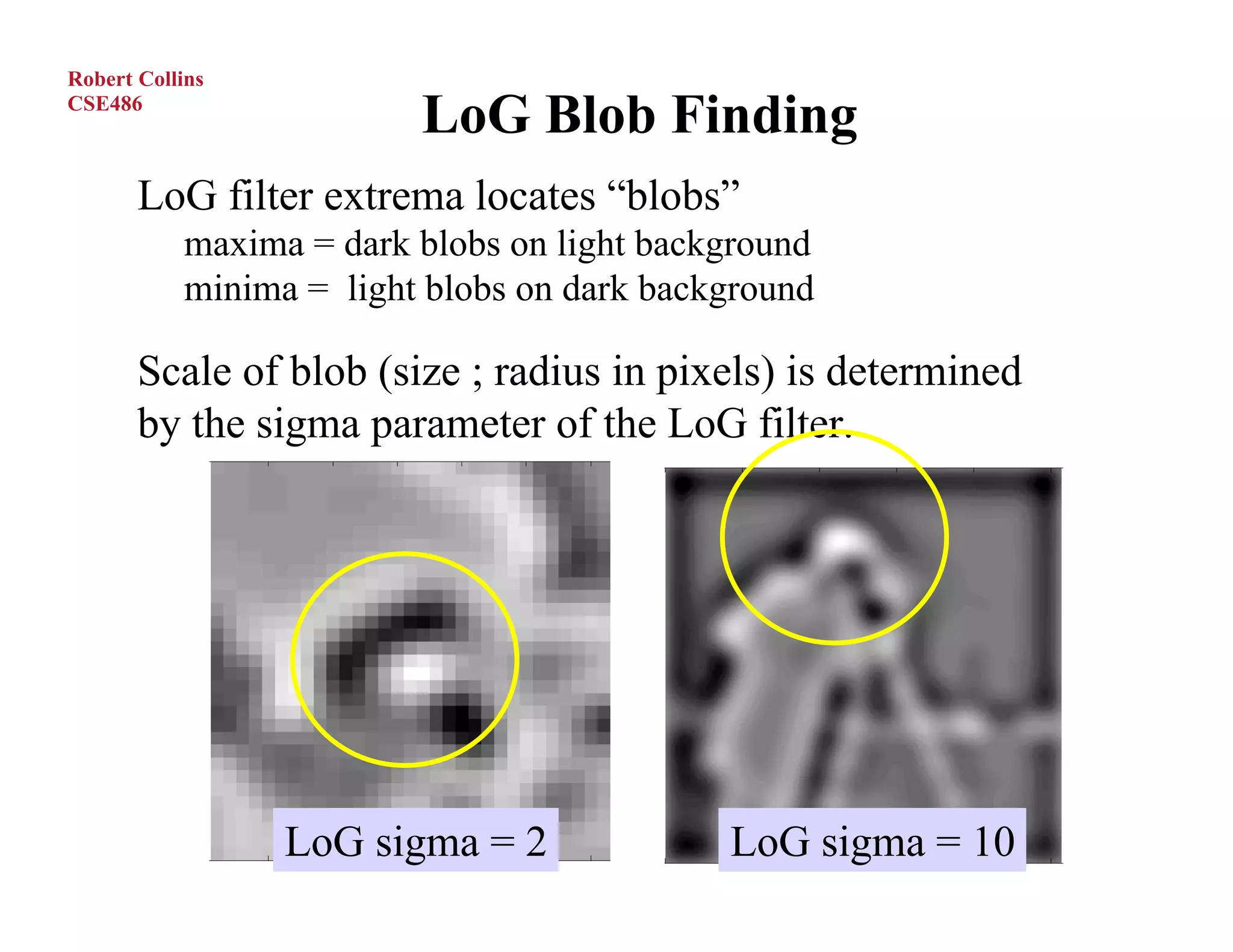
                         LoG Blob Finding
       LoG filter extrema locates “blobs”
           maxima = dark blobs on light background
           minima = light blobs on dark background

       Scale of blob (size ; radius in pixels) is determined
       by the sigma parameter of the LoG filter.


                 LoG sigma = 2              LoG sigma = 10
Robert Collins
CSE486
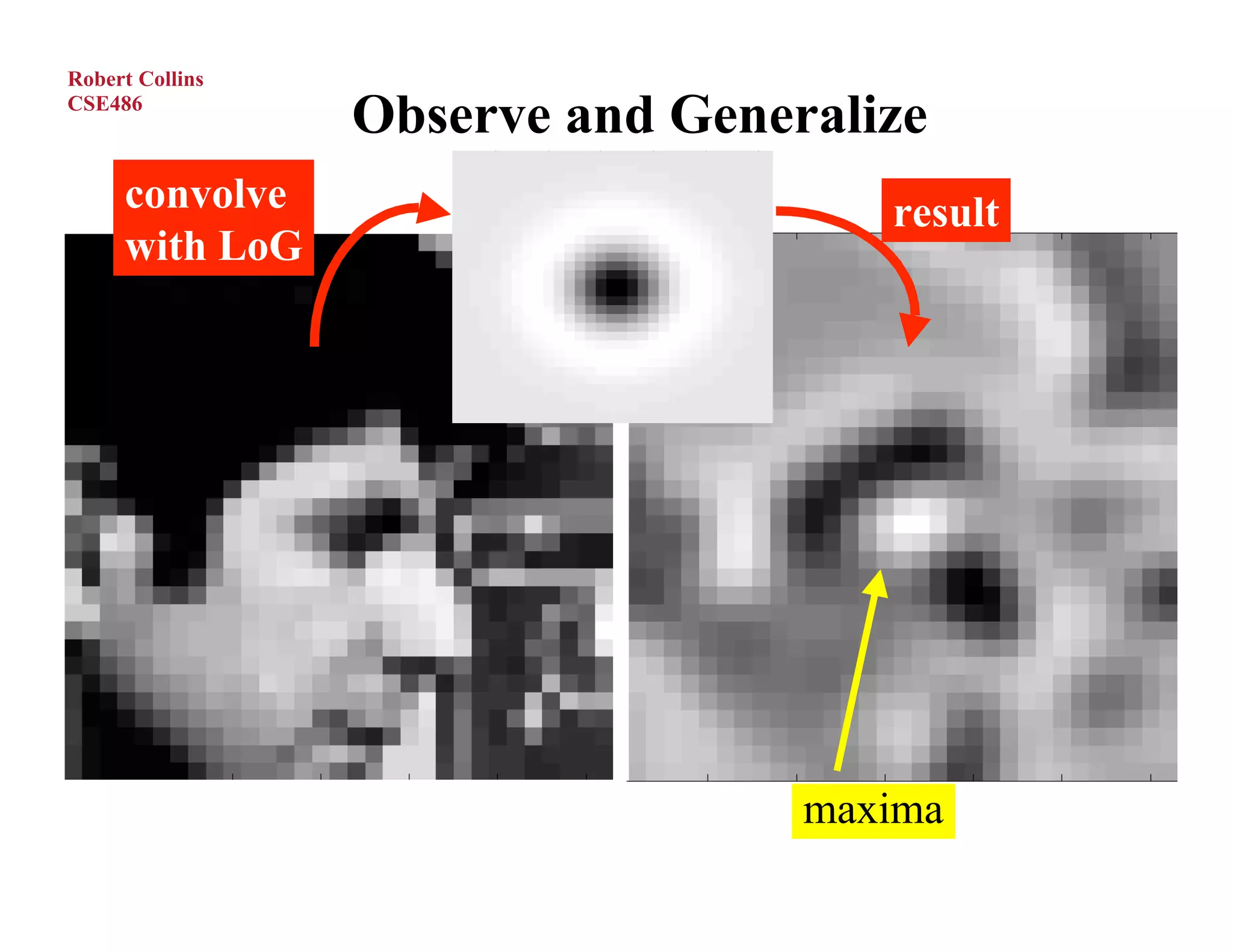
                 Observe and Generalize
     convolve                        result
     with LoG


                                  maxima
Robert Collins
CSE486
                 Observe and Generalize

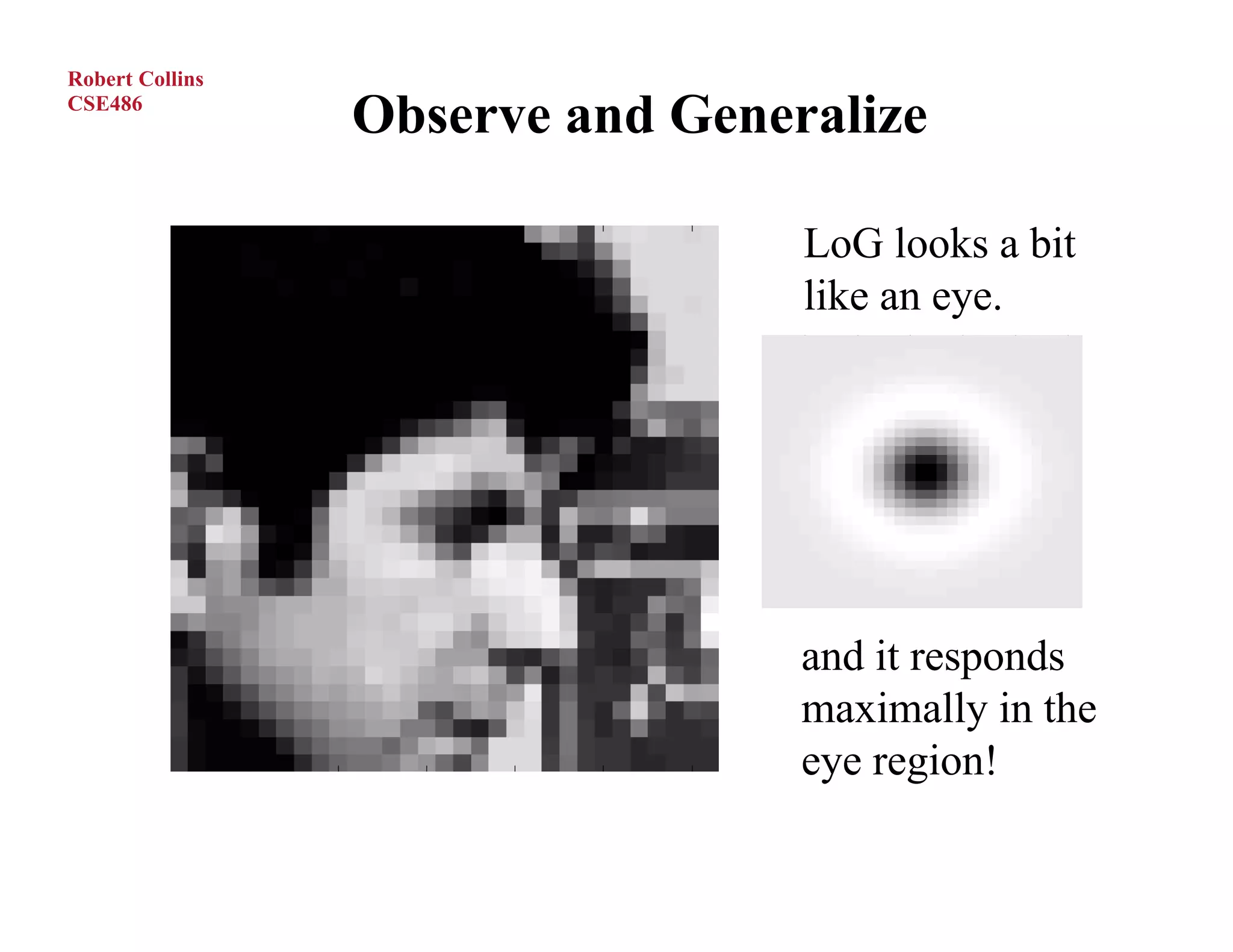
                                  LoG looks a bit
                                  like an eye.


                                  and it responds
                                  maximally in the
                                  eye region!
Robert Collins
CSE486
                       Observe and Generalize
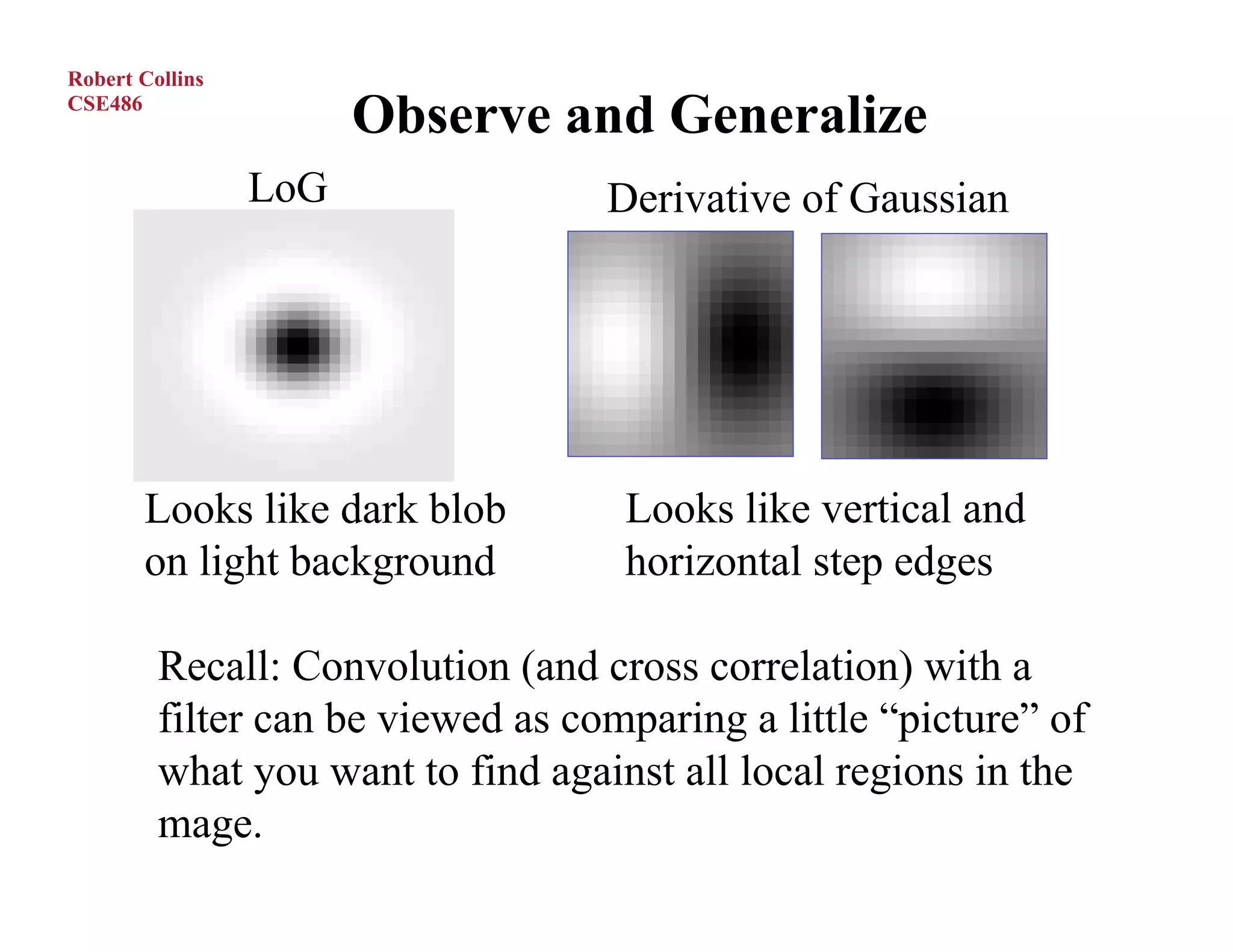
                 LoG               Derivative of Gaussian


       Looks like dark blob         Looks like vertical and
       on light background          horizontal step edges

         Recall: Convolution (and cross correlation) with a
         filter can be viewed as comparing a little “picture” of
         what you want to find against all local regions in the
         mage.
Robert Collins
CSE486
                        Observe and Generalize
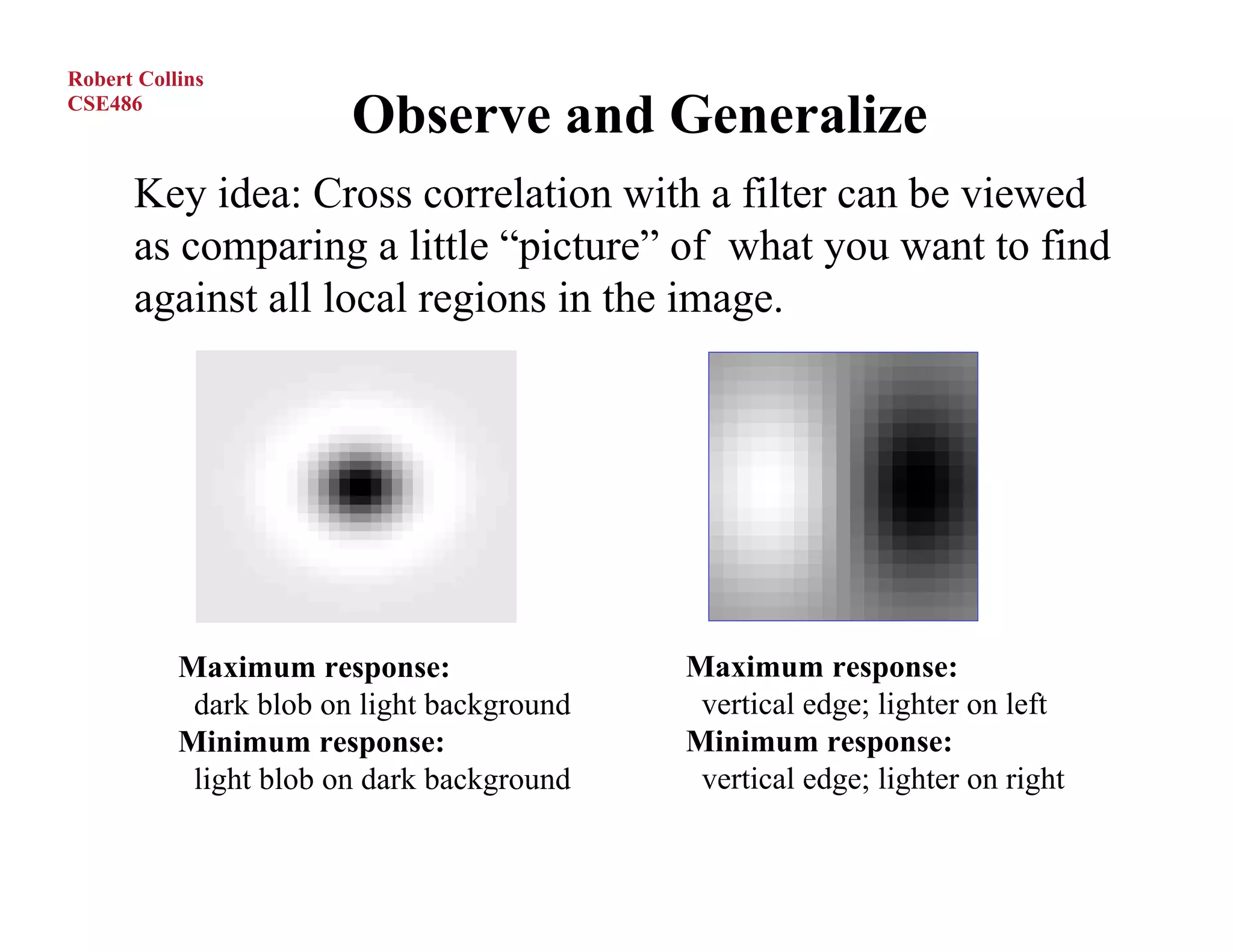
      Key idea: Cross correlation with a filter can be viewed
      as comparing a little “picture” of what you want to find
      against all local regions in the image.


           Maximum response:                Maximum response:
            dark blob on light background    vertical edge; lighter on left
           Minimum response:                Minimum response:
            light blob on dark background    vertical edge; lighter on right
Robert Collins
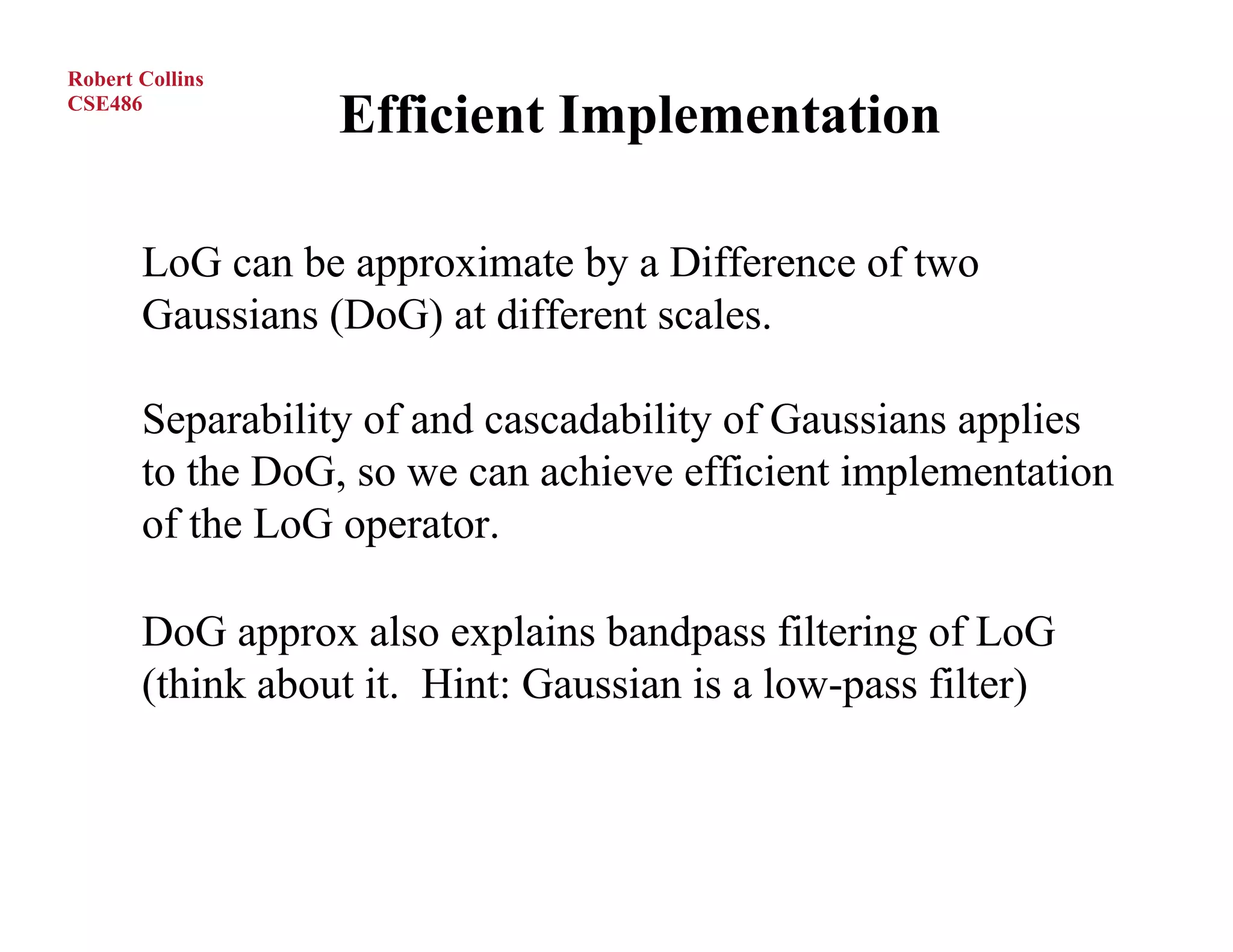
CSE486             Efficient Implementation
                 Approximating LoG with DoG
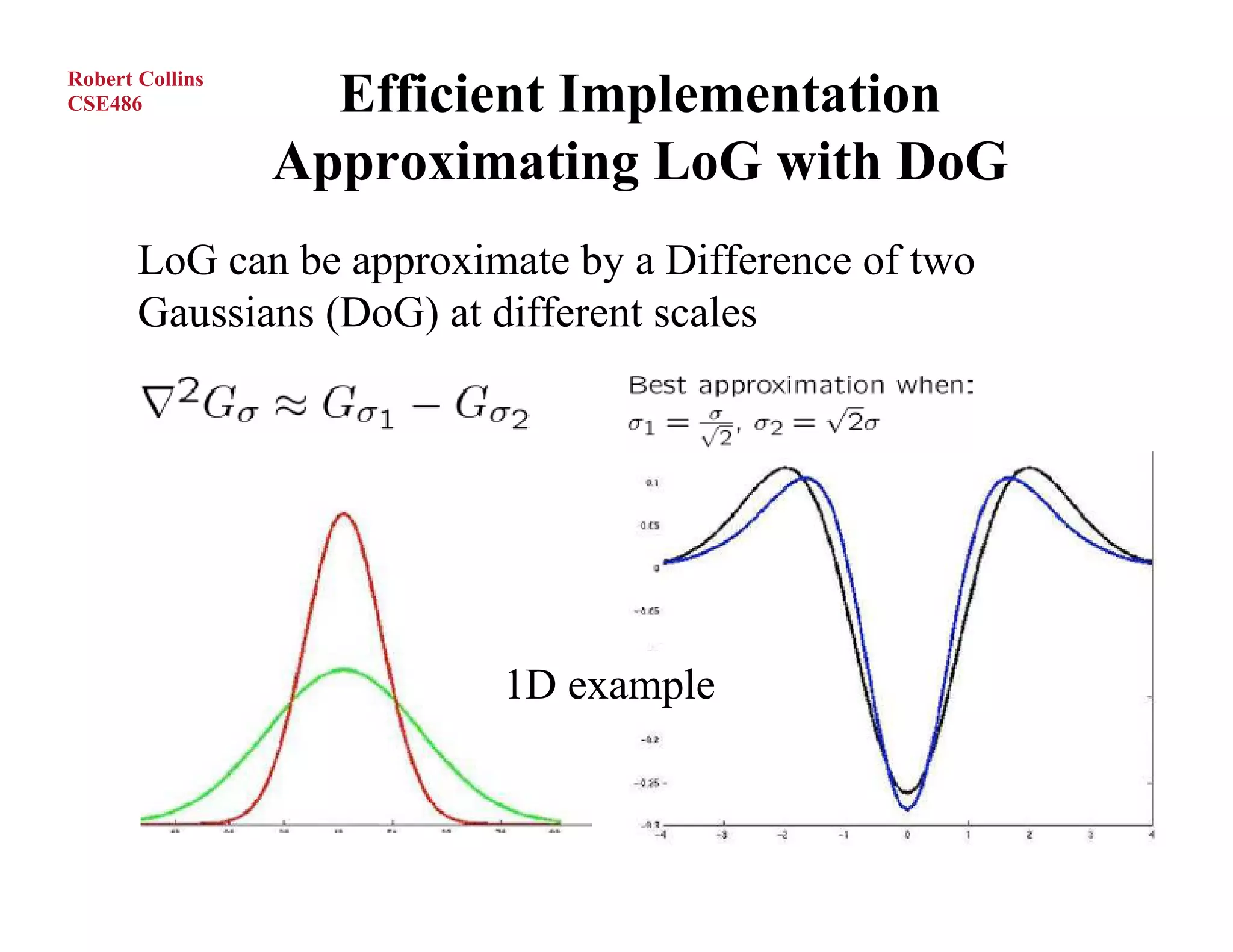
       LoG can be approximate by a Difference of two
       Gaussians (DoG) at different scales


                          1D example


M.Hebert, CMU
Robert Collins
CSE486
                  Efficient Implementation

       LoG can be approximate by a Difference of two
       Gaussians (DoG) at different scales.

       Separability of and cascadability of Gaussians applies
       to the DoG, so we can achieve efficient implementation
       of the LoG operator.

       DoG approx also explains bandpass filtering of LoG
       (think about it. Hint: Gaussian is a low-pass filter)
Robert Collins
CSE486
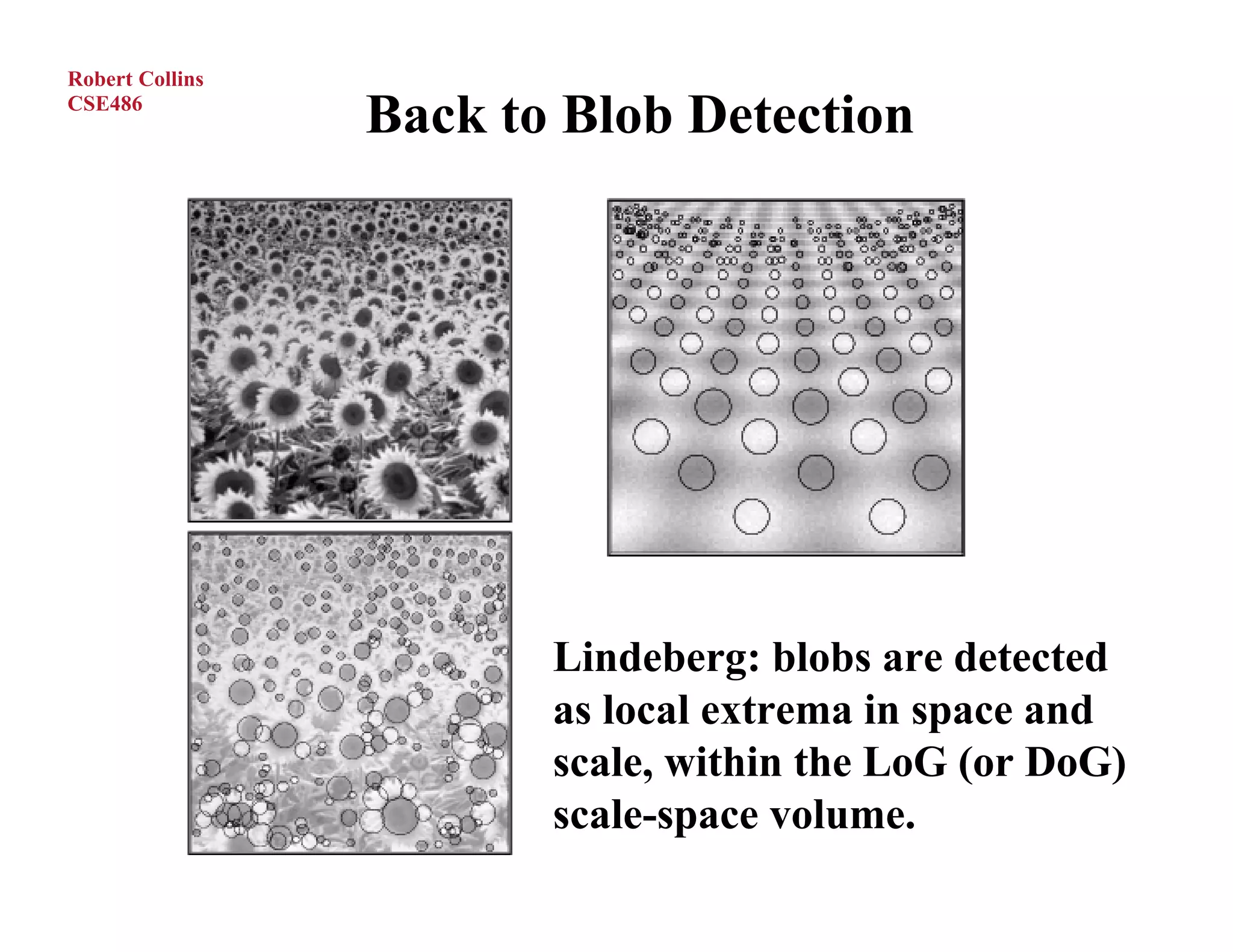
                 Back to Blob Detection


                        Lindeberg: blobs are detected
                        as local extrema in space and
                        scale, within the LoG (or DoG)
                        scale-space volume.
Robert Collins
CSE486
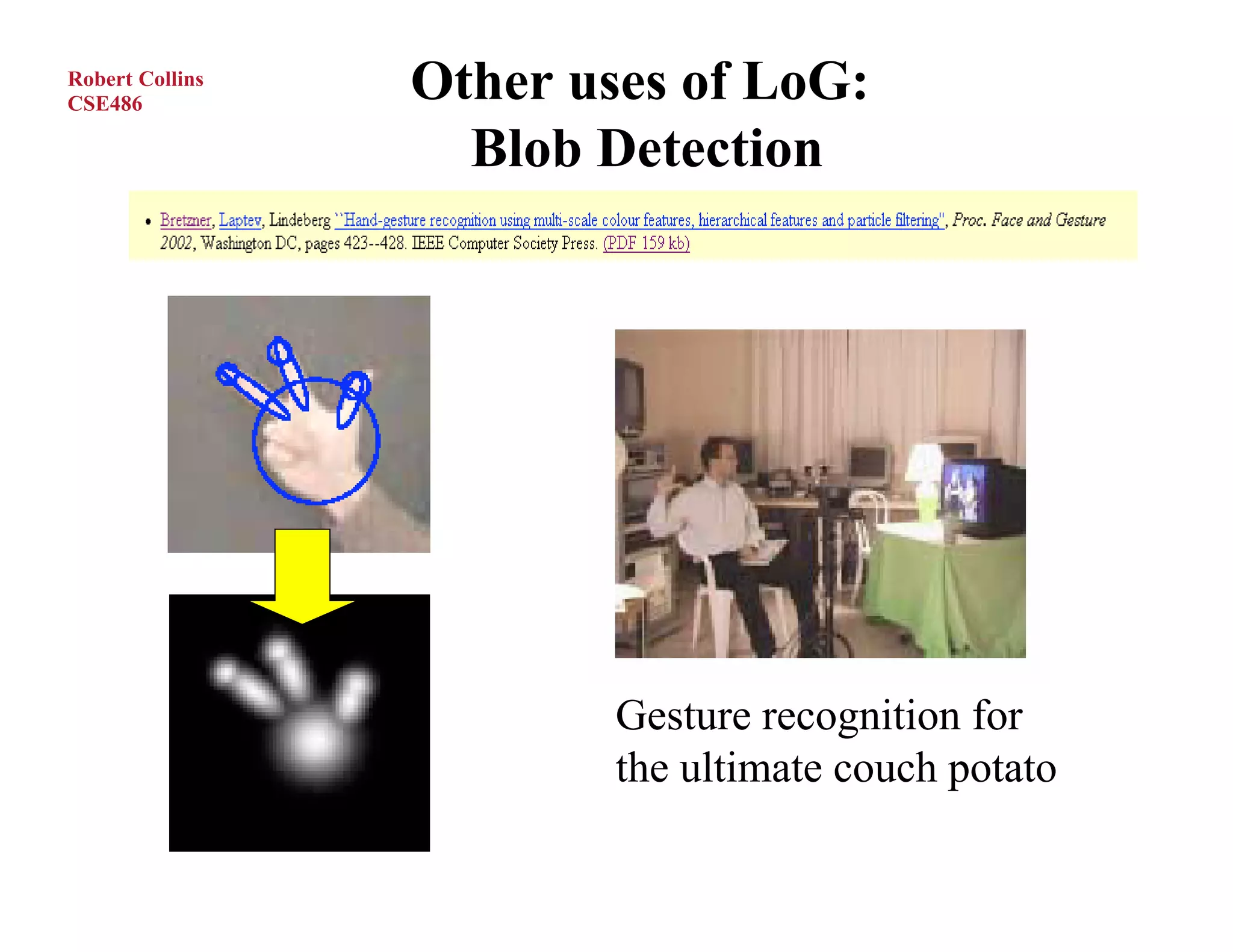
                 Other uses of LoG:
                   Blob Detection


                         Gesture recognition for
                         the ultimate couch potato
Robert Collins
CSE486
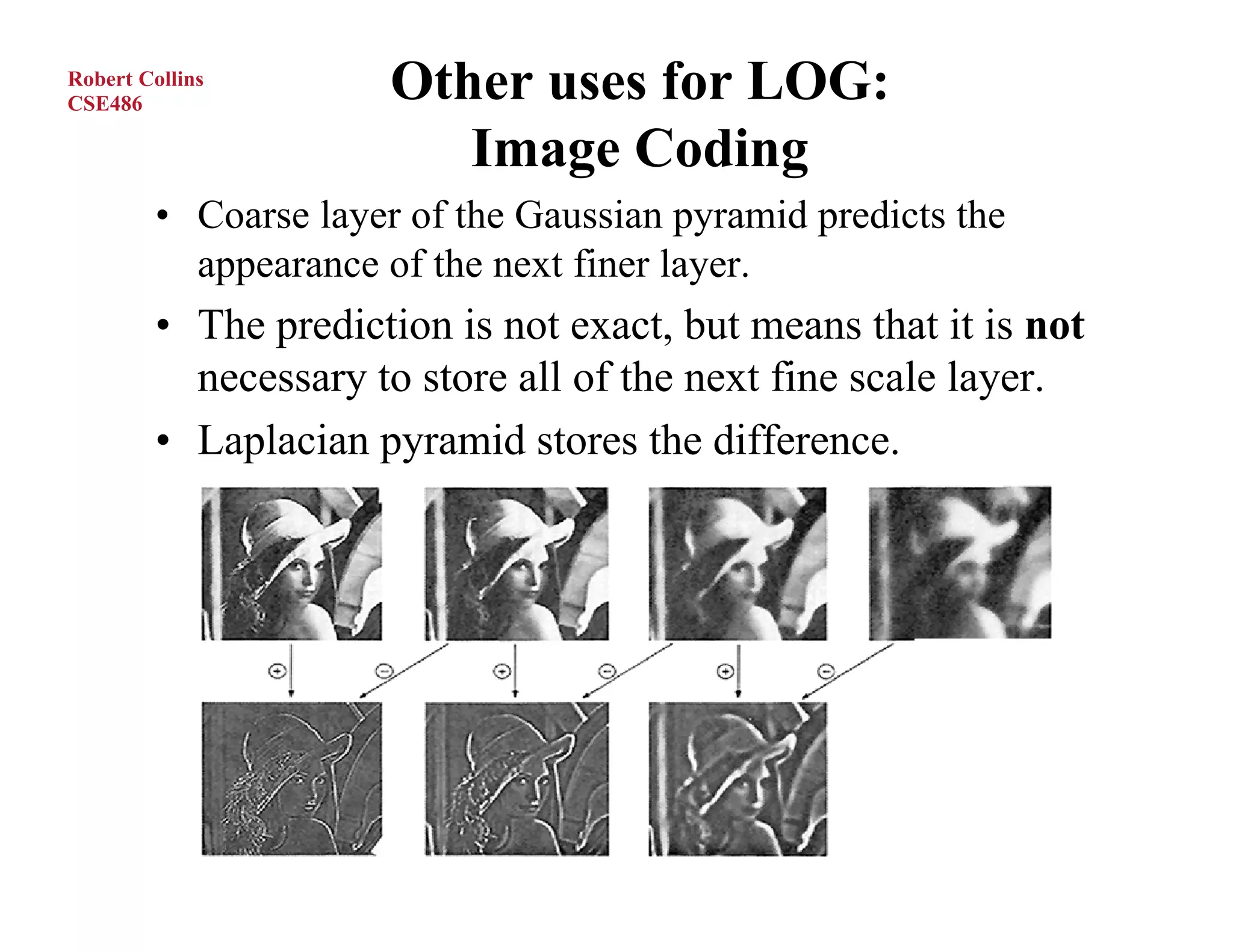
                       Other uses for LOG:
                          Image Coding
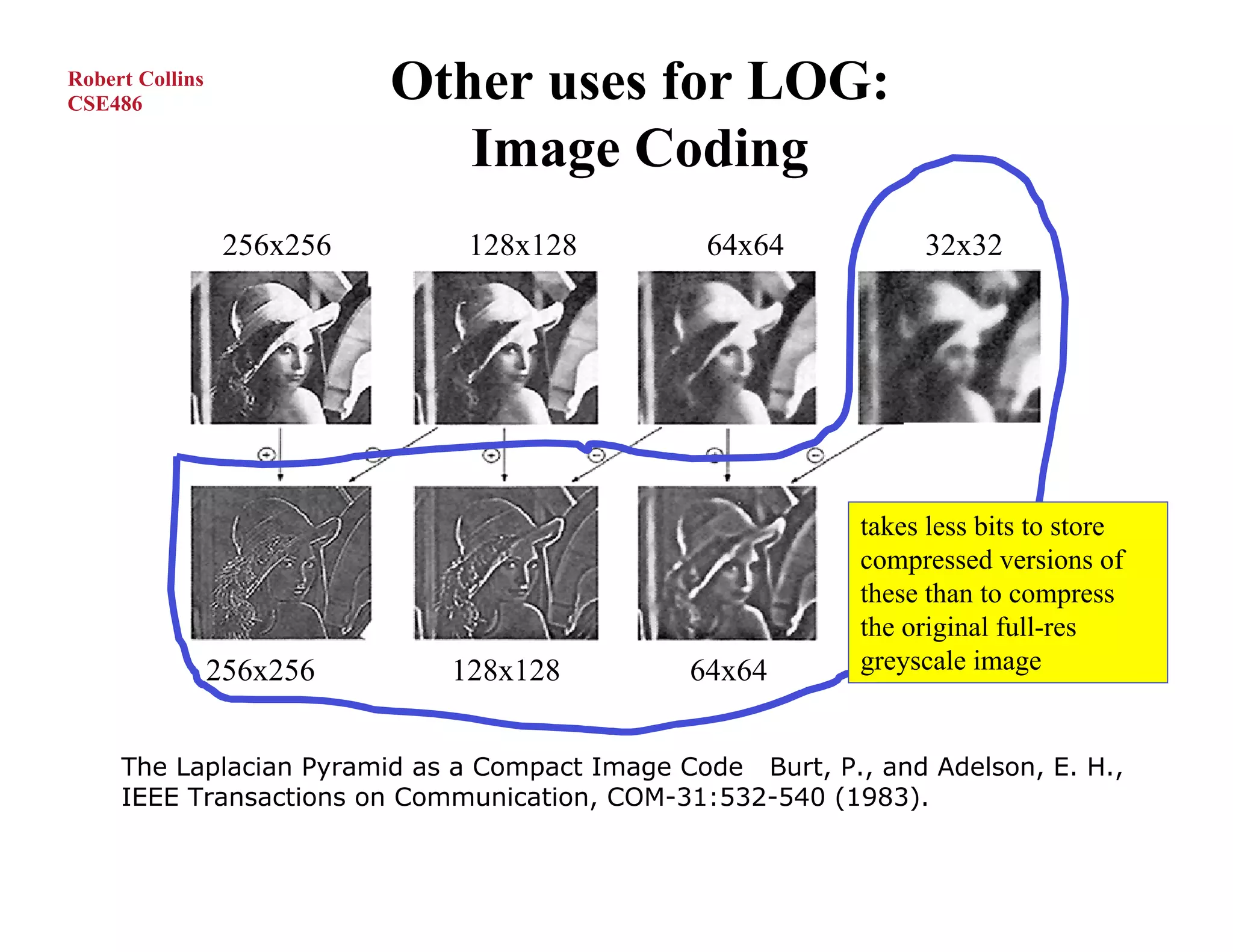
         • Coarse layer of the Gaussian pyramid predicts the
           appearance of the next finer layer.
         • The prediction is not exact, but means that it is not
           necessary to store all of the next fine scale layer.
         • Laplacian pyramid stores the difference.
Robert Collins
CSE486
                            Other uses for LOG:
                               Image Coding
                  256x256      128x128          64x64            32x32


                                                            takes less bits to store
                                                            compressed versions of
                                                            these than to compress
                                                            the original full-res
                 256x256      128x128          64x64        greyscale image


     The Laplacian Pyramid as a Compact Image Code Burt, P., and Adelson, E. H.,
     IEEE Transactions on Communication, COM-31:532-540 (1983).
Lecture11

  • 1.
    Robert Collins CSE486 Lecture 11: LoG and DoG Filters
  • 2.
    Robert Collins CSE486 Today’s Topics Laplacian of Gaussian (LoG) Filter - useful for finding edges - also useful for finding blobs! approximation using Difference of Gaussian (DoG)
  • 3.
    Robert Collins Recall: First Derivative Filters CSE486 • Sharp changes in gray level of the input image correspond to “peaks or valleys” of the first-derivative of the input signal. F(x) F ’(x) x (1D example) O.Camps, PSU
  • 4.
    Robert Collins CSE486 Second-Derivative Filters • Peaks or valleys of the first-derivative of the input signal, correspond to “zero-crossings” of the second-derivative of the input signal. F(x) F ’(x) F’’(x) x O.Camps, PSU
  • 5.
    Robert Collins CSE486 Numerical Derivatives See also T&V, Appendix A.2 Taylor Series expansion add Central difference approx 1 -2 1 to second derivative
  • 6.
    Robert Collins CSE486 Example: Second Derivatives Ixx=d2I(x,y)/dx2 [ 1 -2 1 ] I(x,y) 2nd Partial deriv wrt x 1 -2 1 Iyy=d2I(x,y)/dy2 2nd Partial deriv wrt y
  • 7.
    Robert Collins CSE486 Example: Second Derivatives Ixx Iyy benefit: you get clear localization of the edge, as opposed to the “smear” of high gradient magnitude values across an edge
  • 8.
    Robert Collins CSE486 Compare: 1st vs 2nd Derivatives Ixx Iyy Ix Iy
  • 9.
    Robert Collins CSE486 Finding Zero-Crossings An alternative approx to finding edges as peaks in first deriv is to find zero-crossings in second deriv. In 1D, convolve with [1 -2 1] and look for pixels where response is (nearly) zero? Problem: when first deriv is zero, so is second. I.e. the filter [1 -2 1] also produces zero when convolved with regions of constant intensity. So, in 1D, convolve with [1 -2 1] and look for pixels where response is nearly zero AND magnitude of first derivative is “large enough”.
  • 10.
    Edge Detection Summary RobertCollins CSE486 1D 2D y step edge F(x) I(x) I(x,y) x x 2nd deriv 1st deriv dI(x) |∇I(x,y)| =(Ix 2(x,y) + Iy2(x,y))1/2 > Th > Th dx tan θ = Ix(x,y)/ Iy(x,y) d2I(x) =0 ∇2I(x,y) =Ix x (x,y) + Iyy (x,y)=0 dx2 Laplacian
  • 11.
    Robert Collins CSE486 Finite Difference Laplacian Laplacian filter ∇2I(x,y)
  • 12.
    Robert Collins CSE486 Example: Laplacian I(x,y) Ixx + Iyy
  • 13.
    Robert Collins CSE486 Example: Laplacian Ixx Iyy Ixx+Iyy ∇2I(x,y)
  • 14.
    Robert Collins CSE486 Notes about the Laplacian: • ∇2I(x,y) is a SCALAR – ↑ Can be found using a SINGLE mask – ↓ Orientation information is lost • ∇2I(x,y) is the sum of SECOND-order derivatives – But taking derivatives increases noise – Very noise sensitive! • It is always combined with a smoothing operation: I(x,y) O(x,y) Smooth Laplacian O.Camps, PSU
  • 15.
    Robert Collins CSE486 LoG Filter • First smooth (Gaussian filter), • Then, find zero-crossings (Laplacian filter): – O(x,y) = ∇2(I(x,y) * G(x,y)) Laplacian of Laplacian of Gaussian (LoG) Gaussian-filtered image -filtered image Do you see the distinction? O.Camps, PSU
  • 16.
    Robert Collins CSE486 1D Gaussian and Derivatives x2 − 2σ 2 g ( x) = e x2 x2 1 − 2 x − 2 g ' ( x) = − 2 2 xe 2σ =− 2 e 2σ 2σ σ 2 x2 x 1 − 2σ 2 g ' ' ( x ) = ( 4 − 2 )e σ3 σ O.Camps, PSU
  • 17.
    Robert Collins CSE486 Second Derivative of a Gaussian 2 x2 x 1 − 2 g ' ' ( x ) = ( 4 − 2 )e 3 2σ σ σ 2D analog LoG “Mexican Hat” O.Camps, PSU
  • 18.
    Robert Collins CSE486 Effect of LoG Operator Original LoG-filtered Band-Pass Filter (suppresses both high and low frequencies) Why? Easier to explain in a moment.
  • 19.
    Robert Collins CSE486 Zero-Crossings as an Edge Detector Raw zero-crossings (no contrast thresholding) LoG sigma = 2, zero-crossing
  • 20.
    Robert Collins CSE486 Zero-Crossings as an Edge Detector Raw zero-crossings (no contrast thresholding) LoG sigma = 4, zero-crossing
  • 21.
    Robert Collins CSE486 Zero-Crossings as an Edge Detector Raw zero-crossings (no contrast thresholding) LoG sigma = 8, zero-crossing
  • 22.
    Robert Collins CSE486 Note: Closed Contours You may have noticed that zero-crossings form closed contours. It is easy to see why… Think of equal-elevation contours on a topo map. Each is a closed contour. Zero-crossings are contours at elevation = 0 . remember that in our case, the height map is of a LoG filtered image - a surface with both positive and negative “elevations”
  • 23.
    Robert Collins CSE486 Other uses of LoG: Blob Detection Lindeberg: ``Feature detection with automatic scale selection''. International Journal of Computer Vision, vol 30, number 2, pp. 77-- 116, 1998.
  • 24.
    Robert Collins CSE486 Pause to Think for a Moment: How can an edge finder also be used to find blobs in an image?
  • 25.
    Robert Collins CSE486 Example: LoG Extrema LoG maxima sigma = 2 minima
  • 26.
    Robert Collins CSE486 LoG Extrema, Detail maxima LoG sigma = 2
  • 27.
    Robert Collins CSE486 LoG Blob Finding LoG filter extrema locates “blobs” maxima = dark blobs on light background minima = light blobs on dark background Scale of blob (size ; radius in pixels) is determined by the sigma parameter of the LoG filter. LoG sigma = 2 LoG sigma = 10
  • 28.
    Robert Collins CSE486 Observe and Generalize convolve result with LoG maxima
  • 29.
    Robert Collins CSE486 Observe and Generalize LoG looks a bit like an eye. and it responds maximally in the eye region!
  • 30.
    Robert Collins CSE486 Observe and Generalize LoG Derivative of Gaussian Looks like dark blob Looks like vertical and on light background horizontal step edges Recall: Convolution (and cross correlation) with a filter can be viewed as comparing a little “picture” of what you want to find against all local regions in the mage.
  • 31.
    Robert Collins CSE486 Observe and Generalize Key idea: Cross correlation with a filter can be viewed as comparing a little “picture” of what you want to find against all local regions in the image. Maximum response: Maximum response: dark blob on light background vertical edge; lighter on left Minimum response: Minimum response: light blob on dark background vertical edge; lighter on right
  • 32.
    Robert Collins CSE486 Efficient Implementation Approximating LoG with DoG LoG can be approximate by a Difference of two Gaussians (DoG) at different scales 1D example M.Hebert, CMU
  • 33.
    Robert Collins CSE486 Efficient Implementation LoG can be approximate by a Difference of two Gaussians (DoG) at different scales. Separability of and cascadability of Gaussians applies to the DoG, so we can achieve efficient implementation of the LoG operator. DoG approx also explains bandpass filtering of LoG (think about it. Hint: Gaussian is a low-pass filter)
  • 34.
    Robert Collins CSE486 Back to Blob Detection Lindeberg: blobs are detected as local extrema in space and scale, within the LoG (or DoG) scale-space volume.
  • 35.
    Robert Collins CSE486 Other uses of LoG: Blob Detection Gesture recognition for the ultimate couch potato
  • 36.
    Robert Collins CSE486 Other uses for LOG: Image Coding • Coarse layer of the Gaussian pyramid predicts the appearance of the next finer layer. • The prediction is not exact, but means that it is not necessary to store all of the next fine scale layer. • Laplacian pyramid stores the difference.
  • 37.
    Robert Collins CSE486 Other uses for LOG: Image Coding 256x256 128x128 64x64 32x32 takes less bits to store compressed versions of these than to compress the original full-res 256x256 128x128 64x64 greyscale image The Laplacian Pyramid as a Compact Image Code Burt, P., and Adelson, E. H., IEEE Transactions on Communication, COM-31:532-540 (1983).