Forces: Equilibrium Examples  Today’s lecture will cover  Textbook Sections 2.1-2.7  Physics 101:  Lecture 02 Phys 101 URL: http://online.physics.uiuc.edu/courses/phys101 Read the course description & FAQ! Office hours start Monday; see web page  for locations & times. Exam I
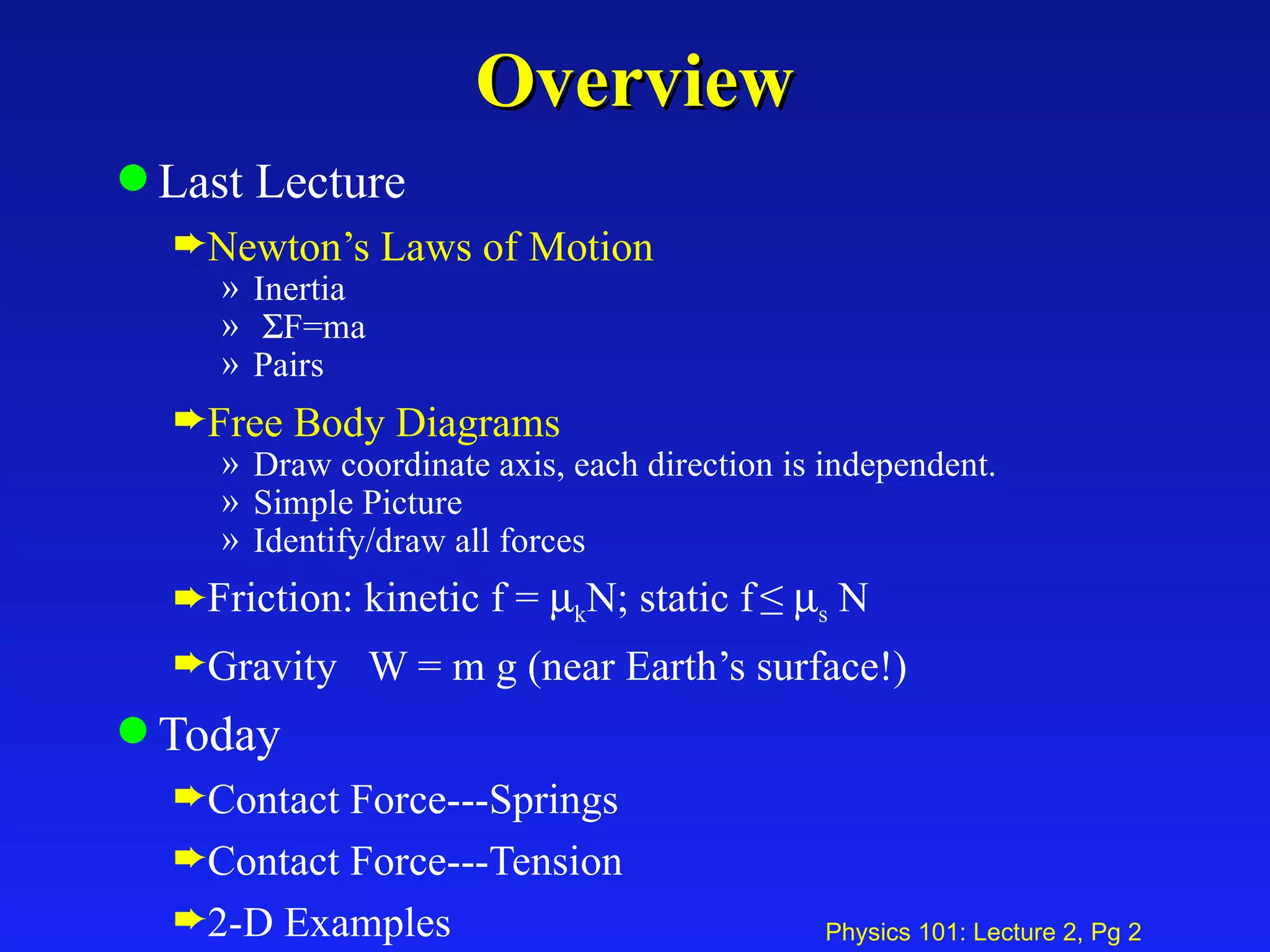
Overview Last Lecture Newton’s Laws of Motion Inertia  F=ma Pairs Free Body Diagrams Draw coordinate axis, each direction is independent. Simple Picture Identify/draw all forces Friction: kinetic f =   k N; static f   ≤    s  N Gravity  W = m g (near Earth’s surface!) Today Contact Force---Springs Contact Force---Tension 2-D Examples
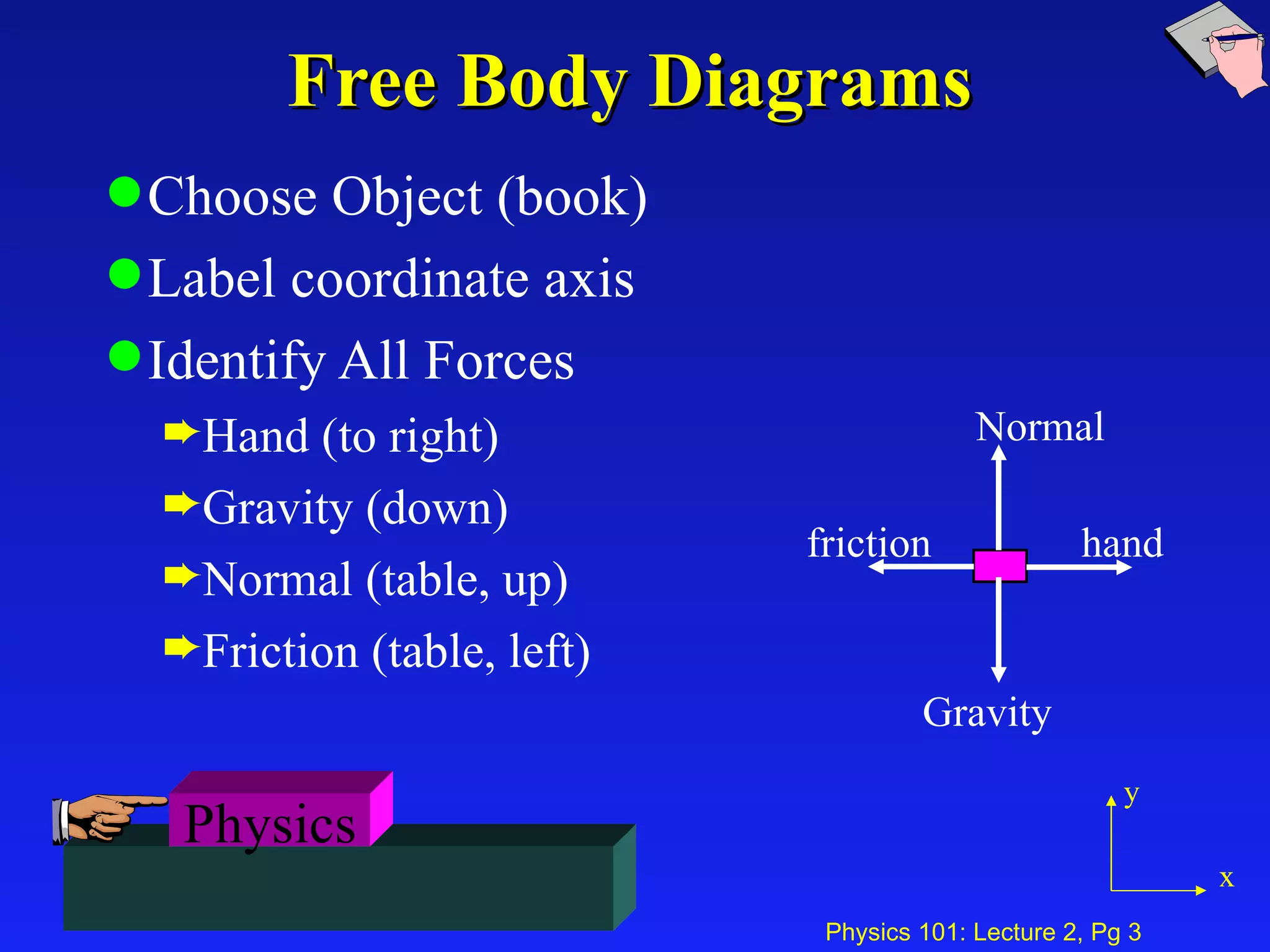
Free Body Diagrams Choose Object (book) Label coordinate axis Identify All Forces Hand (to right) Gravity (down) Normal (table, up) Friction (table, left) Physics hand Gravity Normal friction y x
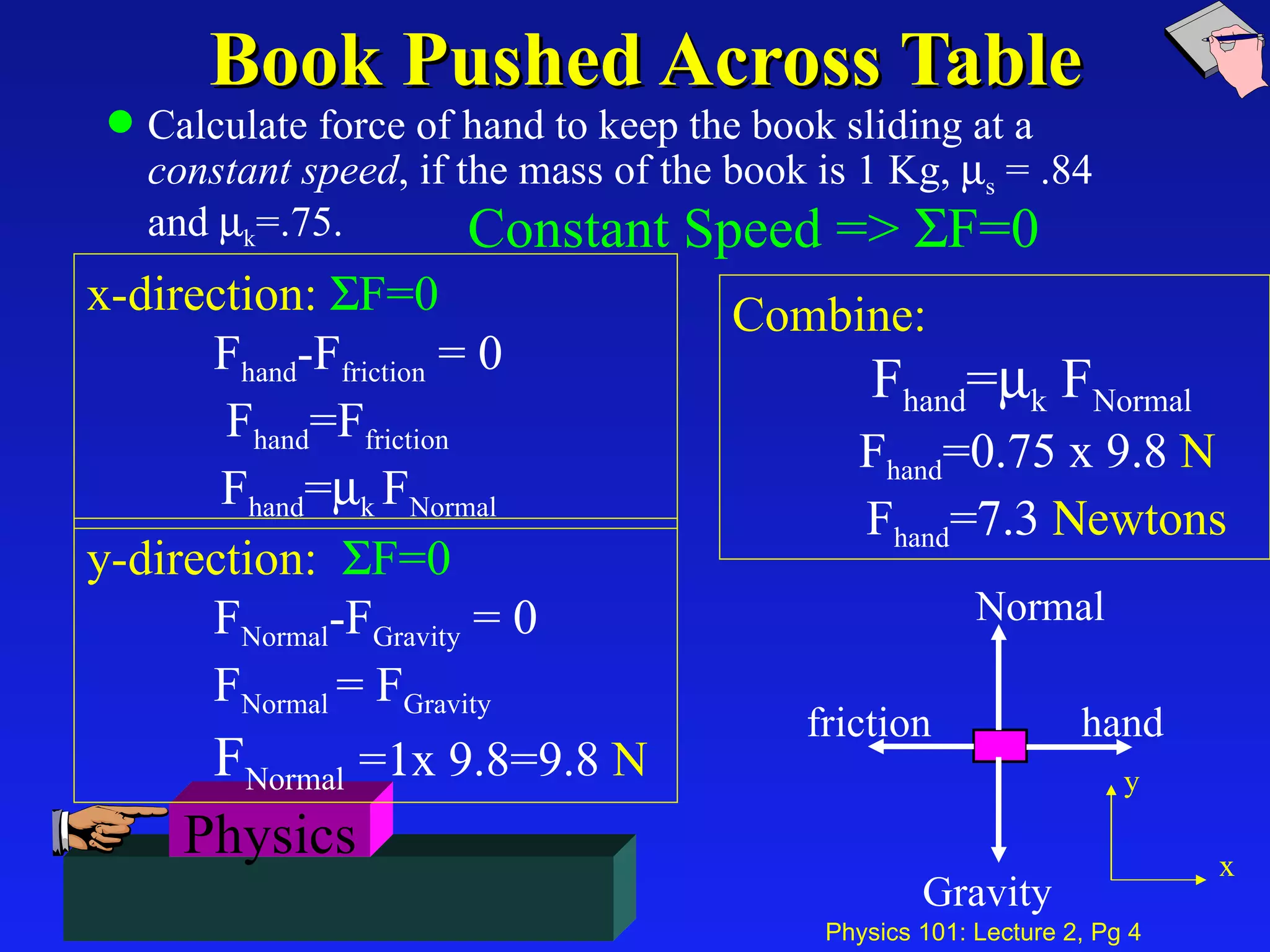
Book Pushed Across Table Calculate force of hand to keep the book sliding at a  constant speed , if the mass of the book is 1 Kg,   s  = .84 and   k =.75. Physics hand Gravity Normal friction x-direction:   F=0 F hand -F friction  = 0   F hand =F friction   F hand =  k  F Normal y-direction:   F=0 F Normal -F Gravity  = 0 F Normal  = F Gravity F Normal   =  x 9.8=9.8  N Combine:   F hand =  k  F Normal     F hand =0.75 x 9.8  N   F hand =   ewtons Constant Speed =>   F=0 y x
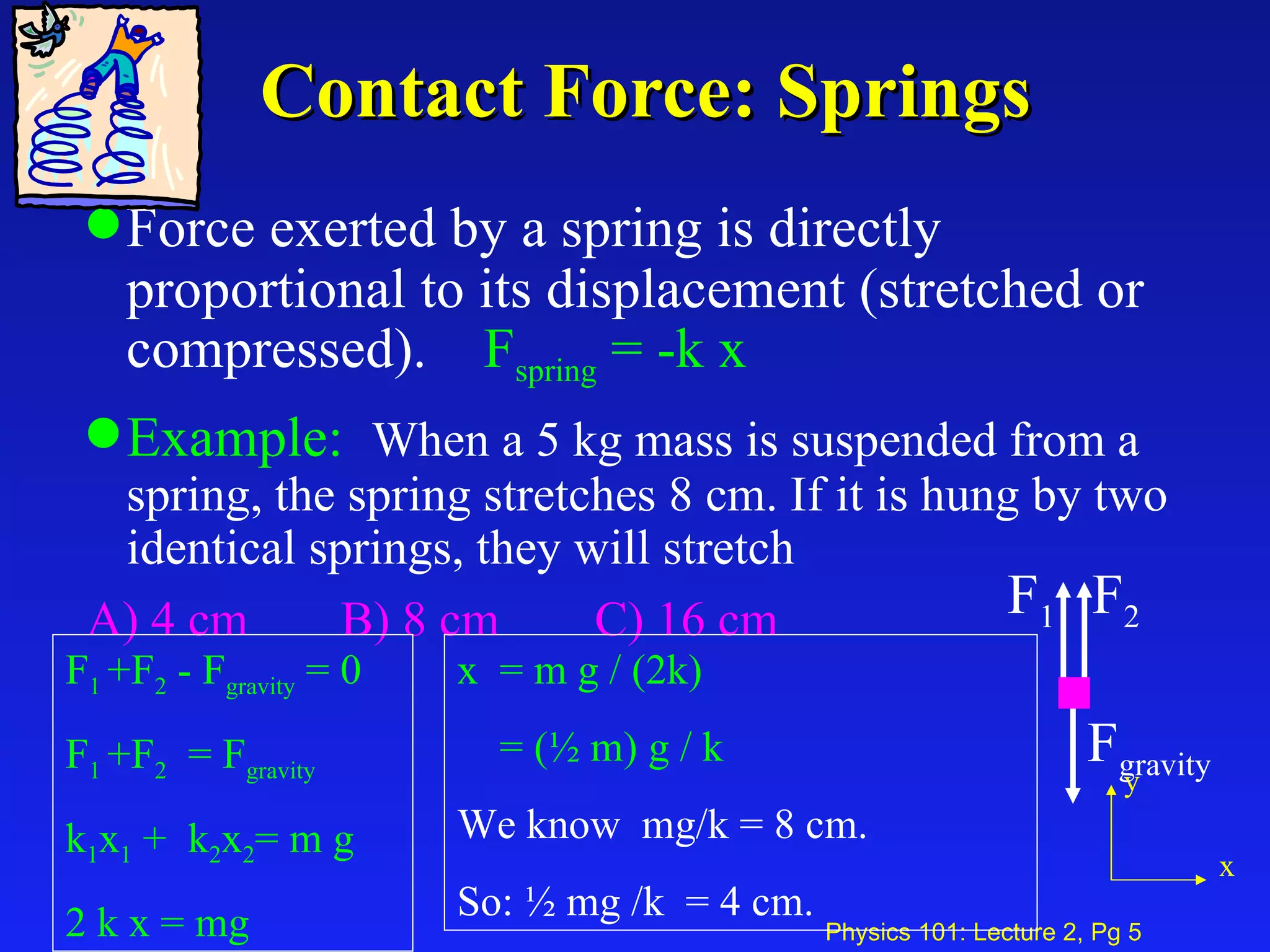
Contact Force: Springs Force exerted by a spring is directly proportional to its displacement (stretched or compressed).  F spring   = -k x   Example:   When a 5 kg mass is suspended from a spring, the spring stretches 8 cm. If it is hung by two identical springs, they will stretch A) 4 cm B) 8 cm C) 16 cm F 1  +F 2  - F gravity  = 0 F 1  +F 2   = F gravity k 1 x 1  +  k 2 x 2 = m g 2 k x = mg x  = m g / (2k) = (½ m) g / k We know  mg/k = 8 cm.  So: ½ mg /k  = 4 cm. y x F 2 F gravity F 1
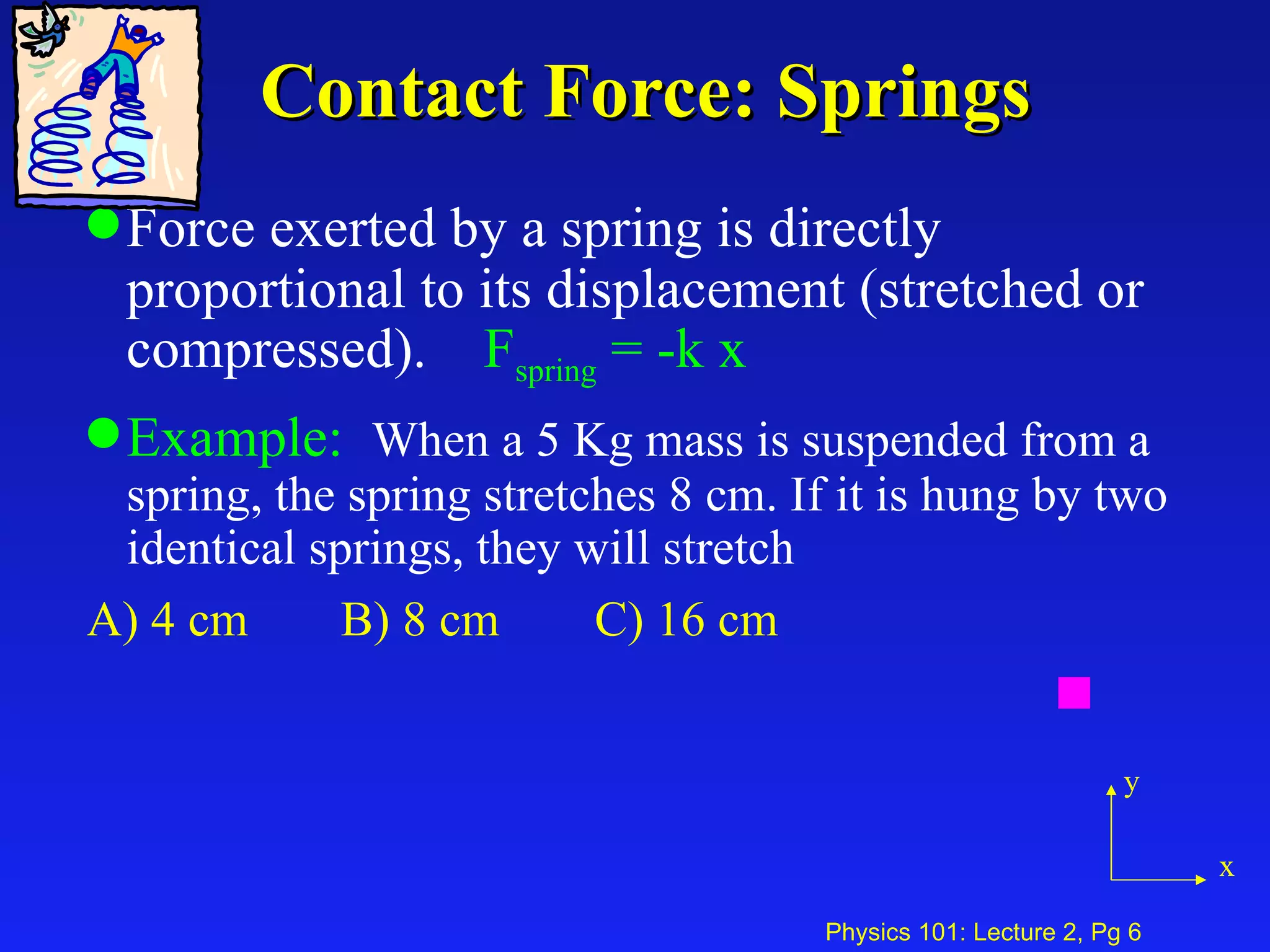
Contact Force: Springs Force exerted by a spring is directly proportional to its displacement (stretched or compressed).  F spring   = -k x   Example:   When a 5 Kg mass is suspended from a spring, the spring stretches 8 cm. If it is hung by two identical springs, they will stretch A) 4 cm B) 8 cm C) 16 cm y x
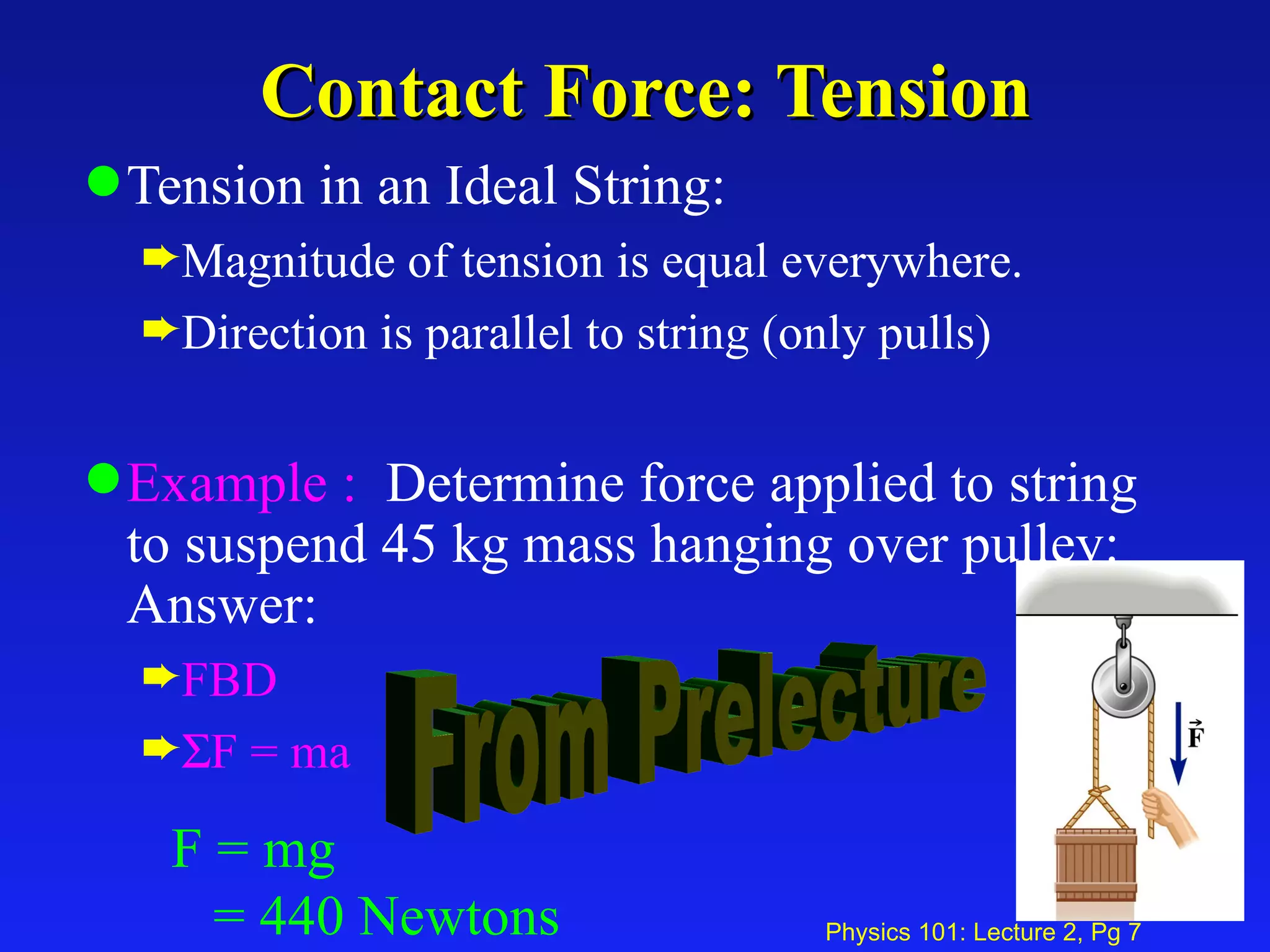
Contact Force: Tension Tension in an Ideal String:  Magnitude of tension is equal everywhere. Direction is parallel to string (only pulls) Example :   Determine force applied to string to suspend 45 kg mass hanging over pulley:  Answer:  FBD  F = ma F = mg = 440 Newtons From Prelecture
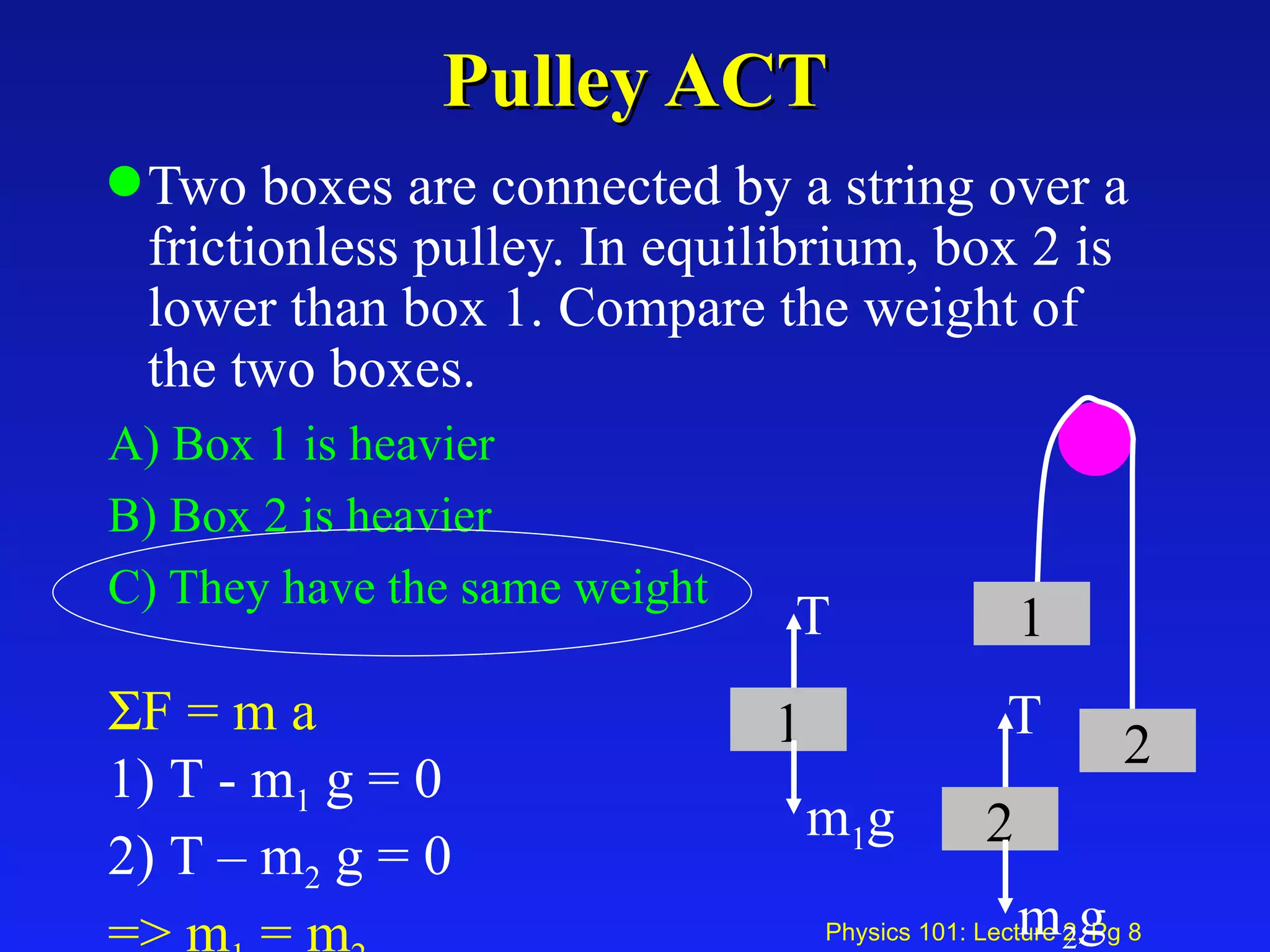
Pulley ACT Two boxes are connected by a string over a frictionless pulley. In equilibrium, box 2 is lower than box 1. Compare the weight of the two boxes. A) Box 1 is heavier B) Box 2 is heavier C) They have the same weight 1 2  F = m a 1) T - m 1  g = 0 2) T – m 2  g = 0 => m 1  = m 2   1 T m 1 g 2 T m 2 g
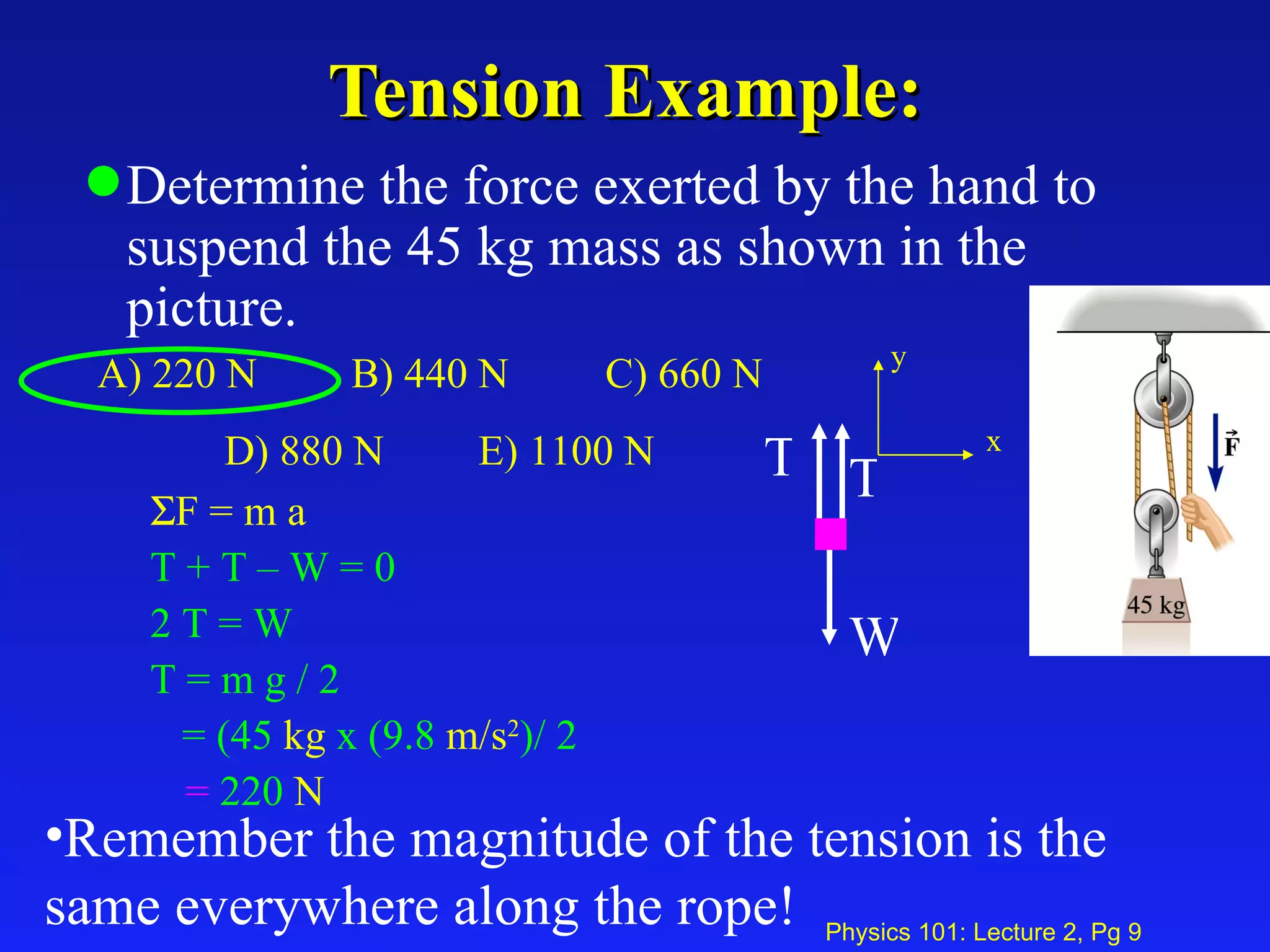
Tension Example:  Determine the force exerted by the hand to suspend the 45 kg mass as shown in the picture.  F = m a T + T – W = 0 2 T = W T = m g / 2   = (45   kg   x (9.8   m/s 2 )/ 2 =   220  N Remember the magnitude of the tension is the same everywhere along the rope! A) 220 N B) 440 N C) 660 N D) 880 N E) 1100 N y x T T W
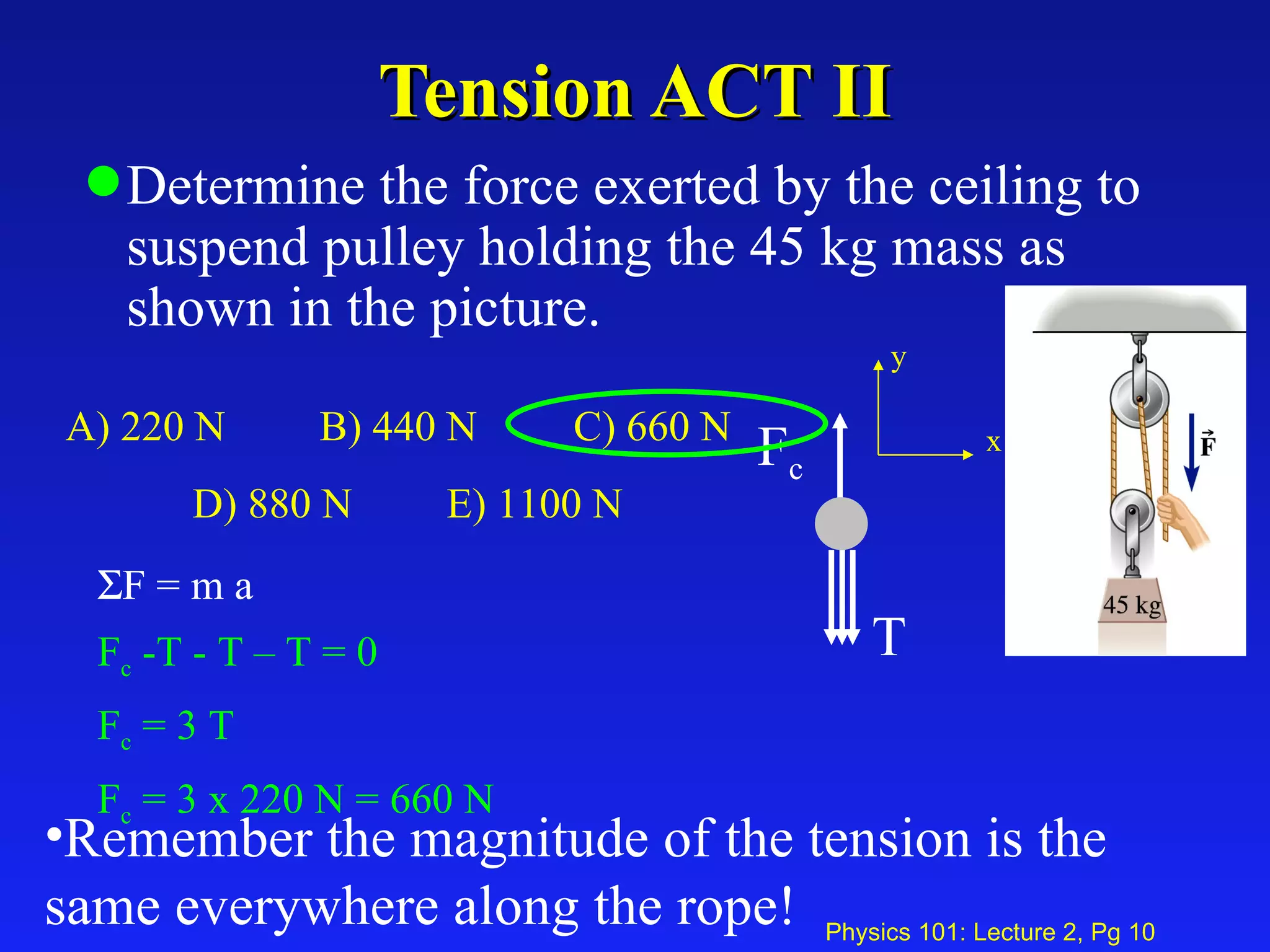
Tension ACT II Determine the force exerted by the ceiling to suspend pulley holding the 45 kg mass as shown in the picture.  F = m a F c  -T - T – T = 0 F c  = 3 T F c  = 3 x 220 N = 660 N Remember the magnitude of the tension is the same everywhere along the rope! A) 220 N B) 440 N C) 660 N D) 880 N E) 1100 N y x F c T
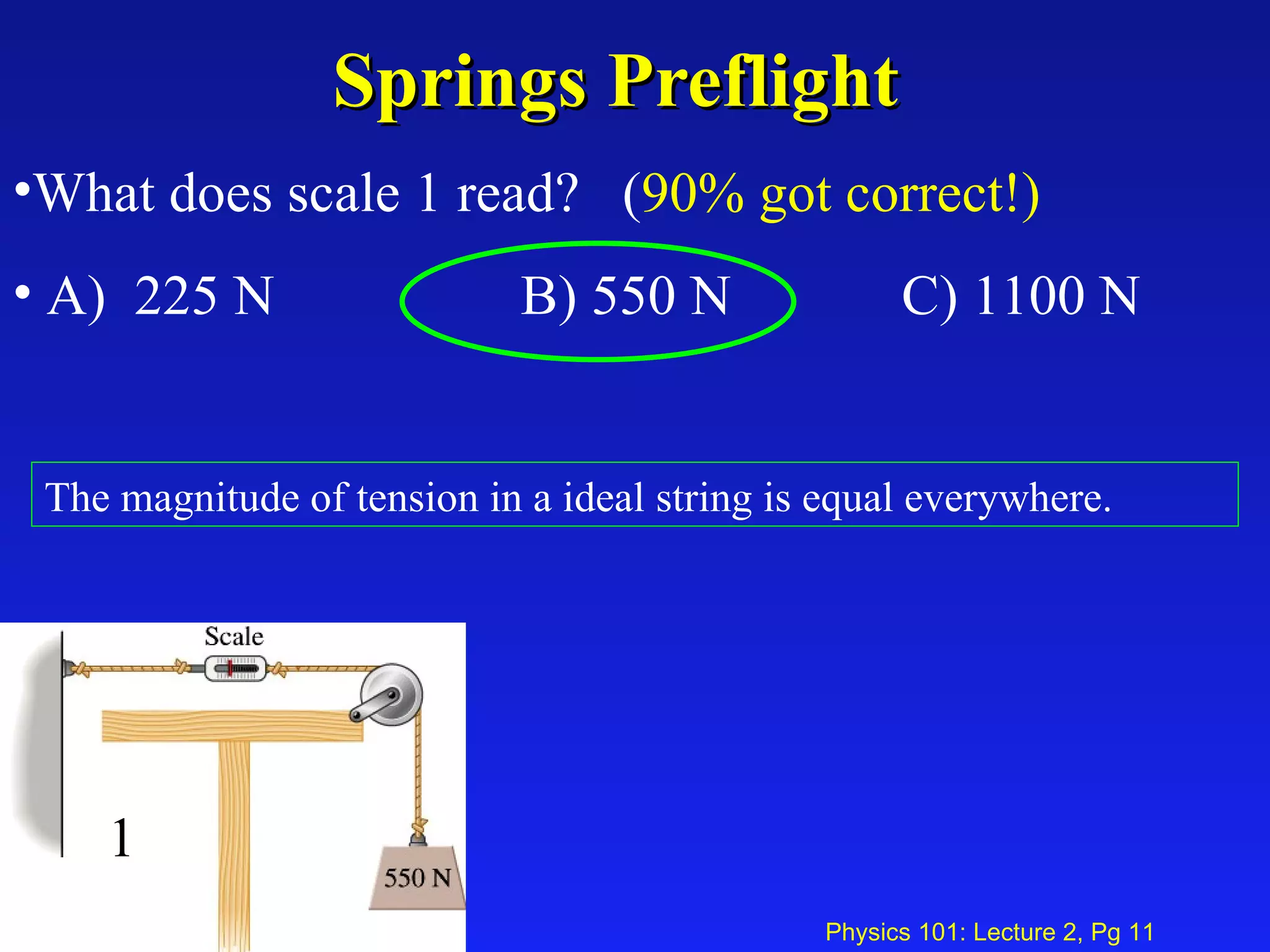
Springs Preflight  What does scale 1 read?  ( 90% got correct!) A)  225 N B) 550 N C) 1100 N   1 The magnitude of tension in a ideal string is equal everywhere.
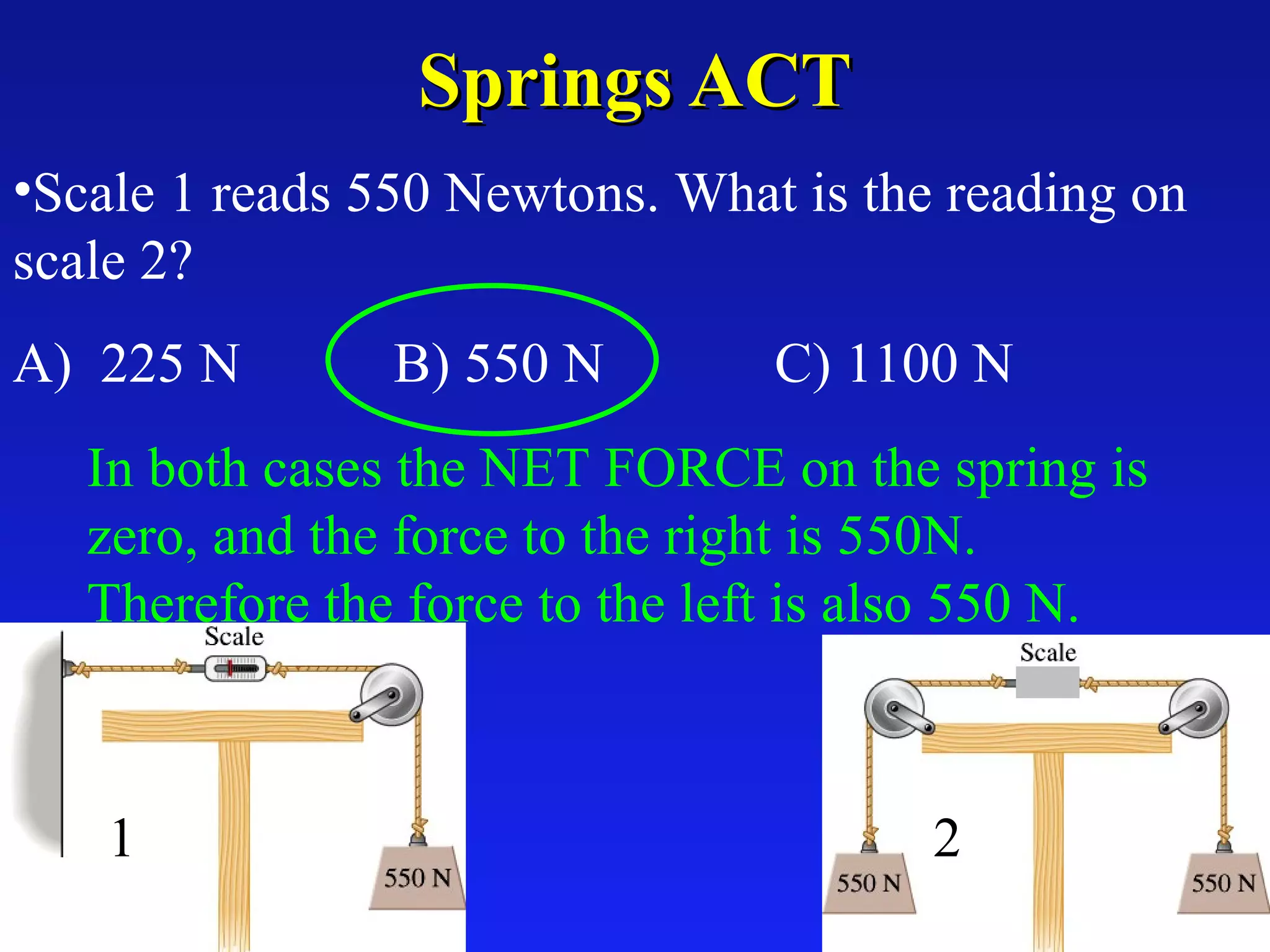
Springs ACT Scale 1 reads 550 Newtons. What is the reading on scale 2? A)  225 N B) 550 N C) 1100 N   In both cases the NET FORCE on the spring is zero, and the force to the right is 550N. Therefore the force to the left is also 550 N. 1 2
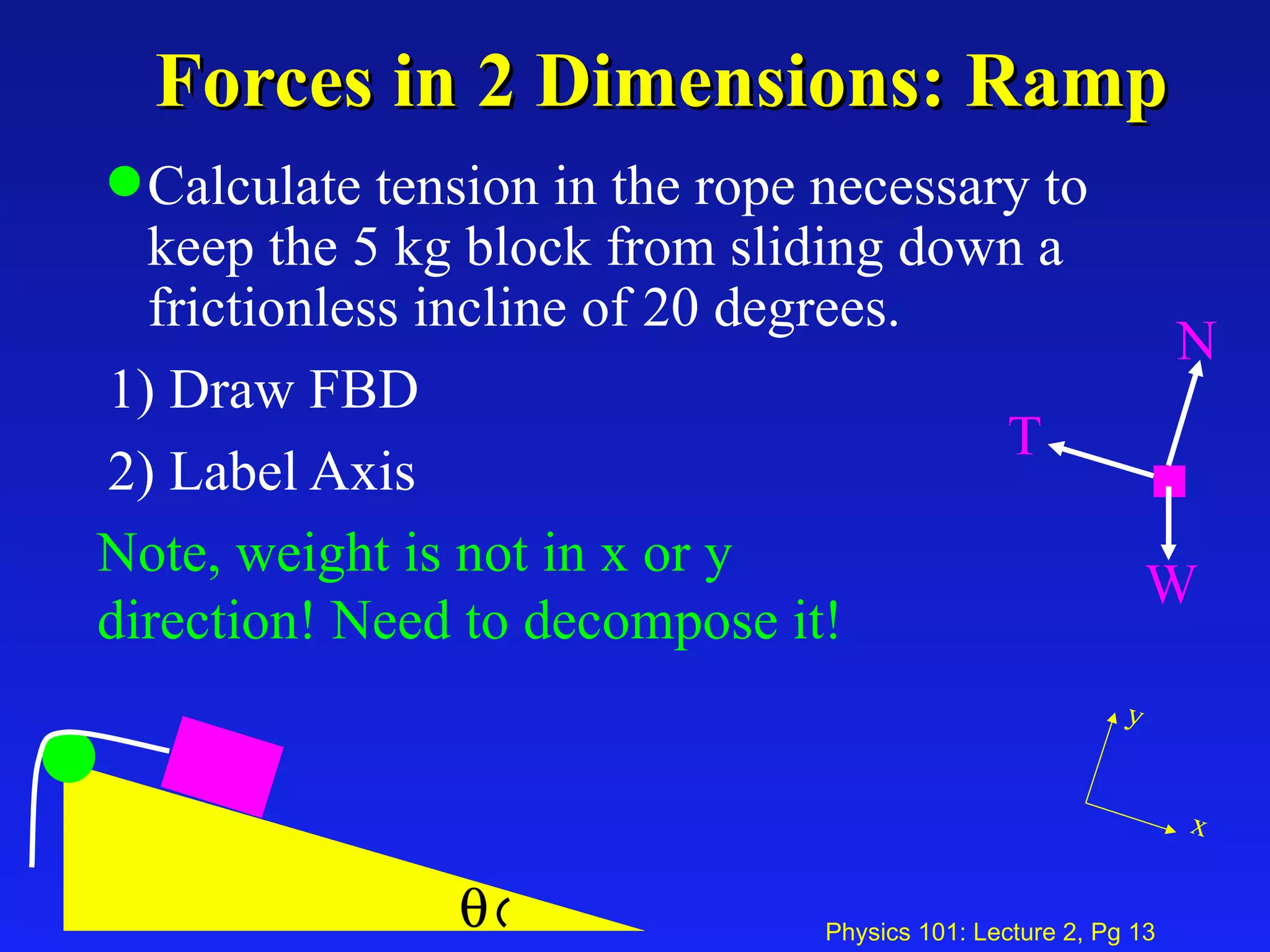
Forces in 2 Dimensions: Ramp Calculate tension in the rope necessary to keep the 5 kg block from sliding down a frictionless incline of 20 degrees. 1) Draw FBD 2) Label Axis Note, weight is not in x or y direction! Need to decompose it!  y x T N W
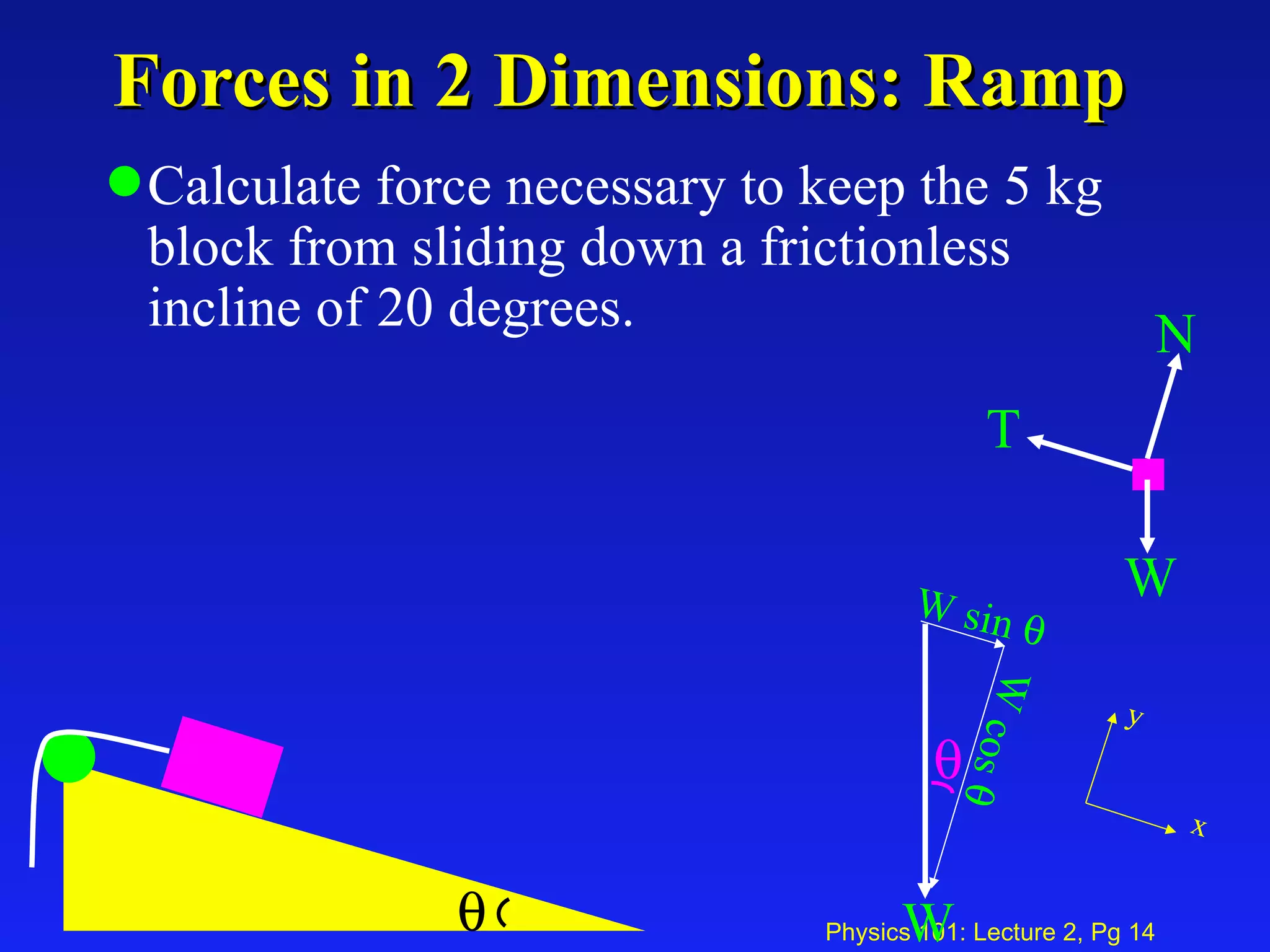
Forces in 2 Dimensions: Ramp Calculate force necessary to keep the 5 kg block from sliding down a frictionless incline of 20 degrees.   W sin   W cos   y x W T N W
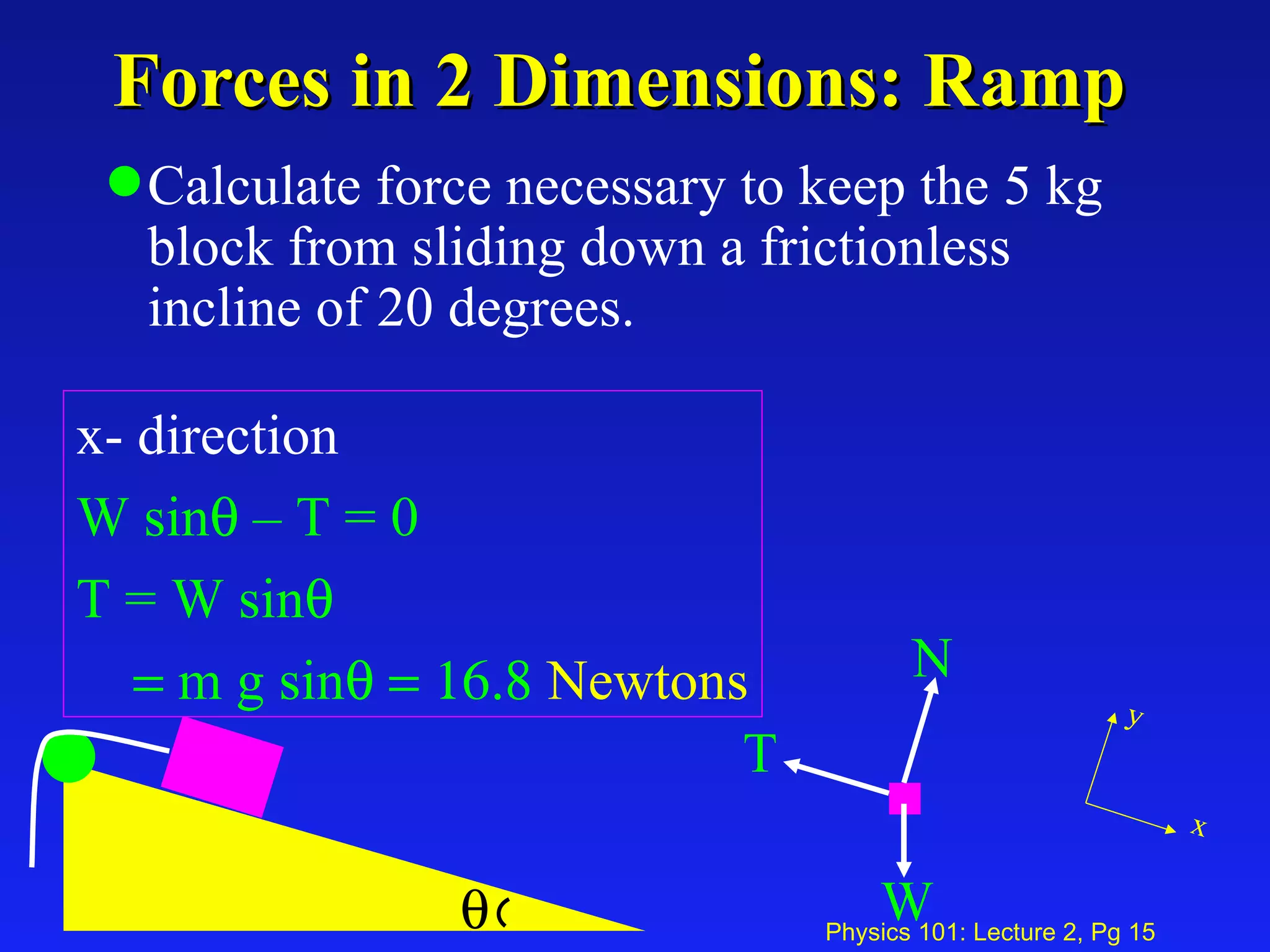
Forces in 2 Dimensions: Ramp Calculate force necessary to keep the 5 kg block from sliding down a frictionless incline of 20 degrees. x- direction W sin   – T = 0 T = W sin   m g sin   Newtons  y x T N W
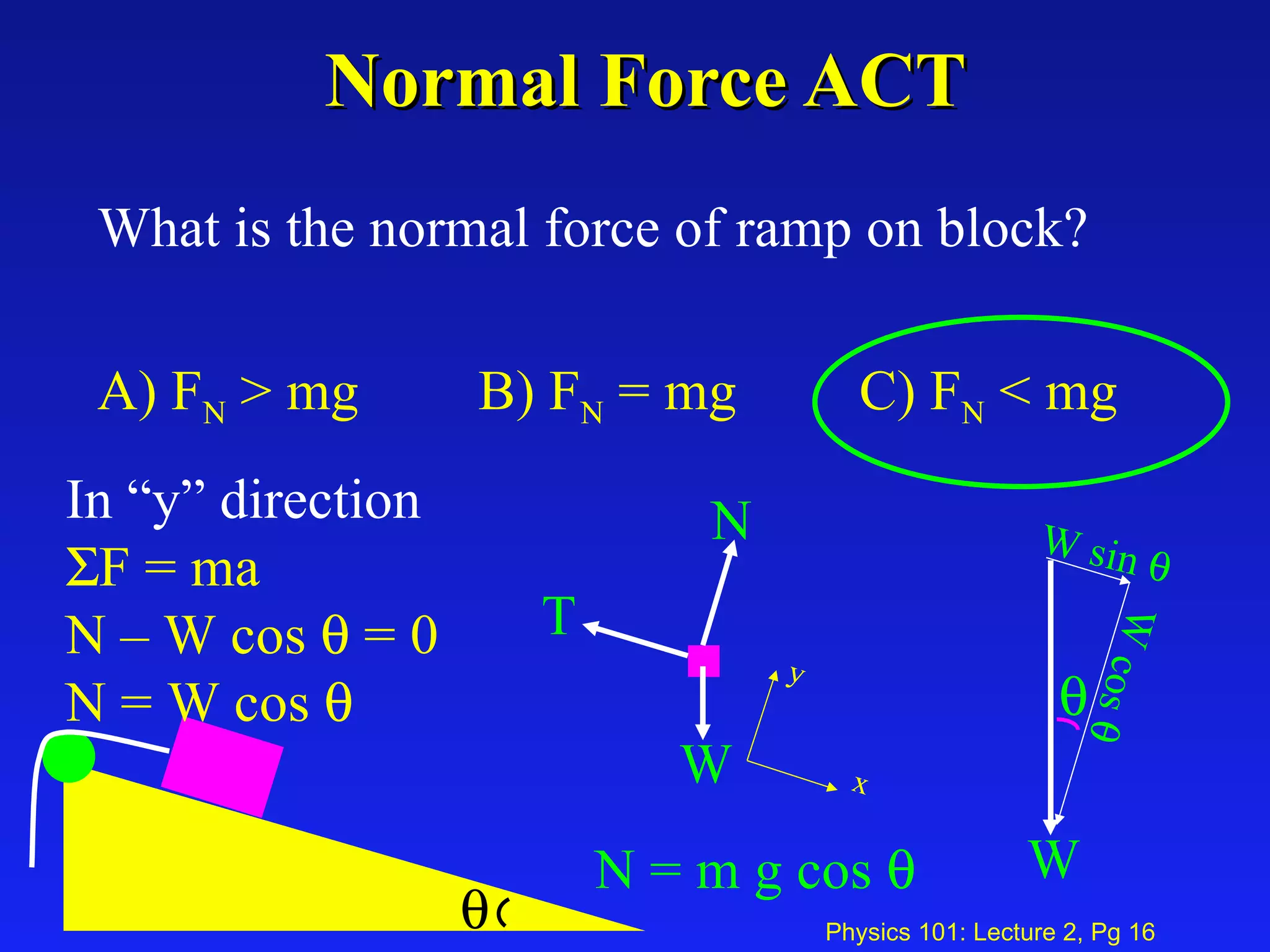
Normal Force ACT What is the normal force of ramp on block? A) F N  > mg  B) F N  = mg  C) F N  < mg In “y” direction  F = ma N – W cos    = 0 N = W cos   N = m g cos    T N W y x W  W sin   W cos  
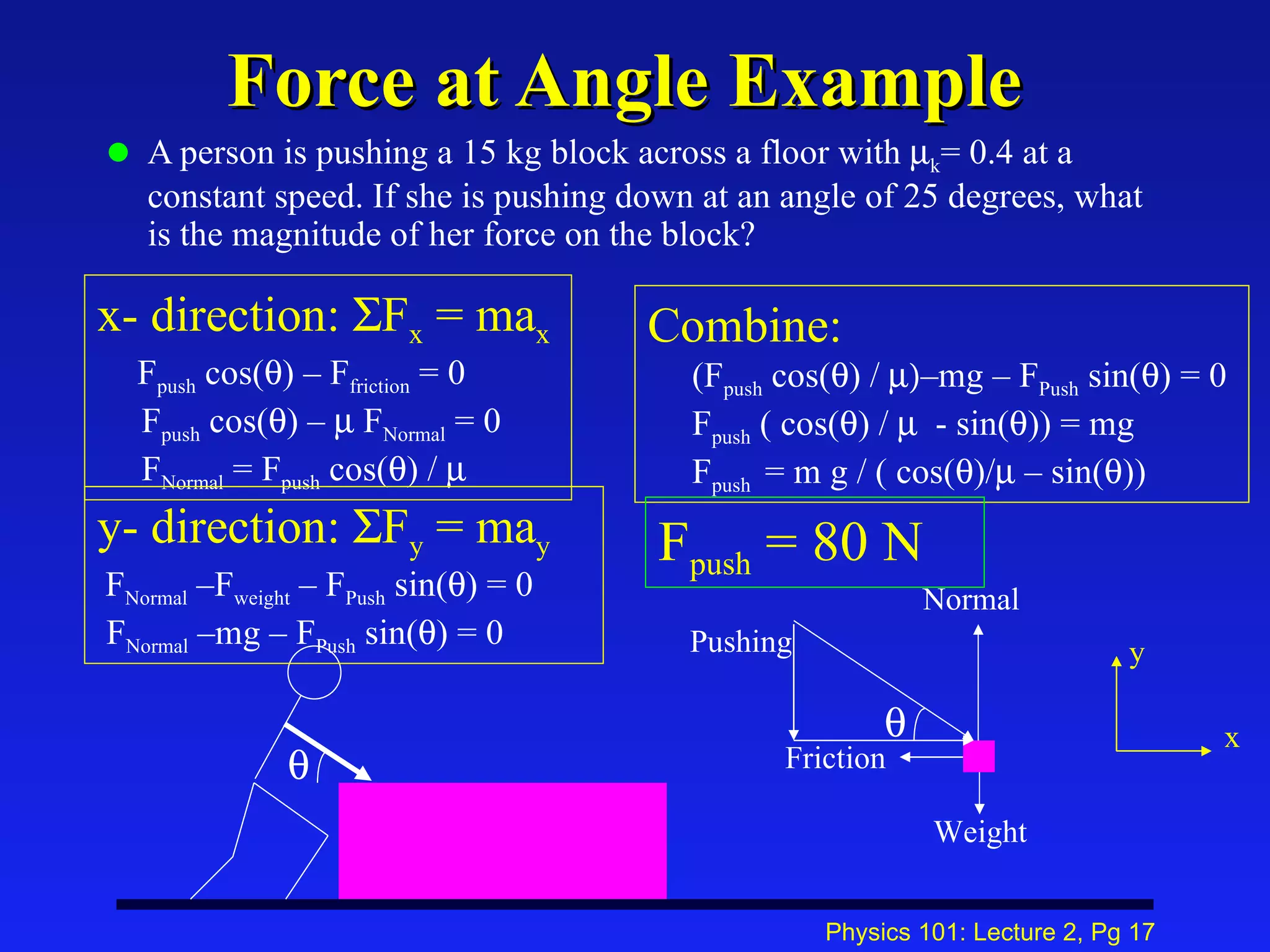
Force at Angle Example A person is pushing a 15 kg block across a floor with   k = 0.4 at a constant speed. If she is pushing down at an angle of 25 degrees, what is the magnitude of her force on the block? x- direction:   F x  = ma x F push  cos(  ) – F friction  = 0 F push  cos(  ) –    F Normal  = 0 F Normal  = F push  cos(  ) /   y- direction:   F y  = ma y F Normal  –F weight  – F Push  sin(  ) = 0 F Normal  –mg – F Push  sin(  ) = 0 Combine: (F push  cos(  ) /   –mg – F Push  sin(  ) = 0 F push  ( cos(  ) /     - sin(  )) = mg F push  = m g / ( cos(  )/   – sin(  )) F push  = 80 N y x Normal Weight Pushing  Friction 
Summary Contact Force: Spring Can push or pull, force proportional to displacement F = k x Contact Force: Tension Always Pulls, tension equal everywhere Force parallel to string Two Dimensional Examples Choose coordinate system Analyze each direction is independent

Lecture02

  • 1.
    Forces: Equilibrium Examples Today’s lecture will cover Textbook Sections 2.1-2.7 Physics 101: Lecture 02 Phys 101 URL: http://online.physics.uiuc.edu/courses/phys101 Read the course description & FAQ! Office hours start Monday; see web page for locations & times. Exam I
  • 2.
    Overview Last LectureNewton’s Laws of Motion Inertia  F=ma Pairs Free Body Diagrams Draw coordinate axis, each direction is independent. Simple Picture Identify/draw all forces Friction: kinetic f =  k N; static f ≤  s N Gravity W = m g (near Earth’s surface!) Today Contact Force---Springs Contact Force---Tension 2-D Examples
  • 3.
    Free Body DiagramsChoose Object (book) Label coordinate axis Identify All Forces Hand (to right) Gravity (down) Normal (table, up) Friction (table, left) Physics hand Gravity Normal friction y x
  • 4.
    Book Pushed AcrossTable Calculate force of hand to keep the book sliding at a constant speed , if the mass of the book is 1 Kg,  s = .84 and  k =.75. Physics hand Gravity Normal friction x-direction:  F=0 F hand -F friction = 0 F hand =F friction F hand =  k F Normal y-direction:  F=0 F Normal -F Gravity = 0 F Normal = F Gravity F Normal =  x 9.8=9.8 N Combine: F hand =  k F Normal F hand =0.75 x 9.8 N F hand =   ewtons Constant Speed =>  F=0 y x
  • 5.
    Contact Force: SpringsForce exerted by a spring is directly proportional to its displacement (stretched or compressed). F spring = -k x Example: When a 5 kg mass is suspended from a spring, the spring stretches 8 cm. If it is hung by two identical springs, they will stretch A) 4 cm B) 8 cm C) 16 cm F 1 +F 2 - F gravity = 0 F 1 +F 2 = F gravity k 1 x 1 + k 2 x 2 = m g 2 k x = mg x = m g / (2k) = (½ m) g / k We know mg/k = 8 cm. So: ½ mg /k = 4 cm. y x F 2 F gravity F 1
  • 6.
    Contact Force: SpringsForce exerted by a spring is directly proportional to its displacement (stretched or compressed). F spring = -k x Example: When a 5 Kg mass is suspended from a spring, the spring stretches 8 cm. If it is hung by two identical springs, they will stretch A) 4 cm B) 8 cm C) 16 cm y x
  • 7.
    Contact Force: TensionTension in an Ideal String: Magnitude of tension is equal everywhere. Direction is parallel to string (only pulls) Example : Determine force applied to string to suspend 45 kg mass hanging over pulley: Answer: FBD  F = ma F = mg = 440 Newtons From Prelecture
  • 8.
    Pulley ACT Twoboxes are connected by a string over a frictionless pulley. In equilibrium, box 2 is lower than box 1. Compare the weight of the two boxes. A) Box 1 is heavier B) Box 2 is heavier C) They have the same weight 1 2  F = m a 1) T - m 1 g = 0 2) T – m 2 g = 0 => m 1 = m 2 1 T m 1 g 2 T m 2 g
  • 9.
    Tension Example: Determine the force exerted by the hand to suspend the 45 kg mass as shown in the picture.  F = m a T + T – W = 0 2 T = W T = m g / 2 = (45 kg x (9.8 m/s 2 )/ 2 = 220 N Remember the magnitude of the tension is the same everywhere along the rope! A) 220 N B) 440 N C) 660 N D) 880 N E) 1100 N y x T T W
  • 10.
    Tension ACT IIDetermine the force exerted by the ceiling to suspend pulley holding the 45 kg mass as shown in the picture.  F = m a F c -T - T – T = 0 F c = 3 T F c = 3 x 220 N = 660 N Remember the magnitude of the tension is the same everywhere along the rope! A) 220 N B) 440 N C) 660 N D) 880 N E) 1100 N y x F c T
  • 11.
    Springs Preflight What does scale 1 read? ( 90% got correct!) A) 225 N B) 550 N C) 1100 N 1 The magnitude of tension in a ideal string is equal everywhere.
  • 12.
    Springs ACT Scale1 reads 550 Newtons. What is the reading on scale 2? A) 225 N B) 550 N C) 1100 N In both cases the NET FORCE on the spring is zero, and the force to the right is 550N. Therefore the force to the left is also 550 N. 1 2
  • 13.
    Forces in 2Dimensions: Ramp Calculate tension in the rope necessary to keep the 5 kg block from sliding down a frictionless incline of 20 degrees. 1) Draw FBD 2) Label Axis Note, weight is not in x or y direction! Need to decompose it!  y x T N W
  • 14.
    Forces in 2Dimensions: Ramp Calculate force necessary to keep the 5 kg block from sliding down a frictionless incline of 20 degrees.   W sin  W cos  y x W T N W
  • 15.
    Forces in 2Dimensions: Ramp Calculate force necessary to keep the 5 kg block from sliding down a frictionless incline of 20 degrees. x- direction W sin  – T = 0 T = W sin   m g sin   Newtons  y x T N W
  • 16.
    Normal Force ACTWhat is the normal force of ramp on block? A) F N > mg B) F N = mg C) F N < mg In “y” direction  F = ma N – W cos  = 0 N = W cos  N = m g cos   T N W y x W  W sin  W cos 
  • 17.
    Force at AngleExample A person is pushing a 15 kg block across a floor with  k = 0.4 at a constant speed. If she is pushing down at an angle of 25 degrees, what is the magnitude of her force on the block? x- direction:  F x = ma x F push cos(  ) – F friction = 0 F push cos(  ) –  F Normal = 0 F Normal = F push cos(  ) /  y- direction:  F y = ma y F Normal –F weight – F Push sin(  ) = 0 F Normal –mg – F Push sin(  ) = 0 Combine: (F push cos(  ) /  –mg – F Push sin(  ) = 0 F push ( cos(  ) /  - sin(  )) = mg F push = m g / ( cos(  )/  – sin(  )) F push = 80 N y x Normal Weight Pushing  Friction 
  • 18.
    Summary Contact Force:Spring Can push or pull, force proportional to displacement F = k x Contact Force: Tension Always Pulls, tension equal everywhere Force parallel to string Two Dimensional Examples Choose coordinate system Analyze each direction is independent

Editor's Notes

  • #2 Could add the truck example/demo, or the dog on leash example.
  • #5 Key idea here is we can do each direction independently!
  • #6 Maybe simple demo, add twice as much mass, get twice the stretching before showing the slide. Also make note that this is NOT as big a deal as Newton’s laws. Just an example of a contact force.
  • #7 Maybe simple demo, add twice as much mass, get twice the stretching before showing the slide. Also make note that this is NOT as big a deal as Newton’s laws. Just an example of a contact force. First solve for k = 5*9.8/8 = 6.125 Then FBD
  • #14 Tell them any choice is OK, but this way only have 1 force to decompose
  • #15 T = W sin(theta) = 16.8 N
  • #16 Tell them any choice is OK, but this way only have 1 force to decompose
  • #18 Could do this on over head to help people work through it.
  • #19 hhh