UNIT 4
System Schedule
ME 342 A
System Design and Analysis
Dr. Kailash Chaudhary
Ph.D. (Mechanical Design), M.E. (P & I), B.E. (Mechanical Engg)
Assistant Professor
Department of Mechanical Engineering
MBM University Jodhpur
2
Project Planning, Scheduling and Control
Project a set of partially ordered,
interrelated activities that must be
completed to achieve a goal.
3
Network Models
PERT Program Evaluation and Review
Technique
probabilistic features
CPM Critical Path Method
cost/time trade-offs
project scheduler
4
Objectives
Planning, scheduling, and control of complex
projects
Find critical activities to manage resources
(management by exception)
Determine flexibility of non-critical activities
(slack)
Estimate earliest completion time of project
Determine time cost trade-offs
5
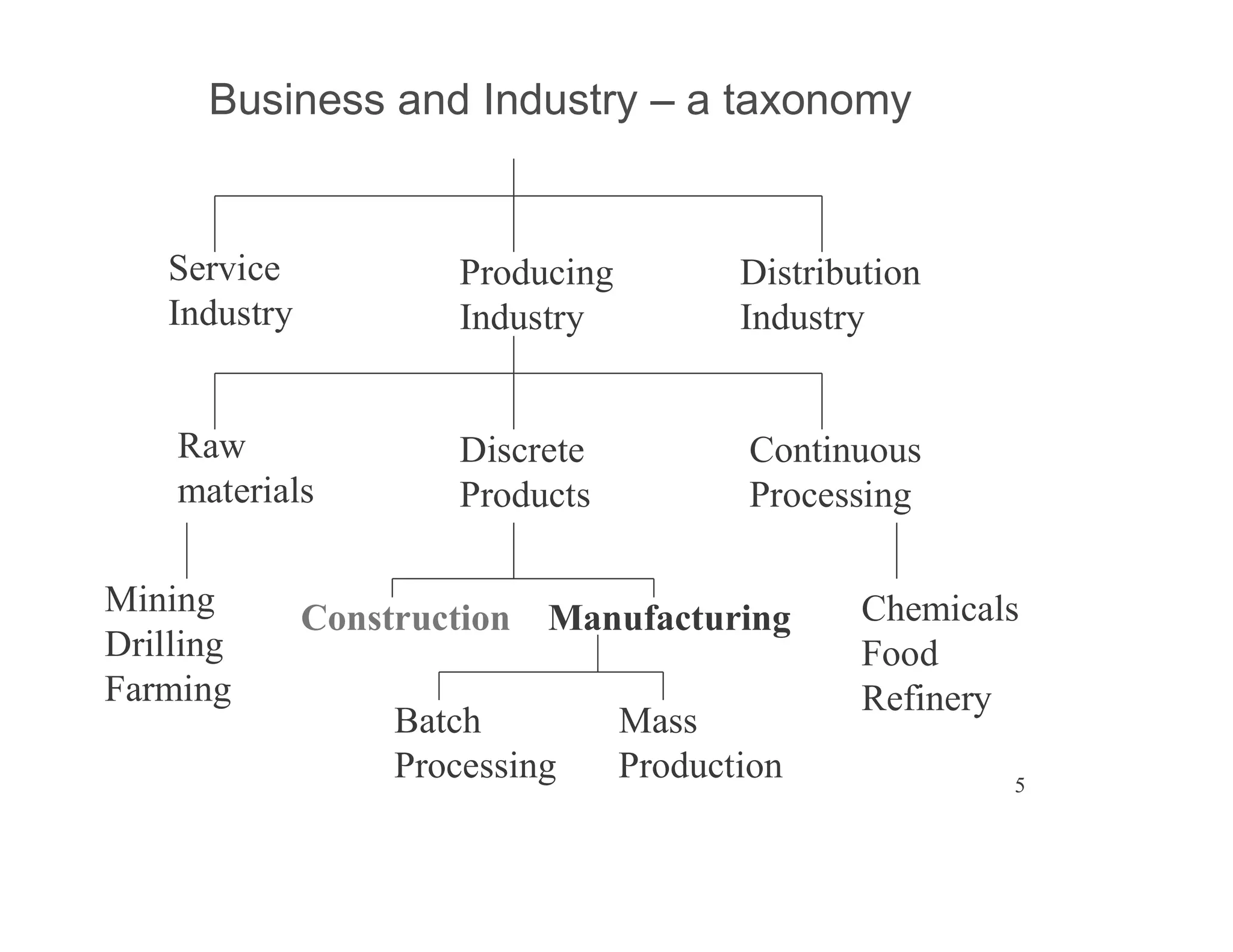
Service
Industry
Distribution
Industry
Producing
Industry
Business and Industry a taxonomy
Raw
materials
Continuous
Processing
Discrete
Products
Mining
Drilling
Farming
Construction Manufacturing Chemicals
Food
Refinery
Batch Mass
Processing Production
6
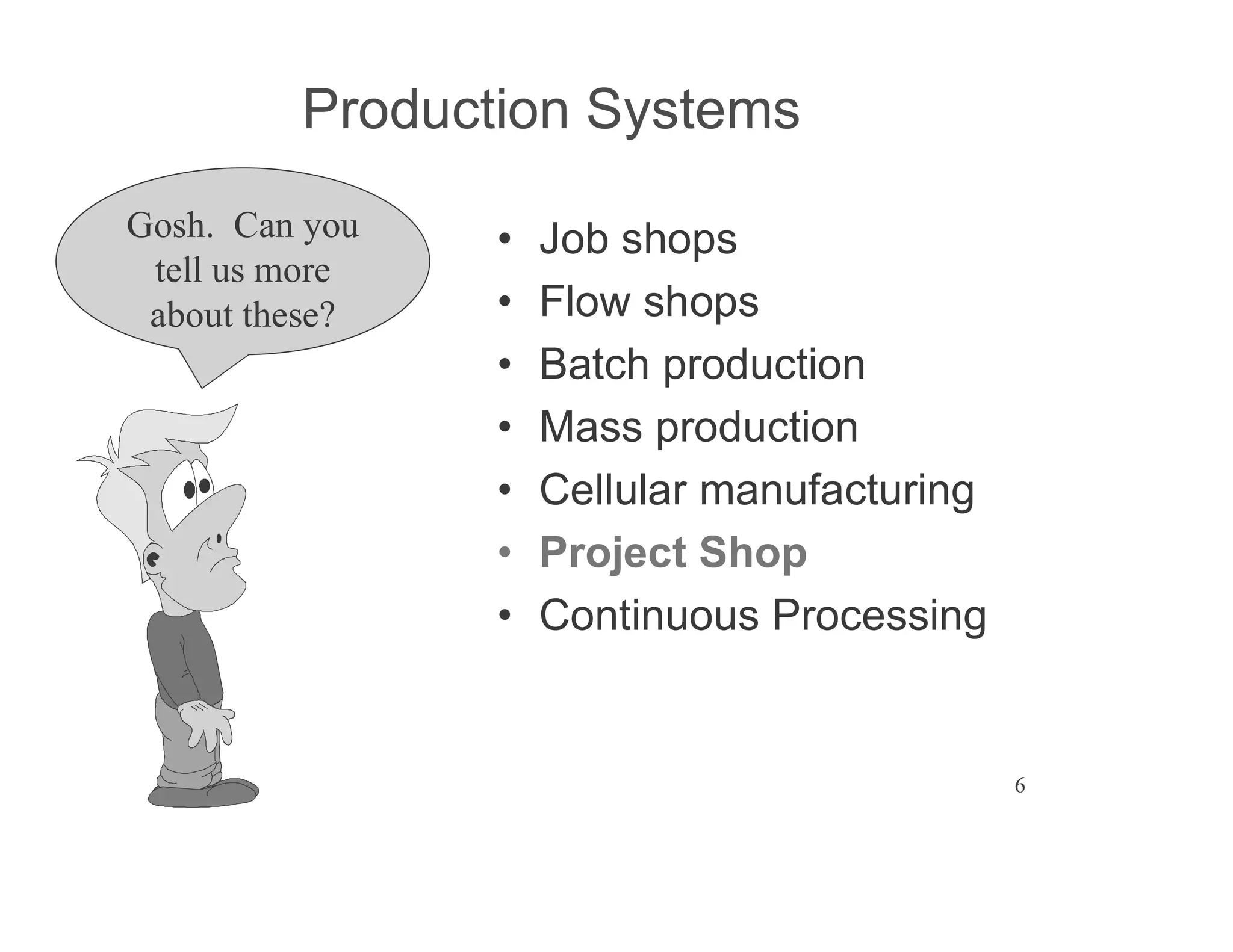
Production Systems
Job shops
Flow shops
Batch production
Mass production
Cellular manufacturing
Project Shop
Continuous Processing
Gosh. Can you
tell us more
about these?
7
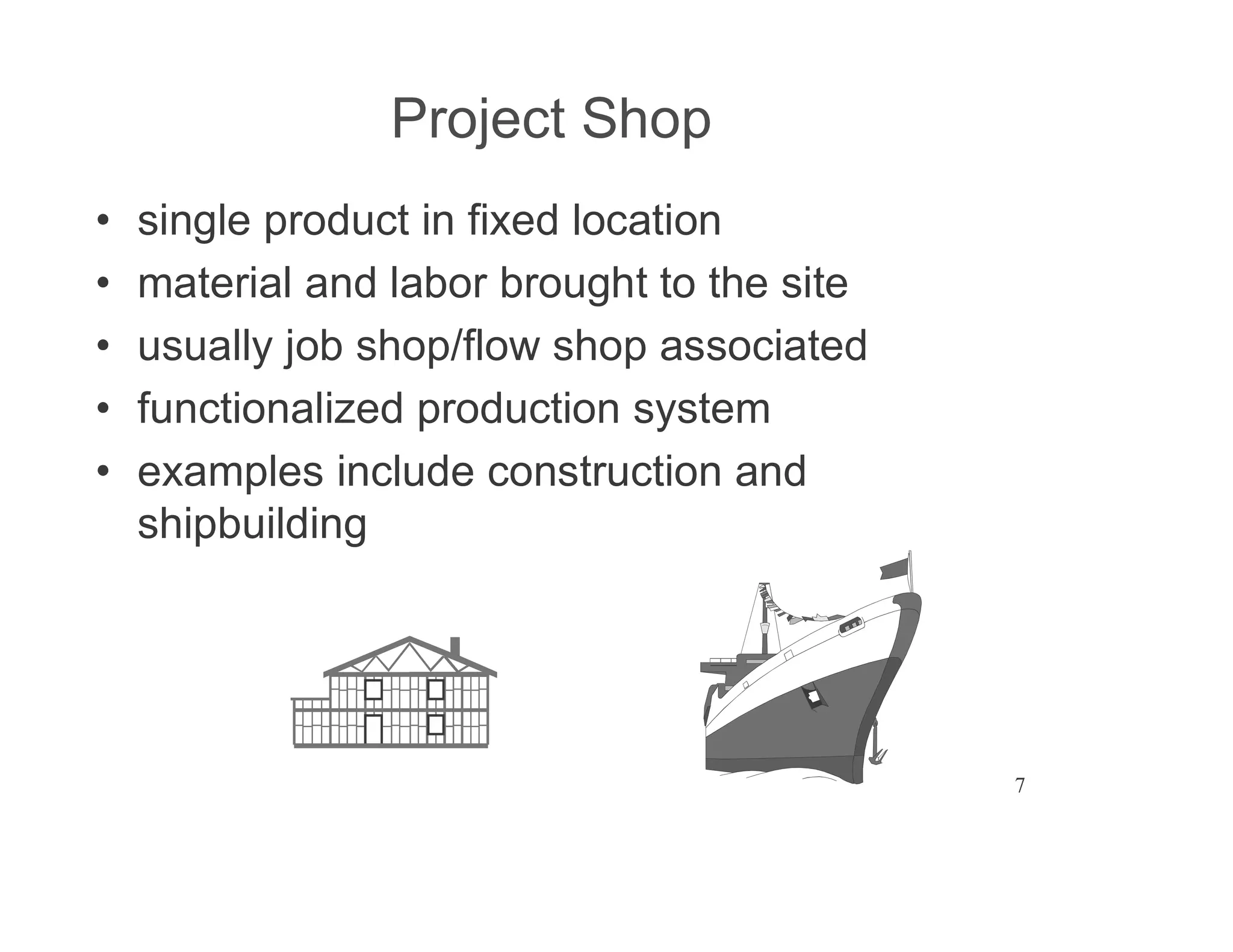
Project Shop
single product in fixed location
material and labor brought to the site
usually job shop/flow shop associated
functionalized production system
examples include construction and
shipbuilding
8
The Elements of Project Scheduling
Project Definition. Statement of project, goals, and
resources required.
Activity Definitions. Content and requirements of
each activity.
Project Scheduling. Specification of starting and
ending times of all activities.
Project Monitoring. Keeping track of the progress of
the project.
9
Definitions
Activity an effort (task) that requires resources and
takes a certain amount of time.
Event a specific accomplishment or milestone (the
start or finish of an activity).
Project a collection of activities and events leading
to a definable goal.
Network a graphical representation of a project
depicting the precedence relationships among the
activities and events.
Critical Activity an activity that if delayed will hold
up the scheduled completion of a project.
Critical Path the sequence of critical activities that
forms a continuous path from the start of a project to
its completion.
10
Framework for Analysis
Analyze project in terms of activities and
events
Determine sequence (precedence) of
activities (develop network)
Assign estimates of time, cost, and resources
to all activities
Identify the critical path
monitor, evaluate, and control progress of
project
11
Network Representation
Projects may be represented as networks with:
Arrows representing activities.
Nodes representing completion of a set of activities
(milestones).
Pseudo activities may be required to satisfy
precedence relationships.
12
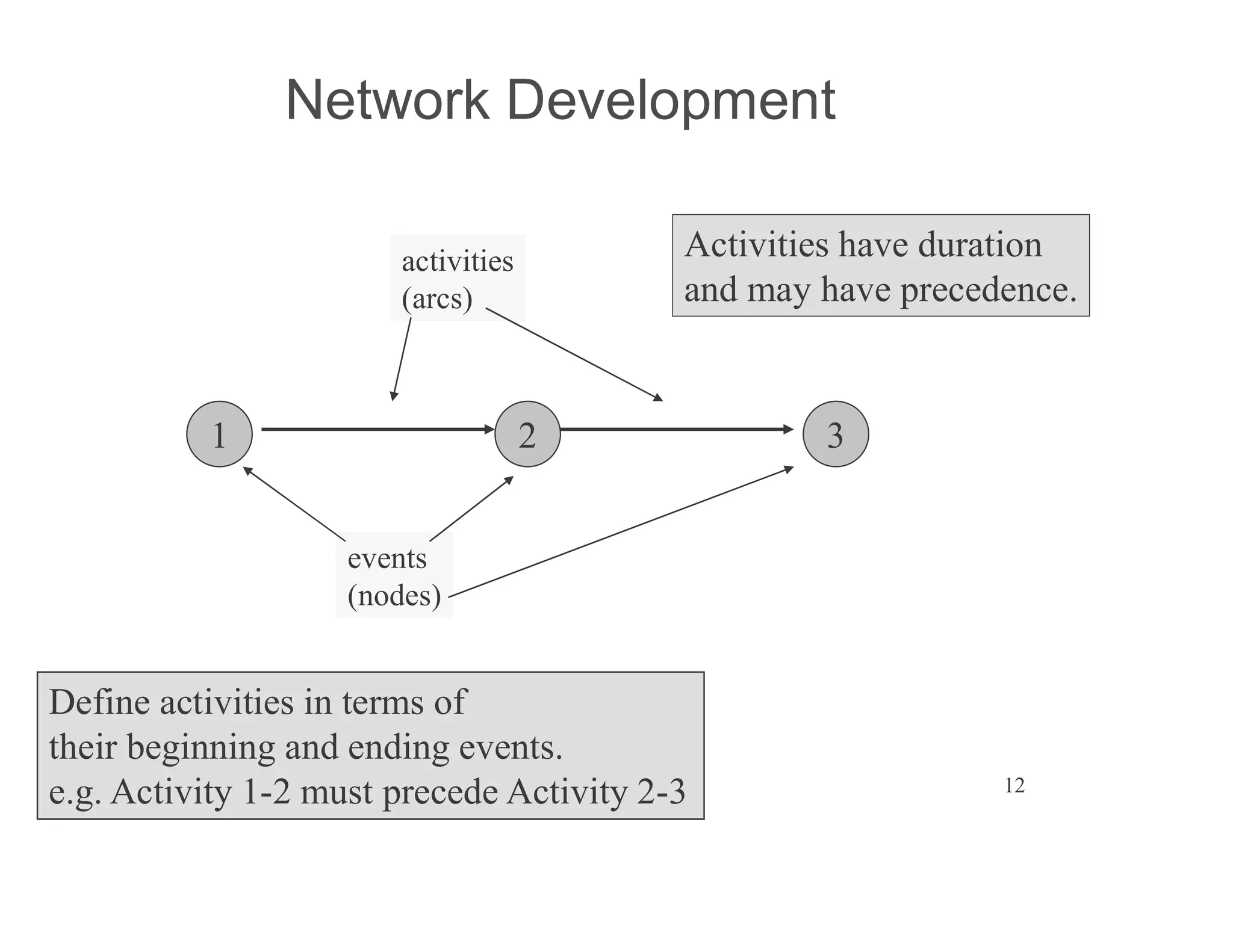
Network Development
1 2 3
events
(nodes)
activities
(arcs)
Activities have duration
and may have precedence.
Define activities in terms of
their beginning and ending events.
e.g. Activity 1-2 must precede Activity 2-3
13
Network Development (continued)
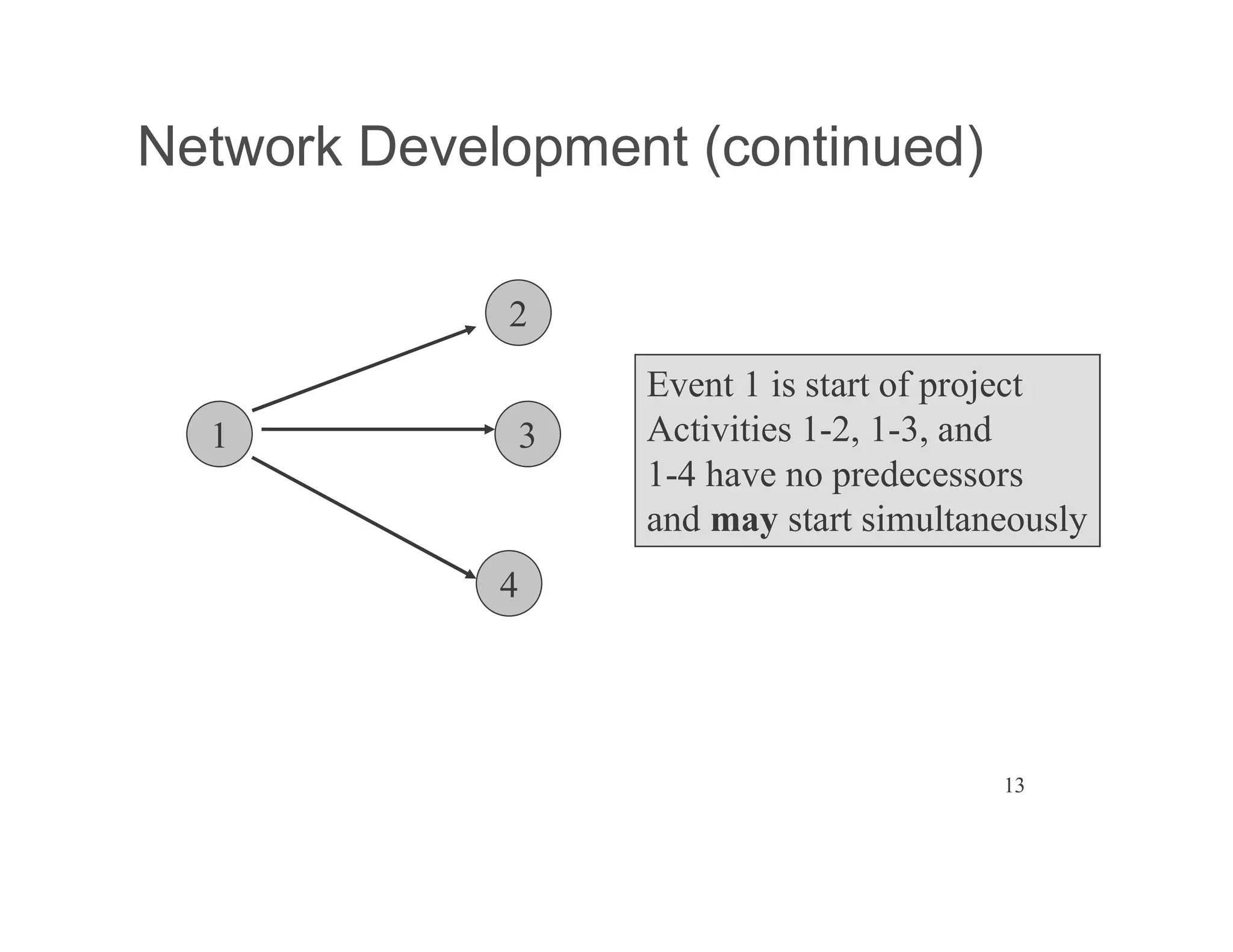
1
2
3
4
Event 1 is start of project
Activities 1-2, 1-3, and
1-4 have no predecessors
and may start simultaneously
14
Network Development (continued)
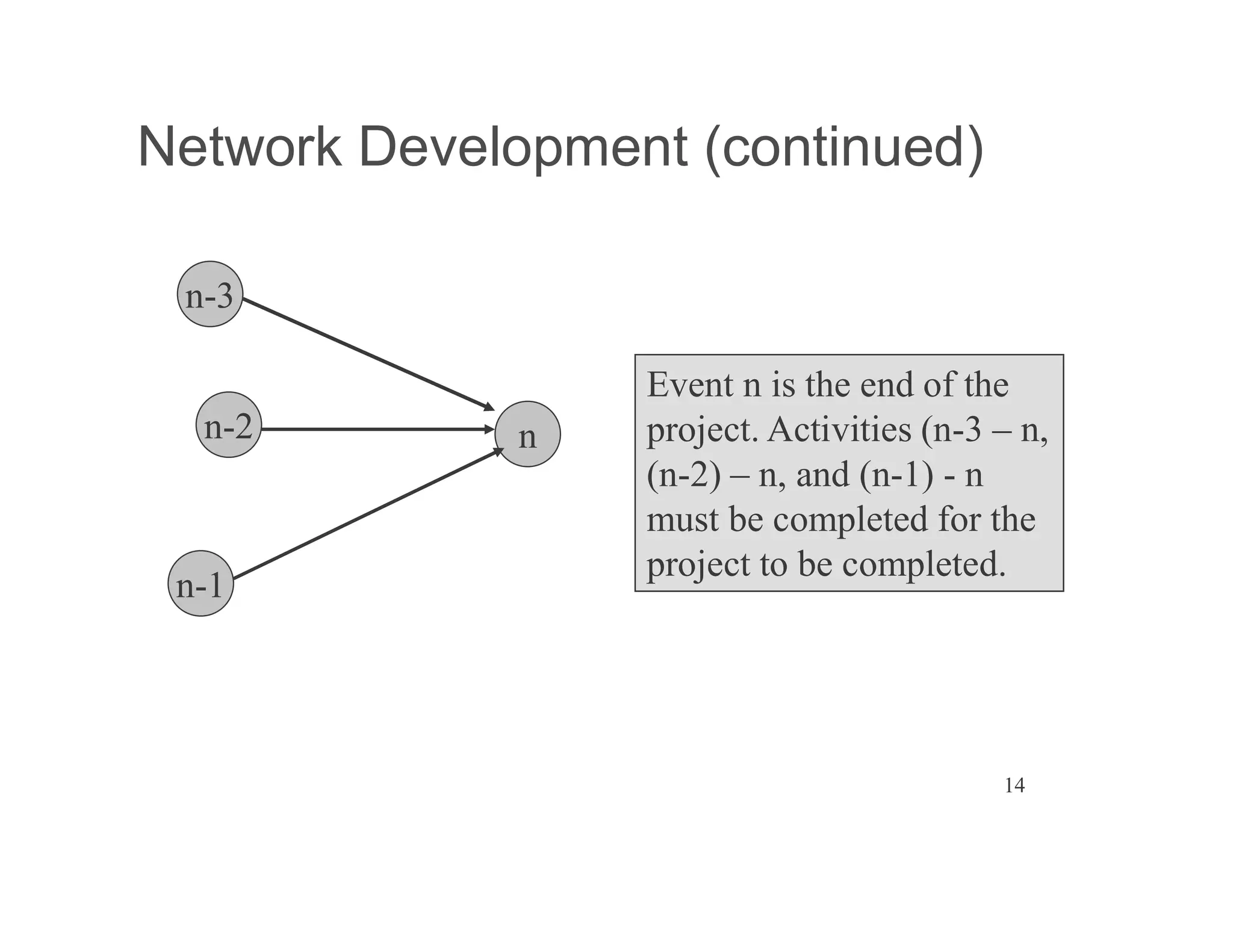
n-2
n-3
n
n-1
Event n is the end of the
project. Activities (n-3 n,
(n-2) n, and (n-1) - n
must be completed for the
project to be completed.
15
Network Development (continued)
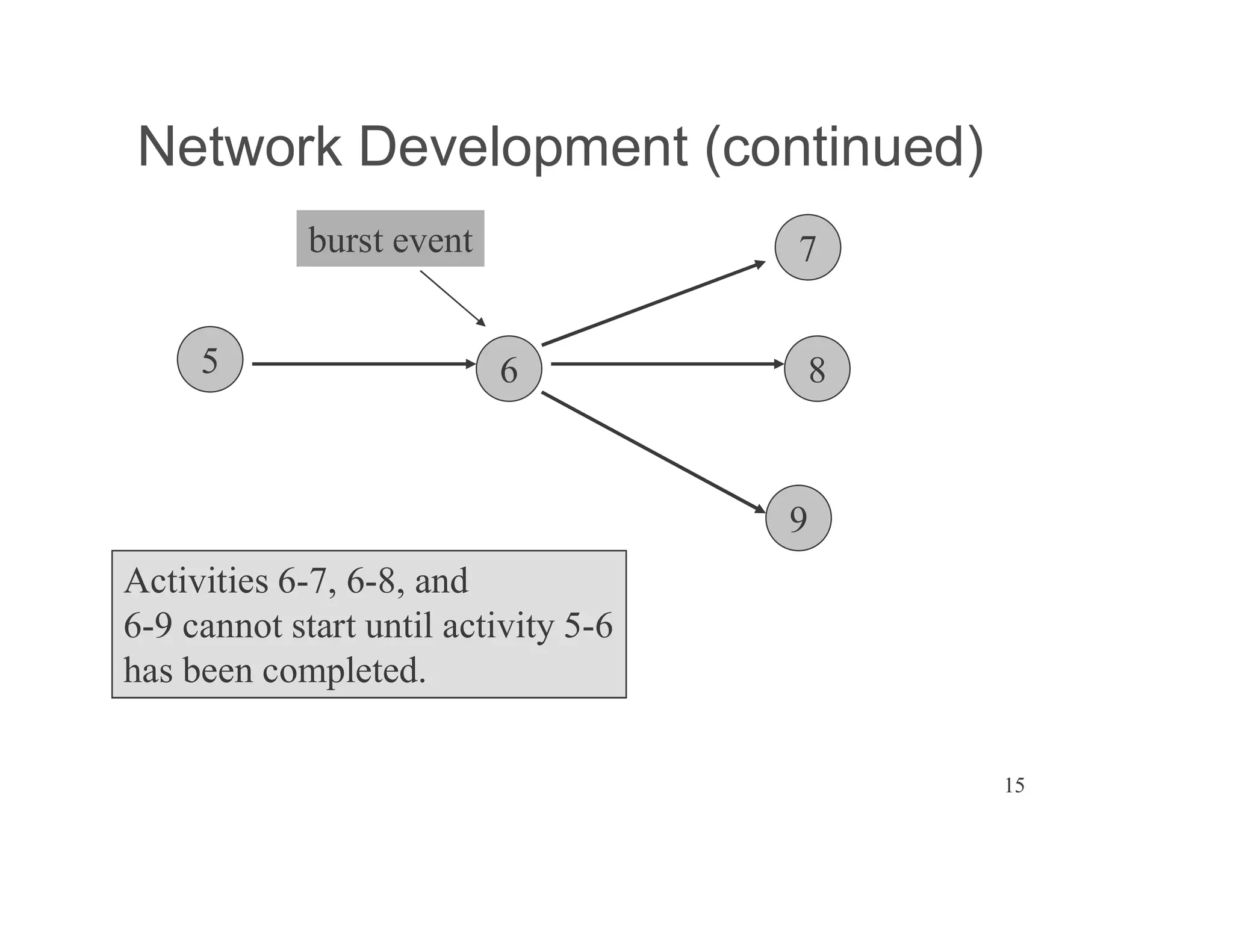
6
7
8
9
Activities 6-7, 6-8, and
6-9 cannot start until activity 5-6
has been completed.
5
burst event
16
Network Development (continued)
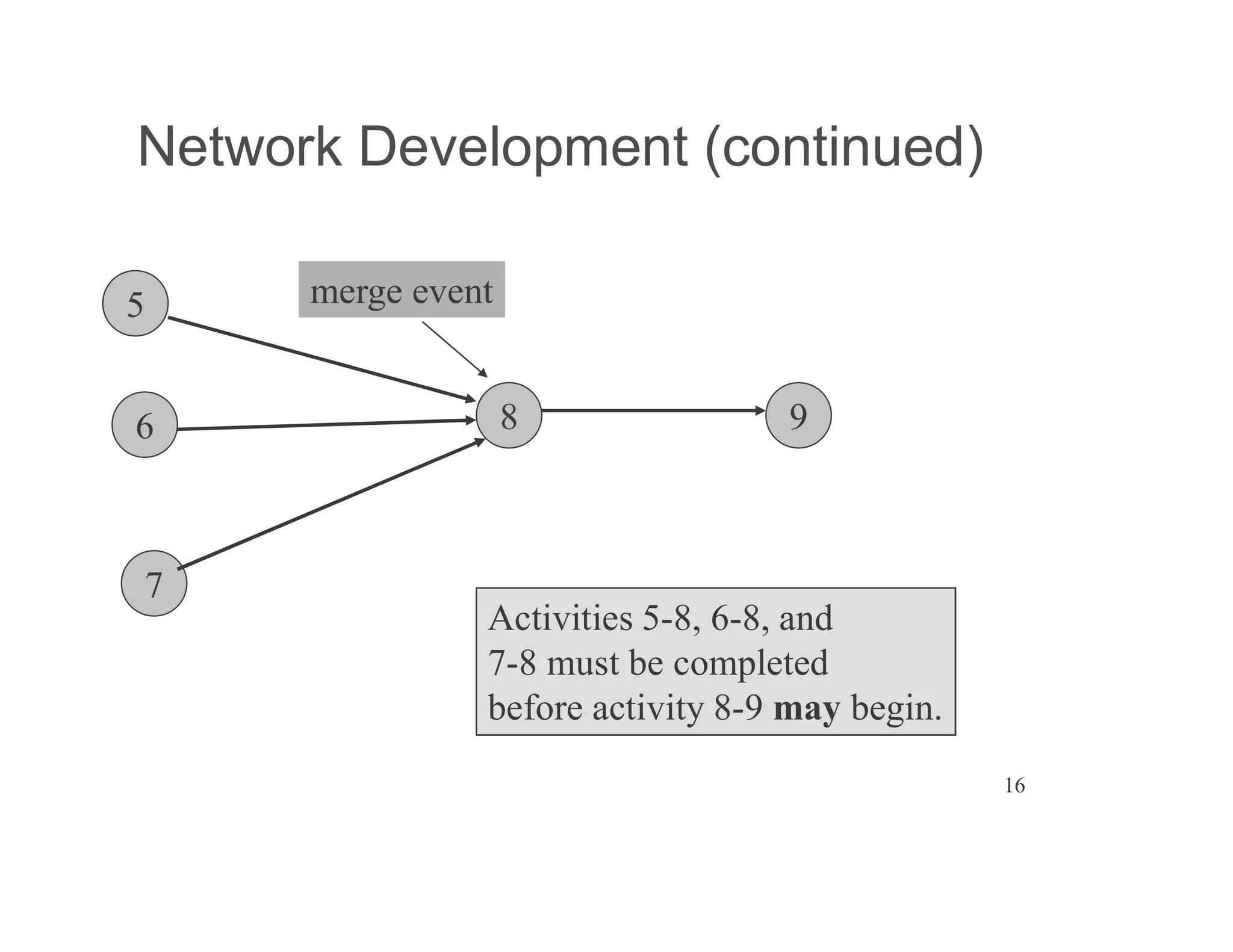
8
5
6
7
Activities 5-8, 6-8, and
7-8 must be completed
before activity 8-9 may begin.
9
merge event
17
Network Development (continued)
8
5
6
7
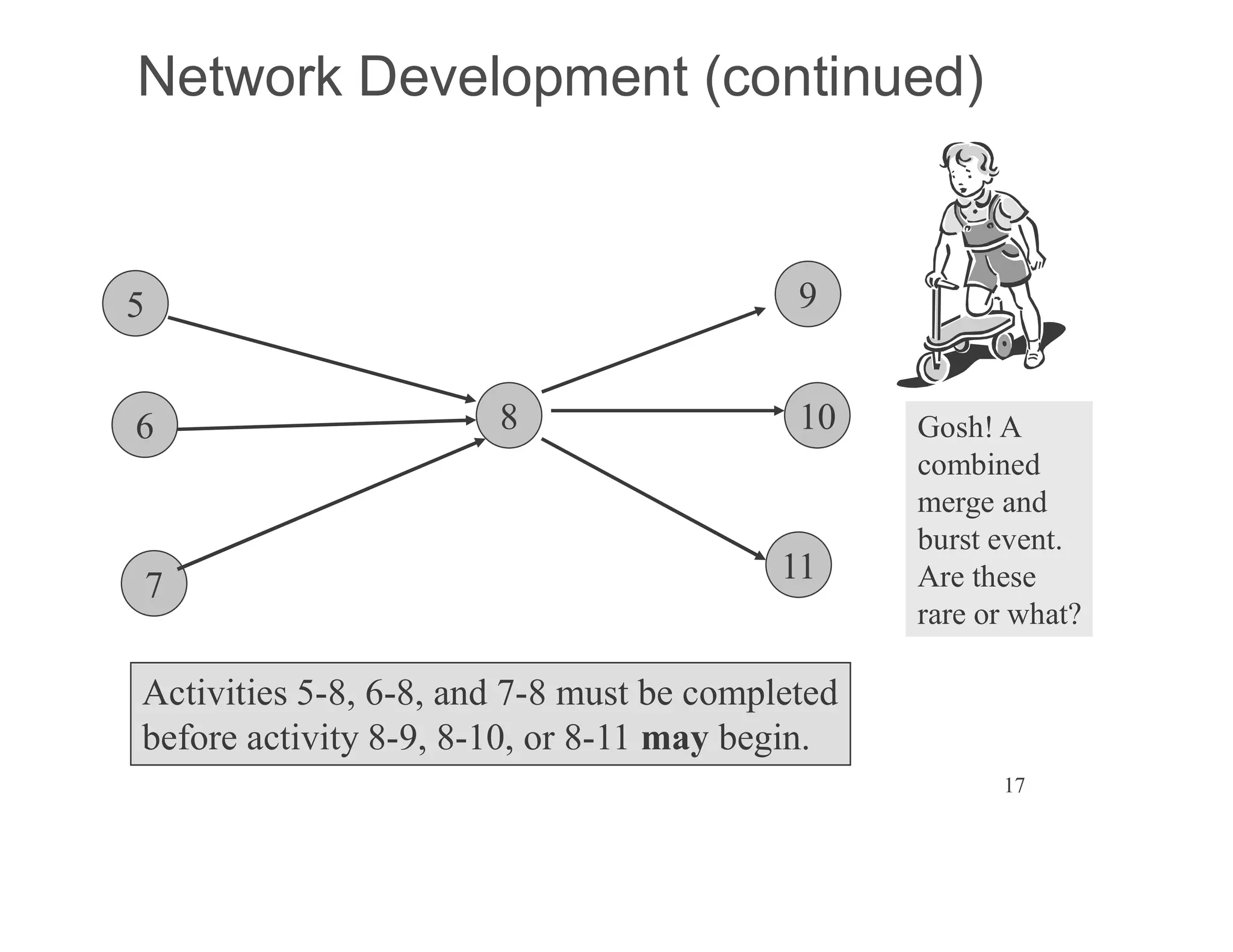
Activities 5-8, 6-8, and 7-8 must be completed
before activity 8-9, 8-10, or 8-11 may begin.
9
10
11
Gosh! A
combined
merge and
burst event.
Are these
rare or what?
18
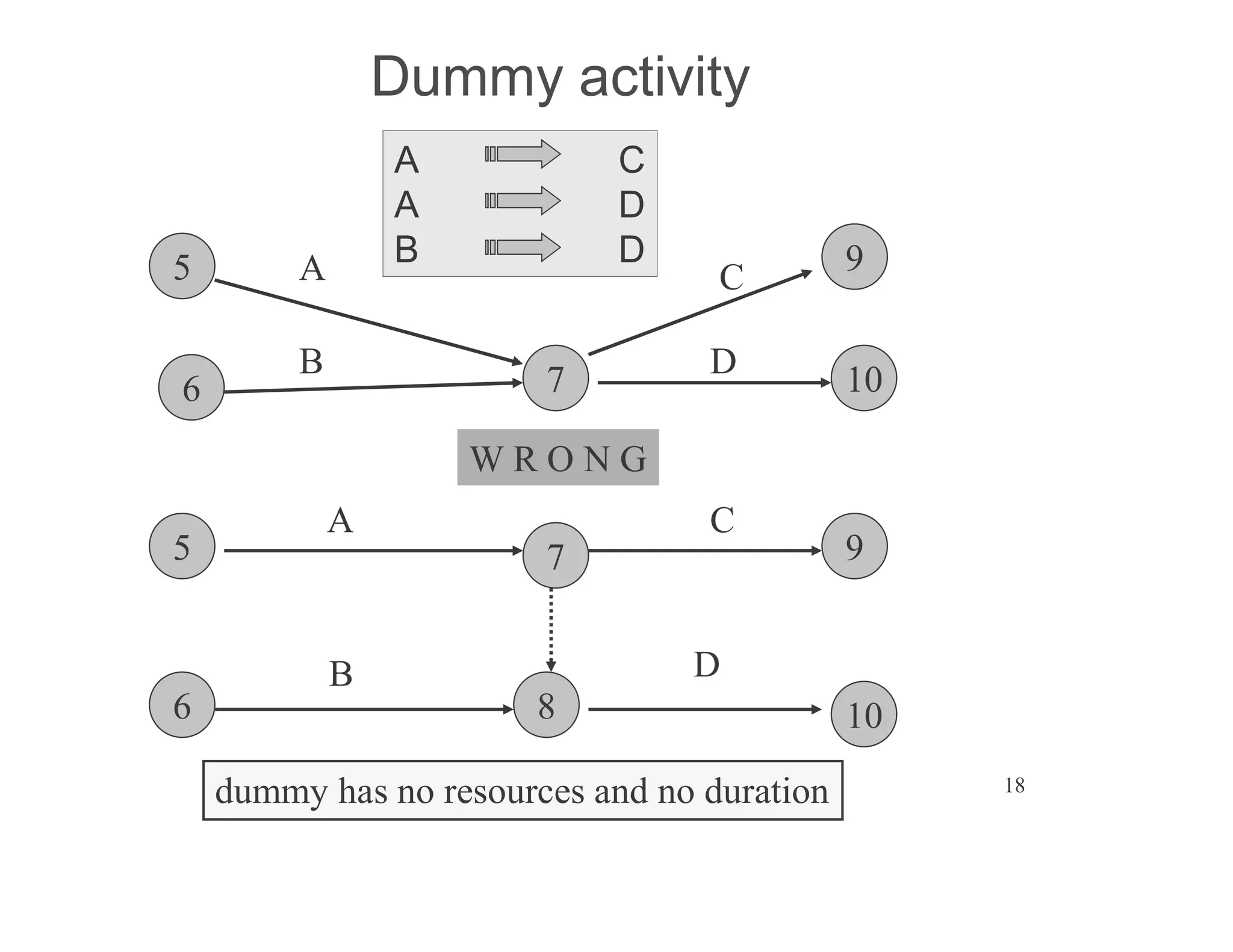
Dummy activity
A C
A D
B D
W R O N G
7
5
6
9
10
A
B
C
D
7
5
6
9
10
A
B D
C
8
dummy has no resources and no duration
19
Project Networks
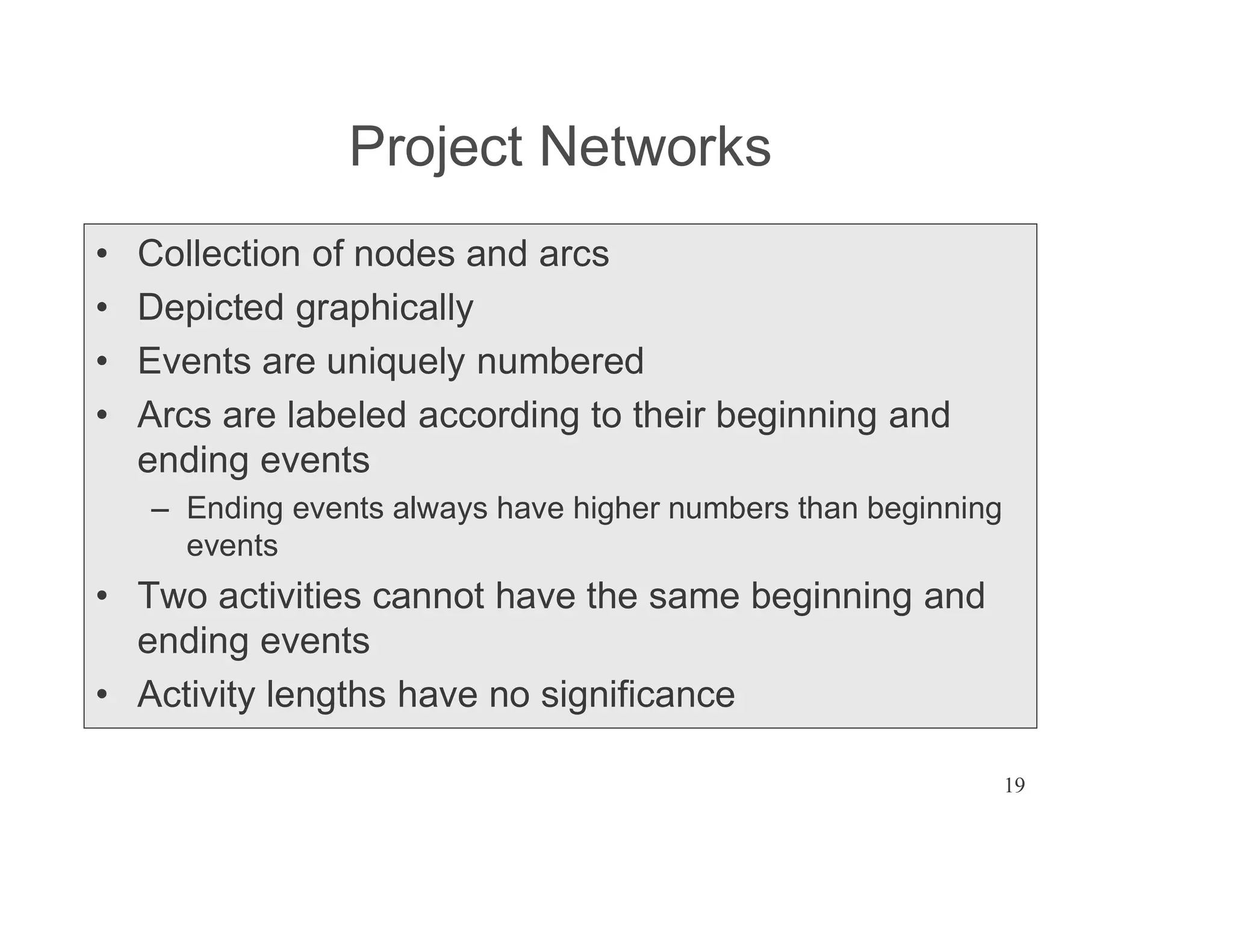
Collection of nodes and arcs
Depicted graphically
Events are uniquely numbered
Arcs are labeled according to their beginning and
ending events
Ending events always have higher numbers than beginning
events
Two activities cannot have the same beginning and
ending events
Activity lengths have no significance
20
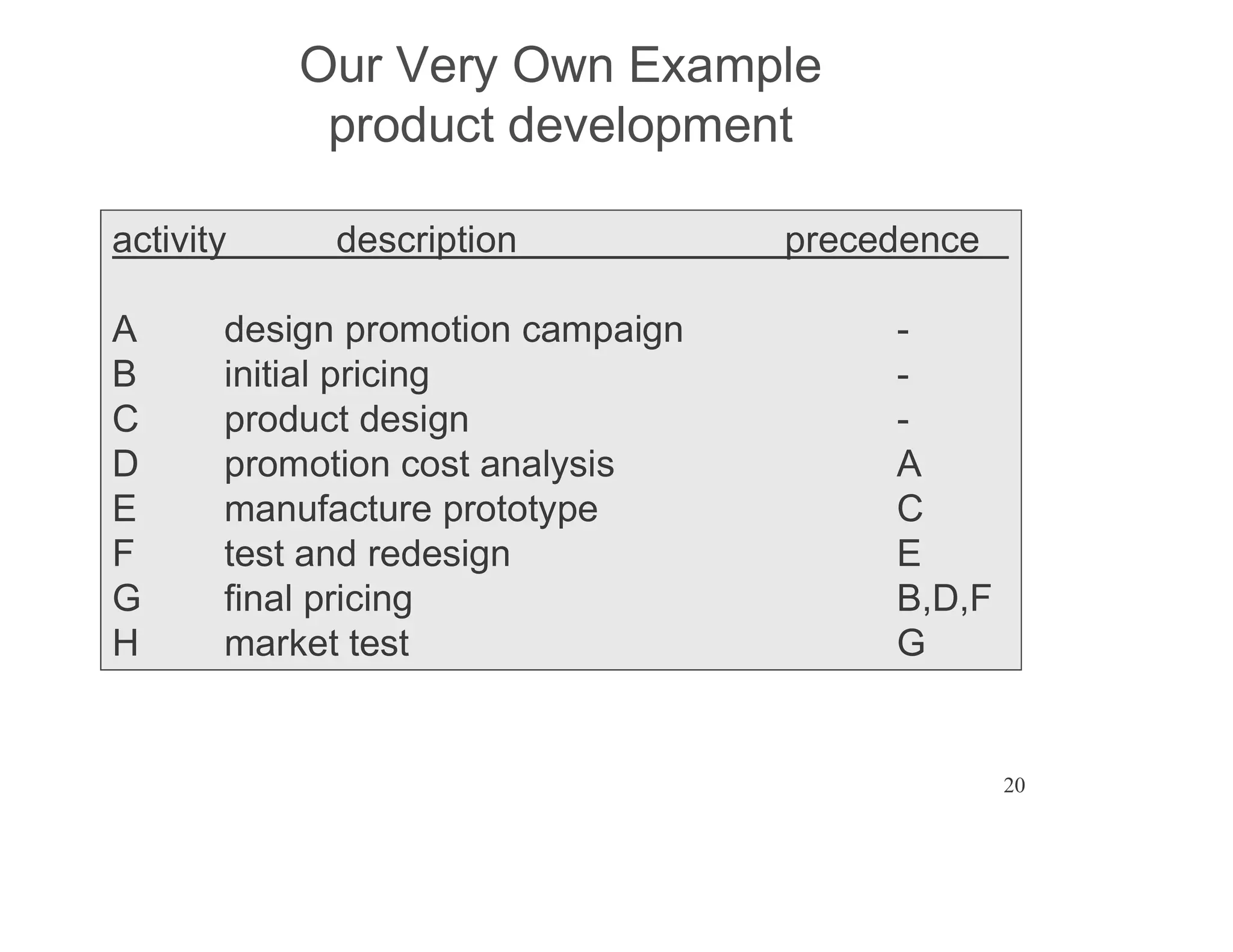
Our Very Own Example
product development
activity description precedence
A design promotion campaign -
B initial pricing -
C product design -
D promotion cost analysis A
E manufacture prototype C
F test and redesign E
G final pricing B,D,F
H market test G
21
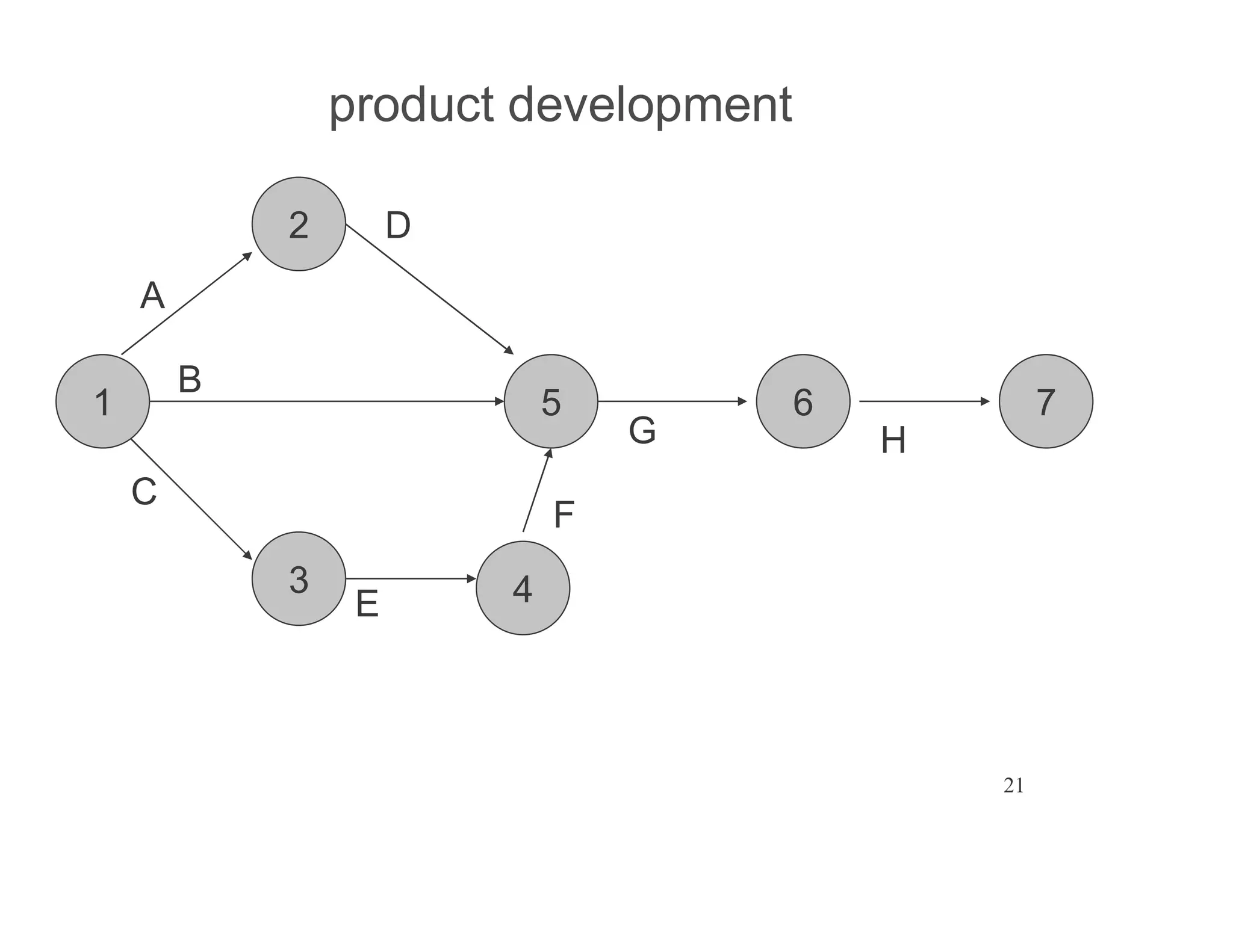
product development
1
2
3 4
6 7
5
A
B
C
D
E
F
G H
22
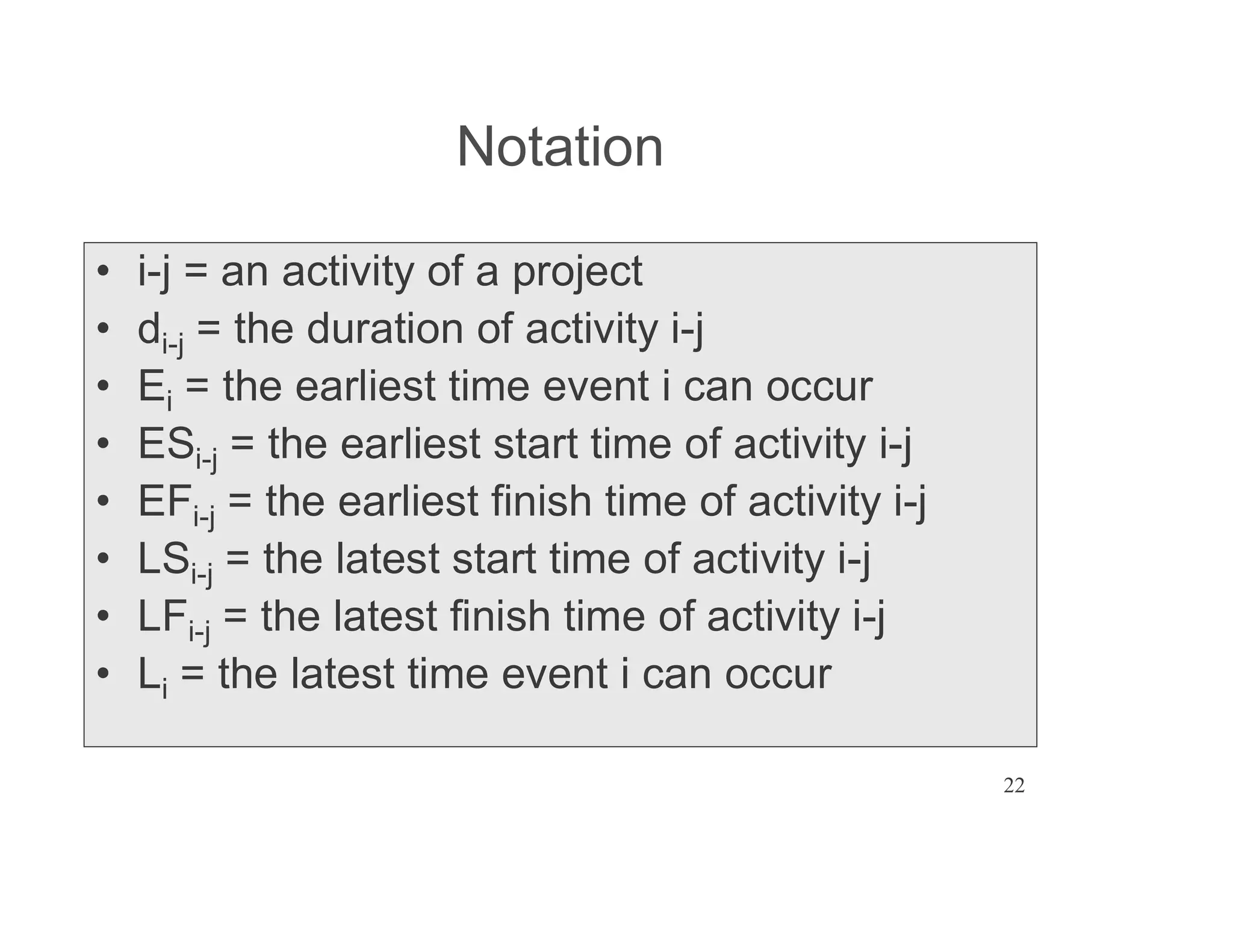
Notation
i-j = an activity of a project
di-j = the duration of activity i-j
Ei = the earliest time event i can occur
ESi-j = the earliest start time of activity i-j
EFi-j = the earliest finish time of activity i-j
LSi-j = the latest start time of activity i-j
LFi-j = the latest finish time of activity i-j
Li = the latest time event i can occur
23
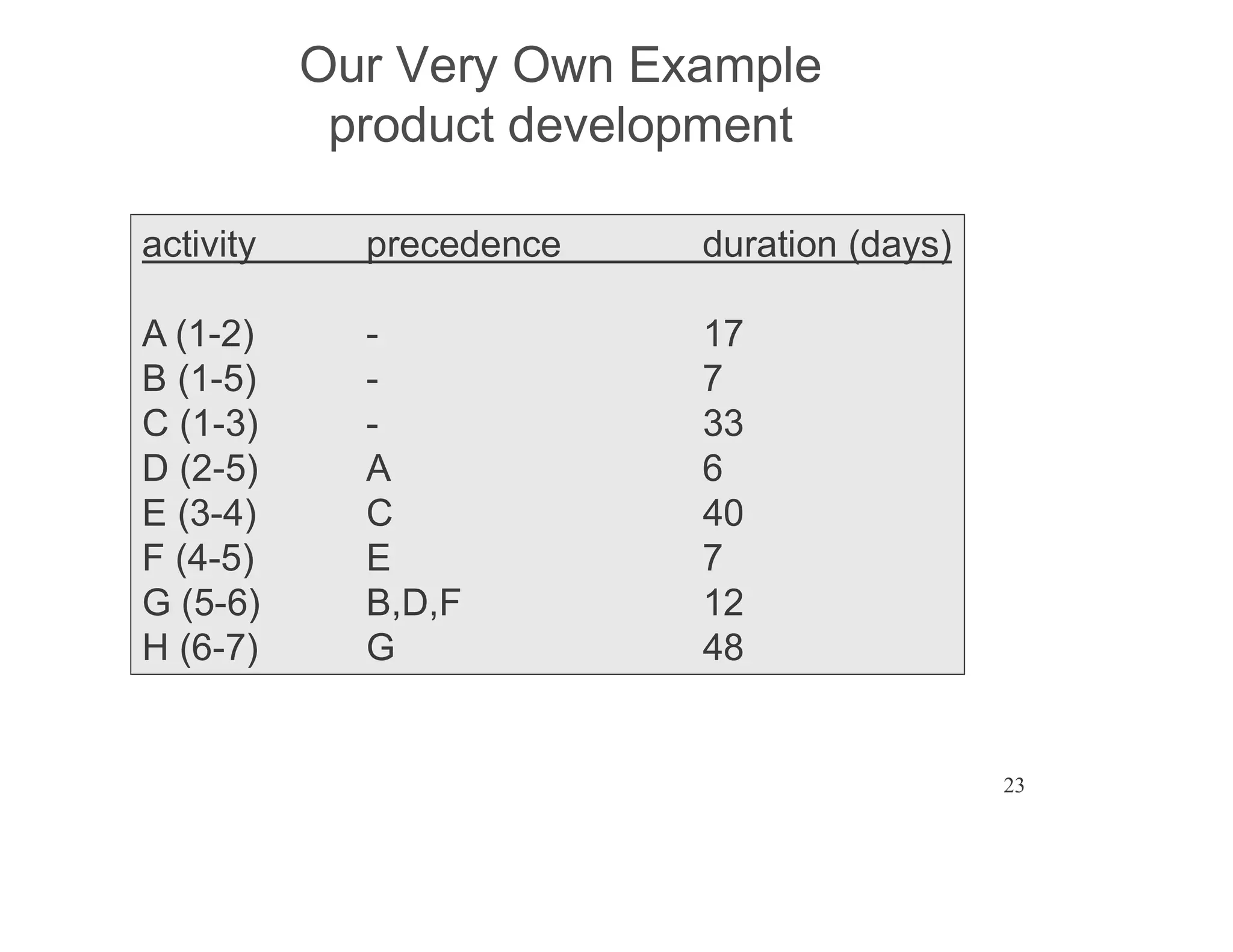
Our Very Own Example
product development
activity precedence duration (days)
A (1-2) - 17
B (1-5) - 7
C (1-3) - 33
D (2-5) A 6
E (3-4) C 40
F (4-5) E 7
G (5-6) B,D,F 12
H (6-7) G 48
24
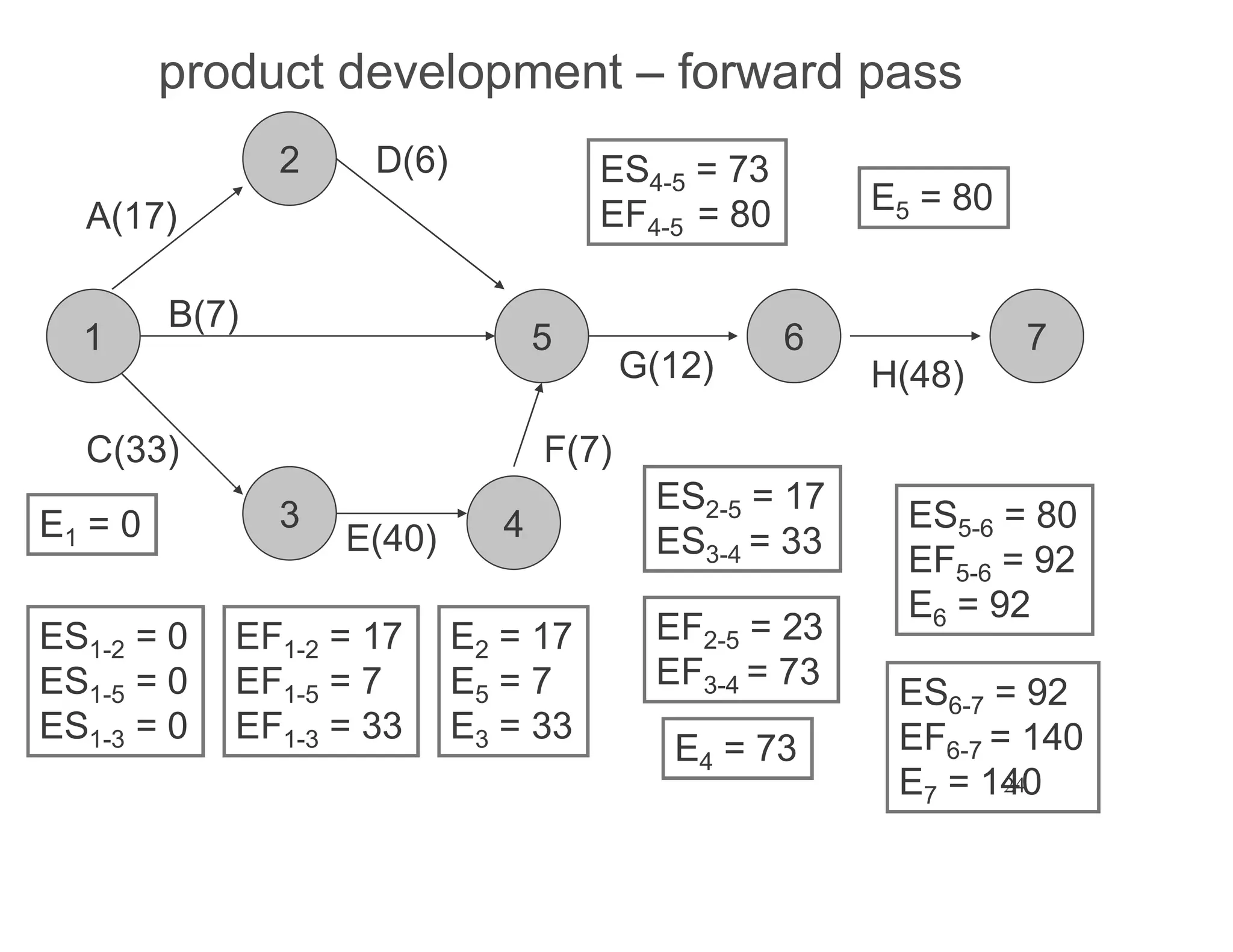
product development forward pass
1
2
3 4
6 7
5
A(17)
B(7)
C(33)
D(6)
E(40)
F(7)
G(12) H(48)
E1 = 0
ES1-2 = 0
ES1-5 = 0
ES1-3 = 0
EF1-2 = 17
EF1-5 = 7
EF1-3 = 33
E2 = 17
E5 = 7
E3 = 33
ES5-6 = 80
EF5-6 = 92
E6 = 92
ES2-5 = 17
ES3-4 = 33
EF2-5 = 23
EF3-4 = 73
E4 = 73
ES4-5 = 73
EF4-5 = 80 E5 = 80
ES6-7 = 92
EF6-7 = 140
E7 = 140
25
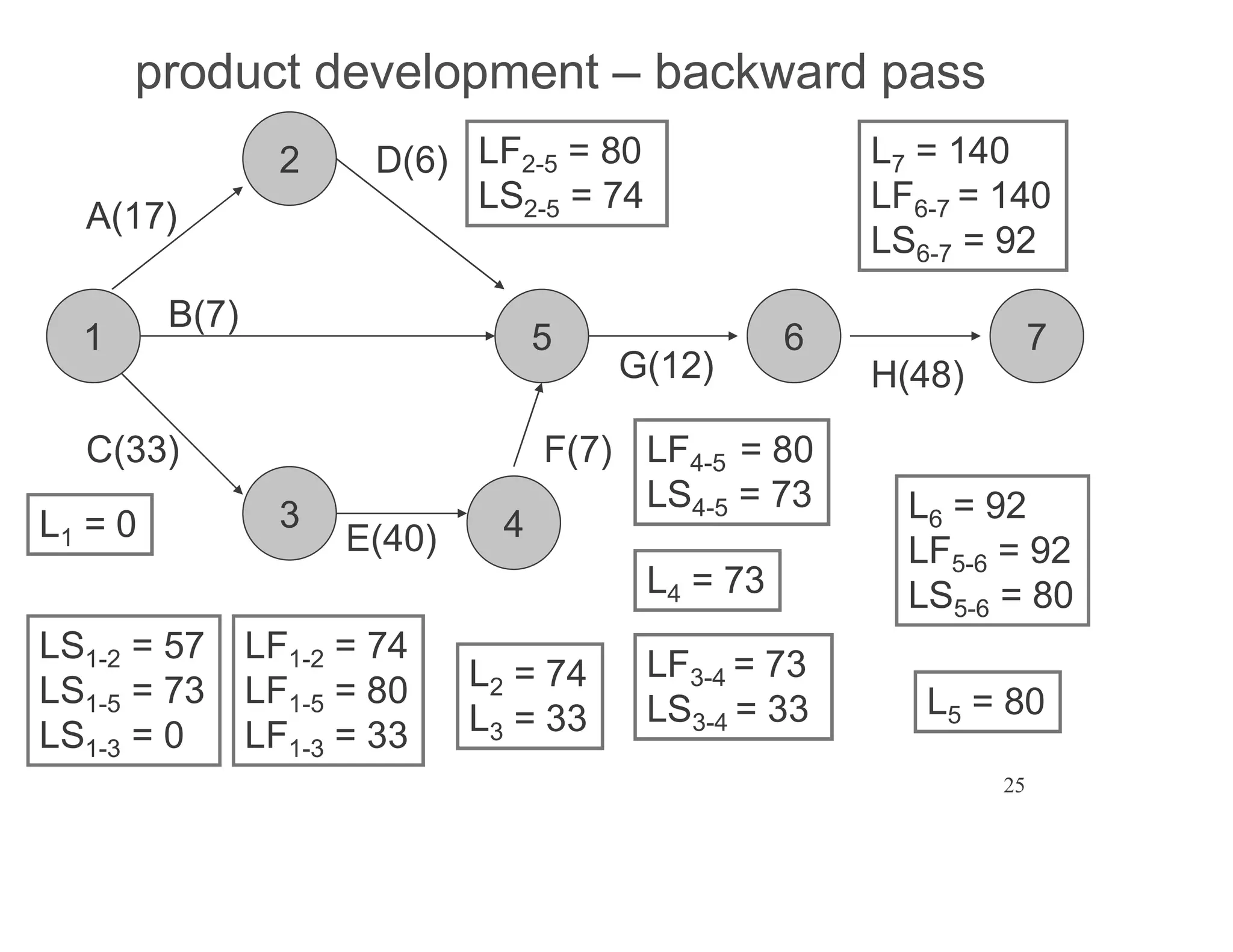
product development backward pass
1
2
3 4
6 7
5
A(17)
B(7)
C(33)
D(6)
E(40)
F(7)
G(12) H(48)
L1 = 0
LF1-2 = 74
LF1-5 = 80
LF1-3 = 33
L2 = 74
L3 = 33
L6 = 92
LF5-6 = 92
LS5-6 = 80
LF2-5 = 80
LS2-5 = 74
LF3-4 = 73
LS3-4 = 33
L4 = 73
LF4-5 = 80
LS4-5 = 73
L5 = 80
L7 = 140
LF6-7 = 140
LS6-7 = 92
LS1-2 = 57
LS1-5 = 73
LS1-3 = 0
26
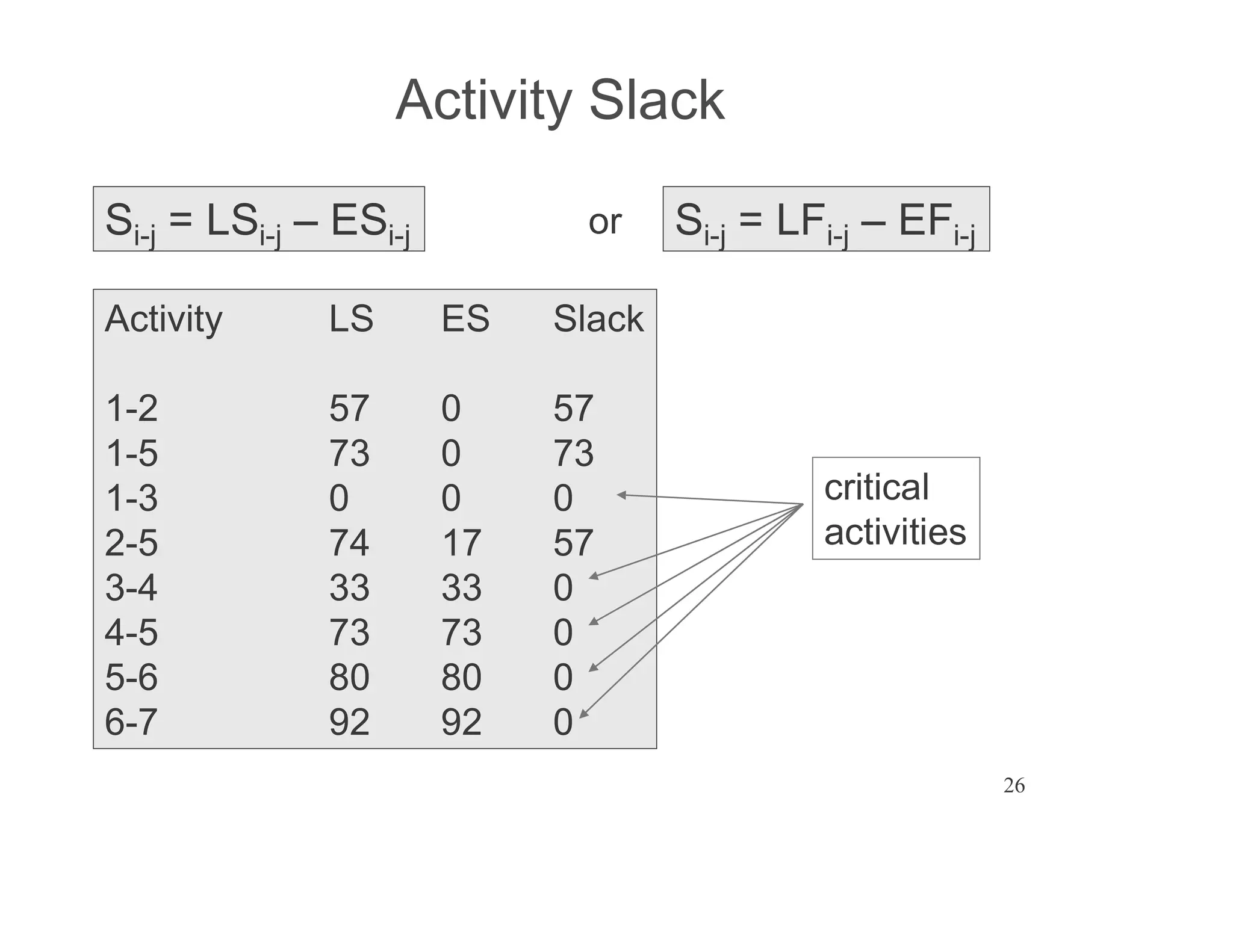
Activity Slack
Si-j = LSi-j ESi-j Si-j = LFi-j EFi-j
or
Activity LS ES Slack
1-2 57 0 57
1-5 73 0 73
1-3 0 0 0
2-5 74 17 57
3-4 33 33 0
4-5 73 73 0
5-6 80 80 0
6-7 92 92 0
critical
activities
27
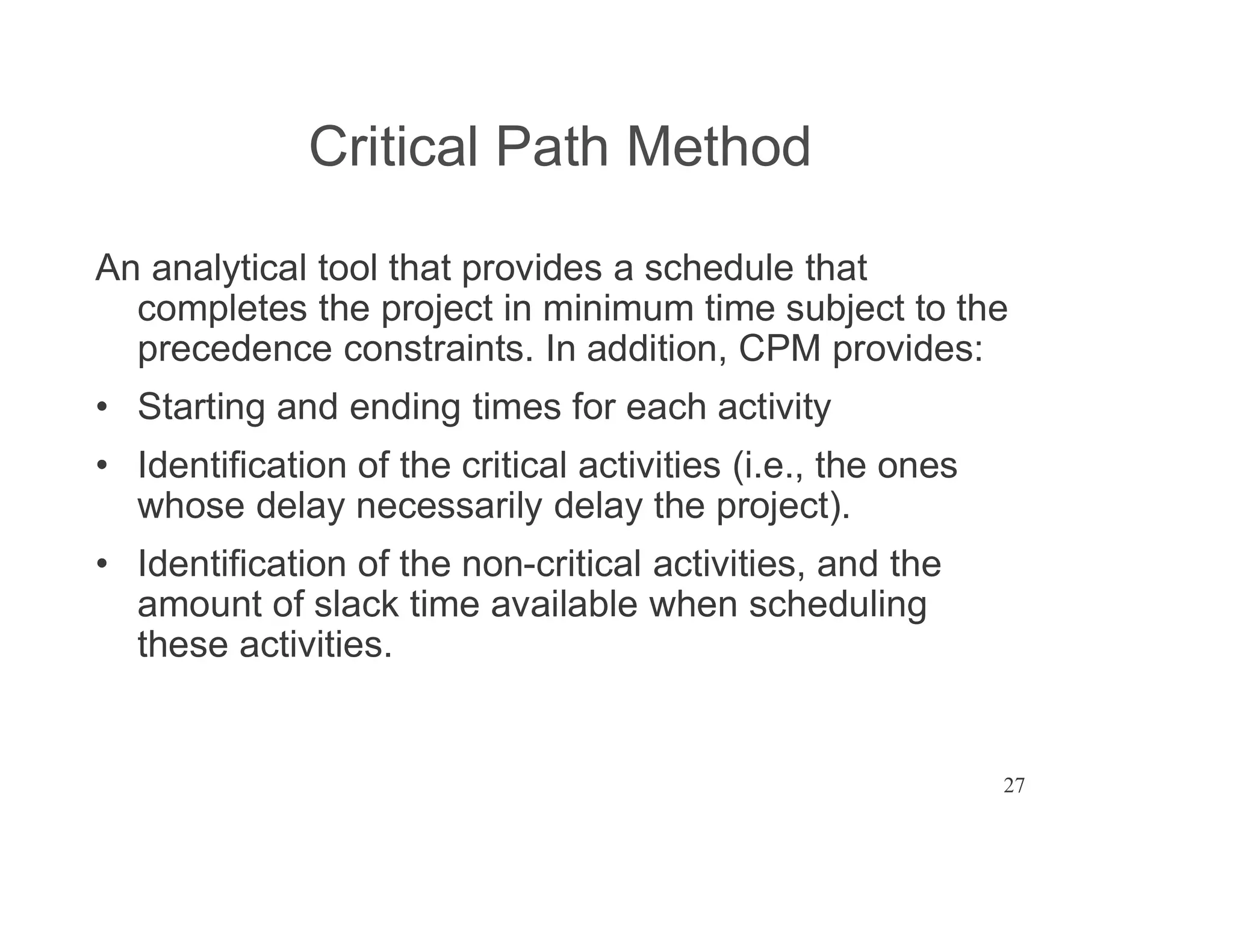
Critical Path Method
An analytical tool that provides a schedule that
completes the project in minimum time subject to the
precedence constraints. In addition, CPM provides:
Starting and ending times for each activity
Identification of the critical activities (i.e., the ones
whose delay necessarily delay the project).
Identification of the non-critical activities, and the
amount of slack time available when scheduling
these activities.
28
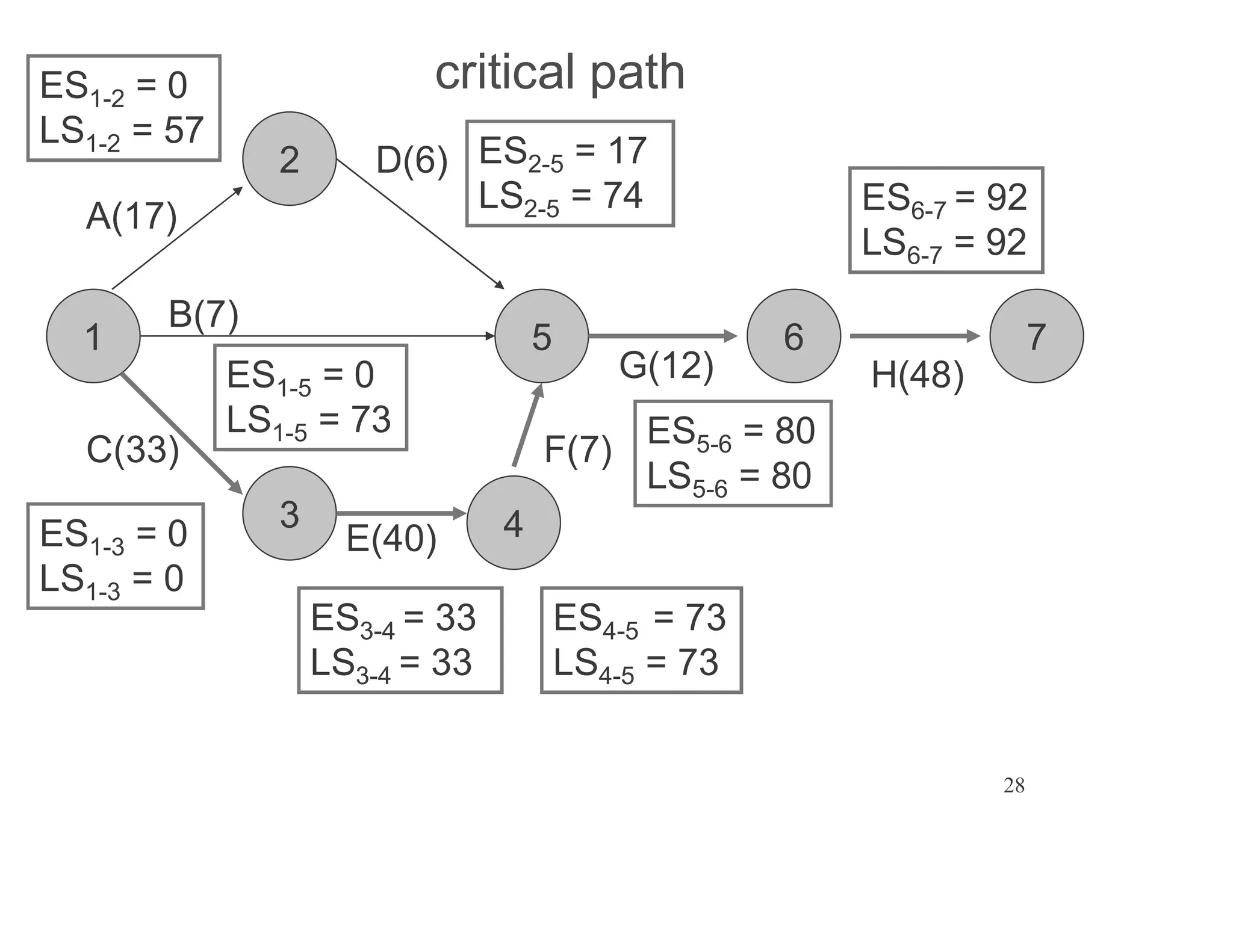
critical path
1
2
3 4
6 7
5
A(17)
B(7)
C(33)
D(6)
E(40)
F(7)
G(12) H(48)
ES1-3 = 0
LS1-3 = 0
ES5-6 = 80
LS5-6 = 80
ES3-4 = 33
LS3-4 = 33
ES4-5 = 73
LS4-5 = 73
ES6-7 = 92
LS6-7 = 92
ES1-5 = 0
LS1-5 = 73
ES2-5 = 17
LS2-5 = 74
ES1-2 = 0
LS1-2 = 57
29
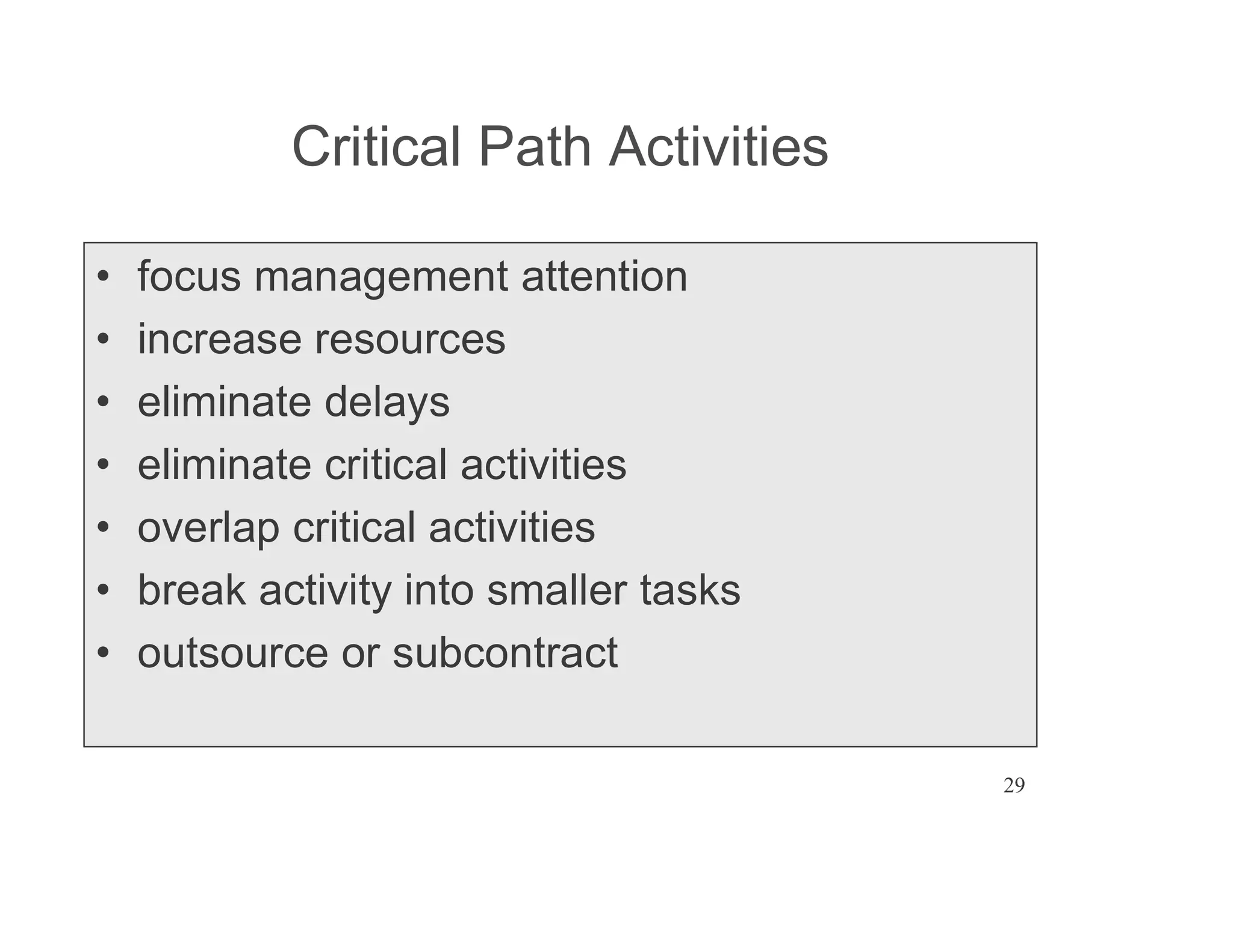
Critical Path Activities
focus management attention
increase resources
eliminate delays
eliminate critical activities
overlap critical activities
break activity into smaller tasks
outsource or subcontract
30
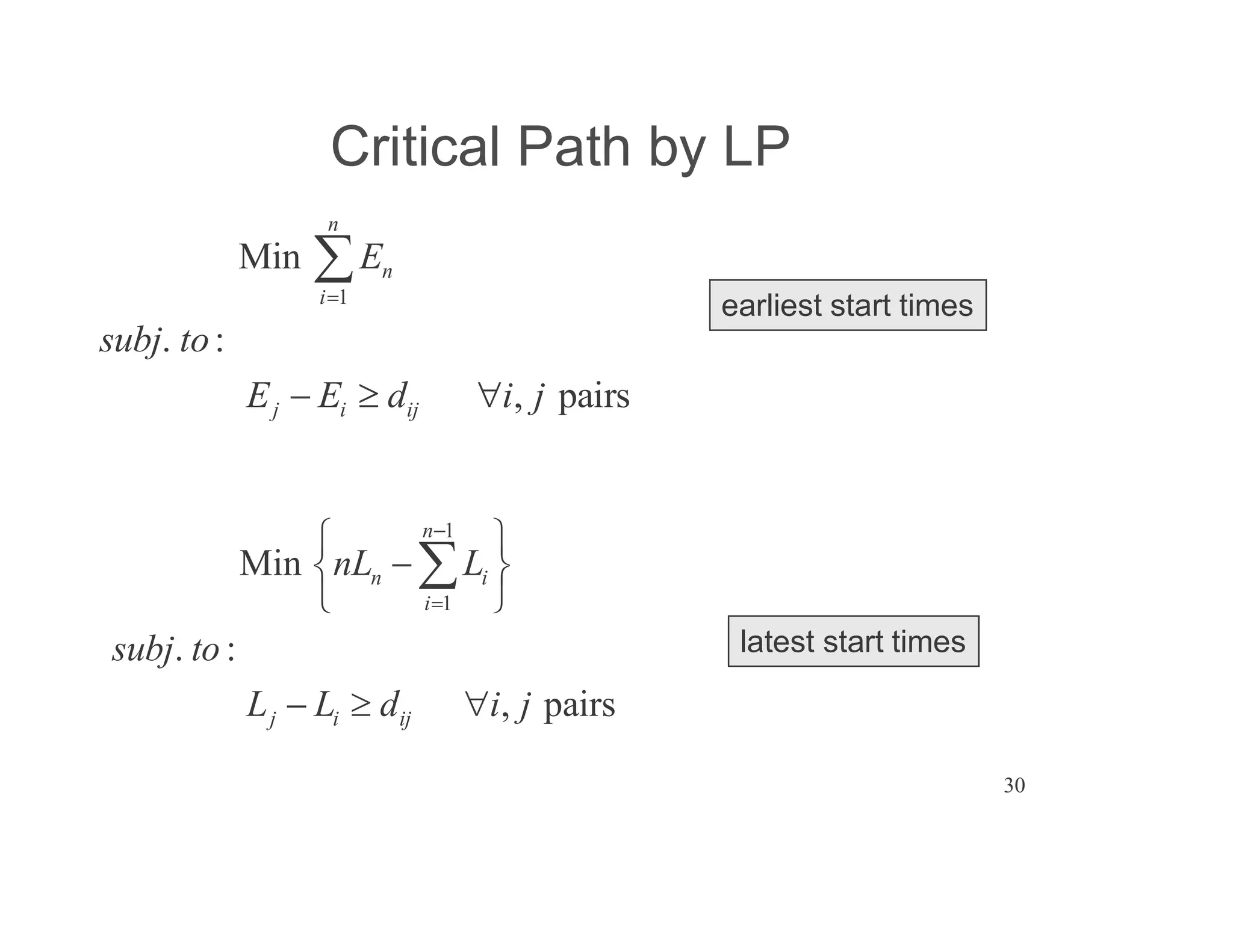
Critical Path by LP
1
Min
. :
, pairs
n
n
i
j i ij
E
subj to
E E d i j
earliest start times
1
1
Min
. :
, pairs
n
n i
i
j i ij
nL L
subj to
L L d i j
latest start times
31
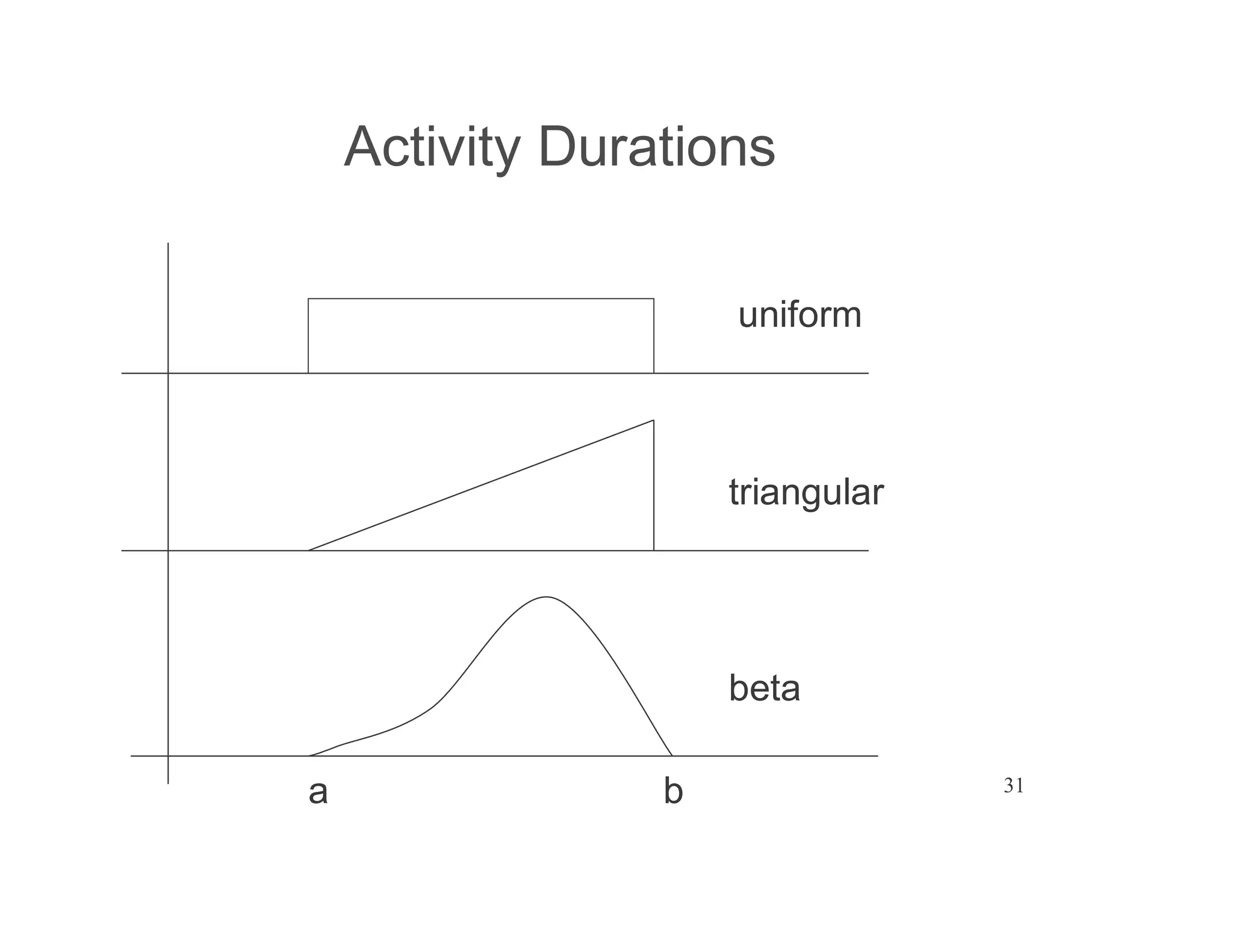
Activity Durations
a b
uniform
triangular
beta
32
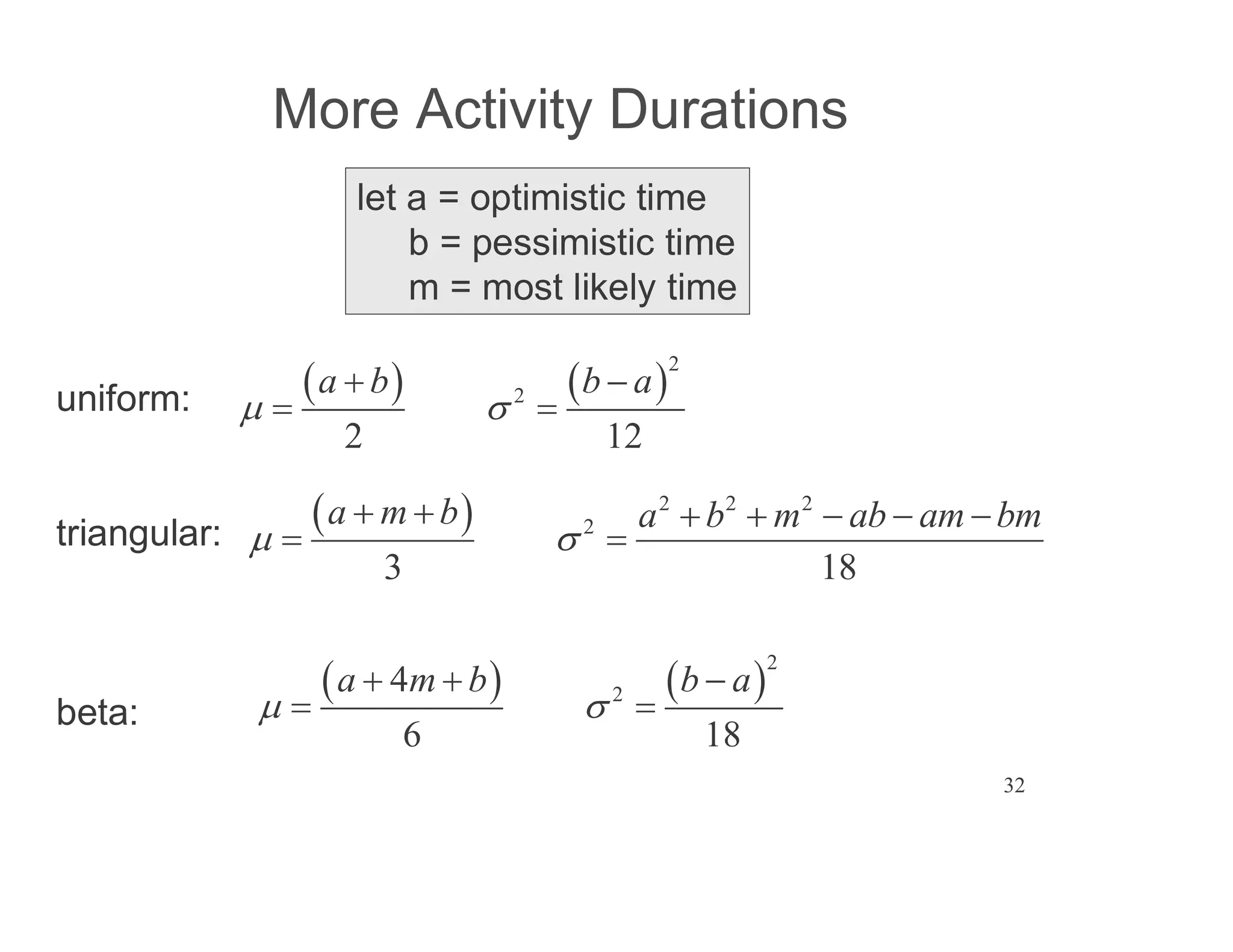
More Activity Durations
let a = optimistic time
b = pessimistic time
m = most likely time
2
2
2 12
a b b a
2 2 2
2
3 18
a m b a b m ab am bm
2
2
4
6 18
a m b b a
uniform:
triangular:
beta:
33
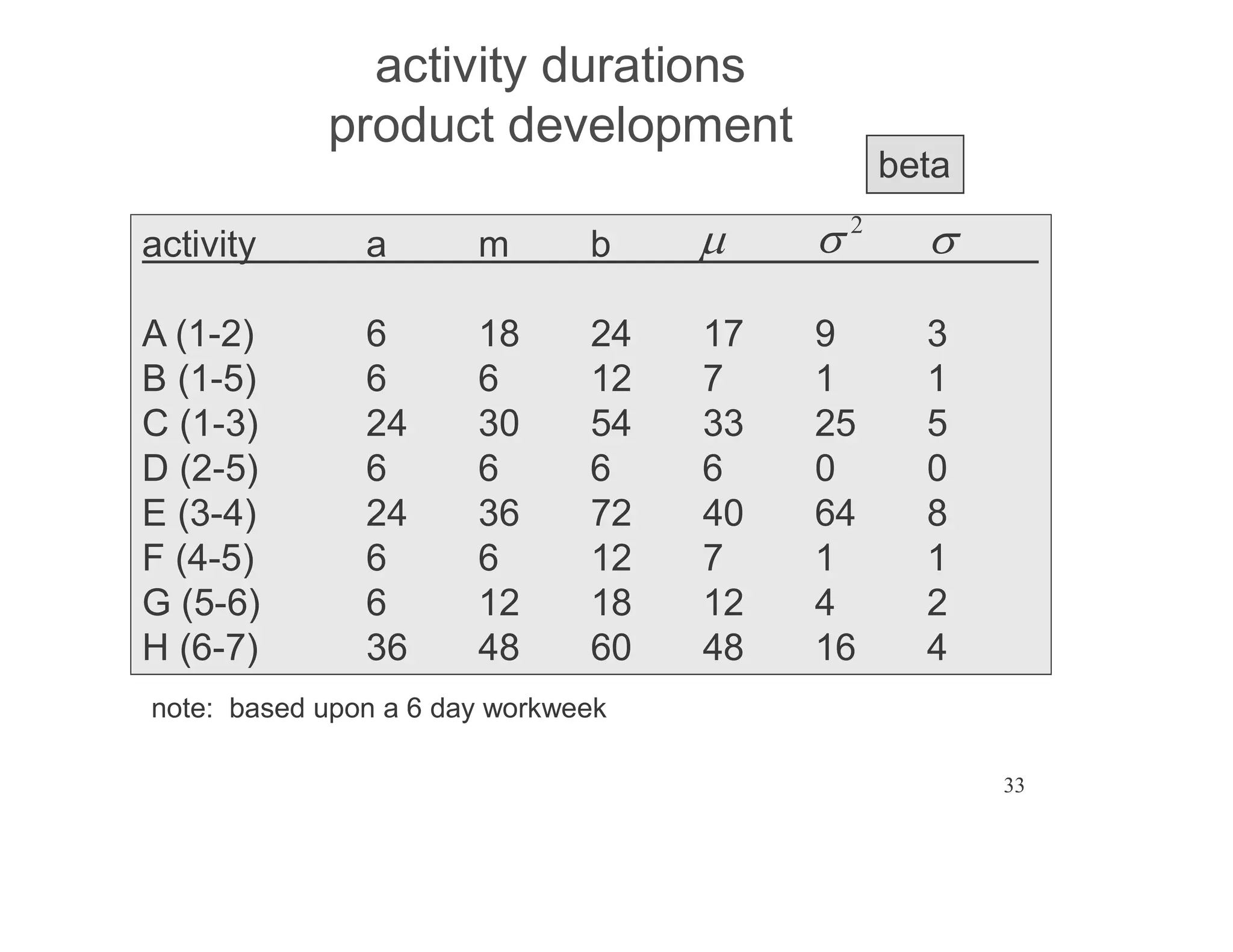
activity durations
product development
activity a m b
A (1-2) 6 18 24 17 9 3
B (1-5) 6 6 12 7 1 1
C (1-3) 24 30 54 33 25 5
D (2-5) 6 6 6 6 0 0
E (3-4) 24 36 72 40 64 8
F (4-5) 6 6 12 7 1 1
G (5-6) 6 12 18 12 4 2
H (6-7) 36 48 60 48 16 4
2
beta
note: based upon a 6 day workweek
34
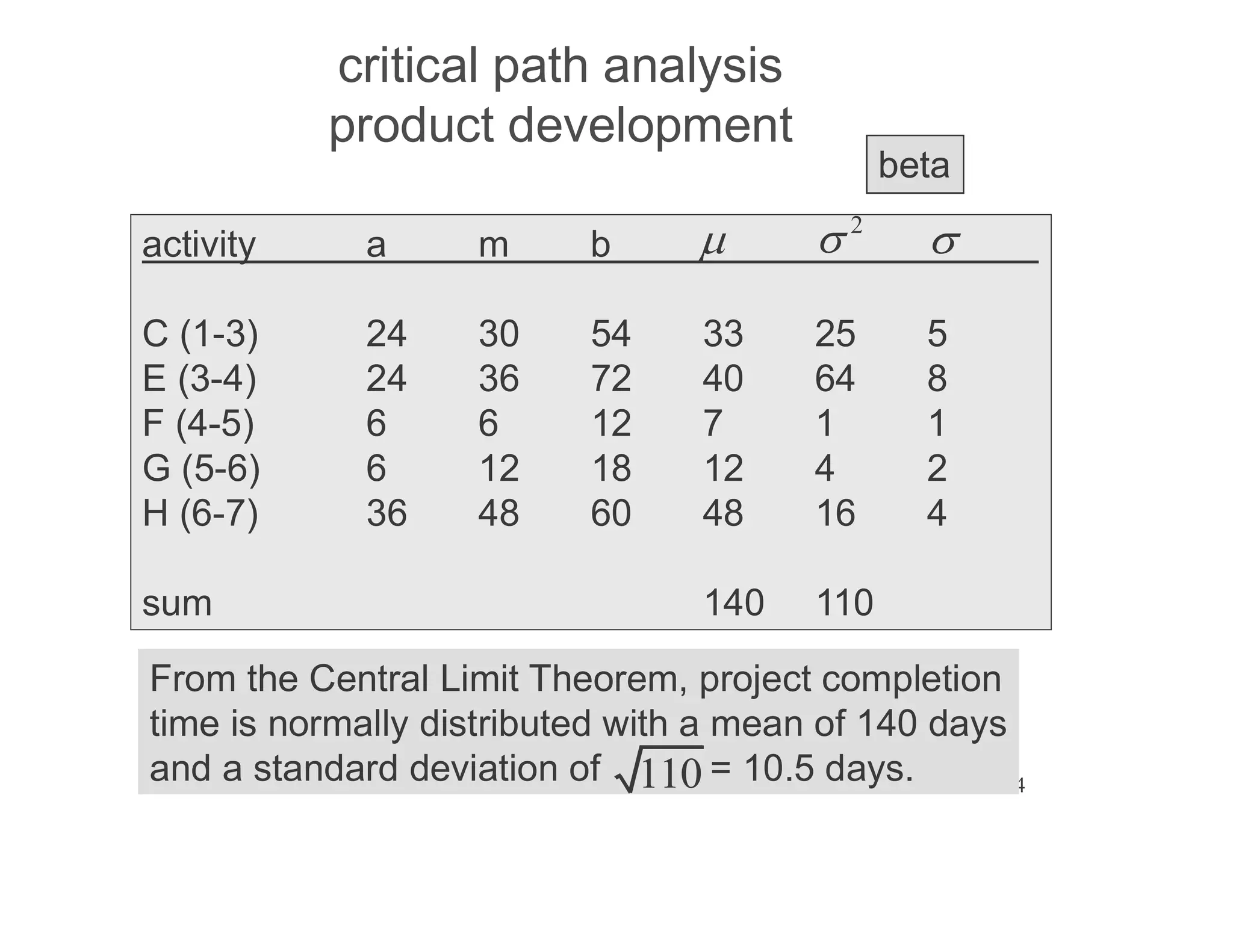
critical path analysis
product development
activity a m b
C (1-3) 24 30 54 33 25 5
E (3-4) 24 36 72 40 64 8
F (4-5) 6 6 12 7 1 1
G (5-6) 6 12 18 12 4 2
H (6-7) 36 48 60 48 16 4
sum 140 110
2
beta
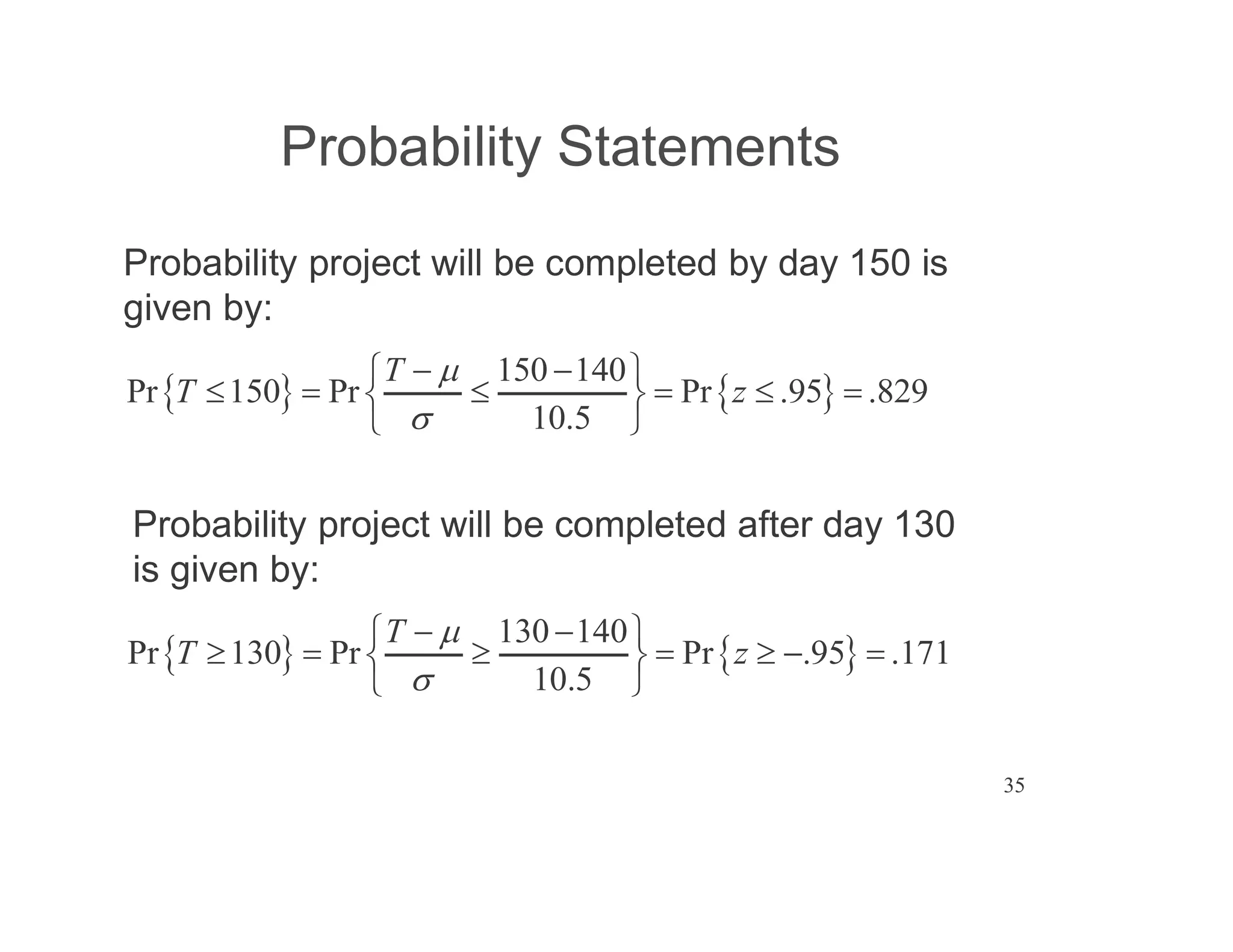
From the Central Limit Theorem, project completion
time is normally distributed with a mean of 140 days
and a standard deviation of = 10.5 days.
110
35
Probability Statements
Probability project will be completed by day 150 is
given by:
150 140
Pr 150 Pr Pr .95 .829
10.5
T
T z
Probability project will be completed after day 130
is given by:
130 140
Pr 130 Pr Pr .95 .171
10.5
T
T z
36
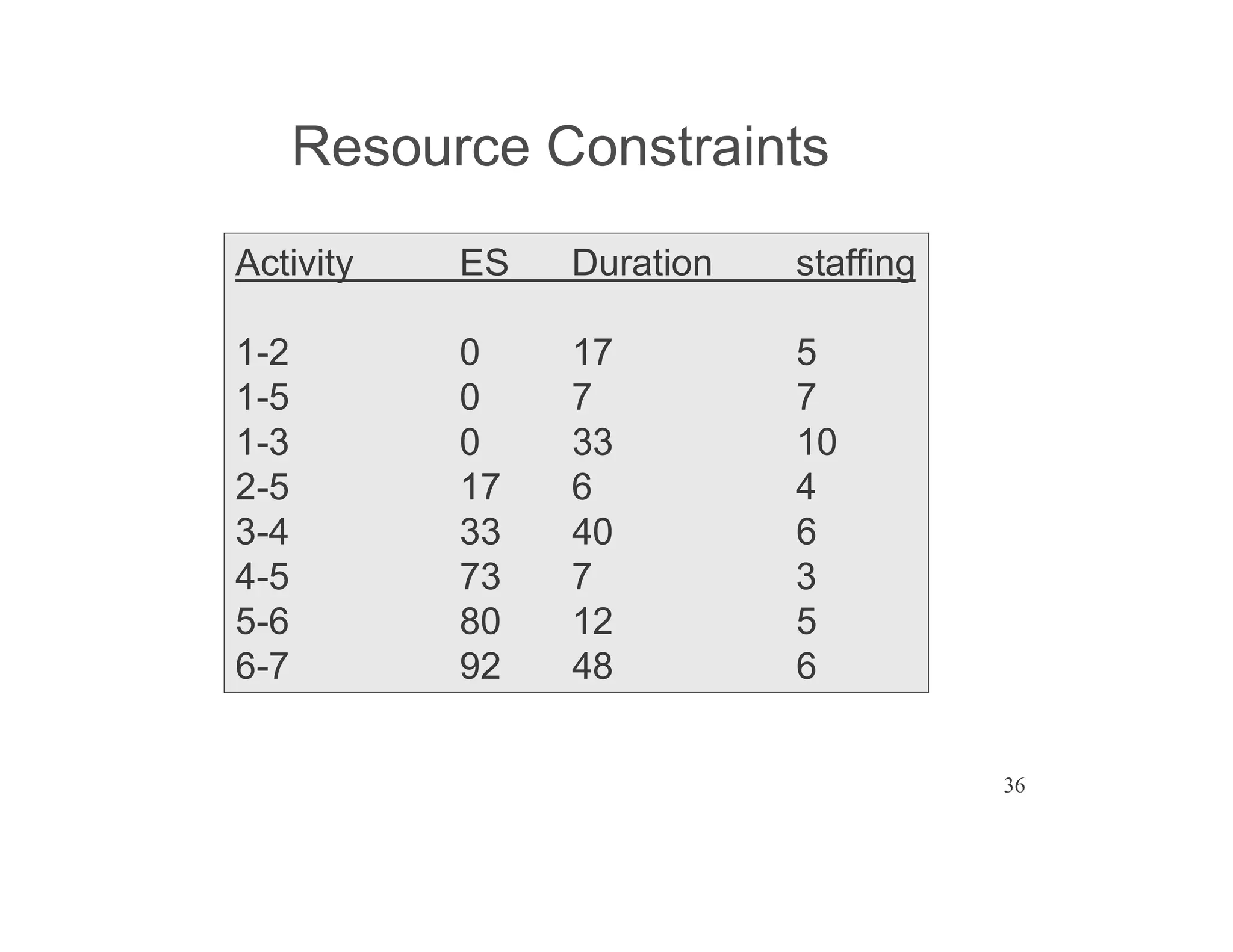
Resource Constraints
Activity ES Duration staffing
1-2 0 17 5
1-5 0 7 7
1-3 0 33 10
2-5 17 6 4
3-4 33 40 6
4-5 73 7 3
5-6 80 12 5
6-7 92 48 6
37
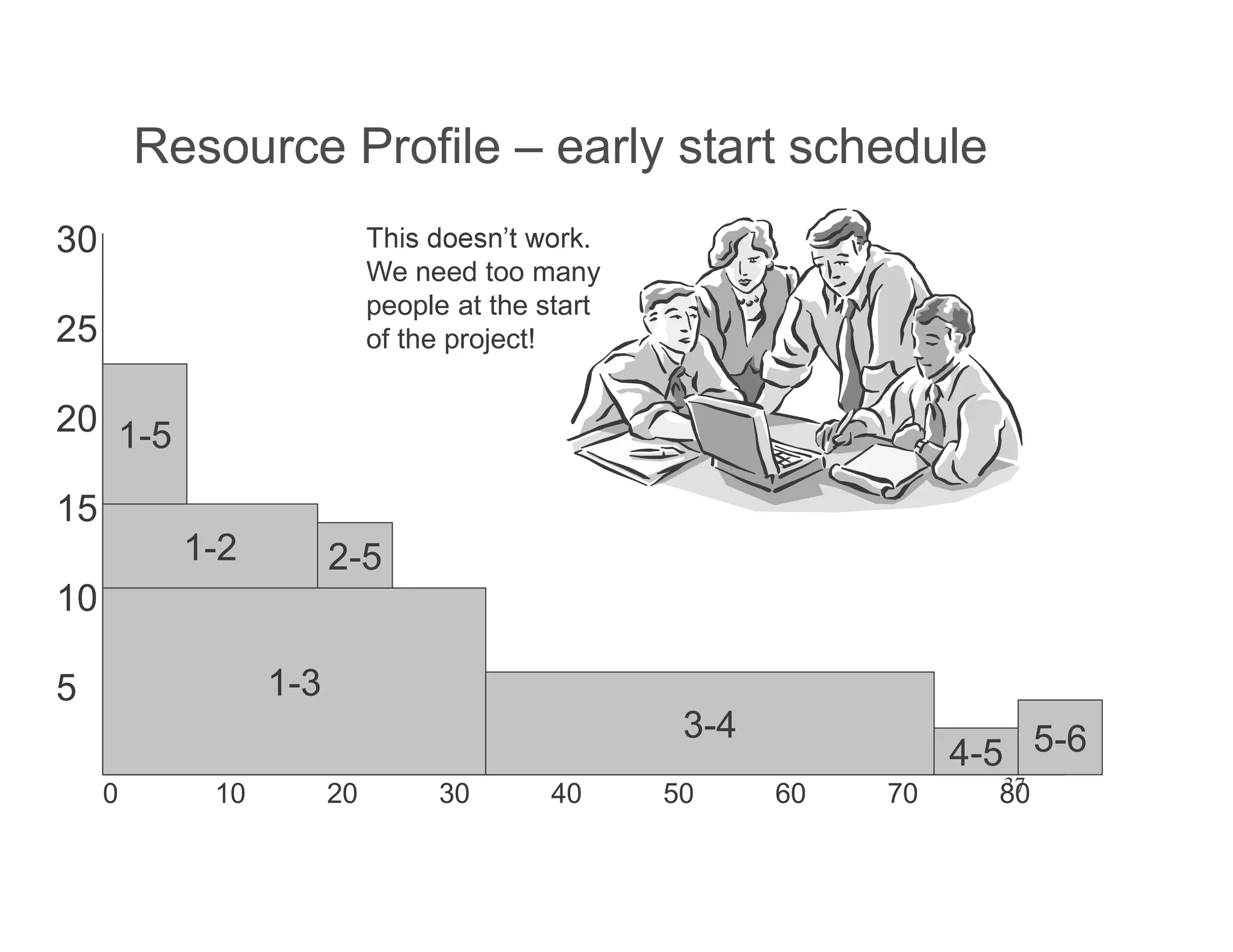
Resource Profile early start schedule
0 10 20 30 40 50 60 70 80
30
25
20
15
10
5
1-2
1-5
1-3
3-4
2-5
4-5 5-6
We need too many
people at the start
of the project!
38
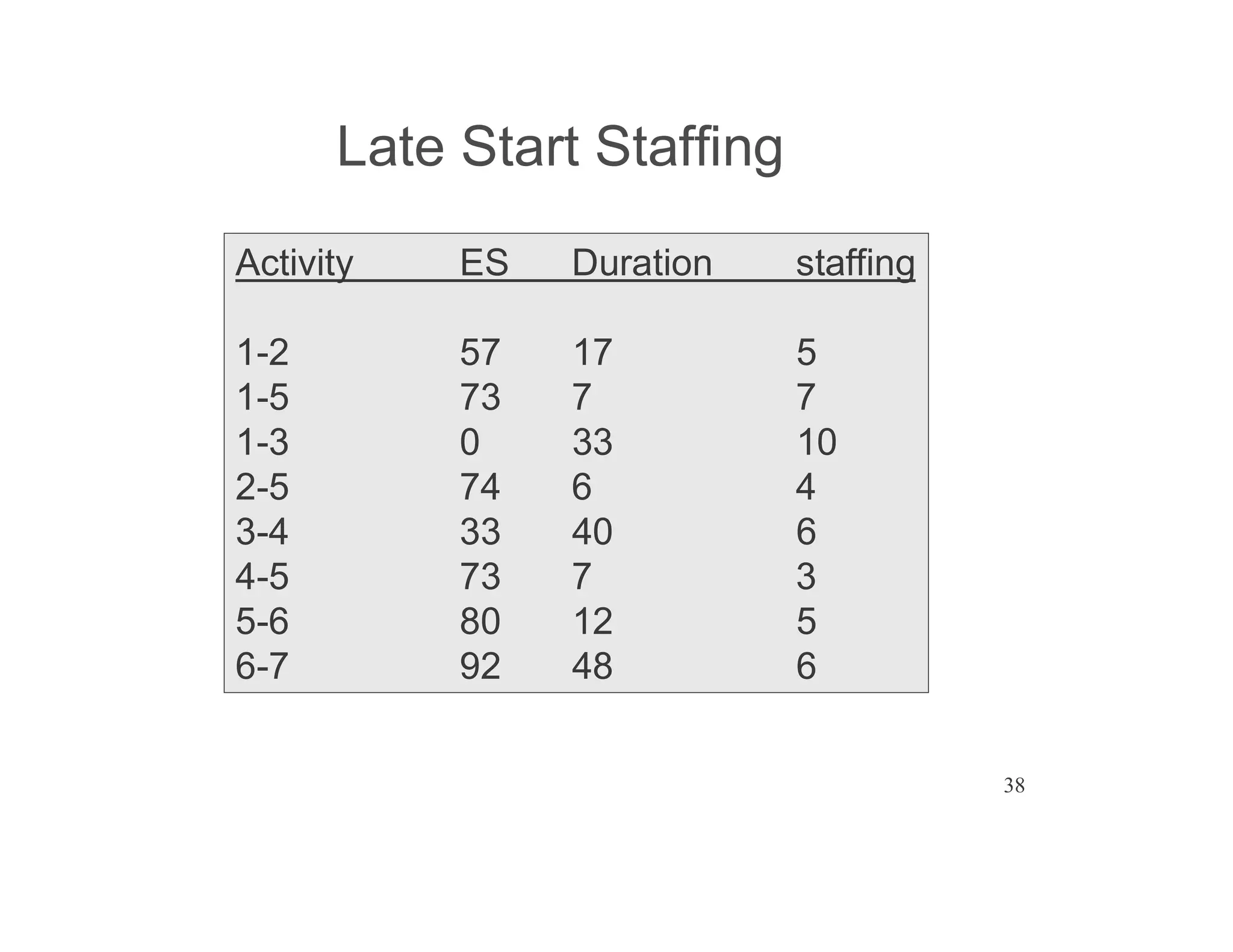
Late Start Staffing
Activity ES Duration staffing
1-2 57 17 5
1-5 73 7 7
1-3 0 33 10
2-5 74 6 4
3-4 33 40 6
4-5 73 7 3
5-6 80 12 5
6-7 92 48 6
39
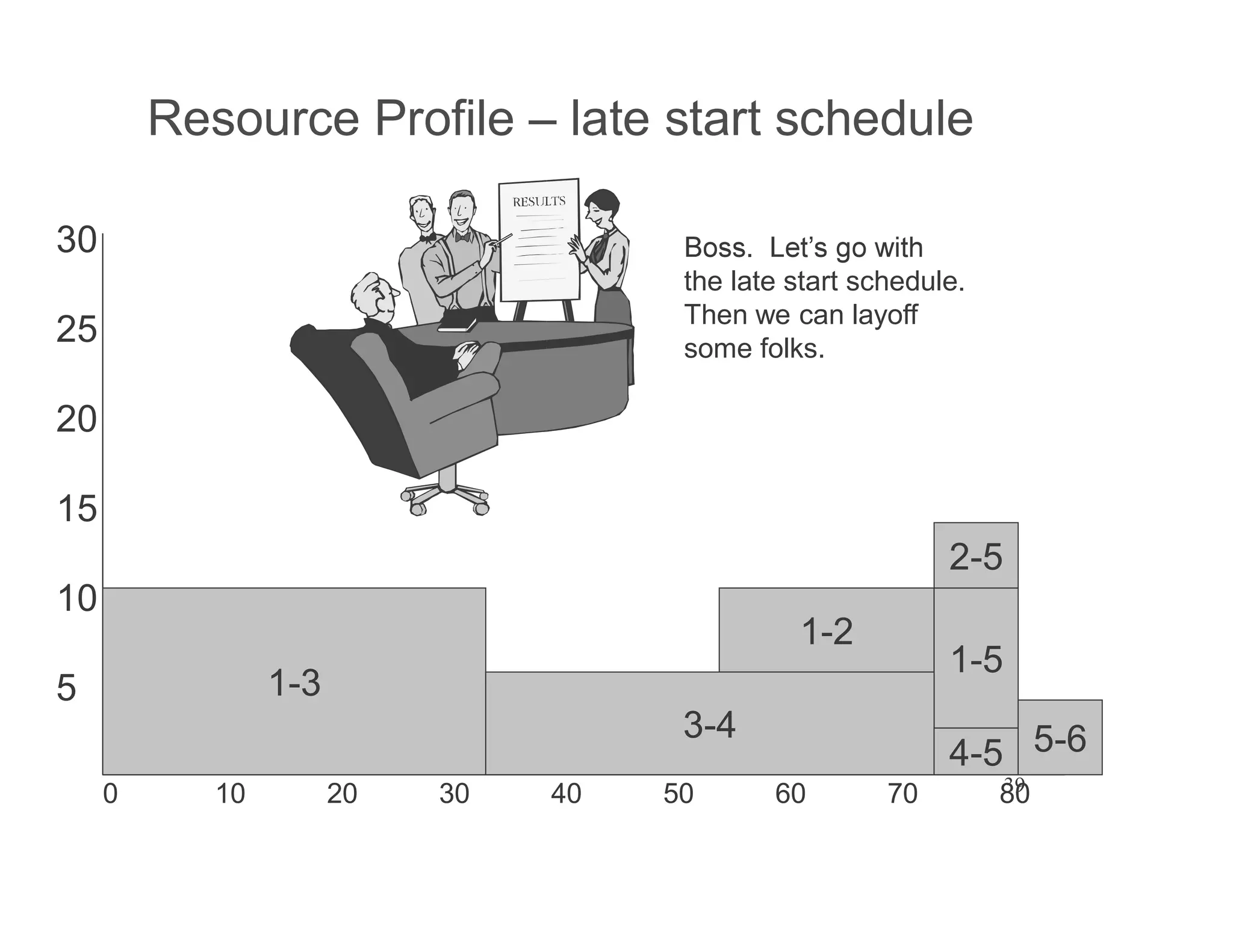
Resource Profile late start schedule
0 10 20 30 40 50 60 70 80
30
25
20
15
10
5
1-2
1-5
1-3
3-4
2-5
4-5 5-6
the late start schedule.
Then we can layoff
some folks.
40
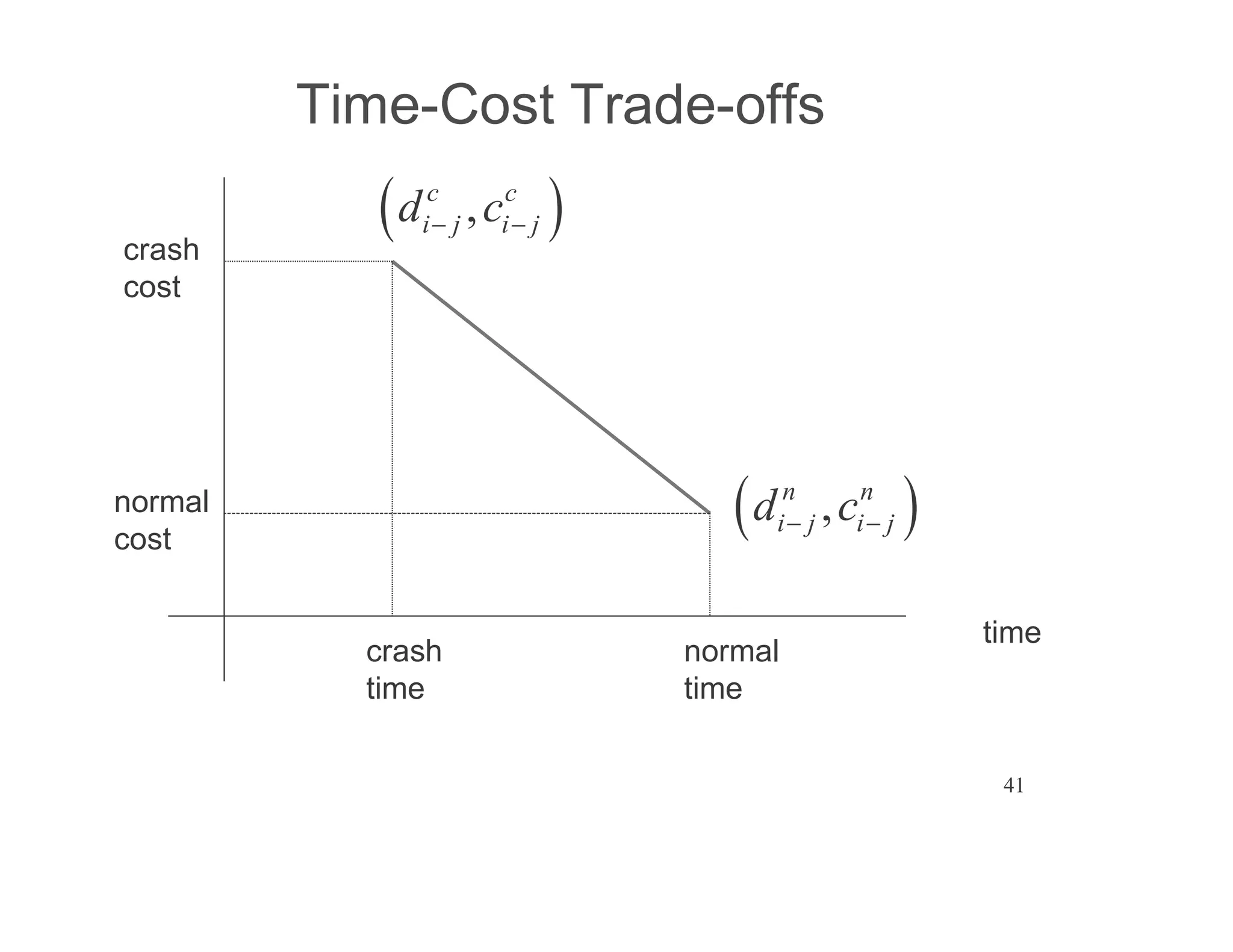
Time Costing Methods
Suppose that projects can be expedited by
reducing the time required for critical activities.
Doing so results in an increase in some costs
and a decrease in others. The goal is to
determine the optimal number of days to
schedule the project to minimize total cost.
Assume that there is a linear time/cost
relationship for each activity.
41
Time-Cost Trade-offs
time
crash
time
normal
time
crash
cost
normal
cost
,
n n
i j i j
d c
,
c c
i j i j
d c
42
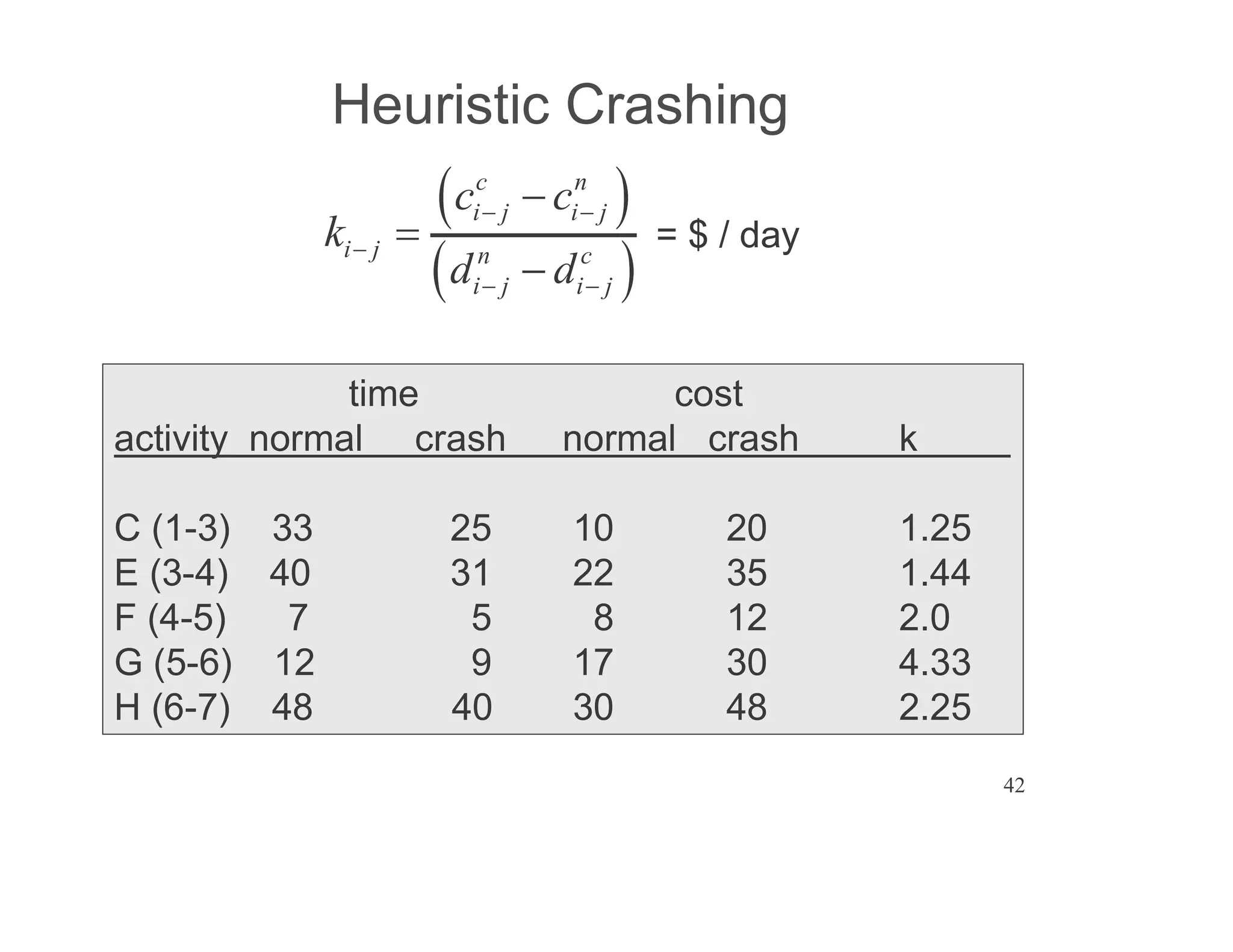
Heuristic Crashing
c n
i j i j
i j n c
i j i j
c c
k
d d
= $ / day
time cost
activity normal crash normal crash k
C (1-3) 33 25 10 20 1.25
E (3-4) 40 31 22 35 1.44
F (4-5) 7 5 8 12 2.0
G (5-6) 12 9 17 30 4.33
H (6-7) 48 40 30 48 2.25
43
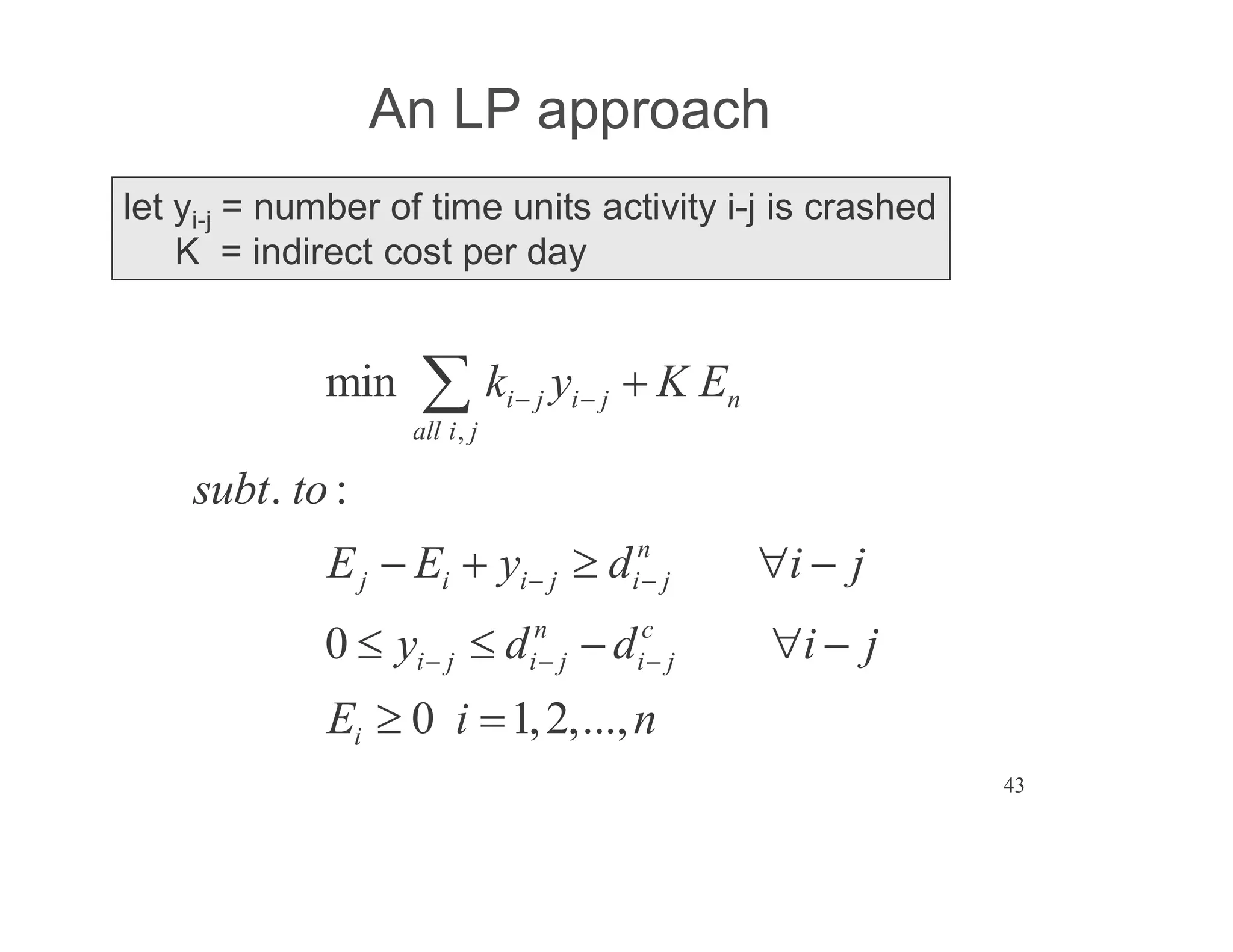
An LP approach
let yi-j = number of time units activity i-j is crashed
K = indirect cost per day
,
min
. :
0
0 1,2,...,
i j i j n
all i j
n
j i i j i j
n c
i j i j i j
i
k y K E
subt to
E E y d i j
y d d i j
E i n
44
The End
Backups Follow
45
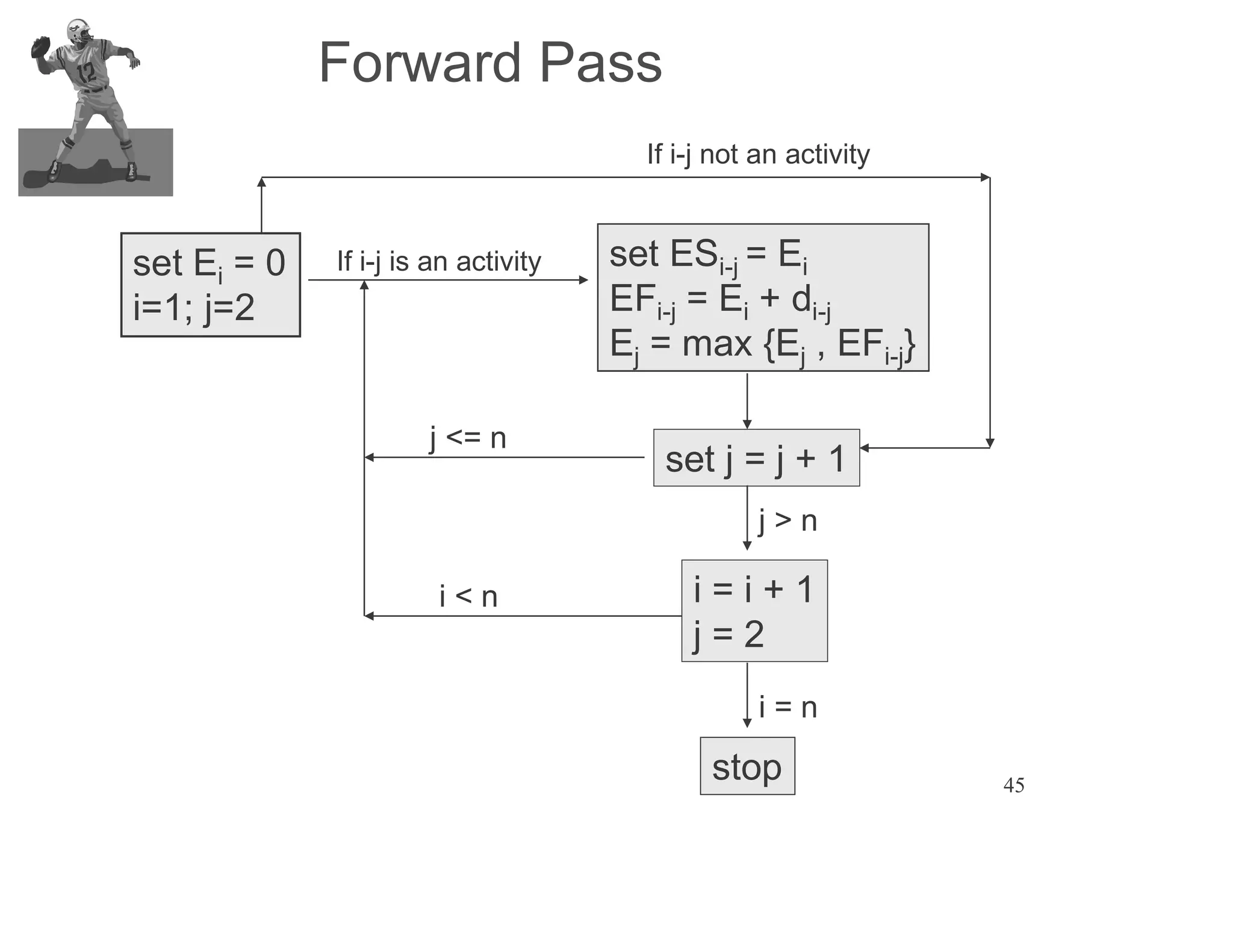
Forward Pass
set Ei = 0
i=1; j=2
set ESi-j = Ei
EFi-j = Ei + di-j
Ej = max {Ej , EFi-j}
If i-j is an activity
set j = j + 1
j <= n
i = i + 1
j = 2
j > n
i < n
stop
i = n
If i-j not an activity
46
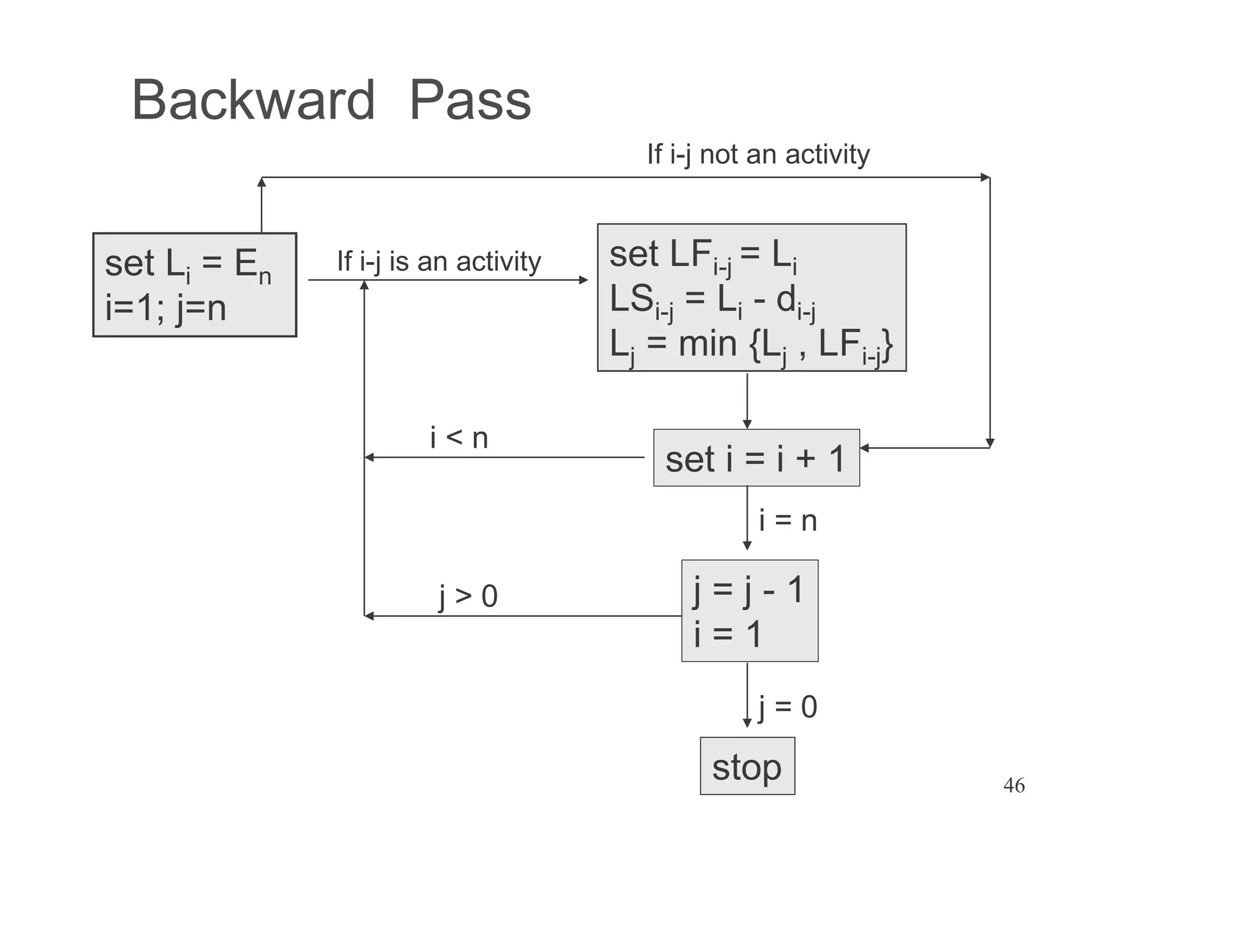
Backward Pass
set Li = En
i=1; j=n
set LFi-j = Li
LSi-j = Li - di-j
Lj = min {Lj , LFi-j}
If i-j is an activity
set i = i + 1
i < n
j = j - 1
i = 1
i = n
j > 0
stop
j = 0
If i-j not an activity

Lecture - Project, Planning and Control.pdf

  • 1.
    UNIT 4 System Schedule ME342 A System Design and Analysis Dr. Kailash Chaudhary Ph.D. (Mechanical Design), M.E. (P & I), B.E. (Mechanical Engg) Assistant Professor Department of Mechanical Engineering MBM University Jodhpur
  • 2.
    2 Project Planning, Schedulingand Control Project a set of partially ordered, interrelated activities that must be completed to achieve a goal.
  • 3.
    3 Network Models PERT ProgramEvaluation and Review Technique probabilistic features CPM Critical Path Method cost/time trade-offs project scheduler
  • 4.
    4 Objectives Planning, scheduling, andcontrol of complex projects Find critical activities to manage resources (management by exception) Determine flexibility of non-critical activities (slack) Estimate earliest completion time of project Determine time cost trade-offs
  • 5.
    5 Service Industry Distribution Industry Producing Industry Business and Industrya taxonomy Raw materials Continuous Processing Discrete Products Mining Drilling Farming Construction Manufacturing Chemicals Food Refinery Batch Mass Processing Production
  • 6.
    6 Production Systems Job shops Flowshops Batch production Mass production Cellular manufacturing Project Shop Continuous Processing Gosh. Can you tell us more about these?
  • 7.
    7 Project Shop single productin fixed location material and labor brought to the site usually job shop/flow shop associated functionalized production system examples include construction and shipbuilding
  • 8.
    8 The Elements ofProject Scheduling Project Definition. Statement of project, goals, and resources required. Activity Definitions. Content and requirements of each activity. Project Scheduling. Specification of starting and ending times of all activities. Project Monitoring. Keeping track of the progress of the project.
  • 9.
    9 Definitions Activity an effort(task) that requires resources and takes a certain amount of time. Event a specific accomplishment or milestone (the start or finish of an activity). Project a collection of activities and events leading to a definable goal. Network a graphical representation of a project depicting the precedence relationships among the activities and events. Critical Activity an activity that if delayed will hold up the scheduled completion of a project. Critical Path the sequence of critical activities that forms a continuous path from the start of a project to its completion.
  • 10.
    10 Framework for Analysis Analyzeproject in terms of activities and events Determine sequence (precedence) of activities (develop network) Assign estimates of time, cost, and resources to all activities Identify the critical path monitor, evaluate, and control progress of project
  • 11.
    11 Network Representation Projects maybe represented as networks with: Arrows representing activities. Nodes representing completion of a set of activities (milestones). Pseudo activities may be required to satisfy precedence relationships.
  • 12.
    12 Network Development 1 23 events (nodes) activities (arcs) Activities have duration and may have precedence. Define activities in terms of their beginning and ending events. e.g. Activity 1-2 must precede Activity 2-3
  • 13.
    13 Network Development (continued) 1 2 3 4 Event1 is start of project Activities 1-2, 1-3, and 1-4 have no predecessors and may start simultaneously
  • 14.
    14 Network Development (continued) n-2 n-3 n n-1 Eventn is the end of the project. Activities (n-3 n, (n-2) n, and (n-1) - n must be completed for the project to be completed.
  • 15.
    15 Network Development (continued) 6 7 8 9 Activities6-7, 6-8, and 6-9 cannot start until activity 5-6 has been completed. 5 burst event
  • 16.
    16 Network Development (continued) 8 5 6 7 Activities5-8, 6-8, and 7-8 must be completed before activity 8-9 may begin. 9 merge event
  • 17.
    17 Network Development (continued) 8 5 6 7 Activities5-8, 6-8, and 7-8 must be completed before activity 8-9, 8-10, or 8-11 may begin. 9 10 11 Gosh! A combined merge and burst event. Are these rare or what?
  • 18.
    18 Dummy activity A C AD B D W R O N G 7 5 6 9 10 A B C D 7 5 6 9 10 A B D C 8 dummy has no resources and no duration
  • 19.
    19 Project Networks Collection ofnodes and arcs Depicted graphically Events are uniquely numbered Arcs are labeled according to their beginning and ending events Ending events always have higher numbers than beginning events Two activities cannot have the same beginning and ending events Activity lengths have no significance
  • 20.
    20 Our Very OwnExample product development activity description precedence A design promotion campaign - B initial pricing - C product design - D promotion cost analysis A E manufacture prototype C F test and redesign E G final pricing B,D,F H market test G
  • 21.
  • 22.
    22 Notation i-j = anactivity of a project di-j = the duration of activity i-j Ei = the earliest time event i can occur ESi-j = the earliest start time of activity i-j EFi-j = the earliest finish time of activity i-j LSi-j = the latest start time of activity i-j LFi-j = the latest finish time of activity i-j Li = the latest time event i can occur
  • 23.
    23 Our Very OwnExample product development activity precedence duration (days) A (1-2) - 17 B (1-5) - 7 C (1-3) - 33 D (2-5) A 6 E (3-4) C 40 F (4-5) E 7 G (5-6) B,D,F 12 H (6-7) G 48
  • 24.
    24 product development forwardpass 1 2 3 4 6 7 5 A(17) B(7) C(33) D(6) E(40) F(7) G(12) H(48) E1 = 0 ES1-2 = 0 ES1-5 = 0 ES1-3 = 0 EF1-2 = 17 EF1-5 = 7 EF1-3 = 33 E2 = 17 E5 = 7 E3 = 33 ES5-6 = 80 EF5-6 = 92 E6 = 92 ES2-5 = 17 ES3-4 = 33 EF2-5 = 23 EF3-4 = 73 E4 = 73 ES4-5 = 73 EF4-5 = 80 E5 = 80 ES6-7 = 92 EF6-7 = 140 E7 = 140
  • 25.
    25 product development backwardpass 1 2 3 4 6 7 5 A(17) B(7) C(33) D(6) E(40) F(7) G(12) H(48) L1 = 0 LF1-2 = 74 LF1-5 = 80 LF1-3 = 33 L2 = 74 L3 = 33 L6 = 92 LF5-6 = 92 LS5-6 = 80 LF2-5 = 80 LS2-5 = 74 LF3-4 = 73 LS3-4 = 33 L4 = 73 LF4-5 = 80 LS4-5 = 73 L5 = 80 L7 = 140 LF6-7 = 140 LS6-7 = 92 LS1-2 = 57 LS1-5 = 73 LS1-3 = 0
  • 26.
    26 Activity Slack Si-j =LSi-j ESi-j Si-j = LFi-j EFi-j or Activity LS ES Slack 1-2 57 0 57 1-5 73 0 73 1-3 0 0 0 2-5 74 17 57 3-4 33 33 0 4-5 73 73 0 5-6 80 80 0 6-7 92 92 0 critical activities
  • 27.
    27 Critical Path Method Ananalytical tool that provides a schedule that completes the project in minimum time subject to the precedence constraints. In addition, CPM provides: Starting and ending times for each activity Identification of the critical activities (i.e., the ones whose delay necessarily delay the project). Identification of the non-critical activities, and the amount of slack time available when scheduling these activities.
  • 28.
    28 critical path 1 2 3 4 67 5 A(17) B(7) C(33) D(6) E(40) F(7) G(12) H(48) ES1-3 = 0 LS1-3 = 0 ES5-6 = 80 LS5-6 = 80 ES3-4 = 33 LS3-4 = 33 ES4-5 = 73 LS4-5 = 73 ES6-7 = 92 LS6-7 = 92 ES1-5 = 0 LS1-5 = 73 ES2-5 = 17 LS2-5 = 74 ES1-2 = 0 LS1-2 = 57
  • 29.
    29 Critical Path Activities focusmanagement attention increase resources eliminate delays eliminate critical activities overlap critical activities break activity into smaller tasks outsource or subcontract
  • 30.
    30 Critical Path byLP 1 Min . : , pairs n n i j i ij E subj to E E d i j earliest start times 1 1 Min . : , pairs n n i i j i ij nL L subj to L L d i j latest start times
  • 31.
  • 32.
    32 More Activity Durations leta = optimistic time b = pessimistic time m = most likely time 2 2 2 12 a b b a 2 2 2 2 3 18 a m b a b m ab am bm 2 2 4 6 18 a m b b a uniform: triangular: beta:
  • 33.
    33 activity durations product development activitya m b A (1-2) 6 18 24 17 9 3 B (1-5) 6 6 12 7 1 1 C (1-3) 24 30 54 33 25 5 D (2-5) 6 6 6 6 0 0 E (3-4) 24 36 72 40 64 8 F (4-5) 6 6 12 7 1 1 G (5-6) 6 12 18 12 4 2 H (6-7) 36 48 60 48 16 4 2 beta note: based upon a 6 day workweek
  • 34.
    34 critical path analysis productdevelopment activity a m b C (1-3) 24 30 54 33 25 5 E (3-4) 24 36 72 40 64 8 F (4-5) 6 6 12 7 1 1 G (5-6) 6 12 18 12 4 2 H (6-7) 36 48 60 48 16 4 sum 140 110 2 beta From the Central Limit Theorem, project completion time is normally distributed with a mean of 140 days and a standard deviation of = 10.5 days. 110
  • 35.
    35 Probability Statements Probability projectwill be completed by day 150 is given by: 150 140 Pr 150 Pr Pr .95 .829 10.5 T T z Probability project will be completed after day 130 is given by: 130 140 Pr 130 Pr Pr .95 .171 10.5 T T z
  • 36.
    36 Resource Constraints Activity ESDuration staffing 1-2 0 17 5 1-5 0 7 7 1-3 0 33 10 2-5 17 6 4 3-4 33 40 6 4-5 73 7 3 5-6 80 12 5 6-7 92 48 6
  • 37.
    37 Resource Profile earlystart schedule 0 10 20 30 40 50 60 70 80 30 25 20 15 10 5 1-2 1-5 1-3 3-4 2-5 4-5 5-6 We need too many people at the start of the project!
  • 38.
    38 Late Start Staffing ActivityES Duration staffing 1-2 57 17 5 1-5 73 7 7 1-3 0 33 10 2-5 74 6 4 3-4 33 40 6 4-5 73 7 3 5-6 80 12 5 6-7 92 48 6
  • 39.
    39 Resource Profile latestart schedule 0 10 20 30 40 50 60 70 80 30 25 20 15 10 5 1-2 1-5 1-3 3-4 2-5 4-5 5-6 the late start schedule. Then we can layoff some folks.
  • 40.
    40 Time Costing Methods Supposethat projects can be expedited by reducing the time required for critical activities. Doing so results in an increase in some costs and a decrease in others. The goal is to determine the optimal number of days to schedule the project to minimize total cost. Assume that there is a linear time/cost relationship for each activity.
  • 41.
  • 42.
    42 Heuristic Crashing c n ij i j i j n c i j i j c c k d d = $ / day time cost activity normal crash normal crash k C (1-3) 33 25 10 20 1.25 E (3-4) 40 31 22 35 1.44 F (4-5) 7 5 8 12 2.0 G (5-6) 12 9 17 30 4.33 H (6-7) 48 40 30 48 2.25
  • 43.
    43 An LP approach letyi-j = number of time units activity i-j is crashed K = indirect cost per day , min . : 0 0 1,2,..., i j i j n all i j n j i i j i j n c i j i j i j i k y K E subt to E E y d i j y d d i j E i n
  • 44.
  • 45.
    45 Forward Pass set Ei= 0 i=1; j=2 set ESi-j = Ei EFi-j = Ei + di-j Ej = max {Ej , EFi-j} If i-j is an activity set j = j + 1 j <= n i = i + 1 j = 2 j > n i < n stop i = n If i-j not an activity
  • 46.
    46 Backward Pass set Li= En i=1; j=n set LFi-j = Li LSi-j = Li - di-j Lj = min {Lj , LFi-j} If i-j is an activity set i = i + 1 i < n j = j - 1 i = 1 i = n j > 0 stop j = 0 If i-j not an activity