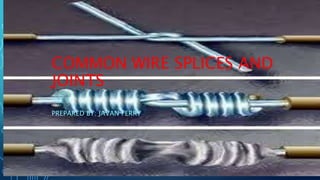
COMMON WIRE SPLICES AND
JOINTS
TLE 9
PREPARED BY: JAVAN FERRY
INTRODUCTION
•As a student in Electrical Installation and
Maintenance you should acquire the important
knowledge and skills in wire splices and joints and
should be familiar with the actual application of
every splice and joint. This will serve as your tool
in performing actual wiring installation. Of course,
another factor is the knowledge in interpreting and
analyzing the wiring diagram especially if the
circuit is complicated.
THE FOLLOWING ARE THE COMMON
ELECTRICAL WIRE SPLICES AND JOINTS.
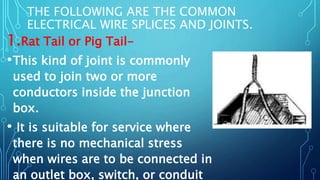
1.Rat Tail or Pig Tail-
•This kind of joint is commonly
used to join two or more
conductors inside the junction
box.
• It is suitable for service where
there is no mechanical stress
when wires are to be connected in
an outlet box, switch, or conduit
THE FOLLOWING ARE THE COMMON
ELECTRICAL WIRE SPLICES AND JOINTS.
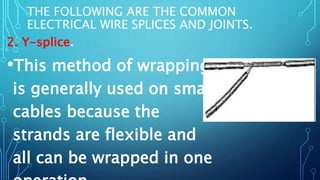
2. Y-splice.
•This method of wrapping
is generally used on small
cables because the
strands are flexible and
all can be wrapped in one
THE FOLLOWING ARE THE COMMON
ELECTRICAL WIRE SPLICES AND JOINTS.
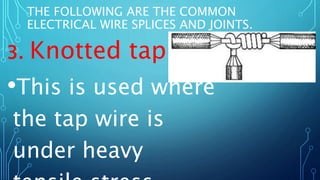
3. Knotted tap.
•This is used where
the tap wire is
under heavy
THE FOLLOWING ARE THE COMMON
ELECTRICAL WIRE SPLICES AND JOINTS.
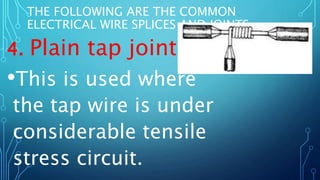
4. Plain tap joint.
•This is used where
the tap wire is under
considerable tensile
stress circuit.
THE FOLLOWING ARE THE COMMON
ELECTRICAL WIRE SPLICES AND JOINTS.
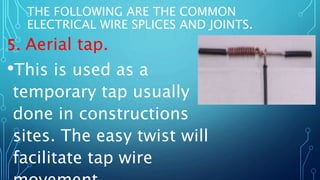
5. Aerial tap.
•This is used as a
temporary tap usually
done in constructions
sites. The easy twist will
facilitate tap wire
THE FOLLOWING ARE THE COMMON
ELECTRICAL WIRE SPLICES AND JOINTS.
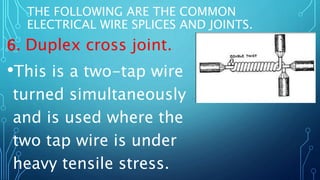
6. Duplex cross joint.
•This is a two-tap wire
turned simultaneously
and is used where the
two tap wire is under
heavy tensile stress.
THE FOLLOWING ARE THE COMMON
ELECTRICAL WIRE SPLICES AND JOINTS.
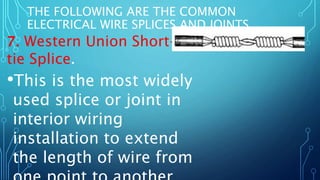
7. Western Union Short-
tie Splice.
•This is the most widely
used splice or joint in
interior wiring
installation to extend
the length of wire from
THE FOLLOWING ARE THE COMMON
ELECTRICAL WIRE SPLICES AND JOINTS.
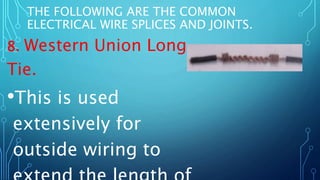
8. Western Union Long
Tie.
•This is used
extensively for
outside wiring to
THE FOLLOWING ARE THE COMMON
ELECTRICAL WIRE SPLICES AND JOINTS.
9. Cross joint.
•The same application is
done as in plain tap
and the only difference
is that this tap is a
combination of two
plain taps place side by
THE FOLLOWING ARE THE COMMON
ELECTRICAL WIRE SPLICES AND JOINTS.
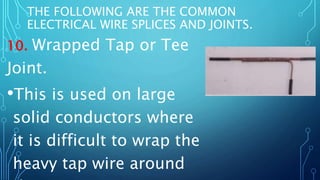
10. Wrapped Tap or Tee
Joint.
•This is used on large
solid conductors where
it is difficult to wrap the
heavy tap wire around
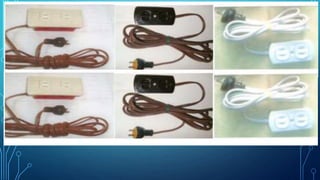
EXTENSION CORD
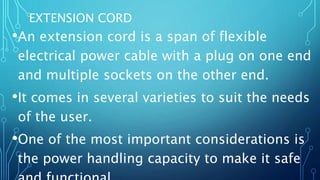
•An extension cord is a span of flexible
electrical power cable with a plug on one end
and multiple sockets on the other end.
•It comes in several varieties to suit the needs
of the user.
•One of the most important considerations is
the power handling capacity to make it safe
•Electrical gadgets are product of modern
technology to make our life better.
•The number of electrical gadgets available at
home and in offices may exceed the existing
convenience outlet installed in every room.
•The best remedy to address the insufficiency of
available outlet is to use an extension cord
especially if the electrical gadgets need to operate
at the same time.
Common wire splices and joints

Common wire splices and joints

  • 1.
    COMMON WIRE SPLICESAND JOINTS TLE 9 PREPARED BY: JAVAN FERRY
  • 2.
    INTRODUCTION •As a studentin Electrical Installation and Maintenance you should acquire the important knowledge and skills in wire splices and joints and should be familiar with the actual application of every splice and joint. This will serve as your tool in performing actual wiring installation. Of course, another factor is the knowledge in interpreting and analyzing the wiring diagram especially if the circuit is complicated.
  • 3.
    THE FOLLOWING ARETHE COMMON ELECTRICAL WIRE SPLICES AND JOINTS. 1.Rat Tail or Pig Tail- •This kind of joint is commonly used to join two or more conductors inside the junction box. • It is suitable for service where there is no mechanical stress when wires are to be connected in an outlet box, switch, or conduit
  • 4.
    THE FOLLOWING ARETHE COMMON ELECTRICAL WIRE SPLICES AND JOINTS. 2. Y-splice. •This method of wrapping is generally used on small cables because the strands are flexible and all can be wrapped in one
  • 5.
    THE FOLLOWING ARETHE COMMON ELECTRICAL WIRE SPLICES AND JOINTS. 3. Knotted tap. •This is used where the tap wire is under heavy
  • 6.
    THE FOLLOWING ARETHE COMMON ELECTRICAL WIRE SPLICES AND JOINTS. 4. Plain tap joint. •This is used where the tap wire is under considerable tensile stress circuit.
  • 7.
    THE FOLLOWING ARETHE COMMON ELECTRICAL WIRE SPLICES AND JOINTS. 5. Aerial tap. •This is used as a temporary tap usually done in constructions sites. The easy twist will facilitate tap wire
  • 8.
    THE FOLLOWING ARETHE COMMON ELECTRICAL WIRE SPLICES AND JOINTS. 6. Duplex cross joint. •This is a two-tap wire turned simultaneously and is used where the two tap wire is under heavy tensile stress.
  • 9.
    THE FOLLOWING ARETHE COMMON ELECTRICAL WIRE SPLICES AND JOINTS. 7. Western Union Short- tie Splice. •This is the most widely used splice or joint in interior wiring installation to extend the length of wire from
  • 10.
    THE FOLLOWING ARETHE COMMON ELECTRICAL WIRE SPLICES AND JOINTS. 8. Western Union Long Tie. •This is used extensively for outside wiring to
  • 11.
    THE FOLLOWING ARETHE COMMON ELECTRICAL WIRE SPLICES AND JOINTS. 9. Cross joint. •The same application is done as in plain tap and the only difference is that this tap is a combination of two plain taps place side by
  • 12.
    THE FOLLOWING ARETHE COMMON ELECTRICAL WIRE SPLICES AND JOINTS. 10. Wrapped Tap or Tee Joint. •This is used on large solid conductors where it is difficult to wrap the heavy tap wire around
  • 13.
    EXTENSION CORD •An extensioncord is a span of flexible electrical power cable with a plug on one end and multiple sockets on the other end. •It comes in several varieties to suit the needs of the user. •One of the most important considerations is the power handling capacity to make it safe
  • 14.
    •Electrical gadgets areproduct of modern technology to make our life better. •The number of electrical gadgets available at home and in offices may exceed the existing convenience outlet installed in every room. •The best remedy to address the insufficiency of available outlet is to use an extension cord especially if the electrical gadgets need to operate at the same time.