Physics Simplified: A review of Unit 5, part II Chapter 9 Section 9.4: Inelastic Collisions Section 9.5: Explosions Section 9.6: Momentum in Two Dimensions Ben Caffrey
Tips: To me, one of the hardest parts of momentum is simply conceptualizing and realizing the various types of situations. Just to make sure, here is a breakdown: Elastic Collision:  A ‘bouncy’ collision, in which two objects move  apart at different velocities. Inelastic Collision:  A ‘sticky’ collision, in which two objects travel as a unit,  with the same velocity, after the collision Explosion:  An instance in which objects that are together break apart, with  various parts traveling in different directions with different speeds Remember:  Momentum is  always  conserved. It’s a fundamental law of physics.
Equations: Most momentum questions we will encounter can be solved using the equation for the conservation of momentum: For momentum in two dimensions, we must remember that momentum is conserved in both dimensions: First, simple equation for momentum:
9.4 Inelastic Collisions: A 1,000 kilogram truck traveling at 5 meters per second collides with a smaller, 600 kilogram stationary car at a stop sign. The two vehicles begin sliding into the intersection together. What is their initial velocity after the impact?
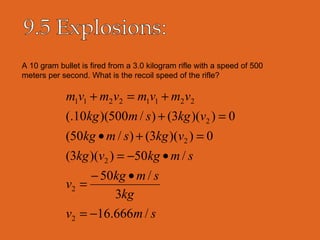
9.5 Explosions: A 10 gram bullet is fired from a 3.0 kilogram rifle with a speed of 500 meters per second. What is the recoil speed of the rifle?
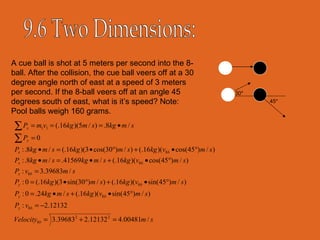
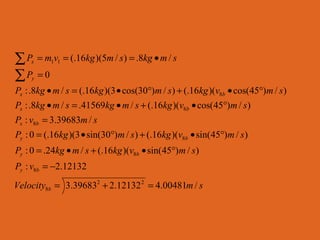
9.6 Two Dimensions: 30* 45* A cue ball is shot at 5 meters per second into the 8-ball. After the collision, the cue ball veers off at a 30 degree angle north of east at a speed of 3 meters per second. If the 8-ball veers off at an angle 45 degrees south of east, what is it’s speed? Note: Pool balls weigh 160 grams.
 

Physics Review

  • 1.
    Physics Simplified: Areview of Unit 5, part II Chapter 9 Section 9.4: Inelastic Collisions Section 9.5: Explosions Section 9.6: Momentum in Two Dimensions Ben Caffrey
  • 2.
    Tips: To me,one of the hardest parts of momentum is simply conceptualizing and realizing the various types of situations. Just to make sure, here is a breakdown: Elastic Collision: A ‘bouncy’ collision, in which two objects move apart at different velocities. Inelastic Collision: A ‘sticky’ collision, in which two objects travel as a unit, with the same velocity, after the collision Explosion: An instance in which objects that are together break apart, with various parts traveling in different directions with different speeds Remember: Momentum is always conserved. It’s a fundamental law of physics.
  • 3.
    Equations: Most momentumquestions we will encounter can be solved using the equation for the conservation of momentum: For momentum in two dimensions, we must remember that momentum is conserved in both dimensions: First, simple equation for momentum:
  • 4.
    9.4 Inelastic Collisions:A 1,000 kilogram truck traveling at 5 meters per second collides with a smaller, 600 kilogram stationary car at a stop sign. The two vehicles begin sliding into the intersection together. What is their initial velocity after the impact?
  • 5.
    9.5 Explosions: A10 gram bullet is fired from a 3.0 kilogram rifle with a speed of 500 meters per second. What is the recoil speed of the rifle?
  • 6.
    9.6 Two Dimensions:30* 45* A cue ball is shot at 5 meters per second into the 8-ball. After the collision, the cue ball veers off at a 30 degree angle north of east at a speed of 3 meters per second. If the 8-ball veers off at an angle 45 degrees south of east, what is it’s speed? Note: Pool balls weigh 160 grams.
  • 7.