Dr. Sujitkumar Pandey (PT)
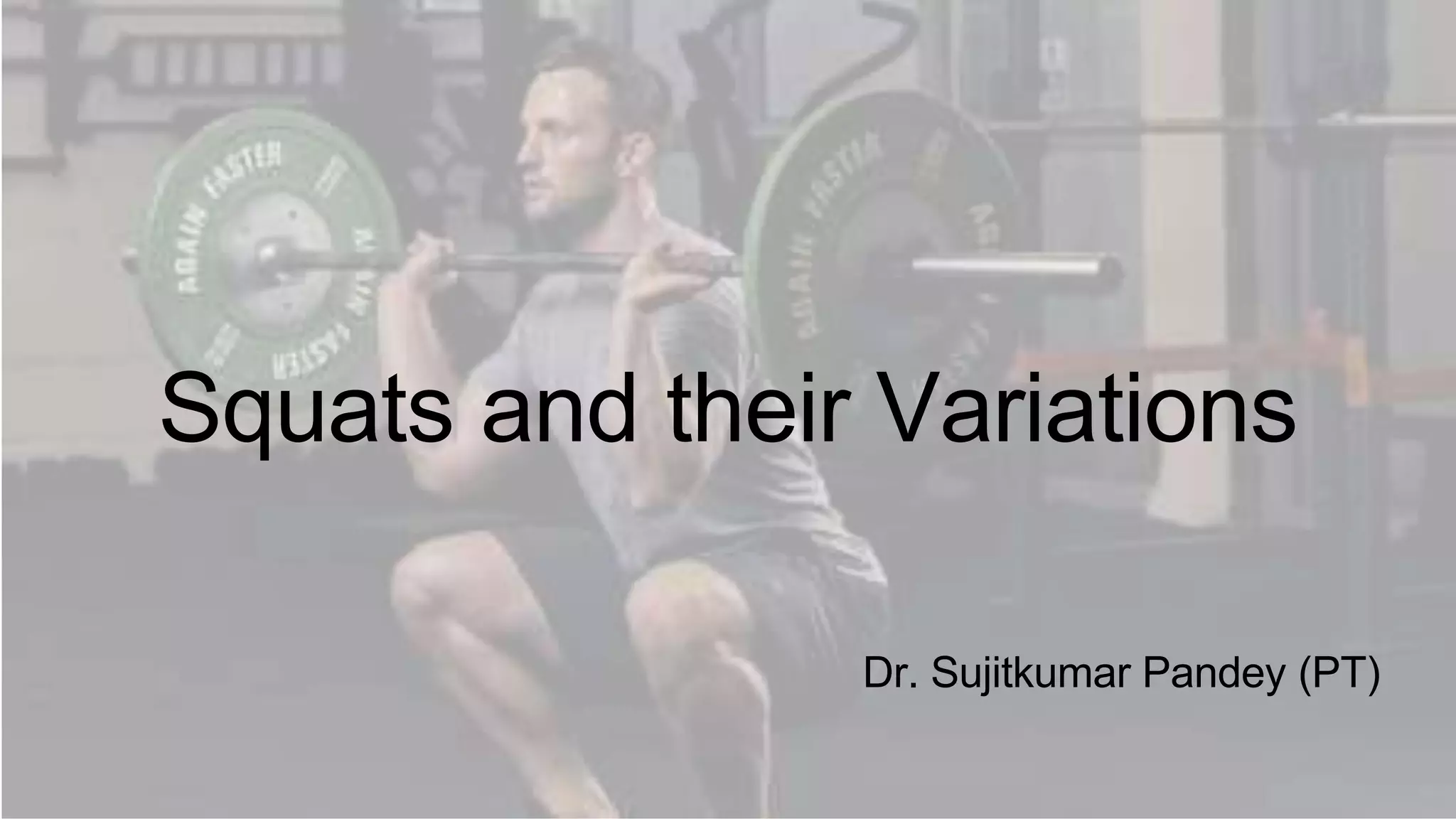
Squats and their Variations
What is a Squat ???
A squat is a strength exercise in which the trainee lowers their hips from a standing
position and then stands back up. During the descent of a squat,
the hip and knee joints flex while the ankle joint dorsiflexes; conversely the hip and knee
joints extend and the ankle joint plantarflexes when standing up.
Squats are considered a vital exercise for increasing the strength and size of the lower body
muscles as well as developing core strength. The primary agonist muscles used during the
squat are the quadriceps femoris, the adductor magnus, and the gluteus maximus.[1] The
squat also isometrically uses the erector spinae and the abdominal muscles, among others.
The squat is one of the three lifts in the strength sport of powerlifting, together with
the deadlift and the bench press. It is also considered a staple exercise in many popular
recreational exercise programs.
Hey lets check out
the variations
then…
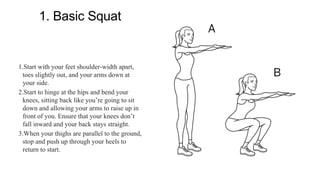
1. Basic Squat
1.Start with your feet shoulder-width apart,
toes slightly out, and your arms down at
your side.
2.Start to hinge at the hips and bend your
knees, sitting back like you’re going to sit
down and allowing your arms to raise up in
front of you. Ensure that your knees don’t
fall inward and your back stays straight.
3.When your thighs are parallel to the ground,
stop and push up through your heels to
return to start.
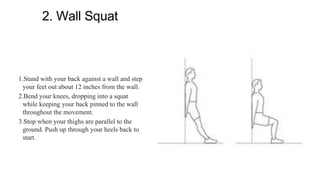
2. Wall Squat
1.Stand with your back against a wall and step
your feet out about 12 inches from the wall.
2.Bend your knees, dropping into a squat
while keeping your back pinned to the wall
throughout the movement.
3.Stop when your thighs are parallel to the
ground. Push up through your heels back to
start.
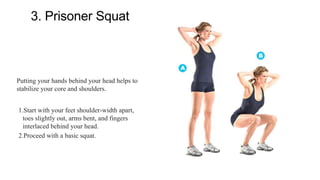
3. Prisoner Squat
Putting your hands behind your head helps to
stabilize your core and shoulders.
1.Start with your feet shoulder-width apart,
toes slightly out, arms bent, and fingers
interlaced behind your head.
2.Proceed with a basic squat.
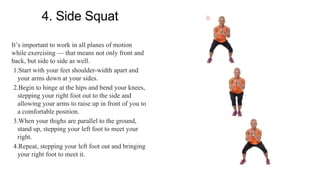
4. Side Squat
It’s important to work in all planes of motion
while exercising — that means not only front and
back, but side to side as well.
1.Start with your feet shoulder-width apart and
your arms down at your sides.
2.Begin to hinge at the hips and bend your knees,
stepping your right foot out to the side and
allowing your arms to raise up in front of you to
a comfortable position.
3.When your thighs are parallel to the ground,
stand up, stepping your left foot to meet your
right.
4.Repeat, stepping your left foot out and bringing
your right foot to meet it.
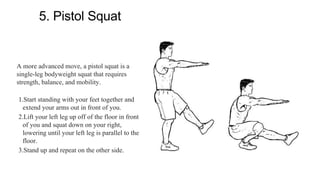
5. Pistol Squat
A more advanced move, a pistol squat is a
single-leg bodyweight squat that requires
strength, balance, and mobility.
1.Start standing with your feet together and
extend your arms out in front of you.
2.Lift your left leg up off of the floor in front
of you and squat down on your right,
lowering until your left leg is parallel to the
floor.
3.Stand up and repeat on the other side.
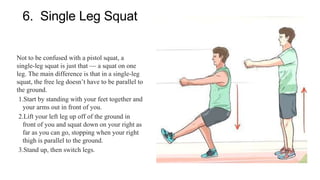
6. Single Leg Squat
Not to be confused with a pistol squat, a
single-leg squat is just that — a squat on one
leg. The main difference is that in a single-leg
squat, the free leg doesn’t have to be parallel to
the ground.
1.Start by standing with your feet together and
your arms out in front of you.
2.Lift your left leg up off of the ground in
front of you and squat down on your right as
far as you can go, stopping when your right
thigh is parallel to the ground.
3.Stand up, then switch legs.
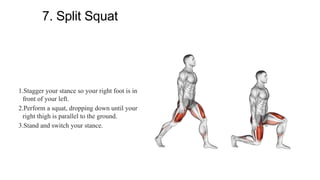
7. Split Squat
1.Stagger your stance so your right foot is in
front of your left.
2.Perform a squat, dropping down until your
right thigh is parallel to the ground.
3.Stand and switch your stance.
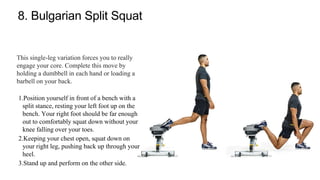
8. Bulgarian Split Squat
This single-leg variation forces you to really
engage your core. Complete this move by
holding a dumbbell in each hand or loading a
barbell on your back.
1.Position yourself in front of a bench with a
split stance, resting your left foot up on the
bench. Your right foot should be far enough
out to comfortably squat down without your
knee falling over your toes.
2.Keeping your chest open, squat down on
your right leg, pushing back up through your
heel.
3.Stand up and perform on the other side.
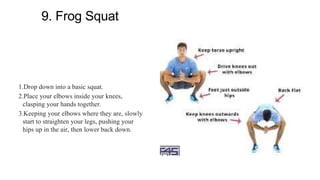
9. Frog Squat
1.Drop down into a basic squat.
2.Place your elbows inside your knees,
clasping your hands together.
3.Keeping your elbows where they are, slowly
start to straighten your legs, pushing your
hips up in the air, then lower back down.
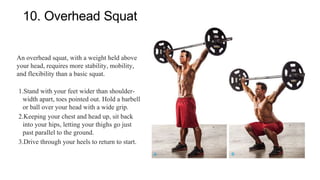
10. Overhead Squat
An overhead squat, with a weight held above
your head, requires more stability, mobility,
and flexibility than a basic squat.
1.Stand with your feet wider than shoulder-
width apart, toes pointed out. Hold a barbell
or ball over your head with a wide grip.
2.Keeping your chest and head up, sit back
into your hips, letting your thighs go just
past parallel to the ground.
3.Drive through your heels to return to start.
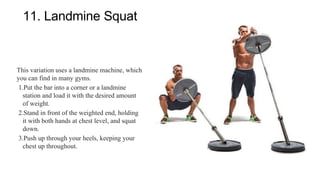
11. Landmine Squat
This variation uses a landmine machine, which
you can find in many gyms.
1.Put the bar into a corner or a landmine
station and load it with the desired amount
of weight.
2.Stand in front of the weighted end, holding
it with both hands at chest level, and squat
down.
3.Push up through your heels, keeping your
chest up throughout.
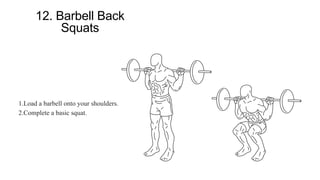
12. Barbell Back
Squats
1.Load a barbell onto your shoulders.
2.Complete a basic squat.
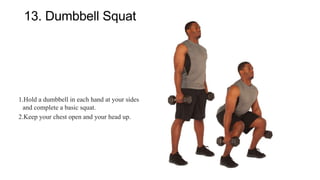
13. Dumbbell Squat
1.Hold a dumbbell in each hand at your sides
and complete a basic squat.
2.Keep your chest open and your head up.
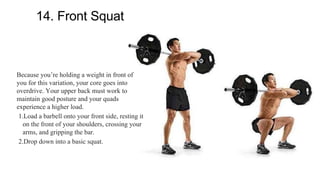
14. Front Squat
Because you’re holding a weight in front of
you for this variation, your core goes into
overdrive. Your upper back must work to
maintain good posture and your quads
experience a higher load.
1.Load a barbell onto your front side, resting it
on the front of your shoulders, crossing your
arms, and gripping the bar.
2.Drop down into a basic squat.
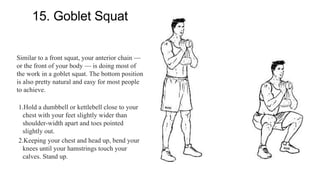
15. Goblet Squat
Similar to a front squat, your anterior chain —
or the front of your body — is doing most of
the work in a goblet squat. The bottom position
is also pretty natural and easy for most people
to achieve.
1.Hold a dumbbell or kettlebell close to your
chest with your feet slightly wider than
shoulder-width apart and toes pointed
slightly out.
2.Keeping your chest and head up, bend your
knees until your hamstrings touch your
calves. Stand up.
Wow !!!
that was some awesome
information….
But can you tell the benefits of squat
???
• Squats Help Build Muscle.
• Squats Burn Calories Fast.
• Squats Help Improve
Flexibility.
• Squats Help with Mobility and
Balance.
• Squats Help Strengthen Your
Lungs and Heart.
• Squats Can Help Prevent
Injuries
• Squats Can Maintain &
Improve Your Joints.
• Squatting Keeps Bones
Strong.
• Improves Your Speed and
your Ability to Jump.
• Postural Improvements.
• Squats Improve Digestion and
Circulation.
• Improve Your Daily Life &
Physical Abilities.

Squats and Variations

  • 1.
    Dr. Sujitkumar Pandey(PT) Squats and their Variations
  • 2.
    What is aSquat ???
  • 3.
    A squat isa strength exercise in which the trainee lowers their hips from a standing position and then stands back up. During the descent of a squat, the hip and knee joints flex while the ankle joint dorsiflexes; conversely the hip and knee joints extend and the ankle joint plantarflexes when standing up. Squats are considered a vital exercise for increasing the strength and size of the lower body muscles as well as developing core strength. The primary agonist muscles used during the squat are the quadriceps femoris, the adductor magnus, and the gluteus maximus.[1] The squat also isometrically uses the erector spinae and the abdominal muscles, among others. The squat is one of the three lifts in the strength sport of powerlifting, together with the deadlift and the bench press. It is also considered a staple exercise in many popular recreational exercise programs.
  • 4.
    Hey lets checkout the variations then…
  • 5.
    1. Basic Squat 1.Startwith your feet shoulder-width apart, toes slightly out, and your arms down at your side. 2.Start to hinge at the hips and bend your knees, sitting back like you’re going to sit down and allowing your arms to raise up in front of you. Ensure that your knees don’t fall inward and your back stays straight. 3.When your thighs are parallel to the ground, stop and push up through your heels to return to start.
  • 6.
    2. Wall Squat 1.Standwith your back against a wall and step your feet out about 12 inches from the wall. 2.Bend your knees, dropping into a squat while keeping your back pinned to the wall throughout the movement. 3.Stop when your thighs are parallel to the ground. Push up through your heels back to start.
  • 7.
    3. Prisoner Squat Puttingyour hands behind your head helps to stabilize your core and shoulders. 1.Start with your feet shoulder-width apart, toes slightly out, arms bent, and fingers interlaced behind your head. 2.Proceed with a basic squat.
  • 8.
    4. Side Squat It’simportant to work in all planes of motion while exercising — that means not only front and back, but side to side as well. 1.Start with your feet shoulder-width apart and your arms down at your sides. 2.Begin to hinge at the hips and bend your knees, stepping your right foot out to the side and allowing your arms to raise up in front of you to a comfortable position. 3.When your thighs are parallel to the ground, stand up, stepping your left foot to meet your right. 4.Repeat, stepping your left foot out and bringing your right foot to meet it.
  • 9.
    5. Pistol Squat Amore advanced move, a pistol squat is a single-leg bodyweight squat that requires strength, balance, and mobility. 1.Start standing with your feet together and extend your arms out in front of you. 2.Lift your left leg up off of the floor in front of you and squat down on your right, lowering until your left leg is parallel to the floor. 3.Stand up and repeat on the other side.
  • 10.
    6. Single LegSquat Not to be confused with a pistol squat, a single-leg squat is just that — a squat on one leg. The main difference is that in a single-leg squat, the free leg doesn’t have to be parallel to the ground. 1.Start by standing with your feet together and your arms out in front of you. 2.Lift your left leg up off of the ground in front of you and squat down on your right as far as you can go, stopping when your right thigh is parallel to the ground. 3.Stand up, then switch legs.
  • 11.
    7. Split Squat 1.Staggeryour stance so your right foot is in front of your left. 2.Perform a squat, dropping down until your right thigh is parallel to the ground. 3.Stand and switch your stance.
  • 12.
    8. Bulgarian SplitSquat This single-leg variation forces you to really engage your core. Complete this move by holding a dumbbell in each hand or loading a barbell on your back. 1.Position yourself in front of a bench with a split stance, resting your left foot up on the bench. Your right foot should be far enough out to comfortably squat down without your knee falling over your toes. 2.Keeping your chest open, squat down on your right leg, pushing back up through your heel. 3.Stand up and perform on the other side.
  • 13.
    9. Frog Squat 1.Dropdown into a basic squat. 2.Place your elbows inside your knees, clasping your hands together. 3.Keeping your elbows where they are, slowly start to straighten your legs, pushing your hips up in the air, then lower back down.
  • 14.
    10. Overhead Squat Anoverhead squat, with a weight held above your head, requires more stability, mobility, and flexibility than a basic squat. 1.Stand with your feet wider than shoulder- width apart, toes pointed out. Hold a barbell or ball over your head with a wide grip. 2.Keeping your chest and head up, sit back into your hips, letting your thighs go just past parallel to the ground. 3.Drive through your heels to return to start.
  • 15.
    11. Landmine Squat Thisvariation uses a landmine machine, which you can find in many gyms. 1.Put the bar into a corner or a landmine station and load it with the desired amount of weight. 2.Stand in front of the weighted end, holding it with both hands at chest level, and squat down. 3.Push up through your heels, keeping your chest up throughout.
  • 16.
    12. Barbell Back Squats 1.Loada barbell onto your shoulders. 2.Complete a basic squat.
  • 17.
    13. Dumbbell Squat 1.Holda dumbbell in each hand at your sides and complete a basic squat. 2.Keep your chest open and your head up.
  • 18.
    14. Front Squat Becauseyou’re holding a weight in front of you for this variation, your core goes into overdrive. Your upper back must work to maintain good posture and your quads experience a higher load. 1.Load a barbell onto your front side, resting it on the front of your shoulders, crossing your arms, and gripping the bar. 2.Drop down into a basic squat.
  • 19.
    15. Goblet Squat Similarto a front squat, your anterior chain — or the front of your body — is doing most of the work in a goblet squat. The bottom position is also pretty natural and easy for most people to achieve. 1.Hold a dumbbell or kettlebell close to your chest with your feet slightly wider than shoulder-width apart and toes pointed slightly out. 2.Keeping your chest and head up, bend your knees until your hamstrings touch your calves. Stand up.
  • 20.
    Wow !!! that wassome awesome information…. But can you tell the benefits of squat ???
  • 21.
    • Squats HelpBuild Muscle. • Squats Burn Calories Fast. • Squats Help Improve Flexibility. • Squats Help with Mobility and Balance. • Squats Help Strengthen Your Lungs and Heart. • Squats Can Help Prevent Injuries • Squats Can Maintain & Improve Your Joints. • Squatting Keeps Bones Strong. • Improves Your Speed and your Ability to Jump. • Postural Improvements. • Squats Improve Digestion and Circulation. • Improve Your Daily Life & Physical Abilities.