• Memory Hierarchy
• Main Memory
• Auxiliary Memory
• Associative Memory
• Cache Memory
• Virtual Memory
• Memory Management Hardware
MEMORY ORGANIZATION
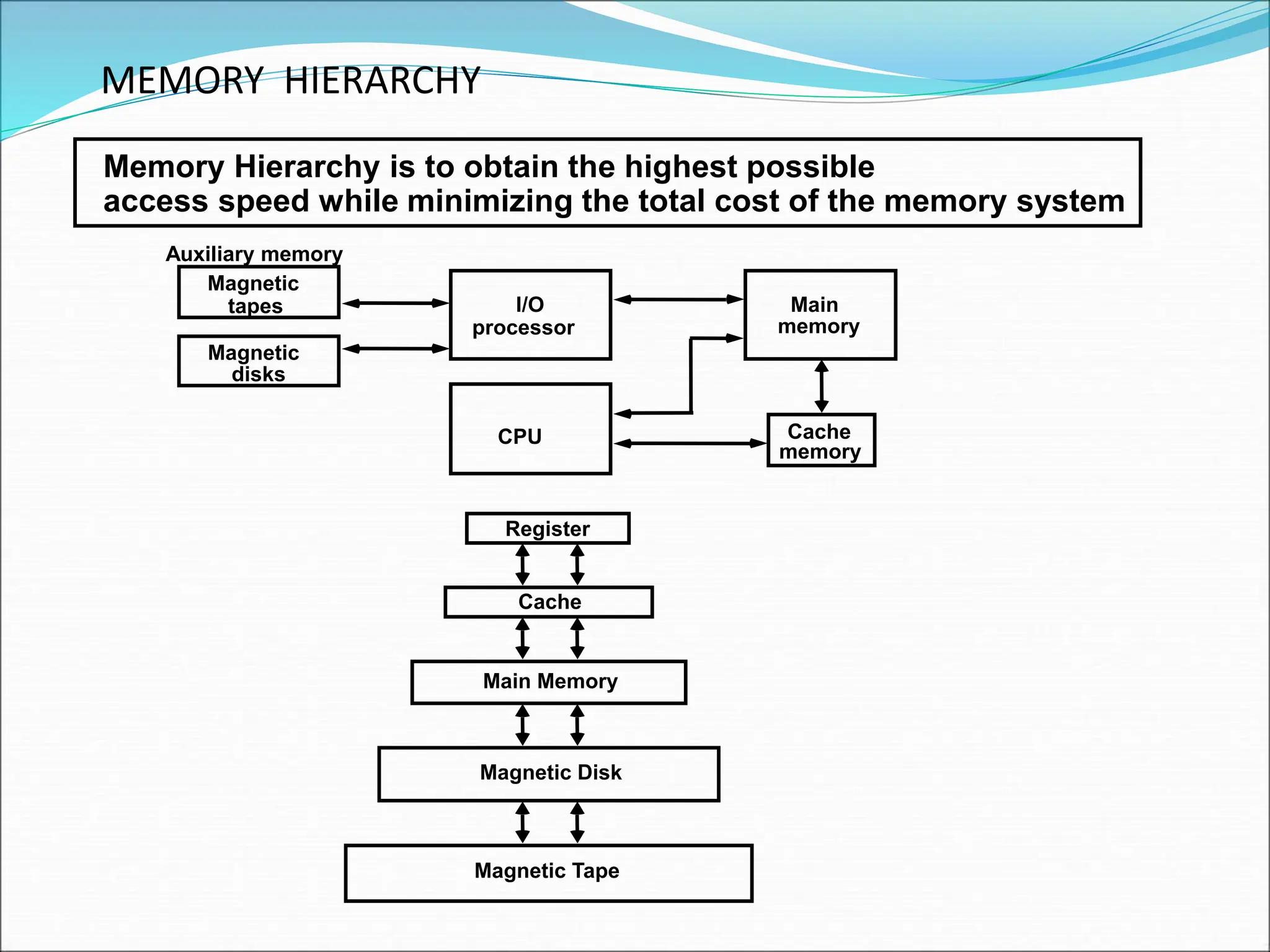
MEMORY HIERARCHY
Magnetic
tapes
Magnetic
disks
I/O
processor
CPU
Main
memory
Cache
memory
Auxiliary memory
Register
Cache
Main Memory
Magnetic Disk
Magnetic Tape
Memory Hierarchy is to obtain the highest possible
access speed while minimizing the total cost of the memory system
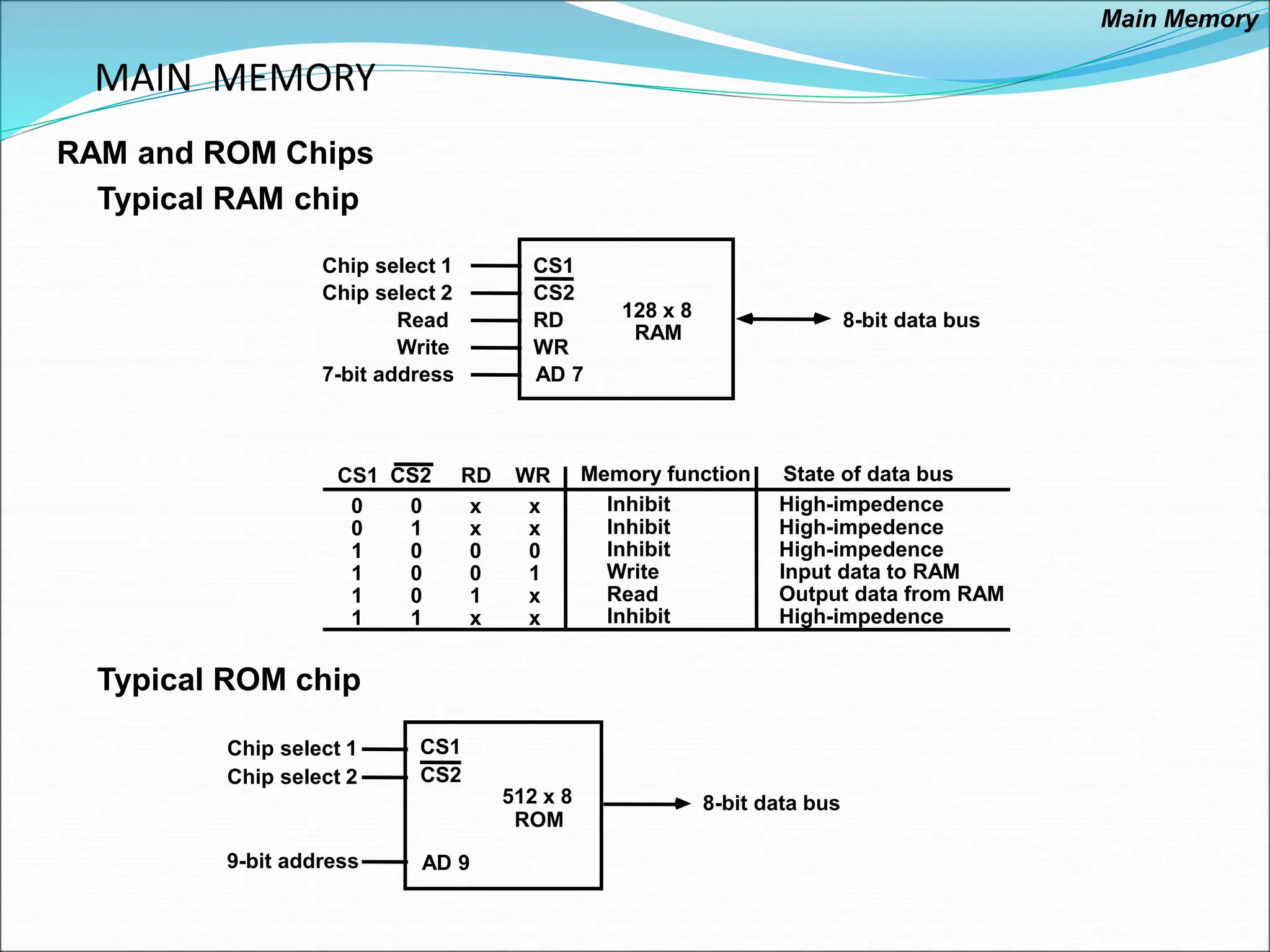
MAIN MEMORY
RAM and ROM Chips
Typical RAM chip
Typical ROM chip
Chip select 1
Chip select 2
Read
Write
7-bit address
CS1
CS2
RD
WR
AD 7
128 x 8
RAM
8-bit data bus
CS1 CS2 RD WR
0 0 x x
0 1 x x
1 0 0 0
1 0 0 1
1 0 1 x
1 1 x x
Memory function
Inhibit
Inhibit
Inhibit
Write
Read
Inhibit
State of data bus
High-impedence
High-impedence
High-impedence
Input data to RAM
Output data from RAM
High-impedence
Chip select 1
Chip select 2
9-bit address
CS1
CS2
AD 9
512 x 8
ROM
8-bit data bus
Main Memory
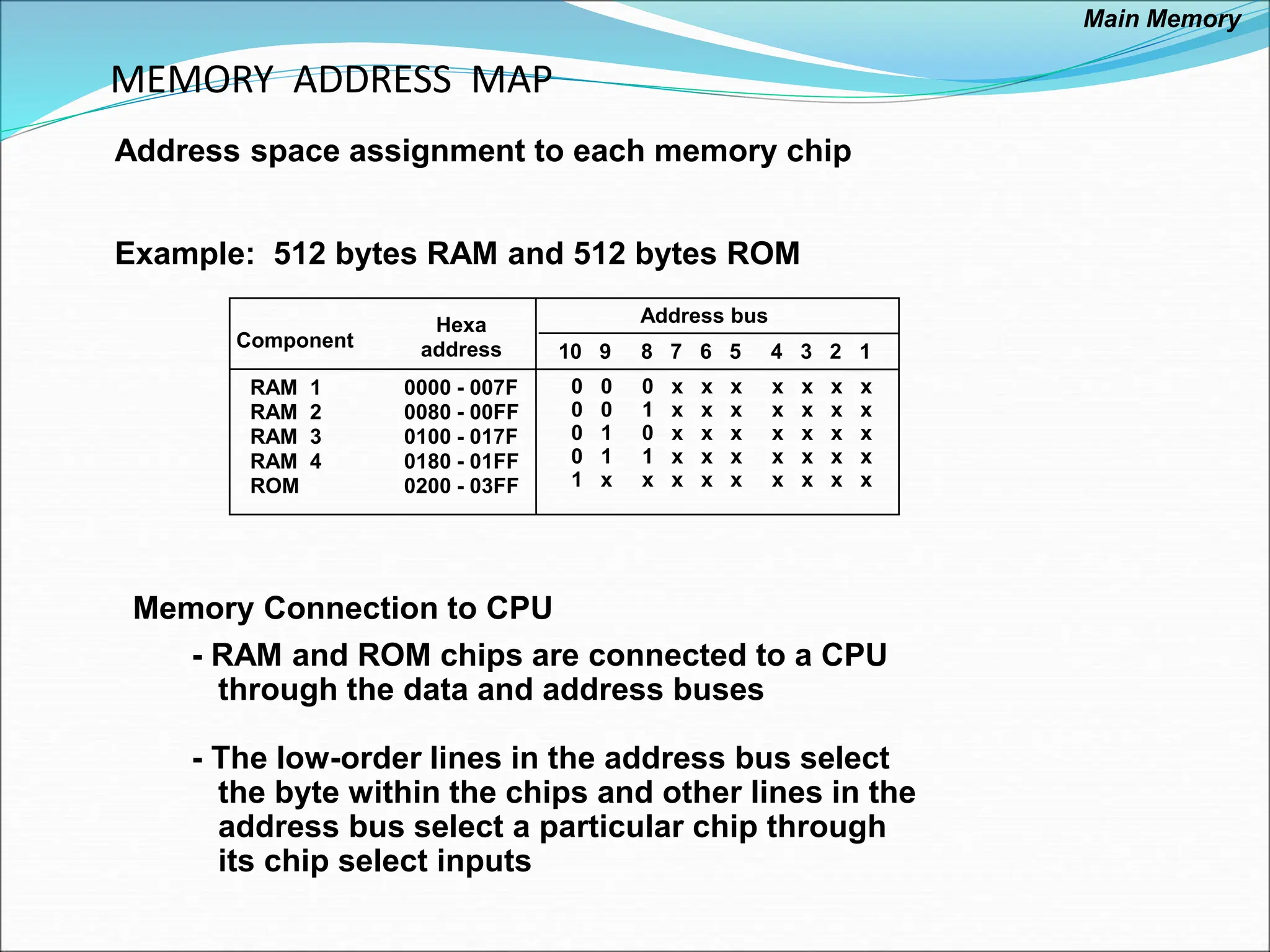
MEMORY ADDRESS MAP
RAM 1
RAM 2
RAM 3
RAM 4
ROM
0000 - 007F
0080 - 00FF
0100 - 017F
0180 - 01FF
0200 - 03FF
Component
Hexa
address
0 0 0 x x x x x x x
0 0 1 x x x x x x x
0 1 0 x x x x x x x
0 1 1 x x x x x x x
1 x x x x x x x x x
10 9 8 7 6 5 4 3 2 1
Address bus
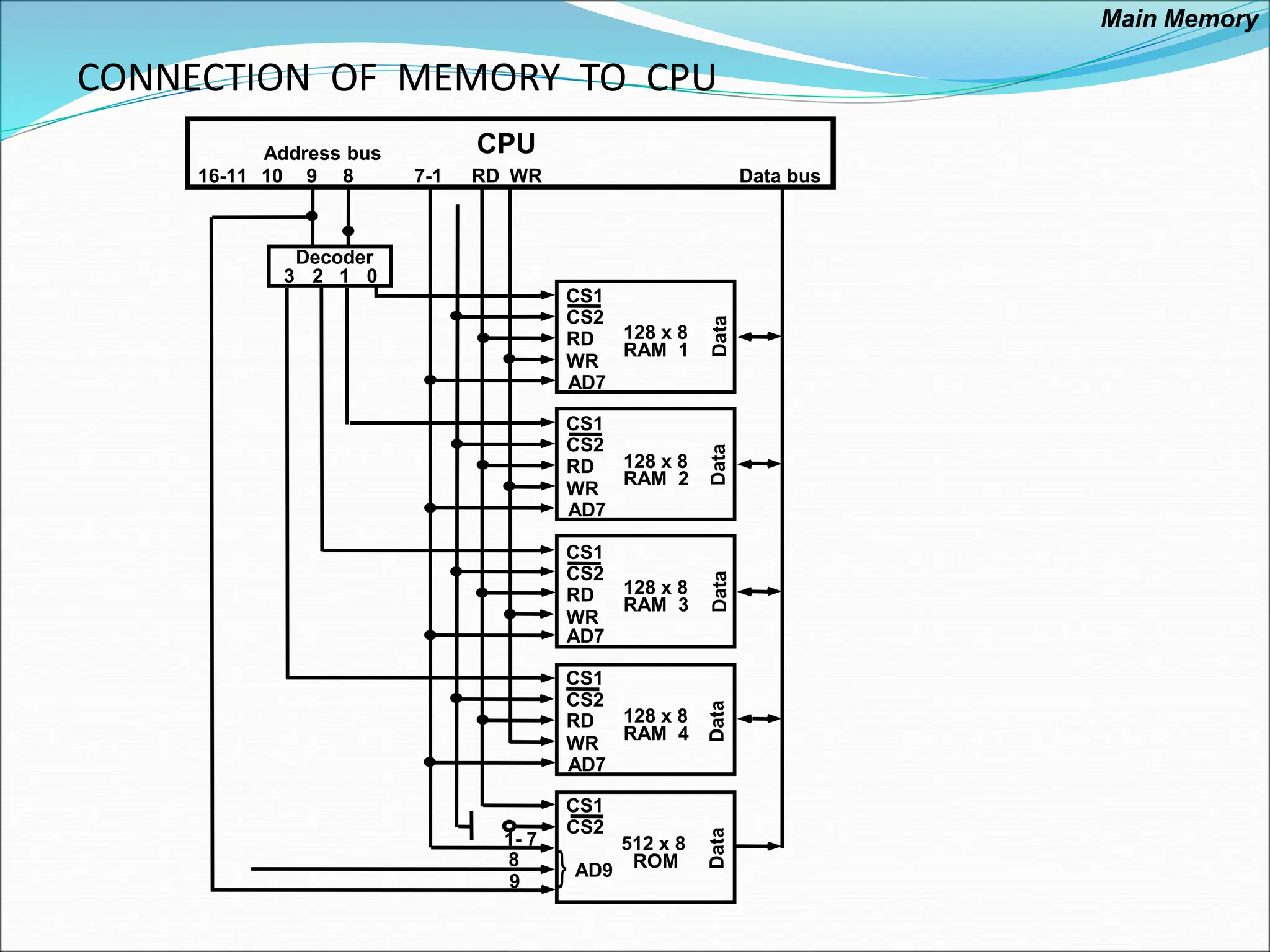
Memory Connection to CPU
- RAM and ROM chips are connected to a CPU
through the data and address buses
- The low-order lines in the address bus select
the byte within the chips and other lines in the
address bus select a particular chip through
its chip select inputs
Address space assignment to each memory chip
Example: 512 bytes RAM and 512 bytes ROM
Main Memory
CONNECTION OF MEMORY TO CPU
Main Memory
}
CS1
CS2
RD
WR
AD7
128 x 8
RAM 1
CS1
CS2
RD
WR
AD7
128 x 8
RAM 2
CS1
CS2
RD
WR
AD7
128 x 8
RAM 3
CS1
CS2
RD
WR
AD7
128 x 8
RAM 4
Decoder
3 2 1 0
WR
RD
9 8 7-1
10
16-11
Address bus
Data bus
CPU
CS1
CS2
512 x 8
ROM
AD9
1- 7
9
8
Data
Data
Data
Data
Data
AUXILIARY MEMORY
Organization of Disk Hardware
Track
Moving Head Disk Fixed Head Disk
Auxiliary Memory
ASSOCIATIVE MEMORY
- Accessed by the content of the data rather than by an address
- Also called Content Addressable Memory (CAM)
Hardware Organization Argument register(A)
Key register (K)
Associative memory
array and logic
m words
n bits per word
Match
register
Input
Read
Write
M
- Compare each word in CAM in parallel with the
content of A(Argument Register)
- If CAM Word[i] = A, M(i) = 1
- Read sequentially accessing CAM for CAM Word(i) for M(i) = 1
- K(Key Register) provides a mask for choosing a
particular field or key in the argument in A
(only those bits in the argument that have 1’s in
their corresponding position of K are compared)
Associative Memory
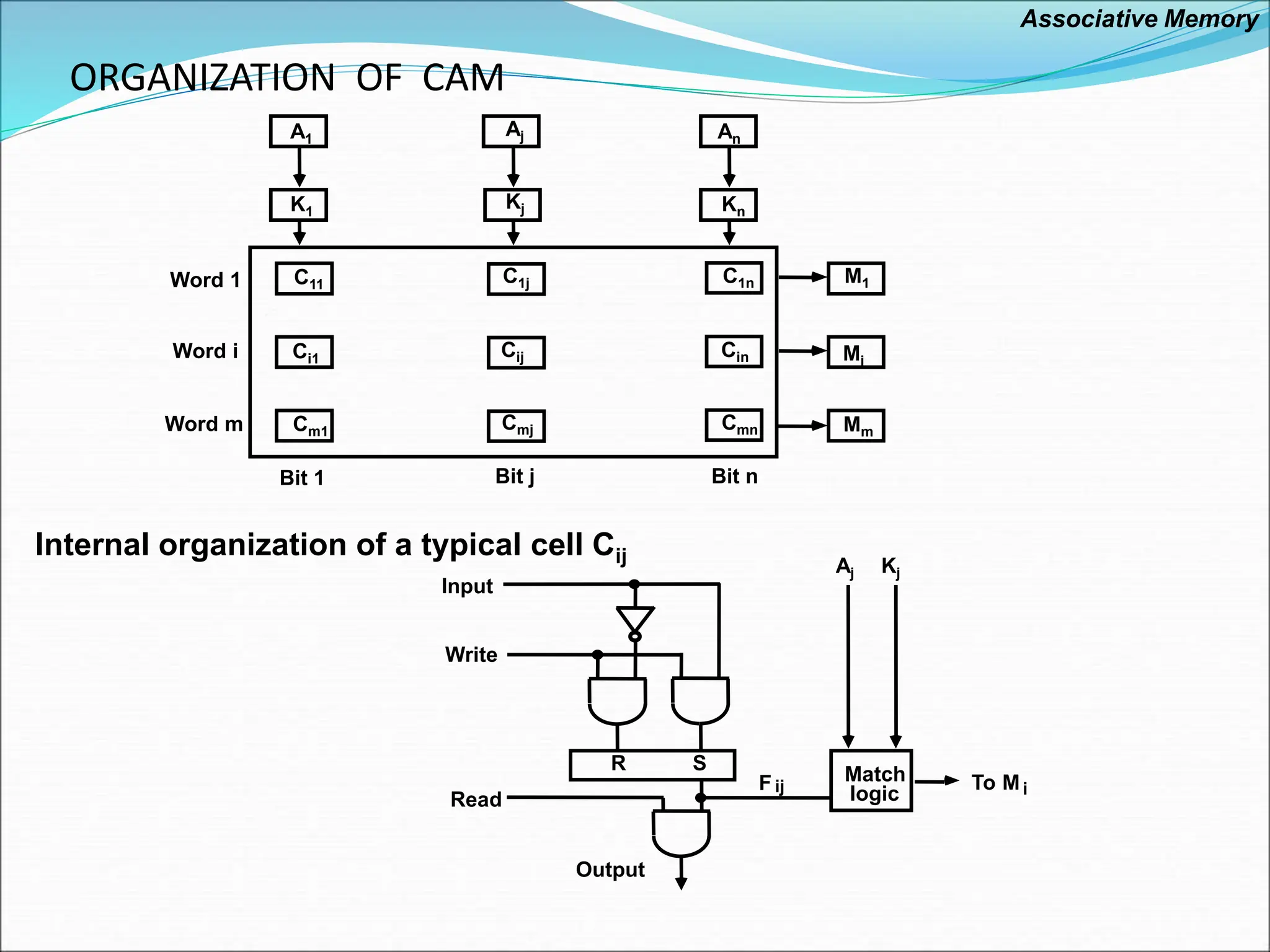
ORGANIZATION OF CAM
Internal organization of a typical cell Cij
C11
Word 1
Word i
Word m
Bit 1 Bit j Bit n
M1
Mi
Mm
Associative Memory
Aj
R S
Output
Match
logic
Input
Write
Read
Kj
Mi
To
Fij
A1
Aj An
K1
Kj Kn
C1j C1n
Ci1 Cij Cin
Cm1 Cmj Cmn
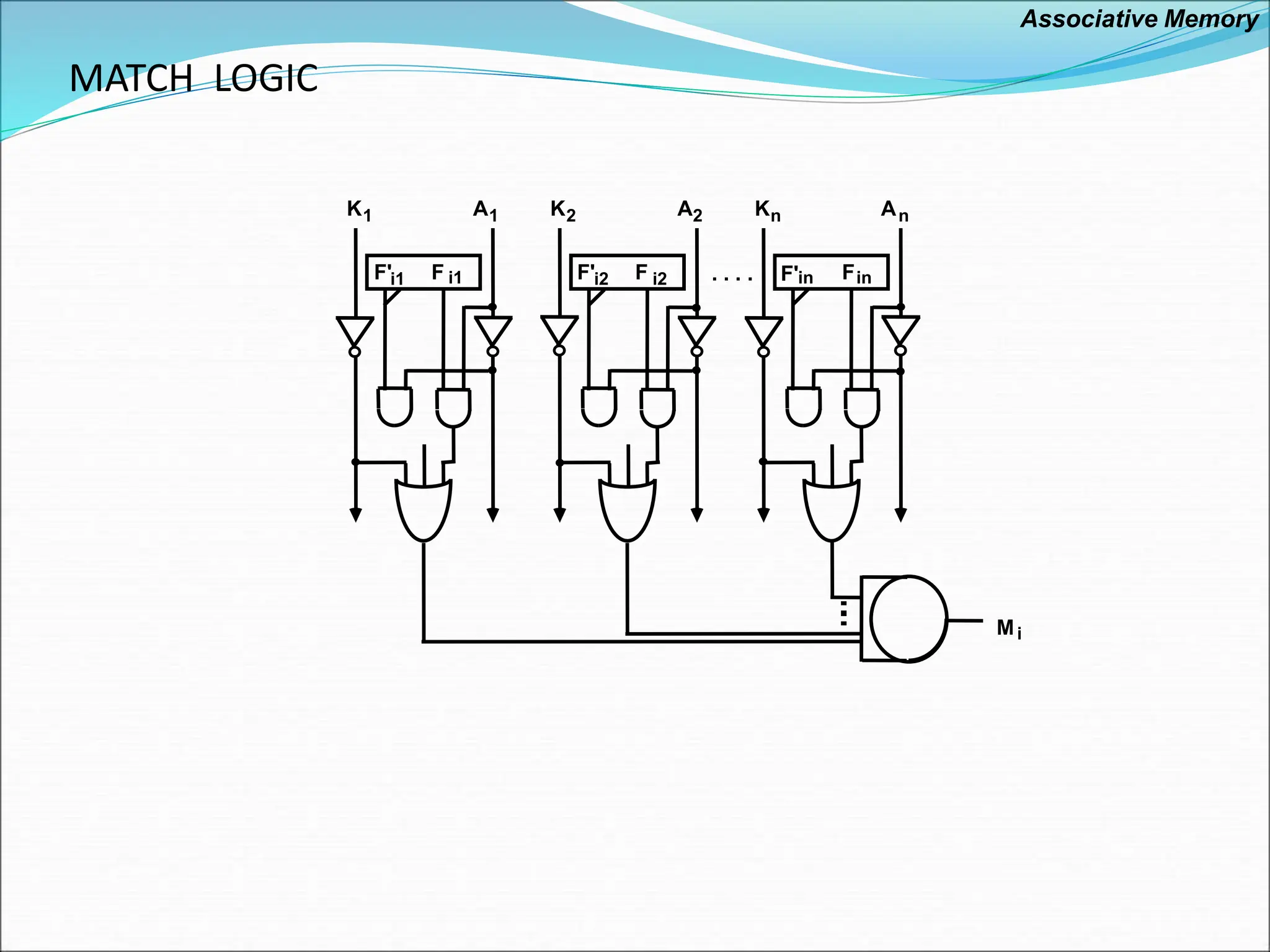
MATCH LOGIC
Associative Memory
F'i1 F i1
K1 A1
F'i2 F i2
K2 A2
F'in Fin
Kn An
. . . .
Mi
CACHE MEMORY
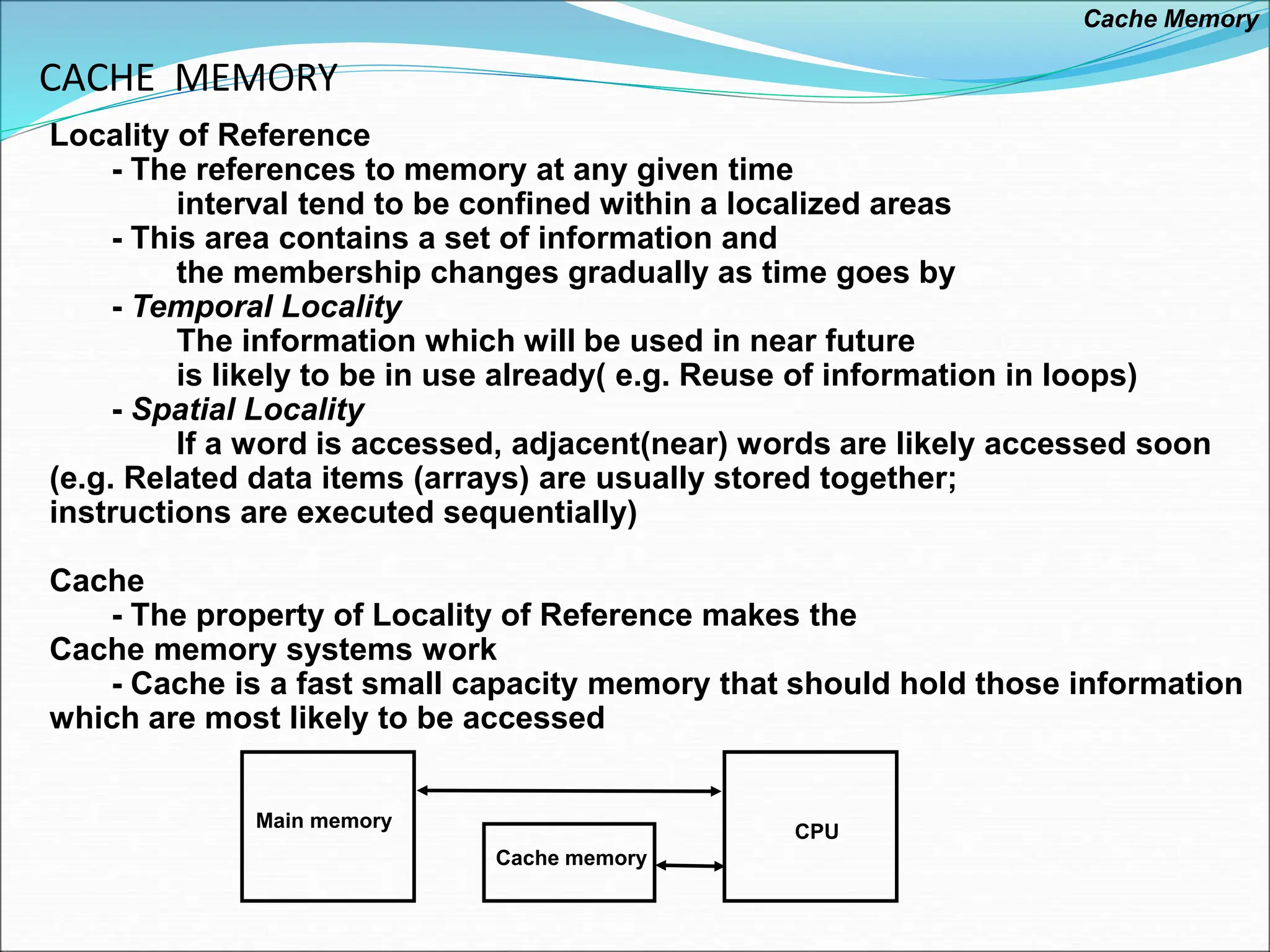
Locality of Reference
- The references to memory at any given time
interval tend to be confined within a localized areas
- This area contains a set of information and
the membership changes gradually as time goes by
- Temporal Locality
The information which will be used in near future
is likely to be in use already( e.g. Reuse of information in loops)
- Spatial Locality
If a word is accessed, adjacent(near) words are likely accessed soon
(e.g. Related data items (arrays) are usually stored together;
instructions are executed sequentially)
Cache
- The property of Locality of Reference makes the
Cache memory systems work
- Cache is a fast small capacity memory that should hold those information
which are most likely to be accessed
Cache Memory
Main memory
Cache memory
CPU
PERFORMANCE OF CACHE
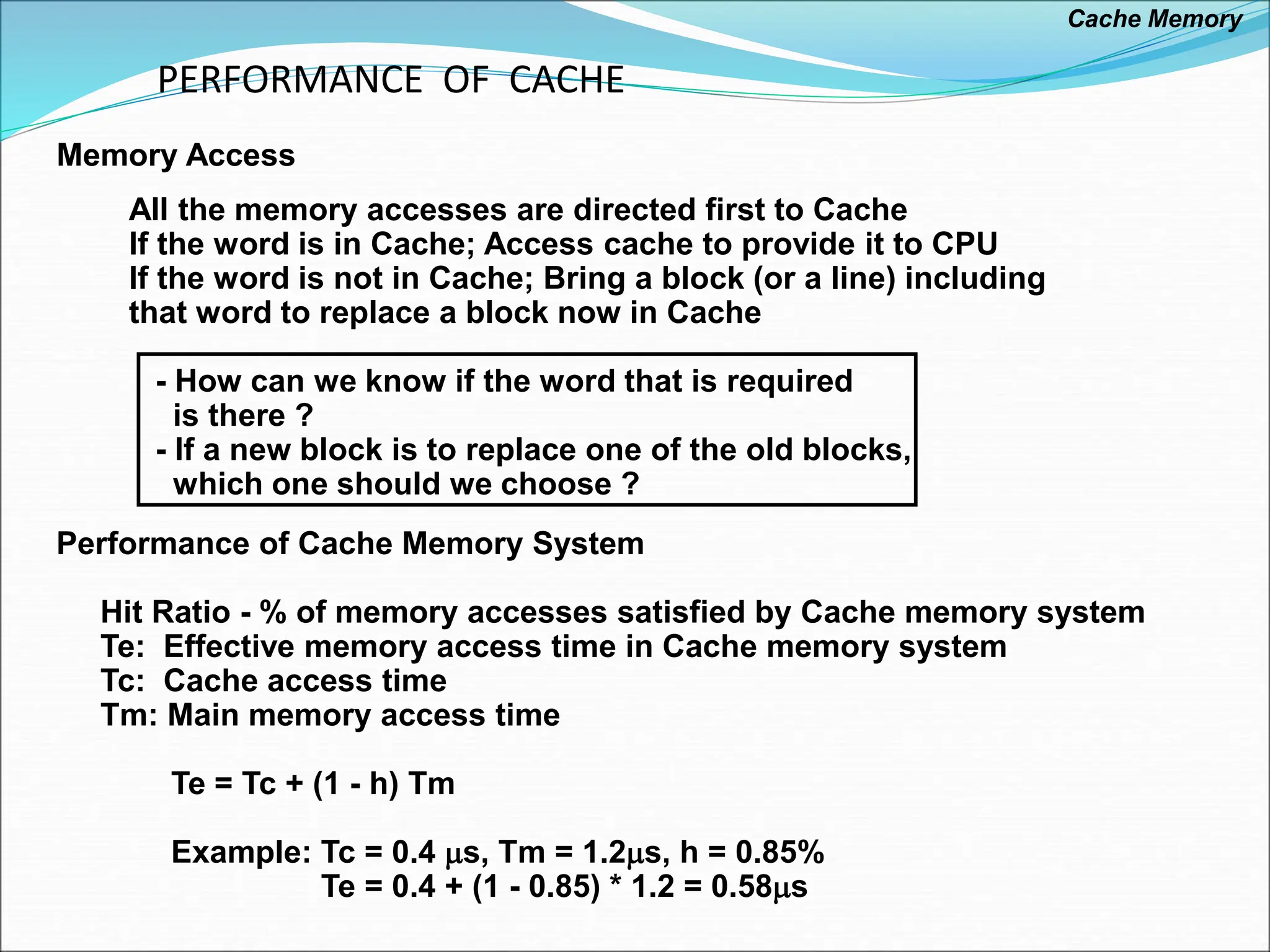
All the memory accesses are directed first to Cache
If the word is in Cache; Access cache to provide it to CPU
If the word is not in Cache; Bring a block (or a line) including
that word to replace a block now in Cache
- How can we know if the word that is required
is there ?
- If a new block is to replace one of the old blocks,
which one should we choose ?
Memory Access
Performance of Cache Memory System
Hit Ratio - % of memory accesses satisfied by Cache memory system
Te: Effective memory access time in Cache memory system
Tc: Cache access time
Tm: Main memory access time
Te = Tc + (1 - h) Tm
Example: Tc = 0.4 s, Tm = 1.2s, h = 0.85%
Te = 0.4 + (1 - 0.85) * 1.2 = 0.58s
Cache Memory
MEMORY AND CACHE MAPPING - ASSOCIATIVE MAPPLING -
Associative mapping
Direct mapping
Set-associative mapping
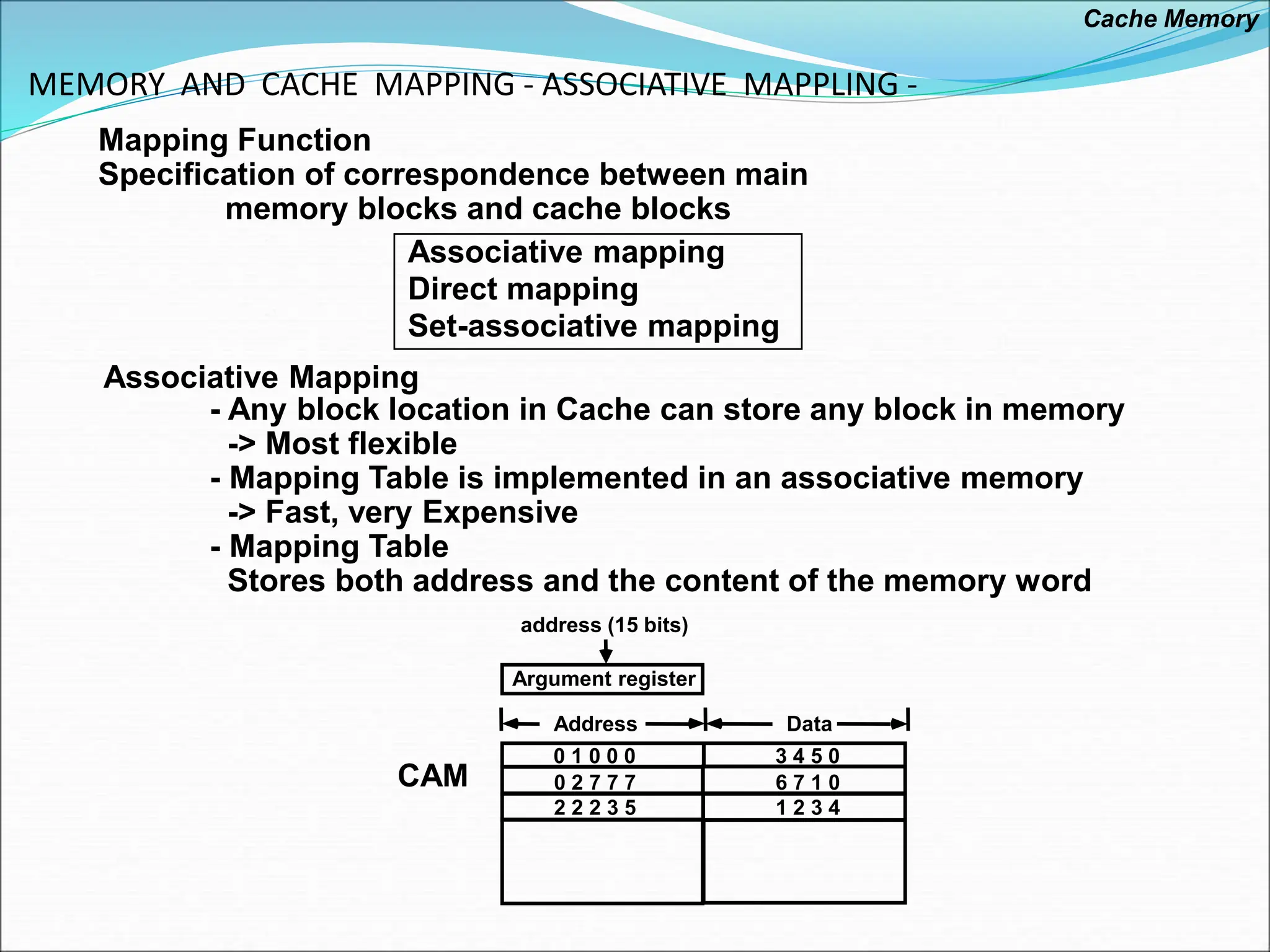
Associative Mapping
Mapping Function
Specification of correspondence between main
memory blocks and cache blocks
- Any block location in Cache can store any block in memory
-> Most flexible
- Mapping Table is implemented in an associative memory
-> Fast, very Expensive
- Mapping Table
Stores both address and the content of the memory word
address (15 bits)
Argument register
Address Data
0 1 0 0 0
0 2 7 7 7
2 2 2 3 5
3 4 5 0
6 7 1 0
1 2 3 4
CAM
Cache Memory
MEMORY AND CACHE MAPPING - DIRECT MAPPING -
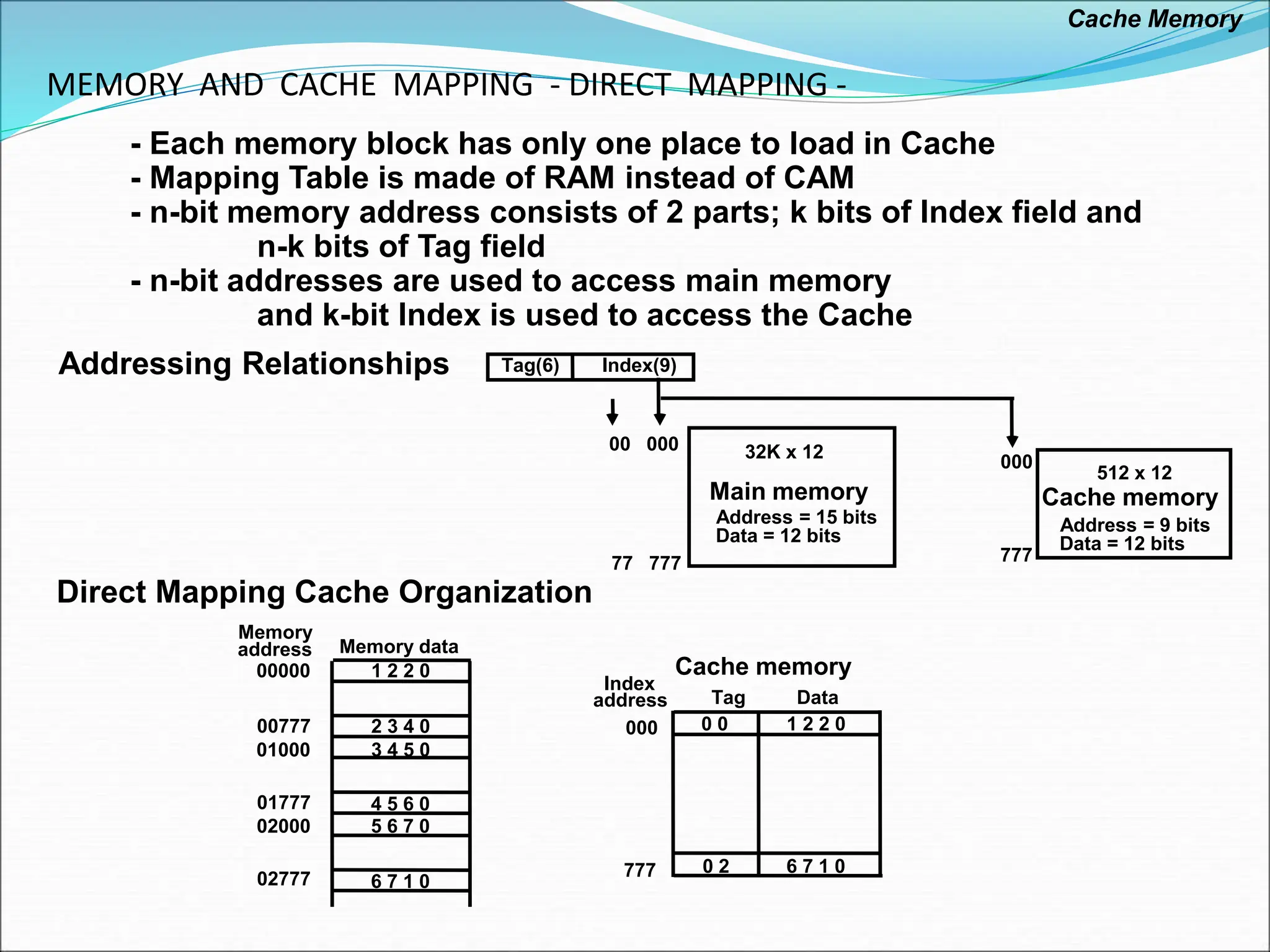
Addressing Relationships
Direct Mapping Cache Organization
Memory
address Memory data
00000 1 2 2 0
00777
01000
01777
02000
02777
2 3 4 0
3 4 5 0
4 5 6 0
5 6 7 0
6 7 1 0
Index
address Tag Data
000 0 0 1 2 2 0
0 2 6 7 1 0
777
Cache memory
Tag(6) Index(9)
32K x 12
Main memory
Address = 15 bits
Data = 12 bits
512 x 12
Cache memory
Address = 9 bits
Data = 12 bits
00 000
77 777
000
777
- Each memory block has only one place to load in Cache
- Mapping Table is made of RAM instead of CAM
- n-bit memory address consists of 2 parts; k bits of Index field and
n-k bits of Tag field
- n-bit addresses are used to access main memory
and k-bit Index is used to access the Cache
Cache Memory
DIRECT MAPPING
Direct Mapping with block size of 8 words
Operation
- CPU generates a memory request with (TAG;INDEX)
- Access Cache using INDEX ; (tag; data)
Compare TAG and tag
- If matches -> Hit
Provide Cache[INDEX](data) to CPU
- If not match -> Miss
M[tag;INDEX] <- Cache[INDEX](data)
Cache[INDEX] <- (TAG;M[TAG; INDEX])
CPU <- Cache[INDEX](data)
Index tag data
000 0 1 3 4 5 0
007 0 1 6 5 7 8
010
017
770 0 2
777 0 2 6 7 1 0
Block 0
Block 1
Block 63
Tag Block Word
6 6 3
INDEX
Cache Memory
MEMORY AND CACHE MAPPING - SET ASSOCIATIVE MAPPING -
Set Associative Mapping Cache with set size of two
- Each memory block has a set of locations in the Cache to load
Index Tag Data
000 0 1 3 4 5 0 0 2 5 6 7 0
Tag Data
777 0 2 6 7 1 0 0 0 2 3 4 0
Operation
- CPU generates a memory address(TAG; INDEX)
- Access Cache with INDEX, (Cache word = (tag 0, data 0); (tag 1, data 1))
- Compare TAG and tag 0 and then tag 1
- If tag i = TAG -> Hit, CPU <- data i
- If tag i  TAG -> Miss,
Replace either (tag 0, data 0) or (tag 1, data 1),
Assume (tag 0, data 0) is selected for replacement,
(Why (tag 0, data 0) instead of (tag 1, data 1) ?)
M[tag 0, INDEX] <- Cache[INDEX](data 0)
Cache[INDEX](tag 0, data 0) <- (TAG, M[TAG,INDEX]),
CPU <- Cache[INDEX](data 0)
Cache Memory

Memory Organizationsssssssssssssssss.ppt

  • 1.
    • Memory Hierarchy •Main Memory • Auxiliary Memory • Associative Memory • Cache Memory • Virtual Memory • Memory Management Hardware MEMORY ORGANIZATION
  • 2.
    MEMORY HIERARCHY Magnetic tapes Magnetic disks I/O processor CPU Main memory Cache memory Auxiliary memory Register Cache MainMemory Magnetic Disk Magnetic Tape Memory Hierarchy is to obtain the highest possible access speed while minimizing the total cost of the memory system
  • 3.
    MAIN MEMORY RAM andROM Chips Typical RAM chip Typical ROM chip Chip select 1 Chip select 2 Read Write 7-bit address CS1 CS2 RD WR AD 7 128 x 8 RAM 8-bit data bus CS1 CS2 RD WR 0 0 x x 0 1 x x 1 0 0 0 1 0 0 1 1 0 1 x 1 1 x x Memory function Inhibit Inhibit Inhibit Write Read Inhibit State of data bus High-impedence High-impedence High-impedence Input data to RAM Output data from RAM High-impedence Chip select 1 Chip select 2 9-bit address CS1 CS2 AD 9 512 x 8 ROM 8-bit data bus Main Memory
  • 4.
    MEMORY ADDRESS MAP RAM1 RAM 2 RAM 3 RAM 4 ROM 0000 - 007F 0080 - 00FF 0100 - 017F 0180 - 01FF 0200 - 03FF Component Hexa address 0 0 0 x x x x x x x 0 0 1 x x x x x x x 0 1 0 x x x x x x x 0 1 1 x x x x x x x 1 x x x x x x x x x 10 9 8 7 6 5 4 3 2 1 Address bus Memory Connection to CPU - RAM and ROM chips are connected to a CPU through the data and address buses - The low-order lines in the address bus select the byte within the chips and other lines in the address bus select a particular chip through its chip select inputs Address space assignment to each memory chip Example: 512 bytes RAM and 512 bytes ROM Main Memory
  • 5.
    CONNECTION OF MEMORYTO CPU Main Memory } CS1 CS2 RD WR AD7 128 x 8 RAM 1 CS1 CS2 RD WR AD7 128 x 8 RAM 2 CS1 CS2 RD WR AD7 128 x 8 RAM 3 CS1 CS2 RD WR AD7 128 x 8 RAM 4 Decoder 3 2 1 0 WR RD 9 8 7-1 10 16-11 Address bus Data bus CPU CS1 CS2 512 x 8 ROM AD9 1- 7 9 8 Data Data Data Data Data
  • 6.
    AUXILIARY MEMORY Organization ofDisk Hardware Track Moving Head Disk Fixed Head Disk Auxiliary Memory
  • 7.
    ASSOCIATIVE MEMORY - Accessedby the content of the data rather than by an address - Also called Content Addressable Memory (CAM) Hardware Organization Argument register(A) Key register (K) Associative memory array and logic m words n bits per word Match register Input Read Write M - Compare each word in CAM in parallel with the content of A(Argument Register) - If CAM Word[i] = A, M(i) = 1 - Read sequentially accessing CAM for CAM Word(i) for M(i) = 1 - K(Key Register) provides a mask for choosing a particular field or key in the argument in A (only those bits in the argument that have 1’s in their corresponding position of K are compared) Associative Memory
  • 8.
    ORGANIZATION OF CAM Internalorganization of a typical cell Cij C11 Word 1 Word i Word m Bit 1 Bit j Bit n M1 Mi Mm Associative Memory Aj R S Output Match logic Input Write Read Kj Mi To Fij A1 Aj An K1 Kj Kn C1j C1n Ci1 Cij Cin Cm1 Cmj Cmn
  • 9.
    MATCH LOGIC Associative Memory F'i1F i1 K1 A1 F'i2 F i2 K2 A2 F'in Fin Kn An . . . . Mi
  • 10.
    CACHE MEMORY Locality ofReference - The references to memory at any given time interval tend to be confined within a localized areas - This area contains a set of information and the membership changes gradually as time goes by - Temporal Locality The information which will be used in near future is likely to be in use already( e.g. Reuse of information in loops) - Spatial Locality If a word is accessed, adjacent(near) words are likely accessed soon (e.g. Related data items (arrays) are usually stored together; instructions are executed sequentially) Cache - The property of Locality of Reference makes the Cache memory systems work - Cache is a fast small capacity memory that should hold those information which are most likely to be accessed Cache Memory Main memory Cache memory CPU
  • 11.
    PERFORMANCE OF CACHE Allthe memory accesses are directed first to Cache If the word is in Cache; Access cache to provide it to CPU If the word is not in Cache; Bring a block (or a line) including that word to replace a block now in Cache - How can we know if the word that is required is there ? - If a new block is to replace one of the old blocks, which one should we choose ? Memory Access Performance of Cache Memory System Hit Ratio - % of memory accesses satisfied by Cache memory system Te: Effective memory access time in Cache memory system Tc: Cache access time Tm: Main memory access time Te = Tc + (1 - h) Tm Example: Tc = 0.4 s, Tm = 1.2s, h = 0.85% Te = 0.4 + (1 - 0.85) * 1.2 = 0.58s Cache Memory
  • 12.
    MEMORY AND CACHEMAPPING - ASSOCIATIVE MAPPLING - Associative mapping Direct mapping Set-associative mapping Associative Mapping Mapping Function Specification of correspondence between main memory blocks and cache blocks - Any block location in Cache can store any block in memory -> Most flexible - Mapping Table is implemented in an associative memory -> Fast, very Expensive - Mapping Table Stores both address and the content of the memory word address (15 bits) Argument register Address Data 0 1 0 0 0 0 2 7 7 7 2 2 2 3 5 3 4 5 0 6 7 1 0 1 2 3 4 CAM Cache Memory
  • 13.
    MEMORY AND CACHEMAPPING - DIRECT MAPPING - Addressing Relationships Direct Mapping Cache Organization Memory address Memory data 00000 1 2 2 0 00777 01000 01777 02000 02777 2 3 4 0 3 4 5 0 4 5 6 0 5 6 7 0 6 7 1 0 Index address Tag Data 000 0 0 1 2 2 0 0 2 6 7 1 0 777 Cache memory Tag(6) Index(9) 32K x 12 Main memory Address = 15 bits Data = 12 bits 512 x 12 Cache memory Address = 9 bits Data = 12 bits 00 000 77 777 000 777 - Each memory block has only one place to load in Cache - Mapping Table is made of RAM instead of CAM - n-bit memory address consists of 2 parts; k bits of Index field and n-k bits of Tag field - n-bit addresses are used to access main memory and k-bit Index is used to access the Cache Cache Memory
  • 14.
    DIRECT MAPPING Direct Mappingwith block size of 8 words Operation - CPU generates a memory request with (TAG;INDEX) - Access Cache using INDEX ; (tag; data) Compare TAG and tag - If matches -> Hit Provide Cache[INDEX](data) to CPU - If not match -> Miss M[tag;INDEX] <- Cache[INDEX](data) Cache[INDEX] <- (TAG;M[TAG; INDEX]) CPU <- Cache[INDEX](data) Index tag data 000 0 1 3 4 5 0 007 0 1 6 5 7 8 010 017 770 0 2 777 0 2 6 7 1 0 Block 0 Block 1 Block 63 Tag Block Word 6 6 3 INDEX Cache Memory
  • 15.
    MEMORY AND CACHEMAPPING - SET ASSOCIATIVE MAPPING - Set Associative Mapping Cache with set size of two - Each memory block has a set of locations in the Cache to load Index Tag Data 000 0 1 3 4 5 0 0 2 5 6 7 0 Tag Data 777 0 2 6 7 1 0 0 0 2 3 4 0 Operation - CPU generates a memory address(TAG; INDEX) - Access Cache with INDEX, (Cache word = (tag 0, data 0); (tag 1, data 1)) - Compare TAG and tag 0 and then tag 1 - If tag i = TAG -> Hit, CPU <- data i - If tag i  TAG -> Miss, Replace either (tag 0, data 0) or (tag 1, data 1), Assume (tag 0, data 0) is selected for replacement, (Why (tag 0, data 0) instead of (tag 1, data 1) ?) M[tag 0, INDEX] <- Cache[INDEX](data 0) Cache[INDEX](tag 0, data 0) <- (TAG, M[TAG,INDEX]), CPU <- Cache[INDEX](data 0) Cache Memory