Deterministic Memory Abstraction and
Supporting Multicore System Architecture
Farzad Farshchi$, Prathap Kumar Valsan^, Renato Mancuso*, Heechul Yun$
$ University of Kansas, ^ Intel, * Boston University
Multicore Processors in CPS
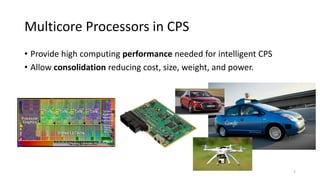
• Provide high computing performance needed for intelligent CPS
• Allow consolidation reducing cost, size, weight, and power.
2
Challenge: Shared Memory Hierarchy
3
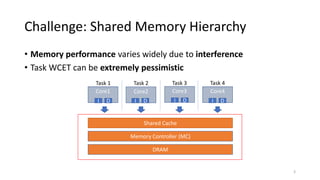
• Memory performance varies widely due to interference
• Task WCET can be extremely pessimistic
Core1 Core2 Core3 Core4
Memory Controller (MC)
Shared Cache
DRAM
Task 1 Task 2 Task 3 Task 4
I D I D I D I D
Challenge: Shared Memory Hierarchy
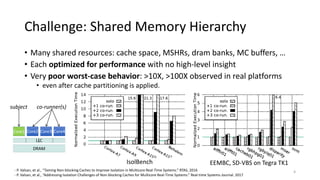
• Many shared resources: cache space, MSHRs, dram banks, MC buffers, …
• Each optimized for performance with no high-level insight
• Very poor worst-case behavior: >10X, >100X observed in real platforms
• even after cache partitioning is applied.
4
DRAM
LLC
Core1 Core2 Core3 Core4
subject co-runner(s)
IsolBench EEMBC, SD-VBS on Tegra TK1
- P. Valsan, et al., “Taming Non-blocking Caches to Improve Isolation in Multicore Real-Time Systems.” RTAS, 2016
- P. Valsan, et al., “Addressing Isolation Challenges of Non-blocking Caches for Multicore Real-Time Systems.” Real-time Systems Journal. 2017
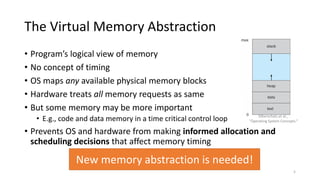
The Virtual Memory Abstraction
• Program’s logical view of memory
• No concept of timing
• OS maps any available physical memory blocks
• Hardware treats all memory requests as same
• But some memory may be more important
• E.g., code and data memory in a time critical control loop
• Prevents OS and hardware from making informed allocation and
scheduling decisions that affect memory timing
5
New memory abstraction is needed!
Silberschatz et al.,
“Operating System Concepts.”
Outline
• Motivation
• Our Approach
• Deterministic Memory Abstraction
• DM-Aware Multicore System Design
• Implementation
• Evaluation
• Conclusion
6
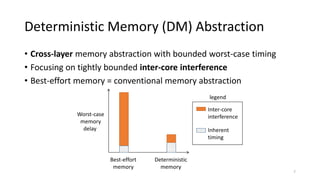
Deterministic Memory (DM) Abstraction
• Cross-layer memory abstraction with bounded worst-case timing
• Focusing on tightly bounded inter-core interference
• Best-effort memory = conventional memory abstraction
7
Inter-core
interference
Inherent
timing
legend
Best-effort
memory
Deterministic
memory
Worst-case
memory
delay
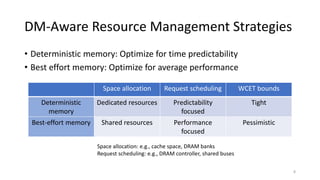
DM-Aware Resource Management Strategies
• Deterministic memory: Optimize for time predictability
• Best effort memory: Optimize for average performance
8
Space allocation Request scheduling WCET bounds
Deterministic
memory
Dedicated resources Predictability
focused
Tight
Best-effort memory Shared resources Performance
focused
Pessimistic
Space allocation: e.g., cache space, DRAM banks
Request scheduling: e.g., DRAM controller, shared buses
System Design: Overview
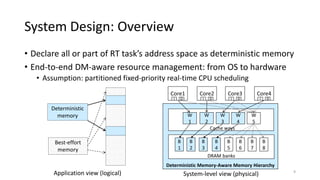
• Declare all or part of RT task’s address space as deterministic memory
• End-to-end DM-aware resource management: from OS to hardware
• Assumption: partitioned fixed-priority real-time CPU scheduling
9
Application view (logical) System-level view (physical)
Deterministic
memory
Best-effort
memory
Deterministic Memory-Aware Memory Hierarchy
Core1 Core2 Core3 Core4
W
5
W
1
W
2
W
3
W
4
I D I D I D I D
B
1
B
2
B
3
B
4
B
5
B
6
B
7
B
8
DRAM banks
Cache ways
OS and Architecture Extensions for DM
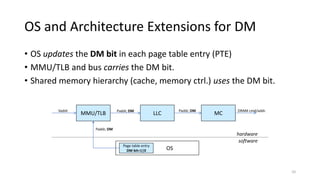
• OS updates the DM bit in each page table entry (PTE)
• MMU/TLB and bus carries the DM bit.
• Shared memory hierarchy (cache, memory ctrl.) uses the DM bit.
10
OS
MMU/TLB
Page table entry
DM bit=1|0
LLC MCPaddr, DM Paddr, DM
Paddr, DM
Vaddr DRAM cmd/addr.
hardware
software
DM-Aware Shared Cache
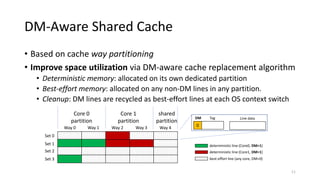
• Based on cache way partitioning
• Improve space utilization via DM-aware cache replacement algorithm
• Deterministic memory: allocated on its own dedicated partition
• Best-effort memory: allocated on any non-DM lines in any partition.
• Cleanup: DM lines are recycled as best-effort lines at each OS context switch
11
Way 0 Way 1 Way 2 Way 3
Core 0
partition
Core 1
partition
best-effort line (any core, DM=0)
deterministic line (Core0, DM=1)
deterministic line (Core1, DM=1)
Way 4
shared
partition
Set 0
Set 1
Set 2
Set 3
0
DM Tag Line data
DM-Aware Memory (DRAM) Controller
• OS allocates DM pages on reserved banks, others on shared banks
• Memory-controller implements two-level scheduling (*)
12
Determinism
focused scheduling
(Round-Robin)
Throughput focused
scheduling
(FR-FCFS)
yes noDeterministic
memory request
exist?
(a) Memory controller (MC) architecture (b) Scheduling algorithm
(*) P. Valsan, et al., “MEDUSA: A Predictable and High-Performance DRAM Controller for Multicore based Embedded Systems.” CPSNA, 2015
Implementation
• Fully functional end-to-end implementation in Linux and Gem5.
• Linux kernel extensions
• Use an unused bit combination in ARMv7 PTE to indicate a DM page.
• Modified the ELF loader and system calls to declare DM memory regions
• DM-aware page allocator, replacing the buddy allocator, based on PALLOC (*)
• Dedicated DRAM banks for DM are configured through Linux’s CGROUP interface.
ARMv7 page table entry (PTE)
13
(*) H. Yun et. al, “PALLOC: DRAM Bank-Aware Memory Allocator for Performance Isolation on Multicore Platforms.” RTAS’14
Implementation
• Gem5 (a cycle-accurate full-system simulator) extensions
• MMU/TLB: Add DM bit support
• Bus: Add the DM bit in each bus transaction
• Cache: implement way-partitioning and DM-aware replacement algorithm
• DRAM controller: implement DM-aware two-level scheduling algorithm.
• Hardware implementability
• MMU/TLB, Bus: adding 1 bit is not difficult. (e.g., Use AXI bus QoS bits)
• Cache and DRAM controllers: logic change and additional storage are
minimal.
14
Outline
• Motivation
• Our Approach
• Deterministic Memory Abstraction
• DM-Aware Multicore System Design
• Implementation
• Evaluation
• Conclusion
15
Simulation Setup
• Baseline Gem5 full-system simulator
• 4 out-of-order cores, 2 GHz
• 2 MB Shared L2 (16 ways)
• LPDDR2@533MHz, 1 rank, 8 banks
• Linux 3.14 (+DM support)
• Workload
• EEMBC, SD-VBS, SPEC2006, IsolBench
16
Real-Time Benchmark Characteristics
• Critical pages: pages accessed in the main loop
• Critical (T98/T90): pages accounting 98/90% L1 misses of all L1 misses of the critical pages.
• Only 38% of pages are critical pages
• Some pages contribute more to L1 misses (hence shared L2 accesses)
• Not all memory is equally important
svm L1 miss distribution
17
Effects of DM-Aware Cache
• Questions
• Does it provide strong cache isolation for real-time tasks using DM?
• Does it improve cache space utilization for best-effort tasks?
• Setup
• RT: EEMBC, SD-VBS, co-runners: 3x Bandwidth
• Comparisons
• NoP: free-for-all sharing. No partitioning
• WP: cache way partitioning (4 ways/core)
• DM(A): all critical pages of a benchmark are marked as DM
• DM(T98): critical pages accounting 98% L1 misses are marked as DM
• DM(T90): critical pages accounting 98% L1 misses are marked as DM
18
DRAM
LLC
Core1 Core2 Core3 Core4
RT co-runner(s)
Effects of DM-Aware Cache
• Does it provide strong cache isolation for real-time tasks using DM?
• Yes. DM(A) and WP (way-partitioning) offer equivalent isolation.
• Does it improve cache space utilization for best-effort tasks?
• Yes. DM(A) uses only 50% cache partition of WP.
19
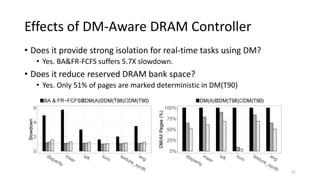
Effects of DM-Aware DRAM Controller
• Questions
• Does it provide strong isolation for real-time tasks using DM?
• Does it reduce reserved DRAM bank space?
• Setup
• RT: SD-VBS (input: CIF), co-runners: 3x Bandwidth
• Comparisons
• BA & FR-FCFS: Linux’s default buddy allocator + FR-FCFS scheduling in MC
• DM(A): DM on private DRAM banks + two-level scheduling in MC
• DM(T98): same as DM(A), except pages accounting 98% L1 misses are DM
• DM(T90): same as DM(A), except pages accounting 90% L1 misses are DM
20
Effects of DM-Aware DRAM Controller
• Does it provide strong isolation for real-time tasks using DM?
• Yes. BA&FR-FCFS suffers 5.7X slowdown.
• Does it reduce reserved DRAM bank space?
• Yes. Only 51% of pages are marked deterministic in DM(T90)
21
Conclusion
• Challenge
• Balancing performance and predictability in multicore real-time systems
• Memory timing is important to WCET
• The current memory abstraction is limiting: no concept of timing.
• Deterministic Memory Abstraction
• Memory with tightly bounded worst-case timing.
• Enable predictable and high-performance multicore systems
• DM-aware multicore system designs
• OS, MMU/TLB, bus support
• DM-aware cache and DRAM controller designs
• Implemented and evaluated in Linux kernel and gem5
• Availability
• https://github.com/CSL-KU/detmem
22
Ongoing/Future Work
• SoC implementation in FPGA
• Based on open-source RISC-V quad-core SoC
• Basic DM support in bus protocol and Linux
• Implementing DM-aware cache and DRAM controllers
• Tool support and other applications
• Finding “optimal” deterministic memory blocks
• Better timing analysis integration (initial work in the paper)
• Closing micro-architectural side-channels.
23
Thank You
Disclaimer:
Our research has been supported by the National Science
Foundation (NSF) under the grant number CNS 1718880
24

Deterministic Memory Abstraction and Supporting Multicore System Architecture

  • 1.
    Deterministic Memory Abstractionand Supporting Multicore System Architecture Farzad Farshchi$, Prathap Kumar Valsan^, Renato Mancuso*, Heechul Yun$ $ University of Kansas, ^ Intel, * Boston University
  • 2.
    Multicore Processors inCPS • Provide high computing performance needed for intelligent CPS • Allow consolidation reducing cost, size, weight, and power. 2
  • 3.
    Challenge: Shared MemoryHierarchy 3 • Memory performance varies widely due to interference • Task WCET can be extremely pessimistic Core1 Core2 Core3 Core4 Memory Controller (MC) Shared Cache DRAM Task 1 Task 2 Task 3 Task 4 I D I D I D I D
  • 4.
    Challenge: Shared MemoryHierarchy • Many shared resources: cache space, MSHRs, dram banks, MC buffers, … • Each optimized for performance with no high-level insight • Very poor worst-case behavior: >10X, >100X observed in real platforms • even after cache partitioning is applied. 4 DRAM LLC Core1 Core2 Core3 Core4 subject co-runner(s) IsolBench EEMBC, SD-VBS on Tegra TK1 - P. Valsan, et al., “Taming Non-blocking Caches to Improve Isolation in Multicore Real-Time Systems.” RTAS, 2016 - P. Valsan, et al., “Addressing Isolation Challenges of Non-blocking Caches for Multicore Real-Time Systems.” Real-time Systems Journal. 2017
  • 5.
    The Virtual MemoryAbstraction • Program’s logical view of memory • No concept of timing • OS maps any available physical memory blocks • Hardware treats all memory requests as same • But some memory may be more important • E.g., code and data memory in a time critical control loop • Prevents OS and hardware from making informed allocation and scheduling decisions that affect memory timing 5 New memory abstraction is needed! Silberschatz et al., “Operating System Concepts.”
  • 6.
    Outline • Motivation • OurApproach • Deterministic Memory Abstraction • DM-Aware Multicore System Design • Implementation • Evaluation • Conclusion 6
  • 7.
    Deterministic Memory (DM)Abstraction • Cross-layer memory abstraction with bounded worst-case timing • Focusing on tightly bounded inter-core interference • Best-effort memory = conventional memory abstraction 7 Inter-core interference Inherent timing legend Best-effort memory Deterministic memory Worst-case memory delay
  • 8.
    DM-Aware Resource ManagementStrategies • Deterministic memory: Optimize for time predictability • Best effort memory: Optimize for average performance 8 Space allocation Request scheduling WCET bounds Deterministic memory Dedicated resources Predictability focused Tight Best-effort memory Shared resources Performance focused Pessimistic Space allocation: e.g., cache space, DRAM banks Request scheduling: e.g., DRAM controller, shared buses
  • 9.
    System Design: Overview •Declare all or part of RT task’s address space as deterministic memory • End-to-end DM-aware resource management: from OS to hardware • Assumption: partitioned fixed-priority real-time CPU scheduling 9 Application view (logical) System-level view (physical) Deterministic memory Best-effort memory Deterministic Memory-Aware Memory Hierarchy Core1 Core2 Core3 Core4 W 5 W 1 W 2 W 3 W 4 I D I D I D I D B 1 B 2 B 3 B 4 B 5 B 6 B 7 B 8 DRAM banks Cache ways
  • 10.
    OS and ArchitectureExtensions for DM • OS updates the DM bit in each page table entry (PTE) • MMU/TLB and bus carries the DM bit. • Shared memory hierarchy (cache, memory ctrl.) uses the DM bit. 10 OS MMU/TLB Page table entry DM bit=1|0 LLC MCPaddr, DM Paddr, DM Paddr, DM Vaddr DRAM cmd/addr. hardware software
  • 11.
    DM-Aware Shared Cache •Based on cache way partitioning • Improve space utilization via DM-aware cache replacement algorithm • Deterministic memory: allocated on its own dedicated partition • Best-effort memory: allocated on any non-DM lines in any partition. • Cleanup: DM lines are recycled as best-effort lines at each OS context switch 11 Way 0 Way 1 Way 2 Way 3 Core 0 partition Core 1 partition best-effort line (any core, DM=0) deterministic line (Core0, DM=1) deterministic line (Core1, DM=1) Way 4 shared partition Set 0 Set 1 Set 2 Set 3 0 DM Tag Line data
  • 12.
    DM-Aware Memory (DRAM)Controller • OS allocates DM pages on reserved banks, others on shared banks • Memory-controller implements two-level scheduling (*) 12 Determinism focused scheduling (Round-Robin) Throughput focused scheduling (FR-FCFS) yes noDeterministic memory request exist? (a) Memory controller (MC) architecture (b) Scheduling algorithm (*) P. Valsan, et al., “MEDUSA: A Predictable and High-Performance DRAM Controller for Multicore based Embedded Systems.” CPSNA, 2015
  • 13.
    Implementation • Fully functionalend-to-end implementation in Linux and Gem5. • Linux kernel extensions • Use an unused bit combination in ARMv7 PTE to indicate a DM page. • Modified the ELF loader and system calls to declare DM memory regions • DM-aware page allocator, replacing the buddy allocator, based on PALLOC (*) • Dedicated DRAM banks for DM are configured through Linux’s CGROUP interface. ARMv7 page table entry (PTE) 13 (*) H. Yun et. al, “PALLOC: DRAM Bank-Aware Memory Allocator for Performance Isolation on Multicore Platforms.” RTAS’14
  • 14.
    Implementation • Gem5 (acycle-accurate full-system simulator) extensions • MMU/TLB: Add DM bit support • Bus: Add the DM bit in each bus transaction • Cache: implement way-partitioning and DM-aware replacement algorithm • DRAM controller: implement DM-aware two-level scheduling algorithm. • Hardware implementability • MMU/TLB, Bus: adding 1 bit is not difficult. (e.g., Use AXI bus QoS bits) • Cache and DRAM controllers: logic change and additional storage are minimal. 14
  • 15.
    Outline • Motivation • OurApproach • Deterministic Memory Abstraction • DM-Aware Multicore System Design • Implementation • Evaluation • Conclusion 15
  • 16.
    Simulation Setup • BaselineGem5 full-system simulator • 4 out-of-order cores, 2 GHz • 2 MB Shared L2 (16 ways) • LPDDR2@533MHz, 1 rank, 8 banks • Linux 3.14 (+DM support) • Workload • EEMBC, SD-VBS, SPEC2006, IsolBench 16
  • 17.
    Real-Time Benchmark Characteristics •Critical pages: pages accessed in the main loop • Critical (T98/T90): pages accounting 98/90% L1 misses of all L1 misses of the critical pages. • Only 38% of pages are critical pages • Some pages contribute more to L1 misses (hence shared L2 accesses) • Not all memory is equally important svm L1 miss distribution 17
  • 18.
    Effects of DM-AwareCache • Questions • Does it provide strong cache isolation for real-time tasks using DM? • Does it improve cache space utilization for best-effort tasks? • Setup • RT: EEMBC, SD-VBS, co-runners: 3x Bandwidth • Comparisons • NoP: free-for-all sharing. No partitioning • WP: cache way partitioning (4 ways/core) • DM(A): all critical pages of a benchmark are marked as DM • DM(T98): critical pages accounting 98% L1 misses are marked as DM • DM(T90): critical pages accounting 98% L1 misses are marked as DM 18 DRAM LLC Core1 Core2 Core3 Core4 RT co-runner(s)
  • 19.
    Effects of DM-AwareCache • Does it provide strong cache isolation for real-time tasks using DM? • Yes. DM(A) and WP (way-partitioning) offer equivalent isolation. • Does it improve cache space utilization for best-effort tasks? • Yes. DM(A) uses only 50% cache partition of WP. 19
  • 20.
    Effects of DM-AwareDRAM Controller • Questions • Does it provide strong isolation for real-time tasks using DM? • Does it reduce reserved DRAM bank space? • Setup • RT: SD-VBS (input: CIF), co-runners: 3x Bandwidth • Comparisons • BA & FR-FCFS: Linux’s default buddy allocator + FR-FCFS scheduling in MC • DM(A): DM on private DRAM banks + two-level scheduling in MC • DM(T98): same as DM(A), except pages accounting 98% L1 misses are DM • DM(T90): same as DM(A), except pages accounting 90% L1 misses are DM 20
  • 21.
    Effects of DM-AwareDRAM Controller • Does it provide strong isolation for real-time tasks using DM? • Yes. BA&FR-FCFS suffers 5.7X slowdown. • Does it reduce reserved DRAM bank space? • Yes. Only 51% of pages are marked deterministic in DM(T90) 21
  • 22.
    Conclusion • Challenge • Balancingperformance and predictability in multicore real-time systems • Memory timing is important to WCET • The current memory abstraction is limiting: no concept of timing. • Deterministic Memory Abstraction • Memory with tightly bounded worst-case timing. • Enable predictable and high-performance multicore systems • DM-aware multicore system designs • OS, MMU/TLB, bus support • DM-aware cache and DRAM controller designs • Implemented and evaluated in Linux kernel and gem5 • Availability • https://github.com/CSL-KU/detmem 22
  • 23.
    Ongoing/Future Work • SoCimplementation in FPGA • Based on open-source RISC-V quad-core SoC • Basic DM support in bus protocol and Linux • Implementing DM-aware cache and DRAM controllers • Tool support and other applications • Finding “optimal” deterministic memory blocks • Better timing analysis integration (initial work in the paper) • Closing micro-architectural side-channels. 23
  • 24.
    Thank You Disclaimer: Our researchhas been supported by the National Science Foundation (NSF) under the grant number CNS 1718880 24