ISLAM
and EARLY ISLAMIC
CIVILIZATION
600s to 1200s
ISLAM
Religion AND Empire
In CONTEXT
Islam – submission
Muslim – one who submits
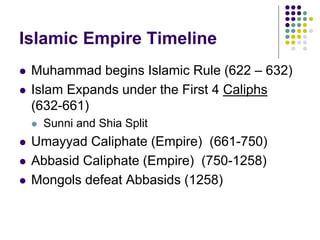
Islamic Empire Timeline
 Muhammad begins Islamic Rule (622 – 632)
 Islam Expands under the First 4 Caliphs
(632-661)
 Sunni and Shia Split
 Umayyad Caliphate (Empire) (661-750)
 Abbasid Caliphate (Empire) (750-1258)
 Mongols defeat Abbasids (1258)
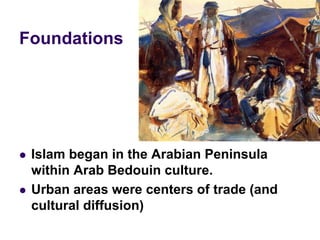
Foundations
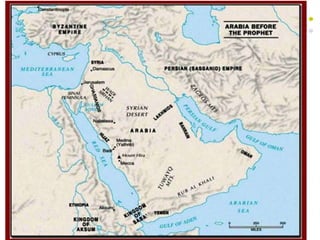
 Islam began in the Arabian Peninsula
within Arab Bedouin culture.
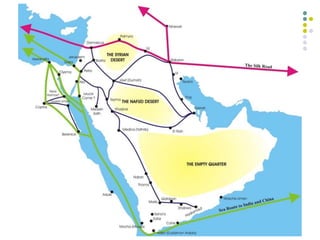
 Urban areas were centers of trade (and
cultural diffusion)
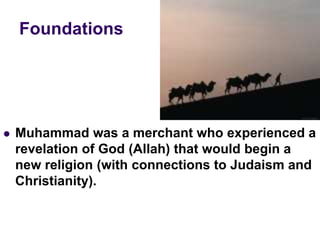
Foundations
 Muhammad was a merchant who experienced a
revelation of God (Allah) that would begin a
new religion (with connections to Judaism and
Christianity).
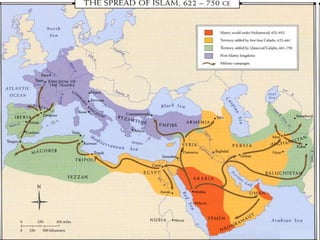
Spread
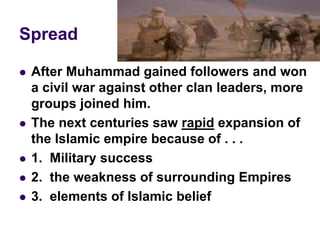
 After Muhammad gained followers and won
a civil war against other clan leaders, more
groups joined him.
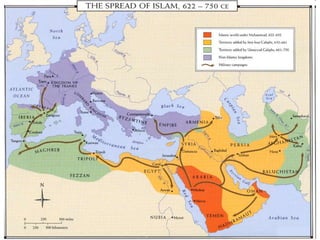
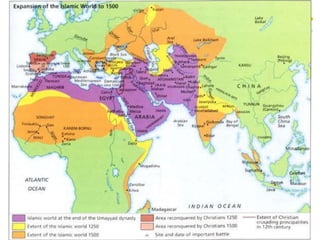
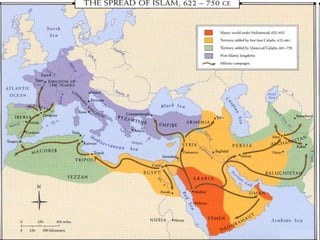
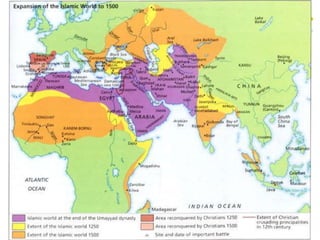
 The next centuries saw rapid expansion of
the Islamic empire because of . . .
 1. Military success
 2. the weakness of surrounding Empires
 3. elements of Islamic belief
Spread
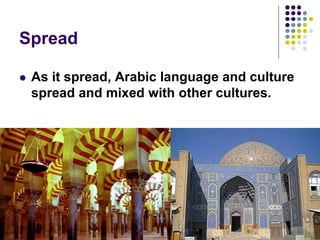
 As it spread, Arabic language and culture
spread and mixed with other cultures.
The Spread of Islam:
Map Snapshot
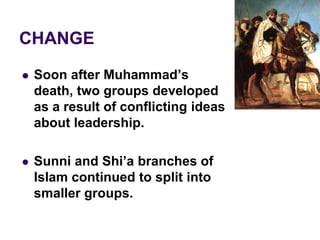
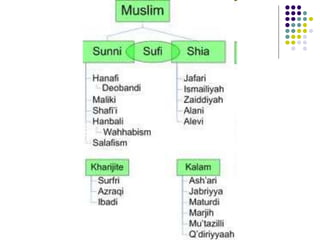
CHANGE
 Soon after Muhammad’s
death, two groups developed
as a result of conflicting ideas
about leadership.
 Sunni and Shi’a branches of
Islam continued to split into
smaller groups.
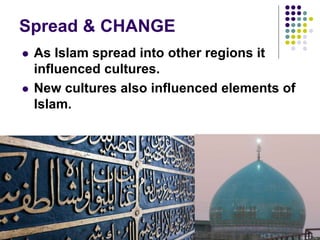
Spread & CHANGE
 As Islam spread into other regions it
influenced cultures.
 New cultures also influenced elements of
Islam.
Texts
 The Quran (Koran) contains the
revelations given to Muhammad.
 The Hadith are the teachings and actions
of Muhammad.
Islam compared to
Christianity
 Both monotheistic … “perfections”
 Both founders did NOT write the texts
 Both teachings initially appealed to lower
classes and women
 Both belief systems emphasized social
justice
Islam compared to
Christianity
 Unlike Christianity, Islam began and
continued as both a religion and a
political structure. (Caliph / Sharia)
 Unlike Christianity, Islam does not
emphasize religious authorities like
priests, popes, bishops
Connections with Judaism
and Christianity
 Islam retained elements of Judaism and
Christianity.
 Abraham
 Jesus (as a prophet)
 The Torah and Quran have similar narratives
ESSAY Prompts
 Analyze the continuities and changes
over time in the social structure of
Islamic Civilization as it spread from
600 ce to 1500 ce.
ESSAY Prompts
 Analyze the continuities and changes
over time in the political structure of
Islamic Civilization as it spread from
600 ce to 1500 ce.
ESSAY Prompt
 Analyze the continuities and changes
over time in the culture of Islamic
Civilization as it spread from 600 ce to
1500 ce.
ESSAY Prompts
 Analyze the continuities and changes
over time in the commerce and trade of
Islamic Civilization as it spread from
600 ce to 1500 ce.
ESSAY Prompts
 Analyze the continuities and changes
over time in Islamic Civilization as it
spread from 600 ce to 1500 ce.
 Analyze the similarities and differences
in TWO of the following societies as
they were impacted by Islam from 600
to 1500 ce.
 India
 Anatolia
 West Africa
 Spain

Islam & Islamic Empire intro

  • 1.
  • 2.
    ISLAM Religion AND Empire InCONTEXT Islam – submission Muslim – one who submits
  • 5.
    Islamic Empire Timeline Muhammad begins Islamic Rule (622 – 632)  Islam Expands under the First 4 Caliphs (632-661)  Sunni and Shia Split  Umayyad Caliphate (Empire) (661-750)  Abbasid Caliphate (Empire) (750-1258)  Mongols defeat Abbasids (1258)
  • 6.
    Foundations  Islam beganin the Arabian Peninsula within Arab Bedouin culture.  Urban areas were centers of trade (and cultural diffusion)
  • 8.
    Foundations  Muhammad wasa merchant who experienced a revelation of God (Allah) that would begin a new religion (with connections to Judaism and Christianity).
  • 10.
    Spread  After Muhammadgained followers and won a civil war against other clan leaders, more groups joined him.  The next centuries saw rapid expansion of the Islamic empire because of . . .  1. Military success  2. the weakness of surrounding Empires  3. elements of Islamic belief
  • 13.
    Spread  As itspread, Arabic language and culture spread and mixed with other cultures.
  • 16.
    The Spread ofIslam: Map Snapshot
  • 17.
    CHANGE  Soon afterMuhammad’s death, two groups developed as a result of conflicting ideas about leadership.  Sunni and Shi’a branches of Islam continued to split into smaller groups.
  • 19.
    Spread & CHANGE As Islam spread into other regions it influenced cultures.  New cultures also influenced elements of Islam.
  • 20.
    Texts  The Quran(Koran) contains the revelations given to Muhammad.  The Hadith are the teachings and actions of Muhammad.
  • 21.
    Islam compared to Christianity Both monotheistic … “perfections”  Both founders did NOT write the texts  Both teachings initially appealed to lower classes and women  Both belief systems emphasized social justice
  • 22.
    Islam compared to Christianity Unlike Christianity, Islam began and continued as both a religion and a political structure. (Caliph / Sharia)  Unlike Christianity, Islam does not emphasize religious authorities like priests, popes, bishops
  • 23.
    Connections with Judaism andChristianity  Islam retained elements of Judaism and Christianity.  Abraham  Jesus (as a prophet)  The Torah and Quran have similar narratives
  • 24.
    ESSAY Prompts  Analyzethe continuities and changes over time in the social structure of Islamic Civilization as it spread from 600 ce to 1500 ce.
  • 25.
    ESSAY Prompts  Analyzethe continuities and changes over time in the political structure of Islamic Civilization as it spread from 600 ce to 1500 ce.
  • 26.
    ESSAY Prompt  Analyzethe continuities and changes over time in the culture of Islamic Civilization as it spread from 600 ce to 1500 ce.
  • 27.
    ESSAY Prompts  Analyzethe continuities and changes over time in the commerce and trade of Islamic Civilization as it spread from 600 ce to 1500 ce.
  • 28.
    ESSAY Prompts  Analyzethe continuities and changes over time in Islamic Civilization as it spread from 600 ce to 1500 ce.  Analyze the similarities and differences in TWO of the following societies as they were impacted by Islam from 600 to 1500 ce.  India  Anatolia  West Africa  Spain