Judaism-Christianity-Islam
Professor CHEE- 2.2015
What do these three religions have in common?
What are their differences?
What is the Judeo-Christian-Islamic traditions and
their shared heritage?
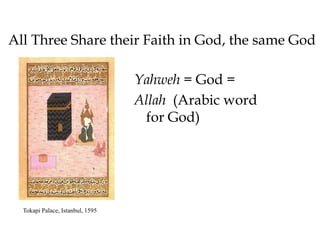
All Three Share their Faith in God, the same God
Yahweh = God =
Allah (Arabic word
for God)
Tokapi Palace, Istanbul, 1595
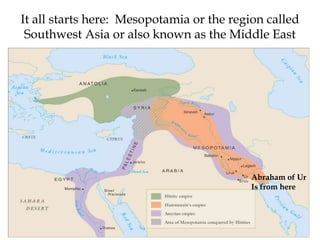
It all starts here: Mesopotamia or the region called
Southwest Asia or also known as the Middle East
Abraham of Ur
Is from here
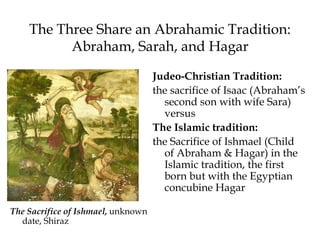
The Three Share an Abrahamic Tradition:
Abraham, Sarah, and Hagar
Judeo-Christian Tradition:
the sacrifice of Isaac (Abraham’s
second son with wife Sara)
versus
The Islamic tradition:
the Sacrifice of Ishmael (Child
of Abraham & Hagar) in the
Islamic tradition, the first
born but with the Egyptian
concubine Hagar
The Sacrifice of Ishmael, unknown
date, Shiraz
What are their differences?
On the Messiah and Jesus Christ
Jews: waiting for Messiah, Jesus is the Jewish son of
a carpenter
Christians: Jesus is the Messiah and the son of God
Muslims: waiting for Messiah, Jesus is a prophet
Other differences: Time, languages, geographic
locations
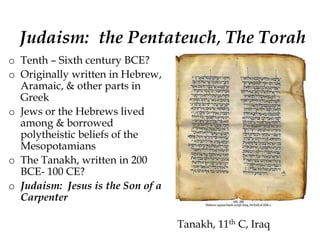
Judaism: the Pentateuch, The Torah
o Tenth – Sixth century BCE?
o Originally written in Hebrew,
Aramaic, & other parts in
Greek
o Jews or the Hebrews lived
among & borrowed
polytheistic beliefs of the
Mesopotamians
o The Tanakh, written in 200
BCE- 100 CE?
o Judaism: Jesus is the Son of a
Carpenter
Tanakh, 11th C, Iraq
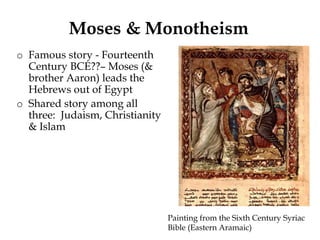
Moses & Monotheism
o Famous story - Fourteenth
Century BCE??– Moses (&
brother Aaron) leads the
Hebrews out of Egypt
o Shared story among all
three: Judaism, Christianity
& Islam
Painting from the Sixth Century Syriac
Bible (Eastern Aramaic)
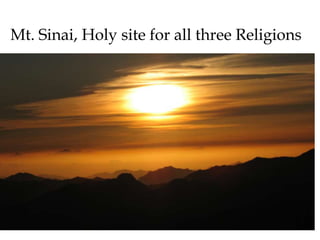
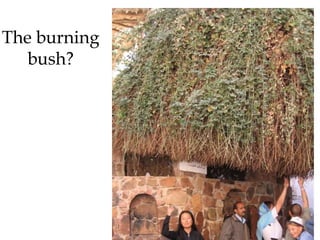
Mt. Sinai, Holy site for all three Religions
The burning
bush?
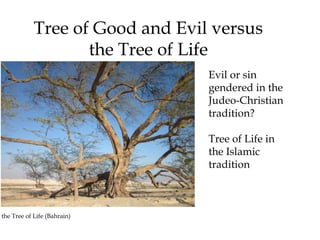
Tree of Good and Evil versus
the Tree of Life
Evil or sin
gendered in the
Judeo-Christian
tradition?
Tree of Life in
the Islamic
tradition
the Tree of Life (Bahrain)
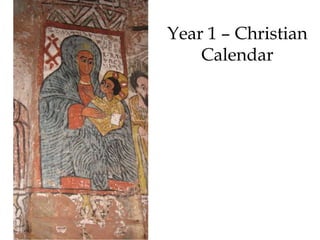
Year 1 – Christian
Calendar
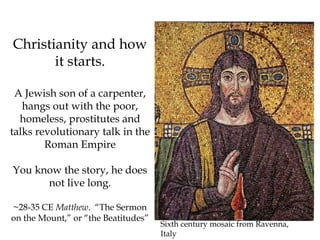
Christianity and how
it starts.
A Jewish son of a carpenter,
hangs out with the poor,
homeless, prostitutes and
talks revolutionary talk in the
Roman Empire
You know the story, he does
not live long.
~28-35 CE Matthew. “The Sermon
on the Mount,” or “the Beatitudes”
Sixth century mosaic from Ravenna,
Italy
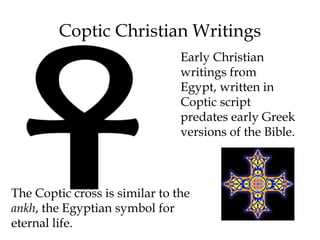
Coptic Christian Writings
Early Christian
writings from
Egypt, written in
Coptic script
predates early Greek
versions of the Bible.
The Coptic cross is similar to the
ankh, the Egyptian symbol for
eternal life.
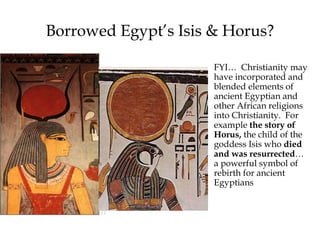
Borrowed Egypt’s Isis & Horus?
FYI… Christianity may
have incorporated and
blended elements of
ancient Egyptian and
other African religions
into Christianity. For
example the story of
Horus, the child of the
goddess Isis who died
and was resurrected…
a powerful symbol of
rebirth for ancient
Egyptians
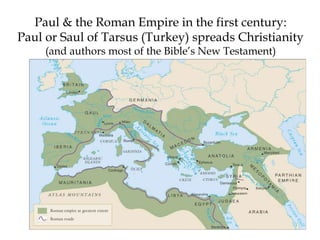
Paul & the Roman Empire in the first century:
Paul or Saul of Tarsus (Turkey) spreads Christianity
(and authors most of the Bible’s New Testament)
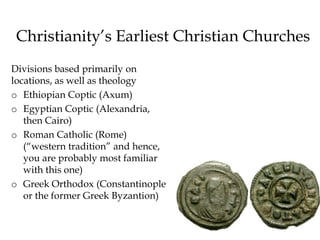
Christianity’s Earliest Christian Churches
Divisions based primarily on
locations, as well as theology
o Ethiopian Coptic (Axum)
o Egyptian Coptic (Alexandria,
then Cairo)
o Roman Catholic (Rome)
(“western tradition” and hence,
you are probably most familiar
with this one)
o Greek Orthodox (Constantinople
or the former Greek Byzantion)
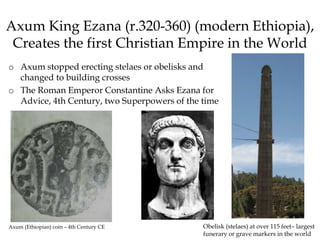
Axum King Ezana (r.320-360) (modern Ethiopia),
Creates the first Christian Empire in the World
o Axum stopped erecting stelaes or obelisks and
changed to building crosses
o The Roman Emperor Constantine Asks Ezana for
Advice, 4th Century, two Superpowers of the time
Obelisk (stelaes) at over 115 feet– largest
funerary or grave markers in the world
Axum (Ethiopian) coin – 4th Century CE
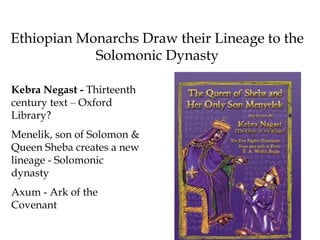
Ethiopian Monarchs Draw their Lineage to the
Solomonic Dynasty
Kebra Negast - Thirteenth
century text – Oxford
Library?
Menelik, son of Solomon &
Queen Sheba creates a new
lineage - Solomonic
dynasty
Axum - Ark of the
Covenant
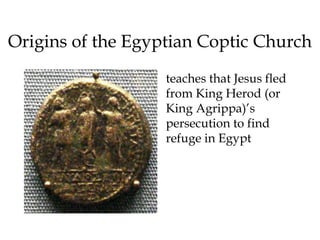
Origins of the Egyptian Coptic Church
teaches that Jesus fled
from King Herod (or
King Agrippa)’s
persecution to find
refuge in Egypt
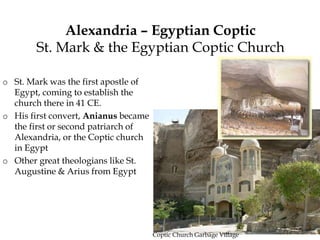
Alexandria – Egyptian Coptic
St. Mark & the Egyptian Coptic Church
o St. Mark was the first apostle of
Egypt, coming to establish the
church there in 41 CE.
o His first convert, Anianus became
the first or second patriarch of
Alexandria, or the Coptic church
in Egypt
o Other great theologians like St.
Augustine & Arius from Egypt
Coptic Church Garbage Village
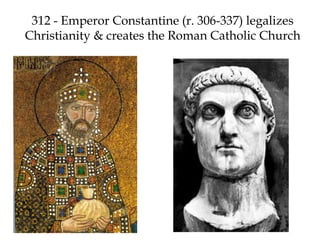
312 - Emperor Constantine (r. 306-337) legalizes
Christianity & creates the Roman Catholic Church
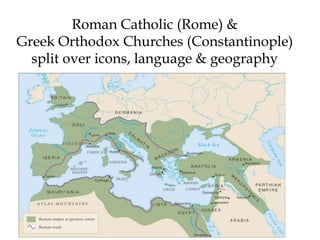
Roman Catholic (Rome) &
Greek Orthodox Churches (Constantinople)
split over icons, language & geography
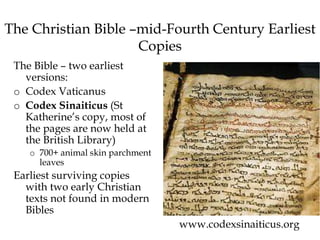
The Christian Bible –mid-Fourth Century Earliest
Copies
The Bible – two earliest
versions:
o Codex Vaticanus
o Codex Sinaiticus (St
Katherine’s copy, most of
the pages are now held at
the British Library)
o 700+ animal skin parchment
leaves
Earliest surviving copies
with two early Christian
texts not found in modern
Bibles
www.codexsinaiticus.org
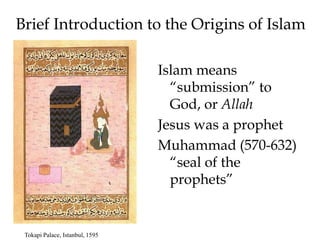
Brief Introduction to the Origins of Islam
Islam means
“submission” to
God, or Allah
Jesus was a prophet
Muhammad (570-632)
“seal of the
prophets”
Tokapi Palace, Istanbul, 1595
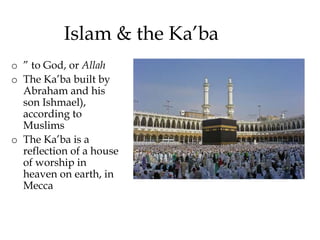
Islam & the Ka’ba
o ” to God, or Allah
o The Ka’ba built by
Abraham and his
son Ishmael),
according to
Muslims
o The Ka’ba is a
reflection of a house
of worship in
heaven on earth, in
Mecca
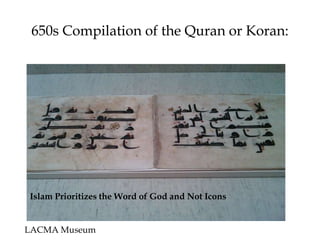
650s Compilation of the Quran or Koran:
LACMA Museum
Islam Prioritizes the Word of God and Not Icons
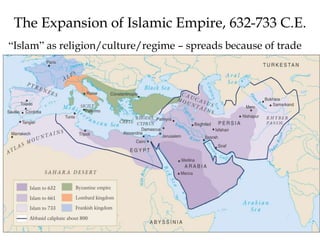
The Expansion of Islamic Empire, 632-733 C.E.
“Islam” as religion/culture/regime – spreads because of trade
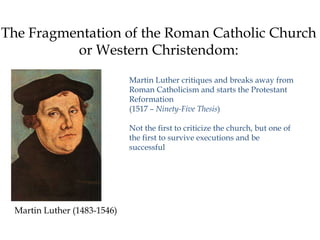
The Fragmentation of the Roman Catholic Church
or Western Christendom:
Martin Luther critiques and breaks away from
Roman Catholicism and starts the Protestant
Reformation
(1517 – Ninety-Five Thesis)
Not the first to criticize the church, but one of
the first to survive executions and be
successful
Martin Luther (1483-1546)
The Protestant Reformation
Martin Luther (and John Calvin) attack Roman Catholic
church practices
o Indulgences
o Sacraments
o Priestly authority, & hierarchy esp the Pope
Luther (and John Calvin) pre-occupied by the question:
“What must I do to be saved?”
oFaith, & how to get to faith?
oPrayer
oReading the Bible: Bible translated from Latin
into vernacular, coincided with new printing
technology
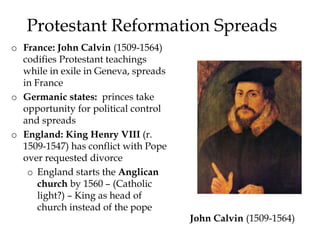
Protestant Reformation Spreads
o France: John Calvin (1509-1564)
codifies Protestant teachings
while in exile in Geneva, spreads
in France
o Germanic states: princes take
opportunity for political control
and spreads
o England: King Henry VIII (r.
1509-1547) has conflict with Pope
over requested divorce
o England starts the Anglican
church by 1560 – (Catholic
light?) – King as head of
church instead of the pope
John Calvin (1509-1564)
In Conclusion:
Judaism-Christianity (Catholic-Protestant) -Islam
Similarities:
cousin religions, all worship the same God!
All three written in Semite languages: Hebrew,
Aramaic, and Arabic
Shared stories & traditions
Differences:
Perspectives on the Messiah or Jesus Christ
Time, language, cultures
Geographic locations and power dynamics split
churches
Copyright
Grace Chee
2015
Message to students:
Professor Chee does not endorse other slideshare
presentations.
You may want to read your primary sources, textbook,
and other readings/videos on Etudes modules

Judaism Christianity Islam 2020

  • 1.
    Judaism-Christianity-Islam Professor CHEE- 2.2015 Whatdo these three religions have in common? What are their differences? What is the Judeo-Christian-Islamic traditions and their shared heritage?
  • 2.
    All Three Sharetheir Faith in God, the same God Yahweh = God = Allah (Arabic word for God) Tokapi Palace, Istanbul, 1595
  • 3.
    It all startshere: Mesopotamia or the region called Southwest Asia or also known as the Middle East Abraham of Ur Is from here
  • 4.
    The Three Sharean Abrahamic Tradition: Abraham, Sarah, and Hagar Judeo-Christian Tradition: the sacrifice of Isaac (Abraham’s second son with wife Sara) versus The Islamic tradition: the Sacrifice of Ishmael (Child of Abraham & Hagar) in the Islamic tradition, the first born but with the Egyptian concubine Hagar The Sacrifice of Ishmael, unknown date, Shiraz
  • 5.
    What are theirdifferences? On the Messiah and Jesus Christ Jews: waiting for Messiah, Jesus is the Jewish son of a carpenter Christians: Jesus is the Messiah and the son of God Muslims: waiting for Messiah, Jesus is a prophet Other differences: Time, languages, geographic locations
  • 6.
    Judaism: the Pentateuch,The Torah o Tenth – Sixth century BCE? o Originally written in Hebrew, Aramaic, & other parts in Greek o Jews or the Hebrews lived among & borrowed polytheistic beliefs of the Mesopotamians o The Tanakh, written in 200 BCE- 100 CE? o Judaism: Jesus is the Son of a Carpenter Tanakh, 11th C, Iraq
  • 7.
    Moses & Monotheism oFamous story - Fourteenth Century BCE??– Moses (& brother Aaron) leads the Hebrews out of Egypt o Shared story among all three: Judaism, Christianity & Islam Painting from the Sixth Century Syriac Bible (Eastern Aramaic)
  • 8.
    Mt. Sinai, Holysite for all three Religions
  • 9.
  • 10.
    Tree of Goodand Evil versus the Tree of Life Evil or sin gendered in the Judeo-Christian tradition? Tree of Life in the Islamic tradition the Tree of Life (Bahrain)
  • 11.
    Year 1 –Christian Calendar
  • 12.
    Christianity and how itstarts. A Jewish son of a carpenter, hangs out with the poor, homeless, prostitutes and talks revolutionary talk in the Roman Empire You know the story, he does not live long. ~28-35 CE Matthew. “The Sermon on the Mount,” or “the Beatitudes” Sixth century mosaic from Ravenna, Italy
  • 13.
    Coptic Christian Writings EarlyChristian writings from Egypt, written in Coptic script predates early Greek versions of the Bible. The Coptic cross is similar to the ankh, the Egyptian symbol for eternal life.
  • 14.
    Borrowed Egypt’s Isis& Horus? FYI… Christianity may have incorporated and blended elements of ancient Egyptian and other African religions into Christianity. For example the story of Horus, the child of the goddess Isis who died and was resurrected… a powerful symbol of rebirth for ancient Egyptians
  • 15.
    Paul & theRoman Empire in the first century: Paul or Saul of Tarsus (Turkey) spreads Christianity (and authors most of the Bible’s New Testament)
  • 16.
    Christianity’s Earliest ChristianChurches Divisions based primarily on locations, as well as theology o Ethiopian Coptic (Axum) o Egyptian Coptic (Alexandria, then Cairo) o Roman Catholic (Rome) (“western tradition” and hence, you are probably most familiar with this one) o Greek Orthodox (Constantinople or the former Greek Byzantion)
  • 17.
    Axum King Ezana(r.320-360) (modern Ethiopia), Creates the first Christian Empire in the World o Axum stopped erecting stelaes or obelisks and changed to building crosses o The Roman Emperor Constantine Asks Ezana for Advice, 4th Century, two Superpowers of the time Obelisk (stelaes) at over 115 feet– largest funerary or grave markers in the world Axum (Ethiopian) coin – 4th Century CE
  • 18.
    Ethiopian Monarchs Drawtheir Lineage to the Solomonic Dynasty Kebra Negast - Thirteenth century text – Oxford Library? Menelik, son of Solomon & Queen Sheba creates a new lineage - Solomonic dynasty Axum - Ark of the Covenant
  • 19.
    Origins of theEgyptian Coptic Church teaches that Jesus fled from King Herod (or King Agrippa)’s persecution to find refuge in Egypt
  • 20.
    Alexandria – EgyptianCoptic St. Mark & the Egyptian Coptic Church o St. Mark was the first apostle of Egypt, coming to establish the church there in 41 CE. o His first convert, Anianus became the first or second patriarch of Alexandria, or the Coptic church in Egypt o Other great theologians like St. Augustine & Arius from Egypt Coptic Church Garbage Village
  • 21.
    312 - EmperorConstantine (r. 306-337) legalizes Christianity & creates the Roman Catholic Church
  • 22.
    Roman Catholic (Rome)& Greek Orthodox Churches (Constantinople) split over icons, language & geography
  • 23.
    The Christian Bible–mid-Fourth Century Earliest Copies The Bible – two earliest versions: o Codex Vaticanus o Codex Sinaiticus (St Katherine’s copy, most of the pages are now held at the British Library) o 700+ animal skin parchment leaves Earliest surviving copies with two early Christian texts not found in modern Bibles www.codexsinaiticus.org
  • 24.
    Brief Introduction tothe Origins of Islam Islam means “submission” to God, or Allah Jesus was a prophet Muhammad (570-632) “seal of the prophets” Tokapi Palace, Istanbul, 1595
  • 25.
    Islam & theKa’ba o ” to God, or Allah o The Ka’ba built by Abraham and his son Ishmael), according to Muslims o The Ka’ba is a reflection of a house of worship in heaven on earth, in Mecca
  • 26.
    650s Compilation ofthe Quran or Koran: LACMA Museum Islam Prioritizes the Word of God and Not Icons
  • 27.
    The Expansion ofIslamic Empire, 632-733 C.E. “Islam” as religion/culture/regime – spreads because of trade
  • 28.
    The Fragmentation ofthe Roman Catholic Church or Western Christendom: Martin Luther critiques and breaks away from Roman Catholicism and starts the Protestant Reformation (1517 – Ninety-Five Thesis) Not the first to criticize the church, but one of the first to survive executions and be successful Martin Luther (1483-1546)
  • 29.
    The Protestant Reformation MartinLuther (and John Calvin) attack Roman Catholic church practices o Indulgences o Sacraments o Priestly authority, & hierarchy esp the Pope Luther (and John Calvin) pre-occupied by the question: “What must I do to be saved?” oFaith, & how to get to faith? oPrayer oReading the Bible: Bible translated from Latin into vernacular, coincided with new printing technology
  • 30.
    Protestant Reformation Spreads oFrance: John Calvin (1509-1564) codifies Protestant teachings while in exile in Geneva, spreads in France o Germanic states: princes take opportunity for political control and spreads o England: King Henry VIII (r. 1509-1547) has conflict with Pope over requested divorce o England starts the Anglican church by 1560 – (Catholic light?) – King as head of church instead of the pope John Calvin (1509-1564)
  • 31.
    In Conclusion: Judaism-Christianity (Catholic-Protestant)-Islam Similarities: cousin religions, all worship the same God! All three written in Semite languages: Hebrew, Aramaic, and Arabic Shared stories & traditions Differences: Perspectives on the Messiah or Jesus Christ Time, language, cultures Geographic locations and power dynamics split churches
  • 32.
    Copyright Grace Chee 2015 Message tostudents: Professor Chee does not endorse other slideshare presentations. You may want to read your primary sources, textbook, and other readings/videos on Etudes modules