1
Lecture 4
Needs Analysis
-The WHO- WHY- WHERE –WHEN: Needs Analysis
-Views on the Needs
-Target Needs
- Gathering Information about Target Needs
-Learning Needs
-Analysing Learning Needs
Dr. Hameed Al-ZubeiryESP
2
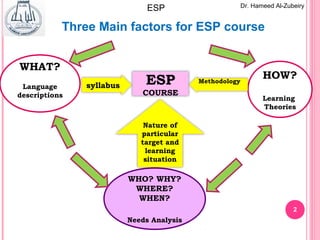
Three Main factors for ESP course
Dr. Hameed Al-ZubeiryESP
WHAT?
Language
descriptions
WHO? WHY?
WHERE?
WHEN?
Needs Analysis
HOW?
Learning
Theories
ESP
COURSE
Nature of
particular
target and
learning
situation
syllabus
Methodology
3
Dr. Hameed Al-Zubeiry
The WHO- WHY- WHERE –
WHEN:
Needs Analysis
ESP
-Need: Wants, desires, demands, expectation, motivations,
lacks, gaps, necessities, constraints, and requirements
-Needs Analysis: Procedures for collecting information about
learners’ needs;
-………..is the irreducible minimum ESP approach to course
design;
- …….. is the awareness of a target situation-definable need
to communicate in English- that distinguishes the ESP learner
from the EGP one.
4
Dr. Hameed Al-ZubeiryESP
Views on the Needs
-According to the Language-Centred Approach:
………is the ability to comprehend and/or produce the
linguistic features of the target situation.
- Target Needs: what the learner needs to do in the target
situation
- Learning Needs: what the learner needs to do in order to
learn.
5
Dr. Hameed Al-ZubeiryESP
1) Target Needs: What the learner needs to do
in the target situation
Necessities Lacks Wants etc,...
Umbrella like term hiding important distinctions
6
Dr. Hameed Al-ZubeiryESP
Target Needs… continued ..
a) Necessities: according to the demands of the target
situation, this is what the learner has to know in order to
function effectively in that situation. (Munby, 1978) CNP
(Communication Needs Processor )
7
Dr. Hameed Al-ZubeiryESP
b) Lacks: according to what the learner already knows, we
decide what necessities are missing. There is a gap between
the existing proficiency and the target proficiency.
c) Wants: according to what we have considered from an
objective point of view, we have to say that ‘a need does not
exist independent of a person. It is people who build their
images of their needs on the basis of data relating to
themselves and their environment.
Target Needs… continued ..
8
Dr. Hameed Al-ZubeiryESP
Need concepts Objective
(as perceived by course
designers)
Subjective
( as perceived by students)
Necessities The English needed for
success in Agriculture/
veterinary studies.
To reluctantly cope with a
‘second-best’ situation.
Lacks (presumably) areas of English
needed for Agriculture/veterinary
studies.
Means of doing medical
studies
Wants To succeed in
Agriculture/veterinary studies.
To undertake Medical Studies
NOTE: objective and subjective views of needs can conflict
motivation. The ESP course designer or teacher has to be aware of
such differences and take account of them in materials and
methodology. Important decisions are to be made.
9
Dr. Hameed Al-ZubeiryESP
2) Gathering Information about Target Needs
Ways of gathering information about needs :
Questionnaires
Interviews
Observation
Data collection
Informal consultations
NOTE: the choice will depend on the time and resources available.
And, needs analysis is not a once-for-all activity. It should be a
continuing process.
10
Dr. Hameed Al-ZubeiryESP
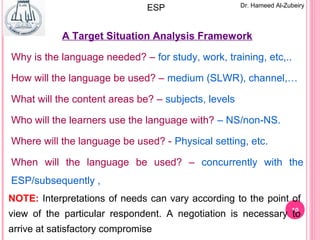
NOTE: Interpretations of needs can vary according to the point of
view of the particular respondent. A negotiation is necessary to
arrive at satisfactory compromise
A Target Situation Analysis Framework
Why is the language needed? – for study, work, training, etc,..
How will the language be used? – medium (SLWR), channel,…
What will the content areas be? – subjects, levels
Who will the learners use the language with? – NS/non-NS.
Where will the language be used? - Physical setting, etc.
When will the language be used? – concurrently with the
ESP/subsequently ,
11
Dr. Hameed Al-ZubeiryESP
3) Learning Needs
A warming- up analogous situation :
1.ESP = journey 2. Lacks = starting point
3. necessities = destination 4. wants = where the destination
should be.- We have finished the what/where in the journey: the target situation;
-The remaining stage is 5. the route (How): the Learning Needs.
* An example of situation: long & dull reading Text
Make it more interesting or humorous
Generate the motivation needed
12
Dr. Hameed Al-ZubeiryESP
In Short: The target situation alone is not a reliable indicator of
what is needed in the ESP course. It can determine the destination,
BUT we must also choose our route:
the conditions of the learning situation
the learner’s knowledge, skills and strategies
the learner’s motivation
13
Dr. Hameed Al-ZubeiryESP
4) Analysing Learning Needs
Learning Needs Analysis Framework
Why are the learners taking the course? – Compulsory/optional,
How do the learners learn? –Learning Background
What resources are available? – number and competence of Ts.
Who are the learners?– age/sex/nationality
Where will the ESP course take place? –surroundings
conditions
When will the ESP course take place? – Time of day,
everyday/months, etc,…
14
Dr. Hameed Al-Zubeiry
- Hutchinson, T., & Waters, A. (1987). English for specific purposes:
a learning-centred approach. Cambridge: Cambridge University
Press.
-Munby, J. (1978). Communicative syllabus design.
Cambridge: Cambridge University Press.
Reading materials:
ESP

Lecture 4

  • 1.
    1 Lecture 4 Needs Analysis -TheWHO- WHY- WHERE –WHEN: Needs Analysis -Views on the Needs -Target Needs - Gathering Information about Target Needs -Learning Needs -Analysing Learning Needs Dr. Hameed Al-ZubeiryESP
  • 2.
    2 Three Main factorsfor ESP course Dr. Hameed Al-ZubeiryESP WHAT? Language descriptions WHO? WHY? WHERE? WHEN? Needs Analysis HOW? Learning Theories ESP COURSE Nature of particular target and learning situation syllabus Methodology
  • 3.
    3 Dr. Hameed Al-Zubeiry TheWHO- WHY- WHERE – WHEN: Needs Analysis ESP -Need: Wants, desires, demands, expectation, motivations, lacks, gaps, necessities, constraints, and requirements -Needs Analysis: Procedures for collecting information about learners’ needs; -………..is the irreducible minimum ESP approach to course design; - …….. is the awareness of a target situation-definable need to communicate in English- that distinguishes the ESP learner from the EGP one.
  • 4.
    4 Dr. Hameed Al-ZubeiryESP Viewson the Needs -According to the Language-Centred Approach: ………is the ability to comprehend and/or produce the linguistic features of the target situation. - Target Needs: what the learner needs to do in the target situation - Learning Needs: what the learner needs to do in order to learn.
  • 5.
    5 Dr. Hameed Al-ZubeiryESP 1)Target Needs: What the learner needs to do in the target situation Necessities Lacks Wants etc,... Umbrella like term hiding important distinctions
  • 6.
    6 Dr. Hameed Al-ZubeiryESP TargetNeeds… continued .. a) Necessities: according to the demands of the target situation, this is what the learner has to know in order to function effectively in that situation. (Munby, 1978) CNP (Communication Needs Processor )
  • 7.
    7 Dr. Hameed Al-ZubeiryESP b)Lacks: according to what the learner already knows, we decide what necessities are missing. There is a gap between the existing proficiency and the target proficiency. c) Wants: according to what we have considered from an objective point of view, we have to say that ‘a need does not exist independent of a person. It is people who build their images of their needs on the basis of data relating to themselves and their environment. Target Needs… continued ..
  • 8.
    8 Dr. Hameed Al-ZubeiryESP Needconcepts Objective (as perceived by course designers) Subjective ( as perceived by students) Necessities The English needed for success in Agriculture/ veterinary studies. To reluctantly cope with a ‘second-best’ situation. Lacks (presumably) areas of English needed for Agriculture/veterinary studies. Means of doing medical studies Wants To succeed in Agriculture/veterinary studies. To undertake Medical Studies NOTE: objective and subjective views of needs can conflict motivation. The ESP course designer or teacher has to be aware of such differences and take account of them in materials and methodology. Important decisions are to be made.
  • 9.
    9 Dr. Hameed Al-ZubeiryESP 2)Gathering Information about Target Needs Ways of gathering information about needs : Questionnaires Interviews Observation Data collection Informal consultations NOTE: the choice will depend on the time and resources available. And, needs analysis is not a once-for-all activity. It should be a continuing process.
  • 10.
    10 Dr. Hameed Al-ZubeiryESP NOTE:Interpretations of needs can vary according to the point of view of the particular respondent. A negotiation is necessary to arrive at satisfactory compromise A Target Situation Analysis Framework Why is the language needed? – for study, work, training, etc,.. How will the language be used? – medium (SLWR), channel,… What will the content areas be? – subjects, levels Who will the learners use the language with? – NS/non-NS. Where will the language be used? - Physical setting, etc. When will the language be used? – concurrently with the ESP/subsequently ,
  • 11.
    11 Dr. Hameed Al-ZubeiryESP 3)Learning Needs A warming- up analogous situation : 1.ESP = journey 2. Lacks = starting point 3. necessities = destination 4. wants = where the destination should be.- We have finished the what/where in the journey: the target situation; -The remaining stage is 5. the route (How): the Learning Needs. * An example of situation: long & dull reading Text Make it more interesting or humorous Generate the motivation needed
  • 12.
    12 Dr. Hameed Al-ZubeiryESP InShort: The target situation alone is not a reliable indicator of what is needed in the ESP course. It can determine the destination, BUT we must also choose our route: the conditions of the learning situation the learner’s knowledge, skills and strategies the learner’s motivation
  • 13.
    13 Dr. Hameed Al-ZubeiryESP 4)Analysing Learning Needs Learning Needs Analysis Framework Why are the learners taking the course? – Compulsory/optional, How do the learners learn? –Learning Background What resources are available? – number and competence of Ts. Who are the learners?– age/sex/nationality Where will the ESP course take place? –surroundings conditions When will the ESP course take place? – Time of day, everyday/months, etc,…
  • 14.
    14 Dr. Hameed Al-Zubeiry -Hutchinson, T., & Waters, A. (1987). English for specific purposes: a learning-centred approach. Cambridge: Cambridge University Press. -Munby, J. (1978). Communicative syllabus design. Cambridge: Cambridge University Press. Reading materials: ESP