Types of Needs
Definition of Needs
The requirements of the
target situation
Enable the learner to
communicate effectively in
the target situation
Levels of language
knowledge of the learners
This means that there are different
types of needs (Dudley-Evans and St Johns 1998)
Professional information about
the learners: the tasks and
activities learners are/will be
using English for
Professional information about
the learners: factors which may
affect the way which they learn
English language information
about the learners
Learners lacks
Language learning
information: effective ways of
learning the skills and
language
Professional communication
information
What is wanted from the course
Information about the
environment in which the course
will be run (means analysis)
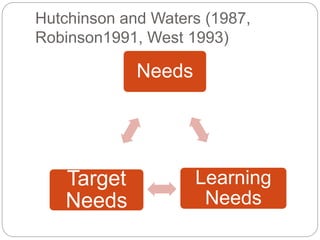
Hutchinson and Waters (1987,
Robinson1991, West 1993)
Needs
Learning
Needs
Target
Needs
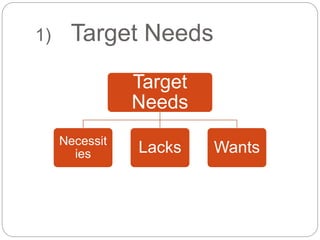
1) Target Needs
Target
Needs
Necessit
ies Lacks Wants
Necessities
The requirements of the target
situation
The needed level of language
proficiency of the students to
achieve their academic or
occupational purposes
They are also called the
objective needs
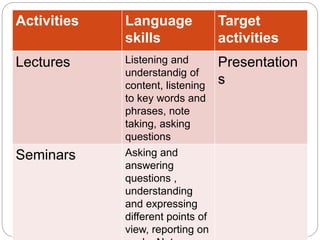
Activities Language
skills
Target
activities
Lectures Listening and
understandig of
content, listening
to key words and
phrases, note
taking, asking
questions
Presentation
s
Seminars Asking and
answering
questions ,
understanding
and expressing
different points of
view, reporting on
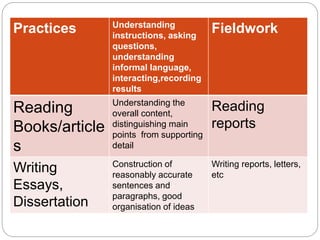
Practices Understanding
instructions, asking
questions,
understanding
informal language,
interacting,recording
results
Fieldwork
Reading
Books/article
s
Understanding the
overall content,
distinguishing main
points from supporting
detail
Reading
reports
Writing
Essays,
Dissertation
Construction of
reasonably accurate
sentences and
paragraphs, good
organisation of ideas
Writing reports, letters,
etc
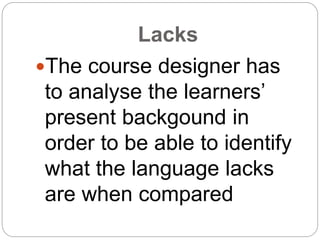
Lacks
The course designer has
to analyse the learners’
present backgound in
order to be able to identify
what the language lacks
are when compared
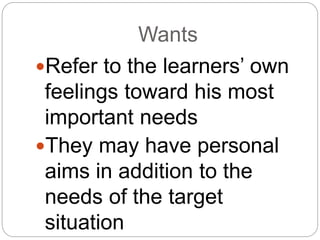
Wants
Refer to the learners’ own
feelings toward his most
important needs
They may have personal
aims in addition to the
needs of the target
situation
 The learners have a clear idea
about the necessities
 They may also be aware of their
lacks
 The views of the students may
conflict with the perception of the
other parties involved in the ESP
situation
Constraints (WEST 1993)
It involves the non-
pedagogic limits that
control a course planning
process such as the role of
the national policy and the
financial restrictions
Learning Needs
 They involve an answer to the
question:
How are we going
to the destination?
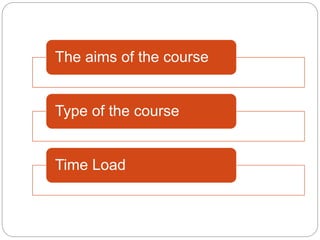
The aims of the course
Type of the course
Time Load
Type of
Learners
Their learning
Styles
The available
materials
Setting
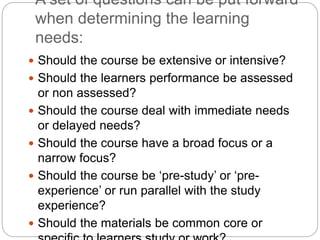
A set of questions can be put forward
when determining the learning
needs:
 Should the course be extensive or intensive?
 Should the learners performance be assessed
or non assessed?
 Should the course deal with immediate needs
or delayed needs?
 Should the course have a broad focus or a
narrow focus?
 Should the course be ‘pre-study’ or ‘pre-
experience’ or run parallel with the study
experience?
 Should the materials be common core or
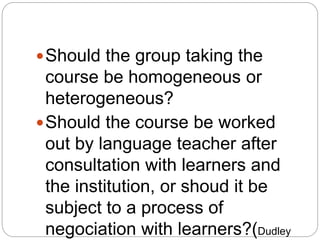
Should the group taking the
course be homogeneous or
heterogeneous?
Should the course be worked
out by language teacher after
consultation with learners and
the institution, or shoud it be
subject to a process of
negociation with learners?(Dudley
The balance of parameters
mentioned in the above
questions allows the researcher
to link the different expectations
and learning needs of the
learners
 Learning needs analysis which takes
into consideration the pedagogical
requirements that allow the learners to
get to the destination. (learners attitudes
can also be included within this step)
 The learning environment is an
important resource for teaching aids
including the institution, the type of
classroom and the time load for the ESP
training.

Types of needs

  • 1.
  • 2.
    Definition of Needs Therequirements of the target situation Enable the learner to communicate effectively in the target situation Levels of language knowledge of the learners
  • 3.
    This means thatthere are different types of needs (Dudley-Evans and St Johns 1998) Professional information about the learners: the tasks and activities learners are/will be using English for Professional information about the learners: factors which may affect the way which they learn
  • 4.
    English language information aboutthe learners Learners lacks Language learning information: effective ways of learning the skills and language
  • 5.
    Professional communication information What iswanted from the course Information about the environment in which the course will be run (means analysis)
  • 6.
    Hutchinson and Waters(1987, Robinson1991, West 1993) Needs Learning Needs Target Needs
  • 7.
  • 8.
    Necessities The requirements ofthe target situation The needed level of language proficiency of the students to achieve their academic or occupational purposes They are also called the objective needs
  • 9.
    Activities Language skills Target activities Lectures Listeningand understandig of content, listening to key words and phrases, note taking, asking questions Presentation s Seminars Asking and answering questions , understanding and expressing different points of view, reporting on
  • 10.
    Practices Understanding instructions, asking questions, understanding informallanguage, interacting,recording results Fieldwork Reading Books/article s Understanding the overall content, distinguishing main points from supporting detail Reading reports Writing Essays, Dissertation Construction of reasonably accurate sentences and paragraphs, good organisation of ideas Writing reports, letters, etc
  • 11.
    Lacks The course designerhas to analyse the learners’ present backgound in order to be able to identify what the language lacks are when compared
  • 12.
    Wants Refer to thelearners’ own feelings toward his most important needs They may have personal aims in addition to the needs of the target situation
  • 13.
     The learnershave a clear idea about the necessities  They may also be aware of their lacks  The views of the students may conflict with the perception of the other parties involved in the ESP situation
  • 14.
    Constraints (WEST 1993) Itinvolves the non- pedagogic limits that control a course planning process such as the role of the national policy and the financial restrictions
  • 15.
    Learning Needs  Theyinvolve an answer to the question: How are we going to the destination?
  • 16.
    The aims ofthe course Type of the course Time Load
  • 17.
  • 18.
  • 19.
    A set ofquestions can be put forward when determining the learning needs:  Should the course be extensive or intensive?  Should the learners performance be assessed or non assessed?  Should the course deal with immediate needs or delayed needs?  Should the course have a broad focus or a narrow focus?  Should the course be ‘pre-study’ or ‘pre- experience’ or run parallel with the study experience?  Should the materials be common core or
  • 20.
    Should the grouptaking the course be homogeneous or heterogeneous? Should the course be worked out by language teacher after consultation with learners and the institution, or shoud it be subject to a process of negociation with learners?(Dudley
  • 21.
    The balance ofparameters mentioned in the above questions allows the researcher to link the different expectations and learning needs of the learners
  • 22.
     Learning needsanalysis which takes into consideration the pedagogical requirements that allow the learners to get to the destination. (learners attitudes can also be included within this step)  The learning environment is an important resource for teaching aids including the institution, the type of classroom and the time load for the ESP training.