
www.eshikshak.co.in
Popularity of ‘C’
● Robust
● Efficient and fast
● Portable
● Structured Programming


             www.eshikshak.co.in
Character Set
 ● A character can a number, alphabet, or
   any special symbol to represent
   information

Alphabets A, B, ….., Y, Z
a, b, ……, y, z
Digits 0, 1, 2, 3, 4, 5, 6, 7, 8, 9
Special symbols ~ ‘ ! @ # % ^ & * ( ) _ - + =
|{}[]:;"'<>,.?/


                 www.eshikshak.co.in
Constants, Variables and
Keywords
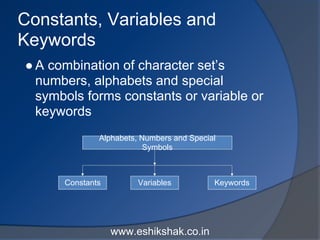
● A combination of character set’s
  numbers, alphabets and special
  symbols forms constants or variable or
  keywords
              Alphabets, Numbers and Special
                          Symbols


      Constants         Variables          Keywords


                  www.eshikshak.co.in
Constants
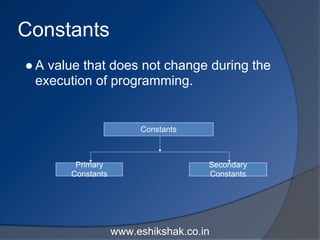
● A value that does not change during the
  execution of programming.


                        Constants


        Primary                      Secondary
       Constants                     Constants


                   www.eshikshak.co.in
Variables
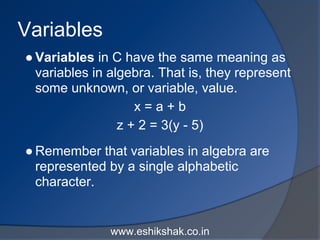
● Variables in C have the same meaning as
  variables in algebra. That is, they represent
  some unknown, or variable, value.
                    x=a+b
                 z + 2 = 3(y - 5)
● Remember that variables in algebra are
  represented by a single alphabetic
  character.


               www.eshikshak.co.in
Keywords
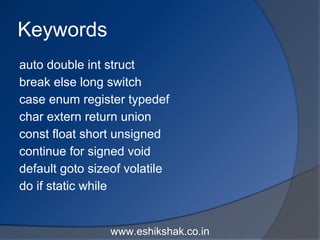
auto double int struct
break else long switch
case enum register typedef
char extern return union
const float short unsigned
continue for signed void
default goto sizeof volatile
do if static while


                 www.eshikshak.co.in
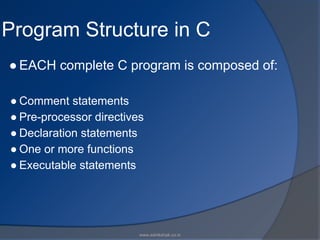
Program Structure in C
● EACH complete C program is composed of:

● Comment statements
● Pre-processor directives
● Declaration statements
● One or more functions
● Executable statements


                         www.eshikshak.co.in
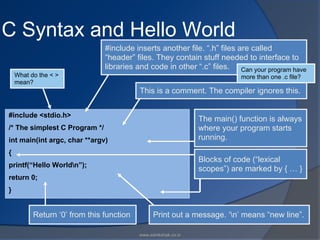
C Syntax and Hello World
                               #include inserts another file. “.h” files are called
                               “header” files. They contain stuff needed to interface to
                               libraries and code in other “.c” files. Can your program have
    What do the < >                                                        more than one .c file?
    mean?
                                          This is a comment. The compiler ignores this.


#include <stdio.h>
                                                                The main() function is always
/* The simplest C Program */                                    where your program starts
int main(int argc, char **argv)                                 running.
{
                                                                Blocks of code (“lexical
printf(“Hello Worldn”);
                                                                scopes”) are marked by { … }
return 0;
}


          Return ‘0’ from this function         Print out a message. ‘n’ means “new line”.

                                          www.eshikshak.co.in
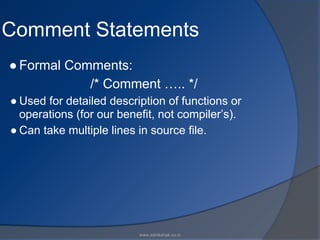
Comment Statements
● Formal Comments:
            /* Comment ….. */
● Used for detailed description of functions or
  operations (for our benefit, not compiler’s).
● Can take multiple lines in source file.


                          www.eshikshak.co.in
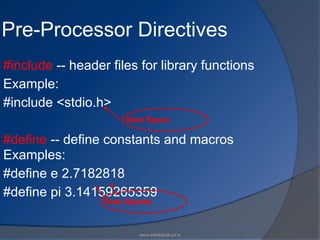
Pre-Processor Directives
#include -- header files for library functions
Example:
#include <stdio.h>
                      Note Space

#define -- define constants and macros
Examples:
#define e 2.7182818
#define pi 3.14159265359
                  Note Spaces


                         www.eshikshak.co.in
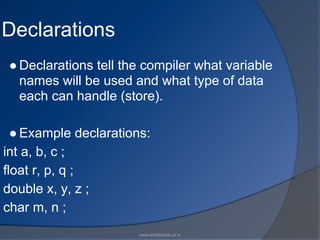
Declarations
● Declarations tell the compiler what variable
  names will be used and what type of data
  each can handle (store).

  ● Example declarations:
int a, b, c ;
float r, p, q ;
double x, y, z ;
char m, n ;
                       www.eshikshak.co.in

Lecture 3 getting_started_with__c_

  • 1.
  • 2.
    Popularity of ‘C’ ●Robust ● Efficient and fast ● Portable ● Structured Programming www.eshikshak.co.in
  • 3.
    Character Set ●A character can a number, alphabet, or any special symbol to represent information Alphabets A, B, ….., Y, Z a, b, ……, y, z Digits 0, 1, 2, 3, 4, 5, 6, 7, 8, 9 Special symbols ~ ‘ ! @ # % ^ & * ( ) _ - + = |{}[]:;"'<>,.?/ www.eshikshak.co.in
  • 4.
    Constants, Variables and Keywords ●A combination of character set’s numbers, alphabets and special symbols forms constants or variable or keywords Alphabets, Numbers and Special Symbols Constants Variables Keywords www.eshikshak.co.in
  • 5.
    Constants ● A valuethat does not change during the execution of programming. Constants Primary Secondary Constants Constants www.eshikshak.co.in
  • 6.
    Variables ● Variables inC have the same meaning as variables in algebra. That is, they represent some unknown, or variable, value. x=a+b z + 2 = 3(y - 5) ● Remember that variables in algebra are represented by a single alphabetic character. www.eshikshak.co.in
  • 7.
    Keywords auto double intstruct break else long switch case enum register typedef char extern return union const float short unsigned continue for signed void default goto sizeof volatile do if static while www.eshikshak.co.in
  • 8.
    Program Structure inC ● EACH complete C program is composed of: ● Comment statements ● Pre-processor directives ● Declaration statements ● One or more functions ● Executable statements www.eshikshak.co.in
  • 9.
    C Syntax andHello World #include inserts another file. “.h” files are called “header” files. They contain stuff needed to interface to libraries and code in other “.c” files. Can your program have What do the < > more than one .c file? mean? This is a comment. The compiler ignores this. #include <stdio.h> The main() function is always /* The simplest C Program */ where your program starts int main(int argc, char **argv) running. { Blocks of code (“lexical printf(“Hello Worldn”); scopes”) are marked by { … } return 0; } Return ‘0’ from this function Print out a message. ‘n’ means “new line”. www.eshikshak.co.in
  • 10.
    Comment Statements ● FormalComments: /* Comment ….. */ ● Used for detailed description of functions or operations (for our benefit, not compiler’s). ● Can take multiple lines in source file. www.eshikshak.co.in
  • 11.
    Pre-Processor Directives #include --header files for library functions Example: #include <stdio.h> Note Space #define -- define constants and macros Examples: #define e 2.7182818 #define pi 3.14159265359 Note Spaces www.eshikshak.co.in
  • 12.
    Declarations ● Declarations tellthe compiler what variable names will be used and what type of data each can handle (store). ● Example declarations: int a, b, c ; float r, p, q ; double x, y, z ; char m, n ; www.eshikshak.co.in