

ACCOUNTING INFORMATION SYSTEM & E-
COMMERCE
LECTURE 3-ECOMMERCE
CHAPTER 2: E-COMMERCE BUSINESS
MODELS AND CONCEPTS
By
Habib Ullah Qamar
MSCS,MBA(HRM)
LEARNING OBJECTIVE
 Identify the key components of e-commerce
business models.
 Describe the major B2C business models.
 Describe the major B2B business models.
 Understand key business concepts and strategies
applicable to e-commerce
RECOMMENDED BOOKS / RESOURCES
 http://www.theITeducation.com/
 Wikipedia.org
 E-Commerce by Kenneth C. Loudon, Carol Traver :
2014 version –Chapter 2
 http://slideshare.net/habibullahqamar/
LETS START
E-Commerce
WHAT IS THE MAJOR FACTOR
OF THE SUCCESS OF A
BUSINESS?
Spending Investment and capital
Getting more Customers
Other
THE ANSWER
 Read the story of Twitter, Facebook, Pintrest,
Imagebazar, hamriweb etc
 You will find minimum capital and investment
 Started with zero customer
 But
 Started with a Planned Business Model,
 That is the key to success for a business!
WHAT IS BUSINESS MODEL?
 A set of planned activities designed to result in a
profit in a marketplace.
 A business model is not always the same as a
business strategy, although in some cases they
are very close insofar as the business model
explicitly takes into account the competitive
environment (Magretta, 2002).
 The business model is at the center of the business
plan. A business plan is a document that
describes a firm’s business model.
 An e-commerce business model aims to use and
control the unique qualities of the Internet, the Web,
and the mobile platform.
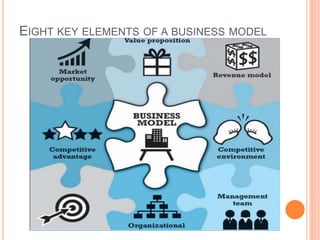
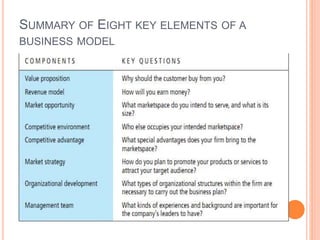
EIGHT KEY ELEMENTS OF A BUSINESS MODEL
 Why customers will choose to do business with the
firm instead of another company and what the firm
provides that other firms do not and cannot?
 Value proposition : defines how a company’s product
or service fulfills the needs of customers. A company’s
value proposition is at the very heart of its business
model.
 From the consumer point of view, successful e-
commerce value propositions include personalization
and customization of product offerings, reduction of
product search costs, reduction of price discovery costs,
and facilitation of transactions by managing product
delivery.
EIGHT KEY ELEMENTS OF A BUSINESS MODEL
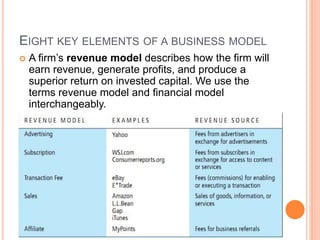
 A firm’s revenue model describes how the firm will
earn revenue, generate profits, and produce a
superior return on invested capital. We use the
terms revenue model and financial model
interchangeably.
EIGHT KEY ELEMENTS OF A BUSINESS MODEL
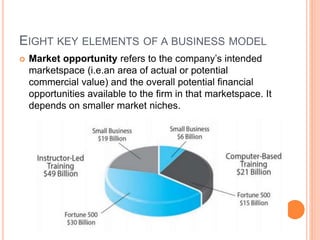
 Market opportunity refers to the company’s intended
marketspace (i.e.an area of actual or potential
commercial value) and the overall potential financial
opportunities available to the firm in that marketspace. It
depends on smaller market niches.
EIGHT KEY ELEMENTS OF A BUSINESS MODEL
 A firm’s competitive environment refers to the
other companies selling similar products and
operating in the same marketspace.
 It also refers to the presence of substitute
products and potential new entrants to the
market, as well as the power of customers and
suppliers over your business.
 How many competitors are active, how large their
operations are, what the market share of each
competitor is, how profitable these firms are, and
how they price their products, all these queries
must be learned.
EIGHT KEY ELEMENTS OF A BUSINESS MODEL
 competitive advantage : achieved by a firm when
it can produce a superior product and/or bring the
product to market at a lower price than most, or all,
of its competitors.
 Asymmetry : has more resources
 first-mover advantage
 Complementary resources: resources other than
production i.e. marketing and reputation
 unfair competitive advantage : factor other firm
cannot (brand name copy or imitate)
 Perfect market (no asymmetry, equal )
 Leverage : using name into other markets
EIGHT KEY ELEMENTS OF A BUSINESS MODEL
 Market strategy : the plan you put together that
details exactly how you intend to enter a new
market and attract new customers.
 The best business concept, or idea, will fail if it is
not properly marketed to potential customers.
 For instance, Twitter, YouTube, and Pinterest have
a social network marketing strategy that
encourages users to post their content on the sites
for free, build per-sonal profile pages, contact their
friends, and build a community. In these cases, the
customer becomes part of the marketing staff!
EIGHT KEY ELEMENTS OF A BUSINESS MODEL
 Although many entrepreneurial ventures are started by one
visionary individual(FB), it is rare that one person alone can
grow an idea into a multi-million dollar company.
 Fast-growth companies ,especially e-commerce businesses,
need employees and a set of business procedures.
 In short need an organization to efficiently implement their
business plans and strategies.
 Organizational development : plan describes how the
company will organize the work that needs to be
accomplished.
 eBay founder Pierre Omidyar started an online auction site,
according to some sources, to help his girlfriend trade Pez
dispensers with other collectors, but within a few months the
volume of business had far exceeded what he alone could
handle.
EIGHT KEY ELEMENTS OF A BUSINESS MODEL
 Management Team : employees of the company
responsible for making the business model work.
 A strong management team gives a model instant
credibility to outside investors, immediate market-
specific knowledge, and experience in
implementing business plans.
 Team should be able to change the model and
redefine the business as it becomes necessary
SUMMARY OF EIGHT KEY ELEMENTS OF A
BUSINESS MODEL
RESOURCES
 E-Commerce by Kenneth C. Loudon, Carol Traver :
2014 version : Chapter 2
 www.Wikipedia.org
 http://www.businessdictionary.com/
 http://theITeducation.com/
THANK YOU

Lecture 3 e-cmmerce , business models and concpets-chapter 2

  • 1.
    ACCOUNTING INFORMATION SYSTEM& E- COMMERCE LECTURE 3-ECOMMERCE CHAPTER 2: E-COMMERCE BUSINESS MODELS AND CONCEPTS By Habib Ullah Qamar MSCS,MBA(HRM)
  • 2.
    LEARNING OBJECTIVE  Identifythe key components of e-commerce business models.  Describe the major B2C business models.  Describe the major B2B business models.  Understand key business concepts and strategies applicable to e-commerce
  • 3.
    RECOMMENDED BOOKS /RESOURCES  http://www.theITeducation.com/  Wikipedia.org  E-Commerce by Kenneth C. Loudon, Carol Traver : 2014 version –Chapter 2  http://slideshare.net/habibullahqamar/
  • 4.
  • 5.
    WHAT IS THEMAJOR FACTOR OF THE SUCCESS OF A BUSINESS? Spending Investment and capital Getting more Customers Other
  • 6.
    THE ANSWER  Readthe story of Twitter, Facebook, Pintrest, Imagebazar, hamriweb etc  You will find minimum capital and investment  Started with zero customer  But  Started with a Planned Business Model,  That is the key to success for a business!
  • 7.
    WHAT IS BUSINESSMODEL?  A set of planned activities designed to result in a profit in a marketplace.  A business model is not always the same as a business strategy, although in some cases they are very close insofar as the business model explicitly takes into account the competitive environment (Magretta, 2002).  The business model is at the center of the business plan. A business plan is a document that describes a firm’s business model.  An e-commerce business model aims to use and control the unique qualities of the Internet, the Web, and the mobile platform.
  • 8.
    EIGHT KEY ELEMENTSOF A BUSINESS MODEL
  • 9.
    EIGHT KEY ELEMENTSOF A BUSINESS MODEL  Why customers will choose to do business with the firm instead of another company and what the firm provides that other firms do not and cannot?  Value proposition : defines how a company’s product or service fulfills the needs of customers. A company’s value proposition is at the very heart of its business model.  From the consumer point of view, successful e- commerce value propositions include personalization and customization of product offerings, reduction of product search costs, reduction of price discovery costs, and facilitation of transactions by managing product delivery.
  • 10.
    EIGHT KEY ELEMENTSOF A BUSINESS MODEL  A firm’s revenue model describes how the firm will earn revenue, generate profits, and produce a superior return on invested capital. We use the terms revenue model and financial model interchangeably.
  • 11.
    EIGHT KEY ELEMENTSOF A BUSINESS MODEL  Market opportunity refers to the company’s intended marketspace (i.e.an area of actual or potential commercial value) and the overall potential financial opportunities available to the firm in that marketspace. It depends on smaller market niches.
  • 12.
    EIGHT KEY ELEMENTSOF A BUSINESS MODEL  A firm’s competitive environment refers to the other companies selling similar products and operating in the same marketspace.  It also refers to the presence of substitute products and potential new entrants to the market, as well as the power of customers and suppliers over your business.  How many competitors are active, how large their operations are, what the market share of each competitor is, how profitable these firms are, and how they price their products, all these queries must be learned.
  • 13.
    EIGHT KEY ELEMENTSOF A BUSINESS MODEL  competitive advantage : achieved by a firm when it can produce a superior product and/or bring the product to market at a lower price than most, or all, of its competitors.  Asymmetry : has more resources  first-mover advantage  Complementary resources: resources other than production i.e. marketing and reputation  unfair competitive advantage : factor other firm cannot (brand name copy or imitate)  Perfect market (no asymmetry, equal )  Leverage : using name into other markets
  • 14.
    EIGHT KEY ELEMENTSOF A BUSINESS MODEL  Market strategy : the plan you put together that details exactly how you intend to enter a new market and attract new customers.  The best business concept, or idea, will fail if it is not properly marketed to potential customers.  For instance, Twitter, YouTube, and Pinterest have a social network marketing strategy that encourages users to post their content on the sites for free, build per-sonal profile pages, contact their friends, and build a community. In these cases, the customer becomes part of the marketing staff!
  • 15.
    EIGHT KEY ELEMENTSOF A BUSINESS MODEL  Although many entrepreneurial ventures are started by one visionary individual(FB), it is rare that one person alone can grow an idea into a multi-million dollar company.  Fast-growth companies ,especially e-commerce businesses, need employees and a set of business procedures.  In short need an organization to efficiently implement their business plans and strategies.  Organizational development : plan describes how the company will organize the work that needs to be accomplished.  eBay founder Pierre Omidyar started an online auction site, according to some sources, to help his girlfriend trade Pez dispensers with other collectors, but within a few months the volume of business had far exceeded what he alone could handle.
  • 16.
    EIGHT KEY ELEMENTSOF A BUSINESS MODEL  Management Team : employees of the company responsible for making the business model work.  A strong management team gives a model instant credibility to outside investors, immediate market- specific knowledge, and experience in implementing business plans.  Team should be able to change the model and redefine the business as it becomes necessary
  • 17.
    SUMMARY OF EIGHTKEY ELEMENTS OF A BUSINESS MODEL
  • 18.
    RESOURCES  E-Commerce byKenneth C. Loudon, Carol Traver : 2014 version : Chapter 2  www.Wikipedia.org  http://www.businessdictionary.com/  http://theITeducation.com/
  • 19.