+
UNIT 1: INTRODUCTION TO PSYCHOLOGY
AND SOCIAL PSYCHOLOGY
+
What is Psychology?
Psyche: mind or soul
Logos/-ology: the study of ….
 The study of the mind
+
Psychology is the study of…
How we perceive the world
How the mind works
How we behave
Why we do what we do
Why we feel the way we feel
Why we think as we think
+
Definitions
 Psychology is the scientific study of the behavior of
individuals and their mental processes.
Psychology is the scientific study of the way the
human mind works and how it influences behavior,
or the influence of a particular person's character
on their behavior.
+
Science
 “Soft” or Inexact science:
difficult to establish strictly
measure criteria
e.g. sociology, psychology,
anthropology
 “Hard” or Exact science:
precise mathematical
description
e.g.: chemistry, physics,
biology
+
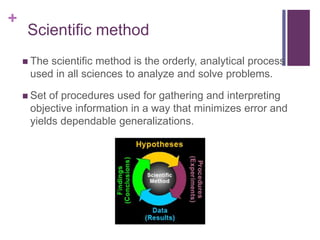
 The scientific method is the orderly, analytical process
used in all sciences to analyze and solve problems.
 Set of procedures used for gathering and interpreting
objective information in a way that minimizes error and
yields dependable generalizations.
Scientific method
+
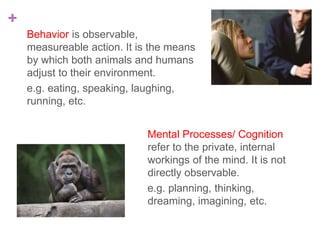
Behavior is observable,
measureable action. It is the means
by which both animals and humans
adjust to their environment.
e.g. eating, speaking, laughing,
running, etc.
Mental Processes/ Cognition
refer to the private, internal
workings of the mind. It is not
directly observable.
e.g. planning, thinking,
dreaming, imagining, etc.
+
Behavioral data defined:
 Behavioral data are reports of observations about
behavior and conditions under which they occur.
 Researchers choose an appropriate level of
analysis
 Measures of behavioral data must be objective
+
Topics in Psychology
 Language and Perception
 Memory
 Dreams
 Love and Hate
 Morality
 Depression and Anxiety
 Happiness
 Human nature
+
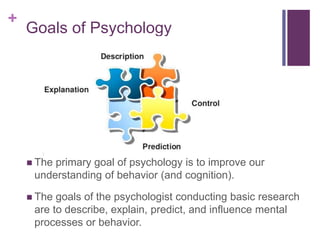
 The primary goal of psychology is to improve our
understanding of behavior (and cognition).
 The goals of the psychologist conducting basic research
are to describe, explain, predict, and influence mental
processes or behavior.
Goals of Psychology
+
 Descriptions: describe what happened
 Explanations: look to explain “how behavior works”
and “why it occurs”
- Internal factors
- Genetic makeup, motivation, intelligence
- External factors
- Situational factors
Goals of Psychology
+
 Prediction
- Scientific Prediction
Based on an understanding of the ways events relate to
one another
Suggest what mechanisms link those events to certain
predictors
- Casual Prediction:
Specifies conditions under which behaviors will change
 Control behavior: what factors influence this behavior
Goals of Psychology
+
 Neuroscience perspective
 Developmental perspective
 Social perspective
 Cognitive perspective
 Evolutionary perspective
 Personality perspective
 Clinical perspective
 And many others
Sub-fields of Psychology
+
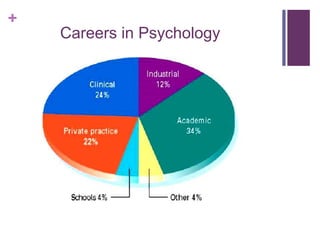
Careers in Psychology
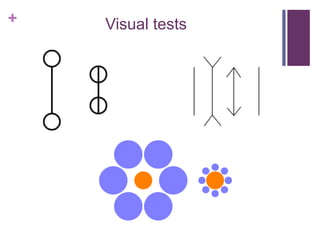
+ Visual tests
+
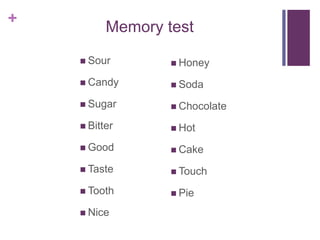
 Sour
 Candy
 Sugar
 Bitter
 Good
 Taste
 Tooth
 Nice
 Honey
 Soda
 Chocolate
 Hot
 Cake
 Touch
 Pie
Memory test
+
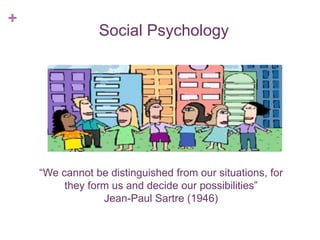
“We cannot be distinguished from our situations, for
they form us and decide our possibilities”
Jean-Paul Sartre (1946)
Social Psychology
+
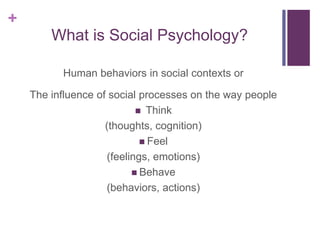
What is Social Psychology?
Human behaviors in social contexts or
The influence of social processes on the way people
 Think
(thoughts, cognition)
 Feel
(feelings, emotions)
 Behave
(behaviors, actions)
+
What is Social Psychology?
Definitions
The study of how people and groups interact.
 The scientific study of how people’s thoughts, feelings,
and behaviors are influenced by the actual, imagined, or
implied presence of others.
 A branch of psychology concerned with the personality,
attitudes, motivations, and behavior of the individual or
group in the context of social interaction. It is the study of
how individuals perceive, influence, and relate to others.
+
Three broad domains
 Social Perception
How we think about/ interpret others, e.g., attributions
 Social Influence
How we are influenced by others in terms of attributes
and behaviors/ the power of the situation,
e.g., conformity
 Social Relations
How we react with others in the social world, e.g., human
relationships
+
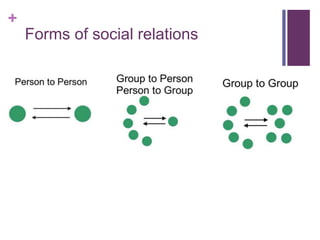
Forms of social relations
+
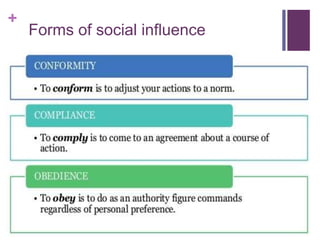
Forms of social influence
+
 How do we explain people’s behaviors?
 How do we form our beliefs and attitudes?
 How does what we think affect what we do?
 How can attitudes be influenced and behaviors changed?
 How do we influence each other?
 How are we affected by pressures to conform and obey?
 How are we affected by group interaction?
 How do group affect our behaviors?
 What causes us to harm, help, and to fall in love?
 How can we transform aggression into compassion?
+
Aspects of social behavior
 Social behavior is goal-oriented
e.g.: the need for social ties, the desire to understand
ourselves and others, the wish to gain or maintain status
or protection and the need to attract companions.
 The interaction between the individual and the
situation helps determine the outcome
e.g.: environmental and situational variables play an
important role and have a strong influence on our
behavior.
+
 Behavior is a good indicator of one’s personality
The theory of correspondence and inferences explains
that the actions and behaviors of others correspond to
their intentions and personalities.
Studying social psychology can enrich our understanding
of ourselves and of the world around us. Continue
exploring this subject in the links below to enrich your
understanding of social behavior.
Aspects of social behavior
+
Applications
 Business
 Health services
 Education
 Criminal Justice
 Politics
 Environment
+
Sociology vs. Social Psychology
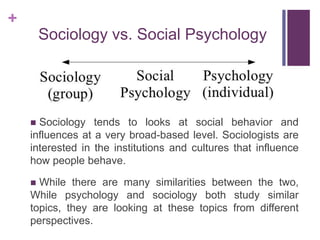
 Sociology tends to looks at social behavior and
influences at a very broad-based level. Sociologists are
interested in the institutions and cultures that influence
how people behave.
 While there are many similarities between the two,
While psychology and sociology both study similar
topics, they are looking at these topics from different
perspectives.
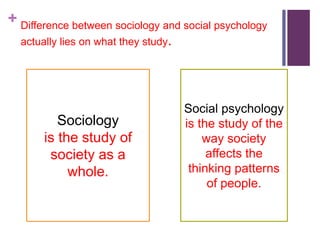
+ Difference between sociology and social psychology
actually lies on what they study.
Sociology
is the study of
society as a
whole.
Social psychology
is the study of the
way society
affects the
thinking patterns
of people.
+
+
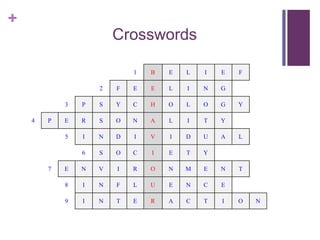
Crosswords
1 B E L I E F
2 F E E L I N G
3 P S Y C H O L O G Y
4 P E R S O N A L I T Y
5 I N D I V I D U A L
6 S O C I E T Y
7 E N V I R O N M E N T
8 I N F L U E N C E
9 I N T E R A C T I O N

Lecture 2.1. introduction

  • 1.
    + UNIT 1: INTRODUCTIONTO PSYCHOLOGY AND SOCIAL PSYCHOLOGY
  • 2.
    + What is Psychology? Psyche:mind or soul Logos/-ology: the study of ….  The study of the mind
  • 3.
    + Psychology is thestudy of… How we perceive the world How the mind works How we behave Why we do what we do Why we feel the way we feel Why we think as we think
  • 4.
    + Definitions  Psychology isthe scientific study of the behavior of individuals and their mental processes. Psychology is the scientific study of the way the human mind works and how it influences behavior, or the influence of a particular person's character on their behavior.
  • 5.
    + Science  “Soft” orInexact science: difficult to establish strictly measure criteria e.g. sociology, psychology, anthropology  “Hard” or Exact science: precise mathematical description e.g.: chemistry, physics, biology
  • 6.
    +  The scientificmethod is the orderly, analytical process used in all sciences to analyze and solve problems.  Set of procedures used for gathering and interpreting objective information in a way that minimizes error and yields dependable generalizations. Scientific method
  • 7.
    + Behavior is observable, measureableaction. It is the means by which both animals and humans adjust to their environment. e.g. eating, speaking, laughing, running, etc. Mental Processes/ Cognition refer to the private, internal workings of the mind. It is not directly observable. e.g. planning, thinking, dreaming, imagining, etc.
  • 8.
    + Behavioral data defined: Behavioral data are reports of observations about behavior and conditions under which they occur.  Researchers choose an appropriate level of analysis  Measures of behavioral data must be objective
  • 9.
    + Topics in Psychology Language and Perception  Memory  Dreams  Love and Hate  Morality  Depression and Anxiety  Happiness  Human nature
  • 10.
    +  The primarygoal of psychology is to improve our understanding of behavior (and cognition).  The goals of the psychologist conducting basic research are to describe, explain, predict, and influence mental processes or behavior. Goals of Psychology
  • 11.
    +  Descriptions: describewhat happened  Explanations: look to explain “how behavior works” and “why it occurs” - Internal factors - Genetic makeup, motivation, intelligence - External factors - Situational factors Goals of Psychology
  • 12.
    +  Prediction - ScientificPrediction Based on an understanding of the ways events relate to one another Suggest what mechanisms link those events to certain predictors - Casual Prediction: Specifies conditions under which behaviors will change  Control behavior: what factors influence this behavior Goals of Psychology
  • 13.
    +  Neuroscience perspective Developmental perspective  Social perspective  Cognitive perspective  Evolutionary perspective  Personality perspective  Clinical perspective  And many others Sub-fields of Psychology
  • 14.
  • 15.
  • 16.
    +  Sour  Candy Sugar  Bitter  Good  Taste  Tooth  Nice  Honey  Soda  Chocolate  Hot  Cake  Touch  Pie Memory test
  • 17.
    + “We cannot bedistinguished from our situations, for they form us and decide our possibilities” Jean-Paul Sartre (1946) Social Psychology
  • 18.
    + What is SocialPsychology? Human behaviors in social contexts or The influence of social processes on the way people  Think (thoughts, cognition)  Feel (feelings, emotions)  Behave (behaviors, actions)
  • 19.
    + What is SocialPsychology? Definitions The study of how people and groups interact.  The scientific study of how people’s thoughts, feelings, and behaviors are influenced by the actual, imagined, or implied presence of others.  A branch of psychology concerned with the personality, attitudes, motivations, and behavior of the individual or group in the context of social interaction. It is the study of how individuals perceive, influence, and relate to others.
  • 20.
    + Three broad domains Social Perception How we think about/ interpret others, e.g., attributions  Social Influence How we are influenced by others in terms of attributes and behaviors/ the power of the situation, e.g., conformity  Social Relations How we react with others in the social world, e.g., human relationships
  • 21.
  • 22.
  • 23.
    +  How dowe explain people’s behaviors?  How do we form our beliefs and attitudes?  How does what we think affect what we do?  How can attitudes be influenced and behaviors changed?  How do we influence each other?  How are we affected by pressures to conform and obey?  How are we affected by group interaction?  How do group affect our behaviors?  What causes us to harm, help, and to fall in love?  How can we transform aggression into compassion?
  • 24.
    + Aspects of socialbehavior  Social behavior is goal-oriented e.g.: the need for social ties, the desire to understand ourselves and others, the wish to gain or maintain status or protection and the need to attract companions.  The interaction between the individual and the situation helps determine the outcome e.g.: environmental and situational variables play an important role and have a strong influence on our behavior.
  • 25.
    +  Behavior isa good indicator of one’s personality The theory of correspondence and inferences explains that the actions and behaviors of others correspond to their intentions and personalities. Studying social psychology can enrich our understanding of ourselves and of the world around us. Continue exploring this subject in the links below to enrich your understanding of social behavior. Aspects of social behavior
  • 26.
    + Applications  Business  Healthservices  Education  Criminal Justice  Politics  Environment
  • 27.
    + Sociology vs. SocialPsychology  Sociology tends to looks at social behavior and influences at a very broad-based level. Sociologists are interested in the institutions and cultures that influence how people behave.  While there are many similarities between the two, While psychology and sociology both study similar topics, they are looking at these topics from different perspectives.
  • 28.
    + Difference betweensociology and social psychology actually lies on what they study. Sociology is the study of society as a whole. Social psychology is the study of the way society affects the thinking patterns of people.
  • 29.
  • 30.
    + Crosswords 1 B EL I E F 2 F E E L I N G 3 P S Y C H O L O G Y 4 P E R S O N A L I T Y 5 I N D I V I D U A L 6 S O C I E T Y 7 E N V I R O N M E N T 8 I N F L U E N C E 9 I N T E R A C T I O N