(New!) Media - and journalism in the online age -
This lecture aims to:   Build on the notions presented the previous day (convergence and web 2.0) Discuss the challenges that the emergence of new media pose to traditional media   Analyze the changes in media landscape (both in terms of practice and technology) and their implication on the journalism practice
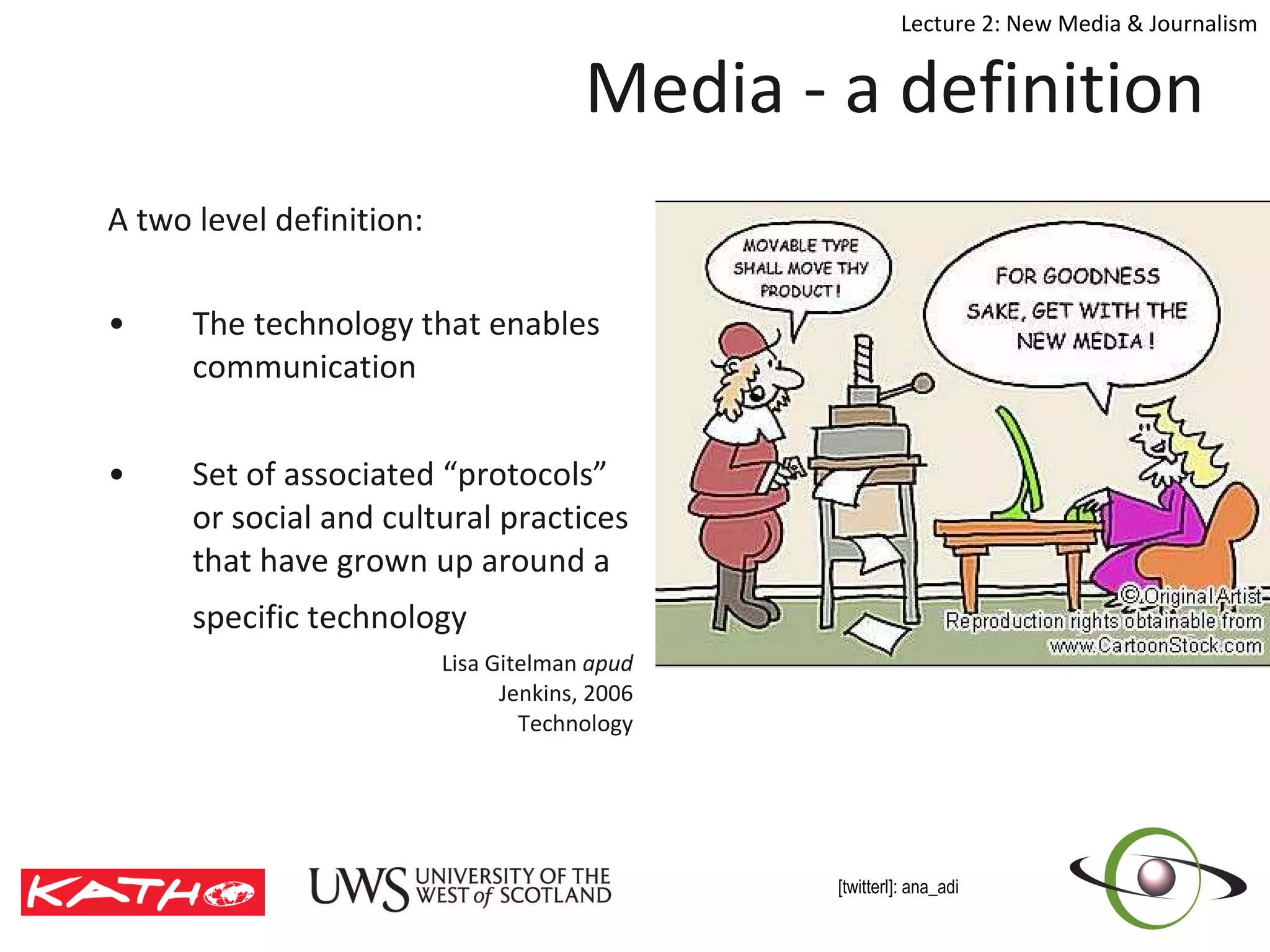
Media - a definition A two level definition:  The technology that enables communication Set of associated “protocols” or social and cultural practices that have grown up around a specific technology   Lisa Gitelman  apud  Jenkins, 2006   Technology
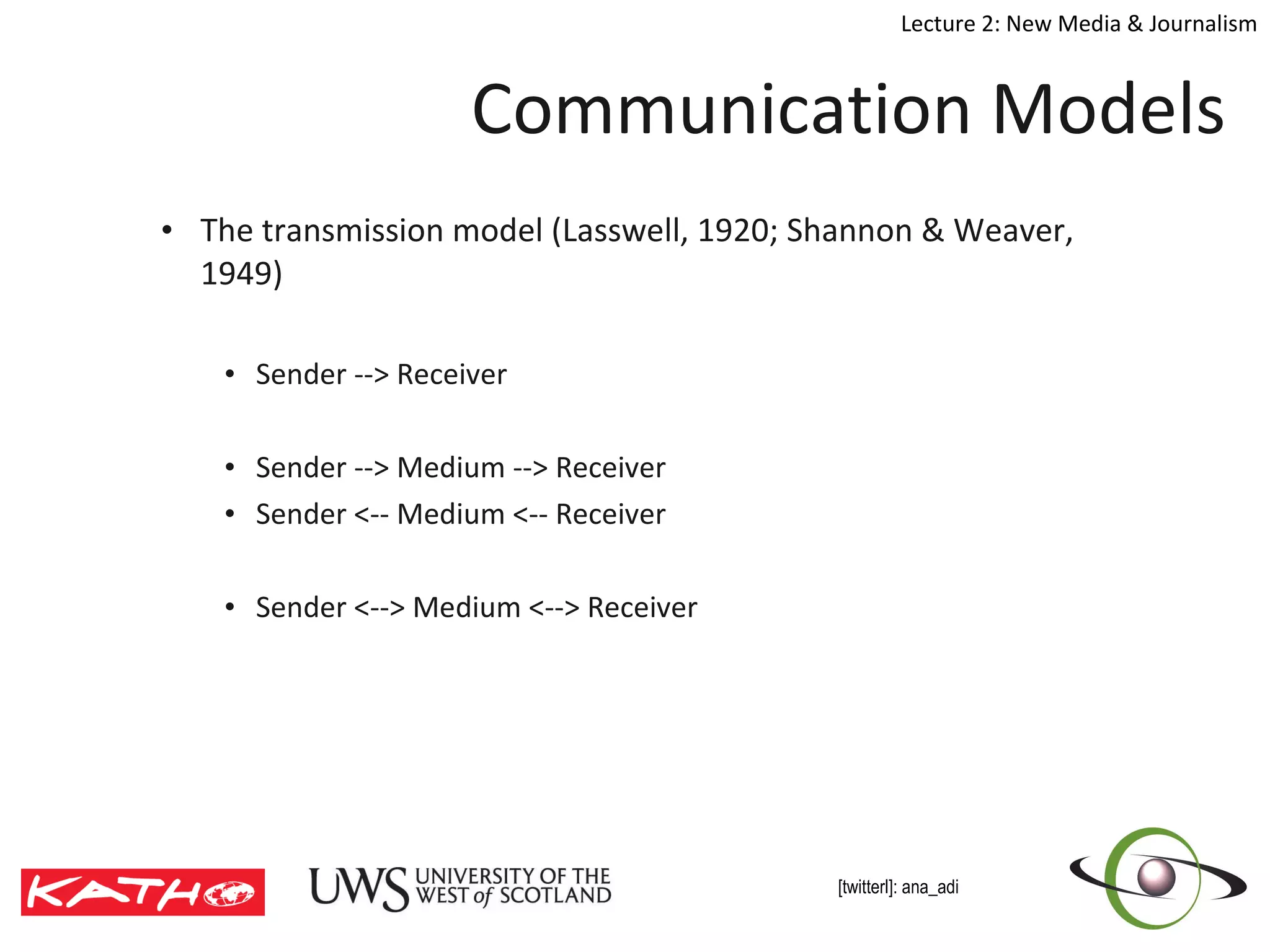
Communication Models The transmission model (Lasswell, 1920; Shannon & Weaver, 1949) Sender --> Receiver Sender --> Medium --> Receiver  Sender <-- Medium <-- Receiver  Sender <--> Medium <--> Receiver
The journalist’s role What is the role of the (new) media in your society? Which media: news, entertainment, arts, documentary, sports? How has the role of the media developed? Does the media fulfill this social obligation?
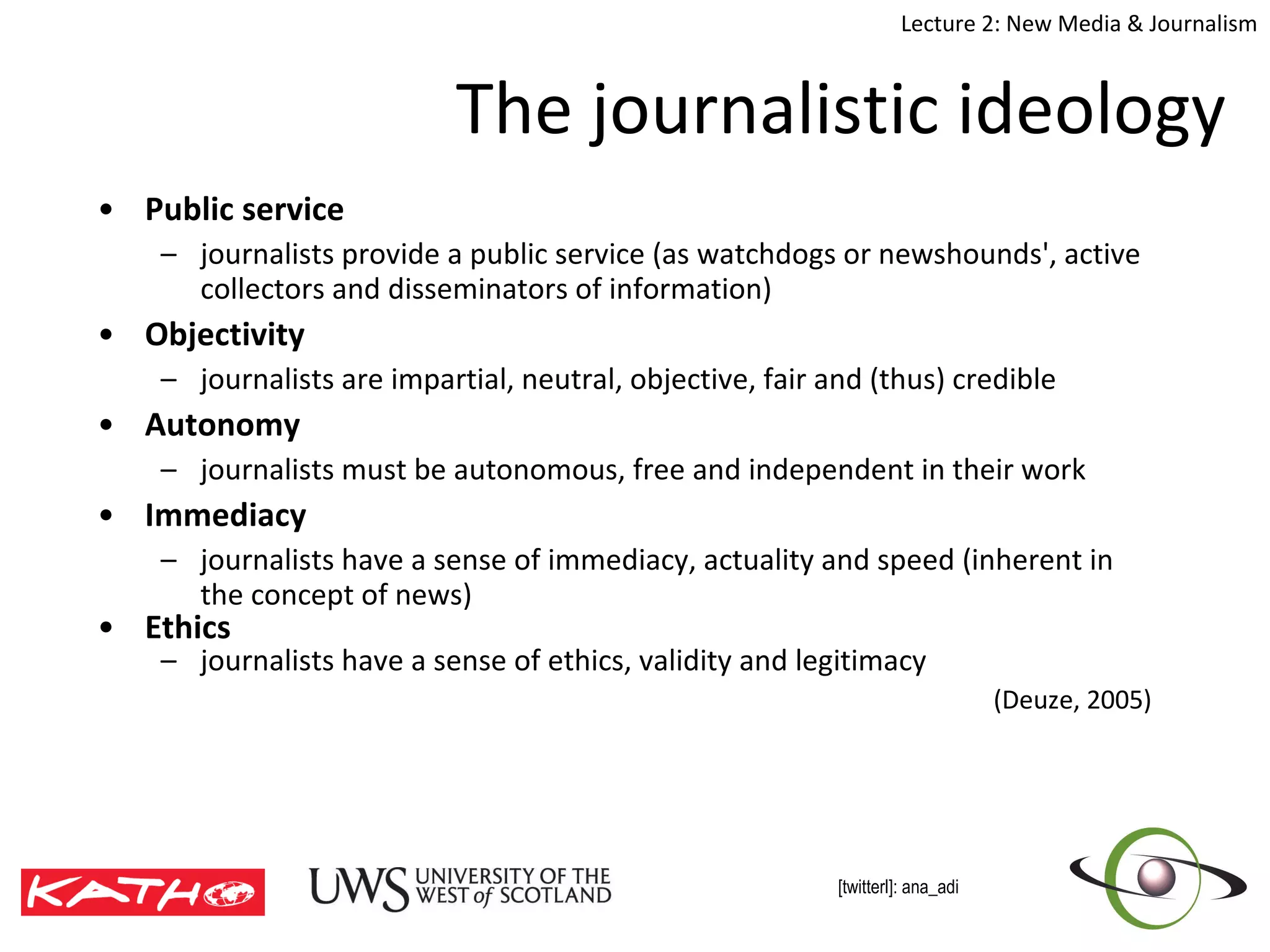
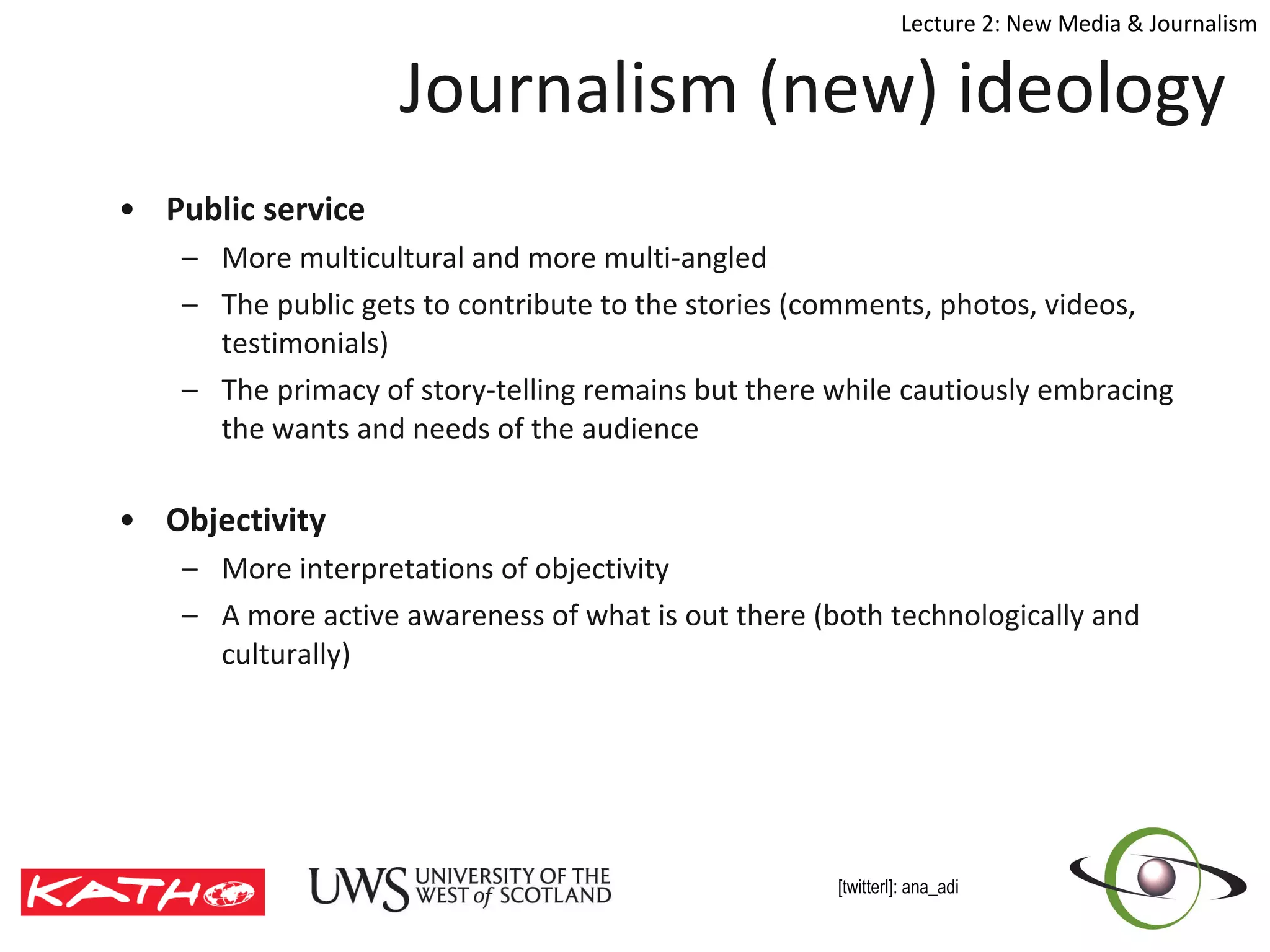
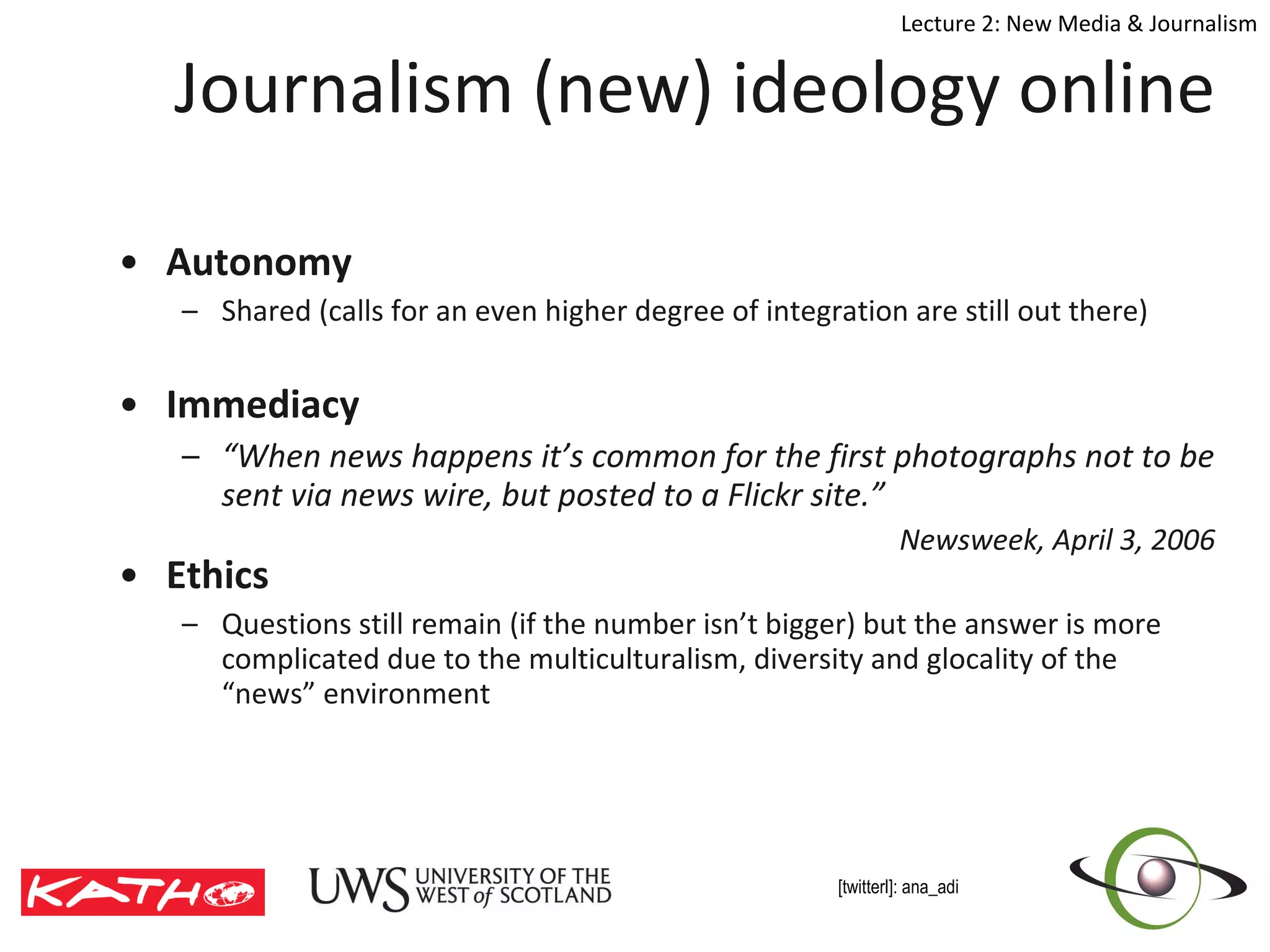
The journalistic ideology Public service journalists provide a public service (as watchdogs or  n ewshounds', active collectors and disseminators of information) Objectivity journalists are impartial, neutral, objective, fair and (thus) credible Autonomy journalists must be autonomous, free and independent in their work Immediacy  journalists have a sense of immediacy, actuality and speed (inherent in the concept of  n ews ) Ethics  journalists have a sense of ethics, validity and legitimacy (Deuze, 2005)
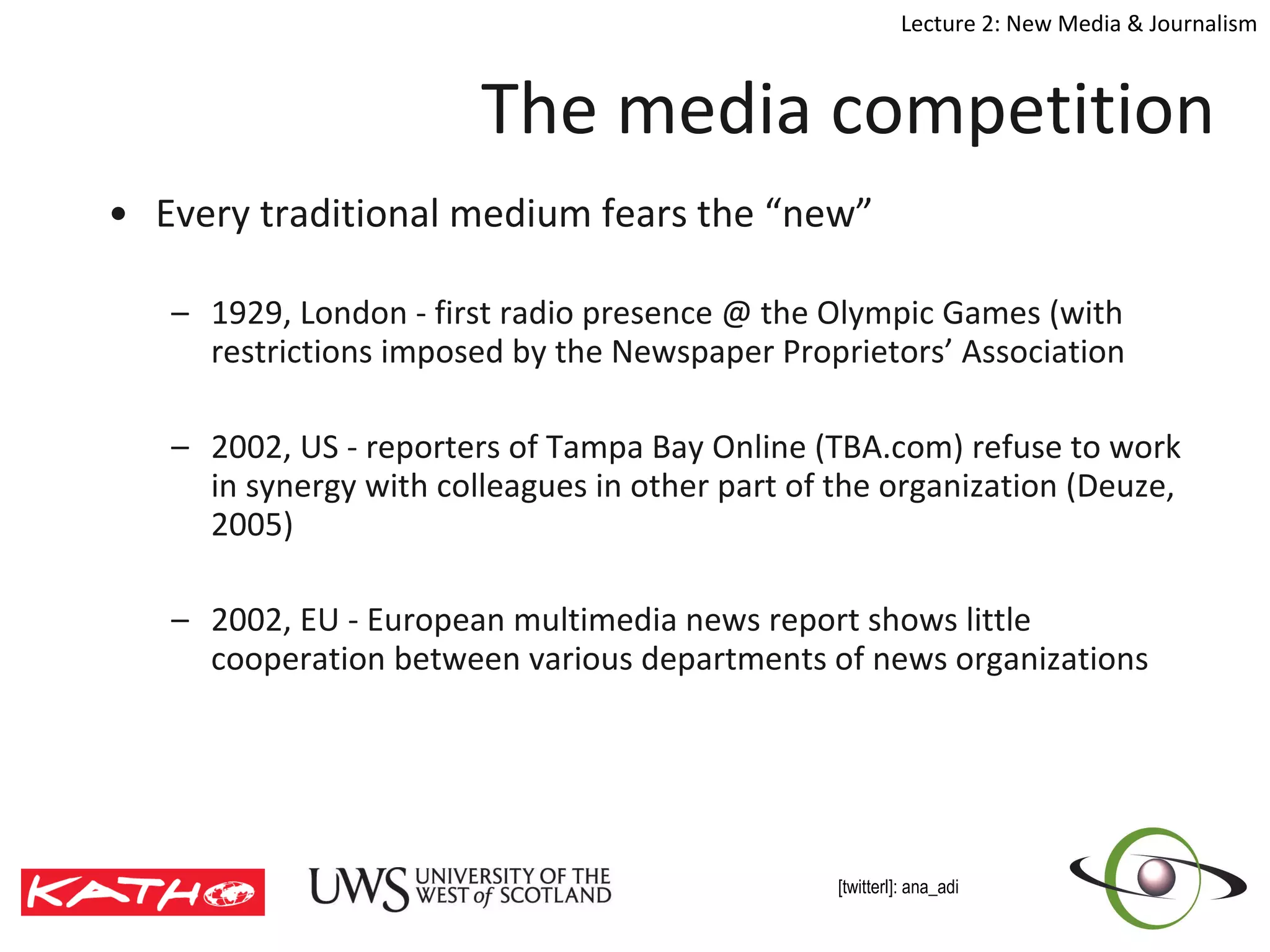
Every traditional medium fears the “new” 1929, London - first radio presence @ the Olympic Games (with restrictions imposed by the Newspaper Proprietors’ Association 2002, US - reporters of Tampa Bay Online (TBA.com) refuse to work in synergy with colleagues in other part of the organization (Deuze, 2005) 2002, EU - European multimedia news report shows little cooperation between various departments of news organizations The media competition
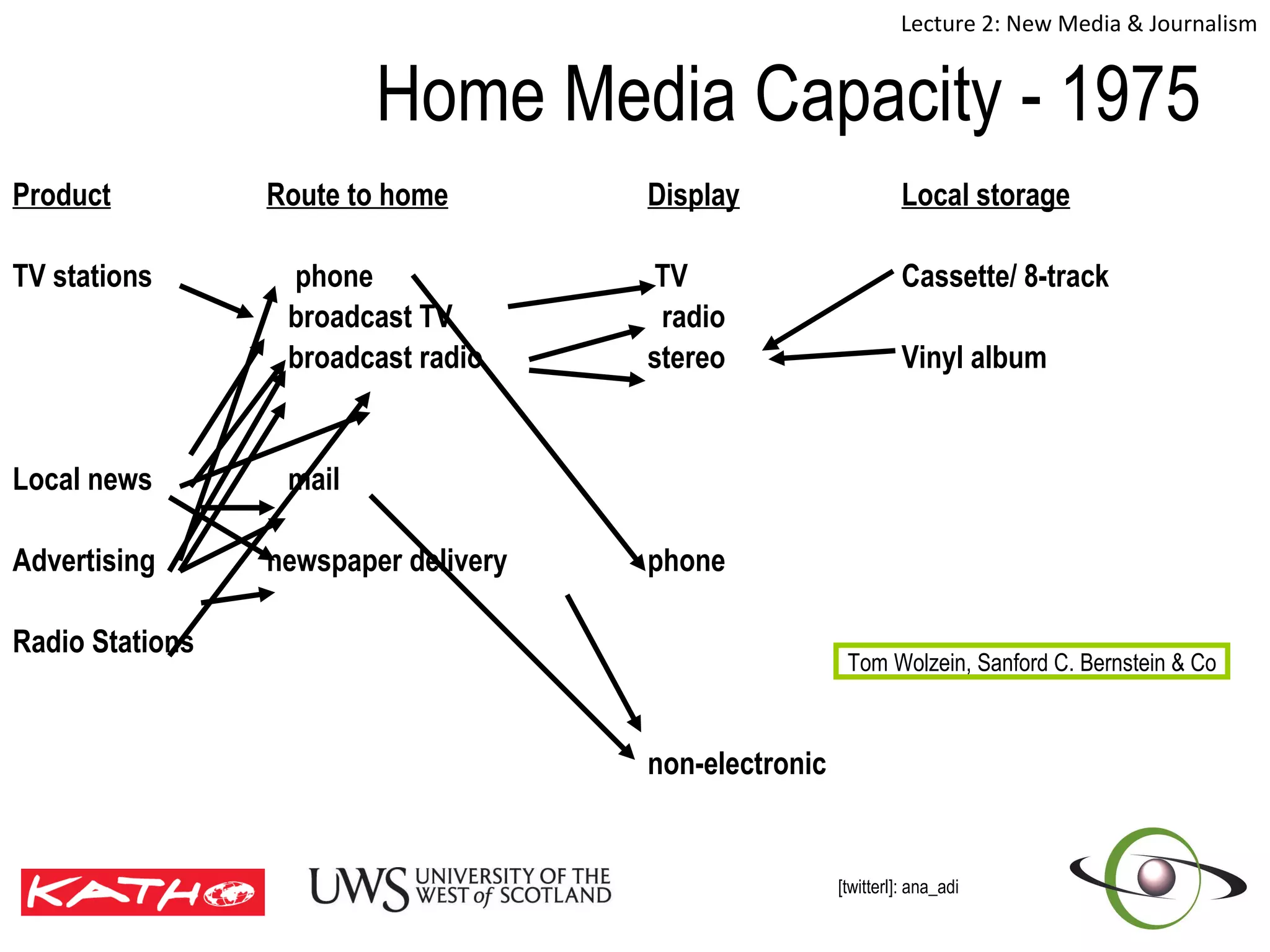
Home Media Capacity - 1975 Product   Route to home   Display   Local storage TV stations   phone    TV Cassette/ 8-track   broadcast TV   radio   broadcast radio   stereo Vinyl album Local news   mail Advertising  newspaper delivery phone Radio Stations non-electronic Tom Wolzein, Sanford C. Bernstein & Co
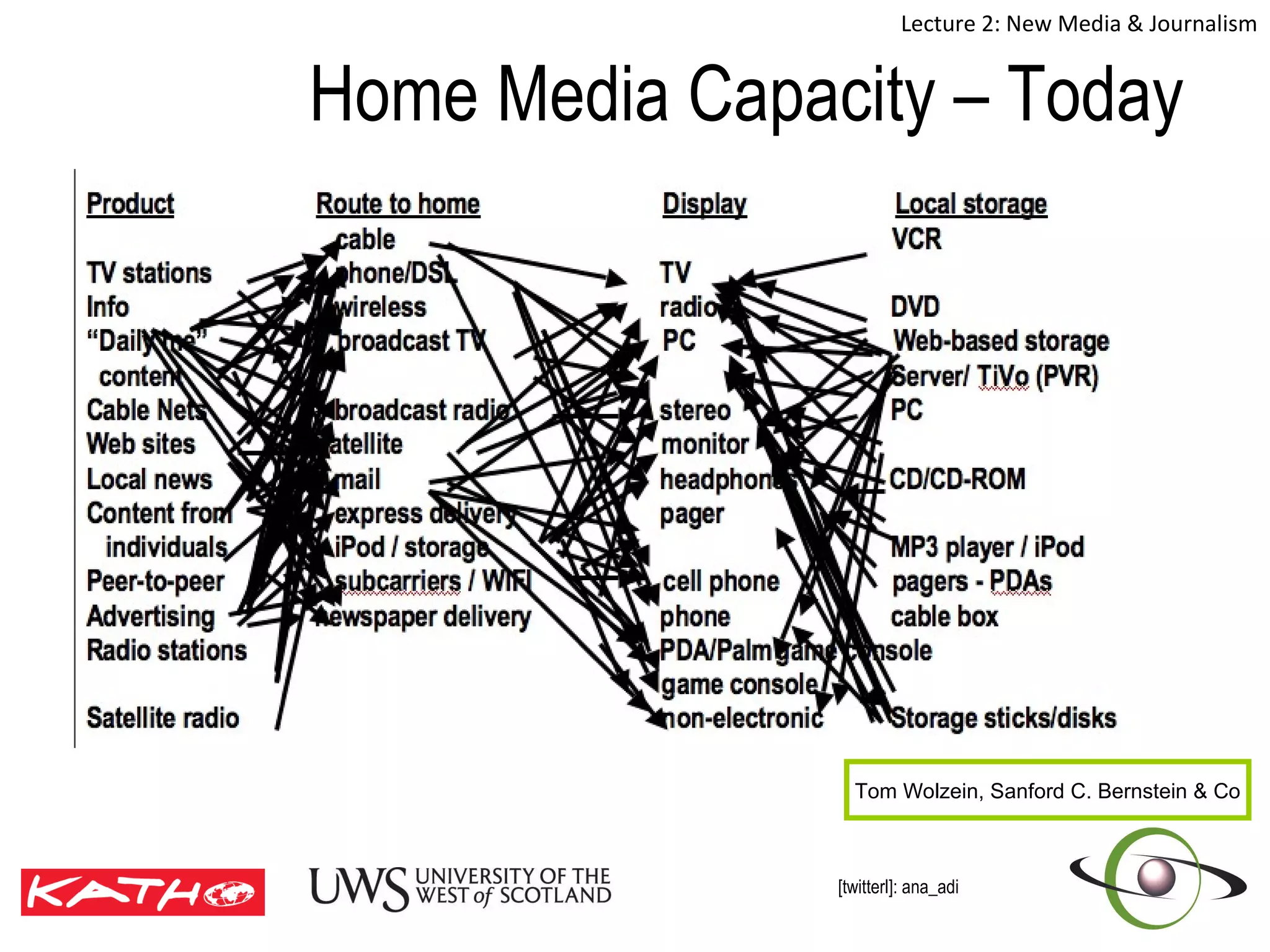
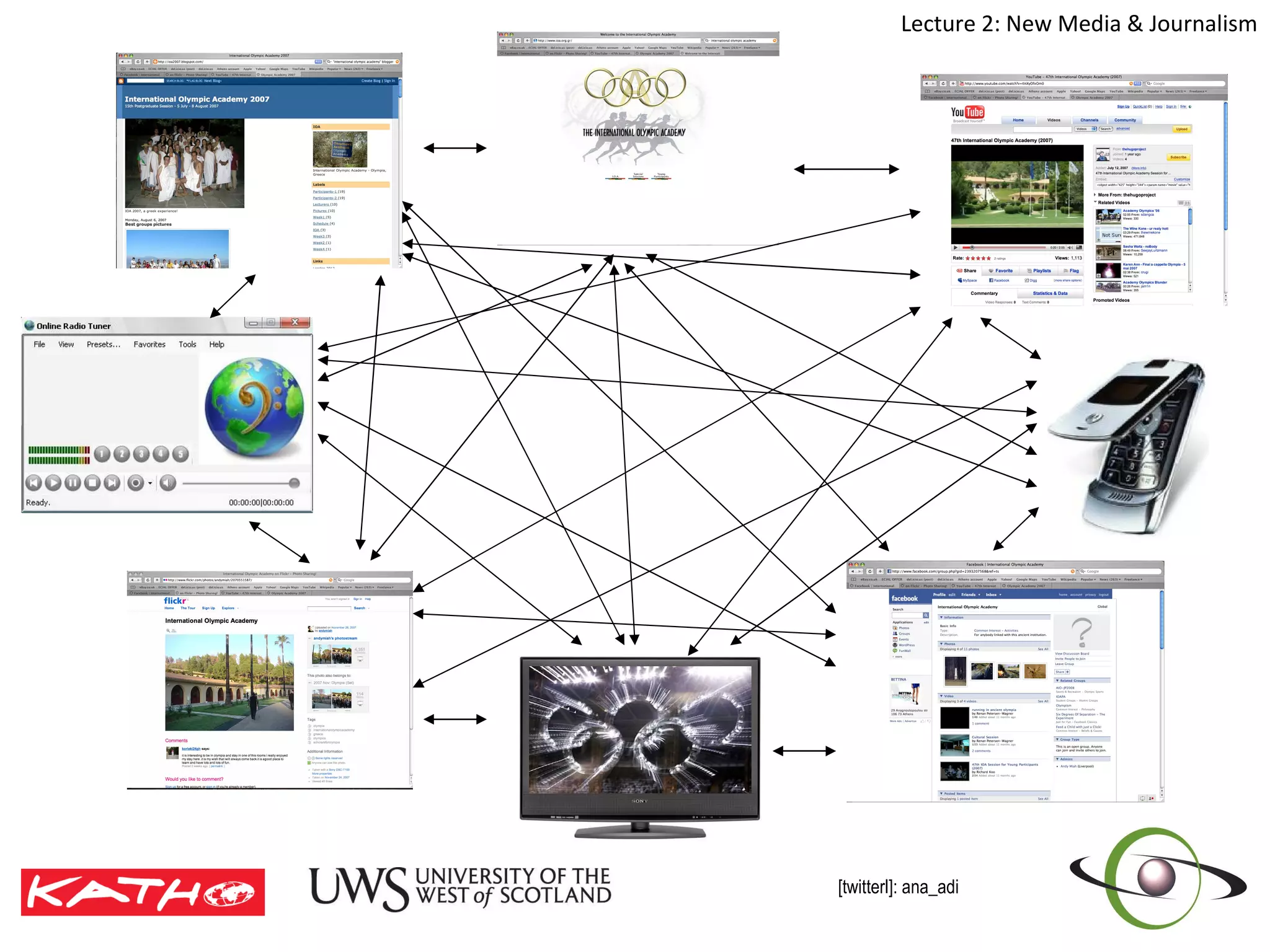
Home Media Capacity – Today Tom Wolzein, Sanford C. Bernstein & Co
 
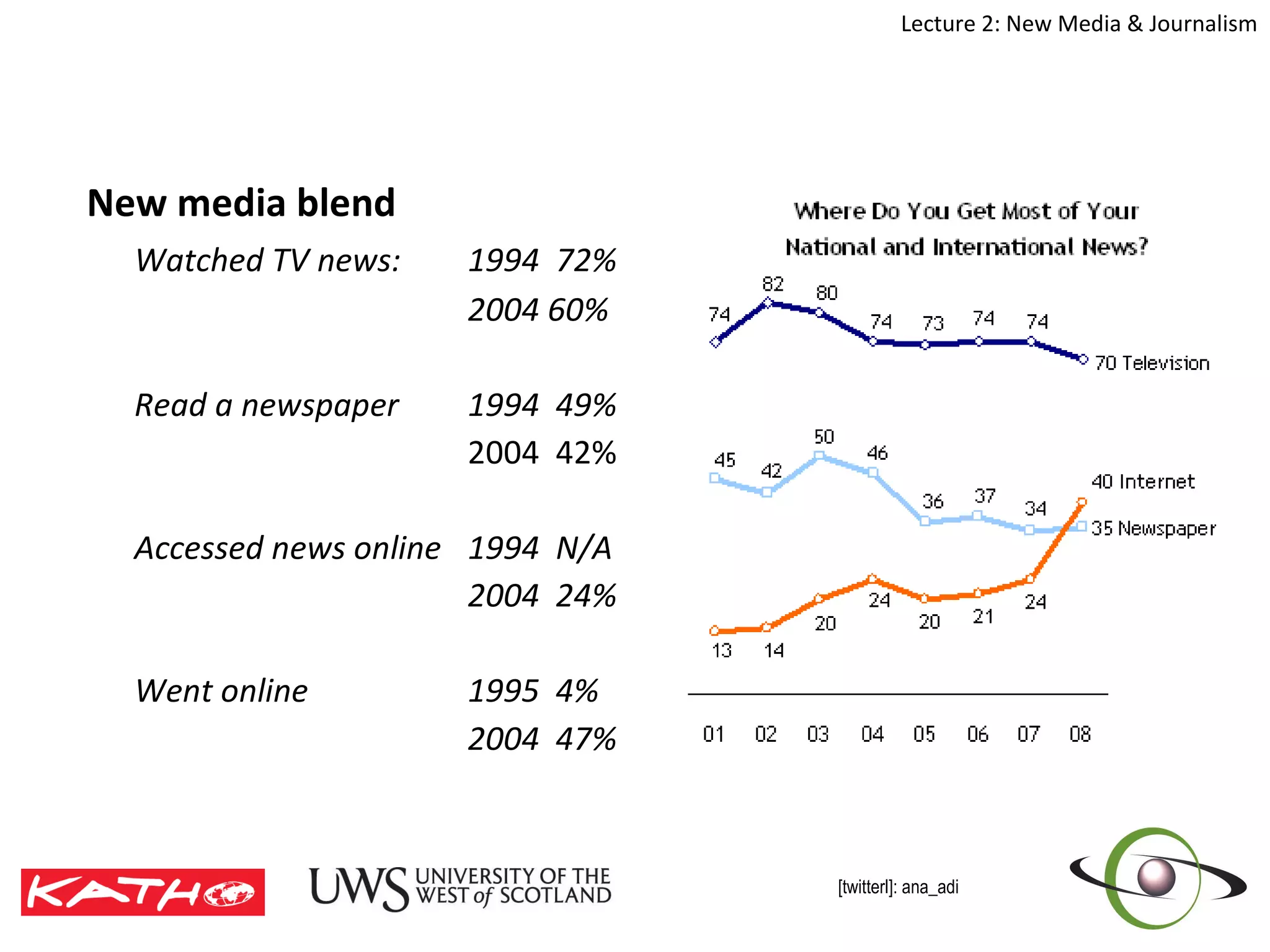
New media blend Watched TV news:  1994  72% 2004 60% Read a newspaper 1994  49% 2004  42% Accessed news online 1994  N/A 2004  24% Went online 1995  4% 2004  47%
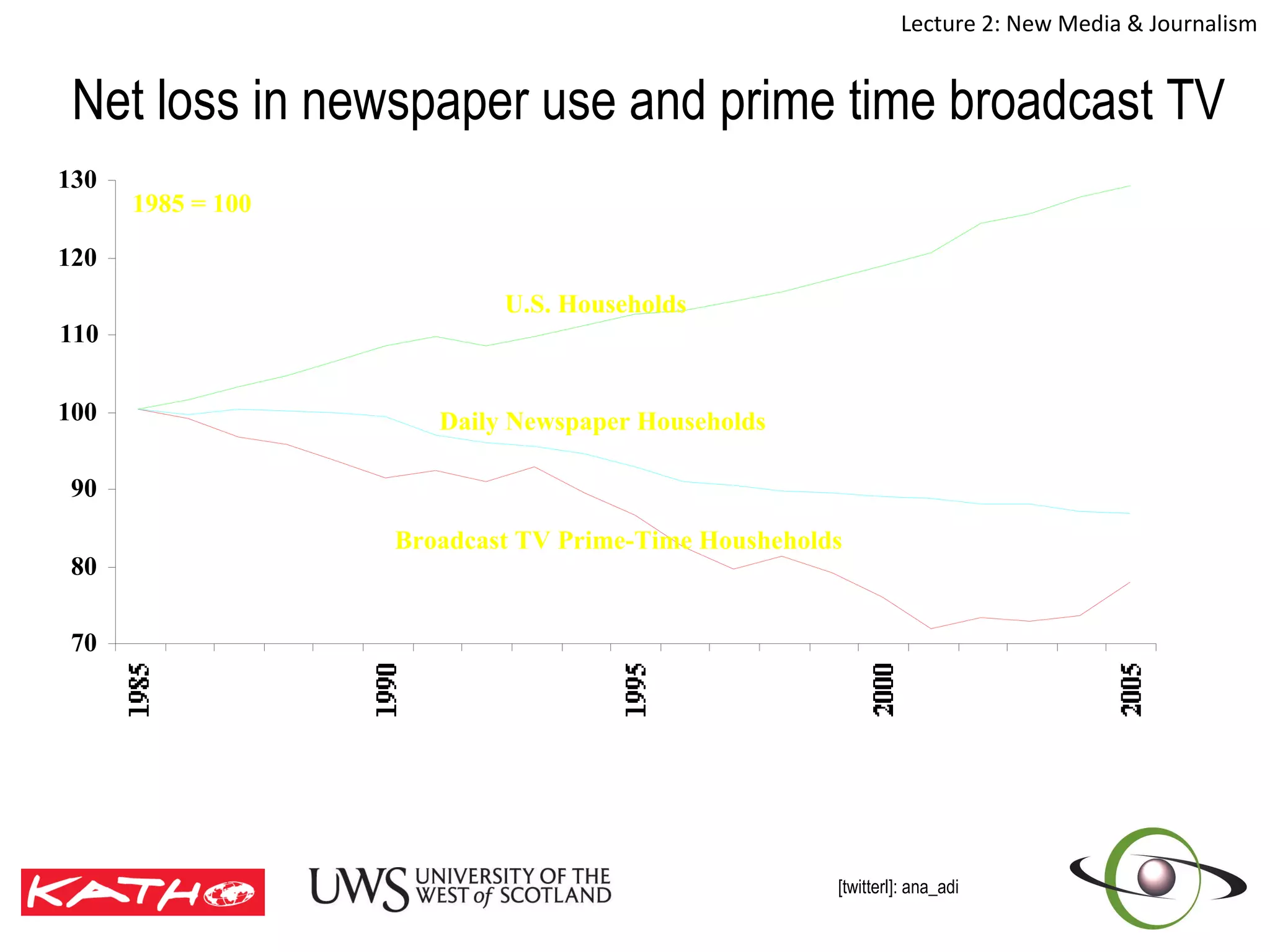
Net loss in newspaper use and prime time broadcast TV
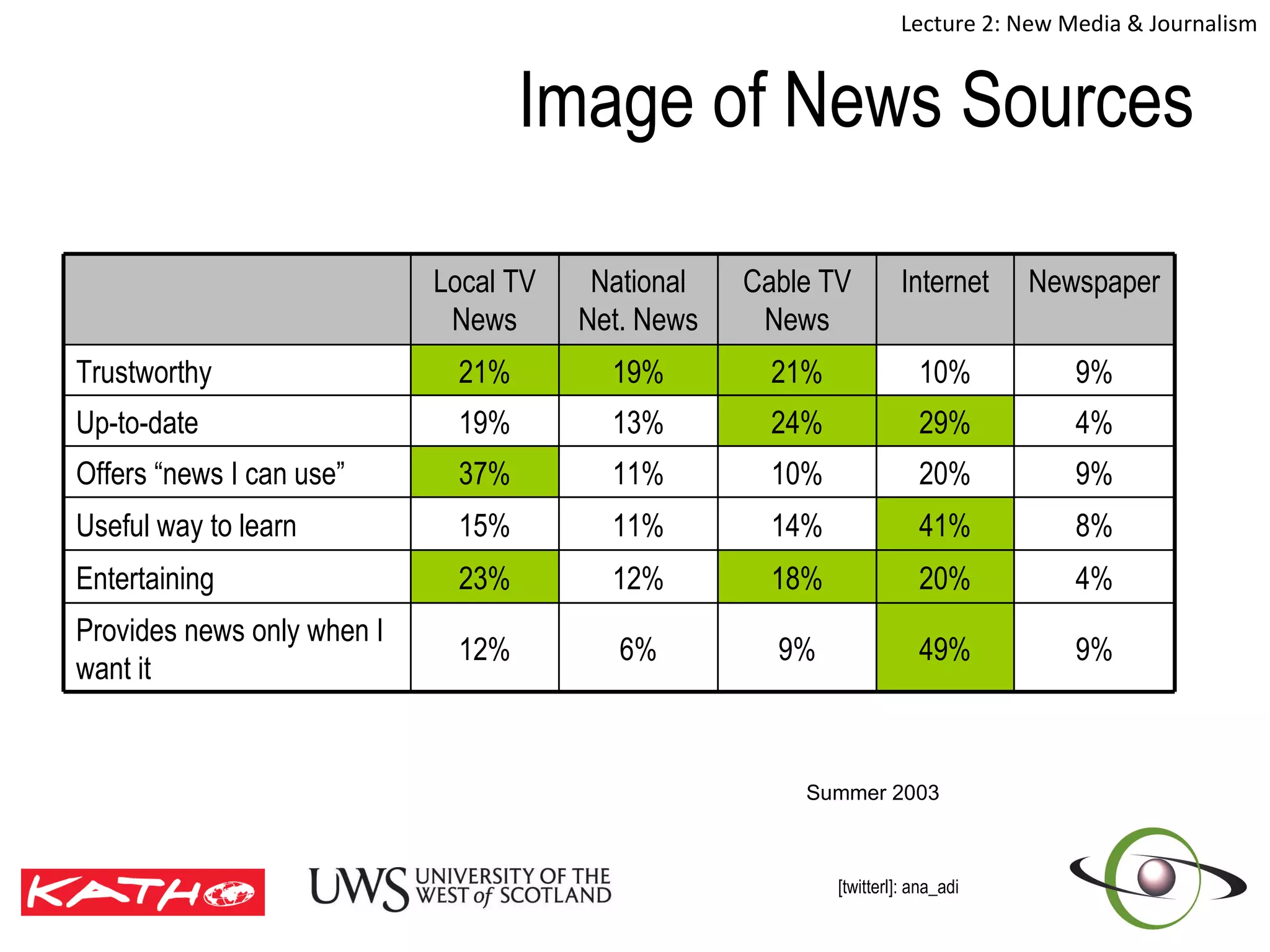
Summer 2003 Image of News Sources 8% 41% 14% 11% 15% Useful way to learn 9% 20% 10% 11% 37% Offers “news I can use” 4% 29% 24% 13% 19% Up-to-date 9% 10% 21% 19% 21% Trustworthy 12% 23% Local TV News Newspaper Internet Cable TV News National Net. News 9% 49% 9% 6% Provides news only when I want it 4% 20% 18% 12% Entertaining
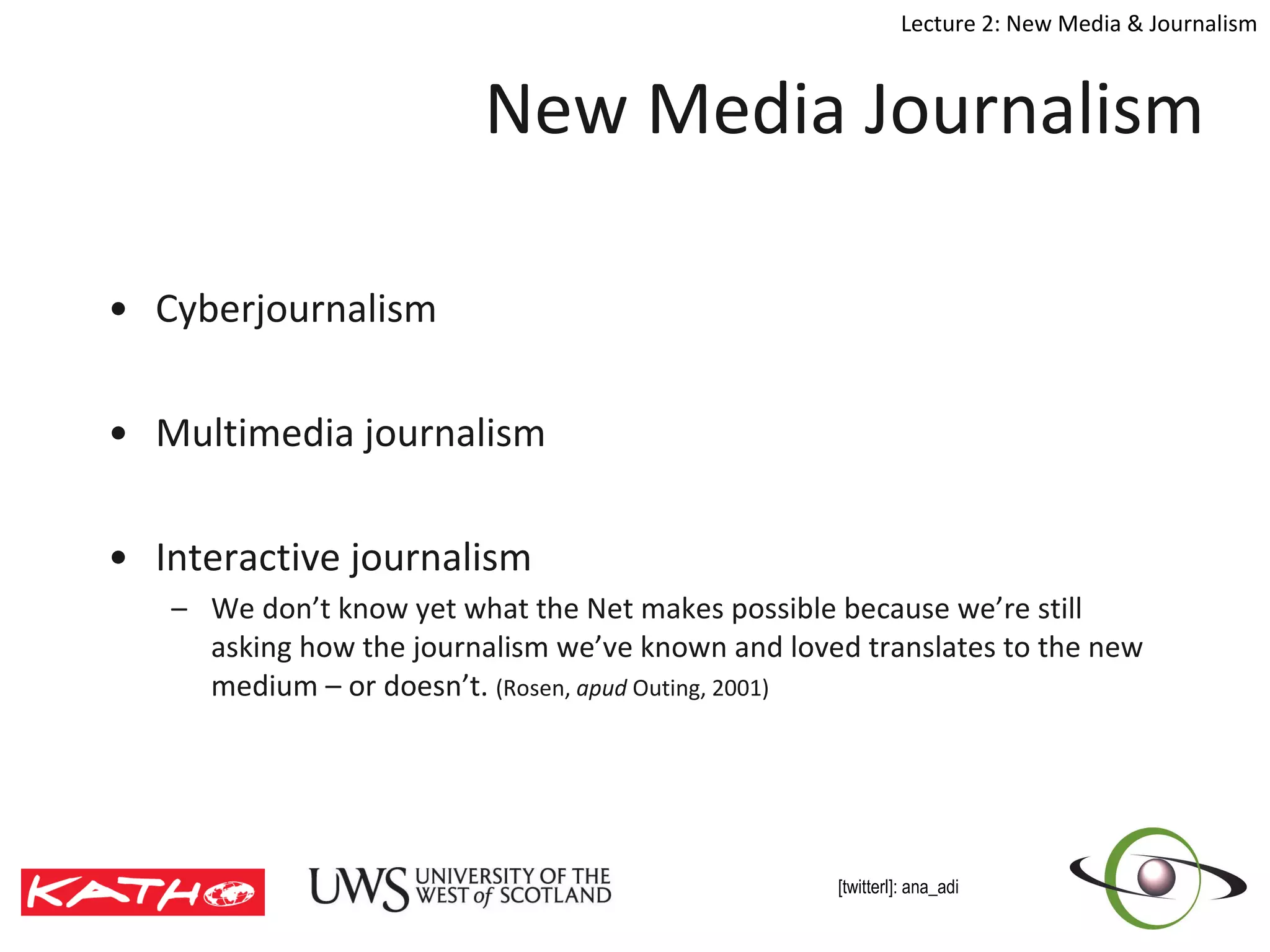
New Media Journalism Cyberjournalism  Multimedia journalism Interactive journalism We don’t know yet what the Net makes possible because we’re still asking how the journalism we’ve known and loved translates to the new medium – or doesn’t.  (Rosen,  apud  Outing, 2001)
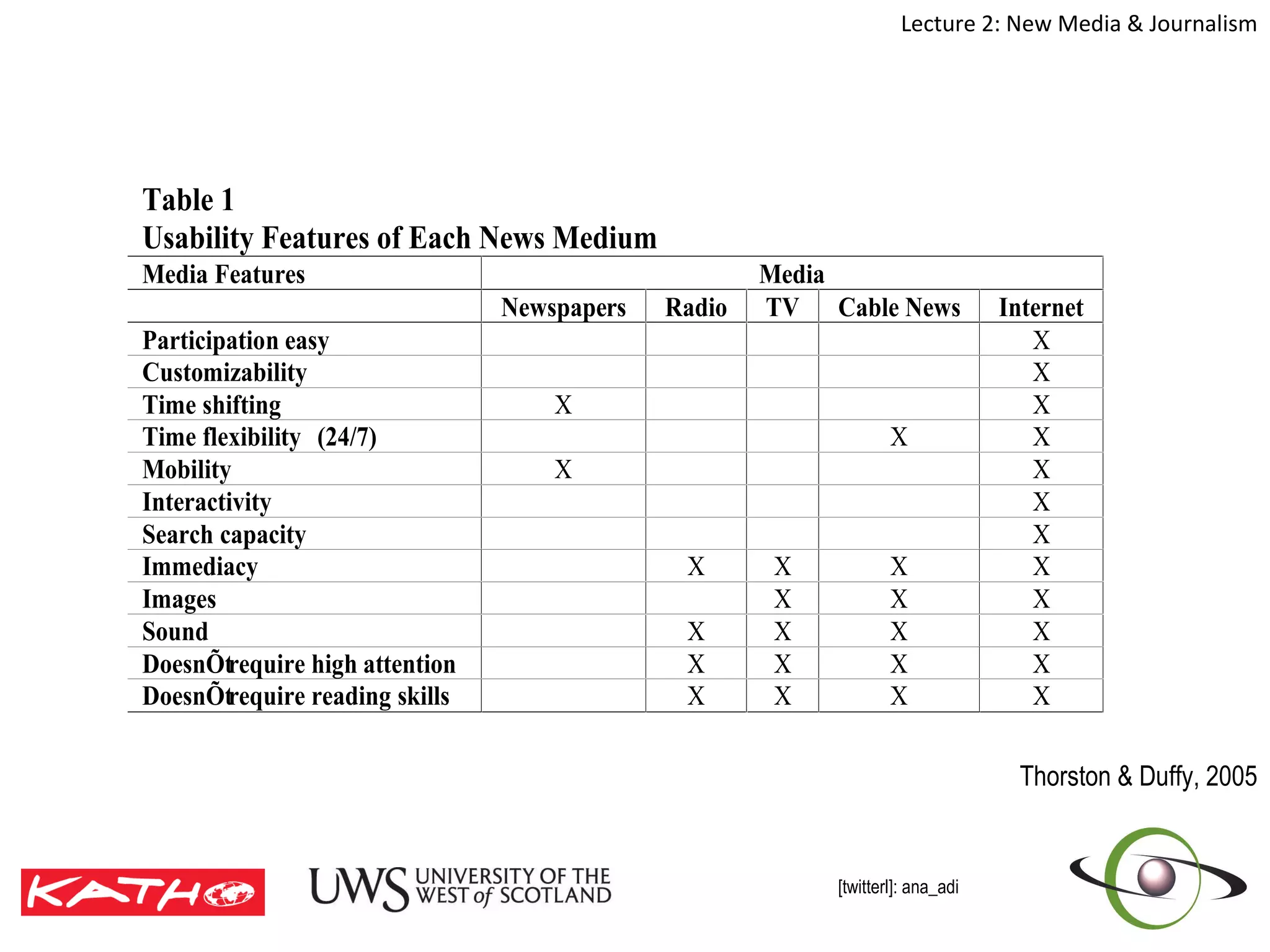
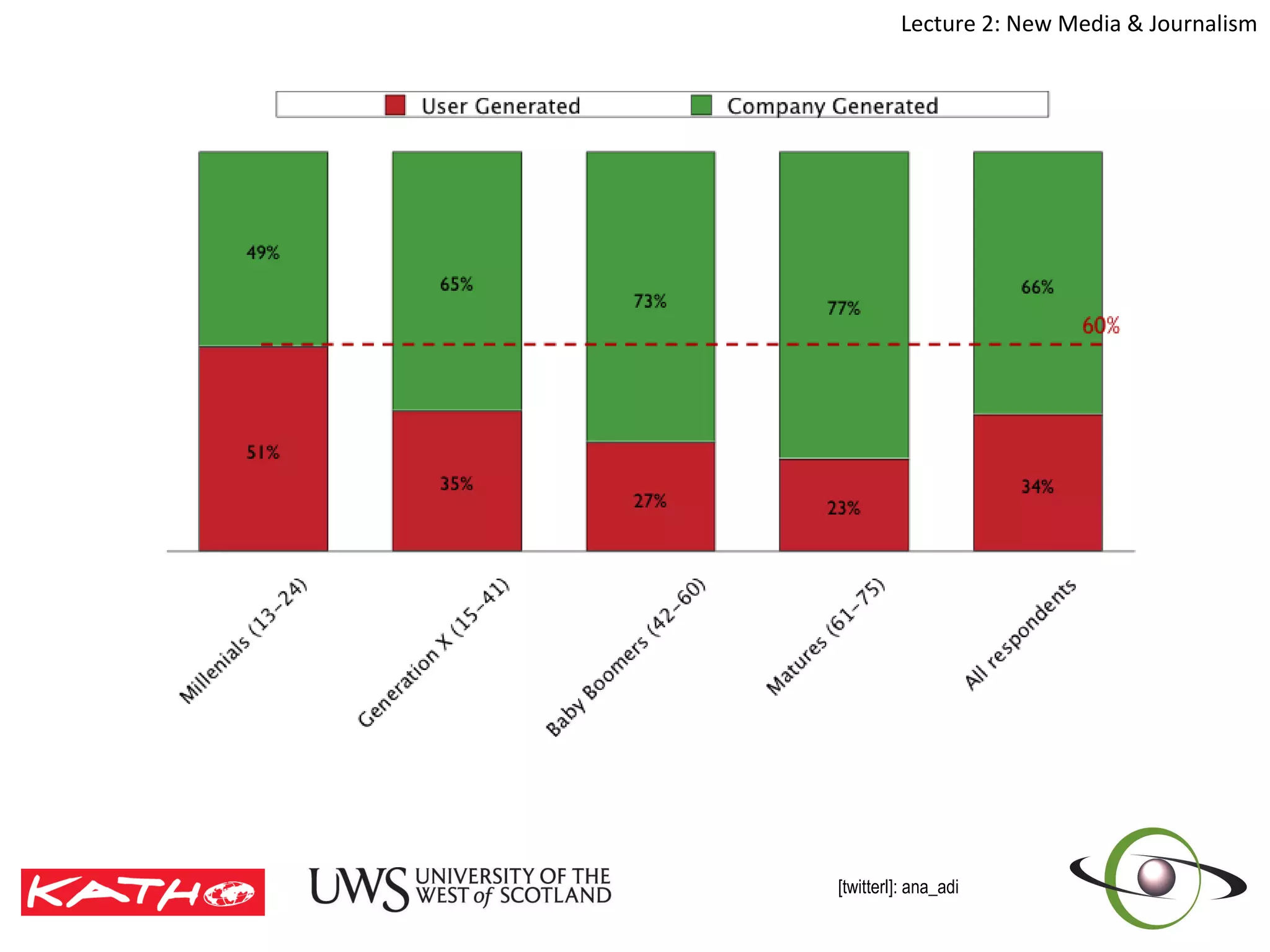
Thorston & Duffy, 2005
Show: EPIC movie 2015 Future of media
 
Imagine for a moment that you are a journalist in Brussels. You don’t work for a TV company or newspaper. You have no particular assignment. What would you write about? What story do you want? What will you be prepared to report, to get the truth out?
 
Citizen Journalism? Producer/consumer blurred Non-professional Hyperlinked (Ephemeral and Informal)  Citizenship Critical of media Global moral code rather than ethical code Little attempt to impose a hierarchy Community value, rather than commercial Irreverent opinion
The Values of Citizen Journalists Politically motivated? Agenda setting? Shared resources Open source
How/where? Blog Videos (shared) Photos (shared) Podcasts/audio (share) Social networking Mobile phone
Outing’s layers of citizen journalism Open up to public comment -  not only articles but other sections as well - moderate/ subscription Citizen as an add-on reporter - citizens add information to a current story (eg. Theft/Burglary - they provide the examples, photos, solutions) Open-source reporting contact with knowledgeable readers  submit just to a couple of readers for suggestions  Ask for readers/viewers for questions for a future interview
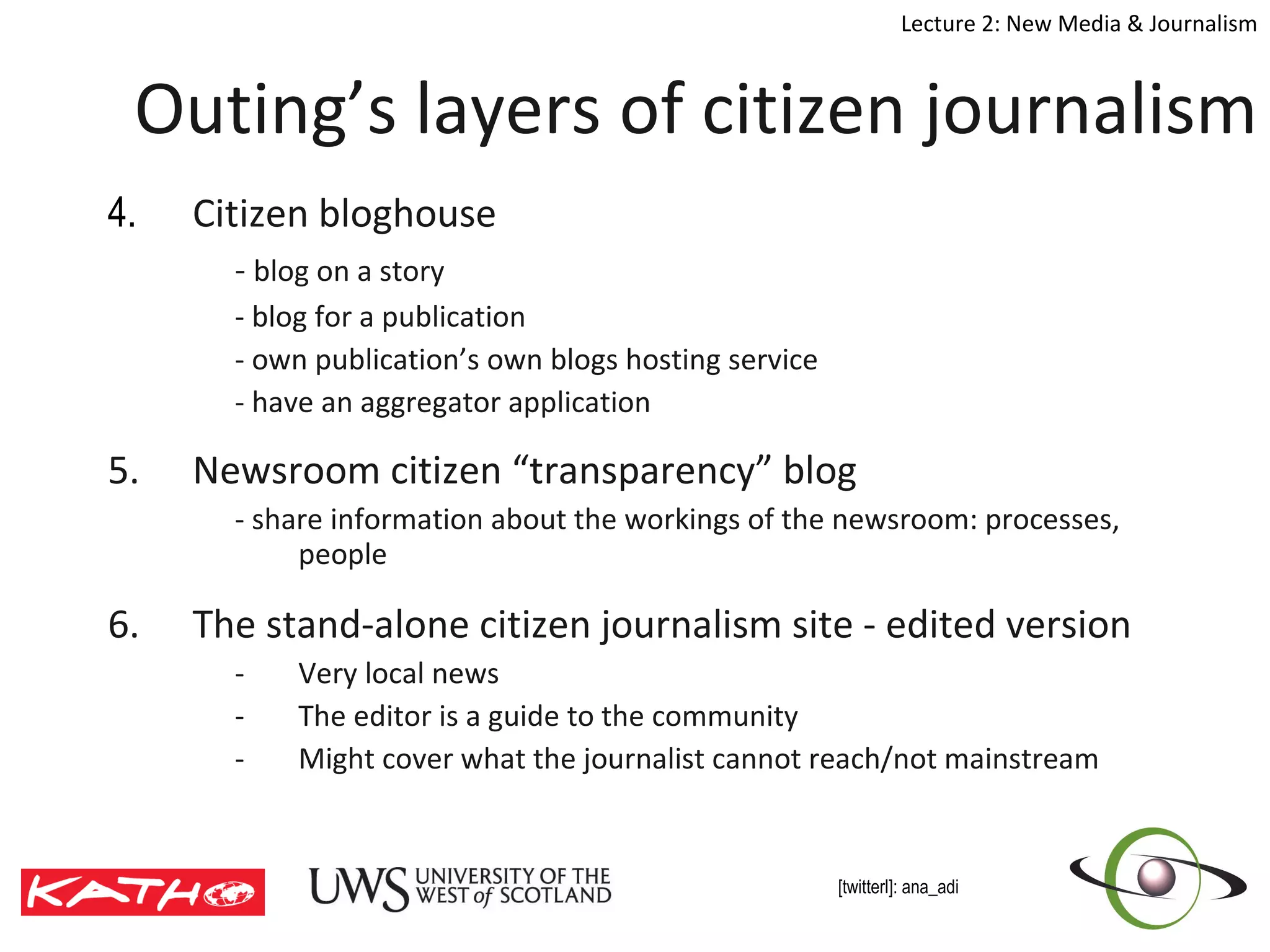
Outing’s layers of citizen journalism 4.  Citizen bloghouse -  blog on a story  - blog for a publication - own publication’s own blogs hosting service - have an aggregator application 5. Newsroom citizen “transparency” blog - share information about the workings of the newsroom: processes, people 6. The stand-alone citizen journalism site - edited version Very local news The editor is a guide to the community  Might cover what the journalist cannot reach/not mainstream
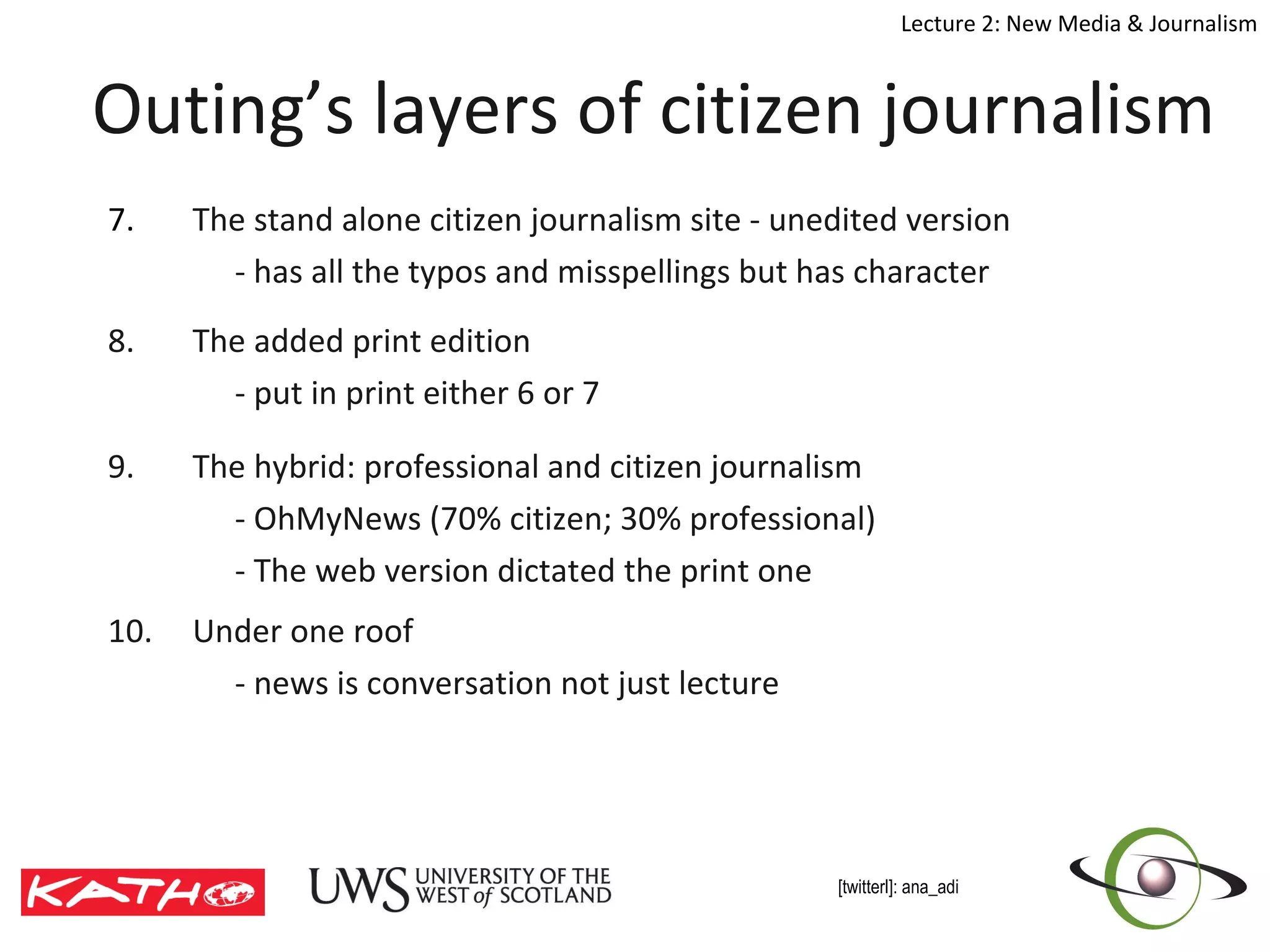
Outing’s layers of citizen journalism 7. The stand alone citizen journalism site - unedited version - has all the typos and misspellings but has character 8. The added print edition - put in print either 6 or 7 9. The hybrid: professional and citizen journalism  - OhMyNews (70% citizen; 30% professional) - The web version dictated the print one  10. Under one roof - news is conversation not just lecture
Outing’s layers of citizen journalism Wiki Journalism  -  readers are editors (WIKI NEWS)  SHOW FILM: WIKIS IN PLAIN ENGLISH
New(s) media types Authoritative:  Created and produced by news professionals Created:  News and information produced by audiences Opinionated:  News and information with attitude and voice
 
Journalism (new) ideology Public service More multicultural and more multi-angled The public gets to contribute to the stories (comments, photos, videos, testimonials) The primacy of story-telling remains but there while cautiously embracing the wants and needs of the audience Objectivity More interpretations of objectivity A more active awareness of what is out there (both technologically and culturally)
Journalism (new) ideology online Autonomy Shared (calls for an even higher degree of integration are still out there) Immediacy  “ When news happens it’s common for the first photographs not to be sent via news wire, but posted to a Flickr site.” Newsweek, April 3, 2006 Ethics  Questions still remain (if the number isn’t bigger) but the answer is more complicated due to the multiculturalism, diversity and glocality of the “news” environment
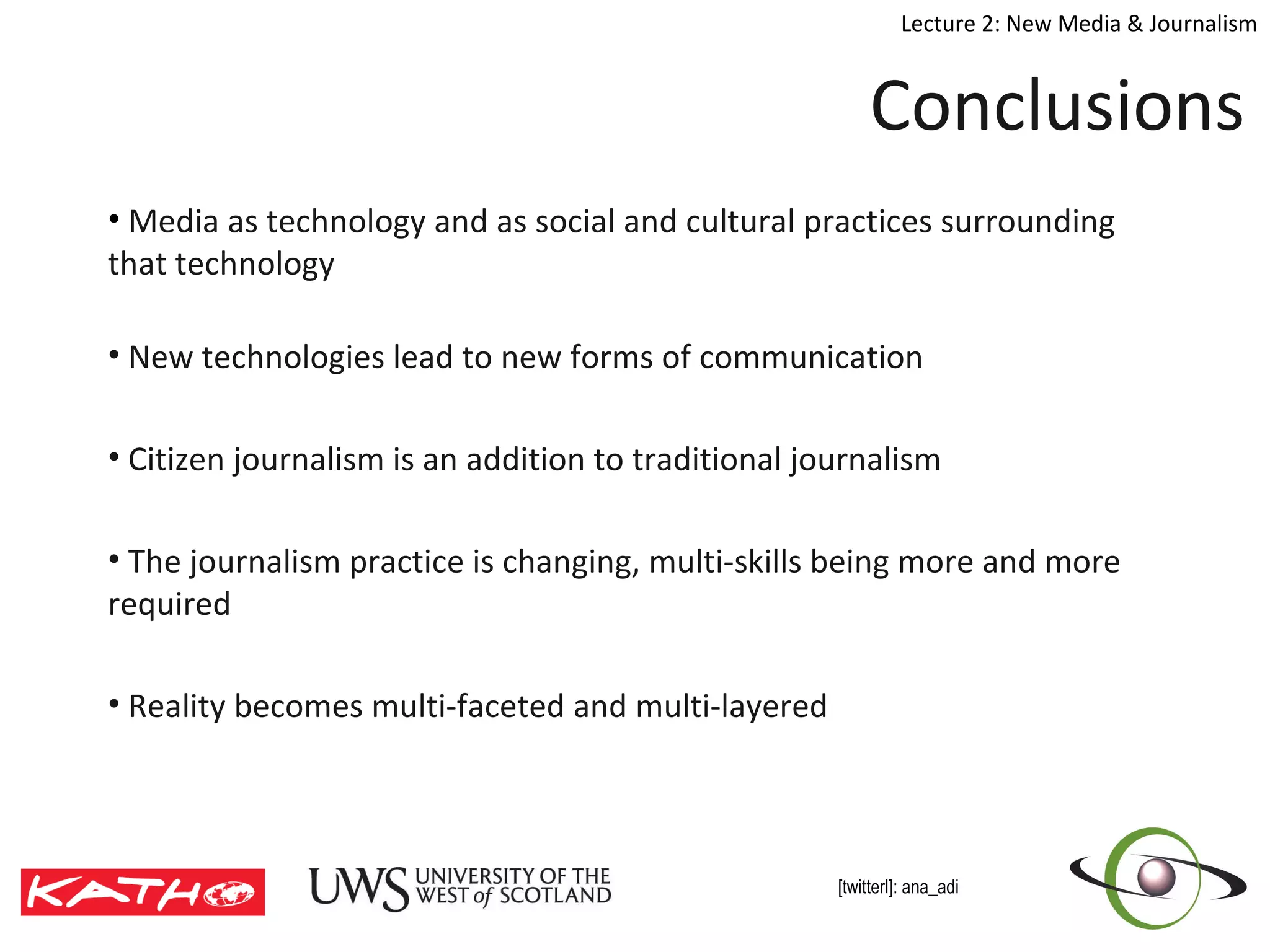
Conclusions  Media as technology and as social and cultural practices surrounding that technology  New technologies lead to new forms of communication Citizen journalism is an addition to traditional journalism  The journalism practice is changing, multi-skills being more and more required  Reality becomes multi-faceted and multi-layered
Tomorrow: Practice day

Lecture 2 New Media & Journalism Dec09

  • 1.
    (New!) Media -and journalism in the online age -
  • 2.
    This lecture aimsto: Build on the notions presented the previous day (convergence and web 2.0) Discuss the challenges that the emergence of new media pose to traditional media Analyze the changes in media landscape (both in terms of practice and technology) and their implication on the journalism practice
  • 3.
    Media - adefinition A two level definition: The technology that enables communication Set of associated “protocols” or social and cultural practices that have grown up around a specific technology Lisa Gitelman apud Jenkins, 2006 Technology
  • 4.
    Communication Models Thetransmission model (Lasswell, 1920; Shannon & Weaver, 1949) Sender --> Receiver Sender --> Medium --> Receiver Sender <-- Medium <-- Receiver Sender <--> Medium <--> Receiver
  • 5.
    The journalist’s roleWhat is the role of the (new) media in your society? Which media: news, entertainment, arts, documentary, sports? How has the role of the media developed? Does the media fulfill this social obligation?
  • 6.
    The journalistic ideologyPublic service journalists provide a public service (as watchdogs or n ewshounds', active collectors and disseminators of information) Objectivity journalists are impartial, neutral, objective, fair and (thus) credible Autonomy journalists must be autonomous, free and independent in their work Immediacy journalists have a sense of immediacy, actuality and speed (inherent in the concept of n ews ) Ethics journalists have a sense of ethics, validity and legitimacy (Deuze, 2005)
  • 7.
    Every traditional mediumfears the “new” 1929, London - first radio presence @ the Olympic Games (with restrictions imposed by the Newspaper Proprietors’ Association 2002, US - reporters of Tampa Bay Online (TBA.com) refuse to work in synergy with colleagues in other part of the organization (Deuze, 2005) 2002, EU - European multimedia news report shows little cooperation between various departments of news organizations The media competition
  • 8.
    Home Media Capacity- 1975 Product Route to home Display Local storage TV stations phone TV Cassette/ 8-track broadcast TV radio broadcast radio stereo Vinyl album Local news mail Advertising newspaper delivery phone Radio Stations non-electronic Tom Wolzein, Sanford C. Bernstein & Co
  • 9.
    Home Media Capacity– Today Tom Wolzein, Sanford C. Bernstein & Co
  • 10.
  • 11.
    New media blendWatched TV news: 1994 72% 2004 60% Read a newspaper 1994 49% 2004 42% Accessed news online 1994 N/A 2004 24% Went online 1995 4% 2004 47%
  • 12.
    Net loss innewspaper use and prime time broadcast TV
  • 13.
    Summer 2003 Imageof News Sources 8% 41% 14% 11% 15% Useful way to learn 9% 20% 10% 11% 37% Offers “news I can use” 4% 29% 24% 13% 19% Up-to-date 9% 10% 21% 19% 21% Trustworthy 12% 23% Local TV News Newspaper Internet Cable TV News National Net. News 9% 49% 9% 6% Provides news only when I want it 4% 20% 18% 12% Entertaining
  • 14.
    New Media JournalismCyberjournalism Multimedia journalism Interactive journalism We don’t know yet what the Net makes possible because we’re still asking how the journalism we’ve known and loved translates to the new medium – or doesn’t. (Rosen, apud Outing, 2001)
  • 15.
  • 16.
    Show: EPIC movie2015 Future of media
  • 17.
  • 18.
    Imagine for amoment that you are a journalist in Brussels. You don’t work for a TV company or newspaper. You have no particular assignment. What would you write about? What story do you want? What will you be prepared to report, to get the truth out?
  • 19.
  • 20.
    Citizen Journalism? Producer/consumerblurred Non-professional Hyperlinked (Ephemeral and Informal) Citizenship Critical of media Global moral code rather than ethical code Little attempt to impose a hierarchy Community value, rather than commercial Irreverent opinion
  • 21.
    The Values ofCitizen Journalists Politically motivated? Agenda setting? Shared resources Open source
  • 22.
    How/where? Blog Videos(shared) Photos (shared) Podcasts/audio (share) Social networking Mobile phone
  • 23.
    Outing’s layers ofcitizen journalism Open up to public comment - not only articles but other sections as well - moderate/ subscription Citizen as an add-on reporter - citizens add information to a current story (eg. Theft/Burglary - they provide the examples, photos, solutions) Open-source reporting contact with knowledgeable readers submit just to a couple of readers for suggestions Ask for readers/viewers for questions for a future interview
  • 24.
    Outing’s layers ofcitizen journalism 4. Citizen bloghouse - blog on a story - blog for a publication - own publication’s own blogs hosting service - have an aggregator application 5. Newsroom citizen “transparency” blog - share information about the workings of the newsroom: processes, people 6. The stand-alone citizen journalism site - edited version Very local news The editor is a guide to the community Might cover what the journalist cannot reach/not mainstream
  • 25.
    Outing’s layers ofcitizen journalism 7. The stand alone citizen journalism site - unedited version - has all the typos and misspellings but has character 8. The added print edition - put in print either 6 or 7 9. The hybrid: professional and citizen journalism - OhMyNews (70% citizen; 30% professional) - The web version dictated the print one 10. Under one roof - news is conversation not just lecture
  • 26.
    Outing’s layers ofcitizen journalism Wiki Journalism - readers are editors (WIKI NEWS) SHOW FILM: WIKIS IN PLAIN ENGLISH
  • 27.
    New(s) media typesAuthoritative: Created and produced by news professionals Created: News and information produced by audiences Opinionated: News and information with attitude and voice
  • 28.
  • 29.
    Journalism (new) ideologyPublic service More multicultural and more multi-angled The public gets to contribute to the stories (comments, photos, videos, testimonials) The primacy of story-telling remains but there while cautiously embracing the wants and needs of the audience Objectivity More interpretations of objectivity A more active awareness of what is out there (both technologically and culturally)
  • 30.
    Journalism (new) ideologyonline Autonomy Shared (calls for an even higher degree of integration are still out there) Immediacy “ When news happens it’s common for the first photographs not to be sent via news wire, but posted to a Flickr site.” Newsweek, April 3, 2006 Ethics Questions still remain (if the number isn’t bigger) but the answer is more complicated due to the multiculturalism, diversity and glocality of the “news” environment
  • 31.
    Conclusions Mediaas technology and as social and cultural practices surrounding that technology New technologies lead to new forms of communication Citizen journalism is an addition to traditional journalism The journalism practice is changing, multi-skills being more and more required Reality becomes multi-faceted and multi-layered
  • 32.

Editor's Notes

  • #5 There are many mass communication models and theories but the transmission models (either in the form Shannon and Weaver prosed in 1949 or in the verbal form presented by Laswell) are the easiest to look at the changes in media scenery With students draw and expand on the simple transmission model of communication highlighting the roles media/new media played
  • #6 What is the role? first break apart the concept ‘media’ based on the definition and the previous day’s lecture perhaps then examine the professions (journalism, entertainment, documentary, art) - each with different roles and determine whether they have a different working ideology New media Producer/consumer blurred Non-professional Citizenship Critical of media Global moral code rather than ethical code Community value, rather than commercial
  • #7 There were many studies done to determine whether there are any universal journalistic standards that would define the profession and its occupational ideology. It was concluded that journalists in elective democracies share similar characteristics and speak of similar values in the context of their daily work, but apply these in a variety of ways to give meaning to what they do. Journalists in all media types, genres and formats carry the ideology of journalism. It is therefore possible to speak of a dominant occupational ideology of journalism on which most newsworkers base their professional perceptions and praxis, but which is interpreted, used and applied differently among journalists across media (Shoemaker and Reese, 1996: 11 So, what would be the role of the new media journalist: New media Producer/consumer blurred Non-professional Citizenship Critical of media Global moral code rather than ethical code Community value, rather than commercial
  • #9 This represents the sources of news, the routes they had into home, the way they were displayed, and the way they were stored 30 years ago. As you can see, media choices were relatively simple and straightforward.
  • #10 Now on this purposely “mashed up” slide, you can see the massive proliferation of media services, devices and choices--and the explosion of new ways to access and store media continues.
  • #15 Due to the lack of cooperation between journalists, online journalism was perceived as outmoded and unsatisfactory, the online versions of news being the same as in print A revision of the journalistic model was necessary
  • #17 Discussion on the future of media in the case of depicted in the film. Is it credible? Is it a believable future? What are the things that seem odd in it? How prepared are you for such a future?