Safety and biosecurity
Laboratory Lecture 2:- Fire safety
Dr. Raghda Saad Mohammed
Fire Extinguishers
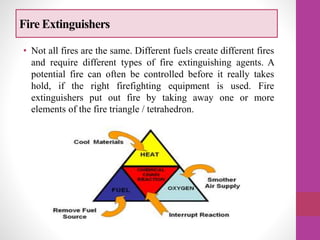
• Not all fires are the same. Different fuels create different fires
and require different types of fire extinguishing agents. A
potential fire can often be controlled before it really takes
hold, if the right firefighting equipment is used. Fire
extinguishers put out fire by taking away one or more
elements of the fire triangle / tetrahedron.
Extinguishers categories
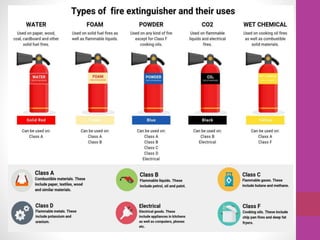
• Different types of fire extinguishers are designed to fight
different classes of fire. It is important to know what types of
fire you can attempt to extinguish with them. Each facility is
required at the minimum. Fire extinguishers are located in
every lab or directly outside each lab. Fire extinguishers are
serviced annually, and inspections are documented on the
hang tags. Personnel who use the lab on a regular basis, or
other specifically assigned personnel should conduct a visual
inspection of each unit to confirm that they are present and
that the pressure gauge is in the green, operational zone.
There should be nothing placed in front of fire extinguishers
so that they may be easily accessed. Facility personnel should
be trained on how to use the extinguisher and the evacuation
plan. Below is an overview of each type of fire extinguisher
including what fire classes they tackle.
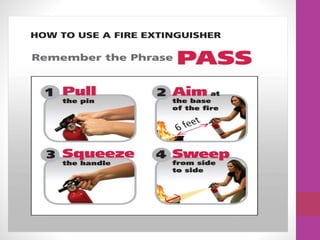
How to Use a Fire Extinguisher
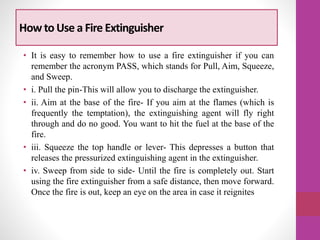
• It is easy to remember how to use a fire extinguisher if you can
remember the acronym PASS, which stands for Pull, Aim, Squeeze,
and Sweep.
• i. Pull the pin-This will allow you to discharge the extinguisher.
• ii. Aim at the base of the fire- If you aim at the flames (which is
frequently the temptation), the extinguishing agent will fly right
through and do no good. You want to hit the fuel at the base of the
fire.
• iii. Squeeze the top handle or lever- This depresses a button that
releases the pressurized extinguishing agent in the extinguisher.
• iv. Sweep from side to side- Until the fire is completely out. Start
using the fire extinguisher from a safe distance, then move forward.
Once the fire is out, keep an eye on the area in case it reignites
Fire evacuation plan
In case of fire alarm triggering, all personnel have to
stop immediately their work, leave all their belongings
behind and proceed calmly to the evacuation of the
building to gather on the parking.
Assisting other personnel
In summary one shall use “RACE” which is an
acronym for:
R=Rescue persons in danger (this can be done without
putting your life in danger.
A=Activate or sound alarm
C=Confine the fire by closing doors and windows
E=Extinguish the fire with the nearest fire appropriate
fire extinguisher
Chemical safety
• Workers in microbiological laboratories are not only exposed
to pathogenic microorganisms, but also to chemical hazards. It
is important that they have proper knowledge of the toxic
effects of these chemicals, the routes of exposure and the
hazards that may be associated with handling and storage.
safety data sheets (SDS), which describe the hazards
associated with the use of a given chemical, are available from
chemical manufacturers and/or suppliers.
Routes of Exposure
• Exposure to hazardous chemicals may occur by:
• 1. Inhalation: Chemicals may cause irritation, sensitization, allergic
reactions, respiratory disease, or cancer.
• 2. Contact: Contact with skin may cause chemical burns,
conjunctivitis of the eyes, or systemic poisoning.
• 3. Ingestion: Hazardous chemicals may be accidentally swallowed
via mouth pipetting, or contamination of food or drinks.
• 4. Through broken skin: Hazardous chemicals may enter the body
via cuts, abrasions or needle-sticks.
Thanks for
your
attention
9/17/2022
11

safety and biosecurity (lab2).pptx

  • 1.
    Safety and biosecurity LaboratoryLecture 2:- Fire safety Dr. Raghda Saad Mohammed
  • 2.
    Fire Extinguishers • Notall fires are the same. Different fuels create different fires and require different types of fire extinguishing agents. A potential fire can often be controlled before it really takes hold, if the right firefighting equipment is used. Fire extinguishers put out fire by taking away one or more elements of the fire triangle / tetrahedron.
  • 3.
    Extinguishers categories • Differenttypes of fire extinguishers are designed to fight different classes of fire. It is important to know what types of fire you can attempt to extinguish with them. Each facility is required at the minimum. Fire extinguishers are located in every lab or directly outside each lab. Fire extinguishers are serviced annually, and inspections are documented on the hang tags. Personnel who use the lab on a regular basis, or other specifically assigned personnel should conduct a visual inspection of each unit to confirm that they are present and that the pressure gauge is in the green, operational zone. There should be nothing placed in front of fire extinguishers so that they may be easily accessed. Facility personnel should be trained on how to use the extinguisher and the evacuation plan. Below is an overview of each type of fire extinguisher including what fire classes they tackle.
  • 5.
    How to Usea Fire Extinguisher • It is easy to remember how to use a fire extinguisher if you can remember the acronym PASS, which stands for Pull, Aim, Squeeze, and Sweep. • i. Pull the pin-This will allow you to discharge the extinguisher. • ii. Aim at the base of the fire- If you aim at the flames (which is frequently the temptation), the extinguishing agent will fly right through and do no good. You want to hit the fuel at the base of the fire. • iii. Squeeze the top handle or lever- This depresses a button that releases the pressurized extinguishing agent in the extinguisher. • iv. Sweep from side to side- Until the fire is completely out. Start using the fire extinguisher from a safe distance, then move forward. Once the fire is out, keep an eye on the area in case it reignites
  • 7.
    Fire evacuation plan Incase of fire alarm triggering, all personnel have to stop immediately their work, leave all their belongings behind and proceed calmly to the evacuation of the building to gather on the parking. Assisting other personnel In summary one shall use “RACE” which is an acronym for: R=Rescue persons in danger (this can be done without putting your life in danger. A=Activate or sound alarm C=Confine the fire by closing doors and windows E=Extinguish the fire with the nearest fire appropriate fire extinguisher
  • 9.
    Chemical safety • Workersin microbiological laboratories are not only exposed to pathogenic microorganisms, but also to chemical hazards. It is important that they have proper knowledge of the toxic effects of these chemicals, the routes of exposure and the hazards that may be associated with handling and storage. safety data sheets (SDS), which describe the hazards associated with the use of a given chemical, are available from chemical manufacturers and/or suppliers.
  • 10.
    Routes of Exposure •Exposure to hazardous chemicals may occur by: • 1. Inhalation: Chemicals may cause irritation, sensitization, allergic reactions, respiratory disease, or cancer. • 2. Contact: Contact with skin may cause chemical burns, conjunctivitis of the eyes, or systemic poisoning. • 3. Ingestion: Hazardous chemicals may be accidentally swallowed via mouth pipetting, or contamination of food or drinks. • 4. Through broken skin: Hazardous chemicals may enter the body via cuts, abrasions or needle-sticks.
  • 11.